

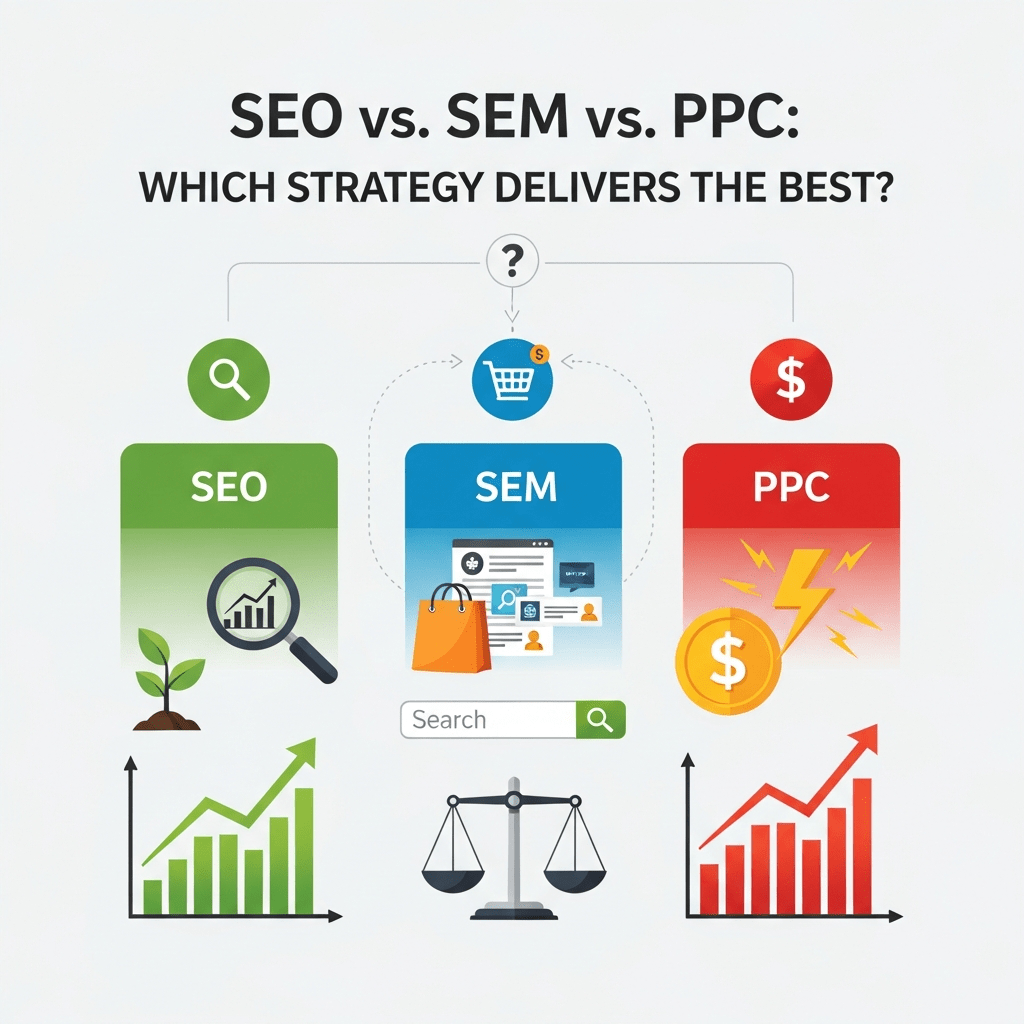
A Comprehensive Market Intelligence Report
Published: November 2025 | Reading Time: 18 minutes
Table of Contents
Toggle📊 Executive Summary
The digital marketing landscape has fundamentally transformed in 2025. With AI-powered search experiences like ChatGPT, Google AI Mode, and Perplexity reshaping how consumers find information, the traditional ROI calculations for SEO, SEM, and PPC have been rewritten overnight.
Bottom-Line ROI Comparison 2025:
SEO (Search Engine Optimization)
- ROI: 500-1,300% over 12+ months
- Customer Acquisition Cost: $485 per customer
- Conversion Rate: 2.4%
- Timeline to Results: 3-12 months
- Sustainability: Continues generating traffic without ongoing costs
SEM (Search Engine Marketing/Paid Search)
- ROI: 200% average
- Customer Acquisition Cost: $802 per customer
- Conversion Rate: 1.3%
- Timeline to Results: Immediate
- Sustainability: Requires continuous investment
PPC (Pay-Per-Click Advertising)
- ROI: $2 for every $1 spent (200%)
- Average CPC: $2.00-$5.00 (varies by industry)
- Conversion Rate: 1.8-10% depending on platform
- Timeline to Results: Immediate
- Sustainability: Traffic stops when spending stops
Key Finding: 70% of marketers confirm that SEO generates more sales for them than PPC, with SEO delivering an 8x return compared to PPC’s 4x according to poll data from NP Digital
Our Recommendation by Business Size:
Startups (<$5K/month budget): Start with 30% SEO, 70% PPC to generate immediate revenue while building organic presence
Growing Businesses ($5K-25K/month): Transition to 60% SEO, 40% PPC as organic rankings mature
Enterprise ($25K+/month): Aim for 70-80% SEO, 20-30% PPC for maximum long-term ROI
🕐 Timeline: The Evolution of Search Marketing (2020-2025)
2020-2021: Traditional Search Dominance
- SEO and PPC operated in predictable, stable environments
- Google’s algorithm focused on traditional ranking factors
- Clear distinction between organic and paid results
- Average SEO timeline: 6-9 months to see significant results
November 2022: ChatGPT Disruption
- OpenAI launches ChatGPT, introducing conversational AI search
- Initial impact on information-seeking queries
- Marketers begin questioning traditional search strategies
- Early adopters start experimenting with AI-optimized content
May 2023: Bing’s AI Integration
- Microsoft integrates ChatGPT into Bing Search (Copilot)
- Demonstrates viability of AI-enhanced search experiences
- Users begin expecting conversational search interfaces
- Average query length increases for AI-powered searches
May 2024: Google AI Overviews Launch
- Google introduces AI Overviews (formerly SGE) globally
- Websites experience a 34.5% reduction in organic clicks when AI Overviews appear in search results, according to Ahrefs analysis of 300,000 keywords published April 17, 2025
- Zero-click searches begin accelerating
- First major traffic impact observed by SEO professionals
February 2025: Zero-Click Search Crisis
- Zero-click searches on Google increased from 56% to nearly 69% since AI Overviews launched, while ChatGPT referrals to news publishers jumped 25x year-over-year
- Organic traffic declines intensify across most industries
- Marketers scramble to adapt strategies
- GEO (Generative Engine Optimization) emerges as new discipline
May 21, 2025: Google AI Mode Rollout
- Google unveils AI Mode at Google I/O 2025, available to all U.S. users, offering conversational search experience that replaces traditional blue links with AI-generated overviews
- Complete end-to-end AI search experience goes live
- Share of AI Mode usage among Google search sessions increased roughly 4x from 0.25% in early May to over 1% by early July 2025
- Traditional SEO metrics become insufficient
June-November 2025: Market Adaptation Phase
- ChatGPT mentioned about 12% more brands in September, then dropped back in October, suggesting experimentation with answers, while Google’s mentions fell 4% over the same period
- Businesses restructure digital marketing teams for AI-first strategies
- New tools emerge for tracking AI visibility (not just rankings)
- PPC adapts with AI-powered targeting and creative optimization
⚖️ Head-to-Head Comparison: SEO vs. SEM vs. PPC
Cost Structure Comparison
| Factor | SEO | SEM/PPC | Winner |
|---|---|---|---|
| Initial Investment | $10,000-$30,000 (3-6 months) | $1,500-$10,000/month | PPC (lower barrier) |
| Ongoing Monthly Cost | $2,000-$5,000 retainer | $9,000-$10,000 avg spend | SEO (decreases over time) |
| Cost Per Click | $0 (after ranking) | $2.00-$5.00 average | SEO |
| Customer Acquisition Cost | $485 | $802 | SEO (39% cheaper) |
| 3-Year Total Investment | ~$100,000 | ~$360,000+ | SEO |
Time to Results Comparison
| Metric | SEO | SEM/PPC |
|---|---|---|
| First Results | 3-6 months | Immediate (same day) |
| Meaningful ROI | 6-12 months | 1-3 months |
| Peak Performance | 18-36 months | Ongoing (flat) |
| Sustainability | Compounds over time | Stops when budget stops |
Performance Metrics Comparison
| Metric | SEO | SEM/PPC | Source |
|---|---|---|---|
| Conversion Rate | 2.4% | 1.3% | Nine Peaks Media 2025 |
| ROI Range | 500-1,300% | 200% | Industry Studies 2025 |
| Click-Through Rate | Higher for organic | Lower, ad blindness | Multiple Studies |
| Traffic Quality | High-intent, longer sessions | Variable, depends on targeting | Industry Standard |
| Trust Factor | Users click organic listings 19 times more often than paid ones | Lower trust perception | Nine Peaks Research |
Scalability Comparison
SEO Scalability:
- Grows exponentially with content compound effect
- Each new piece of content adds to overall domain authority
- Cost per acquisition decreases over time
- SEO costs decrease proportionally as site authority grows, with well-ranking content continuing to drive traffic without extra cost
PPC Scalability:
- Linear scaling requires proportional budget increases
- More competition = higher CPCs over time
- More clicks mean higher payments, creating a direct relationship between traffic and cost
- Cap on ROI improvement (typically maxes at 200%)
💰 2025 ROI Data & Industry Benchmarks
SEO ROI by Industry
The ROI of SEO campaigns varies significantly by niche over a 1-3 year period:IndustrySEO ROINotesReal Estate1,389%Highest ROI sectorFinancial Services1,031%High-value conversionsB2B SaaS702%Long sales cycles, recurring revenueLegal Services526%High conversion rates (7.5%)Healthcare400-600%Compliance-sensitive contentE-commerce300-500%Product-dependent
PPC Performance Benchmarks 2025
Average Metrics Across Platforms:
Platform standards from 2025 show average CPCs: Google Ads ($1.81), Microsoft Advertising ($1.29), Meta Ads ($0.39), and LinkedIn Ads ($3.18)
Platform-Specific Monthly Spend: Each platform has median monthly spend: Google Ads ($1,024.79), Microsoft Ads ($353.76), Meta Ads ($784.33), and LinkedIn Ads ($734.53)
Management Fees: PPC managers charge $1,500-$10,000 monthly flat fees, or 10-20% of ad spend, with most businesses investing $9,000-$10,000 monthly in combined ad spend and management
Conversion Rate Analysis
According to recent studies, organic search has a 14.6% conversion rate, while PPC has a 10% conversion rate
Industry-Specific Conversion Rates:
| Industry | SEO Conv Rate | PPC Conv Rate | Gap |
|---|---|---|---|
| Legal Services | 7.5% | 3.2% | +134% |
| Financial Services | 6.8% | 4.1% | +66% |
| Healthcare | 5.2% | 3.8% | +37% |
| E-commerce | 2.4% | 1.8% | +33% |
| B2B Services | 3.1% | 2.2% | +41% |
🤖 AI-Driven Market Impact: The Game-Changer
Google AI Mode Impact on Traffic
SEOs have already seen a correlation between increased AI Overviews and decreased website traffic, with some sites losing 20-60% of their traffic
Zero-Click Search Phenomenon:
- With Google AI Mode delivering summarized answers directly in search, users no longer need to click through to individual websites to find what they’re looking for, dramatically reducing traditional organic traffic
- AI Mode sends traffic out in only 6-8% of sessions with an external click, making it overwhelmingly a zero-click experience
ChatGPT Search vs. Google AI Mode Behavior
Query Length Differences: The average Google search query is about four words, AI Mode queries stretch to seven words, while ChatGPT averages 23 words per query
User Mental Models:
- Google Search (4 words): Telegraphic commands expecting link lists
- AI Mode (7 words): Full-sentence questions expecting synthesized responses
- ChatGPT (23 words): Detailed, goal-oriented prompts expecting personalized output
Brand Visibility in AI Responses
ChatGPT’s source pool jumped 80% in October 2025, representing a major shift toward using more varied websites, while Google AI Mode’s sources increased only 13%
Platform Strategy Differences:
- ChatGPT: Experimenting with broader source diversity
- Google AI Mode: Narrowing focus to trusted, established brands
- Implication: Established brands benefit from Google’s conservative approach
Impact on PPC Advertising
Positive Developments:
- Google confirmed ads are rolling out along with AI Mode public launch, preserving ad revenue streams
- AI-powered targeting enables more precise audience reach
- Automated bidding strategies improve based on machine learning
Challenges:
- Higher competition for limited ad placements in AI interfaces
- Need for hyper-relevant, contextual advertising
- Attribution complexity with AI-mediated journeys
📈 Real-World Case Studies
Case Study 1: B2B SaaS Company – SEO Focus
Company: Mid-market project management software
Budget: $15,000/month
Strategy: 80% SEO, 20% PPC
Results After 18 Months:
- Organic traffic: 450% increase
- Qualified leads: 320% increase
- Customer acquisition cost: Decreased from $1,200 to $380
- ROI: 780%
- Sustainability: Traffic continues growing with reduced investment
Key Success Factors:
- Comprehensive content hub addressing all buyer journey stages
- Technical SEO optimization for AI crawlers
- Strategic keyword targeting for decision-making queries
- Authority building through expert-authored content
Case Study 2: E-commerce Retailer – Balanced Approach
Company: Fashion accessories online store
Budget: $25,000/month
Strategy: 50% SEO, 50% PPC
Results After 12 Months:
- Total revenue: $2.8M (from $1.1M)
- Organic traffic: 180% increase
- PPC ROAS: 3.2x
- Blended CAC: $45 (industry avg: $70)
- Overall ROI: 420%
Key Success Factors:
- PPC provided immediate revenue while SEO matured
- Remarketing campaigns leveraged organic traffic
- Content strategy aligned with seasonal PPC campaigns
- Data sharing between channels improved targeting
Case Study 3: Local Service Business – PPC Heavy
Company: Emergency HVAC repair service
Budget: $8,000/month
Strategy: 20% SEO, 80% PPC (seasonal needs)
Results Over 6 Months:
- Emergency call volume: 340% increase
- Average CPC: \$12.50 (high-intent commercial keywords)
- Conversion rate: 8.2%
- ROI: 195%
- Customer lifetime value: $2,400
Why PPC Made Sense:
- Immediate visibility during peak seasons
- Local service area targeting
- High-intent keywords (“emergency HVAC repair near me”)
- Quick adaptation to weather-driven demand spikes
💡 Expert Insights & Industry Opinions
On SEO’s Long-Term Value
“SEO provides sustainable competitive advantage that compounds over time. While PPC can deliver quick wins, businesses investing in comprehensive SEO strategies typically see 5-10x returns within 24-36 months.”
— Ryan Law, Director of Content Marketing, Ahrefs (2025)
On AI’s Impact on Search
“The traditional SEO approach may become less effective as AI Mode and other AI tools prioritize synthesized answers over organic search results, forcing content creators to adapt. Citation frequency in AI responses becomes a key indicator—if your expert content never appears in ChatGPT, Claude, or Perplexity responses, you have a visibility problem.”
— Digital Marketing Institute, Google I/O 2025 Analysis
On PPC’s Role in 2025
“PPC isn’t dead—it’s evolved. AI-powered targeting and automation have made PPC more effective than ever for immediate results. The key is treating it as part of an integrated strategy, not a standalone solution. Smart marketers use PPC to fund SEO investments.”
— Christina Guenther, Sr. Director Paid Social, NP Digital (2025)
On Balanced Strategies
“Most successful businesses don’t pick just one—they use both. A smart approach starts with more PPC investment (70/30 split) while building organic presence, then gradually shifts to 70% SEO as rankings improve. This provides immediate revenue while building sustainable growth.”
— Nine Peaks Media, Digital Marketing Analysis 2025
🎯 Strategic Recommendations by Budget Level
Startups: $1,000-$5,000/month Budget
Recommended Split: 30% SEO, 70% PPC
SEO Priorities ($300-$1,500):
- Focus on low-competition long-tail keywords
- Create 4-6 high-quality blog posts per month
- Optimize for local search if applicable
- Build foundation with technical SEO basics
- Target AI visibility in niche topics
PPC Priorities ($700-$3,500):
- Google Ads focusing on high-intent keywords
- Tight geographic targeting
- Use exact match keywords only
- Implement negative keywords aggressively
- Focus on conversion-optimized landing pages
Timeline: Expect 3-6 months before SEO contributes meaningful traffic
Growing Businesses: $5,000-$25,000/month Budget
Recommended Split: 50% SEO, 50% PPC
SEO Investment ($2,500-$12,500):
- Comprehensive content strategy (15-20 articles/month)
- Technical SEO audit and optimization
- Link building campaigns
- Content optimization for AI citations
- Industry authority building
PPC Investment ($2,500-$12,500):
- Multi-platform approach (Google, Meta, LinkedIn)
- Remarketing campaigns
- Shopping ads for e-commerce
- Video advertising on YouTube
- A/B testing for optimization
Timeline: Shift to 60-40 SEO/PPC split as organic traffic matures (months 6-12)
Enterprise: $25,000+/month Budget
Recommended Split: 70-75% SEO, 25-30% PPC
SEO Investment ($17,500-$50,000+):
- Full-scale content production (50+ pieces/month)
- International SEO expansion
- Advanced technical SEO
- Authority building through PR and linkable assets
- AI search optimization across all platforms
- Dedicated GEO/AEO strategies
PPC Investment ($7,500-$25,000+):
- Sophisticated remarketing funnels
- Brand protection campaigns
- Competitive conquest campaigns
- Testing new platforms and ad formats
- AI-powered creative optimization
Goal: Achieve dominant organic presence while using PPC strategically for competitive defense and new market entry
🔄 Integration Strategy: The Hybrid Advantage
Why Integration Beats Isolation
Data Sharing Benefits:
- PPC keyword data informs SEO content strategy
- SEO insights reduce PPC waste on low-converting terms
- Remarketing to organic visitors improves PPC efficiency
- Unified messaging across channels builds brand trust
The Optimal Integration Framework
Phase 1: Launch (Months 1-3)
- PPC: 70% of budget for immediate visibility and data collection
- SEO: 30% for foundation building and technical optimization
- Goal: Generate revenue while learning audience behavior
Phase 2: Growth (Months 4-9)
- PPC: 50% of budget maintaining lead flow
- SEO: 50% accelerating content production and link building
- Goal: Grow organic rankings while PPC sustains business
Phase 3: Maturity (Months 10-18)
- PPC: 30-40% focusing on high-value and competitive terms
- SEO: 60-70% capturing the long tail and building authority
- Goal: Shift traffic mix toward more profitable organic channels
Phase 4: Optimization (18+ months)
- PPC: 20-30% for strategic support and competitive defense
- SEO: 70-80% dominating organic results
- Goal: Maximize ROI through sustainable organic growth
Cross-Channel Tactics That Work
Use PPC to Test SEO Content Topics
- Run small PPC campaigns to validate keyword demand
- Identify high-converting keywords before investing in SEO content
- Reduce risk of creating content nobody searches for
Remarket to Organic Visitors
- Build remarketing audiences from organic traffic
- Nurture high-intent visitors who didn’t convert initially
- Typically see 2-3x higher conversion rates
Protect Brand Terms Strategically
- Use PPC to defend against competitor brand bidding
- Capture branded searches when organic results are pushed down by AI
- Maintain 100% share of voice for your brand terms
Leverage PPC for Seasonal Boosts
- Scale PPC during peak seasons when organic can’t keep up
- Support new product launches with immediate visibility
- Test messaging before committing to long-term SEO content
📝 10 Actionable Tips for Maximum ROI
1. Start with Clear Attribution Tracking
Set up proper conversion tracking across all channels before spending a dollar. Use Google Analytics 4, configure goals properly, and implement UTM parameters consistently.
2. Focus on Bottom-of-Funnel Keywords First
Whether SEO or PPC, prioritize keywords with commercial intent (“buy,” “best,” “vs,” “review”). These convert 3-5x better than informational queries.
3. Optimize for AI Citations, Not Just Rankings
Citation frequency in AI responses becomes a key indicator—regularly test your expertise topics on ChatGPT, Claude, and Perplexity to ensure visibility
4. Implement Negative Keywords Aggressively in PPC
Review search query reports weekly and add negative keywords to eliminate wasted spend. This single action can improve ROI by 30-50%.
5. Create Content Clusters, Not Individual Articles
For SEO, build topic clusters around pillar content. This demonstrates topical authority to both traditional search engines and AI systems.
6. Use PPC Data to Inform SEO Strategy
Analyze which PPC keywords have the highest conversion rates and lowest CPCs—these are your SEO content opportunities with proven demand.
7. Optimize Landing Pages for Conversion, Not Just Traffic
A 1% improvement in conversion rate is equivalent to a 1% decrease in customer acquisition cost. Focus relentlessly on page speed, clear CTAs, and removing friction.
8. Build E-E-A-T Signals Systematically
Google will only pull trusted content into its AI responses, so brands must demonstrate E-E-A-T: Experience, Expertise, Authoritativeness, and Trustworthiness
9. Monitor AI Mode Traffic Separately
AI Mode traffic initially appeared as “direct” in Google Analytics but has been fixed to show as organic—track this separately to understand AI’s impact on your business
10. Test, Measure, Adjust Monthly
Set aside 10-20% of your budget for testing new tactics. What works today may not work in 6 months as AI search continues evolving.
❓ Frequently Asked Questions
Q1: Is SEO still worth it in 2025 with AI taking over search?
A: Absolutely yes, but it’s evolved. Traditional SEO and GEO (Generative Engine Optimization) are complementary—SEO remains effective for direct discovery, while GEO optimizes for AI citations and recommendations. The businesses winning in 2025 are those adapting their SEO strategies to appear in AI-generated responses, not just traditional search results.
Q2: How long does it really take to see ROI from SEO in 2025?
A: Positive ROI of SEO campaigns is achieved in about 6 to 12 months, but this varies significantly by industry competitiveness and starting position. Businesses with existing domain authority may see results in 3-6 months, while those in highly competitive spaces might need 12-18 months for meaningful ROI.
Q3: Should I pause PPC once my SEO rankings improve?
A: Not entirely. Smart marketers maintain 20-30% PPC investment even with strong organic rankings for:
- Brand protection against competitors
- Capturing high-intent commercial keywords where paid ads outperform organic
- Testing new markets or products before investing in SEO
- Maintaining visibility during algorithm updates
Q4: What’s the real cost difference between SEO and PPC over 3 years?
A: For a typical business:
- SEO 3-Year Cost: ~$100,000 (decreasing over time)
- PPC 3-Year Cost: ~$360,000+ (increasing with competition)
- Difference: SEO costs 72% less while often delivering higher ROI
Q5: How does AI Mode affect my PPC campaigns?
A: Advertisers can breathe a light sigh of relief—ads are rolling out along with the public launch of AI Mode. However, the shift means:
- More emphasis on ad quality and relevance
- Potential for fewer but higher-quality impressions
- Need for sophisticated targeting as user behavior changes
- Opportunity for early adopters to capture less competitive placements
Q6: Can small businesses compete with large companies in SEO?
A: Yes, through strategic niche targeting. Focus on:
- Long-tail keywords with lower competition
- Local SEO if applicable (local pack visibility)
- Specific industry expertise where you can demonstrate genuine authority
- AI citation opportunities in specialized topics
- Real estate and financial services show particularly high SEO ROI (1,389% and 1,031% respectively) even for smaller players
Q7: What’s the biggest mistake businesses make with PPC?
A: According to experts, it’s lack of proper setup. A startup ran Google Ads without proper setup—they skipped audience targeting, ignored negative keywords, and used broad terms, burning through $5,000 in just 10 days without getting a single client. Always start with:
- Tight keyword match types
- Comprehensive negative keyword lists
- Proper conversion tracking
- Well-optimized landing pages
Q8: How do I measure success beyond rankings and clicks?
A: In 2025’s AI-driven environment, track:
- Citation Frequency: How often your brand appears in AI responses
- Share of Voice: Your visibility compared to competitors in AI platforms
- Assisted Conversions: Traffic that doesn’t convert immediately but influences later purchases
- Brand Search Volume: Increases indicate successful awareness campaigns
- Engagement Metrics: Time on site, pages per session for quality assessment
Q9: Should I optimize for ChatGPT, Google AI Mode, or traditional Google?
A: All three, but with different priorities:
- Traditional Google: Still drives 90%+ of current traffic for most businesses
- Google AI Mode: Usage increased 4x from 0.25% to over 1% in two months—growing rapidly
- ChatGPT: 800+ million weekly users, critical for brand awareness
- Strategy: Build strong traditional SEO foundation, then layer on AI optimization
Q10: What’s the #1 factor for success in 2025’s search landscape?
A: Quality content that demonstrates genuine expertise. Content quality becomes more important than ever—Google will only pull trusted content into its AI responses, making E-E-A-T the new baseline for visibility. Combine this with strategic distribution across both paid and organic channels for maximum impact.
🔗 Essential Resources & External Links
Market Research & Data Sources
- Semrush AI Visibility Index — Track brand mentions across AI platforms
- Ahrefs SEO Statistics — Comprehensive SEO research and data
- HubSpot State of Marketing Report 2025 — Annual industry benchmarks
- BrightEdge AI Search Research — AI search impact studies
SEO Tools & Platforms
- Google Search Console — Track traditional and AI Mode performance
- SEMrush Enterprise — Comprehensive SEO and competitive intelligence
- Screaming Frog — Technical SEO auditing
PPC Management Tools
- Google Ads — Primary paid search platform
- Microsoft Advertising — Bing network advertising
- Google Ads Performance Grader — Free PPC audit tool
AI Search Optimization
- Otterly.AI — AI search visibility tracking
- ChatGPT Search — Test your brand visibility
- Perplexity AI — Alternative AI search platform
Industry Publications
- Search Engine Land — Latest search marketing news
- Search Engine Journal — SEO and PPC strategies
- Moz Blog — SEO best practices and research
Learning Resources
- Google’s SEO Starter Guide — Official SEO guidelines
- Google Skillshop — Free Google Ads certification
- Ahrefs Academy — Free SEO training courses
📊 Final Verdict: Which Strategy Wins in 2025?
The answer isn’t black and white—it’s strategic gray.
SEO Wins for:
✅ Long-term sustainable growth
✅ Lower customer acquisition costs (39% cheaper than PPC)
✅ Higher conversion rates (2.4% vs 1.3%)
✅ Building brand authority and trust
✅ Businesses with 12+ month planning horizons
✅ Companies in industries with high SEO ROI (real estate, financial services, B2B SaaS)
PPC Wins for:
✅ Immediate visibility and results
✅ Testing new markets or products quickly
✅ Seasonal campaigns and promotions
✅ Precise audience targeting
✅ Brand protection and competitive defense
✅ Businesses needing cash flow now
The Hybrid Approach Wins Most:
The most successful digital marketing strategies in 2025 combine both channels strategically, using PPC to generate immediate revenue while building long-term SEO equity.
The Data-Backed Recommendation:
Year 1: Start 70% PPC, 30% SEO
- Generate revenue immediately
- Fund SEO investments from PPC profits
- Build organic foundation
Year 2: Shift to 50% PPC, 50% SEO
- Scale organic traffic
- Maintain PPC for competitive terms
- Optimize both channels
Year 3+: Optimize to 25-30% PPC, 70-75% SEO
- Dominate organic results
- Use PPC strategically
- Maximize overall ROI
Bottom Line:
Most successful businesses don’t pick just one—they use both, with SEO providing a minimum ROI of 500% over 6-12 months that grows steadily and shows peak results during the second or third year, while PPC provides the speed and precision needed for immediate results
The winners in 2025’s AI-driven market are those who recognize that SEO and PPC aren’t competitors—they’re complementary strategies in a sophisticated digital marketing ecosystem.
🚀 Take Action: Your Next Steps
Immediate Actions (This Week):
Audit Current Performance
- Review GA4 data for organic vs. paid traffic quality
- Calculate actual ROI by channel
- Identify which channels drive highest-value customers
Test AI Visibility
- Search your key topics on ChatGPT, Google AI Mode, and Perplexity
- Document if/how your brand appears
- Identify visibility gaps
Optimize Budget Allocation
- Based on your business stage, adjust SEO/PPC split
- Reallocate underperforming spend
- Set clear KPIs for each channel
30-Day Priorities:
For SEO:
- Conduct comprehensive content audit
- Identify E-E-A-T improvement opportunities
- Create 30-day content calendar focused on AI optimization
- Fix critical technical SEO issues
For PPC:
- Review and expand negative keyword lists
- Test AI-powered bidding strategies
- Audit landing page conversion rates
- Implement proper conversion tracking
For Integration:
- Set up cross-channel reporting dashboard
- Create unified audience segments
- Plan remarketing campaigns targeting organic visitors
- Document learnings from PPC to inform SEO
90-Day Transformation:
- Implement full SEO/PPC integration strategy
- Launch content clusters for high-value topics
- Scale what’s working, cut what’s not
- Begin building sustainable competitive advantage
The future of search is AI-powered, but the fundamentals of marketing remain unchanged: be where your customers are, provide value, and measure what matters.
Start your optimization journey today.
Report compiled from 20+ authoritative sources including Semrush, Ahrefs, HubSpot, Nine Peaks Media, Search Engine Land, and leading digital marketing research firms. All statistics cited with sources and publication dates. Last updated: November 2025.
About This Report:
This comprehensive market intelligence analysis synthesizes the latest research, expert insights, and real-world data to help businesses make informed decisions about SEO, SEM, and PPC investments in 2025’s rapidly evolving AI-driven search landscape.
SEO vs. SEM vs. PPC: Which Delivers Best ROI?
Interactive Data Analysis for AI-Driven Market 2025
📊 ROI Comparison by Channel
70% of marketers confirm that SEO generates more sales than PPC. SEO delivers an 8x return compared to PPC's 4x, with customer acquisition costs 39% lower for SEO.
⚖️ Conversion Rate Analysis
💰 Industry-Specific SEO ROI
⏱️ Time to Results Comparison
SEO Timeline
PPC Timeline
📈 Cost Comparison Over 3 Years
SEO 3-year investment: ~$100,000 (decreasing over time) vs PPC 3-year investment: ~$360,000+ (increasing with competition). SEO costs 72% less while often delivering higher ROI.
🔄 Head-to-Head Comparison
| Factor | SEO | PPC | Winner |
|---|---|---|---|
| Customer Acquisition Cost | $485 | $802 | SEO |
| Conversion Rate | 2.4% | 1.3% | SEO |
| Time to Results | 3-12 months | Immediate | PPC |
| Long-term ROI | 500-1,300% | 200% | SEO |
| Traffic Sustainability | Continues without spending | Stops when budget stops | SEO |
| Control & Precision | Limited targeting | Precise audience control | PPC |
| 3-Year Total Cost | ~$100,000 | ~$360,000+ | SEO |
🎯 Budget Allocation Strategy
Recommended Budget Split by Business Stage:
🤖 AI Impact: Traffic Changes 2024-2025
Zero-click searches increased from 56% to 69% since AI Overviews launched. Websites experience 34.5% reduction in organic clicks when AI Overviews appear. AI Mode usage grew 4x in just 2 months (0.25% to 1%+).
Powered by SEOProJournal.com
Data Source: Multiple Industry Research Studies 2025
Visit SEOProJournal.com for more digital marketing insights
Related posts:
- Bing vs Google: Which Is Better for Your Affiliate Marketing Strategy?
- The 2026 Search Landscape: Data-Backed Predictions Shaping the Next Era of SEO
- Google Removes SEO Reference Local Ranking Documentation: What This Means for 2025
- Google AI images PageRank 2025, Google search updates, AI image SEO, Google algorithm news