



Last Updated: 6 June 2026 | Originally Published: 12 October 2025
Most online store owners treat ecommerce SEO as a traffic problem. Get more visitors, get more sales — the logic seems sound until you realise that 73% of online shoppers never scroll past page one of search results (Source: Backlinko, 2024), and the stores dominating those positions aren’t necessarily selling better products. They’ve built their site authority on a structural foundation that most ecommerce operations skip entirely.
The misconception worth naming early: ecommerce SEO is not regular SEO applied to a shop. The scale is different. The technical failure modes are different. The keyword intent hierarchy is different. A content blog targeting one keyword per page and an ecommerce store managing ten thousand product pages with faceted navigation, inventory fluctuations, and duplicate description risks are facing categorically different problems — and the solutions that work for one actively harm the other.
This guide maps the complete ecommerce SEO system — from site architecture and keyword research through product page optimisation, content strategy, link acquisition, and measurement — using the 6-Layer Store Authority Model that structures each component into a sequence where every layer compounds the one before it.
Post Summary:
- Ecommerce SEO differs from standard SEO in scale, technical complexity, and keyword intent architecture — the same tactics that rank a blog will create duplicate content and crawl budget problems on an ecommerce store
- The 6-Layer Store Authority Model sequences optimisation correctly: Technical Foundation → Architecture → Keyword Mapping → Page Optimisation → Content Authority → Off-Page Signals
- Product pages require unique descriptions (minimum 300 words for primary products), structured data markup, and commercial intent keyword targeting — not manufacturer copy
- Category pages capture broader commercial keywords that individual product pages cannot rank for — they need 300–500 word unique introductions and seasonal content updates
- Internal linking on ecommerce sites serves two functions simultaneously: passing link equity and reducing crawl depth — every product should reach within three clicks of the homepage
- Organic search drives 53% of all ecommerce traffic (Source: BrightEdge, 2024) — the channel that generates the majority of revenue requires systematic, layered investment to sustain
- Schema markup (Product, BreadcrumbList, FAQPage) generates rich snippet eligibility that measurably lifts click-through rate without changing ranking position
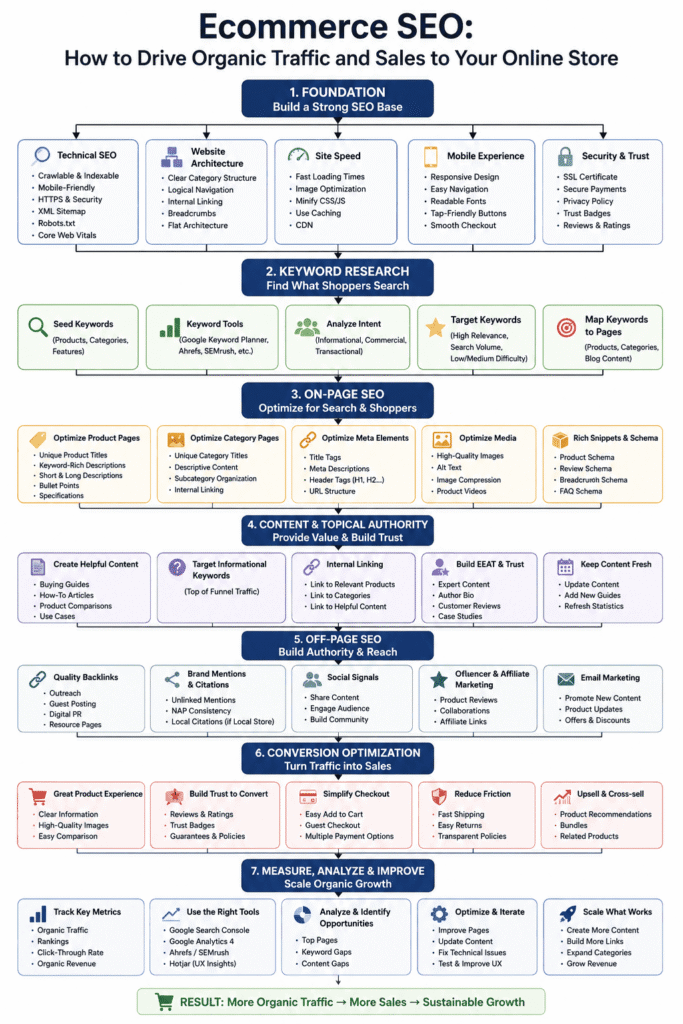
Table of Contents
ToggleWhat Ecommerce SEO Actually Is — and What It Isn’t
Ecommerce SEO refers to the discipline of optimising an online store’s technical infrastructure, site architecture, page content, and off-page authority signals so that product and category pages rank in organic search results for queries with commercial buying intent.
That definition matters because it draws a boundary most practitioners miss. Standard SEO optimises for visibility. Ecommerce SEO optimises for visibility at the specific moment a searcher has commercial intent — when “running shoes for flat feet” means someone is comparing products, not researching biomechanics. The keyword research methodology, the page structure, and the conversion requirements all follow from that intent distinction.
Organic search drives 53% of all website traffic across industries (Source: BrightEdge, 2024), and for ecommerce specifically the proportion is higher — because product searches are inherently search-engine-mediated. A customer who wants a specific jacket doesn’t open a brand’s website directly unless they already know the brand. They type a query. Whether your store appears in the results for that query is an SEO question, not a product quality question.
The structural challenge that makes ecommerce SEO genuinely harder than content SEO: at scale, the site produces ranking problems automatically. Faceted navigation generates thousands of parameter-laden URLs. Manufacturer product descriptions appear on dozens of competing sites simultaneously. Category filters create near-duplicate pages that split ranking signals. Seasonal inventory changes produce 404 errors on pages that had accumulated link equity. None of these problems exist on a ten-page content site — all of them exist on a ten-thousand-product store.
The 6-Layer Store Authority Model
Ecommerce SEO fails most often not because individual tactics are wrong but because they’re applied out of sequence. Schema markup on a site with crawl budget problems is wasted effort. Content strategy on a site with thin product descriptions is premature. Link building to a store with broken category architecture dilutes rather than compounds.
The 6-Layer Store Authority Model sequences optimisation in the order where each layer creates the foundation the next layer requires.
Layer 1 — Technical Foundation: Site speed, crawlability, mobile performance, Core Web Vitals, canonical configuration, and XML sitemap health. Nothing else compounds until this layer is stable.
Layer 2 — Architecture: URL structure, category hierarchy, internal linking depth, breadcrumb implementation, and faceted navigation handling. Architecture determines how Google allocates crawl budget and distributes page authority.
Layer 3 — Keyword Mapping: Commercial intent keyword research matched to specific page types — category pages, product pages, and informational content — with clear keyword-to-URL assignments that prevent cannibalisation.
Layer 4 — Page Optimisation: Unique product descriptions, title tag and meta description patterns, image alt text, structured data markup, and conversion-oriented page elements that serve both rankings and revenue.
Layer 5 — Content Authority: Informational content (buying guides, comparisons, how-to articles) that captures top-of-funnel commercial research queries and internal links to product and category pages.
Layer 6 — Off-Page Signals: Link acquisition from editorial sources, digital PR, product placements, and manufacturer or supplier relationship links that build domain authority and individual page authority.
Work through the model in order. Attempting Layer 6 before Layer 1 is solved produces link equity that lands on a technically weak foundation and dissipates rather than compounding.
Pro Tip: Before any other work, run a crawl of your site using Screaming Frog or Sitebulb and export the response code report. Count the 3xx redirects, 4xx errors, and pages flagged as duplicate or thin. That report is your Layer 1 priority list — fix those before investing a single hour in content or links.
Technical Foundation: The Layer That Determines Everything Downstream
Site speed is not a ranking factor in isolation — it’s a ranking factor because it correlates with user behaviour signals that Google measures directly. Pages loading above three seconds on mobile lose a measurable proportion of visitors before the page renders (Source: Google, 2024). Those departures register as pogo-sticking in Google’s behavioural data, and persistent pogo-sticking is associated with ranking depression for ecommerce product pages specifically — because high-intent searchers who bounce fast are a strong quality signal.
Mobile performance is non-negotiable. Mobile commerce accounted for 60.7% of all ecommerce sales in 2024 (Source: Statista, 2024). That proportion means that any page experience problem on mobile is a revenue problem, not just a rankings problem.
Core Web Vitals — Largest Contentful Paint (LCP), Interaction to Next Paint (INP), and Cumulative Layout Shift (CLS) — are Google’s named user experience signals and confirmed ranking inputs. Target: LCP under 2.5 seconds, INP under 200ms, CLS under 0.1. Ecommerce sites routinely fail CLS because promotional banners and late-loading product images shift page layout after initial render. Fix the layout shift before optimising anything else on the page.
Crawl budget management matters at scale in ways that don’t affect small sites. A ten-thousand-product store with faceted navigation generating parameter URLs is potentially producing hundreds of thousands of URLs for Google to evaluate. Without explicit crawl directives — robots.txt disallow rules for filter parameters, canonical tags pointing filter pages to their parent category, and noindex on pagination beyond a defined depth — Google allocates crawl budget to non-canonical pages instead of product and category pages that need ranking consideration.
Canonical configuration on ecommerce sites specifically: every product that appears in multiple categories needs a canonical tag pointing to the single preferred URL. Every sort-order variant of a category page (sort by price, sort by rating) needs a canonical pointing to the default sort. These are not optional refinements — they’re structural requirements that prevent ranking signal dilution across URL variants.
Site Architecture: How Crawl Depth Affects Rankings
The three-click rule is specific and measurable: every product page should be reachable within three clicks from the homepage. Homepage → Category → Subcategory → Product is four levels, which pushes some products to four clicks. For large catalogs, that depth is sometimes unavoidable — but every additional click level reduces the crawl frequency Google applies to pages at that depth, which delays ranking updates and dilutes internal link equity.
Breadcrumb navigation serves both users and Google. For users: orientation in a large catalog. For Google: a secondary signal confirming the page’s position in the hierarchy. Implement BreadcrumbList schema alongside visible breadcrumb HTML — the schema enables rich result display in search and provides an unambiguous signal to Google about page hierarchy.
Internal linking on ecommerce sites has a different function from content blogs. On a content site, internal links pass authority and help readers discover related content. On an ecommerce site, they do both of those things and simultaneously reduce crawl depth — a product page linked from the homepage, a category page, and a buying guide is effectively at one click, two clicks, and three clicks simultaneously. Strategic internal linking from high-authority pages (homepage, best-performing category pages, top-ranking blog posts) to deep product pages artificially reduces their effective crawl depth.
The faceted navigation problem deserves specific attention. Most ecommerce platforms generate filterable URLs by default — /shoes/colour=red, /shoes/colour=red&size=42, /shoes/brand=nike&colour=red&size=42. Left unmanaged, this produces thousands of near-duplicate pages competing for the same ranking signals. The correct handling depends on whether the filter combination represents genuine search demand. Colour + category (red running shoes) may have search demand and warrant an indexable page. Size + colour combinations almost never do. Configure faceted navigation in Google Search Console’s URL parameter tool and apply noindex + canonical to filter combinations without search demand.
Pro Tip: Internal linking from your store’s blog posts to product and category pages is one of the highest-ROI architecture investments available. A buying guide ranking for “best running shoes for flat feet” that links to your flat-feet running shoe category passes authority from an already-ranking page directly to a commercial page. Map every blog post’s internal links deliberately — not algorithmically.
Keyword Research: Mapping Commercial Intent to Page Types
Ecommerce keyword research produces a different output from content keyword research. The goal isn’t a content calendar — it’s a URL-to-keyword map where every page type targets the intent level that matches its function.
Category pages target broad commercial intent: “running shoes,” “organic cotton t-shirts,” “standing desks.” These queries have high search volume and competitive difficulty, but category pages carry the structural authority (linked from navigation, linked from homepage) to compete for them. Individual product pages cannot rank for broad category terms because their specificity signals the wrong intent match.
Product pages target specific commercial intent: “Brooks Ghost 16 running shoes women’s,” “waterproof hiking boots wide fit UK,” “Ergotron LX monitor arm.” These queries have lower volume but high purchase intent. Someone searching a specific product SKU or a detailed attribute combination is close to a buying decision. Product page keyword targeting focuses on: exact product name + model, product name + key attribute, product name + use case.
Informational content captures research-phase commercial queries: “how to choose running shoes for flat feet,” “standing desk height guide,” “organic cotton vs bamboo sheets.” These queries bring in top-of-funnel traffic from searchers who haven’t yet selected a product. The content page answers the research question and internal links to the relevant category or product pages — converting a research visit into a product consideration.
Long-tail keyword targeting for ecommerce operates on a volume accumulation logic. A single product page optimised for “waterproof hiking boots wide fit UK” may generate 50 visits per month from that specific query — but the page simultaneously ranks for dozens of semantic variations (“wide-fitting waterproof walking boots,” “hiking boots for wide feet UK”) that each contribute additional volume. The aggregate traffic from long-tail specificity routinely exceeds what broad terms deliver, at a fraction of the competitive difficulty.
Keyword cannibalisation on ecommerce sites is a structural risk. When a category page and a product page both target the same keyword, Google allocates ranking consideration between them — and neither ranks as well as one consolidated page would. Map every keyword to a single primary page. If two pages target the same keyword, either merge them or adjust one page’s targeting to a more specific variant.
Ecommerce SEO:
Drive Organic Traffic & Sales
in 2026
The data, frameworks, page types and AI search signals behind ecommerce organic growth — verified from BrightEdge, Statista, Reboot Online, Seer Interactive, and Baymard Institute.
Verified data from BrightEdge, SeoProfy, Reboot Online, Baymard Institute, and Charle Agency (2025–2026).
Sources: Ringly.io 2026, SeoProfy 2026, Taylor Scher SEO 2026, Charle Agency 2026, Statista 2026.
Ecommerce Traffic by Channel
% share of all ecommerce website traffic by source
Ecommerce Search Intent Distribution
% of ecommerce queries by intent type
Mobile Commerce Share of Sales (2018–2026)
% of total ecommerce sales completed on mobile devices
Ecommerce SEO ROI vs Other Channels
Average ROI multiple by marketing channel
Apply layers in order. Technical issues in Layer 1 prevent every other layer from compounding. Schema without crawl health is wasted effort.
Technical Foundation
Site speed, Core Web Vitals (LCP <2.5s, INP <200ms, CLS <0.1), canonical configuration, crawl budget management, XML sitemap health. Fix before everything else.
if load >3 seconds (Google)
Architecture
URL hierarchy, three-click rule, breadcrumb implementation, faceted navigation handling (noindex + canonical on low-demand filter combos), internal linking depth.
to any product page
Keyword Mapping
Commercial intent keywords assigned to page types — category pages target broad terms, product pages target specific SKU + attribute queries. 70% of ecommerce searches are transactional.
are transactional (Taylor Scher)
Page Optimisation
Unique product descriptions (300+ words), title tag structure, image alt text, Product/BreadcrumbList/AggregateRating schema markup. Rich snippets lift CTR measurably at same rank position.
is most important factor
Content Authority
Buying guides, comparison posts, how-to content targeting research-phase commercial queries. 61% of US consumers make purchases based on blog recommendations.
on blog recommendations
Off-Page Signals
Digital PR, manufacturer "where to buy" pages, broken link building, product review outreach. Ecommerce SEO generates 5.2× ROI over a 36-month period.
over 36 months (SeoProfy)
Sources: SeoProfy 2026, Charle Agency 2026, Statista Q4 2025, BigCommerce 2026.
of Ecommerce Traffic Is Mobile
Three in four visitors are on their phones. A site that isn't mobile-optimised is losing the majority of its audience before a product page loads.
of Online Purchases on Smartphones
In Q4 2025, smartphones accounted for 71% of total online purchases — not just browsing. Mobile shoppers are completing transactions, not just window shopping.
Mobile Share of Sales by 2028
Mobile's share of online sales projected to reach 63% by 2028, up from 43% in 2018. The trajectory is consistent and accelerating.
More Organic Sessions with Core Web Vitals Pass
Ecommerce sites passing Core Web Vitals on mobile see 15% more organic sessions from mobile Google search vs failing sites.
Keyword cannibalisation occurs when two page types target the same intent. Map every keyword to a single primary page before creating content.
| Page Type | Search Intent | Keyword Example | Competition | Conversion Rate | Priority |
|---|---|---|---|---|---|
| Category Page | Commercial | "running shoes," "standing desks" | High | 1.5–3% | Layer 3 + 4 |
| Product Page | Transactional | "Brooks Ghost 16 women's wide" | Medium | 3–6% | Layer 4 |
| Buying Guide | Informational | "how to choose running shoes for flat feet" | Low | 0.5–1.5% | Layer 5 |
| Comparison Post | Commercial | "memory foam vs latex mattress" | Medium | 1–2.5% | Layer 5 |
| Brand / Homepage | Transactional | "[brand name] shoes" | Low | 4–8% | Layer 2 + 4 |
| Blog / How-To | Informational | "how to measure ring size at home" | Low | 0.3–1% | Layer 5 |
Sources: Seer Interactive 2025, Charle Agency 2026, Taylor Scher SEO 2026, Gartner 2026.
CTR Decline with AI Overviews
Organic CTR dropped 61% for queries displaying AI Overviews — from 1.76% to 0.61% across 3,119 informational queries tracked over 15 months.
Ecommerce Searches Show AI Overviews
16% of ecommerce searches now display an AI Overview — a share that continues rising. Product schema and structured data improve citation eligibility.
Traffic Boost from AI Overview Citations
Being cited in an AI Overview can boost traffic by 35% — making structured data, E-E-A-T signals, and authoritative content the new competitive advantage.
Screenless Searches by 2026
30% of internet searches projected to be conducted without a traditional screen — voice, AI chatbot, and in-app search within TikTok and Instagram.
aiseojournal.net · by AI-SEO Design Team · Ecommerce SEO Visual Guide 2026 · Data: BrightEdge, SeoProfy, Reboot Online, Baymard Institute, Seer Interactive, Statista, Charle Agency, Taylor Scher SEO, Gartner (2025–2026)
Product Page Optimisation: Where Rankings Meet Revenue
Product pages carry the double requirement that no other page type shares: they must rank in search, and they must convert the visitors they attract. An unoptimised product page that ranks doesn’t generate revenue. An optimised product page that doesn’t rank generates nothing. Both requirements must be met simultaneously.
Unique product descriptions are non-negotiable at the page level and a competitive differentiator at the site level. Manufacturer descriptions appear on every competing retailer’s site — they generate duplicate content signals that dilute ranking potential for every page carrying them. Write original descriptions targeting your focus keyword naturally, prioritising benefits over specifications (not “3000mAh battery” but “lasts a full day of use without a charge”), and including the sensory or experiential details that help a customer imagine the product in their life.
Target 300 words minimum for primary products. That floor isn’t arbitrary — it’s the content volume where Google’s content quality assessment has enough material to evaluate topical relevance. Below 150 words, a product page reads as thin content regardless of its other optimisation signals.
Title tag structure for product pages: [Product Name] — [Key Attribute] | [Brand]. Keep under 60 characters. The product name first (matches search query structure), the differentiating attribute second (serves searchers scanning results), the brand last (recognition signal for returning customers). Meta descriptions for product pages should include the product name, a single benefit claim, and a call to action — they don’t affect ranking directly but they determine whether a ranking impression converts to a click.
Image optimisation on ecommerce sites is a material ranking input. Google Images is a significant traffic source for commercial product queries, and image alt text carries keyword signal that contributes to page relevance scoring. Write descriptive alt text that names the product, its primary attribute, and its context: “Woman wearing red leather ankle boots on cobblestone street” rather than “product-image-3.jpg.” Compress images to WebP format (30–80% smaller than JPEG at equivalent quality) and implement lazy loading for images below the fold.
Product schema markup (using Product, Offer, and AggregateRating types from schema.org) generates rich snippet eligibility that displays star ratings, price, and stock status directly in search results. The click-through rate improvement from rich snippets is measurable — starred results routinely outperform unstarred results at the same ranking position. Validate implementation with Google’s Rich Results Test before deploying at scale. The deployment that generates the most persistent errors: price not marked up with the Offer type, causing Google to display the schema without pricing information.
Category Page Optimisation: Capturing Broad Commercial Keywords
Category pages are the highest-authority pages on most ecommerce sites by structural position — linked from site navigation, linked from the homepage, and receiving internal links from both product pages and blog content. That structural authority makes them the correct home for broad commercial keywords that individual product pages can’t compete for.
The optimisation failure on category pages is almost always the same: no unique content. A category page displaying a grid of products with no introductory text, no descriptive copy, and no internal context is technically a thin page — it has structural authority but no content signal for Google to evaluate topical relevance.
Write 300–500 words of unique category introduction copy that covers: what this category contains, who the products are for, what distinguishes your selection, and any buying guidance specific to this category. Place at least one paragraph above the product grid (visible without scrolling) and the remainder below the grid. This positioning serves both crawlers (who read from top to bottom) and users (who aren’t interrupted by text in their browsing flow).
Update category pages seasonally. A “Winter Jackets” category page with November-specific copy (new arrivals, gift guide mentions, delivery timing for the holiday season) signals to Google that the page is actively maintained. Static category pages that haven’t been touched in eighteen months accumulate freshness penalties that reduce ranking consideration for seasonal queries, even if the underlying product inventory is current.
Internal linking from category pages to related categories, subcategories, and buying guide blog posts distributes the category page’s structural authority through the site. A “Running Shoes” category page linking to “Trail Running Shoes,” “Road Running Shoes,” and a “How to Choose Running Shoes” buying guide creates three additional ranking pathways from the same high-authority starting point.
Content Strategy: Building Authority with Informational Content
Product and category pages capture searchers who have already decided they want a product in a category. Informational content captures searchers earlier — in the research phase, where they’re comparing options, seeking guidance, or solving a problem that your products address.
The commercial value of informational content is indirect but measurable. A buying guide ranking for “best standing desk for home office” doesn’t directly generate a sale — but it brings in a qualified audience, internal links them to relevant category and product pages, and establishes the store as a credible source in the vertical. Customers who find a store through helpful content before they’re ready to buy are more likely to return to that store when they are ready.
Buying guides, comparison posts, and how-to content perform best on ecommerce sites when they’re structured around specific purchase decisions rather than generic educational content. “How to measure your ring size at home” is more commercially valuable than “a history of ring sizing” because the former attracts someone preparing to buy a ring. The informational value and the commercial value align.
Every informational post should link internally to at least two relevant category or product pages — not as sidebar widgets but as contextual links embedded in the body where they’re genuinely relevant to the reader’s question. If you’re looking for trail-specific options, our trail running shoe category covers thirty models with side-by-side comparisons” is a contextual internal link that serves the reader and passes authority simultaneously.
Content freshness matters on ecommerce sites for a reason that doesn’t apply to evergreen content blogs: product ranges change, pricing changes, competitor products enter the market. A buying guide published in 2022 that recommends discontinued products or outdated specifications is an active ranking liability — Google’s quality assessment penalises content that’s demonstrably stale relative to current market conditions. Schedule content audits quarterly and update material that’s lost accuracy.
Link Building for Ecommerce: Off-Page Authority at Scale
Backlinks remain among the strongest ranking signals for competitive commercial keywords (Source: Moz, 2024). For ecommerce specifically, the link types that carry the most weight share a common characteristic: they come from sources that would naturally reference a product or store for editorial reasons rather than reciprocal arrangement.
Digital PR generates editorial links from news sites, industry publications, and vertical media. An ecommerce store in the outdoor equipment space that produces original research (“the most popular hiking trails in the UK by search volume”) creates a link-worthy asset that outdoor publications, local news, and travel blogs will cite. The research doesn’t sell products directly — but the links it earns pass authority to every page on the domain.
Manufacturer and supplier relationships generate links that most ecommerce operators overlook. Brands whose products you stock often maintain “where to buy” pages or “authorised retailer” lists that link to stockists. These links carry strong topical relevance signals — a running shoe brand linking to your running shoe store is a highly relevant endorsement signal. Request inclusion on brand retailer pages for every major brand you carry.
Broken link building on ecommerce sites specifically: find product category pages from competitors or complementary stores that have been discontinued or migrated, identify who links to those dead pages, and pitch your equivalent live category page as a replacement. This is lower-volume than digital PR but has a high acceptance rate because site owners actively want broken links fixed.
For the detailed tactics on building links from editorial sources, media placements, and digital PR campaigns, the Link Building for Ecommerce cluster post covers fifteen specific strategies with outreach templates.
The Ecommerce SEO Cluster: What Each Post Covers
This pillar maps the complete ecommerce SEO system. Each cluster post goes deeper on one component:
Ecommerce Site Structure: The Ultimate Blueprint for SEO Success — URL hierarchy, the three-click rule, breadcrumb implementation, and internal linking architecture for large catalogs.
Ecommerce Keyword Research: The Complete Guide to Finding Profitable Keywords — Commercial intent mapping, long-tail targeting, competitor keyword gap analysis, and the keyword-to-URL assignment process.
Technical SEO for Ecommerce: Essential Fixes — Core Web Vitals, crawl budget management, faceted navigation handling, canonical configuration, and schema deployment at scale.
Category Page SEO: How to Rank Your Ecommerce Categories — Category page content structure, seasonal updates, internal linking from category pages, and competitive keyword targeting.
Mobile SEO for Ecommerce: Why 60% of Your Sales Depend on It — Mobile performance optimisation, Core Web Vitals for mobile, touch UX requirements, and mobile-first indexing compliance.
Link Building for Ecommerce: 15 White-Hat Strategies That Actually Work — Digital PR, manufacturer relationships, broken link building, product review outreach, and scholarship link strategies for ecommerce.
Ecommerce Content Marketing: How to Drive Traffic Without Paid Ads — Buying guide structure, comparison content, informational keyword targeting, and content-to-product internal linking.
Schema Markup for Ecommerce: Boost CTR with Rich Snippets — Product schema, BreadcrumbList, FAQPage, and AggregateRating implementation with validation walkthrough.
How to Handle Out-of-Stock Products for SEO — Temporary vs permanent out-of-stock handling, 301 vs 404 decisions, and preserving link equity through inventory changes.
Frequently Asked Questions About Ecommerce SEO
What is SEO in ecommerce?
Ecommerce SEO is the process of optimising an online store’s pages so they rank in organic search results for queries with commercial buying intent. It covers technical site health, URL architecture, product and category page optimisation, content strategy, and link building — with the specific goal of driving targeted traffic from searchers who are actively looking to buy. Unlike advertising, organic ecommerce traffic doesn’t stop when budgets are cut — it compounds over time as the site accumulates authority.
What are the 7 types of e-commerce?
The standard e-commerce classification covers seven models: B2C (Business to Consumer — a store selling directly to individual buyers), B2B (Business to Business — selling products or services to other companies), C2C (Consumer to Consumer — marketplace platforms like eBay or Etsy), C2B (Consumer to Business — individuals selling services to companies), B2G (Business to Government — selling to public sector organisations), D2C (Direct to Consumer — manufacturers bypassing retailers to sell directly), and social commerce (selling through social media platforms). Each model has different SEO implications, though B2C and D2C share the most direct overlap with standard ecommerce SEO practice.
What is B2C SEO?
B2C SEO (Business to Consumer SEO) is the application of search optimisation to stores selling directly to individual buyers — which describes the majority of ecommerce SEO practice. The distinguishing characteristics of B2C SEO: keyword targeting focuses on purchase-intent queries (“buy red leather boots”), page optimisation prioritises both rankings and conversion rate simultaneously, and content strategy targets research-phase queries from consumers comparing options before buying. The SEO tactics in this guide apply directly to B2C ecommerce.
How long does ecommerce SEO take to show results?
Meaningful organic traffic from ecommerce SEO typically appears within three to six months for low-to-medium competition keywords, and six to twelve months for competitive commercial terms. Technical and architecture fixes produce the fastest results — crawl issue resolutions can generate ranking improvements within two to four weeks of Googlebot re-crawling the affected pages. Content and link building compound more slowly but sustain rankings over longer periods. The stores that see the fastest results combine Layer 1 and Layer 2 fixes in month one with product page optimisation in months two and three, then add content and links from month three onwards.
How does ecommerce SEO differ from SEO for a content blog?
Four structural differences. First, scale: an ecommerce store manages thousands of pages compared to a blog’s dozens, which means crawl budget, duplicate content, and technical debt problems appear that don’t exist at smaller scale. Second, intent: ecommerce pages target commercial and transactional intent; blog content targets informational intent. Third, conversion requirement: an ecommerce page must rank and convert; a blog post only needs to rank and inform. Fourth, technical complexity: faceted navigation, product variants, inventory changes, and platform-generated URL parameters create SEO problems specific to ecommerce that have no equivalent in content-only sites.
Building an Ecommerce SEO System That Compounds
Organic search is the only ecommerce marketing channel where the return compounds rather than resets. Paid advertising stops generating traffic the moment the budget is exhausted. Organic traffic from a well-structured, authoritative ecommerce site continues arriving as long as the rankings hold — and rankings, once established through genuine authority, are substantially more durable than ad-driven position.
The 6-Layer Store Authority Model works precisely because it respects this compounding logic. Technical fixes compound into better crawl efficiency. Better crawl efficiency compounds into more consistent ranking of product pages. Better-ranked product pages accumulate click data that reinforces their positions. Informational content builds domain authority that lifts every product page simultaneously. Links earned through digital PR and supplier relationships extend that authority to pages that haven’t yet earned individual backlinks.
Start with the layer where your site currently has the most significant gap. For most ecommerce operations entering this system, that’s Layer 1 — technical issues that are silently suppressing rankings across hundreds of pages without generating any visible error in the CMS. Run the crawl. Fix the response codes, canonicals, and Core Web Vitals. Then work forward through the model.
The Ecommerce Site Structure post is the logical next step if architecture is your current constraint. The Technical SEO for Ecommerce post covers Layer 1 in full detail if technical issues are where your store needs attention first.
References
BrightEdge. “Organic Search Report.” BrightEdge, 2024. https://www.brightedge.com/resources/research-reports/organic-search Supports: Organic search driving 53% of all website traffic.
Statista. “Mobile Commerce Share of Total Ecommerce Sales.” Statista, 2024. https://www.statista.com/statistics/mobile-commerce-share/ Supports: Mobile commerce accounting for 60.7% of all ecommerce sales in 2024.
Google. “Core Web Vitals.” Google Search Central, 2024. https://developers.google.com/search/docs/appearance/core-web-vitals Supports: LCP, INP, and CLS thresholds as confirmed ranking inputs.
Backlinko. “Google CTR Study.” Backlinko, 2024. https://backlinko.com/google-ctr-stats Supports: 73% of searchers not scrolling past page one of results.
Moz. “Search Engine Ranking Factors.” Moz, 2024. https://moz.com/search-ranking-factors Supports: Backlinks remaining among the strongest ranking signals for competitive commercial keywords.
Google. “Google Search Central — Canonical URLs.” Google, 2024. https://developers.google.com/search/docs/crawling-indexing/consolidate-duplicate-urls Supports: Canonical tag requirements for product URL variant management.
Schema.org. “Product Schema.” Schema.org, 2024. https://schema.org/Product Supports: Product, Offer, and AggregateRating schema types for rich snippet eligibility.
Google. “PageSpeed Insights.” Google Developers, 2024. https://developers.google.com/speed/pagespeed/insights/ Supports: Mobile page speed assessment methodology and performance threshold guidance.