

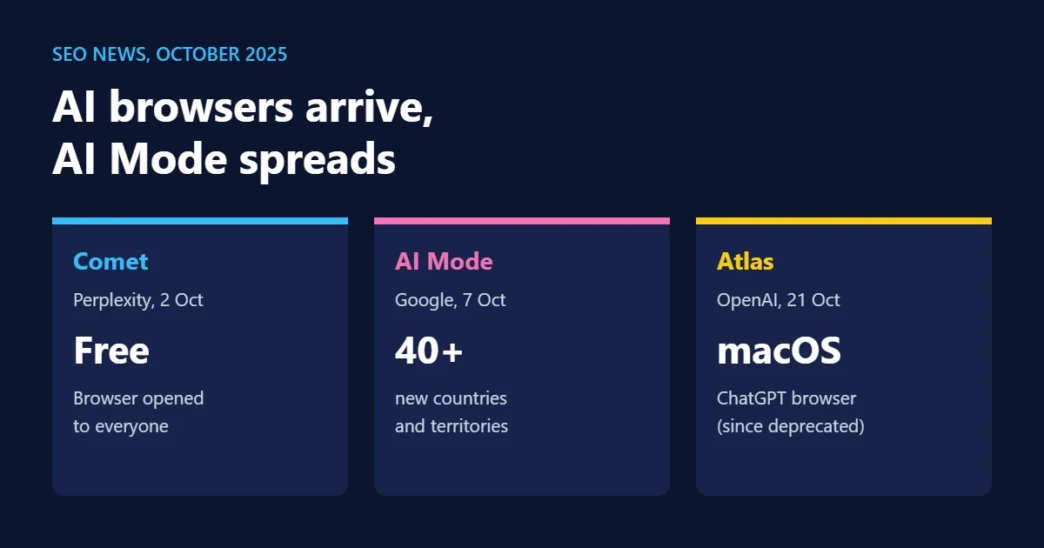
On 21 October 2025, OpenAI launched ChatGPT Atlas, a web browser built around ChatGPT [6]. It was the biggest of several October launches that moved search towards AI browsers and AI answers. Perplexity made its Comet browser free, and Google took AI Mode to more than 40 new countries and territories [1] [3].
This roundup covers the October 2025 SEO news that we could check against the company’s own announcement. Each item says what happened, why it matters and what to do.
Updated 18 November 2026: rebuilt as a dated, checked roundup. The earlier version, titled “Top 10 SEO Industry News – Last 30 Days”, listed mostly conference dates taken from other sites’ event lists. We replaced it with October 2025’s main search news, each from a primary source, and added later updates where things have changed.
| When | What | Who |
|---|---|---|
| 2 Oct | Comet browser released free to everyone [1] | Perplexity |
| 3 Oct | Bing Places for Business rebuilt, moved to bing.com/forbusiness [2] | Microsoft |
| 7 Oct | AI Mode adds 35+ languages and 40+ countries and territories [3] | |
| 9 Oct | Google-NotebookLM added to user-triggered fetchers [4] | |
| 21 Oct | ChatGPT Atlas browser launched on macOS (since deprecated) [6] | OpenAI |
| All month | No Google ranking update began in October [7] |
Table of Contents
ToggleChatGPT Atlas: an AI browser from OpenAI (21 October 2025)
What happened. OpenAI launched ChatGPT Atlas worldwide on macOS for Free, Plus, Pro and Go users. Its agent mode, which can carry out tasks while you browse, was in preview for Plus, Pro and Business users [6].
Why it matters. A browser built around an AI assistant changes where a search starts. Instead of a search box, the user asks ChatGPT, which can read and act on pages for them.
What to do. Check that your key pages work for an assistant reading them on a user’s behalf: clear headings, visible prices and plain-language answers.
Watch out: OpenAI’s announcement page now says “Atlas has since been deprecated” and points to its ChatGPT Work product instead [6]. If you built plans around Atlas specifically, check OpenAI’s current release notes.
Perplexity makes Comet free (2 October 2025)
What happened. Perplexity released its Comet browser to everyone for free. It had first launched Comet to a limited group on 9 July 2025, with a waitlist [1].
Why it matters. Two AI browsers, Comet and Atlas, became widely available within three weeks. Both put an AI answer between the user and your page.
What to do. Look in your server logs for visits from AI browsers and assistants, and note which pages they request. Our report on the Cloudflare and Perplexity crawling dispute explains why these visits can be hard to identify.
Google AI Mode expands to more than 40 new countries (7 October 2025)
What happened. Google added more than 35 new languages and over 40 new countries and territories to AI Mode. That took it to more than 200 countries and territories in total, including many across Europe [3].
Expert quote: people are “asking questions nearly three times longer than traditional searches” in AI Mode — Hema Budaraju, Vice President, Product Management, Search, Google [3]
Why it matters. Longer questions mean more detailed, specific queries. Pages that answer one clear question in depth have more to offer than thin pages chasing a short keyword.
What to do. If you serve readers in newly covered countries, read our guide to AI Overviews vs AI Mode and check your pages in their languages.
Microsoft relaunches Bing Places for Business (3 October 2025)
What happened. Microsoft launched a rebuilt Bing Places for Business and moved it from bingplaces.com to bing.com/forbusiness. It added a faster import from Google Business Profile and a Recommendation Tool for listings [2].
Why it matters. It made a Bing listing quicker to set up for businesses that already have a Google profile.
What to do. Claim or check your listing. We looked at how it has gone a year later in Bing Places for Business, one year on.
Google lists the NotebookLM fetcher (9 October 2025)
What happened. Google added Google-NotebookLM to its list of user-triggered fetchers, “based on feedback” [4]. These fetchers request a page because a user asked for it, for example by adding it as a source in a notebook [5].
Why it matters. Google says user-triggered fetchers generally ignore robots.txt rules, because a person asked for the page [5]. So a robots.txt block will not stop them.
What has changed since. Google’s page now lists Google-NotebookLM as a former agent, supported until August 2026. The current fetcher is for Gemini Notebook, which requests URLs that users provide as sources [5].
What to do. If you filter bot traffic by user agent, add both names. See our guide to managing AI crawlers for the wider list.
Google made one smaller documentation change that month. On 15 October 2025 it updated the list of Google products that use its Read Aloud service [4].
Was there a Google ranking update in October 2025?
What happened. No. Google’s Search Status Dashboard lists no ranking update starting in October 2025. The nearest was the August 2025 spam update. It began on 26 August and lasted 26 days and 15 hours, ending in late September [7].
Why it matters. If your traffic moved in October 2025, a confirmed Google update is not the likely cause. Look at your own changes, seasonality, or shifts in AI features instead.
What to do. Before blaming an algorithm, check the dashboard dates against your own data. Our guide to HTTP status codes covers one common technical cause of drops.
Quick check: Open Search Console, compare October 2025 with September 2025 and note any change of more than 10%. Then check whether it lines up with any of the dates in this roundup.
What did the October 2025 SEO news add up to?
This is our analysis. October 2025 was the month AI browsers went mainstream. In three weeks, two of them became free to download or widely available [1] [6]. At the same time, Google spread AI Mode to most of the world [3].
The common thread is that the user’s first stop is increasingly an AI answer, not a list of links. That does not change what makes a good page. It does change how many people see your page directly, and how many see a summary of it instead.
A year on, the picture is less tidy. OpenAI has deprecated Atlas [6], and Google has replaced the NotebookLM fetcher with a Gemini one [5]. Products in this space change fast, so check the current page before acting on an old announcement.
What did we remove from the earlier version?
- Conference listings. Seven of the original ten items were conference dates and ticket prices copied from other sites’ lists. They were not news, and we did not re-check them.
- An acquisition claim. The earlier version said Ahrefs had acquired Detailed. Detailed’s homepage says its founder now works at Ahrefs, but we did not find an acquisition statement, so we removed the claim.
- Industry figures. An “80% of top results” figure and a “$122 billion” industry value came from pages we did not re-check, so they were removed.
Frequently asked questions
What was the biggest October 2025 SEO news?
OpenAI launched ChatGPT Atlas, a browser built around ChatGPT, on 21 October 2025. Perplexity made Comet free on 2 October, and Google expanded AI Mode to more than 40 new countries on 7 October.
Was there a Google core update in October 2025?
No. Google’s Search Status Dashboard lists no ranking update starting in October 2025. The August 2025 spam update ended in late September.
Is ChatGPT Atlas still available?
OpenAI’s announcement page now says Atlas has since been deprecated and points users to ChatGPT Work. Check OpenAI’s release notes for the current product.
Does robots.txt block Google-NotebookLM?
Google says user-triggered fetchers such as this one generally ignore robots.txt, because a user asked for the page. Google has since replaced it with a Gemini Notebook fetcher.
Where did AI Mode launch in October 2025?
Google added more than 35 languages and over 40 countries and territories, including many across Europe. That brought AI Mode to more than 200 in total.
Where to go next
For more checked news, read our report on Google’s position on AEO and GEO. To see how AI features affect your traffic, use our guide to AI search visibility tracking.
Sources
How we checked this: on 18 November 2026 we opened each company’s own announcement, Google’s documentation log and its Search Status Dashboard. Where a page has changed since October 2025, we say so above. We have no relationship with any company named.
- Perplexity — The internet is better on Comet, 2 October 2025
- Microsoft Bing Blog — Introducing the New Bing Places for Business, 3 October 2025
- Google — AI Mode in Google Search expands to more than 40 new areas, Hema Budaraju, 7 October 2025
- Google Search Central — Latest documentation updates (October 2025 entries)
- Google — Google’s user-triggered fetchers (read 18 November 2026)
- OpenAI — Introducing ChatGPT Atlas, 21 October 2025 (page since updated)
- Google Search Status Dashboard — Ranking incident history