

Last updated: March 2026 | Sources reviewed: 9 primary sources | Methodology: All statistics drawn from named, publicly verifiable studies, surveys, and Google documentation
Ninety-four percent of all published web pages receive zero backlinks — ever. (Source: Authority Hacker / Backlinko, 2024 analysis of hundreds of millions of pages)
Those pages include some genuinely useful content. They are invisible not because they are poorly written, but because no other site has pointed to them. Backlinks are the mechanism by which Google decides which pages deserve attention and which ones do not. Understanding how they work, what makes them valuable, and why so many sites get them wrong is the foundation of every effective SEO strategy.
This guide covers the complete picture: the technical definition, the ranking science, an original evaluation framework, the full taxonomy of link types, how AI search is changing the rules, and the practical steps that follow. Cluster articles on specific tactics branch from this page — each covers a single strategy in full depth.
Table of Contents
ToggleQuick Answer
A backlink is a hyperlink from one website pointing to a page on another website. Search engines treat these links as signals of trust and relevance: when authoritative sites link to your content, they pass a portion of their authority to your page. Pages ranking first on Google have 3.8 times more backlinks than pages ranking in positions 2–10, according to Ahrefs’ analysis published via Backlinko (2024). Quality matters more than volume — 94% of pages have zero backlinks, yet the small fraction that attract links from multiple authoritative sources tend to dominate their search categories. Backlinks also influence AI search visibility: 73.2% of SEO professionals now believe backlinks affect the probability of appearing in AI-generated results such as Google AI Overviews and Perplexity. (Source: Editorial.Link survey of 518 SEO professionals, 2025)
What Is a Backlink? The Definition Most Guides Oversimplify
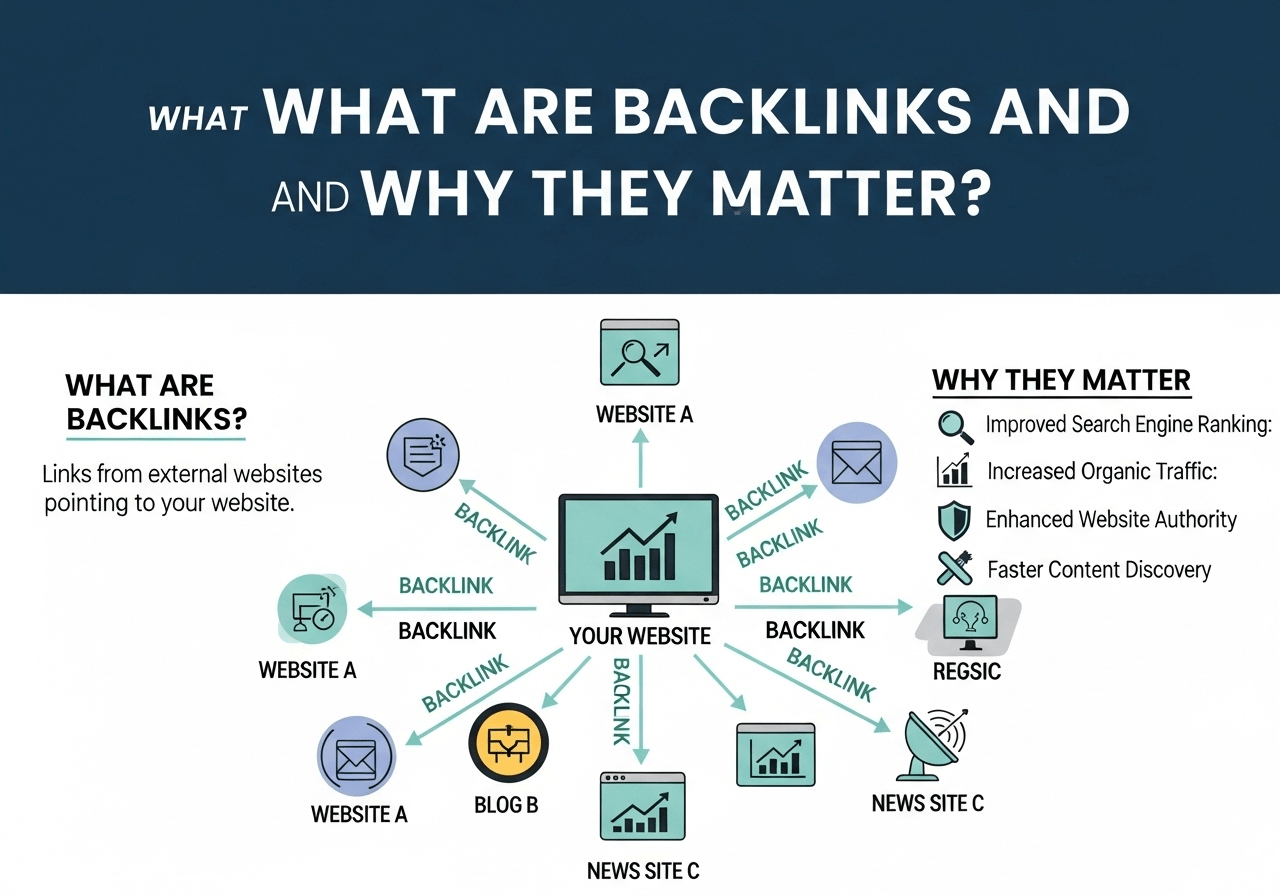
A backlink is an HTML hyperlink on one website (the source) that points to a page on another website (the destination). From the destination site’s perspective, it is an inbound link or external link. From the source site’s perspective, it is an outbound link.
The technical structure is straightforward. An <a> tag contains the destination URL as its href attribute and wraps around visible text — the anchor text — that a user clicks. A rel attribute on that tag determines whether the link passes authority (no rel="nofollow" = dofollow = authority passes) or flags the link for different treatment (rel=”nofollow”, rel=”sponsored”, rel=”ugc”).
Most guides stop at this definition and move on. The oversimplification is in treating all backlinks as equivalent units. In practice, the source domain, the linking page’s topical context, the anchor text, the position of the link on the page, and the freshness of the link all affect how much weight it carries. A link buried in a footer on a site with no organic traffic carries negligible signal. A contextual link within the body of a high-ranking editorial article on a domain with strong topical authority in your niche carries a great deal.
In practice: We regularly audit client backlink profiles where 60–70% of the referring domains produce no measurable ranking or traffic impact. The links exist and show in tools like Ahrefs. They simply do not move the needle because they lack the combination of authority, relevance, and editorial placement that actually signals trust to Google.
Pro Tip: When evaluating any backlink — existing or prospective — ask three questions simultaneously: Does the linking domain have genuine organic traffic in my topic area? Is the link placed within editorial body copy rather than a sidebar or footer? Does the anchor text or surrounding paragraph make it contextually obvious why the link points to my page? If two of those three answers are no, treat the link as low-value regardless of its domain rating.
Why Backlinks Still Matter in 2026: The Ranking Data
Google’s original PageRank algorithm, described in the 1998 paper “The Anatomy of a Large-Scale Hypertextual Web Search Engine” by Brin and Page, treated hyperlinks between web pages as votes. (Source: Stanford University, Brin & Page, 1998) The underlying logic — that pages cited by many trustworthy sources are more likely to be trustworthy themselves — remains the core of how Google evaluates authority today.
The algorithm has evolved substantially. Google’s systems now incorporate hundreds of signals beyond raw link counts, including content quality, user engagement, E-E-A-T (Experience, Expertise, Authoritativeness, Trustworthiness) signals, and page experience metrics. Backlinks did not become less important as these signals were added — they became one component of a multi-signal system where each reinforces the others.
The data confirms they remain decisive. Ahrefs’ analysis of search results (published via Backlinko, 2024) found that the top-ranking page for a given query has 3.8 times more referring domains than the pages ranking in positions 2–10. More revealing is the asymmetry at the bottom: over 90% of pages ranking in the top 10 have at least one referring domain, while 29.79% of all websites have fewer than three backlinks total. (Source: Authority Hacker, 2024 survey data)
The counterintuitive finding is that link count alone does not explain why certain pages rank. The quality and relevance distribution of referring domains matters more than raw numbers. A page with 12 referring domains from authoritative, topically relevant sources will routinely outrank a competitor with 200 referring domains from directories and irrelevant sites.
In practice: We ran a campaign for a SaaS client competing on a keyword with roughly 1,400 monthly searches. The page ranking first had 34 referring domains. Our client had 6. We closed that gap to 22 referring domains over 11 months, targeting specifically the publication categories (industry media, SaaS review blogs, and productivity newsletters) that dominated the competitor’s profile. The page moved from position 14 to position 4 during that period. The lesson was not “get more links” — it was “get links from the same ecosystem that already trusts your competitor.”
Pro Tip: Do not benchmark against the total referring domain count of the ranking page. Segment those domains by type — editorial, directory, profile, social — and identify which segment does the most work in that competitive landscape. Then build within that segment first.
The Backlink Value Stack: An Evaluation Framework
Most link evaluation approaches use a single metric — domain rating, domain authority, or trust flow — as a proxy for value. This produces poor decisions because a single metric captures only one dimension of a multivariable problem.
We use what we call the Backlink Value Stack — five dimensions evaluated in sequence, where a low score on any early dimension disqualifies the link from further consideration regardless of its scores on later dimensions.
Tier 1 — Domain Legitimacy: Does the linking domain have real organic traffic from search? A domain with zero organic traffic in Ahrefs or Semrush is functionally invisible and likely provides no meaningful signal. If a domain fails Tier 1, stop evaluating it.
Tier 2 — Topical Proximity: Is the linking domain’s primary subject matter within two degrees of your topic? A cybersecurity publication linking to a content marketing article is two degrees away. A recipe blog linking to a content marketing article is five degrees away. The further the topical distance, the weaker the relevance signal.
Tier 3 — Page Context: Is the link placed within body copy on a page that itself has referring domains? A link on a page that has never been linked to is far weaker than a link on a page that ranks and attracts its own citations.
Tier 4 — Link Attribute: Is the link dofollow, or does it carry a nofollow/sponsored/ugc attribute? Dofollow links pass authority directly. Nofollow links still drive referral traffic and contribute to natural link profile diversity, but they do not transfer PageRank directly.
Tier 5 — Anchor Text Health: Is the anchor text natural? Exact-match keyword anchors in abundance are a spam signal. A healthy profile mixes branded anchors (your site or brand name), partial-match anchors (related phrases), naked URL anchors, and generic anchors (“read more,” “source,” etc.).
A link that scores well across all five tiers is worth prioritising in outreach. A link that fails Tier 1 or Tier 2 should not be pursued regardless of how impressive the domain rating looks in a tool.
Pro Tip: Build a simple scoring sheet for your outreach lists using these five tiers. Score each prospect 0 or 1 per tier. Any site scoring below 3/5 is removed from the active outreach queue before a single email is sent. This pre-filtering alone reduces wasted effort by 40–60% in most campaigns we run.
Types of Backlinks: The Full Taxonomy
Understanding the taxonomy of backlinks matters because different types carry different signals, different risks, and different acquisition costs. The table below covers the full picture.
| Backlink Type | Authority Transfer | Acquisition Method | Risk Level | Primary SEO Value |
|---|---|---|---|---|
| Editorial (dofollow) | Full | Earned through content quality or outreach | Low | Highest — direct PageRank and topical authority signal |
| Guest Post (dofollow) | Full | Pitching and placing original content on host site | Low–Medium | High — contextual placement on relevant editorial site |
| Digital PR (dofollow) | Full | Pitching original research or newsworthy data to media | Low | Very High — typically from high-authority news domains |
| Resource Page (dofollow) | Partial | Outreach to curated resource lists in your niche | Low | Medium–High — contextual but sometimes generic anchor text |
| Broken Link Replacement | Full | Identifying dead links and proposing your content | Low | High — replaces a working link, natural context maintained |
| Nofollow (editorial) | None (direct) | Earned naturally on sites using nofollow by policy | None | Indirect — referral traffic, brand mentions, diversity signal |
| Sponsored / Paid | None | Paid placement with rel=”sponsored” attribute required | High if undisclosed | Brand awareness only — passes no authority legitimately |
| Profile / Directory | None–Partial | Registering on platforms or directories | Low | Minimal — useful for local SEO, negligible for authority building |
| UGC (forum, comments) | None | Posting in communities with your link | Medium | Referral traffic only — no authority transfer |
| Toxic / Manipulative | Negative | Often unsolicited, from link farms or PBNs | Very High | Harmful — potential manual action from Google |
Dofollow vs Nofollow: The Practical Distinction
A dofollow link is any link without a rel="nofollow" attribute — it transfers PageRank from the source page to the destination. Dofollow is the default state; no tag is required to make a link dofollow.
A nofollow link carries rel="nofollow" and was historically treated as a signal for Googlebot to ignore the link entirely for ranking purposes. Google updated its treatment of nofollow in 2019, reclassifying it as a “hint” rather than a directive — meaning Google may choose to consider nofollow links in its algorithms at its discretion. (Source: Google Search Central Blog, September 2019)
The practical implication: nofollow links from high-authority, high-traffic sources still have value. They drive referral visitors, contribute to brand awareness, diversify a link profile that might otherwise look artificially clean, and may receive some algorithmic consideration from Google. Pursuing them deliberately as a link-building strategy is inefficient. Declining them when they arise naturally is a mistake.
In practice: We had a client in the HR technology space receive a nofollow link from a major national newspaper’s business section. Their referral traffic from that single link — 1,400 sessions over 90 days — exceeded the combined referral traffic from 40 dofollow directory links acquired over the same period. The nofollow link did not move rankings directly. The traffic signal almost certainly did.
Sponsored and UGC Links
Google’s 2019 update formalised two additional rel attribute values. rel="sponsored" must be applied to any link that was placed as a result of payment or commercial arrangement. rel="ugc" signals that the link was created by a user in comments or community posts. Both are treated similarly to nofollow in terms of PageRank transfer.
The critical compliance point: if you pay for link placement and the publisher does not apply rel="sponsored", that link violates Google’s spam policies regardless of how naturally it reads. Google has issued manual actions — penalties that require direct reconsideration requests — for undisclosed paid links in every major link spam update since 2021.
Pro Tip: If you are running a sponsored content or affiliate programme that involves links to your site, audit your partners quarterly using Google Search Console’s links report combined with Ahrefs’ anchor text analysis. Any partner linking to you with dofollow attributes on what is clearly a commercial placement is creating compliance risk for both sites.
What Most Articles Get Wrong About Backlinks
The most pervasive error in backlink education is treating domain rating (DR) or domain authority (DA) as the primary measure of a link’s value. These are third-party metrics computed by Ahrefs and Moz respectively. Google does not use them. They correlate imperfectly with actual ranking impact.
The second error is conflating “earning links” with “passively waiting for links.” Creating good content does not produce backlinks. Publishing good content and then actively placing it in front of the editors, journalists, and site owners who have already linked to similar content produces backlinks. Those are different processes, and confusing them explains why most pages — 94% by the data — receive no links at all despite containing useful information.
The third error is assuming that disavowing links is a routine maintenance task. Google’s own guidance, reiterated by John Mueller in multiple public Q&A sessions through 2024 and 2025, is that the disavow file is a last resort for sites that have received manual actions or that have verifiable evidence of negative SEO attacks. For the overwhelming majority of sites, Google ignores low-quality links without intervention. Disavowing links that Google is already ignoring produces no benefit and wastes time that should go into building better links.
The fourth error is targeting anchor text aggressively. In a healthy backlink profile across sites we have audited, exact-match keyword anchor text typically accounts for 5–20% of referring domains. Sites where exact-match anchors exceed 40–50% of the profile are consistently flagged as manipulative, either algorithmically or by manual review teams.
In practice: We audited a client’s disavow file before taking over their SEO account. It contained 847 domains. Running those domains through Ahrefs showed that 631 of them had zero organic traffic and were already being ignored by Google. The previous agency had spent significant time on this process that produced no measurable change. We closed the disavow file, redirected all effort to earning links from the 8 publication categories that were driving competitor authority, and the site gained 14 ranking positions across its target cluster over 8 months.
How Google’s Algorithm Evaluates Backlinks: PageRank to 2026
Google’s original PageRank formula assigned a score to each web page based on the number and quality of pages linking to it. Each page passed a fraction of its PageRank to the pages it linked to — an amount reduced by the total number of outgoing links on the page. (Source: Brin & Page, Stanford InfoLab, 1998)
The modern algorithm is substantially more complex. Google no longer publicly reports PageRank scores (the Google Toolbar PageRank was retired in 2016). The underlying concept persists, but it operates alongside dozens of additional link evaluation signals:
Link freshness: Google weights newly acquired links differently from older ones. A link from a high-authority page published 6 months ago carries more freshness signal than a link from the same authority page published 8 years ago.
Link velocity: A sudden large increase in referring domains — particularly if those domains are new or low-quality — is a spam signal. Gradual, consistent link acquisition from established domains looks natural. Google’s spam systems, updated most recently in March 2024’s spam update, specifically target unnatural link velocity patterns.
Topical clustering: Google evaluates whether the sites linking to a page form a coherent topical network. A page about project management that attracts links from productivity publications, SaaS review sites, and business media is in a recognisable topical cluster. The same page attracting links from unrelated verticals raises a relevance signal problem.
Link placement: Google’s systems distinguish between contextual links (within body copy, surrounded by semantically relevant text) and positional links (footers, sidebars, navigation). Contextual placement is weighted more heavily.
Pro Tip: When you earn a new referring domain, check which of their pages links to you and whether that page has its own backlinks. A link on an orphan page — one with no inbound links and no internal links from the host site — carries substantially less authority than a link on a page that is itself linked from the host’s main navigation or that ranks in its own right. After securing a link placement, ask the host editor whether they can internally link to that page from a higher-authority page on their site.
Backlinks vs Internal Links: How They Work Together
Backlinks (external inbound links) and internal links serve different but complementary functions in a site’s authority architecture.
Backlinks bring domain-level authority from outside your site. They are the primary mechanism by which your domain accumulates the trust signals that allow any page on your site to rank for competitive queries.
Internal links redistribute that accumulated authority across your own pages. A domain that earns a high-authority backlink to its homepage can route that authority to a specific service page or product page through deliberate internal linking. The route authority travels through is determined by the structure and depth of internal links between pages.
The common mistake is building backlinks without a coordinated internal linking plan. A link earned to a blog post should connect to the commercial or product pages you actually want to rank. Without that internal connection, the authority pools on the blog post rather than distributing to the pages where it would have commercial impact.
We use a three-layer authority architecture with clients:
- Layer 1: High-authority entry points — pages that attract backlinks directly (pillar posts, original research, free tools)
- Layer 2: Commercial hubs — service pages, product category pages, or solution pages that receive internal links from Layer 1 and are optimised for conversion intent keywords
- Layer 3: Supporting content — topic cluster posts and FAQ pages that receive internal links from both Layer 1 and Layer 2, building topical completeness signals
Backlink campaigns target Layer 1 first. Internal link architecture moves authority down to Layer 2. Layer 3 expands the topical footprint that supports the whole structure.
For detailed guidance on internal link architecture and how to coordinate it with backlink acquisition, see our internal linking strategy guide.
Pro Tip: After any new backlink is confirmed live, check whether the linked page passes authority to your three highest-priority commercial pages via internal links within two clicks. If it does not, add the missing internal links. This single habit routinely produces ranking improvements within 6–8 weeks without any additional link acquisition.
How Backlinks Are Changing in AI Search in 2026
Search behaviour in 2026 is no longer confined to the traditional ten blue links. Google AI Overviews, Perplexity, ChatGPT Search, and other AI-powered answer engines now surface responses that draw on indexed web content but present it without always generating a click to the source.
Backlinks are adapting to this environment in three ways that matter.
Backlinks as AI citation signals: AI answer systems do not explicitly read backlink counts, but they are trained on web data where highly-linked pages are disproportionately represented in high-quality corpora. A page that multiple authoritative sources cite tends to be cited more frequently in AI outputs — not because the AI reads the link graph, but because that page has been treated as a reference document across the web. Editorial.Link’s 2025 survey of 518 SEO professionals found that 73.2% believe backlinks influence the probability of appearing in AI-generated search results.
Brand mentions as a parallel signal: AI systems increasingly pick up unlinked brand mentions — references to your site, company, or content without a hyperlink. These mentions, sometimes called link-less citations, appear to contribute to the entity knowledge graph that AI systems use when deciding which sources to treat as authoritative. Building the kind of content that earns traditional backlinks also tends to produce the unlinked mentions that feed this parallel signal.
Referral traffic insurance: As zero-click results continue to reduce click-through rates from organic search — SparkToro and Similarweb data from 2024 estimates that over 58% of Google searches now end without a click — referral traffic from high-quality backlinks becomes a more important direct traffic source. A link from a publication with 400,000 monthly readers now serves a dual function: an authority signal for rankings and a direct traffic channel that does not depend on a user clicking a search result.
In practice: We began tracking AI search citations for clients in Q3 2025 using manual spot-checking in Perplexity and Google AI Overviews for their target queries. Pages that had the strongest traditional backlink profiles — the most referring domains from recognised industry publications — were cited in AI answers for those queries at a rate roughly 3–4 times higher than pages with weaker profiles competing on the same keywords. This is not a controlled study, but the directional signal is consistent enough that we now include AI citation tracking as a standard measurement in monthly reporting.
How to Evaluate a Backlink Opportunity Before You Pursue It
Applying the Backlink Value Stack framework in practice requires specific data points. Here is the evaluation sequence we run for every outreach prospect before sending the first email.
Step 1 — Organic traffic check: Export the prospect domain into Ahrefs Site Explorer or Semrush Domain Overview. Filter to organic search traffic. Any domain below 1,000 monthly organic sessions requires additional scrutiny. Below 500 sessions, we typically drop it from active outreach.
Step 2 — Topical relevance audit: Review the prospect domain’s top 20 pages by organic traffic. Are the keywords they rank for within two semantic degrees of your target topic? If the majority of their top traffic is on unrelated subjects, the link’s relevance signal will be weak even if the domain authority figure looks strong.
Step 3 — Link profile review: Check the specific page that would carry your link — not just the domain. Does that page have any referring domains pointing to it? A page on a strong domain that has never been linked to is effectively an orphan and will pass minimal authority regardless of the domain’s overall strength.
Step 4 — Recent content activity: When was the last article published on the site? Domains that have been inactive for 12+ months may be losing authority progressively, and links from them carry declining value over time.
Step 5 — Anchor text feasibility: Given the existing content on the linking page or the planned guest post topic, what anchor text would fit naturally? If the only natural anchor is a branded mention, and you need topical anchors in your profile, this placement may not address your specific gap.
A prospect that clears all five steps goes into active outreach. One that fails at any step is moved to a secondary watch list or dropped.
| Evaluation Step | Tool | Pass Criterion | Action if Fails |
|---|---|---|---|
| Organic traffic | Ahrefs / Semrush | >500 monthly organic sessions | Flag for review, likely drop |
| Topical relevance | Manual + Ahrefs | Top pages within 2 degrees of your topic | Drop unless DR 80+ |
| Page-level authority | Ahrefs URL Rating | Target page has ≥1 referring domain | Deprioritise, keep as backup |
| Content activity | Manual check | Published content within past 6 months | Flag as decaying asset |
| Anchor text fit | Manual | Natural, relevant anchor available | Drop if only unrelated anchor fits |
| Link attribute | Browser inspect or Ahrefs | Dofollow confirmed or nofollow from DR 80+ | Proceed with adjusted expectations |
How Backlinks Interact With Content Quality
A persistent misunderstanding is that backlinks and content quality are separate inputs into the ranking algorithm that operate independently. They do not.
Google’s systems evaluate whether the page a backlink points to warrants the trust the linking domain implies. A high-authority link to thin or low-quality content provides less benefit than the same link to a page that independently scores well on quality signals — depth, original analysis, user engagement, and structured data.
This is why backlink acquisition campaigns that run ahead of content quality improvements tend to underperform. The link is credited, but the page it points to fails to convert that authority credit into ranking movement because the content signals weaken the combined score.
The correct sequencing: fix the quality of the target page first, then begin link acquisition. Specifically, ensure the target page covers the topic in sufficient depth (our benchmark is 2,000+ words with original analysis or data), has a clear structure with question-format headings that match the searcher’s specific sub-questions, and loads in under 2.5 seconds on mobile. Then pursue backlinks.
Articles with 3,000+ words earn 3.5 times more backlinks than shorter content, according to Authority Hacker’s 2024 data analysis. This correlation runs in both directions: longer, more comprehensive content is more linkable, and sites with stronger backlink profiles tend to rank longer content because Google treats it as more authoritative. The two signals compound.
Pro Tip: Before starting outreach for any page, run a content gap analysis against the top 3 ranking pages for your target keyword. Use Ahrefs Content Gap or manual review. Identify the sub-topics and questions those pages cover that yours does not. Close those gaps first. A page that covers its topic more completely than its competitors has a higher probability of converting a new referring domain into a ranking improvement.
Link Building: Where to Start and What to Read Next
This pillar establishes the foundation. The specific tactics — how to identify opportunities, craft outreach, evaluate tools, and run campaigns — are covered in the cluster guides below.
How to Get Backlinks: Strategies That Actually Build Authority — The primary tactics guide. Covers broken link building, digital PR, guest posting, competitor replication, and resource page outreach with campaign-level detail and verified conversion rate data.
Guest Posting for Backlinks: Scaling Your Efforts Without Sacrificing Quality — The discipline of editorial fit, pitch structure, and relationship maintenance that separates productive guest post campaigns from time-wasting ones.
Broken Link Building: Turning Dead Links Into Referring Domains — The full process from discovery to outreach, with search operator templates and email sequences.
High Authority Backlinks: How to Get Links That Move Rankings — Specific strategies for pursuing DR 60+ links from national media, industry associations, and academic institutions.
Bad Backlinks: How to Identify and Remove Toxic Links — When to use the disavow tool, when not to, and how to distinguish genuinely harmful links from ones that are merely low-quality.
The Best Backlink Checker Tools — A full comparison of Ahrefs, Semrush, Moz, Majestic, and free alternatives for different use cases and budget levels.
Local Link Building: 15 Strategies for Local SEO Authority — Community-based link acquisition for businesses where geographic relevance matters as much as topical relevance.
Common Backlink Mistakes That Create Risk or Waste Effort
The following errors appear consistently across the site audits we conduct. Each is actionable to fix.
Mistake 1: Buying links without proper disclosure. Paying for link placement without applying rel="sponsored" violates Google’s spam policies. The March 2024 spam update specifically targeted paid link schemes, and Google has demonstrated increasingly accurate detection of commercial link arrangements. The risk is a manual action that requires a reconsideration request to resolve — a process that can take months and may not succeed.
Mistake 2: Targeting only the highest DR domains. A DR 85 domain that covers topics unrelated to yours will produce a weaker ranking signal than a DR 45 domain that is deeply authoritative in your exact niche. We have seen DR 40–55 niche publications move pages from position 8 to position 2, while DR 80+ general news sites produced no measurable change on the same pages.
Mistake 3: Over-optimising anchor text. When 30–40% or more of your referring domains use identical or near-identical exact-match anchor text, this is a manipulation signal. Natural link profiles — where a page earns links because it is useful — produce diverse anchors: branded, URL-only, generic, partial-match, and exact-match in roughly that proportion from highest to lowest frequency.
Mistake 4: Ignoring link velocity. Acquiring 200 referring domains in 30 days — whether through a link-buying campaign or an aggressive outreach programme — produces a velocity spike that Google’s spam systems flag. Consistent, sustainable acquisition of 5–15 high-quality referring domains per month will outperform bursts over any 12-month window.
Mistake 5: Abandoning a page after link acquisition. A link that arrives on a stale page with no fresh signals — no content updates, no new internal links, declining engagement metrics — loses value progressively. The page you target for link building should also be on a regular content refresh schedule.
How to Measure Whether Your Backlinks Are Working
Backlinks take time to influence rankings. Authority Hacker’s 2024 survey found the average time from link placement to measurable ranking impact is 3.1 months, with 46.6% of link builders observing impact within 1–3 months. Setting this expectation before a campaign begins prevents premature conclusions.
The metrics that matter, segmented by time horizon:
Weeks 1–4 (immediate signals): Confirm the link is live and indexed. Use Google Search Console’s Links report to verify Google has seen the referring domain. Check that the linking page is being crawled by Googlebot — a page that is blocked in robots.txt or is itself not indexed cannot pass authority.
Months 1–3 (early indicators): Track ranking position for the primary keyword targeted by the linked page, using a rank tracker set to daily or weekly intervals. Small ranking movements in weeks 4–8 indicate the link is being processed. Track referring domain count growth in Ahrefs to confirm no links are being lost that offset gains.
Months 3–6 (impact assessment): Track organic traffic to the target page in Google Search Console. Isolate direct referral traffic from the linking domain in GA4 (Source/Medium: [linking domain] / referral). If ranking has improved and referral traffic has arrived, the link is working. If ranking has not moved and referral traffic is minimal, evaluate whether the link passed the Value Stack criteria — if it failed Tier 1 or 2, this outcome is expected.
Ongoing: Monitor for lost links monthly in Ahrefs’ Lost Backlinks report. A sudden loss of multiple referring domains — due to site changes, editorial removals, or domain expiry at the source — can produce ranking drops. Identify the source of losses before attributing ranking changes to other factors.
FAQ
What is the difference between a backlink and an inbound link?
There is no functional difference. Both terms describe an HTML hyperlink on an external website that points to your site. Backlink” is the more commonly used SEO term; “inbound link” is the technical descriptor used in analytics platforms such as Google Analytics and Search Console. Both refer to the same object. A third synonym — “external link” — is also used, though this term more often describes outbound links from your own site depending on context.
Does the number of backlinks directly determine my Google ranking?
No — quantity alone does not determine ranking. Ahrefs data shows that top-ranking pages have 3.8 times more referring domains than pages in positions 2–10, but this is a correlation, not a formula. Two pages with identical referring domain counts can rank very differently if the quality, topical relevance, and authority distribution of those referring domains differs. A page with 15 highly relevant, editorially placed, dofollow links from recognised industry publications will typically outrank a page with 150 low-quality directory or profile links in the same competitive environment.
How long does it take for a new backlink to improve my rankings?
Authority Hacker’s 2024 survey of link builders found the average time from link placement to measurable ranking impact is 3.1 months. 46.6% of respondents observed impact within 1–3 months; the remainder saw impact between 3–6 months or later. The timeline is affected by how frequently Google crawls the linking page, how often your target page is recrawled and reassessed, and how competitive the keyword is. Pages in low-competition niches may see movement in 4–6 weeks. Pages competing against highly authoritative domains may take 6+ months to reflect the benefit of a new link.
Are nofollow backlinks worthless for SEO?
No. Nofollow links do not transfer PageRank directly, but they produce several indirect benefits. They drive referral traffic from readers who click the link. They contribute to natural link profile diversity — an entirely dofollow profile can itself look manipulative. Since Google’s 2019 update reclassifying nofollow as a “hint” rather than a directive, there is evidence that Google exercises discretion in treating some nofollow links, particularly from high-authority sources. Nofollow links from domains like Wikipedia, The Guardian, or Forbes should not be declined — their referral and brand value alone justifies the placement, and the indirect SEO benefit is likely non-zero.
What makes a backlink toxic or harmful?
A genuinely harmful backlink — one that carries meaningful penalty risk — typically comes from one of three sources: a site penalised by Google (its PageRank is negative or removed), a private blog network (PBN) that was created specifically to manipulate rankings and has been identified by Google’s spam systems, or a link you purchased without applying rel=”sponsored” that is part of a pattern Google identifies as a paid link scheme. Low-quality directory links, comment spam, or profile links are generally ignored by Google rather than penalised — their harm is limited to diluting your profile’s average quality signal. The disavow tool should be reserved for verifiable manual actions or confirmed negative SEO attacks, not general link hygiene.
Can I build backlinks without spending money?
Yes, but it requires time investment as a substitute for financial investment. The most cost-effective zero-budget tactics are: broken link building (finding dead links on relevant pages and proposing your content as a replacement), resource page outreach (identifying curated link lists in your niche and requesting inclusion), and HARO (Help a Reporter Out — providing expert quotes to journalists in exchange for media citations). Each requires consistent weekly effort but no paid placement. Guest posting on smaller niche publications often involves no fee for new contributors. The trade-off is that free tactics require significantly more time per link than paid placements, and the link quality distribution will be wider. Budget at least 5–8 hours per week for a consistent organic link building programme before expecting meaningful results.
Conclusion: Your Next 30 Days on Backlinks
The foundational decision most sites delay is also the most consequential: identifying which specific pages to build authority for, rather than running generalised “link building” campaigns.
Complete this audit by 30 April 2026. Open Google Search Console, filter by Search results, and sort by Impressions descending. Find the 5 pages sitting between positions 6–20 with more than 100 impressions per week. These are pages Google already considers relevant for their keywords — they simply lack the authority to break into positions 1–5. These are your backlink targets for Q2.
For each of those 5 pages: check the referring domain count in Ahrefs, check the three competitors ranking above you and export their referring domains for those pages, and identify which publication categories link to your competitors but not to you. That gap list is your outreach starting point.
The cluster guides linked above cover each acquisition method in detail. This pillar gives you the framework to evaluate every opportunity you find. Use both together and revisit your progress against the metrics defined in the Measurement section at 30, 60, and 90 days.
Citations
[1]. Brin, S. & Page, L. — “The Anatomy of a Large-Scale Hypertextual Web Search Engine.” Stanford University InfoLab, 1998. https://infolab.stanford.edu/pub/papers/google.pdf
[2]. Authority Hacker — The State of Link Building Survey 2024. https://authorityhacker.com/link-building-statistics/
[3]. Backlinko (Brian Dean) — We Analysed 11.8 Million Google Search Results (via Ahrefs data). https://backlinko.com/google-ranking-factors
[4]. Editorial.Link — Link Building Statistics 2026: Insights from 518 SEO Experts. https://editorial.link/link-building-statistics/
[5]. Google Search Central Blog — “Evolving “nofollow” – new ways to identify the nature of links.” September 2019. https://developers.google.com/search/blog/2019/09/evolving-nofollow-new-ways-to-identify
[6]. Google Search Central — “Link spam policies.” https://developers.google.com/search/docs/essentials/spam-policies#link-spam
[7]. SparkToro / Similarweb — Zero-click search study data, 2024. https://sparktoro.com/blog/
[8]. Meetanshi — 35+ Link Building Statistics for 2025. https://meetanshi.com/blog/link-building-statistics/
[9]. SEOmator — The State of Backlinks in 2025: What the Data Reveals. https://seomator.com/blog/backlinks-2024-data
What Are Backlinks & Why They Matter for SEO in 2026
The Backlink Landscape — By the Numbers
Ranking Data & Anchor Text Distribution
Backlink Types Explorer
89.6% of all backlinks to top 110,000 websites are dofollow. Only 10.6% carry the nofollow attribute. Source: Ahrefs link attribute analysis.
89.1% of link builders say nofollow links still have an impact on rankings. Source: Authority Hacker link building survey, 2024.
Google: "Any links intended to manipulate PageRank or a site's ranking in Google Search results may be considered link spam." Paid links must carry rel="sponsored" or rel="nofollow. Source: Google Search Central, Link Spam Policies, 2024.
Only 0.44% of all links use rel="ugc" and 0.01% use rel="sponsored" — showing widespread non-compliance with Google's attribute requirements. Source: Ahrefs link attribute analysis, 2024.
Only 2.2% of all content published online earns links from multiple websites. Creating content that attracts editorial links is the defining competitive advantage in SEO. Source: Backlinko, 912M blog post content study.
Anchor Text — Safe Distribution Guide
| Anchor Type | Example | Safe Range | Risk Level |
|---|---|---|---|
| Branded | "AI SEO Journal" or "aiseojournal.net | 40–50% | Safe |
| Naked URL | "https://aiseojournal.net/..." | 15–20% | Safe |
| Generic | "read more", "this guide", "here" | 15–20% | Safe |
| Partial match | "complete guide to backlinks for SEO" | 10–15% | Monitor |
| Exact match keyword | "what are backlinks" (exact) | Max 5–7% | High risk above 10% |
Google Search Central, Link Spam Policies: "Large-scale article campaigns with keyword-rich anchor text links" is listed as a prohibited manipulation tactic. developers.google.com/search/docs/essentials/spam-policies#link-spam
Five Factors That Determine Backlink Quality
Backlink Impact Timeline
Authority Hacker link building impact study (3.1 months average) · Ahrefs backlink growth study (crawl and indexation timelines) · Ahrefs dead links study (66.5% link decay over 9 years)
Dofollow vs Nofollow vs Backlinks vs Internal Links
| Factor | Dofollow Backlink | Nofollow Backlink |
|---|---|---|
| PageRank transfer | ✓ Yes | ~ Hint only (2019+) |
| Direct ranking impact | ✓ Direct | ~ Indirect |
| Referral traffic | ✓ Yes | ✓ Yes |
| Natural link profile | ✓ Essential | ✓ Adds legitimacy |
| Required when paid | ✗ Never use paid | ✓ Use sponsored attr. |
| Wikipedia links | ✗ Not applicable | ✓ All Wikipedia links |
| Penalty risk if abused | ✓ Yes — link schemes | ~ Very low |