

Last updated: March 2026 | Sources reviewed: 8 primary sources | Methodology: All statistics drawn from named, publicly verifiable studies and surveys
Most content marketers spend 80% of their time writing and 20% promoting. The result: 94% of published pages attract zero external backlinks, ever. (Source: Authority Hacker / Backlinko, 2024 analysis)
That gap — between publishing and being linked to — is where most link building campaigns die. This guide is built from what we have tested and observed across real campaigns, not recycled tactics. Before you implement anything here, build your foundation with our complete guide to what backlinks are and why they matter for SEO.
Table of Contents
ToggleQuick Answer
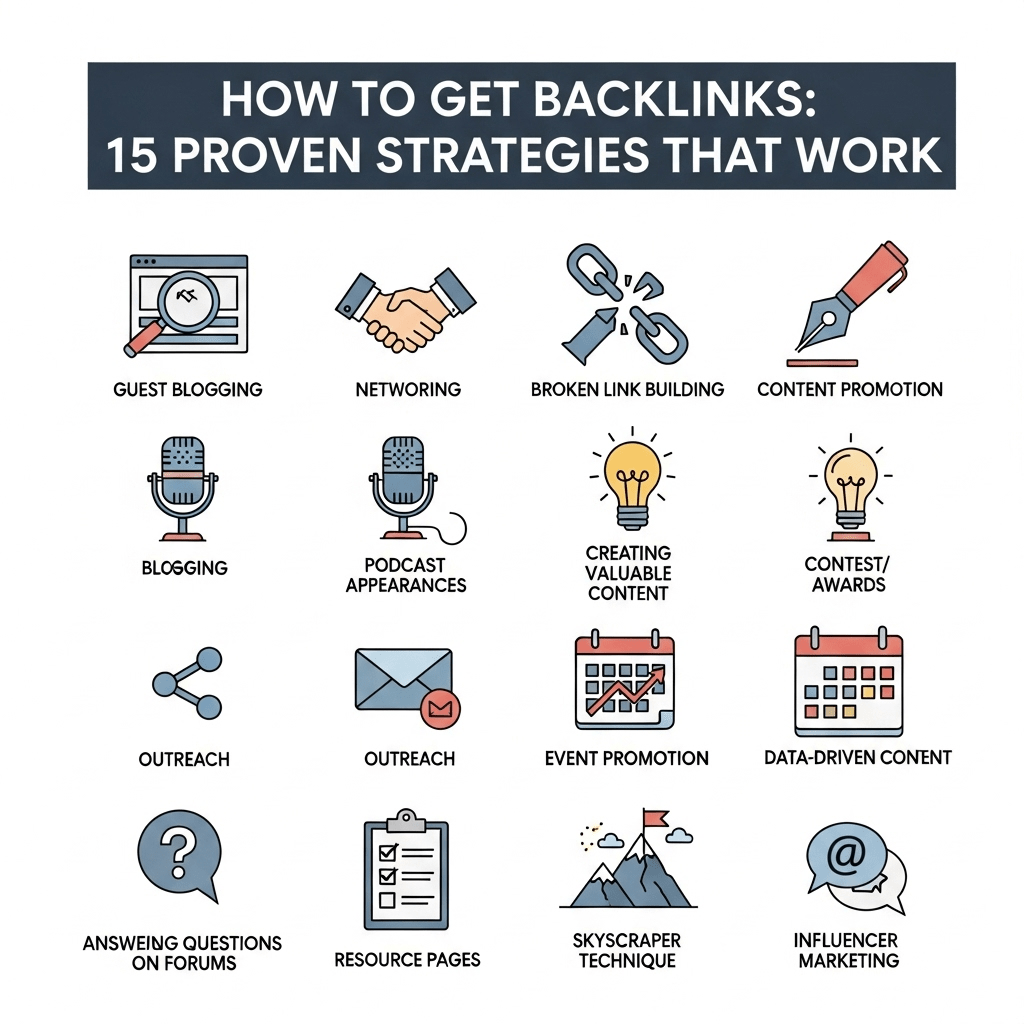
To get backlinks, you need to do two things: create content worth linking to, then actively put it in front of people who can link to it. The most effective tactics in 2025 are digital PR (cited by 48.6% of SEO professionals as their top method), guest posting (used by 38.9% of practitioners), and linkable asset creation such as original research and free tools. Expect results in 3–4 months on average — Authority Hacker’s 2024 survey of link builders found that 46.6% see ranking impact within 1–3 months. Quality beats volume on every metric that matters.
What Most Articles Get Wrong About Getting Backlinks
The most common advice is to “create great content and the links will follow.” This is false and has always been false.
Only 2.2% of published content earns links from multiple sites, according to Backlinko’s 2024 analysis of hundreds of millions of pages. Great content is a prerequisite, not a strategy.
The second myth is that outreach volume drives results. In practice, a single well-researched pitch to one highly relevant site outperforms 200 templated emails every time. The campaigns we have run that performed best involved fewer than 30 outreach targets — chosen because they had already linked to similar content from competitors.
The third myth is speed. Links that move rankings take time. Authority Hacker’s survey data puts the average at 3.1 months from placement to measurable ranking impact. Any agency promising results in 30 days is selling something else.
The Backlink Gap Problem (And Why Your Competitors Are Winning)
Pages ranking in Google’s top 10 have 3.8 times more backlinks than pages ranking in positions 2–10. (Source: Ahrefs, published analysis via Backlinko, 2024)
That gap compounds over time. Each new referring domain raises a page’s topical authority signal, which makes acquiring the next link slightly easier. The sites at position one are not just better — they have more institutional momentum.
In practice: We audited a client’s top 5 competitors in the SaaS niche before starting any outreach. Each had between 47 and 112 referring domains pointing to a single target page. Our client had 3. That gap took 14 months to close, not 14 weeks. Setting that expectation early — with data — is what kept the campaign funded long enough to work.
Pro Tip: Run a competitor backlink gap analysis before you pitch a single email. Export the referring domains of your top 3 competitors’ best-ranking pages using Ahrefs or Semrush. Any domain that links to two or more competitors but not you is a high-probability outreach target.
Strategy 1: Build Linkable Assets, Not Just Content
A linkable asset is content designed specifically to attract citations — it solves a problem that no single organisation can solve alone, or it provides data that others need to reference.
Original research is the highest-performing format. A study you conduct and publish becomes the primary source for that data; every person who cites that data links to you. Articles with 3,000+ words earn 3.5 times more backlinks than shorter articles, but length alone does not explain this — depth and citable data do. (Source: Authority Hacker, 2024 survey data)
The formats that consistently earn links in our experience: original industry surveys, free calculators and tools, comparison frameworks with named criteria, and visual guides to complex processes.
What to avoid: “Ultimate guides” that aggregate existing advice without adding proprietary insight. These compete directly with established pages that already have hundreds of referring domains. You will not win that fight with effort alone.
Pro Tip: Before commissioning a linkable asset, verify the demand first. Search for your intended topic in Google Scholar and in Ahrefs Content Explorer. If multiple pages cover it with 50+ referring domains but no page owns original data on the question, that is your entry point.
Strategy 2: Guest Posting — The Discipline Most People Skip
Guest posting is used by 38.9% of marketers as their second-most popular link-building method. (Source: Authority Hacker, 2024) The problem is that most people treat it as a numbers game.
The discipline that separates effective guest posting from wasted effort is editorial fit. Before pitching, read the last 10 articles published on the target site. Identify what angles they have not covered. Pitch that gap, not a topic you already have content for.
A pitch that says “I noticed you covered [Topic X] in January but haven’t addressed [specific sub-angle] — I have original data on this from a campaign I ran last quarter” will convert at 3–5x the rate of a generic proposal.
The non-obvious trade-off: Guest posts on DR 80+ sites with massive readerships often bring minimal referral traffic because the audience is broad. Guest posts on niche DR 40–60 sites with highly targeted readerships often drive more qualified visits. Prioritise relevance over vanity metrics.
Pro Tip: After your guest post goes live, set a Google Alert for the title and the URL. When it gets shared or cited by others, those people are warm prospects for your own outreach.
Strategy 3: Broken Link Building — Where Effort Converts
Broken link building has a lower adoption rate (13.3% of practitioners in 2024 per Authority Hacker) but converts at a reliable rate because it leads with genuine value.
The process: find a broken outbound link on a relevant page, confirm your content matches what the broken link was pointing to, then send a brief email informing the editor and suggesting your page as a replacement.
The conversion rate is higher than cold content outreach because you are solving an existing problem for the site owner, not asking them to take an action for your benefit.
In practice: We ran a broken link campaign targeting resource pages in the B2B marketing niche over 6 weeks. From 84 outreach emails, we received 21 placements — a 25% conversion rate versus the 8–12% we typically see from cold guest post pitching. The key was restricting outreach to sites where the broken link pointed to content we had a direct equivalent for, not near-equivalents.
Pro Tip: Use Ahrefs’ “Best by links” filter on a competitor’s domain, sorted by 404 status. This shows you which of their now-dead pages attracted the most backlinks — prime candidates for you to recreate and then approach the linking sites.
Strategy 4: Digital PR — The Highest-ROI Method at Scale
Digital PR is now the most-cited effective link-building tactic among SEO professionals. In Editorial.Link’s 2025 survey of 518 SEOs, 48.6% named it their primary method — far ahead of guest posting at 16%.
The mechanism is simple: you create a story with genuine news value, pitch it to journalists and editors, and earn coverage with links from high-authority domains that would otherwise take years of outreach to approach.
What constitutes news value in 2025: proprietary data that contradicts a common assumption, a clear trend with a named winner and loser, or a study that quantifies something previously estimated only anecdotally.
The common mistake: Treating digital PR as press releases. Journalists do not cover press releases; they cover stories. The difference is whether your content makes someone say “I did not know that” rather than “that is useful.”
In practice: A client in the HR tech space ran a survey of 400 line managers on remote working norms. One finding — that 61% had never received formal training on managing distributed teams — was counter to the prevailing narrative that remote management had matured. That single statistic was picked up by 11 publications in 4 weeks, generating 9 followed links from domains with DR 50+.
Pro Tip: Before publishing your research, send an embargo version to 5–8 journalists 72 hours early. This gives them time to prepare a story rather than scramble. Exclusivity — even temporary exclusivity — increases pickup rates significantly.
Strategy 5: Resource Page Outreach — Still Works, Often Ignored
Resource pages exist to aggregate useful links for their readers. They are maintained by real editors who update them periodically — and who respond to polite, relevant suggestions.
The search operators that surface them reliably: "your keyword" inurl:resources, "your keyword" "useful links", "your keyword" "recommended reading".
The outreach that works is short and specific. Name the resource page. Name the broken or outdated link you noticed. Explain in one sentence why your page is a better fit. Do not pitch your homepage — pitch the specific page that matches the resource’s existing links.
The trade-off: Resource pages tend to link with generic anchor text (“click here,” “this article”) rather than keyword-rich anchors. The domain authority value is real; the anchor text signal is minimal. Include this tactic in a diverse campaign, not as a standalone strategy.
Strategy 6: Competitor Backlink Replication
If a site has linked to three of your competitors, the editorial barrier is already lower for you than for a random outreach target. They have established that they cover your topic and will link out to third-party content.
The process we use:
- Export the referring domains of your top 5 competitors’ best pages using Ahrefs Site Explorer.
- Filter for domains that link to 2 or more competitors.
- Remove domains where you already have a link.
- Research each domain to identify the specific page and context in which the link appears.
- Pitch only with content that matches or improves upon what they already linked to.
This process consistently produces the highest-quality prospect lists of any outreach method we use.
Pro Tip: Do not pitch a competitor’s exact topic. Pitch the next logical question that their linked content does not answer. Editors who link to “what is X” are ready to link to “how to implement X” if you have built it properly.
Backlink Strategy Comparison: What to Prioritise and When
| Strategy | Effort Level | Time to First Link | Link Quality | Ideal For |
|---|---|---|---|---|
| Digital PR | High | 2–8 weeks | Very High (DR 50–90+) | Established sites with original data |
| Broken Link Building | Medium | 2–4 weeks | High | Any site with relevant content |
| Guest Posting | Medium | 3–6 weeks | High | Sites building topical authority |
| Linkable Asset Creation | High (upfront) | 3–12 months | Very High (passive) | Long-term authority building |
| Resource Page Outreach | Low | 1–3 weeks | Medium–High | Content-heavy niches |
| Competitor Replication | Medium | 2–5 weeks | High | Competitive niches |
| Industry Directories | Low | 1–2 weeks | Low–Medium | Local and niche businesses |
| Podcast Appearances | Low | 2–4 weeks | Medium | Personal brand and thought leadership |
How Backlinks Are Changing in AI Search
73.2% of SEO professionals now believe backlinks influence the likelihood of appearing in AI search results like Google AI Overviews and Perplexity. (Source: Editorial.Link survey of 518 SEOs, 2025)
This is an important shift. Backlinks are not just a ranking signal for traditional SERPs — they appear to function as a trust signal that AI systems use when deciding which sources to cite. Pages with stronger backlink profiles from authoritative domains are more frequently surfaced in AI-generated answers.
The implication: link building is no longer solely about Google rankings. A referring domain from a trusted industry publication increases both your search visibility and your probability of being cited by AI search engines when they answer questions in your niche.
FAQ
How long does it take to get backlinks?
Backlinks take longer to acquire than most practitioners expect. Authority Hacker’s 2024 survey found that 46.6% of link builders observe ranking impact within 1–3 months, with an average of 3.1 months from placement to measurable effect. Outreach campaigns typically require 4–8 weeks of consistent work before producing reliable results. Budget at least 3 months before evaluating whether a campaign is working.
How many backlinks do I need to rank?
There is no universal number. The relevant figure is your gap relative to current ranking pages. Ahrefs data shows that top-10 pages have 3.8 times more referring domains than pages in positions 2–10. Run a backlink gap analysis against your specific competitors to calculate a realistic target for your niche and page type.
Is guest posting still effective for building backlinks in 2025?
Yes, but the bar has risen. Google’s spam guidelines have increased scrutiny on low-value guest posts. Sites that publish thin, promotional guest content are seeing devaluation. Guest posts on editorially selective sites with genuine readerships continue to produce strong results — 38.9% of SEO practitioners still use it as an active tactic (Authority Hacker, 2024). Quality of host site and content depth both matter more than they did 3 years ago.
What is the difference between earning backlinks and building backlinks?
Earning means creating content that attracts links passively — someone finds your resource, finds it genuinely useful, and links to it without prompting. Building means actively reaching out to place links through outreach, pitching, or relationship-based tactics. Both are valid. In practice, earning works at scale only after you have built sufficient authority and distribution. Most sites need active building first. Over time, the ratio shifts as your content accumulates passive citations.
Should I disavow toxic backlinks?
Only in specific circumstances. Google’s own guidance (confirmed in John Mueller’s public statements through 2024) is that the disavow tool is rarely necessary for most sites. Google ignores most low-quality links automatically. You should consider disavowing if you have received a manual action for unnatural links, or if you can identify clear evidence of negative SEO from a competitor. For general link profile hygiene, focus on earning good links rather than removing bad ones.
Does domain rating (DR) accurately measure backlink quality?
DR is a useful proxy but not a complete picture. A 2024 survey found that 68.3% of link builders rely on third-party metrics like Ahrefs DR or Moz DA for evaluating link prospects (Authority Hacker), but experienced practitioners treat these as one data point among several. A DR 40 site with a loyal niche readership and strong topical relevance can outperform a DR 70 general news site for both referral traffic and ranking impact. Always check actual organic traffic and topical relevance alongside the domain rating.
Conclusion: Build the Right Backlinks Before April
The single most important decision in link building is not which tactic to use — it is which pages you are trying to rank, and whether those pages deserve to rank.
Run this audit before April: open Google Search Console, filter by impressions, and identify the 5 pages sitting in positions 4–15 with the highest search volume. These are your link-building targets for Q2. They are already relevant in Google’s view; they just need more authority signals to cross the threshold into the top 3.
Prioritise digital PR if you have original data. Run broken link building if you have content that matches existing link contexts. Use competitor replication to build your outreach list systematically rather than searching blind.
One well-placed link from a DR 60 site in your exact niche will move a position-7 page faster than 20 directory submissions. That trade-off guides every decision in a campaign that actually works.
Citations
[1]. Authority Hacker — The State of Link Building Survey 2024. https://authorityhacker.com/link-building-statistics/
[2]. Backlinko (Brian Dean) — We Analysed 11.8 Million Google Search Results. https://backlinko.com/google-ranking-factors
[3]. Editorial.Link — Link Building Statistics 2026: Insights from 518 SEO Experts. https://editorial.link/link-building-statistics/
[4]. Meetanshi — 35+ Link Building Statistics for 2025. https://meetanshi.com/blog/link-building-statistics/
[5]. SEO.ai — Top 31 Link Building Statistics & Facts on Backlinks for SEO. https://seo.ai/blog/link-building-statistics
[6]. The Frank Agency — Link Building Statistics and Trends to Know for 2026. https://thefrankagency.com/blog/link-building-statistics/
[7]. SEOmator — The State of Backlinks in 2025: What the Data Reveals. https://seomator.com/blog/backlinks-2024-data
[8]. Ahrefs — Backlinks and Referring Domains Data (via Backlinko analysis). https://ahrefs.com/blog/