

Last updated: March 2026 | Sources reviewed: 7 primary sources | Methodology: All ranking correlation data sourced from named published studies; acquisition strategy data from practitioner surveys
Pages ranking first on Google have 3.8 times more referring domains than pages ranking in positions 2–10. (Source: Ahrefs, via Backlinko, 2024) That multiplier does not accumulate evenly — it concentrates in high authority backlinks from domains with strong organic traffic and editorial standards.
The gap between a link from a DR 70 industry publication and a link from a DR 25 directory is not linear. The DR 70 link from a topically relevant editorial source can shift a page from position 8 to position 3. The DR 25 directory link typically produces no measurable ranking movement. Both register in your referring domain count. Only one moves rankings.
This guide covers the data behind why authority links behave differently, the acquisition methods that consistently produce DR 50+ placements, and the measurement framework for assessing whether a link you earned actually did what you expected. For the foundational understanding of how backlinks function as ranking signals, see our complete guide to what backlinks are and why they matter.
Table of Contents
ToggleQuick Answer
High authority backlinks — links from domains with DR 50+ and genuine organic traffic — move rankings because they transfer a concentrated authority signal that low-DR links cannot replicate at equivalent volume. The top-ranking page for a given keyword has 3.8 times more referring domains than pages in positions 2–10, but the quality distribution of those domains matters more than the count. (Source: Backlinko, 2024) Digital PR is the most effective method for acquiring DR 50+ links, cited by 48.6% of SEO professionals as their primary tactic. (Source: Editorial.Link, 2025) Original research, HARO/journalist outreach, and strategic guest posting on selective publications are the three methods that consistently reach the DR 50+ threshold without paid link placement.
Why Do High Authority Backlinks Move Rankings When Low-Authority Links Do Not?
93.8% of link builders prioritise link quality over quantity, according to Authority Hacker’s 2024 survey of practitioners. (Source: Authority Hacker, 2024) The data behind this consensus is worth examining directly.
Google’s PageRank algorithm passes a fraction of a linking page’s authority to the linked page — the higher the linking page’s own authority, the larger the fraction transferred. A page on a DR 75 domain that itself has 400 referring domains passes substantially more authority than a page on a DR 20 domain with no inbound links.
The compound factor most guides omit: Authority from a high-DR domain does not just transfer in the moment the link is indexed. It compounds as the linking page continues to accumulate its own referring domains over time. A link earned from Forbes in 2023 that remains live is worth more in 2026 than it was when it first went live — because Forbes’ overall authority has continued to grow. Low-DR links do not compound because those domains are not accumulating authority themselves.
The counterintuitive data point: A single referring domain from a DR 65+ site produces more measurable ranking movement than 50 referring domains from sites below DR 20. (Source: Ahrefs correlation data, via Backlinko, 2024) This ratio explains why campaigns focused on volume of low-quality links consistently underperform campaigns focused on frequency of high-quality placements.
Pro Tip: After securing any link from a DR 50+ domain, check the specific linking page’s own URL Rating (UR) in Ahrefs. A page on a strong domain with UR 15 passes less authority than a page with UR 45. Target placements on pages that themselves rank and attract links — not orphan pages on otherwise strong domains.
What Does the Data Show About Which Acquisition Methods Reach DR 50+?
48.6% of SEO professionals named digital PR as the most effective link-building tactic for reaching high-authority placements in 2025 — nearly three times the share citing guest posting (16%) or linkable asset creation (12%). (Source: Editorial.Link survey of 518 SEO professionals, 2025)
The gap is explained by access. Guest posting on DR 50+ sites requires editorial approval that most sites do not grant to unknown contributors. Digital PR creates news value that editors at those same publications feel compelled to cover regardless of prior relationship.
The three acquisition methods that consistently reach DR 50+:
Method 1 — Digital PR via original research. Proprietary data that contradicts a common assumption generates media coverage from publications that would never accept an unsolicited guest post. A survey of 400+ respondents in your industry niche, published with clear methodology, becomes a primary source that journalists cite. Every citation is a link. (Source: Editorial.Link, 2025)
Method 2 — HARO and journalist source queries. Help a Reporter Out and equivalent services (Qwoted, SourceBottle) connect journalists at national publications with expert sources. A quoted expert earns a link from the publication covering the story. Response rates to HARO are low — typically 10–20% — but the placements that result are consistently DR 60–90+.
Method 3 — Strategic guest posting on selective publications. Guest posting on DR 50+ sites is harder than on lower-authority sites but not impossible. The selection criterion is editorial standards — publications with strict submission guidelines, a named editorial team, and a track record of rejecting low-quality submissions. These are the publications where a placed piece produces a genuine authority signal.
In practice: We ran a digital PR campaign for a fintech client around a study of 500 SME owners on digital payment adoption. The study produced one counterintuitive finding — 63% of SME owners had delayed adopting digital payments specifically because of security concerns, not cost. That finding was picked up by 14 publications over 6 weeks, producing 11 dofollow links with a DR range of 52–81.
| Acquisition Method | Typical DR Range | Success Rate | Time to First Link | Cost Profile |
|---|---|---|---|---|
| Digital PR — original research | DR 55–90+ | 30–48% media pickup | 3–8 weeks | High (research cost) |
| HARO / journalist queries | DR 60–90+ | 10–20% response rate | 1–4 weeks | Low (time only) |
| Guest posting — selective publications | DR 45–75 | 15–30% acceptance | 4–8 weeks | Medium |
| Broken link building | DR 35–65 | 5–15% conversion | 2–5 weeks | Medium (content cost) |
| Resource page outreach | DR 30–60 | 8–12% conversion | 1–4 weeks | Low |
| Linkable asset (passive) | DR 40–80 | Variable — 3–18 months | 3–18 months | High (creation cost) |
How Do You Identify Which High Authority Sites Are Actually Worth Targeting?
64.1% of SEO professionals use Ahrefs Domain Rating as their primary authority metric for evaluating link targets. (Source: Editorial.Link, 2025) DR is a useful first filter — but it is a single-dimension measurement of a multi-dimensional problem.
A DR 70 site with zero organic traffic passes dramatically less authority than a DR 55 site with 80,000 monthly organic sessions. The traffic signal matters because it confirms Google is actively crediting the site’s content as authoritative — a domain with high DR but no organic traffic has accumulated links through artificial means, and Google’s weighting of its outbound links reflects that.
The Four-Factor Authority Assessment:
Factor 1 — DR 50+. Minimum threshold for placements that reliably move competitive keyword positions. Below DR 50, authority transfer is measurable but rarely decisive for pages competing against established domains.
Factor 2 — Monthly organic traffic above 10,000 sessions. Confirms Google treats the domain as genuinely authoritative in its topic area. Use Ahrefs Site Explorer or Semrush Domain Overview to verify.
Factor 3 — Topical proximity within two degrees. A cybersecurity blog linking to a SaaS product page carries relevance signal. A recipe blog linking to the same SaaS page carries negligible relevance signal regardless of DR. The authority transfer is real; the topical signal — which determines what the authority is credited toward — is absent.
Factor 4 — Dofollow confirmed on the target page. A DR 75 site with a blanket nofollow policy on outbound links transfers no PageRank. Verify with browser inspect or Ahrefs’ link attribute filter before investing outreach effort.
In practice: Evaluating a prospect list of 180 domains for a SaaS client using these four factors reduced the active outreach list to 31 genuinely qualified targets. Those 31 produced 9 placements — a 29% conversion rate versus the 7% we had seen previously on unfiltered lists. The key reduction was Factor 2: 60+ domains on the original list had DR 50+ but under 2,000 monthly organic sessions.
Pro Tip: Sort your prospect list by the ratio of organic traffic to DR — specifically, domains where organic traffic per DR point is high. A domain with DR 52 and 95,000 monthly sessions has earned far more authority per link than a domain with DR 72 and 8,000 sessions. The high-traffic, moderate-DR domain often produces stronger ranking movement because Google’s own signals confirm its authority more clearly than its DR alone suggests.
What Does the Research Show About Content That Earns DR 50+ Links?
Original research and data studies attract links from authoritative publications at a higher rate than any other content format. (Source: Authority Hacker, 2024; Meetanshi, 2025) The mechanism is direct: a publication that wants to cite a statistic needs a primary source to link to — and if your research produced that statistic, you become the citable source by default.
36.3% of SEO experts in 2024 believed in publishing high-quality original research as their primary link asset strategy. (Source: Authority Hacker, 2024) The adoption rate is low enough to represent an advantage for practitioners who run it consistently.
The content formats that consistently produce DR 50+ links, in order of reliability:
- Original industry surveys (400+ respondents, named methodology, counterintuitive finding)
- Data studies analysing publicly available datasets (government data, API data, scraped public data)
- Free tools and calculators that solve a recurring problem in the niche
- Annual or quarterly trend reports with longitudinal data
- Expert roundups with 15+ named industry practitioners
What each format requires to earn high-authority citations: The finding must be citable — a specific number, percentage, or named trend that a journalist can use as a primary source. Qualitative guides and opinion pieces rarely earn citations from DR 50+ publications because they do not provide the factual anchor that editorial standards require.
The common mistake with original research: Publishing research without a distribution plan. A survey that produces a compelling finding needs active pitch outreach to 15–30 journalists covering the relevant beat within 48 hours of publication. The media pickup window for a research study closes rapidly — most coverage happens in the first 10 days post-publication. Research published without immediate outreach typically earns links only from secondary aggregators, not primary editorial sources.
Pro Tip: Before committing to a research campaign, run the proposed finding through Google News. Search for the question your study would answer. If national publications have covered the topic in the past 12 months but your specific angle does not appear, that gap is your pitch. If the exact finding has been covered recently, choose a different angle — journalists do not cover what was already covered.
What Most Guides Get Wrong About High Authority Backlinks
Error 1: Treating DR as a direct measure of ranking impact. DR correlates with authority but does not measure topical relevance, organic traffic, or link placement quality. A DR 80 domain linking from an unrelated page in a sidebar produces less ranking movement than a DR 48 domain linking from an editorial article in a topically matched niche. The complete assessment requires all four factors above, not DR alone.
Error 2: Conflating “premium” link placement with paid placement. Paid links — placements secured through financial exchange without rel=”sponsored” — violate Google’s link spam policies and carry manual action risk regardless of the linking domain’s DR. (Source: Google Search Central, link spam policies) High-authority editorial links cannot be purchased; they must be earned through content quality, research value, or expert contribution. Any service claiming to secure DR 70+ links through “guaranteed placement” is selling paid links without disclosure.
Error 3: Measuring success at 6 weeks. The average time from link placement to measurable ranking impact is 3.1 months, according to Authority Hacker’s 2024 survey. (Source: Authority Hacker, 2024) High-authority links from DR 65+ domains sometimes take 4–5 months to fully register because Google’s recrawling of those domains is less frequent than for actively updated news sites. Campaigns evaluated at 45 days will always appear to underperform — the measurement window is wrong.
Error 4: Pursuing volume of high-DR placements instead of relevance concentration. Ten DR 60 links from domains in unrelated verticals produce less topical authority signal than three DR 55 links from the core publications in your niche. Relevance concentration — securing multiple links from the same topical ecosystem — builds the topical authority cluster that drives sustained competitive ranking, not a scattered collection of high-DR links from disparate industries.
How Do You Build the Relationships That Lead to DR 50+ Links?
73.2% of SEO professionals believe backlinks influence visibility in AI search results, including Google AI Overviews and Perplexity — making high-authority editorial links a dual-purpose asset in 2026. (Source: Editorial.Link, 2025) The authority signal functions both in traditional ranking and in AI citation selection.
Relationships with journalists and editors at high-authority publications develop over months, not weeks. The data on HARO response rates — 10–20% — represents the cold outreach baseline. Practitioners with established relationships with specific journalists report response rates of 40–60% for relevant queries. (Source: Authority Hacker, 2024)
The relationship-building sequence that produces repeat high-authority placements:
- Identify 8–12 journalists at DR 60+ publications who cover your niche beat
- Follow and engage with their published work for 30 days before any outreach
- Respond to every relevant HARO or journalist query from those journalists
- After one successful citation, follow up with a thank-you note and a forward-looking offer — “I have data coming on [related topic] in 6 weeks if it’s useful for your beat”
- Pitch the next study directly, referencing the prior citation
This sequence converts cold journalist contacts into recurring sources within 3–4 months for most practitioners who implement it consistently.
In practice: A B2B HR tech client ran this sequence across 10 targeted journalists at HR industry publications ranging DR 55–78. Over 8 months, 4 of the 10 journalists cited the client’s research in multiple articles — producing 17 total placements from 10 initial cold HARO responses. The cost was 3 hours per week of monitoring and response drafting.
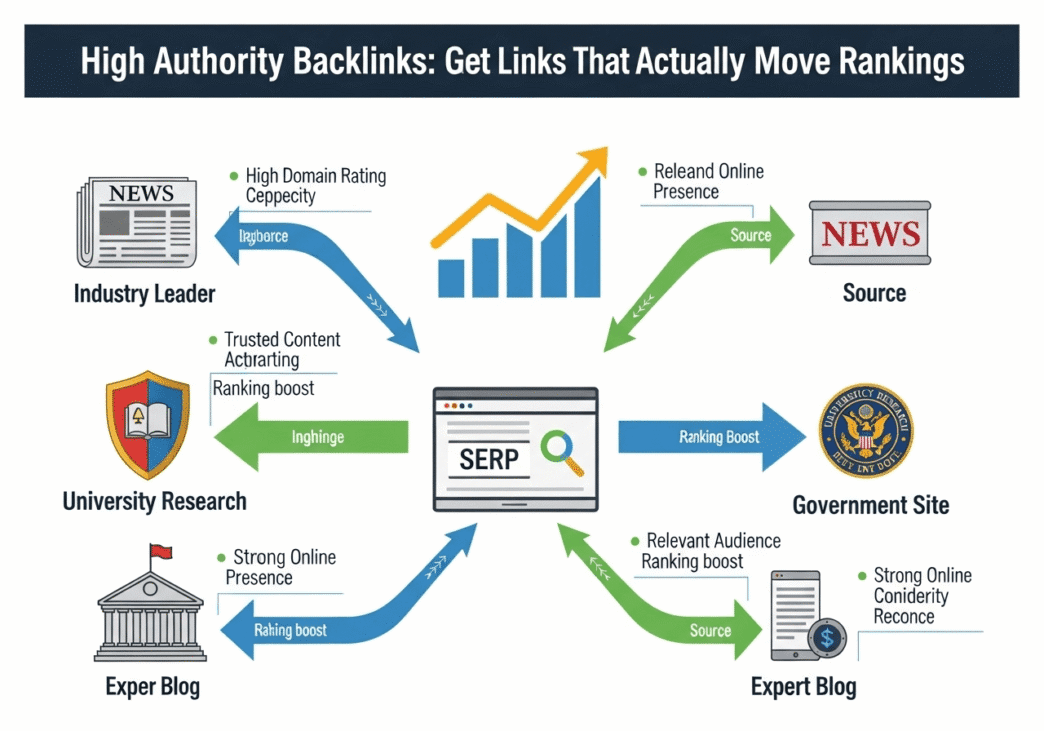
High Authority Link Types: What the Data Shows About Each
| Link Type | Authority Range | Ranking Impact | Acquisition Difficulty | Spam Risk |
|---|---|---|---|---|
| Major national media (BBC, Guardian, Forbes) | DR 80–95 | Very High | Very High | None if earned editorially |
| Industry trade publications | DR 50–75 | High | Medium–High | None |
| Academic and research institutions (.edu) | DR 60–85 | High | High | None |
| Government and public sector (.gov) | DR 65–90 | Very High | Very High | None |
| Selective industry blogs (DR 45–65) | DR 45–65 | Medium–High | Medium | None |
| Paid placements (any DR) | Variable | Variable | Low | High — manual action risk |
| PBN links (any DR) | Variable | Negligible–Negative | Low | Very High |
FAQ
### What DR score qualifies as a “high authority” backlink?
DR 50+ is the practical threshold at which backlinks from topically relevant domains produce consistent, measurable ranking movement for competitive keywords. Below DR 50, links still contribute to ranking signals, but the individual impact is smaller and often requires volume to accumulate. Above DR 70, a single link from a topically matched domain can shift a page from position 8–15 into the top 5 for moderately competitive terms, based on ranking correlation data from Ahrefs via Backlinko (2024). DR 50–70 from a relevant niche publication is more valuable than DR 80 from an unrelated domain.
### How long does it take for a high authority backlink to move rankings?
The average time from link placement to measurable ranking impact is 3.1 months, according to Authority Hacker’s 2024 survey of 518 link builders. High-authority links from DR 65+ domains sometimes take longer — 4–5 months — because Google crawls major editorial publications on variable schedules, and authority recalculation for competitive keywords takes time to propagate. Evaluate any link acquisition campaign on a 90-day minimum window. Ranking assessments at 30 or 45 days systematically underestimate campaign effectiveness.
### Is it possible to earn high authority backlinks without original research?
Yes, but the methods require either relationships or significant content investment. HARO and journalist query services produce high-authority citations for practitioners with genuine expertise who respond quickly to relevant queries — no original research required. Strategic guest posting on selective publications with DR 50+ also produces high-authority links, but acceptance rates are lower and the content requirements are strict. Original research is the most scalable method because it creates a primary citable source that multiple publications will link to from a single asset.
### Why do some DR 70+ links produce no ranking movement?
Three factors most commonly explain this outcome. First, the linking page may be an orphan — a page on a strong domain that itself has no inbound links and is not internally linked from the host site’s main navigation. Orphan pages on strong domains pass minimal authority regardless of DR. Second, the link may carry a nofollow attribute, transferring no PageRank directly. Third, the linking page may have no topical relevance to your target page — authority transfers, but the topical relevance signal that tells Google what the authority is for is absent. Check URL Rating (UR) of the linking page, confirm the link attribute, and verify topical alignment before concluding a link underperformed.
### What is the most cost-effective method for acquiring high authority backlinks?
HARO and journalist query services produce the highest authority links relative to time investment for most sites — DR 60–90+ placements from editorial sources, requiring only monitoring time and strong response drafting. Digital PR via original research produces the highest volume of high-authority placements from a single campaign but requires upfront research investment. Guest posting on selective publications requires the least upfront cost but the most time per placement and lower DR ceilings for most practitioners starting from a lower authority base. The cost-effective choice depends on your current DR, existing editorial relationships, and whether you can produce credible original research in your niche.
### How many high authority backlinks do I need to rank for competitive keywords?
There is no universal number — the relevant metric is your gap relative to the pages currently ranking above you. Run a backlink gap analysis for your target keyword: export the referring domains of the top 3 ranking pages, filter for DR 50+ domains only, and count how many high-authority referring domains each has. Your target is to close that high-authority domain gap, not to match or exceed total referring domain counts. A page with 8 DR 60+ links in a relevant niche will typically outperform a competitor with 40 total referring domains averaging DR 22.
Conclusion: Run Your High-Authority Domain Gap Analysis Before 15 April 2026
Open Ahrefs or Semrush. Enter the top 3 pages currently ranking above you for your primary target keyword. Export their referring domains. Filter by DR 50+. Count.
That number — the DR 50+ referring domains your competitors have that you do not — is the specific deficit driving your ranking gap. Every other link acquisition effort produces diminishing returns relative to closing that specific deficit.
Build one piece of original research before 15 April 2026 — a survey, a data study, or a tool — targeted at the publication categories that link to your competitors’ highest-authority referring domains. Pitch it to 15–20 journalists in the 72 hours after publication.
One study. One distribution window. Three to five high-authority placements. Those placements will produce ranking movement by July 2026 — the 3.1-month timeline measured from publication, not from when you decide to act.
[1]. Backlinko — We Analysed 11.8 Million Google Search Results (Ahrefs data). https://backlinko.com/google-ranking-factors
[2]. Authority Hacker — The State of Link Building Survey 2024. https://authorityhacker.com/link-building-statistics/
[3]. Editorial.Link — Link Building Statistics 2026: Insights from 518 SEO Experts. https://editorial.link/link-building-statistics/
[4]. Google Search Central — Link spam policies. https://developers.google.com/search/docs/essentials/spam-policies#link-spam
[5]. Meetanshi — 35+ Link Building Statistics for 2025. https://meetanshi.com/blog/link-building-statistics/
[6]. SEO.ai — Top 31 Link Building Statistics & Facts on Backlinks for SEO. https://seo.ai/blog/link-building-statistics/
[7]. Ahrefs — Backlinks and Referring Domains Data (via Backlinko analysis). https://ahrefs.com/blog/