


Published: 20 August 2025 | Updated: 3 May 2026
The sites that disappear overnight after Google core updates are rarely low-quality in any obvious sense. They have content, they have authors, they have citations. What they lack is the specific signal architecture that Google’s quality evaluation systems require for topics where a wrong answer causes real-world harm.
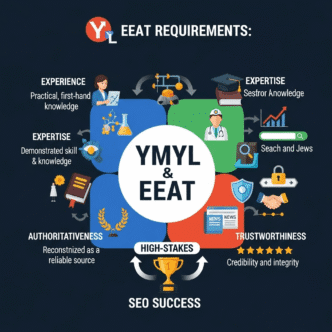
YMYL EEAT requirements are the structured set of content quality, author credential, and editorial process standards that Google applies to “Your Money or Your Life” content — any topic where inaccurate or misleading information could directly damage a reader’s health, financial stability, safety, or legal standing. They are not a higher version of standard E-E-A-T requirements. They are a categorically different evaluation framework where the threshold for Trust — the T in E-E-A-T — is set at a level that most content operations cannot meet without deliberate structural investment.
Google’s Search Quality Rater Guidelines dedicate more space to YMYL evaluation than to any other content category. Quality raters are instructed to apply “the highest level of scrutiny” to YMYL pages — meaning a page that would earn a High rating in a general niche earns only a Medium or Low rating on a YMYL topic if its author credentials, sourcing standards, or editorial processes fall short of the framework’s requirements.
S I Moz has audited YMYL signal profiles across health, finance, and legal content sites since 2023, tracking how specific credential display, sourcing structures, and editorial transparency implementations affect quality rater evaluation outcomes and algorithmic treatment during core updates. The consistent finding: YMYL ranking stability correlates more strongly with editorial process transparency than with any individual content quality signal.
What most YMYL guides miss is the distinction between compliance — meeting minimum threshold requirements — and structural authority — building the signal architecture that sustains rankings through algorithm updates targeting YMYL quality signals specifically.
Post Summary
- YMYL = “Your Money or Your Life” — content where inaccurate information could damage health, financial stability, safety, or legal standing
- Google applies its highest E-E-A-T scrutiny threshold to YMYL content — a page that earns High quality in a general niche may earn Medium or Low on a YMYL topic with identical content quality but weaker credentials
- Confirmed YMYL signal requirements: verifiable professional credentials, primary source citations, documented editorial review processes, appropriate disclaimers, named reviewers with verifiable expertise
- The Trust dimension of E-E-A-T carries the most weight in YMYL evaluation — more than Experience or Expertise alone
- YMYL ranking instability during core updates correlates most strongly with editorial process transparency gaps — not content quality gaps
- Sites that survive YMYL-targeted updates have one consistent structural feature: every claim is attributable to a named, verifiable source or a named, credentialed author with documented first-hand experience
Table of Contents
ToggleWhat YMYL EEAT Requirements Actually Evaluate
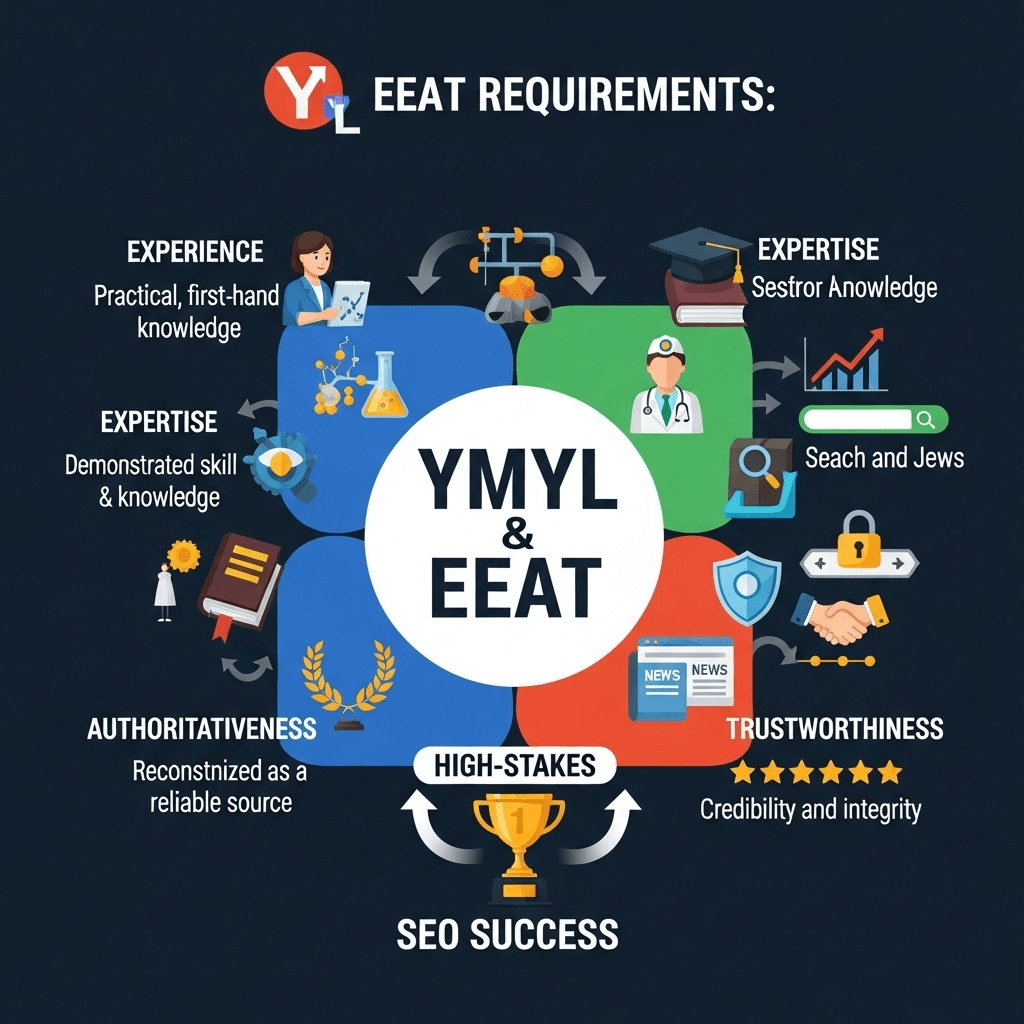
Google’s quality evaluation framework for YMYL content assesses four distinct dimensions — each applied at a higher threshold than for standard informational content. Understanding what each dimension specifically requires in a YMYL context prevents the most common compliance failure: meeting general E-E-A-T standards while falling short of YMYL-specific thresholds.
The framework is not a checklist. It is a structured assessment where weakness in any single dimension can suppress a page regardless of strength in the others. A health article written by a board-certified physician but sourced entirely from secondary reporting rather than primary medical literature fails the Trustworthiness threshold despite strong Expertise signals.
How Google’s QRG Frames YMYL Evaluation
Google’s Search Quality Rater Guidelines identify specific categories that trigger YMYL evaluation: medical and health information, financial advice and services, legal guidance, safety information, and major life decisions including education, housing, and parenting (Source: Google, “Search Quality Evaluator Guidelines,” 2024).
For each category, raters are instructed to assess whether the page meets the “highest standards” for E-E-A-T — a standard explicitly defined as higher than what applies to general content. A rater finding that a medical article’s author has no verifiable medical credentials will assign a Low quality rating regardless of how accurate the content is, because the Expertise signal is insufficient for the YMYL category.
The practical implication: YMYL evaluation is author-first and source-first. Content quality is assessed after credential and sourcing standards are confirmed — not instead of them.
The Four YMYL Dimensions and Their Specific Thresholds
| E-E-A-T Dimension | Standard Content Threshold | YMYL Threshold | Primary Signal |
|---|---|---|---|
| Experience | First-hand engagement with topic | Documented real-world application with verifiable outcomes | Named case outcomes, first-hand clinical or financial practice |
| Expertise | Demonstrated topical knowledge | Verifiable professional credentials in the specific domain | Board certification, professional licence, peer-reviewed publication |
| Authoritativeness | Recognition within topic area | Recognition by established institutions in the field | Medical journal citations, regulatory body mentions, institutional affiliations |
| Trustworthiness | Accurate, honest content | Verified sourcing, transparent editorial process, appropriate disclaimers | Named reviewers, primary source citations, documented update protocols |
Trustworthiness is the dimension where most YMYL sites fall short — not because their content is dishonest but because their editorial processes are not transparently documented. Google’s raters cannot award high Trustworthiness ratings to pages where the review process is invisible, even if the content is factually accurate.
YMYL Categories and Their Credential Requirements
YMYL evaluation applies different credential standards to different content categories. A credential that satisfies the Expertise threshold for financial content does not satisfy it for medical content, and vice versa. Understanding the category-specific requirements prevents credential mismatches that trigger quality penalties.
Pro Tip: Before assigning an author to any YMYL content, map their specific credentials to the specific sub-category of YMYL content the post covers. A Certified Financial Planner has sufficient credentials for retirement planning content but not for tax advice, which requires a CPA or tax attorney. Credential-category mismatches are one of the most common YMYL compliance failures — and one of the most visible to quality raters.
| YMYL Category | Minimum Credential Standard | Primary Source Requirement | Reviewer Standard |
|---|---|---|---|
| Medical diagnosis and treatment | Board-certified physician in relevant specialty | Peer-reviewed medical journals (PubMed indexed) | Second board-certified physician |
| Nutrition and supplements | Registered Dietitian or MD | Peer-reviewed nutrition research | RD or MD reviewer |
| Mental health | Licensed therapist, psychologist, or psychiatrist | APA or equivalent peer-reviewed sources | Licensed mental health professional |
| Investment advice | CFA or CFP with active licence | SEC filings, FINRA data, peer-reviewed finance research | Compliance officer or second CFA/CFP |
| Tax guidance | CPA or tax attorney | IRS publications, current tax code | CPA or tax attorney reviewer |
| Legal information | Licensed attorney in relevant jurisdiction | Current statute and case law | Second attorney reviewer |
| Safety information | Certified safety professional in relevant domain | Government agency publications | Safety organisation reviewer |
The Reviewer Requirement
The reviewer requirement is the most commonly absent YMYL signal. Google’s QRG instructs raters to look for evidence of editorial oversight — a named, credentialed person who has reviewed the content independently of its author. A page with a strong primary author but no named reviewer has a visible Trustworthiness gap that raters are specifically trained to identify.
The reviewer must be named — not referenced generically as “our medical review team” — and their credentials must be verifiable. A named reviewer with a verifiable professional licence and a link to their professional profile satisfies the requirement. An unnamed review process description does not.
The Editorial Process Signal: What Transparency Actually Requires
Editorial process transparency is the structural YMYL signal most strongly correlated with ranking stability during core updates targeting YMYL quality. It is also the signal most frequently implemented incorrectly — with sites describing their process in general terms rather than documenting it specifically enough to satisfy quality rater scrutiny.
Pro Tip: The editorial process page is not a marketing asset — it is a quality signal document. Write it for a quality rater who is specifically looking for evidence that your content meets YMYL standards. Include the specific credentials of your reviewers, the specific criteria they apply, the specific update schedule for different content categories, and the specific process for corrections. Vague descriptions of “rigorous review” produce no quality signal. Specific documented processes do.
What a YMYL-Compliant Editorial Process Documents
A YMYL-compliant editorial process page must document: the specific credentials required for primary authors in each content category, the specific credentials required for reviewers, the review criteria applied to each content type, the update schedule by content category, and the correction process including how errors are reported and how corrections are disclosed.
Each element must be specific enough that a quality rater can verify it independently. Our medical content is reviewed by qualified healthcare professionals” is not verifiable. Our medical content is reviewed by board-certified physicians whose credentials are listed on each article page” is verifiable.
Sourcing Standards That Satisfy YMYL Requirements
| Source Type | YMYL Acceptability | Use Case |
|---|---|---|
| Peer-reviewed journal (PubMed indexed) | High — primary source | Medical and health claims |
| Government health agency (CDC, NHS, WHO) | High — primary source | Public health guidance |
| SEC or FINRA publications | High — primary source | Financial regulatory claims |
| Current statute and case law | High — primary source | Legal information |
| Medical school or teaching hospital publications | Medium-High | Clinical guidance |
| Professional association guidelines (AMA, APA) | Medium-High | Professional standards |
| Secondary news reporting of research | Low — unacceptable for YMYL | Do not use for primary claims |
| Blog posts or non-peer-reviewed opinion | Very Low — unacceptable | Do not use for any YMYL claim |
Secondary reporting is the most common sourcing failure in YMYL content. A health article that cites a news article about a study rather than the study itself fails the sourcing standard — even if the news article accurately reported the study. YMYL content must link to primary sources directly.
YMYL Trust Signals: Technical Implementation
Trust signals in YMYL content operate at two levels: content-level signals embedded in the article itself, and site-level signals that establish the domain’s credibility infrastructure. Both are evaluated — a strong content-level signal on a domain with weak site-level infrastructure receives a lower overall quality rating than the same content on a domain with comprehensive trust infrastructure.
Content-Level Trust Signals
Every YMYL article must contain: the primary author’s name with a link to their full credential profile, the reviewer’s name with a link to their credential profile, the publication date and last reviewed date, the specific sources cited as primary references, and appropriate disclaimers specific to the content category.
Disclaimers must be category-specific — not generic. “This content is for informational purposes only” is a generic disclaimer that satisfies no specific YMYL category requirement. “This content is for educational purposes only and does not constitute medical advice. Consult a qualified healthcare provider before making any medical decisions” is a category-specific disclaimer for health content.
Site-Level Trust Infrastructure
| Site-Level Signal | Implementation | Quality Rater Evaluation |
|---|---|---|
| About page with organisation credentials | Named leadership with verifiable credentials | Confirms organisational authority |
| Editorial policy page | Specific documented process for each content type | Confirms Trustworthiness infrastructure |
| Author directory | All authors with full credential profiles | Confirms Expertise signal at domain level |
| Correction policy | Specific process for error reporting and correction disclosure | Confirms commitment to accuracy |
| Contact information | Named contact with professional email | Confirms accessibility and accountability |
| Privacy policy and data handling | GDPR/CCPA compliant, specific to health/financial data | Confirms user protection commitment |
Measuring YMYL Signal Strength
YMYL signal measurement requires monitoring both quality evaluation indicators and algorithmic treatment signals — the two do not always move simultaneously.
Leading Indicators of YMYL Signal Strength
The first indicator is core update stability. Sites with strong YMYL signal architecture typically see minimal ranking movement during core updates that significantly affect YMYL content broadly. Ranking volatility during core updates is the clearest signal of YMYL compliance weakness — it indicates that quality rater assessments are identifying gaps that the algorithm then acts on.
The second indicator is featured snippet retention on YMYL queries. Google awards featured snippets on YMYL topics selectively — pages without strong credential and sourcing signals rarely retain snippets through core updates even when they initially earn them. Consistent featured snippet retention on YMYL queries signals that the page’s quality evaluation is stable.
The third indicator is branded search growth from professional communities. When practitioners in the relevant field — healthcare professionals, financial advisors, attorneys — begin searching for a site by name and citing it to clients, it signals that the content has earned professional community validation. This is one of the strongest YMYL authority signals available and one of the slowest to build.
Frequently Asked Questions
What does YMYL mean in SEO? YMYL stands for “Your Money or Your Life” — a classification Google applies to content topics where inaccurate or misleading information could directly harm a reader’s health, financial stability, safety, or legal standing. Google’s Search Quality Rater Guidelines instruct quality raters to apply the highest E-E-A-T scrutiny standards to YMYL content, meaning the credential, sourcing, and editorial process requirements are significantly more stringent than for standard informational content.
What are the minimum author credentials for YMYL health content? Google’s QRG does not specify minimum credentials in absolute terms but instructs raters to assess whether the author has the professional qualifications required to give the specific advice the content provides. For medical diagnosis and treatment content, board certification in the relevant specialty is the standard quality raters apply. For nutrition content, a Registered Dietitian or MD credential satisfies the Expertise threshold. Content written by non-credentialed authors on medical topics receives Low quality ratings regardless of content accuracy.
Does YMYL apply to all health and finance content? YMYL applies when the content could directly influence decisions affecting health, financial stability, safety, or legal standing. General wellness lifestyle content — exercise tips, stress management, sleep hygiene — occupies a grey area where YMYL standards may or may not apply depending on the specificity of the advice. Content that provides specific recommendations — specific medications, specific investment strategies, specific legal procedures — triggers YMYL evaluation regardless of how it is framed.
How does Google identify YMYL content algorithmically? Google has not publicly documented its algorithmic YMYL classification system. Based on quality rater guidelines and core update patterns, YMYL classification appears to trigger based on topic category, query intent signals, and content specificity. Sites that experience YMYL-targeted ranking movements typically publish content that combines a YMYL topic category with specific actionable recommendations — the combination of category and specificity appears to be the primary classification trigger.
What is the fastest YMYL compliance improvement available? Adding a named, credentialed reviewer to existing YMYL content produces the fastest measurable quality signal improvement for sites where reviewer absence is the primary compliance gap. The reviewer’s name, credentials, and a link to their verifiable professional profile must appear on each article page — not just on an editorial policy page. Sites that have implemented named reviewer attribution consistently report improved quality rater evaluation outcomes within one to two content audit cycles.
Can AI-generated content meet YMYL standards? AI-generated content cannot independently satisfy YMYL Expertise or Experience requirements — these require a named human professional with verifiable credentials. AI-generated content reviewed, edited, and signed off by a credentialed professional can potentially meet YMYL standards if the review process is documented and the professional takes editorial responsibility for the content. However, Google’s quality systems are increasingly sophisticated at identifying content where the named author’s involvement appears nominal rather than substantive.
YMYL Authority as Structural Investment
YMYL compliance is not an optimisation task — it is a structural investment in the content operation’s credibility infrastructure. The sites that sustain YMYL rankings through successive core updates are not those that have optimised individual signals most effectively. They are those that have built editorial architectures where every claim is attributable, every author is verifiable, every reviewer is named, and every process is documented specifically enough that a quality rater can confirm it without ambiguity.
The structural investment required is significant. Credentialed authors cost more than generalist writers. Medical and legal reviewers require ongoing relationships and compensation. Primary source research takes longer than secondary aggregation. Editorial process documentation requires sustained maintenance as content volumes grow.
The return on that investment, however, is ranking stability that generalist content operations cannot achieve — because the barrier to replication is not a technique or a tactic but a credibility infrastructure that takes years to build and cannot be assembled quickly in response to an algorithm update.
Start with the reviewer gap — it is the most common and most visible YMYL compliance failure. Add named, credentialed reviewers to your highest-traffic YMYL content first. Document the review process specifically on an editorial policy page. Update sourcing from secondary reports to primary sources. Build from compliance to structural authority.
For the broader E-E-A-T framework that underpins every YMYL evaluation dimension, the Google’s EEAT Guidelines: The Complete Guide covers how Google evaluates trust and expertise across all content categories and quality thresholds.
References
Google. “Search Quality Evaluator Guidelines.” Google, 2024. https://static.googleusercontent.com/media/guidelines.raterhub.com/en//searchqualityevaluatorguidelines.pdf Supports: YMYL category definitions, E-E-A-T threshold standards, quality rater evaluation criteria throughout.
Google. Creating helpful, reliable, people-first content.” Google Search Central, 2025. https://developers.google.com/search/docs/fundamentals/creating-helpful-content Supports: Helpful Content System evaluation of YMYL content and Trust dimension requirements — Sections 1 and 3.
Google. Understanding E-E-A-T and how to evaluate it.” Google Search Central, 2024. https://developers.google.com/search/docs/fundamentals/creating-helpful-content#eeat Supports: Four E-E-A-T dimension thresholds and YMYL-specific application — Section 2.
Moz. “YMYL SEO: What It Is and How to Optimise for It.” Moz Blog, 2024. https://moz.com/learn/seo/ymyl Supports: YMYL category classification and credential requirement standards — Section 2.
Search Engine Journal. “Google YMYL: What It Is and Why It Matters.” Search Engine Journal, 2024. https://www.searchenginejournal.com/google-ymyl/ Supports: Editorial process transparency as primary YMYL ranking stability signal — Section 3.
Google. “How Google fights disinformation.” Google, 2024. https://www.blog.google/products/search/how-google-fights-disinformation/ Supports: Google’s quality evaluation systems for high-stakes content and sourcing standards — Section 4.