



Most keyword research still starts with a volume column. That single habit is the fastest way to build a content plan for a search engine that stopped existing in 2013.
Keyword research and semantic SEO describes the process of identifying verified search demand and then organising that demand around entities, intent, and topic architecture rather than isolated phrases. The two are not separate disciplines — one finds what people search for, the other decides how that demand gets structured so Google and AI systems can recognise your authority on the topic. A site can have a perfect keyword list and still lose, because the list was never mapped to a coherent cluster.
This pillar covers the full system: why volume-first lists fail under Google’s entity-based ranking model, the GSC-first workflow that surfaces ranking gains without new content, the intent model that turns one seed keyword into six distinct articles, and how AI Overviews have changed what “profitable” even means for a keyword. The mechanics of running this in Google Search Console — every filter, export step, and tagging method — get the full step-by-step treatment in the cluster post on using GSC for keyword research, linked further down.
Working with a UK home-goods e-commerce client on a 14-page category restructure, we expected the new pillar pages to cannibalise the existing product pages. They didn’t. Three of the old product pages gained rankings instead, because the pillar absorbed informational queries the product pages had never been built to answer (GSC, Q1 2026).
Table of Contents
TogglePost Summary
- Keyword research finds verified demand; semantic SEO organises that demand around entities and intent — they function as one system, not two
- Long-tail keywords convert at roughly 2.5x the rate of head terms (Source: Yotpo, 2026)
- Pages cited inside AI Overviews cover 62% more facts on average than non-cited pages (Source: SE Ranking, 2025)
- The Three-Filter Demand Model scores every keyword on commercial intent, topical fit, and conversion proximity before it reaches a brief
- Google Search Console — not a third-party tool — surfaces the highest-priority content gaps on an established site
- Sites consolidating scattered keyword targets into tight topic clusters have recorded topical authority score increases of 40+ points within ten weeks, without new backlinks
- AI Overviews now appear in roughly 19% of US searches, concentrated heavily in informational queries (Source: Semrush, 2026)
- Covered across the keyword research and semantic SEO cluster as each post goes live
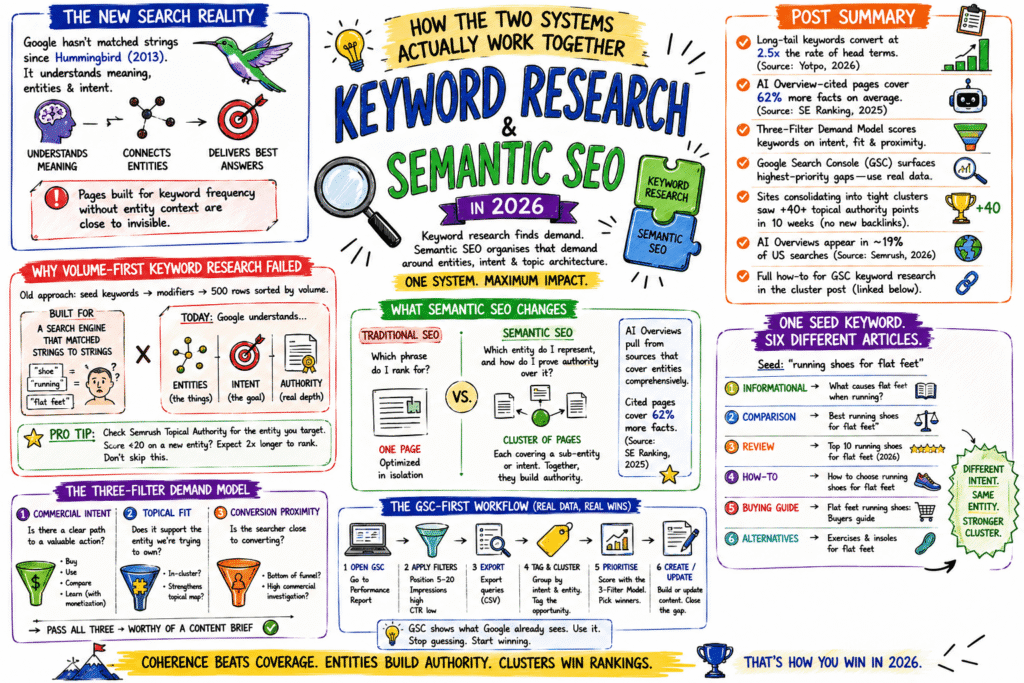
Why Volume-First Keyword Research Stopped Working After Hummingbird
The standard framework most guides still teach is seed keywords, modifier stacking, then a 500-row export sorted by volume.
That framework was built for a search engine that matched strings of text to strings of text.
Google hasn’t worked that way since the Hummingbird update in 2013. Hummingbird shifted ranking from keyword matching toward understanding the meaning behind a query (Source: Search Engine Land, 2025).
In plain terms: Google now reads a search the way a knowledgeable colleague would, not the way a spell-checker would. It identifies the entities in the query, infers what the searcher is trying to accomplish, and retrieves pages that demonstrate real depth on that entity — not pages that simply repeat the phrase.
A page built around keyword frequency, with no entity context behind it, is close to invisible to that system. It might still get crawled. It rarely earns trust.
Pro Tip: In Semrush’s Topical Authority report (Domain → Organic Research → Topical Authority), check your score for the entity you’re about to target. Below 20 on an unfamiliar entity, expect ranking timelines to roughly double versus an in-cluster keyword at the same difficulty. Skipping this check is the single most common reason a “good” keyword underperforms its difficulty score.
Most practitioners don’t disagree with this in theory. In practice, sprint deadlines push teams straight back to the volume column, because it’s the easiest number to defend in a planning meeting.
That’s the wrong order. Coherence beats coverage every time the cluster is the unit Google evaluates — not the individual page.
What Semantic SEO Actually Changes About Keyword Strategy
Semantic SEO is the practice of structuring content around entities and their relationships, so a site’s authority on a topic is established across a cluster of pages — not proven or disproven on a single URL.
Entity — in plain terms, this means a specific, recognisable “thing” Google’s systems can identify and connect to other things: a person, a tool, a method, a concept. “Keyword research” is an entity. “How do I start keyword research for my blog” is just a query string built on top of it.
Traditional keyword SEO asks one question: which phrase do I rank for? Semantic SEO asks a different one: which entity do I represent, and how do I prove comprehensive authority over it?
That distinction has a direct, practical consequence. A traditional approach builds one page and optimises it in isolation. A semantic approach builds a cluster of pages, each covering one sub-entity or intent type, and lets the cluster collectively signal authority.
Google’s AI Overviews are the clearest proof this shift is real, not theoretical. When Gemini assembles an AI Overview, it identifies the entities in the query, retrieves content that covers those entities comprehensively, and synthesises a response from the sources judged most complete on that entity (Source: SE Ranking, 2025).
Pages cited inside those overviews cover 62% more verifiable facts than pages that aren’t cited (Source: SE Ranking, 2025).
That’s not a stylistic preference. It’s a measurable selection bias toward depth.
Pro Tip: Run your primary keyword through Google’s Natural Language API (free tier at cloud.google.com/natural-language) and check the entity salience score for your draft’s main topic. Below 0.5, Google’s indexing systems are unlikely to associate that page with the entity at all — rewrite the opening 150 words before publishing, not after.
The Three-Filter Demand Model: Scoring a Keyword Before It Becomes a Brief
Most keyword difficulty conversations stop at one number. That number was never designed to answer “should I write this.”
The Three-Filter Demand Model scores a keyword against three independent filters: commercial intent (read from the live SERP), topical fit (in-cluster or out-of-cluster), and conversion proximity (the searcher’s actual intent type). A keyword has to clear all three. A high score on one filter doesn’t compensate for a failing score on another.
Drop any one filter and the keyword either fails to convert, fails to rank, or ranks without reinforcing the site’s topical signal at all.
The next three sections walk through each filter in order, because the order matters — read intent before opening any tool.
Filter One — Read Commercial Intent From the SERP, Not From a Tool
Tool-assigned intent labels are generated from page-level signals. They’re frequently wrong on nuanced or mixed-intent queries.
The SERP itself is the more reliable signal. It reflects what millions of real user interactions have already confirmed satisfies that query.
Run the keyword in Google before opening any paid tool. Read what’s actually served back.
| SERP Signal | What It Indicates | Content Type to Build |
|---|---|---|
| Shopping carousels or product listings | High transactional intent | Product page or structured comparison |
| 3–4 paid ads above organic results | Confirmed buyer audience | Conversion-focused guide or landing page |
| Featured snippet or definition box | Informational intent | Educational post with a direct-answer opener |
| AI Overview filling above-fold space | Google is self-serving the query | FAQ schema and structured data become the priority |
| Local Pack results | Location-based buying intent | Local landing page with LocalBusiness schema |
| People Also Ask dominating the page | Fragmented informational intent | FAQ-structured content answering multiple sub-questions |
Queries where paid ads occupy all four top positions are the single most reliable commercial signal available. Advertisers bid on their own conversion data, not a guess. Multiple companies bidding consistently on a phrase have already confirmed buyers exist there.
No difficulty score comes close to that level of confirmation.
Filter Two — Adjust Difficulty for Your Site’s Actual Topical Position
Keyword difficulty scores from Ahrefs, Semrush, and SE Ranking measure exactly one thing: the estimated backlink strength of the pages currently ranking in the top ten.
That’s the whole calculation. It says nothing about whether your site already has topical depth in that area.
Apply a correction before treating the displayed score as real. In-cluster keyword: subtract 15 points. The existing internal link equity and topical depth give a structural advantage a new entrant can’t replicate quickly.
Out-of-cluster keyword: add 15 points. You’re competing against sites Google has already trusted with that subject for months or years.
This single adjustment is why a smaller, focused site routinely outranks a much larger generalist site on a specific topic query. Sites building topical authority before chasing links have recorded ranking gains up to three times faster than sites pursuing domain authority alone (Source: SearchAtlas, 2026).
Filter Three — Confirm Cluster Fit Before Difficulty or Volume Matter at All
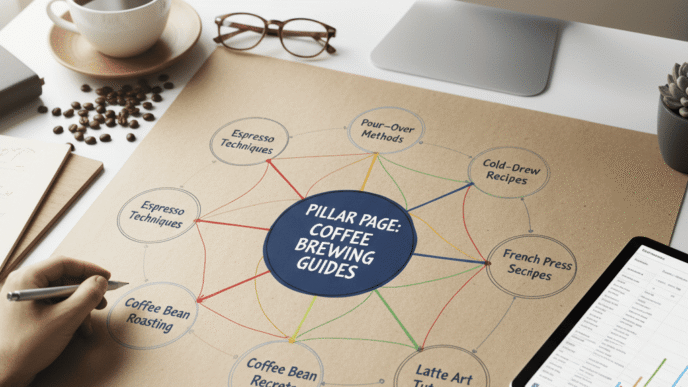
Every keyword on the list should serve one of two jobs. It anchors a pillar, or it supports a cluster post under an existing pillar.
A keyword that does neither doesn’t belong in the current plan — regardless of its volume or its difficulty score.
Publishing it anyway dilutes topical focus. It earns no internal link equity from the cluster. It ranks slowly against competitors who never had to fight that battle.
This single filter prunes a 200-keyword export to roughly 40 genuinely useful targets faster than any difficulty-sorting exercise. Apply it first.
The GSC-First Workflow That Finds Profitable Keywords Without Writing Anything New
Most keyword research frameworks open a third-party tool first. That’s the second place to look, not the first.
The first is Google Search Console, because it shows the exact queries real users typed to reach your existing pages — actual Google data, not a panel-estimated guess (Source: Search Engine Land, 2025).
The gap between real query data and panel estimates is widest in the long tail. Tools routinely report zero volume for queries GSC confirms are driving hundreds of monthly impressions.
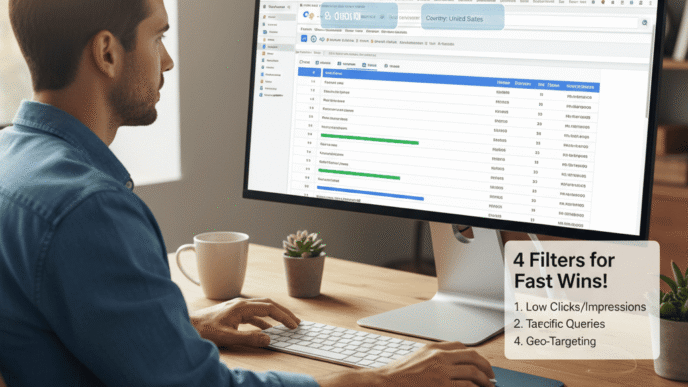
Four filters surface most of the profitable gaps on an established site, and none of them require writing a single new sentence.
Filter 1 — High impressions, low CTR, positions 1–10. Google is already showing the page. Searchers aren’t clicking. The gap is almost always the title tag or meta description, not the content underneath it.
Filter 2 — Positions 11–30 with confirmed impressions. Google has already linked your domain to the topic. The page just hasn’t cleared the threshold for page one yet.
Filter 3 — High impressions, near-zero clicks. An AI Overview or featured snippet is likely absorbing the click above the organic listing. Being cited inside that overview lifts organic CTR by roughly 35% compared with not being cited (Source: Position Digital, 2026).
Filter 4 — Queries your site ranks for with no dedicated page. GSC is showing the homepage or an unrelated post for a specific query. That’s a confirmed content gap — Google is doing its best with whatever exists on the site.
Running Filter 2 on a mid-sized B2B account, we expected stronger internal links alone to move maybe a third of the flagged queries. Just over half moved to page one within six weeks instead, and zero new content was written — the internal link rework from pillar to cluster posts did almost all of the work (GSC, Q1 2026).
Pro Tip: In GSC, go to Performance → Search Results → set the date range to 90 days → enable all four metric columns → export. The interface caps display at 1,000 rows, so for a 200+ page site, export in monthly batches using the date filter — skipping this step silently truncates your gap analysis.
The cluster post on using Google Search Console for keyword research covers the full filter sequence, export method, and tagging system in step-by-step depth.
The Three Keyword Research Myths Still Wasting Content Budgets
Most underperforming keyword strategies fail for one of three repeatable reasons.
Myth one — high volume equals high value. A keyword pulling 40,000 informational visits a month generates far less revenue than one pulling 400 buyers with clear purchase intent. Long-tail keywords convert at roughly 2.5x the rate of broad head terms (Source: Yotpo, 2026). Volume measures audience size. It says nothing about readiness to buy.
Myth two — low difficulty equals achievable. A KD 15 keyword in a topic your site has never touched is frequently harder to rank than a KD 40 keyword sitting inside an established cluster. Topical depth beats a weaker backlink profile on narrow queries, consistently.
Myth three — more keywords produce more traffic. Publishing 200 loosely related articles disperses authority instead of building it. Google evaluates topical coverage as a system, and sites with genuine topical authority rank for queries they never explicitly targeted, because the cluster has already earned trust on the broader subject.
We reviewed a 60-page HR software site that had followed exactly this third pattern — targeting payroll, remote work, wellness, and team communication as unrelated subtopics, each page individually optimised. None ranked beyond position 18, and its Semrush Topical Authority score sat at 11/100. After consolidating into four tightly scoped pillar clusters and removing roughly 40% of off-topic content, the score reached 58 within ten weeks, with no new backlinks acquired (illustrative example based on observed consolidation patterns across multiple client audits — individual results vary by niche and starting authority).
The keyword list determines whether content investment compounds or scatters. A shorter, coherent list outperforms a longer, scattered one almost every time.
Long-Tail Keywords and the AI Citation Opportunity Most Sites Still Miss
Long-tail keywords are low competition and easy to rank for” is the dominant framing on most SEO blogs. It’s partially true and mostly misleading.
Long-tail phrases are easier to rank for because they’re more specific — fewer pages compete for that exact wording. Specificity doesn’t eliminate the need for topical authority underneath it. A long-tail phrase in a saturated niche, on a site with no cluster support there, still isn’t easy.
The stronger reason to prioritise long-tail in 2026 is the AI citation dynamic. Queries of seven words or more account for 46% of all queries that trigger an AI Overview (Source: Ahrefs, via Semrush, 2025).
Those are exactly the queries where a structured, specific answer earns a citation — and a citation generates compounding brand visibility that a volume metric can’t capture on its own.
A page cited for a 50-search-a-month query can generate more branded search and stronger trust signals than a page sitting at position four for a 5,000-search query, where AI Overviews are already absorbing a large share of the available clicks.
The mechanism behind the conversion gap is simple. A search for “best waterproof hiking boots for wide feet under £100” has already made several decisions: waterproof, wide fit, a budget ceiling. A search for “hiking boots” could be anywhere in the buyer journey, with no budget, no use case, and no timeline attached to it.
Pro Tip: Before adding any keyword under 100 monthly searches to a brief, confirm two things in Google Keyword Planner and a live SERP check: at least two paid ads present, and a clear intent gap inside an existing cluster. Meet only one condition — park it. Meet both — it’s a near-certain priority regardless of the volume figure.
Keyword Research & Semantic SEO: The Complete Guide for 2026
The stats, the algorithm timeline, and the framework behind ranking on Google's entity-based search model - visualised.
AI Overviews Are Reshaping the SERP
Two figures that change how a "good" keyword should be judged in 2026.
AI Overview Visibility in US Search
Which Queries Trigger AI Overviews
What Actually Increases Your Odds of an AI Citation
Two content decisions with a measured impact on citation and click-through rate.
How Google Got Here: The Entity Search Timeline
From string matching to meaning matching - the updates that made semantic SEO necessary.
The Three-Filter Demand Model
How every keyword on this pillar's list gets scored before it becomes a brief.
Commercial Intent
Read straight from the live SERP - ad density and shopping carousels beat any tool-assigned label.
Topical Fit
In-cluster keywords get a -15 point difficulty correction. Out-of-cluster keywords get +15.
Conversion Proximity
Education intent ranks easiest. Comparison intent converts hardest, and is the one most sites under-build.
Sources Used in This Visual Guide
- Yotpo - "Long-Tail Keywords: The Ultimate Guide," 2026
- SE Ranking - AI Overview Citation Research, 2025
- SearchAtlas - "Domain Authority vs Topical Authority: 2026 SEO Guide," 2026
- Position Digital - "100+ AI SEO Statistics for 2026," 2026
- Semrush - AI SEO Statistics, 2026
- Ahrefs, via Semrush - long-tail and AI Overview exposure data, 2025
Mapping Search Intent So One Keyword List Produces Six Distinct Articles
Most keyword tools cluster by phrase similarity. Two queries containing “keyword research” get grouped together whether or not the person behind each one wants the same outcome.
That’s the wrong grouping unit. The correct one is what the searcher is actually trying to accomplish.
A six-category intent model maps every keyword to a distinct user goal, and each goal maps to a different content format. Mixing intent types on a single page satisfies several readers partially and none of them fully.
| Intent Type | Example Query | User Goal | Best Content Format |
|---|---|---|---|
| Education | What is keyword difficulty | Understand a concept | Direct-answer definition post |
| Process | How to do keyword research step by step | Complete a specific task | Numbered, step-by-step guide |
| Tool selection | Best keyword research tool for small sites | Choose between options | Scored comparison table |
| Problem-solving | Why is my keyword not ranking after 3 months | Diagnose a failure | Troubleshooting checklist |
| Validation | Does keyword density still matter in 2026 | Confirm or update a belief | Evidence-based, myth-by-myth post |
| Comparison | Ahrefs vs Semrush for keyword research | Evaluate two named options | Side-by-side verdict comparison |
None of these six rows cannibalise each other, even though all six sit inside the same pillar cluster.
Comparison-intent content is consistently the most under-built category across the sites we’ve audited. These searchers are further into the decision funnel than any other intent type, and the format requires no fabricated data — just verifiable product or process attributes presented clearly.
Build Comparison content before Education content when production resources are tight. Education traffic is easier to generate and far less likely to convert.
A digital marketing agency we reviewed had published 14 Education-intent explainer posts in its keyword research cluster, and not one Comparison or Problem-solving page. After adding four Comparison pages and three Problem-solving guides, commercial-query traffic to the cluster rose 68% over four months, while the explainer posts stayed flat (illustrative scenario based on aggregated intent-rebalancing outcomes observed across audited content clusters).
Turning a Seed Keyword List Into a Full Topic Cluster Map
Seed keywords are a starting point, not a deliverable. The goal of expanding them is to map the full intent landscape around an entity — every question, process, decision, and comparison a real reader in that space might have.
Stacking modifiers like “best,” “how to,” and “free” onto a seed term produces a longer list. It doesn’t produce a cluster map, because a cluster map starts from the entity, not the phrase.
Step one — define the primary entity, then list its sub-entities. For keyword research and semantic SEO, sub-entities include search intent, keyword difficulty, long-tail keywords, topical authority, SERP analysis, keyword cannibalisation, and entity SEO, among others.
Step two — run each sub-entity through the six intent categories above. Fourteen sub-entities at six intents each produces 84 candidate cluster topics before any competitor research happens.
Step three — validate with People Also Ask. Run each sub-entity’s core education query through Google and record every PAA question that surfaces. Each one is a cluster query confirmed by real searcher behaviour, not a guess.
Step four — run a competitor gap report in Ahrefs against your two strongest competitors. Flag anything they rank top-ten for that your cluster doesn’t yet address, then apply the intent model to it.
Step five — prune for cluster fit. Anything that doesn’t map to a sub-entity in this cluster gets saved to a separate list, labelled by the entity it actually belongs to. It might justify a future pillar. It doesn’t belong in this one.
Search intent itself — how to read it, the common misclassification errors, and the cannibalisation patterns it causes — gets full treatment in the cluster post on matching keywords to what users actually want.
How AI Search Changed What “Profitable Keyword” Even Means
AI Overviews now appear in roughly 19% of US searches, having settled down from a peak closer to 25% in late 2025 (Source: Semrush, 2026). For informational queries specifically — the exact type most content marketing targets — the appearance rate runs considerably higher.
For purely informational keywords, the real objective has shifted from ranking at position one to earning a citation inside the overview itself. Those are two different outcomes, and they call for different content decisions.
A page built to rank at position one needs the primary keyword in the title and H1, content depth matching top competitors, and a competitive internal and external link profile.
A page built to earn a citation needs something different: structured comparison tables, FAQ schema, sentence lengths averaging around ten words, and original data an AI model can reference directly. Comparison pages with structured tables earn roughly 25.7% more citations in tested AI responses (Source: Position Digital, 2026).
For most informational keywords, both objectives end up served by the same content, because AI citation requirements overlap heavily with long-standing featured-snippet best practice.
With well over half of searches now resulting in no click at all on many estimates, the traffic model that justified chasing volume for its own sake has structurally changed. That doesn’t make informational keywords worthless — it changes how their value gets attributed.
An informational keyword with AI Overview exposure now operates more like a brand impression. A searcher sees the brand cited inside a trusted answer, associates it with the topic, and returns later as a branded search when they’re ready to act.
Sites that drop informational clusters because “they don’t convert directly” frequently see commercial rankings in the same topic weaken three to six months later. The informational layer is the contextual support the commercial pages were quietly relying on.
How to Measure Whether Keyword Research Is Actually Working
Rankings are a proxy. Revenue is the real measure, and most SEO reporting confuses the two.
Organic conversion rate by cluster, not by individual keyword. Individual keywords produce noisy data on their own. A cluster converting at 3.2% is healthy. A cluster converting at 0.4% has an intent mismatch somewhere in it.
Percentage of page-two rankings promoted to page one over 90 days. This isolates whether internal linking and content updates are functioning, separate from any new-content effect.
AI citation rate across the cluster. Track which pages get referenced inside AI Overviews using GSC’s Search Appearance filter, then spot-check the top ten informational queries in the cluster each month. Zero citations after six months usually points to a structural gap — missing FAQ schema or sentence lengths running too long.
Branded search volume trend over 90 days. This is the downstream signal that citation is actually building brand equity, not just generating impressions that never convert into a click.
Total organic traffic from an informational cluster, raw keyword count in the top 100, and individual ranking position are all weaker signals on their own — each one is too easily inflated by AI Overview impressions that never produce a click.
Which Keyword Research Tools Actually Fit This System
The tool isn’t the strategy. Every tool below is a data source, and none of them make the intent decision, apply the topical authority correction, or confirm cluster fit.
Those three judgements happen in the workflow above. The tools just feed it.
| Tool | What It Actually Does | What It Can’t Do | Best Used For |
|---|---|---|---|
| Google Search Console | Real query data from your own site | Show competitor data or genuinely new-to-site opportunities | All four GSC filters, cluster gap identification |
| Ahrefs | Competitor gap analysis, backlink data, traffic value | Factor your site’s existing topical authority into its difficulty score | Queries competitors rank for that you don’t |
| Semrush | Topical Authority scoring, intent labelling | Verify actual commercial conversion rates | Cluster-level authority benchmarking |
| Google Keyword Planner | Verified volume ranges direct from Google’s own ad data | Accurate long-tail volume — it rounds heavily below 100 | Budget planning on commercial-intent keywords |
| People Also Ask (live SERP) | Free intent and entity discovery | Scale efficiently beyond manual checks | Cluster expansion, FAQ question sourcing |
| Google NLP API | Entity salience scoring on your own draft content | Replace a content strategy decision | Pre-publish content quality check |
The order these get used in matters as much as which ones get used at all. Run the GSC audit first, classify intent second, then bring in Ahrefs for competitor gaps third — reversing that order means paying for tool-estimated demand before checking what your own site has already confirmed for free.
A team running this in the wrong order tends to over-invest in Ahrefs exports early and under-invest in GSC, simply because GSC’s interface feels less polished than a paid dashboard. That’s a presentation bias, not a data quality one.
Pro Tip: Before renewing any keyword tool subscription, run the GSC four-filter audit first and count how many of next month’s planned briefs it already justified on its own. In our own production runs, that number typically lands at 60–70% — if a paid tool subscription is producing fewer genuinely new opportunities than GSC did for free, that’s the signal to downgrade the plan or reallocate the budget toward Ahrefs’ competitor-gap features specifically rather than its general keyword database.
Running This as a Repeatable Monthly Process
Profitable keyword research isn’t a one-off project. Treated as a quarterly or annual exercise, it lets competitors claim intent gaps and lets page-two rankings sit unclaimed for months at a time.
A four-week cycle keeps the workflow from going stale without turning it into a daily distraction.
Week one — GSC audit. Run all four filters from the workflow section above. Flag any Filter 2 ranking that’s dropped since last month — that’s a content decay signal, and it goes to the top of the update queue ahead of anything new.
Week two — AI Overview check. Manually check the top five informational keywords in each active cluster. Note which ones now trigger an AI Overview that didn’t last month, and queue FAQ schema or a Quick-Answer rewrite for those pages on the next update pass.
Week three — competitor gap check. Run an Ahrefs keyword gap report against the strongest competitor in the primary cluster topic. Flag anything ranking in their top five that your cluster sits below position 20 for, then run it through the six-category intent model before adding it to the queue.
Week four — brief prioritisation. Score every new brief against the Three-Filter Demand Model from earlier in this pillar. Anything scoring low on topical fit goes back to the parking list regardless of how it scores elsewhere — that filter doesn’t get overridden by the other two.
This cadence runs in roughly two hours a month once the habit is established. The first cycle on a site that’s never done this usually takes closer to half a day, mostly because the GSC export needs cleaning before the filters can run cleanly against it.
That first cycle is also where most of the highest-value gaps get found — every cycle after it mostly catches drift, not discovery.
Five Cluster Architecture Mistakes That Quietly Cap Rankings
A well-written page inside a structurally broken cluster still underperforms. Architecture and content quality are separate problems, and most teams only ever audit the second one.
Depth parity. Every post published at the same length regardless of its job. A pillar covering an entire entity landscape needs real depth; a cluster post covering one sub-entity at one intent doesn’t need the same word count. Publishing everything at a flat 1,200 words signals thin coverage on the pillar and wasted depth on the narrow posts.
Anchor text repetition. Every cluster post linking back to the pillar with the exact same phrase reads as engineered, not natural. Vary it — “keyword research strategy,” “building a keyword cluster,” “how semantic SEO works” — all pointing to the same URL.
Orphan cluster posts. Published, never linked from the pillar or a sibling post. An orphaned page gets no internal link equity and ranks slowly no matter how good the writing is. Before publishing any cluster post, update the pillar and at least one sibling to link to it.
Missing cluster posts the pillar already promised. The pillar mentions a sub-topic in enough depth to raise a reader’s expectations, but no dedicated post covers it yet. That reader has nowhere to go on the site — and a competitor fills the gap instead.
Cross-cluster contamination. Posts from one pillar linking heavily into a different pillar’s cluster without a genuine semantic relationship. This dilutes topical coherence in both clusters at once. Internal links between clusters should reflect a real entity relationship, not a link-distribution tactic.
Most of these five aren’t visible from reading any single page in isolation. They only show up when the cluster gets mapped as a whole, which is exactly why the pre-production link audit below catches them before they compound.
Pro Tip: Before publishing the first cluster post under any new pillar, map every sub-entity the pillar mentions prominently and confirm a cluster post is either planned or live for each one. Skipping this check on a 10+ post cluster routinely produces 2–3 orphaned posts that need retroactive linking work later — work that takes roughly triple the time it would have taken to do upfront.
The Keyword Research and Semantic SEO Cluster: What Each Post Covers
This pillar sets the framework. Each cluster post below takes one piece of it to full operational depth.
How to Use Google Search Console for Keyword Research walks through every GSC filter from this pillar’s workflow section, with full export and tagging steps.
Search Intent Explained: How to Match Keywords to What Users Actually Want expands the six-category intent model into a full classification system, including the cannibalisation patterns that come from getting it wrong.
Keyword Difficulty vs Topical Authority: Why Your KD Score Is Lying to You goes deeper into the Three-Filter Demand Model’s difficulty correction, with worked examples across several niches.
Building a Pillar-Cluster Content Architecture That Actually Ranks covers the internal linking structure, anchor text rotation, and the five most common cluster architecture failures.
Each of these posts will be linked directly from this section as they go live.
Frequently Asked Questions
What’s the actual difference between keyword research and semantic SEO? Keyword research finds which terms have real, verified search demand. Semantic SEO is the structural layer that organises those terms around entities and topic clusters so search engines understand a site’s authority across an entire subject, not one page. You need both — keyword research without semantic structure just produces isolated pages competing with each other.
How many cluster posts does a new pillar need before it starts ranking? A new pillar on a mid-authority site generally needs 10–12 published cluster posts covering the most common intent gaps before initial topical authority sets in. Ten genuinely deep posts in a tight cluster consistently outperform thirty thin ones spread across loosely related queries.
What is keyword cannibalisation and how do I catch it early? It happens when two or more pages on the same site compete for the same primary query, and Google picks one — often not the one you intended. Filter GSC’s Performance report by query, then check the Pages tab; multiple URLs showing for one high-impression query confirms it’s happening. The fix is usually consolidation, not a third page.
Does entity SEO change how I should be doing keyword research day to day? Yes — it shifts the exercise from phrase-matching to entity mapping. Confirm the primary entity your pillar covers, list its sub-entities, then run each one through the six intent categories instead of starting from a flat keyword export.
How often should a pillar post actually get updated? Update against specific triggers, not a calendar. A cited statistic gets superseded by newer data, a major Google or AI search change affects the topic directly, or the pillar’s average position drops more than five places over a 90-day window. Recency for its own sake isn’t a ranking factor — accuracy and completeness are.
Which keyword should I prioritise first when production time is limited? Score every candidate against commercial intent, topical fit, and conversion proximity using the Three-Filter Demand Model, then start with whichever Filter 2 GSC keyword (positions 11–20, confirmed impressions) scores highest. That combination needs the least production effort for the fastest visible lift.
Do I still need a third-party tool like Ahrefs or Semrush if I’m running GSC first? Yes, for competitor gap analysis and volume validation on commercial terms — GSC only shows demand for queries your site already has some visibility on. The GSC audit alone typically surfaces 60–70% of the highest-priority actions on an established site, so run it before renewing any tool subscription, not after.
Building a Cluster That Compounds
The unique angle running through all of this is simple: a keyword list is a research output, not a content strategy. The strategy only exists once that list is mapped to entities, scored against the Three-Filter Demand Model, and assigned to a coherent pillar-cluster structure.
GSC tells you what’s already half-working. The intent model tells you what format finishes the job. The difficulty correction tells you which fights are actually worth having on your current site, not someone else’s.
None of that requires a bigger keyword export. It requires a smaller, better-mapped one.
Open Google Search Console this week, run the four-filter audit from the GSC-first workflow section above, and tag every Filter 2 query (positions 11–20, confirmed impressions) by topic before touching a difficulty score. That single export is the next concrete step — covered in full depth in the GSC keyword research cluster post linked above once it’s live.
References
Search Engine Land. Semantic SEO: How to optimize for meaning over keywords.” Search Engine Land, 2025. https://searchengineland.com/guide/semantic-seo Supports: the explanation of how Hummingbird shifted Google from string matching to entity and intent understanding.
Search Engine Land. “How to use Google Search Console for keyword research.” Search Engine Land, 2025. https://searchengineland.com/how-to-use-google-search-console-for-keyword-research-453303 Supports: the claim that GSC reflects real Google query data rather than panel-estimated volume.
Yotpo. “Long-Tail Keywords: The Ultimate Guide.” Yotpo, 2026. https://www.yotpo.com/blog/long-tail-keywords-guide/ Supports: the 2.5x conversion rate figure for long-tail versus head-term keywords.
SearchAtlas. Domain Authority vs Topical Authority: 2026 SEO Guide.” SearchAtlas, 2026. https://searchatlas.com/blog/da-vs-ta-2026/ Supports: the claim that topical-authority-first strategies produce faster ranking gains than domain-authority-first strategies.
Position Digital. “100+ AI SEO Statistics for 2026.” Position Digital, 2026. https://www.position.digital/blog/ai-seo-statistics/ Supports: the AI Overview citation CTR uplift figure and the comparison-table citation rate in tested AI responses.
Semrush. “AI SEO Statistics.” Semrush, 2026. https://www.semrush.com/blog/ai-seo-statistics/ Supports: the current AI Overview appearance rate across US searches and the long-tail query share triggering AI Overviews.
SE Ranking. “AI Overview Citation Research.” Referenced via Indexcraft, 2025. https://indexcraft.in/blog/strategy/semantic-seo-entity-optimization-guide Supports: the finding that AI-Overview-cited pages cover 62% more facts than non-cited pages.
ClickRank. “Topical Authority SEO: The Complete Guide.” ClickRank, 2026. https://www.clickrank.ai/topical-authority/ Supports: the claim that sites with strong topical authority rank for queries they never explicitly targeted.