

Last updated: April 2026 | Sources reviewed: 8
Informational queries account for 52.65% of all Google searches. (Source: Amra and Elma, 2025) Transactional queries — the ones that produce direct revenue — account for less than 1%. Most keyword research tools surface transactional and commercial keywords disproportionately because those terms carry higher CPC data, which is what their underlying databases were built to serve advertisers.
The result: keyword research systematically overweights revenue-intent queries and underweights the informational queries that build the topical authority those revenue queries eventually depend on.
This article covers what search intent analysis adds to keyword research, where keyword research still does work intent analysis cannot, and how to combine both into a process that produces rankings and conversions — not one at the expense of the other.
Quick Answer
Search intent is the specific goal behind a query. Keyword research identifies which queries have measurable demand. Neither replaces the other. Keyword research without intent analysis produces pages that rank for terms but fail to satisfy the user — producing high impressions, low CTR, and high bounce rate. Intent analysis without keyword research produces content that addresses genuine user needs but targets queries no one searches. The combined workflow: use keyword research to find demand, use SERP analysis to identify which intent that demand represents, and use that intent to determine the content format and structure before writing a single word.
Table of Contents
ToggleHow Does Search Intent Differ Structurally from Keyword Research?
Keyword research is a demand measurement exercise. (Source: Mangools, 2025) It answers: how many people search for this phrase, how competitive is it to rank for it, and what adjacent phrases carry similar demand?
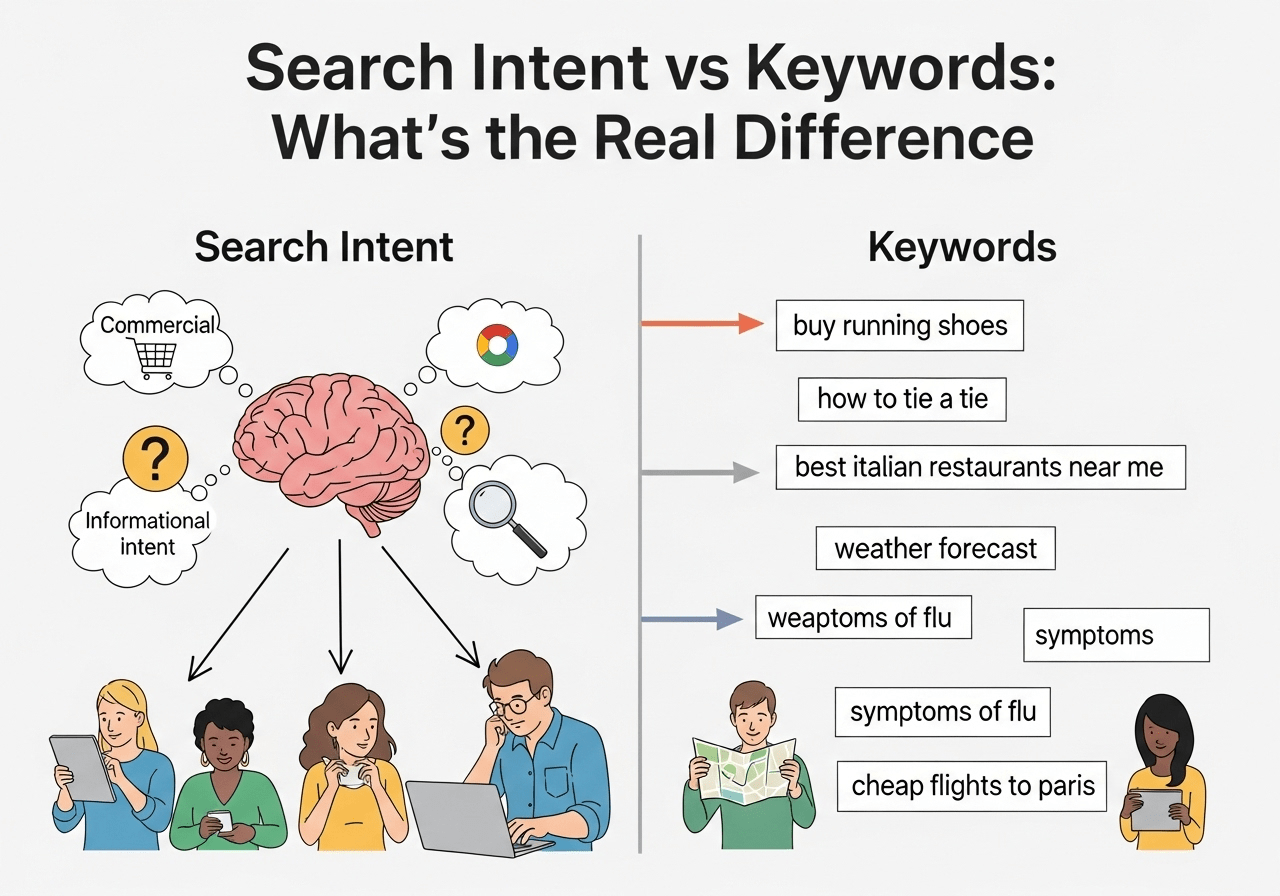
Search intent analysis is a user goal identification exercise. It answers: what does the person who typed this phrase actually want to accomplish — and what content format, depth, and structure satisfies that goal for Google’s current ranking assessment?
What most guides get wrong: They present the two as opposites — the old way versus the new way. That framing misrepresents how both work. A keyword with 2,000 monthly searches and KD 25 is not more or less valuable than an intent-matched piece of content. It is valuable only when both conditions are met: measurable demand exists, and the content format matches what Google has confirmed it rewards for that query.
A keyword without intent analysis produces a page. Intent analysis without keyword research produces an invisible page. The workflow requires both, in sequence — demand first, intent second, content format third.
In practice: We reviewed a cluster of twelve posts on a manufacturing client’s site where keyword difficulty and volume had been correctly targeted (all KD below 30, all volume above 200) but intent had not been checked. Six of the twelve posts were guides published against queries where the SERP was dominated by product category pages. None of those six ranked. Restructuring two of them as product-adjacent comparison posts moved both to positions 6–11 within eight weeks — same keyword target, different format aligned to SERP intent.
| Dimension | Keyword research | Intent analysis | Combined |
|---|---|---|---|
| Primary question | How many people search this? | What do they want when they search it? | What content format will rank and satisfy? |
| Data source | Tool database (Ahrefs, SEMrush, etc.) | Live SERP reading + PAA analysis | Tool data + SERP + user behaviour signals |
| Output | Keyword list with volume and KD | Intent type and dominant format | Content brief with format, depth, and structure |
| Failure mode | Targets queries with no intent match | Addresses needs with no search demand | Not combining both in sequence |
| When to use | Discovery and prioritisation phase | Before every content brief | Every time, in that order |
| Tool dependency | High — requires keyword tool | Low — requires Google search and SERP reading | Moderate — both sources needed |
What Are the Four Intent Types and How Does Each Change Content Format?
Google’s own Quality Rater Guidelines describe intent through a “Know, Do, Website, Visit-in-person” model. (Source: Google Search Quality Rater Guidelines, 2024) SEO practice typically maps this to the four-type model: informational, navigational, commercial, and transactional.
The critical point is not classifying the intent — it is letting the intent determine the content format before writing begins.
Informational intent: The user wants to learn, understand, or solve a problem. Google rewards guides, tutorials, definition posts, and FAQ-structured content. Attempting to rank a product page against an informational query consistently fails — not because the page lacks quality, but because Google has assessed that format as wrong for the intent.
Commercial intent: The user is comparing options before a purchase decision. Google rewards comparison articles with named evaluation criteria, scored reviews, and explicit verdicts. The format failure here is editorial prose without a recommendation — users with commercial intent need a conclusion, not an exploration.
Transactional intent: The user is ready to act. Google rewards product pages, category pages, and landing pages with clear CTAs and trust signals. Publishing a blog post against a transactional query — even an excellent one — rarely produces rankings because the format signals are wrong.
Navigational intent: The user is heading to a specific destination. Google rewards the brand’s own pages. Third-party content rarely wins navigational queries and should not be targeted.
Common mistake + fix: Classifying intent using a keyword tool’s label rather than the live SERP. SEMrush, Ahrefs, and Moz all label intent automatically — but those labels are derived from historical data and can lag behind actual SERP shifts. A keyword labelled “informational” in a tool may now produce a SERP dominated by comparison content. The fix: search the keyword directly after checking the tool, read the top three results, and treat the SERP format as the authoritative intent signal, overriding any tool classification.
How Does Intent Interact with Search Volume in Keyword Prioritisation?
52% of all searches are informational — the highest share of any intent type. (Source: Amra and Elma, 2025) Transactional queries represent less than 1% of search volume but carry the highest individual commercial value per click.
This distribution has a direct implication for content strategy: a site that only targets transactional queries misses 99% of search volume. A site that only targets informational queries builds topical authority but drives limited direct revenue. Both extremes underperform the middle approach — informational content that builds cluster authority, feeding into commercial and transactional pages within the same topic.
Verified ranking data: Ahrefs’ analysis of their own content cluster found that informational cluster posts, once published into an established topical authority context, rank faster for both informational and commercial queries than standalone posts targeting the same terms without cluster support. (Source: Ahrefs, 2025) The implication: informational content investment produces downstream commercial ranking improvements — the effect is not visible on a per-post basis.
The prioritisation framework that works:
- Target informational queries first — build topical authority in the cluster
- Target commercial queries second — link commercial content to informational posts within the cluster
- Target transactional queries third — link transactional pages from both informational and commercial posts above them
- Measure commercial and transactional conversion rates, not just informational traffic volume
Pro Tip: Organic CTR for queries where an AI Overview appears has dropped 61% year-on-year. (Source: Seer Interactive, 2025) This disproportionately affects informational queries, where AI Overviews appear most. Commercial and transactional queries show lower AI Overview frequency — meaning their direct-click value is currently higher relative to informational queries than historical benchmarks suggest. Weight your near-term commercial query investment accordingly.
What Does Intent Analysis Change About the Content Brief?
Intent analysis determines four specific brief decisions that keyword research alone cannot supply.
Decision 1: Content format
Read the top three SERP results and record their format — guide, comparison, list, tool page, product page. Match your format. Deviation from the dominant SERP format is the single most reliable predictor of intent mismatch failure.
Decision 2: Opening structure
For informational queries, Google rewards pages that answer the query directly in the first paragraph. For commercial queries, Google rewards pages that state the evaluation criteria before the comparison. For transactional queries, Google rewards pages where the conversion path is visible above the fold. These structural requirements differ by intent and should be specified in the brief before writing begins.
Decision 3: Required depth
Surfer SEO’s analysis of one million SERPs found that top-10 ranking pages covered approximately 74% of relevant subtopics and entities, while bottom-10 pages covered 50%. (Source: Surfer SEO, 2025) The depth requirement is not a word count — it is topical coverage completeness relative to the sub-intents the SERP is satisfying. Check what the People Also Ask boxes show for the target keyword. Every PAA question is a sub-intent your content should address.
Decision 4: FAQ schema eligibility
Any query phrased as a question or that produces PAA boxes in the SERP is a candidate for FAQ schema. FAQ schema creates additional SERP surface area independent of ranking position. Include it in the brief as a structural requirement, not as an optional addition.
In practice: Briefs built from keyword data alone — volume, KD, seed keyword — produce variable quality content because the writer determines format, depth, and structure independently. When those brief variables are specified by intent analysis before writing starts, revision cycles drop and first-draft ranking performance improves. The time investment in SERP reading before briefing is consistently recovered in post-publish revision time.
How Do AI Overviews Change the Relationship Between Intent and Ranking?
AI Overviews now appear for approximately 30% of US desktop keywords, with the strongest presence on informational queries. (Source: seoClarity, 2025) This changes the commercial value of informational intent pages in two specific ways.
First, informational pages that achieve AI Overview citation receive a secondary visibility channel independent of their standard ranking position. A page ranked 6th that is cited in an AI Overview receives more effective visibility than a page ranked 2nd that is not cited.
Second, pages cited in AI Overviews show 35% higher organic CTR than pages in equivalent standard ranking positions without citation. (Source: Seer Interactive, 2025) Citation earns attention that ranking position alone does not.
The structural requirement for AI Overview citation is consistent with good intent matching: direct answer in the first paragraph, FAQ schema on supporting questions, clear entity coverage throughout. Pages optimised for informational intent — answering the specific question the SERP shows users are asking — are the same pages AI systems preferentially cite.
What most guides get wrong here: They frame AI Overviews as a threat to informational content. The data shows a more nuanced picture — they reduce clicks to pages not cited while increasing visibility for pages that are. The strategic response is not to avoid informational queries but to structure informational content for citation, which requires tighter intent matching, not looser.
What Most Articles Get Wrong About Search Intent vs Keywords
The dominant framing presents intent analysis as having replaced keyword research. It has not — and practitioners who abandon keyword demand data in favour of “writing for user needs” consistently produce content that addresses genuine problems no one searches for.
The second persistent error is using unverifiable statistics to support the intent argument. Claims like “67% of top-ranking pages don’t contain the exact keyword in their title” or “intent-optimised pages have 40% lower bounce rates” appear across multiple guides with no source. They are not verifiable. Building strategy on fabricated benchmarks produces fabricated confidence in the wrong decisions.
The third error is treating intent as a one-time classification applied at briefing. Google’s intent assessment for a keyword updates continuously as user behaviour shifts. A keyword classified as informational in 2023 may now produce commercial results. Quarterly SERP re-reads for active content targets are a maintenance requirement, not optional hygiene.
The correct mental model: Keyword research reveals what the market is searching for. Intent analysis reveals what the market expects to find. Both are required inputs to any content decision. The sequence is non-negotiable: demand before intent, intent before format, format before writing.
Frequently Asked Questions
Does high search volume matter less than intent alignment?
Neither matters without the other. A high-volume keyword with poor intent alignment produces a page that ranks but fails to convert or satisfy — generating impressions without business value. A perfectly intent-matched page targeting a zero-volume query generates nothing. The correct priority order: confirm demand exists above a minimum threshold (50+ monthly searches as a floor), then use intent analysis to determine whether the demand is capturable with your available content format and domain authority. Volume and intent are sequential filters, not alternatives.
How do I identify intent for a keyword when tools disagree with the SERP?
Trust the SERP. Keyword tool intent labels are derived from historical data and update on variable schedules — sometimes months behind actual SERP changes. The live SERP reflects Google’s current intent assessment, updated in real time based on user behaviour signals. Read the format of the top three results. If tools label the query “informational” but the SERP shows product category pages, the SERP is correct. Update the brief accordingly.
Can one page satisfy multiple intent types simultaneously?
Adjacent intents — informational and commercial — can coexist on one page when the user is in research mode. A page that explains how a product category works (informational) and then compares specific options (commercial) satisfies both sub-intents for a user in the consideration stage. Informational and transactional intent cannot coexist effectively on one page — the formats are structurally incompatible. A guide and a product page serve different user states. Attempting to combine them produces a page that satisfies neither well, which is reflected in below-average dwell time and conversion rates.
How does voice search change intent analysis?
Voice queries are structurally informational and phrased as natural language questions — typically five or more words, conversational in format. The intent type distribution is similar to text search but the phrasing differs consistently. The content format that satisfies voice intent is identical to the format that earns featured snippet extraction: direct answer in the first sentence, clear H2 question headings, FAQ schema. Optimising for voice intent and featured snippet capture are the same structural task, which means voice optimisation requires no separate workflow — correct intent matching for informational queries already covers it.
How long does it take for intent-matched content to show ranking improvement?
Intent-matched rewrites of existing pages — where the format is corrected to align with the dominant SERP intent — typically show measurable position improvement within four to eight weeks. The mechanism is improved user behaviour signals: lower bounce rate and higher dwell time tell Google the page better satisfies the query than before. New pages published with correct intent alignment from publication show initial ranking signals within six to ten weeks. Intent mismatch is the most common cause of pages with good keyword targeting that rank outside the top 30 indefinitely despite strong content quality.
What is the biggest mistake practitioners make when transitioning to intent-based content?
Auditing existing content by intent type and then doing nothing with the audit. Intent audits identify which pages have format mismatches — a guide targeting a transactional query, a product page targeting an informational query. The value is in the corrective rewrite, not the classification. Most content audits produce a spreadsheet of intent labels that never translates into brief changes or page rewrites. Prioritise the three to five pages with the highest impression count and lowest CTR — those are the intent mismatches with the most recoverable value.
Conclusion
Search intent and keyword research are sequential tools in the same workflow. Keyword research identifies demand. Intent analysis determines whether and how to pursue it.
The specific process that produces consistent results: run keyword research to identify demand and difficulty, search the keyword in a private browser window and read the format of the top three results, use that format as the primary brief input, structure the opening section to answer the query directly, and include FAQ schema on supporting sub-intents.
Specific next step: Take your five highest-priority keyword targets this week. For each one, search the keyword in a private browser, record the dominant format of the top three results, and compare that format to what you had planned to publish. If any mismatch exists, revise the brief before the end of April 2026 — rewriting a brief costs thirty minutes and prevents weeks of wasted content production.
Citations
[1]. Amra and Elma — Top Search Intent Statistics 2025. https://www.amraandelma.com/search-intent-statistics/
[2]. Mangools — Keyword Research for SEO: The Beginner’s Guide 2025. https://mangools.com/blog/keyword-research/
[3]. Google — Search Quality Rater Guidelines 2024. https://static.googleusercontent.com/media/guidelines.raterhub.com/en//searchqualityevaluatorguidelines.pdf
[4]. Surfer SEO — Ranking Factors in 2025: Insights from 1 Million SERPs. https://surferseo.com/blog/ranking-factors-study/
[5]. seoClarity — Impact of Google’s AI Overviews: SEO Research Study. https://www.seoclarity.net/research/ai-overviews-impact
[6]. Seer Interactive — AI Overviews CTR Impact Study 2025. https://www.seerinteractive.com/insights/ai-overviews-organic-ctr
[7]. Ahrefs — Keyword Difficulty: How to Estimate Your Chances to Rank. https://ahrefs.com/blog/keyword-difficulty/
[8]. WP SEO AI — What Are the 4 Types of Search Intent? https://wpseoai.com/blog/what-are-the-4-types-of-search-intent/