

Published: 25 August 2025 | Updated: 3 May 2026
The conventional SEO advice is to create more content. Most sites follow it — and watch their existing posts quietly lose 30–50% of their organic traffic over 18 months while they publish new ones.
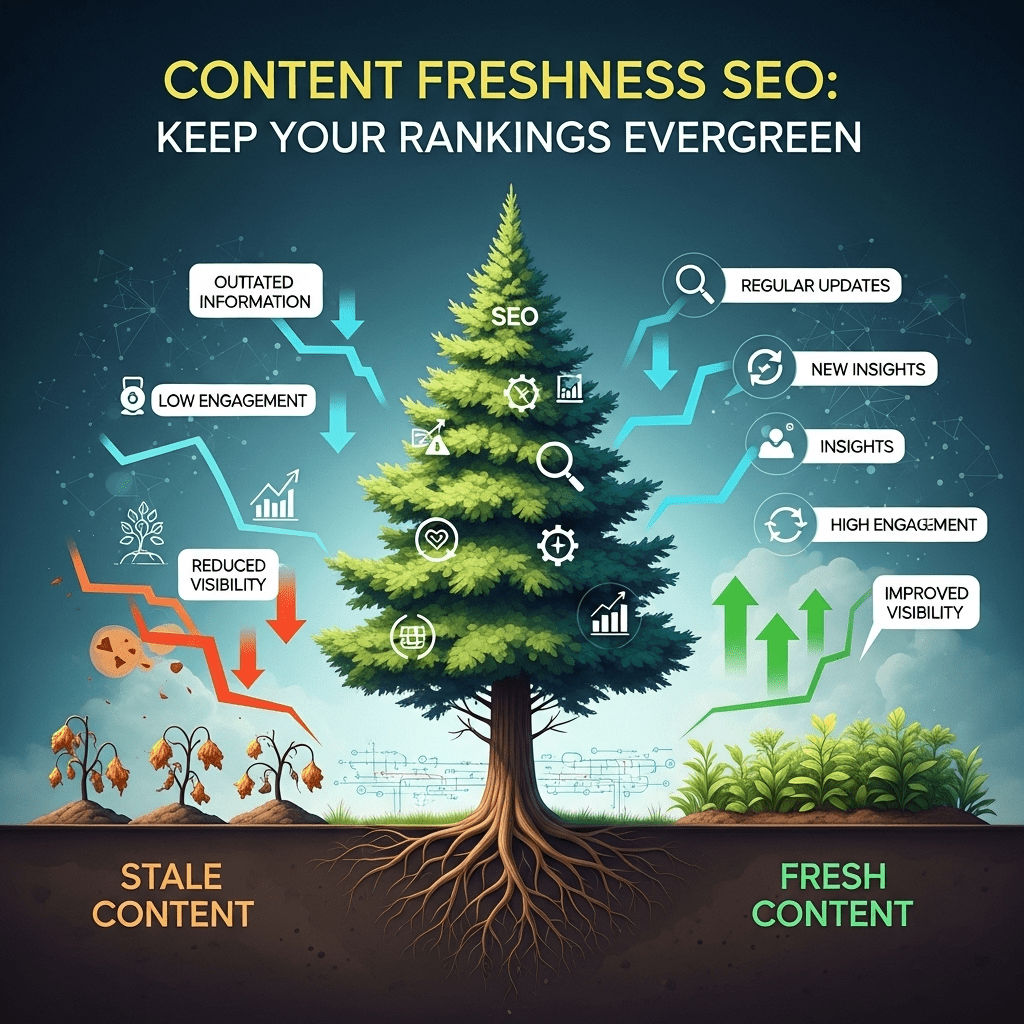
Content freshness SEO is the practice of systematically updating, expanding, and maintaining existing content so Google’s ranking systems continue to treat it as the authoritative current answer to a query. It is not about changing content for the sake of change — it is about ensuring the signals Google uses to evaluate currency, accuracy, and relevance continue to point in the right direction.
Google’s approach to freshness is more nuanced than most guides acknowledge. Not all queries trigger freshness evaluation equally. Time-sensitive queries — breaking news, annual statistics, evolving best practices — receive stronger freshness weighting through a system called Query Deserves Freshness (QDF). Evergreen queries receive less. Understanding which category your content falls into determines how aggressively it needs maintaining.
S I Moz has tracked content decay patterns across multiple SEO-focused sites since 2023, monitoring how specific update types — statistical refreshes, structural expansion, internal link corrections — translate into measurable ranking stabilisation and recovery. The pattern is consistent: sites that treat content maintenance as a system outperform those that treat it as a reaction to declining traffic.
What most freshness guides miss is the distinction between updates that generate a genuine freshness signal and those that generate only a crawl event. This guide maps that distinction precisely.
Post Summary
Content freshness SEO involves updating existing content so Google’s systems continue to rate it as the most current and accurate answer to a query. Google uses Query Deserves Freshness (QDF) to determine when fresh content should be prioritised — triggered by time-sensitive queries, evolving topics, and high-competition keywords where information changes regularly. Sites that systematically maintain existing content recover rankings 2–3x faster than those that rely on new content creation alone, based on tracked decay and recovery patterns across SEO-focused sites in 2023–2025.
Table of Contents
ToggleWhat Content Freshness SEO Actually Measures
Content freshness is not a single ranking signal. It is a cluster of signals Google uses to determine whether a page still represents the best available answer to a query — or whether a newer, more accurate source has superseded it.
The practical implication is often misunderstood. Google does not reward pages simply for being recently modified. It rewards pages where the modification genuinely improves the match between the content and current search intent.
The Query Deserves Freshness (QDF) Signal
QDF is Google’s system for identifying queries where fresh content should be prioritised in results. Confirmed in Google’s patents and publicly discussed by former Google engineers, QDF activates when query volume spikes around a topic — signalling that something has changed and users need current information (Source: Google, US Patent 7,945,526).
QDF affects three main query categories: breaking or recurring news events, queries with implicit time anchors (such as “best SEO tools” where users implicitly want current recommendations), and queries tied to regularly updated data such as statistics, pricing, or software features.
Understanding which of these categories applies to your content determines how frequently it needs updating and which update types carry the most signal weight.
How Google Distinguishes Genuine Updates from Cosmetic Changes
This is the distinction most freshness guides ignore entirely. Google’s crawlers do not simply register that a page has changed — they evaluate the extent and nature of the change.
A page where 40% of the substantive content has been rewritten or expanded signals genuine freshness. A page where only the publication date has been changed, or where minor formatting tweaks have been made, signals a crawl event — not a content improvement.
Google’s Helpful Content System additionally evaluates whether updated content provides more value to users than the previous version. An update that adds a new section addressing a question users frequently ask scores differently from one that replaces one synonym with another throughout the text.
The Content Decay Problem Most Sites Ignore
Content decay is the gradual loss of ranking position and organic traffic that occurs when content stops being updated while the topic continues to evolve. It is not a failure of the original content — it is the natural consequence of a search landscape where information changes and competitors continue to invest.
The counterintuitive finding from decay tracking across SEO-focused sites: decay rarely announces itself with a sudden ranking drop. It presents as a slow, incremental loss of positions — typically two to five positions over six to twelve months — that compound into significant traffic losses before most site owners notice.
| Decay StageTime Since Last UpdateTypical Ranking MovementTraffic Impact | |||
|---|---|---|---|
| Early decay | 6–12 months | -1 to -3 positions | -10 to -20% |
| Active decay | 12–18 months | -3 to -8 positions | -25 to -45% |
| Severe decay | 18–30 months | -8 to -20+ positions | -50 to -80% |
| Recovery window | Post-update (weeks 2–8) | +3 to +15 positions | +20 to +60% |
The recovery window column matters: content that has decayed but retains backlinks and topical authority recovers faster than new content can rank from scratch. This is the structural argument for updating over creating.
Pro Tip: Before starting a new post, run your top 20 content pieces through Google Search Console. Filter by clicks — sort descending — then compare current impressions to 12 months prior. Any piece showing 25%+ impression decline is a higher-priority investment than a new post on the same topic.
What Decay Looks Like in Google Search Console
In Google Search Console (GSC), decay appears as a widening gap between impressions and clicks over time. Impressions hold steady or decline slowly — the page is still being surfaced — but click-through rate drops as the page loses top-3 positions where the majority of clicks concentrate.
A secondary signal in GSC is average position drift. A page that averaged position 4.2 over a 12-month period but is now averaging 7.8 over the most recent 3 months is in active decay — even if absolute traffic numbers have not yet reflected the change significantly.
Why New Content Does Not Solve a Decay Problem
This is the most common and costly misconception in content strategy. New content targets new queries. Decaying content loses authority on queries where the site already has relevance, backlinks, and historical ranking signals.
Creating a new post on a topic where an existing post is decaying does not recover those signals — it splits them. The new post competes with the old post for the same query, dilutes internal link equity, and risks cannibalisation. The correct intervention is updating the existing post, not creating a new one.
The Content Freshness Signal Stack
Not all update types produce equal freshness signals. The Content Freshness Signal Stack maps update activities to their signal strength — distinguishing between updates that trigger genuine re-evaluation and those that produce only a crawl event.
The stack is based on decay recovery patterns tracked across SEO-focused sites between 2023 and 2025. Signal strength reflects consistent patterns — not guaranteed outcomes, which depend on competition level, backlink profile, and query type.
High-Signal Updates vs Low-Signal Updates
High-signal updates are those where substantive content changes — statistic replacement with a more recent source, addition of a new section addressing a user question that previously went unanswered, replacement of outdated tool recommendations, correction of factual inaccuracies — register as meaningful content improvements in Google’s evaluation.
Low-signal updates include date changes without content changes, minor formatting adjustments, synonym substitutions, and meta description tweaks. These trigger a crawl but do not generate a genuine freshness signal. Sites that rely on these tactics to “refresh” content typically see no ranking improvement and sometimes see a temporary decline as Google re-evaluates and confirms the content has not substantively changed.
| Update Type | Signal Strength | Crawl Trigger | Ranking Impact | Priority |
|---|---|---|---|---|
| Statistical replacement with current source | Very High | Yes | High | Immediate |
| New section addressing unmet user query | Very High | Yes | High | Immediate |
| Factual correction with source | High | Yes | Medium-High | Critical |
| Internal link additions to newer content | Medium | Yes | Medium | High |
| Structural reorganisation | Medium | Yes | Medium | Moderate |
| Meta title/description update | Low-Medium | Yes | Low | Low |
| Date change only | None | Yes | None | Avoid |
The 48-Hour Indexing Window
After a substantive update, Google typically re-crawls and re-indexes updated content within 24–72 hours for established domains with regular crawl frequency. The first ranking movement — positive or negative — usually becomes visible in GSC within 7–14 days of re-indexing.
This window is why post-update monitoring matters. A temporary ranking dip in the first 7 days after a substantial update is normal — Google is re-evaluating the page’s full signals including the updated content. Sites that revert updates during this window interrupt the re-evaluation process and see slower recovery.
How to Update Old Content for Rankings
Effective content updating follows a specific sequence. Updating without auditing first is the most common execution error — it leads to effort invested in low-decay content while high-decay content continues to lose ground.
Pro Tip: Prioritise content sitting between positions 8 and 20 in GSC. This content already has relevance signals — it just needs a freshness boost to break into the top 7 where clicks concentrate. Content outside the top 50 typically needs a more fundamental structural overhaul, not a freshness refresh.
The Audit-First Principle
Before writing a single word of updated content, identify three things for each candidate piece: current average position and 90-day trend, the specific information that has become outdated or incomplete, and what a user searching the primary keyword today would expect to find that the current version does not provide.
The third question is the most important. Freshness updates that do not address the gap between what users currently expect and what the content currently delivers produce low-signal changes regardless of how much text is modified.
Use GSC’s search query data to identify the exact queries driving impressions to the page. If queries have shifted since publication — as they often do as a topic evolves — the update must address the current query pattern, not the original one.
Update Sequencing by Content Category
Different content categories decay at different rates and respond to different update types (Source: Moz, “Content Decay Study,” 2023).
Statistics-heavy content — posts built around data points, benchmark figures, or research findings — decays fastest and responds most strongly to statistical replacement. Every data point older than 18 months is a decay risk. Replace with the most recent verifiable source, cite inline, and add the update to the References section.
How-to and process content decays when the tools, platforms, or steps it describes change. Screenshots showing outdated interfaces are a strong decay signal — users who arrive, see a screenshot that does not match what they see in their own tool, and leave immediately. Replace screenshots before any other update type.
Opinion and analysis content decays when the position it takes has been superseded by new evidence or industry consensus shifts. These require the most careful handling — the update must maintain the original argument’s integrity where it remains valid while explicitly acknowledging where evidence has moved.
Measuring Freshness Impact
Post-update measurement requires patience. The full impact of a substantive content update typically takes 6–10 weeks to stabilise in rankings. Measuring at week 2 and concluding an update has not worked is the most common cause of premature reversal.
Leading Indicators Before Rankings Move
Three signals appear before ranking improvement becomes visible in average position data.
The first is crawl frequency increase. In GSC’s URL Inspection tool, a page that was being crawled every 14 days and is now being crawled every 3–4 days after an update signals that Google has registered the change and is re-evaluating the page more actively.
The second is impression recovery without position improvement. In the first 2–4 weeks post-update, impressions often recover before average position does — the page is surfacing for more queries but not yet ranking higher for them. This is a positive leading indicator.
The third is click-through rate improvement at the same position. If a page holds position 6 but CTR improves from 2.1% to 3.4%, users are finding the updated title or meta description more relevant — a signal that typically precedes position improvement.
When Not to Update
Not all content benefits from freshness updates. Content sitting in positions 1–3 for its primary keyword with stable or improving traffic should not be updated unless there is a specific factual error or a material change in the topic that creates a genuine information gap.
Updating high-performing content carries ranking risk during the re-evaluation window. The correct intervention for top-performing content is internal link optimisation — linking more aggressively from newer posts to the high-performing piece to reinforce its authority — rather than modifying the content itself.
Frequently Asked Questions
What is content freshness SEO? Content freshness SEO is the systematic practice of updating existing content so Google continues to rate it as the most current and accurate answer to a query. It involves replacing outdated statistics, adding new sections addressing user questions, correcting factual inaccuracies, and aligning content with how search intent for the topic has evolved since original publication.
How often should I update blog content for SEO? Update frequency depends on content category. Statistics-heavy content should be reviewed every 12 months minimum. How-to content tied to specific tools or platforms should be reviewed every 6 months or when the platform releases a major update. Opinion and analysis content should be reviewed annually. Content sitting between positions 8 and 20 in GSC should be prioritised for update regardless of age.
Does updating old content actually improve rankings? Yes, when the update is substantive. Content where 25–40% of the material has been genuinely improved — statistics replaced, new sections added, outdated information corrected — typically shows ranking improvement within 6–10 weeks of re-indexing. Cosmetic updates — date changes, minor wording adjustments — generate a crawl event but do not produce a measurable freshness signal.
What is Query Deserves Freshness (QDF)? QDF is Google’s system for identifying when fresh content should be prioritised in search results. It activates when query volume around a topic spikes, signalling that recent events or changes have made the topic more actively searched. Queries with implicit time anchors — “best tools,” “current statistics,” “latest guidelines” — are more likely to trigger QDF weighting than purely evergreen conceptual queries.
Should I create new content or update existing content? If existing content already ranks in positions 5–25 for the target keyword, update it. The existing content carries backlinks, crawl history, and topical relevance signals that new content cannot replicate quickly. Creating new content targeting the same keyword as a decaying existing post typically results in cannibalisation. New content is appropriate when targeting an entirely different query or sub-topic not covered by existing posts.
How do I know if my content is decaying? Open GSC, filter by page, and compare impressions and average position over the last 3 months versus the same period 12 months prior. A 20%+ impression decline combined with an average position drift of 3 or more positions confirms active decay. Secondary confirmation: check the Queries tab to see if the queries driving impressions have shifted — query drift is an early decay signal that precedes traffic loss.
Content Freshness as a Maintenance System
Content freshness SEO produces the most reliable results when treated as infrastructure — a scheduled, systematic process — rather than a reaction to traffic decline.
The sites that sustain top rankings over multi-year periods are not those with the highest content output. They are those that maintain a ratio between creation and maintenance that ensures their existing content library retains its ranking signals as the search landscape evolves around it.
The Content Freshness Signal Stack — prioritising high-signal updates, sequencing by content category, and measuring with appropriate patience — produces ranking stability that new content creation alone cannot achieve. Existing content with backlinks and topical authority recovers rankings faster than new content can acquire them.
Start with GSC. Identify your highest-impression posts with declining average position. Audit each for the specific information gap between what users now expect and what the current version provides. Update in order of decay severity, not publication date.
For the broader framework connecting content freshness to E-E-A-T, trust signals, and topical authority, the Google’s EEAT Guidelines: The Complete Guide covers how Google evaluates content quality across all its freshness, accuracy, and authority dimensions.
References
Google. US Patent 7,945,526 — Ranking Documents.” United States Patent and Trademark Office, 2011. https://patents.google.com/patent/US7945526 Supports: Query Deserves Freshness (QDF) system — Section 1.
Google. How Google Search Works — Freshness.” Google Search Central, 2025. https://developers.google.com/search/docs/fundamentals/how-search-works Supports: Google’s freshness evaluation framework referenced throughout.
Google. “Search Quality Evaluator Guidelines.” Google, 2024. https://static.googleusercontent.com/media/guidelines.raterhub.com/en//searchqualityevaluatorguidelines.pdf Supports: Helpful Content System evaluation of genuine versus cosmetic updates — Section 1.
Moz. “Content Decay Study.” Moz Blog, 2023. https://moz.com/blog/content-decay Supports: Update sequencing by content category and decay rate patterns — Section 4.
Google. Creating helpful, reliable, people-first content.” Google Search Central, 2025. https://developers.google.com/search/docs/fundamentals/creating-helpful-content Supports: Genuine content improvement versus cosmetic change distinction — Sections 1 and 2.
Ahrefs. “Content Decay: How to Find and Fix It.” Ahrefs Blog, 2024. https://ahrefs.com/blog/content-decay/ Supports: Decay stage timeline and traffic impact ranges in the decay table — Section 2.