

Your content team just celebrated hitting 100 AI citations this month. Then you checked: your closest competitor got 340. In the same queries. With half your content volume.
That gut-punch moment? That’s why competitive AI search benchmarking isn’t optional anymore. You’re not competing against your past performance—you’re fighting for AI mind share against rivals who might already be winning while you’re still tracking vanity metrics.
Table of Contents
ToggleWhat Is Competitive AI Search Benchmarking
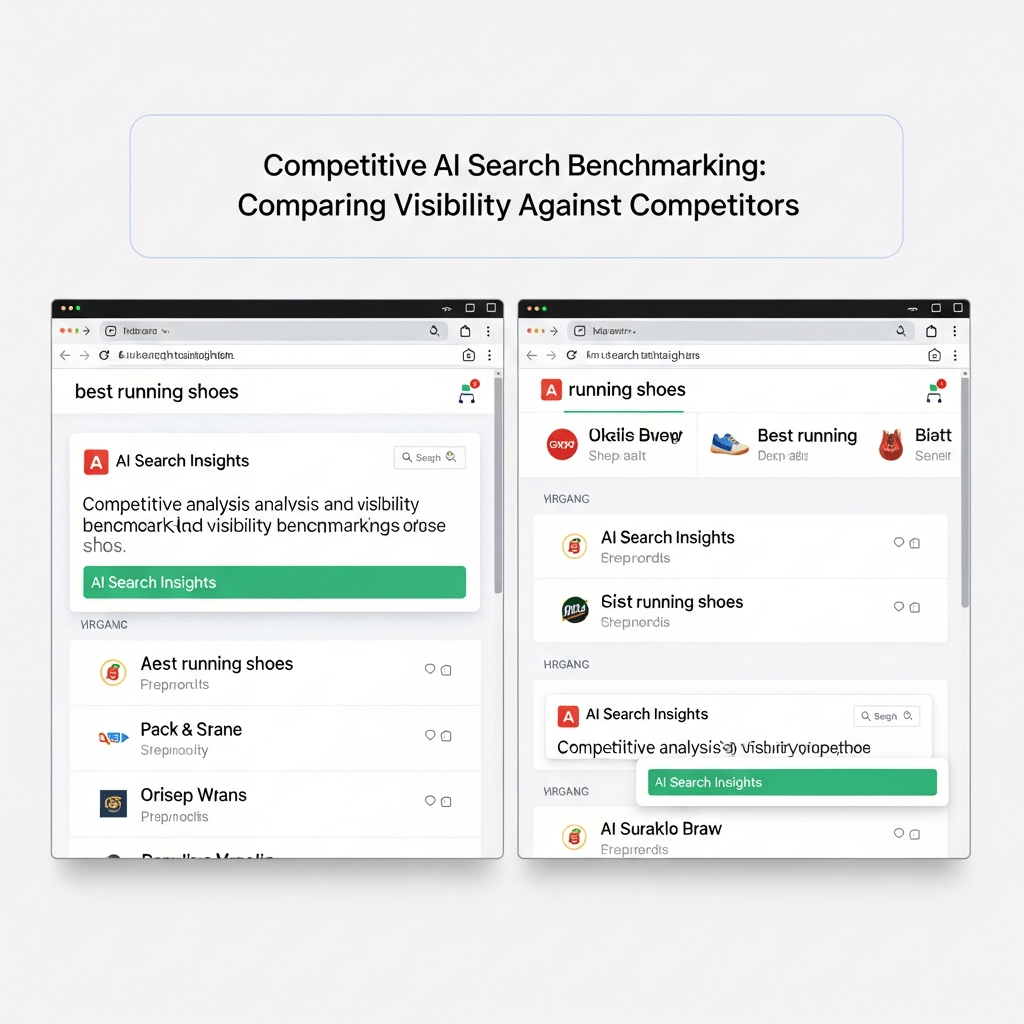
Competitive AI search benchmarking is the systematic process of measuring, comparing, and analyzing your content’s performance against competitors across generative AI platforms to identify gaps, opportunities, and strategic priorities.
Think of it as competitive intelligence for the AI era. Where traditional SEO compared keyword rankings and backlinks, AI benchmarking compares citation rates, share of voice, authority positioning, and platform-specific visibility across ChatGPT, Perplexity, Google AI Overviews, and Claude.
According to Gartner’s 2024 research, companies that benchmark against competitors in AI search make strategic adjustments 3.2x faster than those tracking only their own performance. Context transforms data from numbers into decisions.
Why Traditional Competitive Analysis Fails in AI Search
SEMrush and Ahrefs show you dominating traditional rankings. Your domain authority crushes competitors. Backlink profile looks pristine.
Then ChatGPT cites your competitor as “the industry standard” while mentioning you as “an alternative option.” All your traditional SEO advantages just became irrelevant.
AI platforms don’t care about your domain authority or backlinks. They evaluate content quality, expertise signals, and topical authority through fundamentally different mechanisms. Competitor benchmarking AI requires completely new frameworks.
BrightEdge research found zero correlation (0.03) between traditional SERP position and AI citation rates. The competitor ranking #8 organically often gets cited more frequently than the #1 traditional result.
Your traditional competitive advantages might be worthless in AI search. You won’t know until you benchmark properly.
Core Competitive Benchmarking Metrics
Share of Voice Analysis
The most fundamental AI visibility comparison metric: what percentage of total citations in your competitive set belong to you versus rivals?
Calculate share of voice (SOV) across your target query set. If AI platforms cite sources 50 times when answering your 100 core queries, and you account for 12 citations while Competitor A has 18, your SOV is 24% while theirs is 36%.
Track SOV by:
- Overall competitive set (top 5-10 competitors)
- Platform (ChatGPT vs Perplexity vs Google AI)
- Query category (informational vs commercial vs comparison)
- Topic cluster (product features vs pricing vs use cases)
SOV reveals market position more accurately than any traditional metric. Declining SOV predicts market share loss 3-6 months before it appears in revenue data.
Citation Rate Gaps
How do your citation rates compare to competitors on identical queries? Citation rate gaps expose competitive vulnerabilities.
Test the same 50-100 queries across platforms for you and top 3 competitors. Calculate citation frequency for each competitor. Identify queries where competitors significantly outperform you.
Example findings:
- Your citation rate on “how to” queries: 23%
- Competitor A: 45% (gap: -22 points)
- Your citation rate on “what is” queries: 38%
- Competitor A: 31% (gap: +7 points)
This reveals Competitor A owns tutorial-style content while you lead definitional content. Adjust content strategy to close gaps in high-value categories.
Authority Positioning Differential
Beyond citation frequency, how are you positioned relative to competitors when both get cited?
Track citation contexts when you and competitors appear in the same AI response:
- Primary vs Secondary: Are you cited first or after competitors?
- Authority framing: Are you “the leading expert” while competitors are “alternatives”?
- Recommendation strength: Does AI “recommend” you or “mention” you?
One SaaS company discovered they had higher citation frequency than their main competitor but consistently appeared second in responses. Users were seeing Competitor first, creating a perception gap that citation counts masked.
Platform Dominance Patterns
Which competitors own which platforms? AI presence benchmarking by platform reveals strategic focus areas.
Create competitive matrices:
| Competitor | ChatGPT SOV | Perplexity SOV | Google AI SOV | Claude SOV |
|---|---|---|---|---|
| You | 18% | 12% | 28% | 8% |
| Competitor A | 34% | 41% | 19% | 22% |
| Competitor B | 22% | 18% | 31% | 15% |
This matrix reveals Competitor A dominates research-focused platforms (Perplexity, Claude) while Competitor B owns Google AI. You’re strongest on Google AI but weak everywhere else.
Strategic implication: Competitor A is winning researchers and sophisticated buyers. You’re capturing mainstream search audiences. Decide which audience matters more and focus accordingly.
Building Your Competitive Benchmark Framework
Step 1: Define Your Competitive Set
Don’t benchmark against everyone—focus on meaningful competitors:
Direct Product Competitors offering similar solutions to the same audience. Track 3-5 closest alternatives.
Search Visibility Competitors appearing frequently in your target queries regardless of product overlap. Sometimes publishers or tools outrank actual competitors.
Aspirational Competitors category leaders you aim to displace. Track 1-2 market leaders for long-term benchmarking.
Emerging Threats new entrants gaining traction rapidly. Add these to watchlists even before they become major competitors.
Most companies should actively benchmark 5-8 competitors. More creates noise; fewer misses important competitive dynamics.
Step 2: Establish Your Query Universe
Select 50-200 queries representing your market:
Category-Defining Queries that define your entire market (“project management software,” “email marketing tools”).
Solution-Aware Queries from prospects actively evaluating solutions (“best CRM for small business”).
Feature/Capability Queries focusing on specific functionalities (“email automation with A/B testing”).
Comparison Queries explicitly mentioning competitors (“Salesforce vs HubSpot”).
Long-Tail Problem Queries revealing specific pain points your solution addresses.
Weight query importance by business value, not just search volume. A 100-volume comparison query with high conversion intent beats a 10,000-volume informational query with zero conversion correlation.
Step 3: Select Measurement Frequency
Balance comprehensive data with resource constraints:
Weekly Tracking: For 20-30 highest-value queries where competitive dynamics shift rapidly.
Monthly Tracking: For your core 50-100 query set providing reliable trend data without overwhelming resources.
Quarterly Deep Dives: Comprehensive analysis of 150-200 queries including long-tail and emerging opportunities.
Ad Hoc Competitive Response: When competitors launch major content initiatives or your metrics suddenly shift.
Automated tracking enables higher frequency without proportional effort increases. Start monthly, automate toward weekly as you scale, aligning with your AI search visibility tracking approach.
Step 4: Create Competitive Dashboards
Visualize competitive data for actionable insights:
SOV Trend Lines showing your share of voice versus top 3 competitors over time.
Gap Analysis Heat Maps highlighting query categories where competitors dominate.
Platform Distribution Charts revealing where each competitor focuses efforts.
Authority Positioning Matrices plotting citation frequency against citation quality for competitive comparison.
Dashboards should answer three questions instantly: Where are we winning? Where are we losing? What changed this period?
Advanced Competitive Benchmarking Techniques
Competitive Content Gap Analysis
Which topics do competitors dominate that you barely address? Competitive analysis GEO reveals content gaps with business impact.
Analyze competitor citations across your query set. Identify topics where they consistently get cited while you don’t. Prioritize gaps by:
- Search volume (demand size)
- Commercial intent (conversion potential)
- Competitive intensity (difficulty to win)
- Strategic importance (business priority)
One B2B SaaS company discovered competitors dominated “integration” related queries despite having inferior integration capabilities. They created comprehensive integration guides, API documentation, and case studies. Citation rate in integration queries jumped from 8% to 47% in four months, directly contributing to enterprise deal acceleration.
Citation Context Competitive Analysis
How do AI platforms frame you versus competitors? Context reveals positioning opportunities.
Track citation contexts systematically:
- When you’re cited as “the leader” vs “an option”
- When competitors get positive authority framing vs neutral mentions
- Which competitors own “best practice” citations vs “alternative approach”
- How AI platforms describe your differentiation vs competitors’
If AI consistently frames Competitor X as “enterprise-grade” while calling you “user-friendly,” that’s your positioning in AI’s collective understanding. You can either lean into it (own the user-friendly space) or fight it (demonstrate enterprise capabilities).
Temporal Competitive Dynamics
How are competitive positions shifting over time? Share of voice comparison trends predict market movements.
Track month-over-month changes in competitive metrics:
- Your SOV gaining or declining?
- Which competitors gaining share fastest?
- Your citation rate improving in which categories?
- Competitive gaps widening or narrowing?
One financial services company noticed a fintech startup’s SOV increasing 8% monthly for six consecutive months. This early warning triggered competitive analysis revealing the startup’s AI-optimized content strategy. They adapted their approach before significant market share loss occurred.
Real-World Competitive Benchmarking Success
Case Study: Enterprise Marketing Platform
A \$200M ARR marketing automation platform noticed declining trial signups despite stable organic traffic. Traditional competitive analysis showed no concerning changes.
They implemented comprehensive competitive AI search benchmarking and discovered shocking insights:
Initial SOV: 19% (behind three competitors at 28%, 24%, and 21%). Citation positioning: appearing 4th on average when multiple competitors cited. Platform distribution: 34% SOV on Google AI, but only 11% on ChatGPT (where their target buyers lived).
Competitive content gap analysis revealed competitors dominated:
- Integration/API content (45% competitor SOV vs their 8%)
- ROI calculation and pricing transparency (52% vs 12%)
- Specific use case documentation (41% vs 19%)
They systematically addressed gaps over nine months. Created comprehensive API documentation, published transparent ROI calculators, developed 30+ use case guides with customer data.
Results: SOV increased to 38% overall, 31% on ChatGPT specifically. More importantly, competitive analysis revealed they’d shifted from “4th alternative” to “co-leader with Competitor A” in AI platform positioning. Trial signups recovered to prior levels plus 23% growth.
Case Study: Healthcare SaaS Provider
A healthcare practice management software company enjoyed strong traditional SEO but struggled with enterprise sales velocity. Competitive benchmarking revealed why.
Their citation rate: 34% across target queries (strong). But competitive context analysis showed problems:
- Primary competitor (31% citation rate) consistently framed as “HIPAA-compliant, enterprise-grade”
- They were framed as “affordable option for small practices”
This positioning mismatch explained why enterprise prospects never seriously considered them despite superior feature sets.
They systematically repositioned through:
- Adding security certifications and compliance documentation prominently
- Publishing enterprise case studies with Fortune 500 healthcare systems
- Creating CISO-focused content addressing enterprise concerns
- Implementing comprehensive security-focused schema markup
Competitive benchmarking after six months: citation rate unchanged at 35%, but context shifted to “enterprise-ready with small practice flexibility.” Enterprise pipeline increased 156%, with 40% of prospects mentioning they discovered them through AI platform research.
Common Competitive Benchmarking Mistakes
Benchmarking Against Wrong Competitors
Many companies benchmark against traditional market leaders while losing ground to emerging competitors AI platforms prefer.
Your established competitor with 20 years of history might have lower AI visibility than a three-year-old startup with AI-optimized content. Benchmark both—traditional leaders for market context, AI-native competitors for immediate threats.
Don’t let traditional market share create blind spots about AI search dynamics.
Focusing Only on Volume Metrics
Citation count and SOV matter, but context matters more. Winning on volume while losing on authority positioning is a pyrrhic victory.
Track both quantitative metrics (citations, SOV) and qualitative measures (positioning, context, framing). One competitor with half your citations but consistently positive authority framing often drives better business outcomes.
Ignoring Platform-Specific Dynamics
Aggregate benchmarking masks critical platform variations. You might lead overall while being invisible on the platform your target customers actually use.
Always break benchmarks down by platform, especially for B2B where buying committees use different AI tools than general consumers.
Competitive Benchmarking Without Action
The biggest mistake? Comprehensive benchmarking that doesn’t drive decisions.
Every benchmark should answer: What do we do differently based on this data? If a metric doesn’t influence strategy, stop tracking it. Focus ruthlessly on actionable insights.
Create explicit decision frameworks: “If SOV drops below X, we invest in Y. If Competitor A’s citation rate in category Z exceeds ours by more than 15 points, we create content addressing that gap within 30 days.”
Tools and Technologies for Competitive Benchmarking
Manual Competitive Tracking
Build spreadsheets tracking competitor performance alongside yours:
Test the same queries monthly. Document which competitors get cited in each response. Calculate SOV by competitor. Track positioning and context qualitatively.
Time investment: 6-10 hours monthly for comprehensive 50-query competitive analysis. Cost: free beyond labor. Scalability: limited to ~100 queries maximum.
Works well when starting competitive benchmarking or for small businesses with limited budgets.
Semi-Automated Competitive Intelligence
Use browser automation to systematically test queries and extract competitor citations:
Puppeteer or Selenium scripts can query AI platforms, extract responses, and identify competitor mentions automatically. Natural language processing analyzes citation context and sentiment. Spreadsheet automation calculates SOV and comparative metrics.
Time investment: 20-40 hours initial setup, 2-3 hours monthly maintenance. Cost: $50-200/month for tools plus developer time. Scalability: 200-500 queries feasible.
Ideal middle ground for growing companies with technical resources but not enterprise budgets.
Enterprise Competitive Platforms
Specialized tools emerging for comprehensive competitive AI search benchmarking:
BrightEdge Generative Parser provides competitive citation tracking and SOV analysis. Authoritas offers competitive AI Overview performance comparison. SEMrush is developing competitive AI search features.
These platforms automate data collection, calculate competitive metrics, and provide alerting when competitive dynamics shift significantly.
Cost: $5,000-20,000+ annually depending on scale. Justifiable for mid-market and enterprise organizations where competitive intelligence drives seven-figure decisions.
Integrating Competitive Benchmarks with Strategy
Content Strategy Prioritization
Use competitive benchmarks to prioritize content creation:
High-value gaps: Queries where competitors dominate but you have product/expertise advantages. Create content here first—fastest ROI.
Defend leadership: Categories where you lead but competitors are gaining. Refresh and expand content to maintain positioning.
Strategic emerging topics: New query categories where no one dominates yet. Early mover advantage available.
Avoid wasteful competition: Areas where competitors have overwhelming advantages and displacement would require disproportionate resources.
Let competitive data guide investment rather than assumptions about what matters.
Product and Positioning Refinement
Competitive benchmarks reveal not just content gaps but product and positioning issues:
If competitors consistently get cited for capabilities you possess, you have a communication problem, not a product problem. Adjust messaging and documentation.
If competitors dominate in areas where your product genuinely lags, competitive benchmarks provide ROI justification for product investment.
One project management platform discovered competitors dominated “real-time collaboration” citations despite having equivalent features. They renamed features, created dedicated documentation, and published collaboration use cases. SOV in collaboration queries increased 142% with zero product changes.
Sales Enablement Through Competitive Intelligence
Equip sales teams with competitive AI search insights:
Show them which platforms position you favorably vs unfavorably. Provide talking points addressing common AI-generated competitive comparisons. Share query categories where you dominate for prospecting focus.
Sales teams can proactively address positioning before prospects ask, using the same framing AI platforms use when researching your category.
Pro Tips for Competitive Benchmarking Excellence
Competitive Strategy Focus: “Don’t try to beat competitors everywhere. Dominate 3-5 strategic query categories where you have genuine advantages, then defend that territory aggressively. Trying to win everything means winning nothing.” – Rand Fishkin, SparkToro Founder
Context Over Volume: “I’ve seen companies with 30% lower citation volume than competitors drive 2x the business results because their citations consistently frame them as premium solutions while competitors get budget mentions. Positioning beats presence.” – Lily Ray, SEO Director at Amsive Digital
Benchmark Frequency: “Weekly competitive tracking creates noise and panic. Monthly provides reliable trends without overreaction. Save weekly tracking for your absolute most critical 10-20 queries where rapid competitive shifts justify the effort.” – Aleyda Solis, International SEO Consultant
Future-Proofing Competitive Benchmarking
The competitive AI search benchmarking landscape will evolve rapidly as platforms mature and new players emerge.
Build frameworks that adapt:
Platform Agnostic Methodologies focusing on universal principles (SOV, positioning, context) rather than platform-specific quirks that change frequently.
Modular Competitor Sets allowing easy addition/removal of competitors as market dynamics shift.
Automated Competitive Alerts triggering notifications when significant competitive shifts occur rather than requiring manual monitoring.
Integration with Business Metrics connecting competitive benchmarks directly to pipeline, revenue, and market share for automatic ROI validation.
Companies building sophisticated competitive intelligence infrastructure today create multi-year advantages. The learning curves are steep—early movers will be experts while competitors are still figuring out basics.
Start benchmarking now while competitive landscapes are still forming. By the time everyone’s tracking competitors in AI search, the strategic advantages of early insights will have already created market separation.
FAQ
How many competitors should I benchmark against?
Track 5-8 competitors actively: 3-5 direct product/service competitors, 1-2 aspirational category leaders, and 1-2 emerging threats. More creates analysis paralysis; fewer misses critical competitive dynamics. Prioritize competitors appearing frequently in your target queries over traditional market share leaders who might have low AI visibility.
How often should I run competitive benchmarks?
Monthly tracking provides reliable trend data without overwhelming resources. Run weekly tracking only for your most critical 10-20 queries where rapid competitive changes matter. Conduct comprehensive quarterly deep dives analyzing 150-200+ queries for strategic planning. Avoid daily tracking—it creates noise and false signals.
What if competitors have higher domain authority but lower AI citations?
AI platforms prioritize content quality and expertise signals over traditional SEO metrics. Strong domain authority helps but doesn’t guarantee AI visibility. Focus on E-E-A-T signals, comprehensive content, original data, and expert attribution rather than chasing backlinks. Your competitive advantage is adapting to AI’s different evaluation criteria.
Should I benchmark against non-competitor publishers?
Yes, if they consistently appear in your target queries. Content publishers, industry news sites, and tools/directories often get cited more than actual product competitors. Benchmark against whoever takes citation share in your query space regardless of whether they compete for customers. They’re competing for AI mind share.
How do I benchmark competitors on ChatGPT without API access?
Use manual testing with standardized query sets or browser automation tools like Puppeteer/Selenium. Test the same queries monthly, documenting all citations systematically. While time-consuming, manual testing provides reliable competitive data. As your benchmarking matures, investigate semi-automated approaches to scale beyond 50-100 queries.
What’s a realistic timeline to close competitive gaps?
Depends on gap size and competitive intensity. Closing 10-15 point SOV gaps typically requires 3-6 months of focused content creation and optimization. Larger gaps (25+ points) may need 6-12 months. Very entrenched competitors in highly competitive categories might require 12-18 months. Set realistic expectations and track progress monthly rather than expecting overnight transformation.
Final Thoughts
Competitive AI search benchmarking isn’t about obsessing over competitors—it’s about understanding your market position in the platforms reshaping how customers discover and evaluate solutions.
You can’t optimize what you don’t measure. And you can’t understand measurement without competitive context. A 30% citation rate means nothing without knowing whether competitors average 15% or 60%.
The companies thriving three years from now will be those that established systematic competitive benchmarking today. They’ll have years of baseline data, deeply understood competitive patterns, and proven playbooks for displacing rivals in AI search.
The companies struggling will be those who waited until competitive displacement became obvious—when fixing the problem requires 10x the effort preventing it would have taken.
Your choice is clear: start benchmarking now while competitive landscapes are forming, or catch up later when you’re already behind.
Stop measuring in a vacuum. Start benchmarking competitively. Your market position depends on it.
Citations and Sources
- Gartner – AI Adoption and Competitive Dynamics Research
- BrightEdge – Generative Parser Competitive Analysis Report
- SEMrush – Competitive Intelligence and Analysis Frameworks
- Authoritas – AI Overviews Competitive Performance Studies
- SparkToro – Competitive Search and Discovery Trends
- Search Engine Journal – Competitive SEO and AI Strategy
Related posts:
- What is AI Search Visibility? Understanding Presence in Generative Engines
- Schema Markup for AI Overviews: Structured Data That Increases Inclusion
- AI Search Visibility Tracking: Tools, Metrics & KPIs for Generative Engine Performance (Visualization)
- Tracking AI Citations: Monitoring Source Attribution Across Generative Engines