

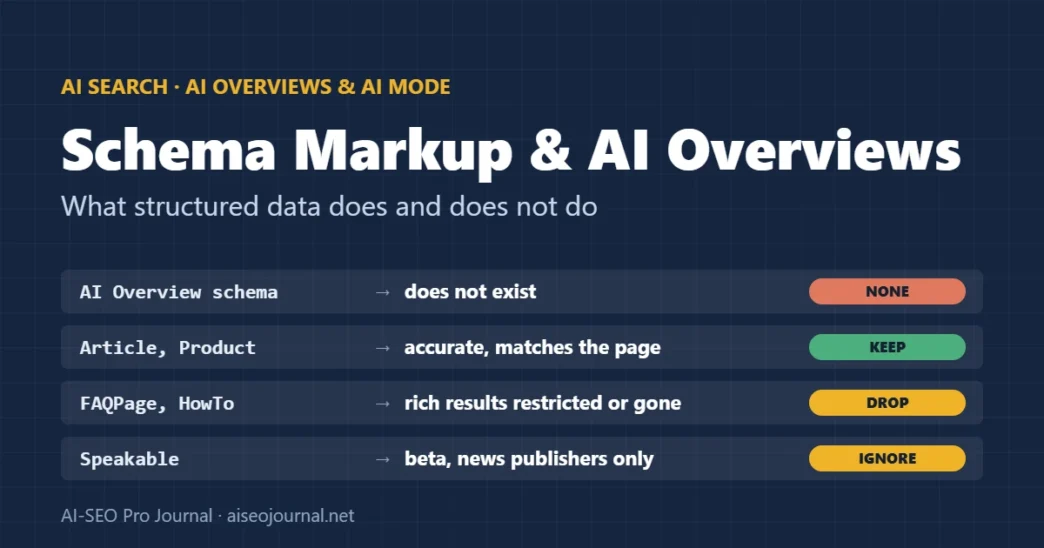
There is no schema type that gets a page into Google’s AI Overviews. Google’s documentation for site owners says there is no special schema.org structured data you need to add for AI Overviews or AI Mode, nor other special optimisations [1]. Any guide that promises “schema that increases AI Overview inclusion” is promising something Google says does not exist.
Structured data still has a job. It helps Google understand a page and can make it eligible for rich results. Inaccurate or hidden markup can also work against you. This guide explains what schema does and does not do in the age of AI search, which types are still worth adding, and which old recommendations to drop. It is part of our Google AI Overviews guide.
Key takeaways
- Google says no special structured data is needed for AI Overviews or AI Mode.
- Structured data helps Google understand a page and enables rich results; it does not guarantee any search feature.
- Markup must match the visible content. Marking up text readers cannot see breaks Google’s guidelines.
- FAQ rich results now appear only for authoritative government and health sites, HowTo rich results are deprecated, and speakable is a beta feature for news publishers.
- Keep the types that describe what the page really is, such as Article, Product, Organization and LocalBusiness, accurate and complete.
Table of Contents
ToggleDoes schema markup help you appear in AI Overviews?
Not directly. Google states there is no special schema.org structured data needed for AI Overviews or AI Mode, and that the only requirement is a page that is indexed and eligible to show with a snippet [1]. Its May 2025 guidance for AI search lists structured data only to say it should match the visible content [2].
From our own site: The previous version of this guide told readers that “pages with comprehensive schema markup get cited in AI Overviews 2.7x more frequently”, credited to a Search Engine Journal article. When we checked in November 2026, the linked article returned “not found”, and we could not find the figure anywhere else. We rewrote the guide around what Google documents instead.
What does structured data actually do?
It gives Google explicit clues about the meaning of a page, in a standard format [3]. Google uses it to understand the content and, for supported types, to show rich results such as product, recipe or event details [3]. Even then, Google does not guarantee that structured data will produce any feature [4].
So the honest case for schema today is accuracy and eligibility. It describes your products, organisation, articles and locations in a form machines can read, and it qualifies the page for the rich results Google still supports.
Which schema should you keep, and which should you drop?
| Type | Status in Google Search | Recommendation |
|---|---|---|
| Article / BlogPosting | Supported; helps Google understand articles | Keep, with accurate headline, dates and author |
| Product, Offer, Review snippets | Supported for eligible pages | Keep on real product pages; values must match the page |
| Organization, LocalBusiness | Supported | Keep accurate and consistent with your Business Profile |
| BreadcrumbList | Supported | Keep if the page shows a breadcrumb trail |
| FAQPage | Rich results only for well-known, authoritative government and health sites since August 2023 [5] | Optional; no snippet or AI benefit for most sites |
| HowTo | Rich results deprecated in September 2023 [5] | No Search benefit; remove if it adds maintenance |
| Speakable | Beta; news publishers, Google Assistant, US English [6] | Ignore unless you are a news publisher |
Auditing structured data
- List typesRich Results Test on each template
- Match pageEvery value visible and current
- Remove duplicatesOne accurate graph per page
- Drop dead weightHidden FAQ, unused HowTo
- ValidateTest the live URL
What rules must your structured data follow?
- It must represent the page. Google’s guidelines say structured data must be a true representation of the page content [4].
- Only mark up visible content. Do not mark up content that is not visible to readers of the page [4]. A common breach is FAQ markup for questions that appear nowhere on the page.
- Keep it current. Prices, availability, dates and authors in the markup must match what the page shows today.
- Validate it. Use the Rich Results Test on the live URL. If the markup is added by JavaScript, test the URL rather than pasted code, so Google renders the page first.
Professional tip: Before adding new markup, audit what you already have. Plugins often output overlapping Organization, WebSite and Article blocks with conflicting values. One accurate graph per page is better than three that disagree.
What helps more than schema for AI Overviews?
The things Google lists in its AI search guidance [2]: unique content that answers longer, more specific questions; pages Google can crawl and index; a good page experience; and preview controls set deliberately rather than by accident. If you want a single technical check, make sure no nosnippet tag or very low max-snippet value is limiting how your content can be used [7].
Here is the structured data (JSON-LD) from one of my pages and the visible text of the same page.
1. List every structured data type and property in the markup.
2. Flag any value that does not appear in the visible text, or that differs from it.
3. Flag duplicate or conflicting entities (for example two Organization blocks with different names).
4. Flag FAQPage, HowTo or speakable markup and say whether it is likely to have any Google Search benefit, based on Google's current documentation.
Do not invent properties or values.

Markup: [paste JSON-LD]
Visible text: [paste page text]
Frequently asked questions
Is there a schema type for AI Overviews?
No. Google states there is no special schema.org structured data you need to add for AI Overviews or AI Mode.
Does FAQ schema help with AI Overviews?
There is no evidence it does, and Google says no special schema is needed. Since August 2023 FAQ rich results are shown only for well-known, authoritative government and health websites.
Should I remove structured data I already have?
No, if it is accurate and describes visible content. It still helps Google understand the page and can enable rich results. Remove or fix markup that describes content readers cannot see.
Does speakable markup help with voice or AI answers?
Only in a narrow case. Speakable is a beta feature for news publishers, used for topical news on Google Assistant devices in US English.
Audit your markup before adding more
Run your five most important templates through the Rich Results Test and list every structured data type each one outputs. Remove duplicates, fix values that do not match the page, and drop markup for content that is not visible. Then spend the time you would have spent on new schema on the questions your pages do not yet answer. The AI Overview trigger queries guide shows how to find them.
Sources
- Google Search Central — AI features and your website
- Google Search Central Blog — Top ways to ensure your content performs well in Google’s AI experiences on Search, 21 May 2025
- Google Search Central — Introduction to structured data markup in Google Search
- Google Search Central — General structured data guidelines
- Google Search Central Blog — Changes to HowTo and FAQ rich results, 8 August 2023 (updated 14 September 2023)
- Google Search Central — Speakable structured data (beta)
- Google Search Central — Robots meta tag, data-nosnippet and X-Robots-Tag specifications