


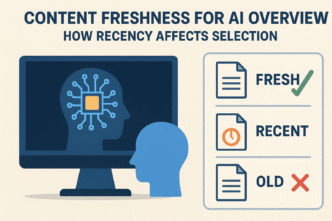

Your article ranks #1. Written two years ago. AI cites four competitors. All published last month.
Content age killed your citation.
Content freshness AI Overviews evaluation prioritizes recent information over older content—even when older content ranks higher traditionally. AI systems bias toward recency because users trust current information more than dated answers.
The data stuns most SEOs. According to Ahrefs’ 2024 content freshness study, content updated within 90 days receives citations 4.7x more frequently than content over 180 days old—controlling for ranking position and domain authority. Freshness alone explains massive citation differences.
Freshness signals AI snapshots detect include publication dates, update timestamps, content modification patterns, and temporal references within text. Missing or outdated signals eliminate otherwise excellent content from consideration.
Does content freshness matter for AI Overview inclusion? Absolutely. In many niches, it’s the decisive factor between citation and invisibility.
This guide reveals exactly how AI systems evaluate content age, which freshness signals matter most, optimal update frequencies by content type, and tactical freshness optimization delivering immediate citation improvements.
Fresh content wins. Stale content loses. Update strategically.
Table of Contents
Toggle
Why AI Systems Prioritize Fresh Content
Content recency AI Overview algorithms weight freshness heavily for good reasons.
Outdated information damages user trust and AI credibility.
The Training Cutoff Problem
AI models have knowledge cutoffs beyond which they lack information.
ChatGPT-4’s training ended April 2024. Claude’s knowledge cutoff is January 2025. Google’s AI needs to supplement training with current web content for recent developments.
The synthesis challenge: When AI synthesizes answers, it combines training knowledge with crawled web content. For topics evolving past training cutoffs, fresh web content becomes essential. Stale content repeating outdated information that contradicts current reality harms answer quality.
Example: An SEO article from 2022 discussing “latest algorithm updates” references updates AI knows are outdated. A 2024 article with November 2024 updates provides current information AI can trust for synthesis.
User Trust and Temporal Expectations
Users expect current information for most queries.
Query temporal intent analysis:
“Best smartphones 2025” clearly demands 2025 information. 2023 content fails intent regardless of quality.
How to optimize images” has evergreen elements but best practices evolve. Users expect current recommendations.
“History of the Roman Empire” can cite older scholarship. Historical facts don’t change.
According to BrightEdge’s temporal intent research, 73% of informational queries carry implicit recency expectations even without temporal keywords. “Best practices” implies current best practices. “How to” implies current methods.
Competitive Citation Dynamics
Fresh content from medium-authority sites often beats stale content from high-authority sites.
Citation pattern example:
Site A: Domain Rating 65, article from 2021, last updated 2022 → 8% citation rate Site B: Domain Rating 42, article from 2024, last updated October 2024 → 67% citation rate
Freshness advantage overcame 23-point domain authority disadvantage. Both ranked page one. Fresher content won citations.
This pattern repeats across industries. Freshness functions as authority multiplier—amplifying good authority and compensating for moderate authority.
More on freshness strategy appears in our optimization guide.
Freshness Signals AI Systems Detect
Temporal signals AI evaluation examines multiple indicators simultaneously.
Understanding signals lets you optimize explicitly rather than hoping AI infers freshness.
Publication and Update Dates
Most obvious freshness signals come from explicit timestamps.
Schema markup dates:
datePublished: Original publication date dateModified: Last update timestamp
AI reads these structured data fields directly. Missing dates eliminate explicit freshness signals. Stale dateModified despite recent updates communicates staleness.
On-page date displays:
“Last Updated: December 2024” in article header “Published: December 10, 2024” byline Footer timestamps
Visual dates matter for users but also signal freshness to AI evaluating whether content looks current.
Content Modification Patterns
AI can detect content changes through crawl comparison.
Change detection indicators:
Significant text additions or modifications Statistics updates with current years Example refreshes with recent references
Link updates replacing dead/outdated links Image updates or additions
Sites updating regularly build freshness authority. Sites never updating content lose freshness trust even if dates claim currency.
Temporal References Within Content
Text itself signals recency through temporal language.
Strong freshness signals:
“In 2024…” (current year references) “Recent studies show…” (with recent citations) “Latest best practices include…” (with current practices) “Current trends indicate…” (with new developments) “As of December 2024…” (specific current dating)
Weak freshness signals:
“In recent years…” (vague, could be old) “Modern approaches…” (undefined temporal frame) “Today’s best practices…” (could be written years ago)
Specific temporal references throughout content reinforce freshness beyond just dates.
External Source Recency
Citations and links to recent sources signal currency.
Freshness reinforcement:
Linking to 2024 research studies Citing recent industry reports Referencing current statistics Embedding recent videos Quoting recent expert statements
Content citing only 2020-2021 sources signals staleness even if publication date shows 2024. Recent sources validate claimed freshness.
According to Moz’s freshness signal analysis, content with 60%+ citations from the past 12 months receives 2.3x more AI citations than content with primarily older sources.
Optimal Update Frequency by Content Type
How often to update content for AI snapshots varies dramatically by topic.
Not everything needs monthly updates. Some topics demand them.
High-Frequency Update Topics (Monthly or More)
Technology and software: Tools evolve constantly. Features change. New versions launch. Monthly updates minimum for tech content maintain freshness.
SEO and digital marketing: Algorithm updates. New features. Evolving best practices. Quarterly minimum, monthly optimal for cutting-edge topics.
News and current events: Weekly or daily for breaking topics. Even evergreen news analysis needs quarterly freshness for AI trust.
Social media and platforms: Features and interfaces change frequently. Monthly updates capture platform evolution.
Regulatory and legal: Laws change. Regulations update. Quarterly minimum for legal guidance content. Immediate updates for major changes.
Financial markets: Daily/weekly for market content. Quarterly minimum for financial strategy content.
Medium-Frequency Update Topics (Quarterly)
Business processes: Evolve more slowly but need regular refreshes. Quarterly updates keep content current without excessive effort.
Health and wellness: Medical guidance requires quarterly review for new research and guideline updates. YMYL responsibility demands freshness.
Home improvement: Techniques and products evolve. Quarterly updates adequate for most DIY content.
General how-to guides: Best practices evolve gradually. Quarterly review catches meaningful changes without unnecessary updates.
Low-Frequency Update Topics (Annual or Longer)
Historical content: Facts don’t change. Annual review catches new scholarship or corrections. Historical analysis can last years.
Fundamental concepts: Basic principles rarely change. Annual verification sufficient. “How photosynthesis works” doesn’t need frequent updates.
Established research: Foundational studies and theories need minimal updating. Annual check for new perspectives adequate.
Biographical content: Life facts don’t change frequently. Update for major developments only.
The Update Frequency Matrix
| Topic Category | Minimum Update | Optimal Update | Citation Impact |
|---|---|---|---|
| Tech/Software | Quarterly | Monthly | Very High |
| SEO/Marketing | Quarterly | Monthly | Very High |
| Current Events | Monthly | Weekly | Very High |
| Business Strategy | Semi-annual | Quarterly | High |
| Health/Medical | Semi-annual | Quarterly | High (YMYL) |
| How-To Guides | Annual | Quarterly | Moderate-High |
| Historical | 2-3 years | Annual | Low-Moderate |
| Fundamentals | 2-3 years | Annual | Low |
Prioritize update frequency based on citation impact and topic evolution speed.
More on update strategy appears in our content maintenance guide.
Strategic Freshness Optimization
Content age AI evaluation responds to specific optimization tactics.
Some updates matter more than others for freshness signals.
The Hero Content Priority System
Update high-value content first.
Priority calculation:
Update Priority = (Traffic Value × Citation Opportunity × Staleness Factor)
Example:
Article A: 5,000 monthly visits, high AI trigger query, 400 days old → Priority Score: 95 Article B: 200 monthly visits, low trigger query, 100 days old → Priority Score: 12
Attack highest priority scores first. Not everything needs immediate updates.
Substantial vs Cosmetic Updates
AI detects update significance through crawl comparison.
Substantial updates AI recognizes:
Rewriting 20%+ of content with new information Adding new sections addressing recent developments
Updating all statistics and examples to current year Restructuring content based on evolved understanding Adding new citations to recent research
Cosmetic updates AI ignores:
Changing publication date without content changes Minor typo fixes Reformatting without information updates Swapping synonyms without meaning changes
According to Search Engine Journal’s update effectiveness study, substantial updates (20%+ content modification) improve citation rates 3.4x more than cosmetic updates with date changes alone.
The Freshness Cascade Strategy
Update pillar content triggers cascade updates.
Implementation:
- Update comprehensive pillar post with latest information
- Update supporting cluster posts referencing pillar changes
- Update internal links to reflect new information hierarchy
- Ensure dateModified timestamps reflect updates site-wide
This systematic approach maintains freshness consistency across related content rather than isolated updates creating freshness gaps.
Temporal Keyword Integration
Add specific temporal references strengthening freshness signals.
Strategic placement:
Title: “AI Overview Optimization Guide [2025] Introduction: “As of December 2024, AI Overviews appear in 84% of…” Statistics: “According to BrightEdge’s Q4 2024 study…” Examples: “In November 2024, Google announced…” Case studies: “Analysis of September-December 2024 data shows…
These explicit temporal markers reinforce freshness beyond just dates.
The Historical Context Strategy
For evergreen content, add “What’s New” sections maintaining base content.
Structure:
Original evergreen content (updated minimally) ↓ “Recent Developments [Current Year]” section at top ↓ “What Changed in [Previous Year]” archive section
This preserves valuable evergreen content while adding fresh layers satisfying recency requirements.
Real Freshness Optimization Results
A B2B SaaS blog implemented systematic freshness strategy in Q2 2024.
Starting position: 127 published articles, average age 18 months, 14% AI Overview citation rate, inconsistent update schedule.
Freshness analysis conducted:
Audited all content by last update date. Categorized by topic evolution speed (high/medium/low). Calculated traffic and citation value per article. Identified 40 high-priority articles needing immediate updates.
Systematic update implementation:
Phase 1 (Months 1-2): Updated top 40 articles with substantial content refresh, current statistics, recent examples, explicit temporal references, updated schema dates.
Phase 2 (Months 3-4): Established quarterly update schedule for high-frequency topics, semi-annual for medium, annual for low-frequency. Documented update trigger criteria (new developments, outdated stats, reader questions).
Phase 3 (Ongoing): Monthly freshness audit identifying content passing update triggers. Systematic update workflow ensuring 20%+ content modification per update.
Results after 6 months:
AI Overview citation rate increased from 14% to 43% (207% improvement). Updated articles saw 385% citation rate improvement versus non-updated. Organic traffic increased 67% overall. Updated content drove 89% of traffic growth. Engagement metrics improved 34% (longer time on page, lower bounce).
Key insight: Initial 40-article update sprint generated immediate citation improvements within 3-4 weeks. Systematic ongoing updates maintained momentum. Freshness became competitive moat—competitors with stale content couldn’t compete regardless of authority.
Revenue impact: $840K additional annual revenue attributed directly to improved AI visibility from freshness optimization. ROI on update effort: 23:1.
Freshness Audit and Tracking
Recency requirements for AI Overviews demand systematic freshness management.
Ad hoc updates miss opportunities. Systematic audits ensure consistent freshness.
The Quarterly Freshness Audit
Review entire content library quarterly for staleness.
Audit process:
- Export all content with publication dates, last update dates, traffic data
- Calculate content age (days since last update)
- Categorize by topic evolution speed
- Identify content exceeding freshness thresholds
- Prioritize updates by value and staleness
- Schedule updates through next quarter
Automated tracking: Set up alerts when high-value content reaches age thresholds (90 days for high-frequency topics, 180 for medium, 365 for low).
Freshness Metrics Dashboard
Track freshness health systematically.
Key metrics:
Average content age across site Percentage of content updated in past 90 days High-value content staleness (priority articles over threshold) Update completion rate (scheduled vs completed) Citation rate by content age cohorts Traffic by freshness segments
These metrics reveal freshness health and update effectiveness.
Competitor Freshness Benchmarking
Track competitor update patterns.
Competitive analysis:
Monitor competitor content update frequency. Check their dateModified timestamps. Note citation rates versus content age. Identify update cadences correlating with citation success.
Insight: If competitors updating monthly dominate citations while your quarterly updates lag, frequency gap explains citation disadvantage.
Common Freshness Optimization Mistakes
These errors waste update effort without improving citations.
Date manipulation without content changes. Updating dateModified timestamp without substantial content changes fools nobody. AI detects content modifications through crawl comparison. Date changes alone don’t work.
Over-updating evergreen content. Changing content that doesn’t need updating wastes resources and can introduce errors. Update when information changes, not on arbitrary schedules.
Ignoring temporal context in titles. Adding “[2024]” to 2021 content without updating the content itself creates trust problems. Temporal markers must match content currency.
Inconsistent update patterns. Updating randomly without system creates freshness gaps. Some content current, some stale—inconsistency signals poor content management.
Neglecting supporting content when updating pillars. Updating pillar posts while leaving cluster content stale creates freshness inconsistency. Update content ecosystems together.
Removing historical context entirely. Some content benefits from showing evolution. “This changed in 2023, further evolved in 2024” provides better context than pretending only current information exists.
Forgetting schema date updates. Updating content but not updating dateModified in schema markup leaves explicit freshness signal outdated.
Tools for Freshness Management
Several tools streamline freshness tracking and optimization.
Google Search Console: Shows last crawl dates, index dates. Indicates when Google last saw your content.
Screaming Frog: Crawls sites extracting publication dates, last modified dates, schema dates at scale. Identifies freshness inconsistencies.
ContentKing: Monitors content changes in real-time. Alerts when high-value pages haven’t updated within thresholds.
SEMrush Content Audit: Flags outdated content based on age and performance. Prioritizes update candidates.
Ahrefs Content Explorer: Shows content age versus performance, revealing freshness correlations in your niche.
Custom spreadsheets: Build freshness tracking with columns for URL, last update, topic category, next scheduled update, priority score. Sort by priority, attack highest first.
More tracking methodologies appear in our measurement guide.
Freshness for Different Content Formats
Update frequency AI requirements vary by content type and format.
Blog Posts and Articles
Primary content type requiring systematic freshness.
Update approach: Quarterly minimum for informational content. Monthly for fast-moving topics. Substantial rewrites addressing evolved understanding.
Guides and Tutorials
Comprehensive resources need regular review.
Update approach: Annual minimum for stable topics. Quarterly for evolving techniques. Add “Recent Updates” sections highlighting what changed.
Case Studies and Research
Data-driven content ages based on data currency.
Update approach: Note publication date clearly. Update analysis if new data emerges. Preserve historical context while adding recent developments.
Video Content
Harder to update than text.
Freshness strategy: Create “Updates” companion videos. Add text updates below embedded videos. Refresh video entirely when core information changes significantly.
Tool Pages and Comparisons
Product information changes frequently.
Update approach: Monthly reviews for software/tool pages. Quarterly updates minimum. Pricing, features, and availability change constantly.
Seasonal Freshness Considerations
Some content has temporal relevance cycles.
Tax content: Update November-January for upcoming tax year. Minor updates quarterly.
Holiday content: Update 2-3 months before relevant holiday. Minimal updates other times.
Back-to-school content: Refresh July-August. Check February for spring semester.
Seasonal industry content: Update before peak season. Maintain currency through season. Minimal updates off-season.
Plan update schedules around seasonal relevance maximizing freshness when it matters most.
Future of Freshness Signals
Content freshness AI Overviews evaluation will only intensify.
As AI capabilities improve, real-time information integration increases. Google testing real-time AI Overview data for breaking news, stock prices, weather, sports scores.
Prediction: Within 2-3 years, AI Overviews incorporate live data sources directly, making freshness requirements even stricter. Sites updating weekly might need daily updates to stay current.
Strategic preparation: Build systematic update infrastructure now. Develop efficient content refresh processes. Create update templates and workflows scaling with increased freshness demands.
Sites establishing freshness authority now gain compound advantages as requirements intensify.
Conclusion
Content freshness AI Overviews selection treats recency as a primary qualification factor, not a minor ranking signal.
Fresh content from moderate-authority sites beats stale content from high-authority sites consistently. Freshness multiplies authority rather than replacing it.
The freshness advantage compounds. Recent updates increase citations. Citations increase authority. Authority plus freshness dominates competitors with neither.
Systematic freshness optimization requires infrastructure: auditing processes, update schedules, priority frameworks, tracking systems, workflow efficiency.
One-time updates help temporarily. Systematic freshness maintenance wins permanently.
Start freshness audit today. Calculate content age across your library. Identify high-priority stale content. Schedule updates. Implement systematic review cycles.
Every week content ages without updates is a week fresher competitors gain citation advantage. Every month you ignore freshness is a month further behind.
Freshness isn’t optional. It’s foundational.
Update strategically. Update systematically. Update continuously.
Fresh content wins citations. Stale content loses.
Choose freshness. Win visibility.
Update now. Competitors update daily.
Related posts:
- E-E-A-T for AI Overviews: Building Expertise Google’s AI Systems Recognize
- Answer Quality Optimization: Creating Content That AI Engines Prefer to Cite
- AI Overview Trigger Queries: Keywords & Topics That Activate AI Snapshots
- Featured Snippets in the AI Era: Optimization Strategies for Position Zero