

Three late-2024 Google Search changes still shape your work in November 2026: the Search Console 24-hour view, the ranking update calendar and the crawling guidance. One is gone and needs no action: the sitelinks search box. This page was first published as “Latest Google Search News” on 13 June 2025, but it summarised items from late 2024. We rebuilt it as a dated archive. Each item below has its date and its source, and a line on where it stands now. For the crawling background, see our technical SEO fundamentals guide.
In short
Of five late-2024 Google Search items, one is gone with no action needed (the sitelinks search box), one has grown (Search Console's hourly data, now with AI reports), and three are reference material (the update calendar, the crawling posts and the Web Almanac). We checked each against Google's own page on 10 November 2026.
Editor’s note, 10 November 2026: we removed items we could not verify from Google’s own pages: an “enhanced recommendations” feature, a “site abuse policy update”, AI tool launches, event locations and a YouTube series list.
Table of Contents
ToggleThen and now at a glance
Read the workflow as text
- 21 Oct 2024: sitelinks search box: Removal from 21 Nov 2024. Now, Now: gone: No action needed. Markup can stay.
- 12 Dec 2024: 24-hour view: Hourly data, last 24 hours. Now, Now: more hourly data: API from Apr 2025. AI reports Jun 2026.
- Nov-Dec 2024: three updates: Two core, one spam. Now, Now: seven by Dec 2025: More listed for 2026.
- Dec 2024: Crawling December: Rendering and HTTP caching. Now, Now: pages still live: Checked on 10 Nov 2026.
- 2 Dec 2024: Web Almanac SEO: 83.9% mobile robots.txt 200. Now, Now: 2025 edition: 84.9%, published 15 Jan 2026.
The sitelinks search box is gone
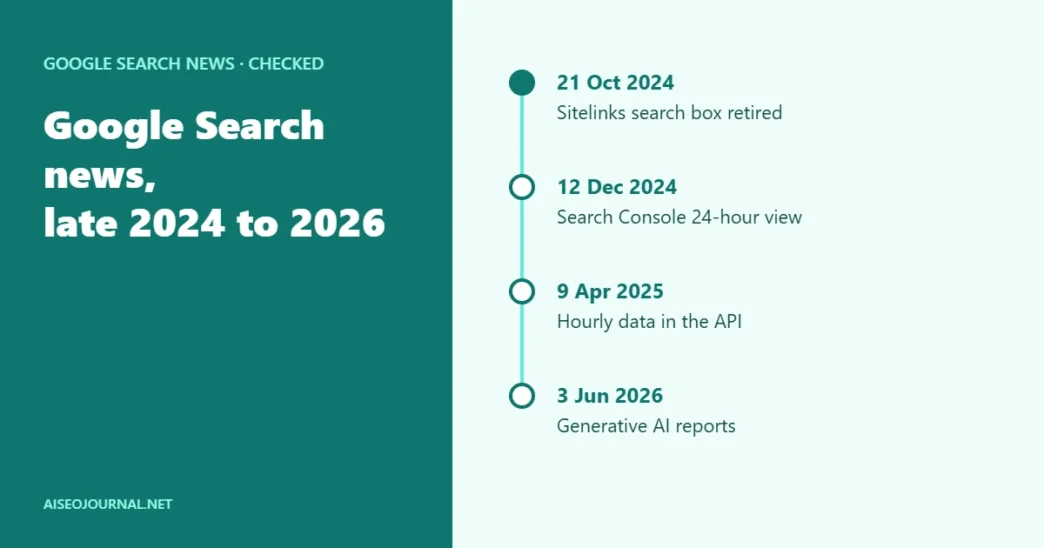
Then. On 21 October 2024, John Mueller wrote that Google would remove the sitelinks search box from 21 November 2024. Usage had dropped over about ten years, and Google wanted to simplify results [1].
Now. That date has passed. Google said no action was needed, rankings and other sitelinks would not change, and the markup could stay. It also said the site name variant of WebSite markup remains supported. The post said Google would remove the Search Console report and stop highlighting the markup in the Rich Results Test, with no date given [1]. We did not re-check those two tools.
Search Console’s 24-hour view, and what came after
Then. On 12 December 2024, Moshe Samet announced a 24-hour view in the performance reports for Search results, Discover and Google News. It appears a few hours late, uses your local time, and marks incomplete points with a dotted line [2]. On 9 April 2025 the API gained an HOUR dimension and a dataState value, HOURLY_ALL, with up to 10 days of hourly data [3].
Now. On 3 June 2026 Google added Search Generative AI performance reports. They show impressions from AI Overviews and AI Mode in Search, and generative AI features in Discover, by page, country and date. Devices are available for Search only [4].
Worth knowing
The June 2026 post says the new AI reports are rolling out to a subset of sites. A banner on the same page says all sites have them from 31 August 2026. The page does not reconcile the two. We report both [4].
The update calendar
The old page said “two core updates” and a spam update had just launched. The Search Status Dashboard confirms that pattern for late 2024. It lists these ranking updates between November 2024 and December 2025 [5]:
| Update | Start (US/Pacific) | Duration listed |
|---|---|---|
| November 2024 core update | 11 Nov 2024 | 23 days 13 hours |
| December 2024 core update | 12 Dec 2024 | 6 days 4 hours |
| December 2024 spam update | 19 Dec 2024 | 7 days 2 hours |
| March 2025 core update | 13 Mar 2025 | 13 days 21 hours |
| June 2025 core update | 30 Jun 2025 | 16 days 18 hours |
| August 2025 spam update | 26 Aug 2025 | 26 days 15 hours |
| December 2025 core update | 11 Dec 2025 | 18 days 2 hours |
The dashboard also lists 2026 entries, such as a February 2026 Discover update and March 2026 core and spam updates. We cover some of those in our March 2026 core update analysis and our December 2025 core update piece.
Watch out
The dashboard gives start dates and durations, not end dates. Do not work out an end date and compare it with your traffic without saying you did the sum.
Crawling December 2024
Then. Martin Splitt and Gary Illyes wrote on 3 December 2024 that Googlebot fetches the HTML first, then the Web Rendering Service fetches scripts and styles. That service caches them for up to 30 days, and the cache ignores HTTP caching directives. They also said blocking rendering-critical resources in robots.txt usually causes rendering problems [6].
On 9 December 2024, Gary Illyes wrote about HTTP caching. Google’s crawlers support ETag and Last-Modified validators. A matching validator can get a 304 response with no body. He gave one figure: about 0.017% of Google’s fetches are cacheable today, against about 0.026% ten years ago [7].
Now. Both pages were still live on 10 November 2026.
Quick check
Open your robots.txt in a browser. Does it return a normal page, and does it block any file your pages need to render?
The Web Almanac SEO chapter and the robots.txt figure
The old page said 84% of sites have a robots.txt. The nearest figure in the Web Almanac is a status-code one. In the 2024 chapter, published 2 December 2024, robots.txt returned 200 for 83.9% of mobile sites and 83.5% of desktop sites. Its data comes from the June 2024 HTTP Archive crawl [8]. The 2025 chapter, published 15 January 2026, shows 84.9% for both [9].
The 2025 chapter also says GPTBot appears in 4.5% of desktop and 4.2% of mobile robots.txt files, up from 2.9% and 2.7% in 2024 [9]. In places the chapters’ text and figures disagree by a tenth of a point, so treat these as rounded.
Which change affects your site?
Pick a change. You get what Google said, and what to do. All dates come from the pages we opened on 10 November 2026.
What changed: Retirement announced 21 October 2024. The visual element was removed from 21 November 2024. Google says rankings and other sitelinks are not affected.
What to do: Nothing is required. You can leave the WebSite markup in place. Keep any WebSite markup that sets your site name.
Source: Google Search Central blog, 21 October 2024
What changed: 12 December 2024: hourly data for the last 24 hours in the Search results, Discover and Google News performance reports. It arrives a few hours late and uses your local time.
What to do: Use it to watch a launch or an outage. Treat the newest points as incomplete: they show as a dotted line.
Source: Google Search Central blog, 12 December 2024
What changed: 9 April 2025: the Search Analytics API gained an HOUR dimension and a dataState value HOURLY_ALL, with up to 10 days of hourly data.
What to do: Pull hourly rows into your own sheet if 24 hours is too short. Expect some partial data.
Source: Google Search Central blog, 9 April 2025
What changed: The Search Status Dashboard lists each ranking update with a start date and a duration, not an end date.
What to do: Compare your own traffic dates with the dashboard before you decide an update hit you.
Source: Search Status Dashboard, Ranking history
What changed: 3 December 2024: how Googlebot crawls and renders a page. 9 December 2024: HTTP caching with ETag and 304 responses.
What to do: Do not block rendering-critical files in robots.txt. Serve ETag and 304 where you can.
Source: Google Search Central blog, Crawling December
What changed: The 2024 chapter, published 2 December 2024, has robots.txt returning 200 for 83.9% of mobile sites. The 2025 chapter, published 15 January 2026, shows 84.9%.
What to do: Check that your own robots.txt returns 200. Ours does, as of 10 November 2026.
Source: Web Almanac SEO chapters, 2024 and 2025
What changed: 3 June 2026: Search Console added Search Generative AI performance reports, with impressions from AI Overviews and AI Mode. The page's banner says all sites have it from 31 August 2026.
What to do: Open Search Console and see whether the report appears. It shows impressions only.
Source: Google Search Central blog, 3 June 2026
What we found on our own site
From our own site
On 10 November 2026 we checked two things on aiseojournal.net. Our robots.txt returns 200 and is 120 bytes, with one group for all crawlers and a sitemap line. It names no AI crawlers. Our home page carries no JSON-LD at all, so it has no sitelinks search box markup to remove.
Method: we fetched /robots.txt and the home page and read them. Limit: two URLs, one day. Other pages are not covered.
The missing home page markup is a gap on our side. We list it for a later fix.
Frequently asked questions
Is the sitelinks search box still shown in Google results?
Google said it would remove the visual element from 21 November 2024. The change applied worldwide, and Google said no action was needed.
What does the Search Console 24-hour view show?
Hourly data for the last 24 hours in the Search results, Discover and Google News reports. It appears a few hours late and uses your local time.
Where can I see when a ranking update started?
On the Search Status Dashboard’s ranking history. It lists a start date and a duration for each update.
Where did the "84% have a robots.txt" figure come from?
The nearest figure we found is the Web Almanac’s status-code result: robots.txt returned 200 for 83.9% of mobile sites in 2024 and 84.9% in 2025.
Check the dashboard, then check your own robots.txt
Next time traffic moves, check the Search Status Dashboard first, then Search Console’s hourly view. For the crawling side, read our technical SEO fundamentals guide.
Sources
- Google Search Central blog, Farewell, Sitelinks Search Box (21 October 2024). Read on 10 November 2026.
- Google Search Central blog, An improved way to view your recent performance data in Search Console (12 December 2024). Read on 10 November 2026.
- Google Search Central blog, The Search Analytics API now supports hourly data (9 April 2025). Read on 10 November 2026.
- Google Search Central blog, Introducing Search Generative AI performance reports in Search Console (3 June 2026). Read on 10 November 2026.
- Google Search Status Dashboard, Ranking incident history. Read on 10 November 2026.
- Google Search Central blog, Crawling December: The how and why of Googlebot crawling (3 December 2024). Read on 10 November 2026.
- Google Search Central blog, Crawling December: HTTP caching (9 December 2024). Read on 10 November 2026.
- HTTP Archive, Web Almanac 2024, SEO chapter (2 December 2024). Read on 10 November 2026.
- HTTP Archive, Web Almanac 2025, SEO chapter (15 January 2026). Read on 10 November 2026.