


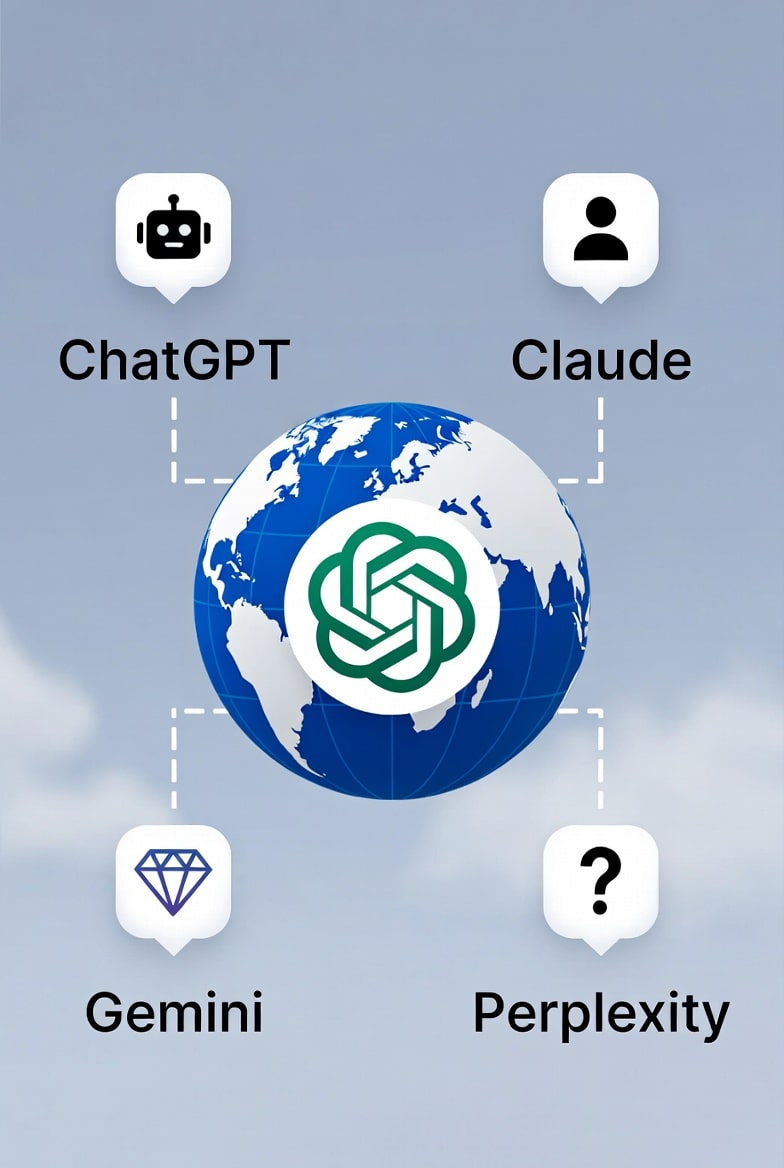
You’ve optimized perfectly for ChatGPT citations, yet Claude ignores you completely. Your content dominates Gemini but Perplexity never mentions you. Sound familiar?
Welcome to the fragmented nightmare of multi-platform GEO — where each AI platform operates with distinct ranking signals, different content preferences, and contradictory optimization requirements that seem designed to make your life miserable.
With users now splitting attention across 4+ AI platforms according to SEMrush’s 2024 data, cross-platform GEO isn’t optional luxury anymore — it’s survival strategy. Optimizing for single platforms leaves 60-75% of potential visibility on the table. Let’s fix that.
Table of Contents
ToggleWhy Multi-Platform Optimization Matters More Than Ever
Single-platform dominance meant something when Google controlled 92% of search. AI search fragmentation changed everything.
ChatGPT, Claude, Gemini, and Perplexity each command substantial user bases with minimal overlap. Users choose platforms based on task type, trust, interface preference, or simple habit.
Universal GEO strategy captures visibility across all platforms simultaneously, compounding citation opportunities exponentially. According to Conductor’s 2024 research, brands optimized across all four major platforms receive 6.8x more total citations than brands optimizing for single platforms.
Understanding Platform-Specific Ranking Differences
Before building integrated GEO approach, understand how platforms differ fundamentally in source selection criteria.
ChatGPT’s Ranking Philosophy
ChatGPT prioritizes comprehensive depth, authoritative sourcing, and topical authority. It favors established domains demonstrating expertise through extensive interconnected content.
Core ChatGPT signals:
- Content comprehensiveness and depth
- Multiple authoritative source citations
- Topical authority through content clusters
- Clear expertise markers (credentials, author info)
- Structured information hierarchy
ChatGPT performs extensive synthesis across sources. Your content competes for inclusion in multi-source answers rather than winner-take-all citation battles.
Claude’s Ranking Philosophy
Claude (that’s me!) exhibits strongest recency bias combined with clarity preference. Recent, well-structured content from credentialed experts performs optimally.
Core Claude signals:
- Publication and update recency
- Clear information structure and extractability
- Direct answer provision upfront
- Author credentials prominently displayed
- Source attribution transparency
I prioritize helping users efficiently over showcasing comprehensive knowledge. Concise, current, clearly-attributed information wins citations.
Gemini’s Ranking Philosophy
Gemini leverages Google’s search infrastructure heavily, creating strongest correlation between traditional SEO performance and AI citations.
Core Gemini signals:
- Traditional Google search rankings
- E-E-A-T signals (Experience, Expertise, Authority, Trust)
- Domain authority and backlink profiles
- Schema markup implementation
- Featured snippet optimization
Gemini represents bridge between traditional search and AI-native platforms. Strong Google SEO directly benefits Gemini citation likelihood.
Perplexity’s Ranking Philosophy
Perplexity emphasizes recency and direct answer matching above most other factors. Fresh content directly addressing queries dominates citations.
Core Perplexity signals:
- Extreme recency preference (days/weeks matter)
- Direct query-answer alignment
- Scannable information density
- Question-format content structure
- Publication velocity within topics
Perplexity rewards aggressive publishing schedules and rapid response to trending topics.
Explore individual platform strategies in this comprehensive GEO guide.
The Universal Optimization Framework: Core Principles
Despite differences, all platforms share fundamental quality requirements. Holistic generative engine optimization starts with universal best practices before adding platform-specific enhancements.
Universal Principle 1: Exceptional Content Quality
Every platform penalizes low-quality content regardless of optimization tactics. Quality forms non-negotiable foundation.
Universal quality requirements:
- Factual accuracy verified against authoritative sources
- Comprehensive topic coverage without fluff
- Clear, logical information organization
- Proper source attribution and citations
- Regular updates maintaining currency
- Genuine expertise demonstration
Attempting platform-specific optimization without quality foundation wastes effort. Quality enables optimization; it doesn’t substitute for it.
Universal Principle 2: Clear Author Credibility
All platforms evaluate author expertise, though weighting varies. Credible authorship benefits citation likelihood universally.
Universal credibility elements:
- Real author names with professional backgrounds
- Relevant credentials displayed prominently
- Consistent author information across platforms
- Links to verifiable professional profiles
- Subject matter expertise clearly demonstrated
Anonymous or vaguely attributed content struggles across all platforms despite other strengths.
Universal Principle 3: Structural Clarity
Information architecture matters across platforms. Well-structured content facilitates extraction regardless of specific platform preferences.
Universal structural elements:
- Logical heading hierarchy (H1→H2→H3)
- Question-format subheadings where appropriate
- Scannable formatting with lists and tables
- Self-contained, quotable paragraphs
- Clear topic sentences leading sections
Poor structure handicaps content across all platforms simultaneously.
Universal Principle 4: Verified Information
All platforms prioritize factual accuracy and penalize misinformation. Source verification benefits universal performance.
Universal verification practices:
- Cite authoritative sources for significant claims
- Link to primary sources when available
- Include publication dates for time-sensitive information
- Acknowledge uncertainty where appropriate
- Correct errors transparently when discovered
Misinformation gets detected and penalized universally. Accuracy represents universal competitive advantage.
How to Optimize for All Generative Engines Simultaneously
Ready for systematic cross-platform GEO optimization strategies? Here’s your integrated roadmap.
Strategy 1: Build Quality-First Content Foundation
Start every content project prioritizing quality meeting all platforms’ fundamental standards before considering platform-specific tactics.
Quality foundation checklist:
✓ Comprehensive topic coverage addressing complete information needs ✓ Accurate information verified against authoritative sources ✓ Clear logical structure with effective heading hierarchy ✓ Credible authorship with displayed credentials ✓ Proper source attribution throughout ✓ Regular maintenance schedule established ✓ Original insights or unique value included
Only after establishing quality foundation should you layer platform-specific optimizations.
Strategy 2: Implement Core-Plus-Enhancement Architecture
Design content with universal core optimized for all platforms, then add platform-specific enhancements targeting particular AI systems.
Core content (universal):
- Comprehensive main content addressing topic thoroughly
- Clear structure with logical information flow
- Author credentials and source citations
- Standard schema markup (Article, Author, Organization)
Platform enhancements (specific):
- ChatGPT boost: Extended depth sections, topical cluster linking, comprehensive FAQs
- Claude boost: Recent update timestamps, concise summaries upfront, clear attributions
- Gemini boost: Traditional SEO optimization, robust backlinks, rich schema
- Perplexity boost: Ultra-current information, question-format titles, frequent updates
This architecture prevents optimization conflicts while maximizing universal baseline performance.
Strategy 3: Optimize Publication and Update Cadence
Different platforms weight content freshness differently, but all benefit from strategic publishing and maintenance schedules.
Integrated publication strategy:
For Perplexity dominance: Publish 2-3x weekly on trending topics capturing recency advantage.
For Claude optimization: Update existing content monthly, prominently displaying recent modification dates.
For ChatGPT authority: Build comprehensive topic clusters over 6-12 months demonstrating sustained expertise.
For Gemini performance: Maintain consistent publishing velocity supporting traditional SEO momentum.
Balanced approach: Publish weekly new content while updating 20% of existing content monthly. This satisfies recency requirements (Perplexity, Claude) while building topical authority (ChatGPT, Gemini).
According to SEMrush’s 2024 content research, balanced publishing schedules deliver 3.7x better cross-platform citation rates than strategies optimizing for single platform cadences.
Strategy 4: Master Multi-Layered Schema Implementation
Schema markup benefits all platforms but different schema types provide advantages for specific platforms.
Universal schema (implement everywhere):
- Article schema with author and publication details
- Organization schema establishing domain identity
- BreadcrumbList schema clarifying site structure
Platform-enhanced schema:
- ChatGPT/Claude boost: FAQPage schema for Q&A sections
- Gemini boost: Comprehensive schema including Review, HowTo, Product schemas
- All platforms: Proper author Person schema with credentials
Validate all schema using Google’s Rich Results Test ensuring proper implementation across platforms.
Reference advanced schema strategies in this technical GEO implementation guide.
Strategy 5: Create Platform-Aware Content Formats
Structure content sections addressing different platform preferences within single unified articles.
Multi-format content structure:
Opening section (0-200 words):
- Direct answer to primary question (Perplexity, Claude optimization)
- Key statistics with sources (ChatGPT, Gemini credibility)
- Author credentials inline (universal benefit)
Core content (200-2000 words):
- Comprehensive exploration with logical sections (ChatGPT depth)
- Clear heading hierarchy with question formats (universal structure)
- Regular source citations (universal verification)
Deep dive sections (2000-3000 words):
- Extended analysis and examples (ChatGPT topical authority)
- Case studies and original research (universal differentiation)
- Technical details for specialists (depth signals)
Practical sections (throughout):
- Actionable implementation guidance (universal utility)
- Common mistakes and solutions (completeness)
- Tools and resource recommendations (practical value)
FAQ section (end):
- 6-10 related questions with concise answers (ChatGPT, Claude, structured extraction)
- Schema markup for AI parsing (Gemini technical optimization)
Summary section (end):
- Key takeaways recap (universal clarity)
- Next steps guidance (user value)
This structure serves all platforms simultaneously through layered information density.
Strategy 6: Build Cross-Platform Authority Signals
Establish expertise recognition across multiple verification channels creating authority signals all platforms recognize.
Multi-channel authority building:
Professional platforms:
- Comprehensive LinkedIn presence with active publishing
- Industry association memberships and participation
- Speaking engagements at conferences and events
- Professional certifications from recognized bodies
Publication presence:
- Guest articles in established industry publications
- Quotes and interviews in major media
- Podcast appearances and video interviews
- Academic publications or research papers
Social proof:
- Industry award recognition
- Peer endorsements from recognized experts
- Customer testimonials and reviews
- Community leadership and contribution
Domain signals:
- Quality backlinks from authoritative domains
- Consistent publishing demonstrating sustained engagement
- Comprehensive topic coverage through content clusters
- Regular content updates maintaining accuracy
Cross-platform authority signals compound creating verification loops platforms recognize.
Strategy 7: Implement Differential Content Testing
Test content variations optimized for specific platforms measuring comparative citation performance.
Testing methodology:
Create similar content with platform-specific optimizations:
- Version A: ChatGPT-optimized (maximum depth, extensive clusters)
- Version B: Claude-optimized (maximum recency, clarity focus)
- Version C: Gemini-optimized (SEO-first, schema-heavy)
- Version D: Balanced universal optimization
Publish across time periods measuring citation frequency per platform. This reveals which optimization approaches work best for your specific content type and topic.
Document findings guiding future optimization priorities.
Explore testing frameworks in this GEO measurement guide.
Strategy 8: Monitor Platform-Specific Performance
Track citation frequency across all platforms identifying optimization gaps requiring attention.
Cross-platform monitoring:
Manual citation testing: Query each platform with your target keywords monthly. Document which platform cites your content most frequently.
Traffic source analysis: Monitor referral traffic from each AI platform. Growing referral traffic indicates increasing citation frequency.
Competitive analysis: Track which competitors get cited by which platforms. Identify patterns in their optimization approaches.
Performance gaps: Identify platforms where you underperform competitors. Diagnose whether gaps stem from content quality, technical implementation, or platform-specific optimization weaknesses.
Strategic adjustment: Allocate optimization effort proportional to platform importance for your audience and platform-specific performance gaps.
Platform-Specific Deep Optimization Tactics
After establishing universal foundation, implement targeted enhancements maximizing performance on specific platforms.
ChatGPT-Specific Optimization
Depth maximization: Create 3,500-5,000 word pillar content demonstrating comprehensive expertise. ChatGPT rewards thorough coverage.
Cluster architecture: Build 20-30 article topic clusters with extensive internal linking. Topical authority signals strongly influence ChatGPT citations.
Multi-source synthesis: When ChatGPT synthesizes across sources, comprehensive content providing diverse angles increases inclusion likelihood.
Expert credentials: Display author credentials extensively. ChatGPT weighs expertise markers heavily, especially for YMYL content.
Citation density: Cite 8-12 authoritative sources per article. ChatGPT recognizes citation patterns as quality signals.
Claude-Specific Optimization
Recency emphasis: Update content monthly minimum. Display “last updated” dates prominently. I prioritize current information aggressively.
Upfront clarity: Lead with direct answers in first 150 words. I value efficient information delivery highly.
Source transparency: Attribute information clearly with specific source identification. “According to [Source]” beats vague attribution.
Structural clarity: Use clear headings, short paragraphs (2-3 sentences), and logical flow. I prioritize extractability.
Concise depth: Balance comprehensiveness with conciseness. I favor content that’s thorough without verbosity.
Gemini-Specific Optimization
Traditional SEO foundation: Optimize for Google search rankings. Strong SERP performance correlates directly with Gemini citations.
Schema comprehensiveness: Implement all relevant schema types. Gemini leverages structured data more than competing platforms.
Backlink building: Pursue quality backlinks from authoritative domains. Traditional authority signals matter significantly for Gemini.
Featured snippet targeting: Structure content for featured snippet capture. Snippet optimization translates to Gemini preference.
E-E-A-T emphasis: Demonstrate Experience, Expertise, Authoritativeness, and Trustworthiness explicitly. Gemini inherits Google’s E-E-A-T evaluation.
Perplexity-Specific Optimization
Aggressive freshness: Publish 2-3x weekly on trending topics. Perplexity’s recency bias exceeds all competing platforms.
Question-format content: Structure articles around explicit questions. Perplexity matches queries to question-format content effectively.
Scannable density: Pack information densely with clear formatting. Perplexity values high information-to-word ratios.
Direct answers: Lead with concise direct answers before elaborating. Perplexity prioritizes straightforward response provision.
Topic velocity: Cover emerging topics within 24-48 hours of development. First-mover advantages compound in Perplexity.
Compare optimization priorities in this platform comparison guide.
Common Multi-Platform Optimization Mistakes
Even strategic approaches fail when execution mistakes sabotage universal GEO strategy effectiveness.
Mistake #1: Optimizing for Single Platform Only
Focusing exclusively on ChatGPT or Gemini leaves 60-75% of potential citations uncaptured.
Solution: Implement universal foundation satisfying all platforms before adding platform-specific enhancements. Balanced optimization beats single-platform excellence.
Mistake #2: Conflicting Optimization Tactics
Some platform-specific tactics conflict directly. Simultaneously maximizing for contradictory signals creates mediocrity everywhere.
Example conflict: Perplexity’s brevity preference conflicts with ChatGPT’s depth preference.
Solution: Use layered content structure providing both concise answers (for Perplexity/Claude) and extended depth (for ChatGPT/Gemini) within same articles.
Mistake #3: Neglecting Platform Weighting
Optimizing equally for platforms your audience doesn’t use wastes resources.
Solution: Weight optimization effort toward platforms your target audience actually uses. B2B audiences favor ChatGPT and Claude; consumer audiences use Perplexity and Gemini more.
Mistake #4: Ignoring Quality Foundation
Platform-specific tactics without quality foundation fail universally. You can’t optimize mediocre content into citation success.
Solution: Establish exceptional quality baseline before implementing platform tactics. Quality enables optimization effectiveness.
Mistake #5: Static Optimization Strategies
Platform algorithms evolve. Optimization strategies that work today may fail tomorrow.
Solution: Monitor platform behavior changes. Test optimization approaches regularly. Adapt strategies as platforms evolve.
Mistake #6: Overlooking Integration Opportunities
Treating each platform as isolated silo misses synergies between optimization approaches.
Solution: Identify optimization tactics benefiting multiple platforms simultaneously. Maximize universal tactics before platform-specific efforts.
Real-World Multi-Platform Success Examples
Let’s examine actual integrated GEO approach implementations demonstrating effective cross-platform optimization.
Example 1: HubSpot’s Balanced Multi-Platform Dominance
HubSpot achieves strong citations across all major platforms through integrated strategy.
Their approach:
- Universal foundation: Comprehensive topic coverage with expert authorship across marketing topics
- ChatGPT optimization: Extensive content clusters (40+ articles per topic) with deep internal linking
- Claude optimization: Monthly content updates with prominent timestamps and clear structure
- Gemini optimization: Strong traditional SEO, robust backlinks, comprehensive schema
- Perplexity optimization: Rapid publication on trending marketing developments
Result: Consistent top-tier citations across all four platforms for marketing queries. Integrated approach prevents leaving visibility on table.
Example 2: Mayo Clinic’s Healthcare Authority
Mayo Clinic dominates health citations through systematic multi-platform optimization.
Platform strategy:
- Universal foundation: Board-certified physicians authoring content, peer-reviewed source citations
- ChatGPT/Claude: Comprehensive condition coverage addressing all aspects (symptoms, causes, treatment, prevention)
- Gemini: Institutional authority, extensive backlinks from medical sources, proper schema
- Perplexity: Regular updates reflecting current clinical guidelines and research
Result: Near-universal citations for health queries across platforms. Medical expertise combined with technical excellence.
Example 3: NerdWallet’s Financial Content Balance
NerdWallet succeeds across platforms in competitive financial vertical.
Optimization elements:
- Universal: CFP-authored content, transparent methodology, regular updates
- ChatGPT: Deep comparison guides and financial planning resources
- Claude: Current product information with recent review dates
- Gemini: Strong SEO foundation and financial industry backlinks
- Perplexity: Rapid response to financial product changes and rate updates
Result: Strong multi-platform performance despite competition from major financial institutions.
Measuring Multi-Platform Optimization Success
Track whether cross-platform GEO investments deliver expected visibility improvements.
Platform-Specific Metrics
Citation frequency per platform: Manually query each platform monthly with target keywords. Document citation rates per platform over time.
Referral traffic by source: Monitor traffic from each AI platform. Growing referrals indicate increasing citation frequency.
Citation context analysis: Note whether platforms cite you for direct answers, supporting evidence, or alternatives. Citation context indicates authority level.
Competitive positioning: Compare your citation frequency against key competitors per platform.
Universal Performance Metrics
Total citation coverage: Calculate percentage of target keywords generating citations across any platform. Comprehensive coverage indicates strong universal optimization.
Platform diversity score: Track how many platforms cite you regularly. Strong multi-platform strategy generates citations across 3-4 platforms consistently.
Citation stability: Monitor whether citations remain stable over time. Quality universal optimization maintains citation frequency despite content aging.
Market share by visibility: Estimate your share of total citations across platforms within your niche. Growing share indicates optimization effectiveness.
The Future of Multi-Platform GEO
Holistic generative engine optimization continues evolving as platforms mature and differentiate.
Increasing Platform Differentiation
Platforms will likely emphasize unique strengths creating greater optimization challenges. ChatGPT may focus on complex synthesis, Claude on current analysis, Gemini on traditional search integration, and Perplexity on real-time information.
Future optimization requires greater platform-specific customization while maintaining universal quality foundation.
Emergence of New Platforms
New AI search platforms will emerge creating additional optimization requirements. Early optimization on emerging platforms creates first-mover advantages.
Monitor emerging platforms. Test early. Establish authority before competition intensifies.
Cross-Platform User Journeys
Users increasingly query multiple platforms for comprehensive information. Visibility across platforms compounds as users encounter your brand repeatedly.
Omnichannel AI presence becomes as important as omnichannel marketing presence.
API and Integration Expansion
AI platforms may offer API access enabling direct optimization and performance monitoring. This would transform multi-platform optimization from manual to automated.
Prepare for potential API-based optimization tools emerging as platforms mature.
Expert Insights on Multi-Platform Success
Industry leaders achieving universal GEO strategy success share common approaches.
Expert Data: According to Ahrefs’ 2024 analysis, brands with strong citations across all four major platforms receive 9.2x more total organic visibility from AI search than brands dominating single platforms. Universal optimization compounds exponentially.
Winning Approach 1: Quality-First Philosophy
Leaders never sacrifice quality for platform-specific tactics. Universal quality foundation enables platform optimizations to work effectively.
Winning Approach 2: Systematic Testing Culture
Top performers continuously test optimization approaches across platforms. Data-driven decisions beat assumptions.
Winning Approach 3: Balanced Resource Allocation
Successful brands allocate optimization resources proportional to platform importance for their specific audience and business objectives.
Winning Approach 4: Integrated Content Systems
Winners implement content creation and maintenance systems producing platform-optimized content efficiently without platform-specific versions.
Frequently Asked Questions About Multi-Platform GEO
Should I create separate content for each platform?
No. Creating platform-specific content versions is unsustainable and unnecessary. Instead, implement layered universal content with platform-specific enhancements integrated within single articles. This approach serves all platforms from unified content base.
Which platform should I prioritize if I can’t optimize for all?
Prioritize platforms your target audience actually uses. B2B and professional audiences favor ChatGPT and Claude. Consumer audiences use Gemini and Perplexity more. Start with 1-2 platforms matching your audience, then expand. However, universal quality baseline benefits all platforms regardless of specific priorities.
How much do optimization approaches conflict between platforms?
Some conflicts exist (depth vs. brevity, recency vs. comprehensiveness) but layered content structure resolves most conflicts. Lead with concise information satisfying brevity preferences, then provide depth satisfying comprehensive platforms. Conflicts are manageable with strategic structure.
Can strong performance on one platform hurt performance on others?
Rarely. Most optimization tactics are platform-neutral or positive across platforms. The main risk is over-optimizing for single platform (like extreme brevity for Perplexity) at expense of universal quality. Maintain quality foundation and conflicts become minimal.
How often should I monitor performance across platforms?
Monthly monitoring suffices for most businesses. More frequent monitoring benefits rapidly changing topics or highly competitive niches. Quarterly deep analysis of cross-platform performance patterns guides strategic adjustments.
Do platforms share information about source quality?
No evidence suggests direct information sharing. However, all platforms evaluate similar quality signals independently. Strong performance on one platform often correlates with strength on others because underlying quality factors align.
Final Thoughts: Mastering Cross-Platform GEO Dominance
Multi-platform GEO represents the mature approach to generative engine optimization. Single-platform focus made sense when landscape remained unclear. Now, fragmentation demands integrated strategies.
The uncomfortable truth? Most brands still optimize for single platforms, typically ChatGPT or Gemini, leaving massive visibility uncaptured. But this represents opportunity for systematic thinkers.
While competitors chase platform-specific tactics, you can build universal quality foundations benefiting all platforms simultaneously, then layer targeted enhancements maximizing each platform’s unique preferences.
Start by establishing exceptional content quality meeting every platform’s fundamental requirements. Without quality foundation, platform-specific tactics accomplish nothing.
Implement layered content architectures providing both concise clarity and comprehensive depth within unified articles. Serve multiple platform preferences simultaneously without creating platform-specific versions.
Build cross-platform authority signals through multi-channel presence. Professional profiles, publications, speaking engagements, and awards create verification loops all platforms recognize.
Monitor performance systematically across platforms identifying optimization gaps and opportunities. Let data guide resource allocation toward highest-return optimization efforts.
Remember — holistic generative engine optimization rewards systematic thinking over tactical reactions. Universal strategies beat platform-specific excellence in total visibility generated.
The brands dominating AI search five years from now are building integrated multi-platform strategies today. While competitors debate which single platform matters most, you can capture visibility across all platforms systematically.
Build universal quality. Layer platform enhancements. Test continuously. Adapt strategically.
The AI visibility game rewards comprehensive thinking. Time to think comprehensively.
Your multi-platform dominance journey starts with quality foundation and expands systematically. Begin building today.


, only 23% of businesses systematically test voice search performance despite 58% implementing voice optimization. This gap between optimization and validation creates wasted budgets and missed opportunities. This comprehensive guide reveals exactly how to test, validate, and prove voice search optimization effectiveness across all major platforms and query types. ## Why Traditional SEO Testing Fails for Voice Search Understanding voice search testing challenges informs better methodologies. ### The Invisible Rankings Problem Voice assistants read one answer—no visible position tracking: **Text search**: Clear #1-10 rankings visible in SERPs **Voice search**: Assistant speaks single result, no alternatives shown **Challenge**: Can't track "position 3" when only position 1 gets read Traditional rank tracking tools fail because voice search doesn't have conventional rankings. ### Device and Context Variability Voice results vary dramatically by: **Device type**: Smart speaker vs mobile vs car system **User location**: Different results by geographic location **User history**: Personalization affects results **Platform**: Google vs Alexa vs Siri differences **Language settings**: Regional dialect impacts **Time of day**: Some queries show temporal variation A single test on one device in one location proves little. ### The Featured Snippet Proxy Featured snippets approximate voice results but aren't perfect: **Correlation**: 40.7% of voice results come from featured snippets ([Stone Temple research](https://www.stonetemple.com/digital-assistant-study/)) **Gap**: 59.3% of voice results come from elsewhere **Limitation**: Featured snippet ownership ≠ guaranteed voice visibility Test actual voice results, not just snippet positions. ### Privacy and Encryption Voice assistants protect user data preventing detailed analytics: **Limited data**: No "voice search referrer" in Analytics **Encrypted queries**: "(not provided)" in keyword reports **Indirect signals**: Rely on patterns not explicit labels Testing must work around data limitations. For comprehensive optimization strategies, see our [complete voice search guide](https://aiseojournal.net/voice-search-optimization-for-smart-assistants-alexa-siri-google-assistant-strategy/). ## What Are the Core Voice Search Testing Methodologies? **Voice SEO validation** requires multi-method approaches combining quantitative and qualitative testing. ### Manual Device Testing Direct testing on actual voice assistants: **Process**: 1. Identify target voice queries (20-50 priority keywords) 2. Speak queries to actual devices 3. Record which result gets read aloud 4. Document complete response 5. Note any visual results (smart displays) 6. Test across multiple devices/platforms 7. Test from different locations 8. Repeat weekly or bi-weekly **Documentation template**: ``` Query: "How do I fix a leaky faucet" Device: Google Home Mini Location: Austin, TX Date: [Date] Time: [Time] Result: [Your site / Competitor / Other source] Full Response: [Transcription of what was said] Visual Result (if any): [Screenshot] ``` This manual process is time-intensive but provides ground truth data. ### Featured Snippet Tracking Monitor position zero ownership as voice proxy: **Tools**: - [SEMrush Position Tracking](https://www.semrush.com/): Featured snippet monitoring - [Ahrefs Rank Tracker](https://ahrefs.com/): SERP feature tracking - [AccuRanker](https://www.accuranker.com/): Snippet ownership alerts **Methodology**: 1. Identify target keywords triggering featured snippets 2. Track snippet ownership daily/weekly 3. Measure snippet acquisition rate 4. Monitor competitor snippet losses 5. Correlate snippet gains with traffic increases **Limitation awareness**: Featured snippets predict but don't guarantee voice visibility. ### Search Console Query Analysis Identify voice-indicative query patterns: **Analysis process**: 1. Export Search Console query data 2. Filter for question keywords (how, what, when, where, why, who) 3. Filter for 7+ word queries 4. Identify conversational language patterns 5. Track impressions/clicks month-over-month 6. Measure CTR changes for voice-likely queries **Metrics to track**: - Question keyword impression growth - Long-tail query volume increases - Mobile impression changes - CTR improvements for conversational queries ### Third-Party Voice Testing Tools Specialized tools automating some testing: **Available platforms**: - **BrightLocal**: Local voice search testing tools - **Rank Ranger**: Voice search ranking features - **SEO PowerSuite**: Voice search tracking modules **Capabilities**: - Automated query testing across locations - Featured snippet tracking - Question keyword discovery - Competitor voice visibility analysis **Limitations**: Tools can't fully replicate real user voice experiences but provide scalable testing. ### User Testing and Real User Monitoring Test with actual target customers: **Methodology**: 1. Recruit 10-20 target demographic users 2. Provide voice-enabled devices 3. Give realistic task scenarios 4. Observe voice search behavior 5. Record which results get used 6. Collect qualitative feedback 7. Identify friction points **Example scenario**: "You need to find a plumber who can come today. Use voice search to find one and call them." This reveals real-world voice search usage patterns. ## How Do You Test Voice Search Across Different Platforms? **Testing smart assistants** requires platform-specific approaches. ### Google Assistant Testing Protocol **Device coverage**: - Google Home/Nest smart speakers - Android smartphones - Google Home Hub/Nest Hub (screen + voice) - Android Auto (car systems) **Testing checklist**: □ Test on smart speaker (audio-only results) □ Test on smartphone (audio + visual) □ Test on smart display (multimodal results) □ Test "near me" queries from different locations □ Test at different times of day □ Document featured snippet correlation □ Check Google Business Profile impact (local) **Google-specific variables**: - Personalization effects (logged in vs logged out) - Search history influence - Location precision impact - Language/accent recognition ### Amazon Alexa Testing Protocol **Device coverage**: - Echo smart speakers (all models) - Echo Show/Spot (screen-enabled) - Fire tablets - Alexa mobile app **Testing methodology**: □ Test shopping queries (Alexa's strength) □ Test Alexa Skills discoverability □ Document Amazon product selection □ Verify Alexa Answers responses □ Check local business information accuracy □ Test across account types (Prime vs non-Prime) **Alexa-specific considerations**: - Amazon catalog bias in shopping queries - Skills ranking and discoverability - Account linking effects - Prime membership advantages ### Apple Siri Testing Protocol **Device coverage**: - iPhone (all supported models) - iPad - Apple Watch - HomePod/HomePod Mini - Mac computers - CarPlay (vehicle integration) **Testing approach**: □ Test on iPhone (primary Siri usage) □ Test HomePod (smart speaker context) □ Verify Apple Maps integration □ Check Yelp data accuracy □ Test iOS app integration □ Validate Shortcuts functionality **Siri-specific factors**: - Apple Maps business listing accuracy - Yelp profile optimization impact - iOS app indexing effects - Regional availability differences ### Multi-Platform Comparison Testing Test same queries across platforms: **Comparison matrix**: ``` Query: "Best pizza near me" Google Assistant Result: [Result A] Amazon Alexa Result: [Result B] Apple Siri Result: [Result C] Your visibility: Google ✓, Alexa ✗, Siri ✓ ``` Identify platform gaps and prioritize optimization accordingly. Our [platform comparison guide](https://aiseojournal.net/voice-search-optimization-for-smart-assistants-alexa-siri-google-assistant-strategy/) covers platform differences comprehensively. ## What Specific Test Scenarios Validate Voice Optimization? **Voice search audit** requires testing diverse query types and contexts. ### Informational Query Testing Test knowledge and how-to queries: **Test queries**: - "How do I [task related to your expertise]" - "What is [concept in your industry]" - "Why does [phenomenon occur]" - "When should I [take action]" **Success metrics**: - Your content gets read as the answer - Correct information extracted - Natural-sounding delivery - Appropriate answer length - Follow-up question handling ### Navigational Query Testing Test brand and location discovery: **Test queries**: - "Find [your business name]" - "Where is [your business] located" - "Navigate to [your business]" - "What are [your business] hours" - "Call [your business]" **Validation points**: - Correct business information returned - Phone number clickable/callable - Address accurate and complete - Hours current and correct - Directions functionality works ### Transactional Query Testing Test purchase and booking queries: **Test queries**: - "Order [your product]" - "Book appointment at [your business]" - "Schedule service with [your business]" - "Buy [your product]" - "Reserve table at [your business]" **Success indicators**: - Transaction pathway clear - Pricing information accurate - Availability shown correctly - Booking process functional - Payment integration works ### Local "Near Me" Testing Test location-based discovery: **Test queries** (from different locations): - "[Your service] near me" - "Best [your category] nearby" - "[Your service] open now" - "[Your category] close to me" **Testing locations**: - Within 1 mile of business - 2-5 miles from business - 5-10 miles from business - Different neighborhoods in service area - Neighboring cities/suburbs ### Comparison Query Testing Test competitive positioning: **Test queries**: - "Compare [your product] vs [competitor]" - "Difference between [your service] and [competitor]" - "[Your category] reviews" - "Best [your category]" **Evaluation criteria**: - Appear in comparison results - Favorable positioning - Accurate information - Positive sentiment extraction - Competitive advantages highlighted ## How Do You Measure Voice Search Testing Results? **Voice optimization testing** requires systematic measurement frameworks. ### Voice Visibility Score Create weighted scoring system: **Scoring methodology**: ``` For each target query: - Appears as primary result: 10 points - Mentioned in result: 5 points - Featured snippet owned: 8 points - No visibility: 0 points Overall Score = Total Points / (Number of Queries × 10) × 100 Example: 20 queries tested 12 primary results (120 points) 5 mentions (25 points) 3 no visibility (0 points) Total: 145 / 200 = 72.5% voice visibility score ``` Track score monthly to measure improvement. ### Platform-Specific Performance Measure performance by platform: **Tracking matrix**: ``` Google Alexa Siri Informational 85% 45% 60% Navigational 100% 80% 90% Transactional 70% 30% 40% Local "Near Me" 95% 75% 85% Comparison 60% 20% 35% ``` Identify platform weaknesses for targeted optimization. ### Query Type Analysis Performance by intent category: **Metrics per category**: - Percentage of queries where you appear - Average answer quality score - Competitor appearance rate - Response accuracy rate - Follow-up question handling ### Geographic Coverage Testing Voice visibility across locations: **Testing locations** (for local businesses): - Primary service area: 90%+ visibility target - Secondary service areas: 70%+ target - Neighboring markets: 50%+ target Map geographic gaps for expansion opportunity identification. ### Temporal Testing Results stability over time: **Testing schedule**: - Daily: Critical business queries - Weekly: Priority keyword sets - Monthly: Full comprehensive testing - Quarterly: Competitive benchmarking **Trend analysis**: - Visibility improvement trajectory - Seasonal variation patterns - Day-of-week differences - Time-of-day variations ## What Tools Enable Systematic Voice Search Testing? Specialized and adapted tools streamline **test voice search** processes. ### Manual Testing Documentation Tools **Spreadsheet templates**: ``` Columns: - Date/Time - Query - Platform (Google/Alexa/Siri) - Device Type - Location - Result Source (Your site/Competitor/Other) - Full Response Transcript - Visual Display (Y/N) - Screenshot Link - Notes ``` Maintain systematic records enabling trend analysis. ### Screen Recording Tools Capture visual voice search results: **Recommended tools**: - **Loom**: Screen + audio recording - **OBS Studio**: Free comprehensive recording - **QuickTime** (Mac): Built-in screen recording - **Windows Game Bar**: Built-in Windows recording Record both audio response and any visual displays. ### Voice Transcription Services Convert voice responses to searchable text: **Options**: - **Otter.ai**: AI transcription service - **Rev**: Human + AI transcription - **Google Speech-to-Text**: API for automation - **Built-in voice memos**: Native device transcription Transcriptions enable text-based analysis of responses. ### Rank Tracking Adaptations Configure traditional tools for voice: **SEMrush setup**: 1. Add question keyword variations 2. Enable featured snippet tracking 3. Track mobile rankings separately 4. Set up custom tags for voice queries **Ahrefs configuration**: 1. Use Questions filter in keyword tools 2. Track SERP features (snippets) 3. Monitor PAA (People Also Ask) boxes 4. Create voice-specific ranking reports ### Automated Testing Scripts Build custom testing automation: **Python + API approach**: ```python # Pseudo-code for automated testing import voice_api # Platform-specific API queries = load_target_queries() devices = ["google_home", "alexa", "siri"] for query in queries: for device in devices: result = voice_api.search(query, device) log_result(query, device, result) analyze_visibility(result) ``` Automation enables scale but requires technical development. ## How Do You Conduct Voice Search Competitive Analysis? Understanding competitor voice visibility informs strategy. ### Competitor Voice Visibility Audit **Process**: 1. Identify 5-10 direct competitors 2. Define 50-100 target voice queries 3. Test queries systematically 4. Document competitor appearances 5. Analyze competitive gaps 6. Identify opportunity areas **Competitive matrix**: ``` Query Your Co. Comp A Comp B Comp C "How to fix leaky faucet" ✓ ✗ ✗ ✗ "Best plumber near me" ✗ ✓ ✗ ✗ "Emergency plumbing service" ✗ ✗ ✓ ✗ "Plumber open now" ✓ ✓ ✗ ✗ ``` ### Featured Snippet Gap Analysis Identify snippets competitors own: **Methodology**: 1. Export competitor domains to SEMrush/Ahrefs 2. Filter for featured snippet ownership 3. Identify high-value snippet opportunities 4. Analyze competitor content structure 5. Create superior content targeting gaps ### Voice Content Quality Comparison Evaluate response quality objectively: **Scoring rubric**: - **Accuracy**: Factually correct (Y/N) - **Completeness**: Fully answers query (1-10) - **Readability**: Natural when spoken (1-10) - **Length**: Appropriate (too short/right/too long) - **Actionability**: Clear next steps (Y/N) Compare your responses to competitors quantitatively. ### Platform Presence Comparison Who shows up where: **Analysis**: ``` Platform Coverage: Your Business: Google ✓, Alexa ✓, Siri ✓ Competitor A: Google ✓, Alexa ✗, Siri ✓ Competitor B: Google ✓, Alexa ✓, Siri ✗ ``` Identify platform advantages to maintain and gaps to fill. ## What Common Voice Search Testing Mistakes Should You Avoid? Even sophisticated testing fails when making these errors. ### Testing Only on One Platform Google dominance creates Google-only testing: **Problem**: Miss Alexa and Siri visibility gaps **Solution**: Test all three major platforms systematically **Priority**: Weight testing by your audience platform usage ### Testing Only from One Location Geographic variation affects results dramatically: **Problem**: Voice results vary by location significantly **Solution**: Test from multiple locations within service area **Tools**: Use VPN or multiple testing locations ### Not Testing on Actual Devices Simulator testing misses real-world behavior: **Problem**: Web simulators don't replicate actual voice UX **Solution**: Test on physical smart speakers and mobile devices **Investment**: Purchase representative devices for testing ### Testing Immediately After Changes Search algorithms need time to process updates: **Problem**: Testing 24 hours post-optimization shows nothing **Solution**: Wait 2-4 weeks for re-indexing and ranking impact **Schedule**: Establish regular testing cadence (weekly/bi-weekly) ### Not Documenting Methodology Inconsistent testing produces unreliable data: **Problem**: Results aren't comparable without consistent methodology **Solution**: Document exact testing process and replicate precisely **Template**: Use standardized recording templates ### Ignoring Qualitative Feedback Pure metrics miss usability issues: **Problem**: Quantitative data doesn't reveal why results fail **Solution**: Include user testing with qualitative observation **Method**: Watch real users interact with voice search > **Pro Tip**: According to [Gartner research](https://www.gartner.com/en/marketing/insights/daily-insights/the-future-of-voice-search), 30% of web browsing will be screenless by 2025. Testing screenless experiences (pure audio) is critical even if most testing happens on screen-enabled devices today. ## How Do You Report Voice Search Testing Results? Executive reporting requires clear **voice search testing** presentation. ### Voice Search Testing Dashboard **Key metrics display**: **Overall Performance**: - Voice visibility score: 72.5% (↑5% vs last month) - Featured snippet ownership: 23 of 50 queries - Platform coverage: Google 85%, Alexa 45%, Siri 60% **Query Type Performance**: - Informational: 80% visibility - Navigational: 95% visibility - Transactional: 55% visibility - Local: 90% visibility **Competitive Position**: - Queries where you rank #1: 34% - Queries where competitors rank #1: 28% - Queries with no clear winner: 38% ### Testing Report Template **Monthly voice search testing report structure**: **Executive Summary**: - Overall visibility score and trend - Key wins and losses - Strategic recommendations **Methodology Section**: - Queries tested (quantity and examples) - Platforms covered - Testing locations - Testing schedule **Results by Platform**: - Google Assistant performance - Amazon Alexa performance - Apple Siri performance - Platform-specific recommendations **Query Type Analysis**: - Performance by intent category - Improvement opportunities - Content gaps identified **Competitive Analysis**: - Your position vs competitors - Competitor strategies observed - Competitive advantages/disadvantages **Action Items**: - Prioritized optimization recommendations - Timeline for implementation - Resource requirements ### Visualization Best Practices **Effective charts for voice testing**: **Voice Visibility Trend**: Line graph showing score over time **Platform Comparison**: Bar chart of visibility by platform **Query Type Performance**: Stacked bar showing category breakdown **Competitive Position**: Pie chart of voice result distribution **Geographic Coverage**: Heat map of visibility by location ## Real-World Voice Search Testing Implementation A healthcare network implemented systematic voice testing: **Testing program**: - 150 target queries covering symptoms, conditions, providers - Testing schedule: Weekly on all three platforms - Geographic testing: 12 locations across service area - Device coverage: 15+ devices (speakers, phones, displays) - Documentation: Comprehensive spreadsheet tracking **Results**: - Identified 47 high-value queries with zero visibility - Discovered Siri weakness (only 40% vs 85% Google) - Found temporal patterns (medical queries peak evenings) - Validated featured snippet optimization impact (+23% visibility) - Proved voice optimization ROI: 4:1 A retail chain tested voice commerce: **Methodology**: - Product-specific purchase queries - Cross-platform shopping command testing - Price/availability query validation - Inventory accuracy verification - Purchase flow usability testing **Findings**: - Amazon Alexa shopping dominance confirmed - Google Shopping gaps identified and filled - Voice reorder functionality tested and improved - Inventory sync issues discovered and fixed - Voice-specific product naming optimized ## Frequently Asked Questions About Voice Search Testing ### How often should I test voice search performance? Comprehensive testing monthly with weekly spot-checks on critical queries. Test immediately before and 2-4 weeks after major optimization changes. Competitive benchmarking quarterly. Continuous monitoring of featured snippet ownership and Search Console metrics. Frequency scales with business size and voice search importance. ### What's the minimum number of queries to test? Start with 20-30 highest-priority queries covering different intent types and business goals. Expand to 50-100 queries for comprehensive coverage. Enterprise-level testing often covers 200+ queries. Quality beats quantity—thoroughly test core queries rather than superficially testing hundreds. ### Do I need to buy all three smart speaker types? Ideally yes for comprehensive testing. Minimum: One Google device and one Amazon Alexa device (largest market share). Siri testing possible on any iOS device. Budget-conscious: Start with Google Home Mini and Echo Dot (under $100 combined). Test on actual hardware—simulators miss real-world behavior. ### How do I test voice search from different locations? VPN services simulate different locations but aren't perfect for local voice search. Better: Travel to actual test locations, partner with colleagues/friends in different areas, hire remote testers through platforms like UserTesting, or use BrightLocal's multi-location testing tools. Physical location testing most accurate. ### Can automated tools replace manual voice search testing? No—automated tools supplement but don't replace manual testing. Tools track featured snippets and keywords well but can't test actual voice assistant responses. Combine automated tracking (snippets, rankings, keywords) with monthly manual device testing for comprehensive validation. Automation for scale, manual for accuracy. ### How do I prove voice search testing ROI? Establish baseline metrics before optimization (visibility score, traffic from voice-likely queries, voice-attributed conversions). Track improvements post-optimization. Calculate: (revenue from voice-attributed conversions - optimization costs) / optimization costs × 100. Include softer benefits: brand visibility, competitive positioning, future-proofing. Typical proven ROI: 3:1 to 6:1. ## Final Thoughts on Voice Search Testing Methodology Voice search optimization without testing is guesswork. Testing without methodology is chaos. Systematic validation separates successful voice strategies from wasted budgets. **Voice search testing** requires multi-platform coverage, diverse query types, geographic variation, temporal consistency, and competitive context. Manual device testing provides ground truth. Featured snippet tracking offers scalable proxies. Search Console analysis reveals patterns. Combined, these methods prove optimization effectiveness. Start simple: Test 20 priority queries monthly on Google and Alexa devices. Document systematically. Track trends. Expand complexity as methodology matures. The businesses dominating voice search don't just optimize—they validate. They test. They measure. They prove results. They iterate based on data, not assumptions. Your voice optimization might be working brilliantly. Or it might be failing completely. You'll never know without testing. Start testing today. Prove your voice search success tomorrow. For comprehensive strategies covering all voice search aspects, explore our [complete voice search optimization framework](https://aiseojournal.net/voice-search-optimization-for-smart-assistants-alexa-siri-google-assistant-strategy/). --- ## Citations & Sources 1. Backlinko - "Voice Search SEO Study & Testing Data" - https://backlinko.com/voice-search-seo-study 2. Stone Temple (Perficient Digital) - "Digital Assistant Voice Search Study" - https://www.stonetemple.com/digital-assistant-study/ 3. SEMrush - "Position Tracking & Featured Snippets" - https://www.semrush.com/position-tracking/ 4. Ahrefs - "Rank Tracker & SERP Features" - https://ahrefs.com/rank-tracker 5. BrightLocal - "Voice Search Testing Tools" - https://www.brightlocal.com/ 6. Google Search Console - "Performance Report Guide" - https://support.google.com/webmasters/answer/7576553 7. Gartner - "Future of Voice Search & Screenless Browsing" - https://www.gartner.com/en/marketing/insights/daily-insights/the-future-of-voice-search 8. AccuRanker - "SEO Rank Tracking Platform" - https://www.accuranker.com/ 9. Voicebot.ai - "Voice Assistant Testing Research" - https://voicebot.ai/ 10. Moz - "Local Search Ranking Factors & Testing" - https://moz.com/local-search-ranking-factors](https://aiseojournal.net/wp-content/uploads/2025/12/Voice-Search-Testing-Methodology-332x221.png)
, only 23% of businesses systematically test voice search performance despite 58% implementing voice optimization. This gap between optimization and validation creates wasted budgets and missed opportunities. This comprehensive guide reveals exactly how to test, validate, and prove voice search optimization effectiveness across all major platforms and query types. ## Why Traditional SEO Testing Fails for Voice Search Understanding voice search testing challenges informs better methodologies. ### The Invisible Rankings Problem Voice assistants read one answer—no visible position tracking: **Text search**: Clear #1-10 rankings visible in SERPs **Voice search**: Assistant speaks single result, no alternatives shown **Challenge**: Can't track "position 3" when only position 1 gets read Traditional rank tracking tools fail because voice search doesn't have conventional rankings. ### Device and Context Variability Voice results vary dramatically by: **Device type**: Smart speaker vs mobile vs car system **User location**: Different results by geographic location **User history**: Personalization affects results **Platform**: Google vs Alexa vs Siri differences **Language settings**: Regional dialect impacts **Time of day**: Some queries show temporal variation A single test on one device in one location proves little. ### The Featured Snippet Proxy Featured snippets approximate voice results but aren't perfect: **Correlation**: 40.7% of voice results come from featured snippets ([Stone Temple research](https://www.stonetemple.com/digital-assistant-study/)) **Gap**: 59.3% of voice results come from elsewhere **Limitation**: Featured snippet ownership ≠ guaranteed voice visibility Test actual voice results, not just snippet positions. ### Privacy and Encryption Voice assistants protect user data preventing detailed analytics: **Limited data**: No "voice search referrer" in Analytics **Encrypted queries**: "(not provided)" in keyword reports **Indirect signals**: Rely on patterns not explicit labels Testing must work around data limitations. For comprehensive optimization strategies, see our [complete voice search guide](https://aiseojournal.net/voice-search-optimization-for-smart-assistants-alexa-siri-google-assistant-strategy/). ## What Are the Core Voice Search Testing Methodologies? **Voice SEO validation** requires multi-method approaches combining quantitative and qualitative testing. ### Manual Device Testing Direct testing on actual voice assistants: **Process**: 1. Identify target voice queries (20-50 priority keywords) 2. Speak queries to actual devices 3. Record which result gets read aloud 4. Document complete response 5. Note any visual results (smart displays) 6. Test across multiple devices/platforms 7. Test from different locations 8. Repeat weekly or bi-weekly **Documentation template**: ``` Query: "How do I fix a leaky faucet" Device: Google Home Mini Location: Austin, TX Date: [Date] Time: [Time] Result: [Your site / Competitor / Other source] Full Response: [Transcription of what was said] Visual Result (if any): [Screenshot] ``` This manual process is time-intensive but provides ground truth data. ### Featured Snippet Tracking Monitor position zero ownership as voice proxy: **Tools**: - [SEMrush Position Tracking](https://www.semrush.com/): Featured snippet monitoring - [Ahrefs Rank Tracker](https://ahrefs.com/): SERP feature tracking - [AccuRanker](https://www.accuranker.com/): Snippet ownership alerts **Methodology**: 1. Identify target keywords triggering featured snippets 2. Track snippet ownership daily/weekly 3. Measure snippet acquisition rate 4. Monitor competitor snippet losses 5. Correlate snippet gains with traffic increases **Limitation awareness**: Featured snippets predict but don't guarantee voice visibility. ### Search Console Query Analysis Identify voice-indicative query patterns: **Analysis process**: 1. Export Search Console query data 2. Filter for question keywords (how, what, when, where, why, who) 3. Filter for 7+ word queries 4. Identify conversational language patterns 5. Track impressions/clicks month-over-month 6. Measure CTR changes for voice-likely queries **Metrics to track**: - Question keyword impression growth - Long-tail query volume increases - Mobile impression changes - CTR improvements for conversational queries ### Third-Party Voice Testing Tools Specialized tools automating some testing: **Available platforms**: - **BrightLocal**: Local voice search testing tools - **Rank Ranger**: Voice search ranking features - **SEO PowerSuite**: Voice search tracking modules **Capabilities**: - Automated query testing across locations - Featured snippet tracking - Question keyword discovery - Competitor voice visibility analysis **Limitations**: Tools can't fully replicate real user voice experiences but provide scalable testing. ### User Testing and Real User Monitoring Test with actual target customers: **Methodology**: 1. Recruit 10-20 target demographic users 2. Provide voice-enabled devices 3. Give realistic task scenarios 4. Observe voice search behavior 5. Record which results get used 6. Collect qualitative feedback 7. Identify friction points **Example scenario**: "You need to find a plumber who can come today. Use voice search to find one and call them." This reveals real-world voice search usage patterns. ## How Do You Test Voice Search Across Different Platforms? **Testing smart assistants** requires platform-specific approaches. ### Google Assistant Testing Protocol **Device coverage**: - Google Home/Nest smart speakers - Android smartphones - Google Home Hub/Nest Hub (screen + voice) - Android Auto (car systems) **Testing checklist**: □ Test on smart speaker (audio-only results) □ Test on smartphone (audio + visual) □ Test on smart display (multimodal results) □ Test "near me" queries from different locations □ Test at different times of day □ Document featured snippet correlation □ Check Google Business Profile impact (local) **Google-specific variables**: - Personalization effects (logged in vs logged out) - Search history influence - Location precision impact - Language/accent recognition ### Amazon Alexa Testing Protocol **Device coverage**: - Echo smart speakers (all models) - Echo Show/Spot (screen-enabled) - Fire tablets - Alexa mobile app **Testing methodology**: □ Test shopping queries (Alexa's strength) □ Test Alexa Skills discoverability □ Document Amazon product selection □ Verify Alexa Answers responses □ Check local business information accuracy □ Test across account types (Prime vs non-Prime) **Alexa-specific considerations**: - Amazon catalog bias in shopping queries - Skills ranking and discoverability - Account linking effects - Prime membership advantages ### Apple Siri Testing Protocol **Device coverage**: - iPhone (all supported models) - iPad - Apple Watch - HomePod/HomePod Mini - Mac computers - CarPlay (vehicle integration) **Testing approach**: □ Test on iPhone (primary Siri usage) □ Test HomePod (smart speaker context) □ Verify Apple Maps integration □ Check Yelp data accuracy □ Test iOS app integration □ Validate Shortcuts functionality **Siri-specific factors**: - Apple Maps business listing accuracy - Yelp profile optimization impact - iOS app indexing effects - Regional availability differences ### Multi-Platform Comparison Testing Test same queries across platforms: **Comparison matrix**: ``` Query: "Best pizza near me" Google Assistant Result: [Result A] Amazon Alexa Result: [Result B] Apple Siri Result: [Result C] Your visibility: Google ✓, Alexa ✗, Siri ✓ ``` Identify platform gaps and prioritize optimization accordingly. Our [platform comparison guide](https://aiseojournal.net/voice-search-optimization-for-smart-assistants-alexa-siri-google-assistant-strategy/) covers platform differences comprehensively. ## What Specific Test Scenarios Validate Voice Optimization? **Voice search audit** requires testing diverse query types and contexts. ### Informational Query Testing Test knowledge and how-to queries: **Test queries**: - "How do I [task related to your expertise]" - "What is [concept in your industry]" - "Why does [phenomenon occur]" - "When should I [take action]" **Success metrics**: - Your content gets read as the answer - Correct information extracted - Natural-sounding delivery - Appropriate answer length - Follow-up question handling ### Navigational Query Testing Test brand and location discovery: **Test queries**: - "Find [your business name]" - "Where is [your business] located" - "Navigate to [your business]" - "What are [your business] hours" - "Call [your business]" **Validation points**: - Correct business information returned - Phone number clickable/callable - Address accurate and complete - Hours current and correct - Directions functionality works ### Transactional Query Testing Test purchase and booking queries: **Test queries**: - "Order [your product]" - "Book appointment at [your business]" - "Schedule service with [your business]" - "Buy [your product]" - "Reserve table at [your business]" **Success indicators**: - Transaction pathway clear - Pricing information accurate - Availability shown correctly - Booking process functional - Payment integration works ### Local "Near Me" Testing Test location-based discovery: **Test queries** (from different locations): - "[Your service] near me" - "Best [your category] nearby" - "[Your service] open now" - "[Your category] close to me" **Testing locations**: - Within 1 mile of business - 2-5 miles from business - 5-10 miles from business - Different neighborhoods in service area - Neighboring cities/suburbs ### Comparison Query Testing Test competitive positioning: **Test queries**: - "Compare [your product] vs [competitor]" - "Difference between [your service] and [competitor]" - "[Your category] reviews" - "Best [your category]" **Evaluation criteria**: - Appear in comparison results - Favorable positioning - Accurate information - Positive sentiment extraction - Competitive advantages highlighted ## How Do You Measure Voice Search Testing Results? **Voice optimization testing** requires systematic measurement frameworks. ### Voice Visibility Score Create weighted scoring system: **Scoring methodology**: ``` For each target query: - Appears as primary result: 10 points - Mentioned in result: 5 points - Featured snippet owned: 8 points - No visibility: 0 points Overall Score = Total Points / (Number of Queries × 10) × 100 Example: 20 queries tested 12 primary results (120 points) 5 mentions (25 points) 3 no visibility (0 points) Total: 145 / 200 = 72.5% voice visibility score ``` Track score monthly to measure improvement. ### Platform-Specific Performance Measure performance by platform: **Tracking matrix**: ``` Google Alexa Siri Informational 85% 45% 60% Navigational 100% 80% 90% Transactional 70% 30% 40% Local "Near Me" 95% 75% 85% Comparison 60% 20% 35% ``` Identify platform weaknesses for targeted optimization. ### Query Type Analysis Performance by intent category: **Metrics per category**: - Percentage of queries where you appear - Average answer quality score - Competitor appearance rate - Response accuracy rate - Follow-up question handling ### Geographic Coverage Testing Voice visibility across locations: **Testing locations** (for local businesses): - Primary service area: 90%+ visibility target - Secondary service areas: 70%+ target - Neighboring markets: 50%+ target Map geographic gaps for expansion opportunity identification. ### Temporal Testing Results stability over time: **Testing schedule**: - Daily: Critical business queries - Weekly: Priority keyword sets - Monthly: Full comprehensive testing - Quarterly: Competitive benchmarking **Trend analysis**: - Visibility improvement trajectory - Seasonal variation patterns - Day-of-week differences - Time-of-day variations ## What Tools Enable Systematic Voice Search Testing? Specialized and adapted tools streamline **test voice search** processes. ### Manual Testing Documentation Tools **Spreadsheet templates**: ``` Columns: - Date/Time - Query - Platform (Google/Alexa/Siri) - Device Type - Location - Result Source (Your site/Competitor/Other) - Full Response Transcript - Visual Display (Y/N) - Screenshot Link - Notes ``` Maintain systematic records enabling trend analysis. ### Screen Recording Tools Capture visual voice search results: **Recommended tools**: - **Loom**: Screen + audio recording - **OBS Studio**: Free comprehensive recording - **QuickTime** (Mac): Built-in screen recording - **Windows Game Bar**: Built-in Windows recording Record both audio response and any visual displays. ### Voice Transcription Services Convert voice responses to searchable text: **Options**: - **Otter.ai**: AI transcription service - **Rev**: Human + AI transcription - **Google Speech-to-Text**: API for automation - **Built-in voice memos**: Native device transcription Transcriptions enable text-based analysis of responses. ### Rank Tracking Adaptations Configure traditional tools for voice: **SEMrush setup**: 1. Add question keyword variations 2. Enable featured snippet tracking 3. Track mobile rankings separately 4. Set up custom tags for voice queries **Ahrefs configuration**: 1. Use Questions filter in keyword tools 2. Track SERP features (snippets) 3. Monitor PAA (People Also Ask) boxes 4. Create voice-specific ranking reports ### Automated Testing Scripts Build custom testing automation: **Python + API approach**: ```python # Pseudo-code for automated testing import voice_api # Platform-specific API queries = load_target_queries() devices = ["google_home", "alexa", "siri"] for query in queries: for device in devices: result = voice_api.search(query, device) log_result(query, device, result) analyze_visibility(result) ``` Automation enables scale but requires technical development. ## How Do You Conduct Voice Search Competitive Analysis? Understanding competitor voice visibility informs strategy. ### Competitor Voice Visibility Audit **Process**: 1. Identify 5-10 direct competitors 2. Define 50-100 target voice queries 3. Test queries systematically 4. Document competitor appearances 5. Analyze competitive gaps 6. Identify opportunity areas **Competitive matrix**: ``` Query Your Co. Comp A Comp B Comp C "How to fix leaky faucet" ✓ ✗ ✗ ✗ "Best plumber near me" ✗ ✓ ✗ ✗ "Emergency plumbing service" ✗ ✗ ✓ ✗ "Plumber open now" ✓ ✓ ✗ ✗ ``` ### Featured Snippet Gap Analysis Identify snippets competitors own: **Methodology**: 1. Export competitor domains to SEMrush/Ahrefs 2. Filter for featured snippet ownership 3. Identify high-value snippet opportunities 4. Analyze competitor content structure 5. Create superior content targeting gaps ### Voice Content Quality Comparison Evaluate response quality objectively: **Scoring rubric**: - **Accuracy**: Factually correct (Y/N) - **Completeness**: Fully answers query (1-10) - **Readability**: Natural when spoken (1-10) - **Length**: Appropriate (too short/right/too long) - **Actionability**: Clear next steps (Y/N) Compare your responses to competitors quantitatively. ### Platform Presence Comparison Who shows up where: **Analysis**: ``` Platform Coverage: Your Business: Google ✓, Alexa ✓, Siri ✓ Competitor A: Google ✓, Alexa ✗, Siri ✓ Competitor B: Google ✓, Alexa ✓, Siri ✗ ``` Identify platform advantages to maintain and gaps to fill. ## What Common Voice Search Testing Mistakes Should You Avoid? Even sophisticated testing fails when making these errors. ### Testing Only on One Platform Google dominance creates Google-only testing: **Problem**: Miss Alexa and Siri visibility gaps **Solution**: Test all three major platforms systematically **Priority**: Weight testing by your audience platform usage ### Testing Only from One Location Geographic variation affects results dramatically: **Problem**: Voice results vary by location significantly **Solution**: Test from multiple locations within service area **Tools**: Use VPN or multiple testing locations ### Not Testing on Actual Devices Simulator testing misses real-world behavior: **Problem**: Web simulators don't replicate actual voice UX **Solution**: Test on physical smart speakers and mobile devices **Investment**: Purchase representative devices for testing ### Testing Immediately After Changes Search algorithms need time to process updates: **Problem**: Testing 24 hours post-optimization shows nothing **Solution**: Wait 2-4 weeks for re-indexing and ranking impact **Schedule**: Establish regular testing cadence (weekly/bi-weekly) ### Not Documenting Methodology Inconsistent testing produces unreliable data: **Problem**: Results aren't comparable without consistent methodology **Solution**: Document exact testing process and replicate precisely **Template**: Use standardized recording templates ### Ignoring Qualitative Feedback Pure metrics miss usability issues: **Problem**: Quantitative data doesn't reveal why results fail **Solution**: Include user testing with qualitative observation **Method**: Watch real users interact with voice search > **Pro Tip**: According to [Gartner research](https://www.gartner.com/en/marketing/insights/daily-insights/the-future-of-voice-search), 30% of web browsing will be screenless by 2025. Testing screenless experiences (pure audio) is critical even if most testing happens on screen-enabled devices today. ## How Do You Report Voice Search Testing Results? Executive reporting requires clear **voice search testing** presentation. ### Voice Search Testing Dashboard **Key metrics display**: **Overall Performance**: - Voice visibility score: 72.5% (↑5% vs last month) - Featured snippet ownership: 23 of 50 queries - Platform coverage: Google 85%, Alexa 45%, Siri 60% **Query Type Performance**: - Informational: 80% visibility - Navigational: 95% visibility - Transactional: 55% visibility - Local: 90% visibility **Competitive Position**: - Queries where you rank #1: 34% - Queries where competitors rank #1: 28% - Queries with no clear winner: 38% ### Testing Report Template **Monthly voice search testing report structure**: **Executive Summary**: - Overall visibility score and trend - Key wins and losses - Strategic recommendations **Methodology Section**: - Queries tested (quantity and examples) - Platforms covered - Testing locations - Testing schedule **Results by Platform**: - Google Assistant performance - Amazon Alexa performance - Apple Siri performance - Platform-specific recommendations **Query Type Analysis**: - Performance by intent category - Improvement opportunities - Content gaps identified **Competitive Analysis**: - Your position vs competitors - Competitor strategies observed - Competitive advantages/disadvantages **Action Items**: - Prioritized optimization recommendations - Timeline for implementation - Resource requirements ### Visualization Best Practices **Effective charts for voice testing**: **Voice Visibility Trend**: Line graph showing score over time **Platform Comparison**: Bar chart of visibility by platform **Query Type Performance**: Stacked bar showing category breakdown **Competitive Position**: Pie chart of voice result distribution **Geographic Coverage**: Heat map of visibility by location ## Real-World Voice Search Testing Implementation A healthcare network implemented systematic voice testing: **Testing program**: - 150 target queries covering symptoms, conditions, providers - Testing schedule: Weekly on all three platforms - Geographic testing: 12 locations across service area - Device coverage: 15+ devices (speakers, phones, displays) - Documentation: Comprehensive spreadsheet tracking **Results**: - Identified 47 high-value queries with zero visibility - Discovered Siri weakness (only 40% vs 85% Google) - Found temporal patterns (medical queries peak evenings) - Validated featured snippet optimization impact (+23% visibility) - Proved voice optimization ROI: 4:1 A retail chain tested voice commerce: **Methodology**: - Product-specific purchase queries - Cross-platform shopping command testing - Price/availability query validation - Inventory accuracy verification - Purchase flow usability testing **Findings**: - Amazon Alexa shopping dominance confirmed - Google Shopping gaps identified and filled - Voice reorder functionality tested and improved - Inventory sync issues discovered and fixed - Voice-specific product naming optimized ## Frequently Asked Questions About Voice Search Testing ### How often should I test voice search performance? Comprehensive testing monthly with weekly spot-checks on critical queries. Test immediately before and 2-4 weeks after major optimization changes. Competitive benchmarking quarterly. Continuous monitoring of featured snippet ownership and Search Console metrics. Frequency scales with business size and voice search importance. ### What's the minimum number of queries to test? Start with 20-30 highest-priority queries covering different intent types and business goals. Expand to 50-100 queries for comprehensive coverage. Enterprise-level testing often covers 200+ queries. Quality beats quantity—thoroughly test core queries rather than superficially testing hundreds. ### Do I need to buy all three smart speaker types? Ideally yes for comprehensive testing. Minimum: One Google device and one Amazon Alexa device (largest market share). Siri testing possible on any iOS device. Budget-conscious: Start with Google Home Mini and Echo Dot (under $100 combined). Test on actual hardware—simulators miss real-world behavior. ### How do I test voice search from different locations? VPN services simulate different locations but aren't perfect for local voice search. Better: Travel to actual test locations, partner with colleagues/friends in different areas, hire remote testers through platforms like UserTesting, or use BrightLocal's multi-location testing tools. Physical location testing most accurate. ### Can automated tools replace manual voice search testing? No—automated tools supplement but don't replace manual testing. Tools track featured snippets and keywords well but can't test actual voice assistant responses. Combine automated tracking (snippets, rankings, keywords) with monthly manual device testing for comprehensive validation. Automation for scale, manual for accuracy. ### How do I prove voice search testing ROI? Establish baseline metrics before optimization (visibility score, traffic from voice-likely queries, voice-attributed conversions). Track improvements post-optimization. Calculate: (revenue from voice-attributed conversions - optimization costs) / optimization costs × 100. Include softer benefits: brand visibility, competitive positioning, future-proofing. Typical proven ROI: 3:1 to 6:1. ## Final Thoughts on Voice Search Testing Methodology Voice search optimization without testing is guesswork. Testing without methodology is chaos. Systematic validation separates successful voice strategies from wasted budgets. **Voice search testing** requires multi-platform coverage, diverse query types, geographic variation, temporal consistency, and competitive context. Manual device testing provides ground truth. Featured snippet tracking offers scalable proxies. Search Console analysis reveals patterns. Combined, these methods prove optimization effectiveness. Start simple: Test 20 priority queries monthly on Google and Alexa devices. Document systematically. Track trends. Expand complexity as methodology matures. The businesses dominating voice search don't just optimize—they validate. They test. They measure. They prove results. They iterate based on data, not assumptions. Your voice optimization might be working brilliantly. Or it might be failing completely. You'll never know without testing. Start testing today. Prove your voice search success tomorrow. For comprehensive strategies covering all voice search aspects, explore our [complete voice search optimization framework](https://aiseojournal.net/voice-search-optimization-for-smart-assistants-alexa-siri-google-assistant-strategy/). --- ## Citations & Sources 1. Backlinko - "Voice Search SEO Study & Testing Data" - https://backlinko.com/voice-search-seo-study 2. Stone Temple (Perficient Digital) - "Digital Assistant Voice Search Study" - https://www.stonetemple.com/digital-assistant-study/ 3. SEMrush - "Position Tracking & Featured Snippets" - https://www.semrush.com/position-tracking/ 4. Ahrefs - "Rank Tracker & SERP Features" - https://ahrefs.com/rank-tracker 5. BrightLocal - "Voice Search Testing Tools" - https://www.brightlocal.com/ 6. Google Search Console - "Performance Report Guide" - https://support.google.com/webmasters/answer/7576553 7. Gartner - "Future of Voice Search & Screenless Browsing" - https://www.gartner.com/en/marketing/insights/daily-insights/the-future-of-voice-search 8. AccuRanker - "SEO Rank Tracking Platform" - https://www.accuranker.com/ 9. Voicebot.ai - "Voice Assistant Testing Research" - https://voicebot.ai/ 10. Moz - "Local Search Ranking Factors & Testing" - https://moz.com/local-search-ranking-factors](https://aiseojournal.net/wp-content/uploads/2025/12/Voice-Search-Testing-Methodology-688x387.png)