

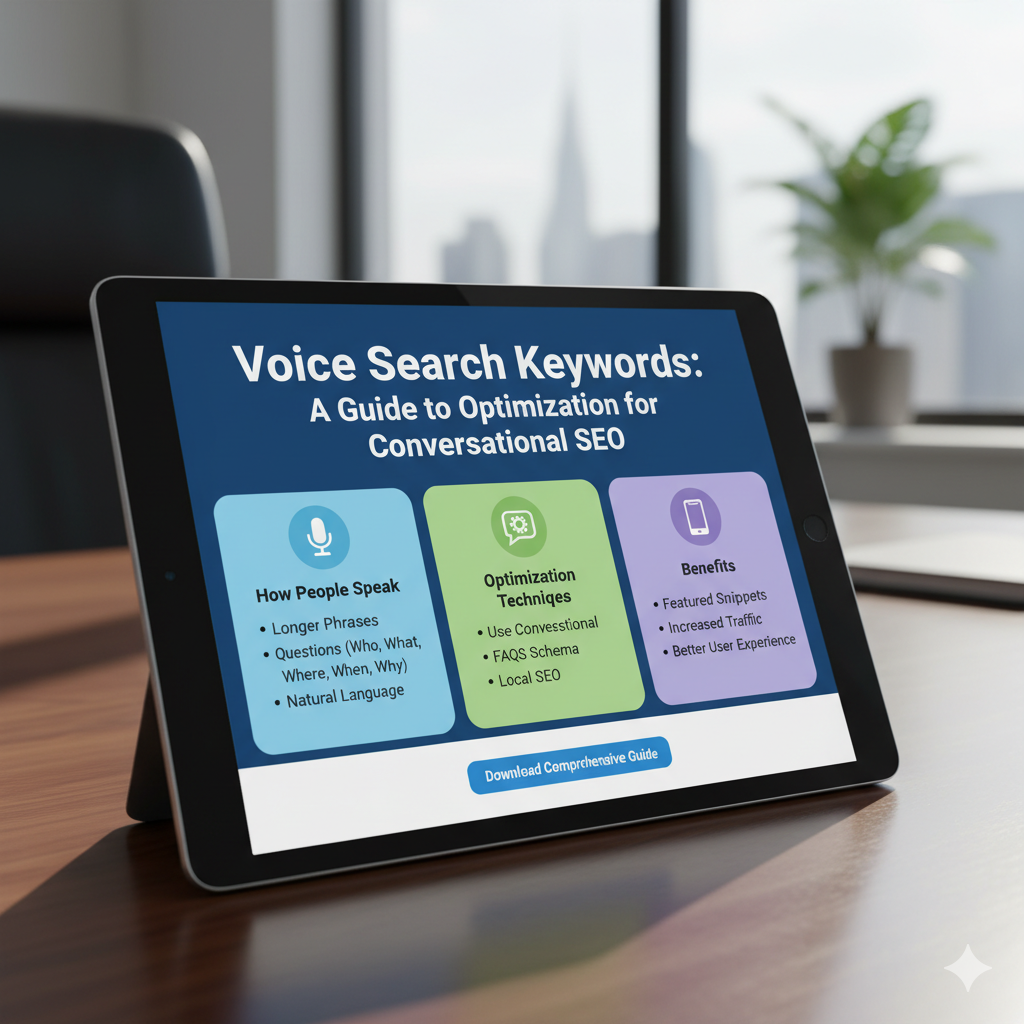
Last updated: April 2026 | Sources reviewed: 7
Layla is driving home on a Tuesday evening. Both hands on the wheel, phone on the dashboard. She asks: “Hey Google, what’s the best Thai restaurant near me that’s open right now?”
Google does not return a list of ten results for Layla to scroll through. It reads her one answer. One business. One address.
The Thai restaurant that gets that answer did not win by stuffing “best Thai restaurant near me” into their title tag. They won because their content, their Google Business Profile, and their page structure aligned precisely with how Layla actually spoke her query — conversational, local, immediate, phrased as a full question.
That is voice search optimisation. Not a parallel SEO strategy. The same discipline applied to a different user behaviour.
Table of Contents
ToggleHow Different Is Voice Search from Typed Search?
The average voice search query is 29 words long. (Source: Digital Silk, 2025) The average typed query is three to four words.
That gap is not cosmetic. It represents a fundamentally different content targeting problem.
A typed search compresses intent into keywords. “Thai restaurant Manchester” strips the query down to the minimum information needed. A voice query expands intent into natural language. “What’s a good Thai restaurant in Manchester city centre that delivers on a Tuesday night?” carries the same core intent but reveals far more about the user’s specific situation.
What most guides get wrong here: They recommend optimising for voice by adding conversational phrases to existing keyword-targeted content. That approach is backwards. Voice queries require identifying the full questions users speak and structuring content to answer those questions directly — not appending conversational language to keyword-optimised pages.
Only 1.71% of voice search results include the exact keyword in the title tag. (Source: Digital Silk, 2025) Voice ranking does not work through keyword matching. It works through question answering.
| Dimension | Typed search | Voice search |
|---|---|---|
| Average query length | 3–4 words | 29 words |
| Query format | Keyword fragment | Complete question |
| Dominant intent | Variable | Informational and local |
| Result format | List of results | Single spoken answer |
| Device context | Primarily desktop | Primarily mobile and smart speaker |
| Keyword in title tag | Common ranking factor | Only 1.71% of voice results |
| Featured snippet dependency | Helpful but optional | ~40.7% of voice answers pulled from featured snippets |
| Page speed requirement | Under 3 seconds | Voice result pages load 52% faster than average |
Why Does Voice Search Demand a Different Keyword Strategy?
Layla will return to this story shortly. Her Tuesday evening is not resolved yet.
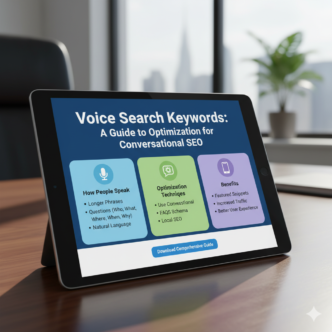
Voice queries are structurally question-based. They begin with who, what, where, when, why, or how. They use full sentences. They include contextual detail — time of day, distance preference, specific situation — that typed queries strip out.
This changes keyword research from finding search volume for short phrases to mapping the full questions users speak aloud in your topic area.
80% of voice searches are conversational in nature — full question phrases rather than keyword fragments. (Source: Synup, 2025) The keyword research task for voice search is identifying those complete questions, not finding variants of a two-word phrase.
Three sources that surface voice-ready questions:
People Also Ask chains. Each PAA question is phrased the way users actually ask questions of Google. Three levels deep into a PAA chain from a seed keyword produces 15–25 distinct conversational questions — each a potential voice search keyword. Crucially, PAA questions are already phrased in the format voice assistants process.
Customer service and support records. The questions customers type into live chat, email support, or call centres are the questions they would ask a voice assistant. Support ticket language is closer to voice query phrasing than any keyword tool database.
Answer the Public and AlsoAsked. Both tools surface question-format queries grouped by interrogative word. The output mirrors voice search phrasing directly — full questions rather than keyword fragments.
In practice: For a physiotherapy client, standard keyword research produced phrases like “sports injury treatment Manchester” and “shoulder physio near me.” Running the same seed keywords through three levels of PAA chain extraction produced 31 distinct questions including “how long does it take to recover from a rotator cuff injury without surgery” and “what should I do immediately after spraining my ankle.” Both became dedicated FAQ content pieces. Both now appear as voice search answers for queries no standard keyword tool had flagged.
What Content Structure Does Voice Search Reward?
Voice assistants return one answer. Not a list. Not a SERP. One spoken response.
Approximately 40.7% of all voice search answers are pulled from featured snippets. (Source: Digital Silk, 2025) The structural implication: content that wins voice search positions must earn featured snippet eligibility first.
Featured snippets are awarded to content that answers a specific question directly, concisely, and in a format Google can extract cleanly. The structural requirements are precise.
The direct answer in the first sentence. Every section that targets a voice query should open with a complete, standalone answer to the question posed by the heading. Not context-setting. Not preamble. The answer, in the first sentence, in 40–60 words.
Layla’s query — “what’s the best Thai restaurant near me open right now?” — gets answered by the business whose Google Business Profile is complete, accurate, and verified. But the surrounding question “what makes a good Thai restaurant” gets answered by the content page that opens its relevant section with: “A good Thai restaurant serves authentic regional dishes, uses fresh aromatics, and maintains consistent heat control across its curries and stir-fries.” That sentence is extractable as a voice answer. A paragraph that builds to that conclusion is not.
Question-format H2 and H3 headings. Voice assistants scan heading structures to locate relevant answer sections. A heading phrased as a question — “How long does shoulder physio take?” — is directly searchable. A heading phrased as a statement — “Shoulder Physiotherapy Duration” — requires interpretation. Voice retrieval systems favour the question format because it mirrors the query format.
FAQ schema. FAQ schema marks up question-and-answer content in machine-readable format, creating discrete answer units that voice assistants can retrieve independently of surrounding content. Each FAQ schema entry is a separately indexable voice search answer. A post with ten FAQ schema entries has ten distinct voice search opportunities — not one.
How Does Local Intent Dominate Voice Search?
58% of consumers have used voice search to find local business information. (Source: MonsterInsights, 2025) 76% of voice searches are local or “near me” queries. (Source: Demand Sage, 2025)
Local voice search is the highest-conversion context in all of SEO. A user asking their phone “where can I get my car tyres changed near me right now” is not browsing. They are choosing a business to call in the next three minutes.
The ranking factors for local voice queries are different from standard organic ranking factors. Google My Business signals — accuracy of NAP data, review volume and recency, business category completeness, and post frequency — carry disproportionate weight for voice results compared to website content optimisation. (Source: Moz, Local Search Ranking Factors, 2023)
The five GMB elements that most directly affect local voice visibility:
Business category accuracy — selecting the most precise primary category, not the broadest available. A “Thai restaurant” category will outperform “restaurant” for Thai-specific voice queries.
Review quantity and recency — voice assistants frequently incorporate review ratings into spoken responses. A business with 200 reviews averaging 4.6 stars is consistently surfaced ahead of a business with 20 reviews averaging 4.8 stars for proximity-based queries.
Q&A section population — Google My Business has a built-in Q&A feature. Populating it with the questions users ask most frequently via voice — opening hours, parking availability, delivery radius, allergen options — creates additional voice-readable content within the GMB profile itself.
Post frequency — regular GMB posts signal active business management and improve local pack visibility, which correlates with local voice result appearances.
Consistent NAP across citations — inconsistent name, address, or phone number across local directories suppresses local voice visibility regardless of content quality.
In practice: A dental practice client had strong website content but inconsistent NAP data across eleven local citation directories — variations in practice name abbreviation and a historic phone number still live on two directories. Correcting the citation inconsistencies and populating the GMB Q&A section with twelve common appointment and pricing questions produced local pack appearance for seven new local voice-relevant queries within six weeks, with no change to the website content.
What Technical Requirements Does Voice Search Add?
Voice search result pages load 52% faster than the average page. (Source: Demand Sage, 2025) Page speed is not a ranking factor that voice SEO adds to the list — it is a threshold requirement. Pages that do not meet minimum speed standards do not appear in voice results regardless of content quality.
More than 70% of websites ranking in Google voice search results are HTTPS-secured. (Source: Demand Sage, 2025) Security is a baseline trust signal that voice retrieval systems apply before content relevance.
Three technical priorities specific to voice search:
Core Web Vitals compliance. Voice search result pages consistently meet Largest Contentful Paint under 2.5 seconds, Interaction to Next Paint under 200 milliseconds, and Cumulative Layout Shift below 0.1. These are not aspirational targets — they are the floor below which voice visibility is structurally unavailable.
Mobile-first rendering. Voice queries originate predominantly from mobile devices and smart speakers. Pages that render correctly and quickly on mobile are the pool from which voice results are drawn. A desktop-optimised page with slow mobile performance is excluded from voice competition regardless of content strength.
Structured data implementation. FAQ schema and HowTo schema create machine-readable answer units that voice assistants can extract with precision. Article schema with explicit dateModified signals communicates freshness — relevant for time-sensitive voice queries where recency matters to the user.
What Most Guides Get Wrong About Voice Search Optimisation
The dominant advice is to “write conversationally” and “use natural language.” That guidance is too vague to change anything.
The specific changes voice search requires are structural, not stylistic. Writing in a friendly tone does not produce voice search rankings. Placing a direct 40–60 word answer in the first sentence of every relevant section does. Including question-format H2 headings does. Adding FAQ schema to question-and-answer content does.
The second persistent error: treating voice search as a separate SEO workstream requiring separate content. Voice search optimisation is standard SEO structured for question-answering. The same page that earns a featured snippet for a typed query will typically serve as the voice answer for the equivalent spoken query. There is no parallel content strategy required — only structural discipline applied to existing content.
The third error: neglecting GMB for the sake of website content. For local businesses, GMB optimisation produces more local voice visibility per hour of work than any website content change. Most local voice queries are answered by the business listing, not the website. Prioritising website content over GMB completeness for local voice search is a systematic misallocation of effort.
Layla’s Tuesday evening resolved. The Thai restaurant Google read to her had complete GMB data, 140 reviews averaging 4.7 stars, an accurate Tuesday opening time, and a delivery radius confirmed in the GMB description. Their website had a FAQ section with schema markup that answered “do you deliver on weekday evenings?” in the first sentence of the relevant answer.
They had not done anything exotic. They had done standard things correctly, in the format a voice assistant could retrieve and speak aloud with confidence.
Layla ordered. The restaurant that appeared on page two of the typed SERP did not get the order.
Frequently Asked Questions
How long should a voice-optimised answer be?
The ideal extractable answer is 40–60 words — long enough to be complete, short enough to be spoken in a single breath by a voice assistant. This length matches what Google typically displays in a featured snippet paragraph. Longer answers risk being truncated when spoken aloud. Shorter answers risk lacking the completeness that earns featured snippet eligibility. Structure the first sentence as a complete standalone answer, then expand in subsequent sentences for users reading the full page.
Does voice search optimisation affect standard text search rankings?
Yes, positively. The structural changes that improve voice search performance — direct answers in opening sentences, question-format headings, FAQ schema, faster page speed — also improve standard text search rankings. Featured snippet eligibility, which is the primary gateway to voice results, requires the same content structure that produces stronger standard rankings. Voice search optimisation is not a trade-off with text search performance; the two sets of requirements are largely overlapping.
How important is HTTPS for voice search specifically?
More than 70% of pages appearing in voice search results are HTTPS-secured. (Source: Demand Sage, 2025) HTTPS is effectively a baseline requirement — pages without it are structurally disadvantaged in voice result selection regardless of content quality. For any site still serving pages over HTTP, securing the domain is the single highest-priority technical fix for voice search visibility before any content changes are made.
Should I optimise for specific voice assistants separately?
The primary voice assistant for search — Google Assistant — draws answers from Google’s standard index, featured snippets, and local pack data. Optimising for Google’s ranking systems covers the majority of voice search exposure. Siri uses Google for general queries in many regions and Bing in others — optimising for both benefits Siri results without requiring a separate strategy. Amazon Alexa draws from Bing, so Bing Webmaster Tools setup and Bing Local equivalent optimisation is relevant for voice commerce queries. In practice, Google optimisation covers the dominant voice search channel for most businesses.
How do I measure voice search performance?
Google Search Console does not currently provide a direct voice search filter. The closest proxy is tracking featured snippet captures — monitor the “position zero” appearances for question-format queries in your GSC Performance report. For local voice search, GMB Insights shows the queries triggering your business listing to appear, which includes voice-originated local queries. Track GMB impression growth for question-format queries as a leading indicator of local voice visibility. Position tracking tools that monitor featured snippet captures per keyword provide the most direct available measurement for voice search performance.
Is voice search optimisation relevant for B2B businesses?
Yes, though the dominant use case differs from B2C. B2B voice queries tend to be informational rather than local or transactional — users asking voice assistants questions during working hours about processes, definitions, and technical topics. US voice assistant users are projected to reach 157 million by 2026. (Source: Seven Atoms, 2025) For B2B, the highest-value voice optimisation is FAQ-format content covering the questions buyers ask during evaluation — “how does [software category] handle [specific process]” type queries that surface in PAA chains for industry keywords.
Conclusion
Voice search optimisation is standard SEO applied to question-answering. The keyword strategy shifts from short phrases to complete questions. The content structure prioritises direct answers in opening sentences. The technical baseline requires speed, security, and structured data. For local businesses, GMB completeness outweighs website content changes in impact.
None of these requirements are exotic. All of them compound with standard SEO practice rather than competing with it.
Specific next step: This week, take your five most important service or product pages. For each one, run the primary keyword through three levels of PAA chain expansion using AlsoAsked or Google’s PAA boxes. Identify the three questions from that chain your page does not currently answer. Add a FAQ section with schema markup addressing those three questions — direct answer in the first sentence of each response, 40–60 words per answer. Publish the updates before the end of April 2026. Those six new FAQ schema entries are six new voice search answer opportunities from pages that already have ranking history.
Citations
[1]. Digital Silk — Top 35 Voice Search Statistics You Shouldn’t Miss in 2025. https://www.digitalsilk.com/digital-trends/voice-search-statistics/
[2]. Demand Sage — 53 Latest Voice Search Statistics 2026. https://www.demandsage.com/voice-search-statistics/
[3]. MonsterInsights — Voice Search Optimization: How to Get More Traffic in 2026. https://www.monsterinsights.com/voice-search-optimization/
[4]. Synup — 80+ Industry Specific Voice Search Statistics for 2025. https://www.synup.com/en/voice-search-statistics
[5]. SEOmator — The Rise of Voice Search: What It Means for SEO in 2026. https://seomator.com/blog/voice-search-seo-strategies
[6]. Seven Atoms — Voice Search Trends 2025: Statistics, Industry Insights, and SEO Strategies. https://www.sevenatoms.com/blog/voice-search-trends
[7]. Moz — Local Search Ranking Factors 2023. https://moz.com/local-search-ranking-factors
🎯 Keyword Organization Workflow
- Google Keyword Planner
- Competitor analysis
- Customer questions
- Google Autocomplete
- Search volume analysis
- Keyword difficulty scores
- Search intent classification
- Competition assessment
- Spreadsheet setup
- Data standardization
- Duplicate removal
- Initial categorization
- Informational keywords
- Commercial keywords
- Transactional keywords
- Navigational keywords
- Pillar topic identification
- Supporting subtopics
- Content cluster mapping
- Internal linking planning
- Business impact scoring
- Difficulty vs opportunity
- Quick wins identification
- Long-term goal setting
- Blog post assignments
- Landing page targeting
- Product page optimization
- FAQ content planning
- Monthly content planning
- Seasonal opportunities
- Resource allocation
- Deadline setting
- Target keyword specification
- Content format guidelines
- Internal linking strategy
- Success metrics definition
- SEO-optimized writing
- Keyword integration
- Internal linking implementation
- Meta tag optimization
- Content publishing
- Google Search Console submission
- Sitemap updates
- Social media promotion
- Ranking position tracking
- Traffic analysis
- Conversion monitoring
- Continuous optimization