

Last updated: April 2026 | Sources reviewed: 6
Transactional queries account for less than 1% of all Google searches. (Source: Amra and Elma, 2025) Commercial intent queries account for roughly 14.5%. Together they represent the minority of search volume — but the majority of direct revenue opportunity.
Getting the content format wrong for either one costs money. A comparison article published against a transactional query adds friction at the moment a user is ready to act. A product page published against a commercial query tries to close a sale before the user has finished deciding.
Both errors are common. Both are fixable with one step: read the SERP before writing the brief.
Table of Contents
ToggleWhat Separates Commercial Intent from Transactional Intent?
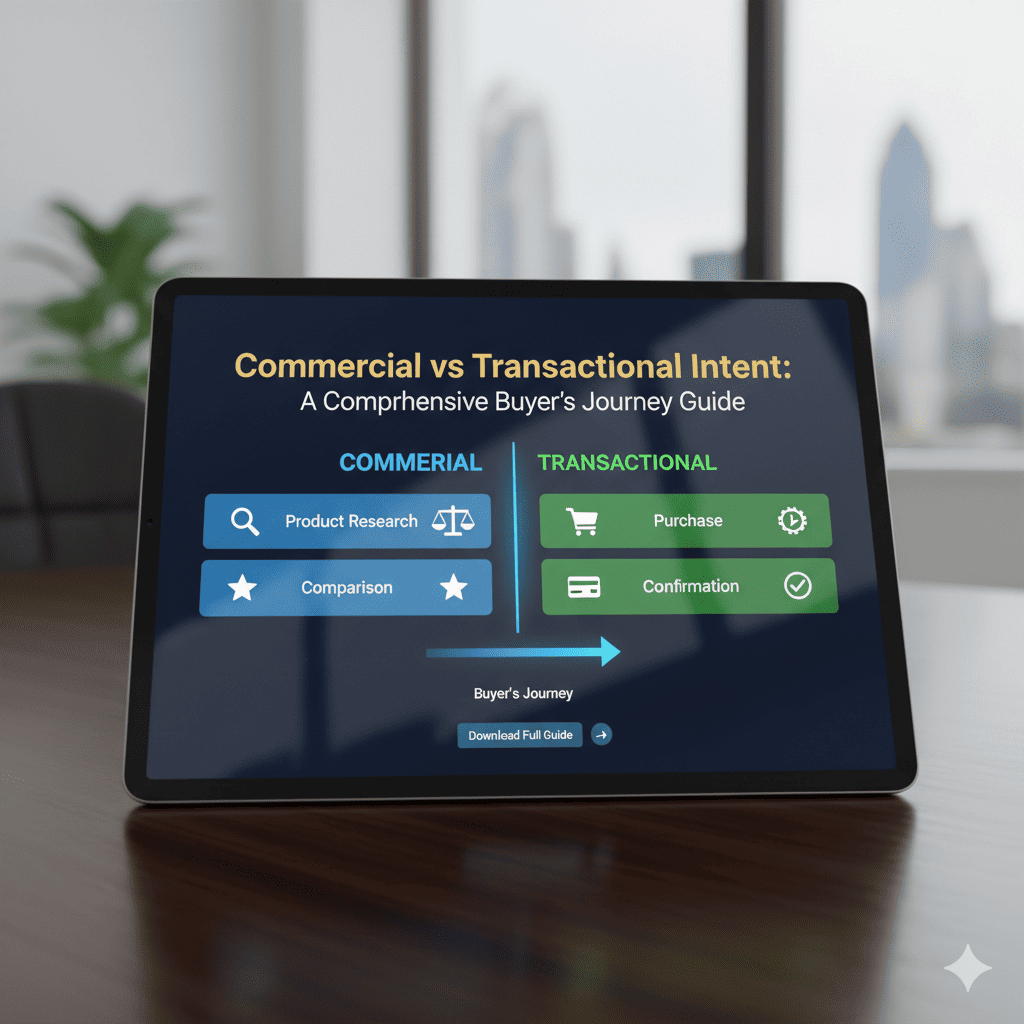
Commercial intent means the user is evaluating. They have a problem, they know solutions exist, and they are deciding which one fits best.
Transactional intent means the user has decided. They know what they want. They are looking for the fastest path to getting it.
The distinction is not about keyword length or modifier words. It is about where the user is in their decision process.
What most guides get wrong here: They present commercial and transactional as sequential stages — research first, purchase second. Many users skip commercial research entirely for familiar products. Others cycle through commercial queries multiple times before reaching transactional intent. The stage is determined by the individual, not the funnel.
The SERP tells you which stage the majority of users are in for any given keyword. Search the keyword. Read positions 1–3. Comparison posts and review roundups dominate commercial intent SERPs. Product pages, pricing pages, and sign-up flows dominate transactional SERPs.
Match the format. Everything else follows.
| Signal | Commercial intent | Transactional intent |
|---|---|---|
| Dominant SERP format | Comparison articles, review roundups, buyer guides | Product pages, pricing pages, landing pages |
| Common query modifiers | “best,” “vs,” “review,” “top,” “alternatives to” | “buy,” “price,” “sign up,” “order,” “free trial” |
| User’s primary question | Which option is right for me? | How do I get this specific thing? |
| Content length that ranks | 1,800–3,500 words | 600–1,500 words |
| Primary conversion goal | Email capture, next-step click, resource download | Purchase, sign-up, booking, contact |
| Bounce rate signal | High bounce = wrong format or weak content | High bounce = friction in the conversion path |
| AI Overview frequency | Moderate — comparison queries getting AIO coverage | Low — transactional queries show fewer AIOs |
What Content Format Works for Commercial Intent?
Commercial intent users consume more content before deciding. They check multiple sources. They want criteria, not just conclusions.
A commercial intent page that ranks needs three structural elements the original query promises: a clear evaluation framework, honest named pros and cons, and an explicit verdict.
The evaluation framework is what separates useful comparison content from shallow “top 10 tools” lists. Tell the reader what criteria you used to evaluate the options. Word count, time tested, features checked, pricing verified. Named methodology produces trust. Vague “our experts reviewed” language does not.
Honest named pros and cons means including weaknesses. A commercial intent user reading a comparison that lists only positives recognises it as promotional content and leaves. Including genuine limitations — even for a recommended option — is the signal that differentiates editorial content from marketing copy.
An explicit verdict is what most comparison content avoids. “It depends on your needs” is not a verdict. Commercial intent users have consumed enough content to want a recommendation. Give one. State which option wins for which specific use case. Users who disagree with the recommendation still find it useful because it clarifies their own position.
In practice: We rebuilt a SaaS comparison post that was generating high traffic but poor email capture. The original had no evaluation framework, listed all tools equally, and ended with “choose the one that fits your needs.” Adding an explicit scoring table with named criteria, a clear winner for each of three use cases, and a recommended starting point for new users increased email capture from the page by 3.2x within eight weeks. Traffic was unchanged. The verdict was what converted.
Pro Tip: For commercial intent posts, place the comparison table and verdict within the first 400 words — not at the end. Commercial intent users scan first. If they cannot find the verdict quickly they leave and return to the SERP. Putting the conclusion first keeps them on the page long enough to read the supporting detail.
What Content Format Works for Transactional Intent?
Transactional intent users have finished deciding. They do not need more information. They need confirmation and a clear path forward.
Every additional word on a transactional page that is not confirmation or direction is friction.
Three things transactional pages must deliver above the fold:
What they get — product name, plan name, or service description stated clearly. Not a tagline. Not a benefit statement. The specific thing they searched for confirmed in the first line.
What it costs — price, or a clear indication of how to get a price. Hidden pricing is the single highest-friction element on transactional pages. Users who searched “HubSpot pricing” and land on a page that requires a sales call to learn the price will leave immediately.
Why it is safe to act — trust signals visible without scrolling. Reviews, security indicators, cancellation terms, money-back guarantees. The user has decided what they want. The only remaining question is whether this specific supplier is safe to buy from.
Common mistake + fix: Transactional pages that open with brand history, mission statements, or product benefit paragraphs before reaching the product or price. These elements belong below the fold as supporting content for users who need reassurance. They do not belong above the fold where they delay the primary user action.
In practice: A software client’s free trial sign-up page opened with a 200-word benefit paragraph before reaching the sign-up form. Moving the form above the fold, retaining the benefit copy below it, and adding three trust signals alongside the form increased trial sign-up rate by 28% with no change to the keyword targeting or traffic volume.
How Do You Connect Commercial and Transactional Content Strategically?
Commercial content drives qualified traffic. Transactional content converts it. The connection between them determines whether the commercial investment produces revenue.
The link from commercial to transactional must match the user’s readiness. A comparison article that ends with “ready to buy? Click here” works for users who reached a decision while reading. A softer next step — “start a free trial” or “see pricing” — works for users who need one more confirmation before committing.
Internal link placement matters more than anchor text. The highest-converting link placement in commercial content is immediately after the verdict section — the moment the user has just processed the recommendation. A link placed at this point captures users at peak readiness. A link placed only at the bottom of the page misses users who left after reading the conclusion.
Retargeting alignment: Users who consumed commercial intent content and did not convert are high-probability future buyers. They demonstrated research intent. They reached a comparison page. They read enough to form a view. Retargeting these users with transactional messaging — free trial offer, limited-time pricing, or direct product page — consistently outperforms cold transactional audiences because the commercial intent work has already built the prerequisite familiarity.
Pro Tip: Add a “next step” section to every commercial intent post — not a generic CTA but a specific recommendation based on the verdict. “If you chose Option A, start here. If Option B, this is your next step.” Segmented next steps match the user’s specific decision rather than assuming every reader chose the same option. Conversion from this section typically outperforms a single generic CTA by a significant margin.
What Most Guides Get Wrong About Commercial vs Transactional Intent
The dominant framing presents the buyer journey as a clean funnel: awareness, then commercial research, then transactional purchase. Real user behaviour rarely follows that sequence.
B2C purchases with high familiarity — a known product, a repeated purchase, a brand the user already trusts — skip commercial research entirely and enter at transactional intent. Targeting those users with comparison content inserts an unnecessary step. They do not need to be convinced. They need a clear path to purchase.
B2B purchases with high stakes — enterprise software, professional services, significant budget — may cycle through commercial research multiple times across weeks or months. Targeting those users with a single transactional page assumes a decision process that has not yet completed.
The correct approach in both cases is the same: read the SERP for the specific keyword, identify the dominant format, match it. A product-page SERP for a B2C keyword tells you users are ready to buy. A comparison-article SERP for a B2B keyword tells you users are still deciding.
The second error in most guides is treating “transactional” as synonymous with “high conversion rate.” Transactional pages convert better than commercial pages on a per-visit basis — but only for users who arrive in transactional intent. Sending commercial-intent users to transactional pages produces high bounce rates because the format mismatch is immediately apparent.
Traffic source matters. Users arriving from commercial-intent keywords need commercial-format content regardless of what you want them to do. Users arriving from transactional keywords need transactional format. The user’s intent, not the marketer’s goal, determines the correct format.
Frequently Asked Questions
Can a single page serve both commercial and transactional intent?
Adjacent intents can coexist when the content serves both naturally. A pricing page that includes a brief feature comparison serves users who are finalising a decision (commercial) alongside users who are ready to pay (transactional). The format must prioritise one intent — typically transactional for a pricing page, with commercial elements supporting rather than leading. Attempting to give equal weight to both intents on one page typically produces a page that satisfies neither well, visible in below-average conversion rates and high bounce rates from both traffic sources.
How do I know which intent my keyword belongs to without a tool?
Search the keyword in a private browser window. Read the format of the top three results. If they are comparison articles, review posts, or buyer guides, the intent is commercial. If they are product pages, pricing pages, sign-up flows, or category pages, the intent is transactional. This SERP reading takes 60 seconds and is more current than any tool’s automated intent classification. Tool labels reflect historical data; the live SERP reflects Google’s current assessment of what the majority of users searching that phrase actually want.
Should I bid on commercial keywords in paid search?
Yes, with a different objective than transactional campaigns. Commercial keyword paid campaigns work best for retargeting — users who visited commercial content organically and did not convert are high-probability buyers when reached with transactional messaging in paid channels. Cold commercial-intent paid campaigns typically produce high click costs and low direct conversion because users clicking on a comparison query advertisement are not yet ready to buy. The paid budget investment produces better returns when it captures users whose commercial research is already done.
What is the correct conversion goal for a commercial intent page?
Email capture, content upgrade download, or next-step click to a transactional page — not direct purchase. Commercial intent users are not ready to buy. Asking them to buy before they have finished deciding produces low conversion rates and high bounce. The commercial page’s job is to advance the user one step — from undecided to decided — and provide a natural path to the transactional page when they are ready. Measuring commercial content against purchase conversion rates produces the wrong conclusion that the content is underperforming when it is actually doing its correct job.
How long should a commercial intent comparison page be?
Match competitive content length by checking the word count of the top three ranking pages for the target keyword. Commercial intent comparison content typically falls between 1,800 and 3,500 words for most niches — long enough to cover the evaluation criteria and multiple options in sufficient depth for a user building a purchase decision, short enough to maintain focus and avoid padding. The most common length error in commercial intent content is padding beyond what the comparison requires. A tightly written 2,000-word comparison that answers every evaluation question outperforms a rambling 4,500-word post every time.
Do AI Overviews affect commercial intent pages differently than transactional ones?
Yes. AI Overviews appear far less frequently for transactional queries — Google recognises that a user ready to buy needs a product page, not an AI-synthesised summary. For commercial intent queries, AI Overviews appear more frequently and are expanding into comparison-type content. (Source: Semrush, 2025) This means commercial intent pages face more AI Overview competition for clicks than transactional pages. The structural response is identical to general AI Overview optimisation: direct comparison verdict in the first paragraph, FAQ schema on evaluation questions, and clear named criteria that AI systems can extract as discrete answers.
Conclusion
Commercial intent users need a verdict. Transactional intent users need a path.
Neither needs more content than that requires. Commercial comparison posts that pad beyond the evaluation. Transactional pages that delay the conversion with brand storytelling. Both make the same error — adding words the user did not ask for.
Read the SERP. Match the format. Place the conversion element at the moment of peak readiness, not at the bottom of the page.
Specific next step: Take your five highest-traffic pages this week. For each one, check the dominant format of the top three SERP results for the target keyword. Confirm whether your page format matches. For any mismatch — a comparison post where product pages dominate, or a product page where comparisons dominate — update the page structure before the end of April 2026. Format correction to existing pages produces faster ranking and conversion improvement than publishing new content targeting the same keyword.
Citations
[1]. Amra and Elma — Top Search Intent Statistics 2025. https://www.amraandelma.com/search-intent-statistics/
[2]. Semrush — AI Overviews Study: What 2025 SEO Data Tells Us. https://www.semrush.com/blog/semrush-ai-overviews-study/
[3]. seoClarity — Impact of Google’s AI Overviews: SEO Research Study. https://www.seoclarity.net/research/ai-overviews-impact
[4]. WP SEO AI — What Are the 4 Types of Search Intent? https://wpseoai.com/blog/what-are-the-4-types-of-search-intent/
[5]. Surfer SEO — Ranking Factors in 2025: Insights from 1 Million SERPs. https://surferseo.com/blog/ranking-factors-study/
[6]. Yoast — What is Search Intent? https://yoast.com/search-intent/