

Last Updated: 6 June 2026 Originally Published: 18 October 2025
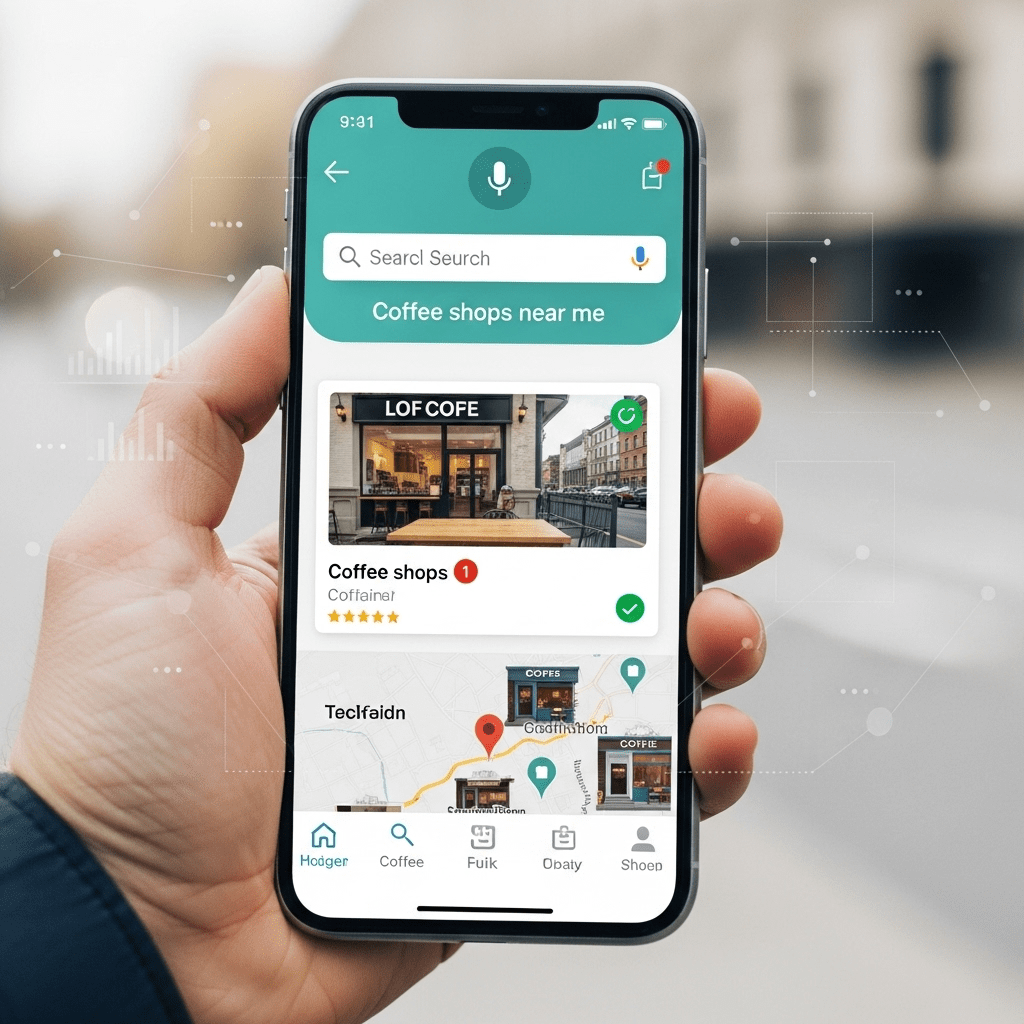
You’ve optimised your site for “emergency plumber Chicago.” You’ve claimed your Google Business Profile. You’ve built citations across forty directories. And yet when someone standing two streets away says “Hey Google, find me a plumber near me open now” — your competitor answers the call.
The disconnect isn’t a rankings gap. It’s a format gap. Typed queries and voice queries are structurally different problems. Someone typing “plumber Chicago” is researching options. Someone speaking “where can I find a plumber near me right now” is standing next to a burst pipe and ready to call the first business that answers. According to Google’s own research, 58% of consumers use voice search to find local business information — and those searchers convert at significantly higher rates than typed-query traffic because the intent is immediate, not exploratory.
Optimising for voice search requires a different content format, a different technical foundation, and a different understanding of how Google selects the answer it speaks aloud. This cluster goes deeper than the voice search overview in our Local SEO Mastery guide covers. You’ll get the specific content structures, schema requirements, and platform-by-platform optimisation tactics that determine whether your business gets spoken or skipped.
Post Summary:
- Voice queries run 3–5× longer than typed queries and are structured as complete questions — content must be written to match that conversational format
- Featured snippets (position zero) are the primary source for voice answers — winning them requires a specific question-plus-direct-answer content structure
- Google Business Profile completeness is the single most impactful lever for “near me” voice results — incomplete profiles are filtered before ranking factors even apply
- Google Assistant, Siri, and Alexa pull from different data sources and require platform-specific optimisation sequences
- FAQPage schema and LocalBusiness schema are the two non-negotiable structured data types for local voice search
- Mobile page speed under three seconds is a hard threshold — voice searches are 95%+ mobile and slow sites lose the result before content quality is even assessed
- The 80/20 rule applies to voice SEO: GBP optimisation and FAQ content generate the overwhelming majority of voice visibility gains
Table of Contents
ToggleWhy Voice Search Is a Different Optimisation Problem, Not a Typed-Search Extension
Most local SEO guides treat voice search as typed search with slightly longer keywords. That framing produces the wrong content, targets the wrong format, and misses the intent signal that makes voice queries commercially valuable.
The structural difference starts with query length. A typed local search averages two to three words. A voice query averages seven to eleven words. “Dentist Chicago” versus “Hey Google, where can I find a dentist near me that accepts new patients.” Those aren’t the same question at different lengths — they represent different stages of the decision process. Typed queries indicate research. Voice queries indicate readiness. The searcher using voice has already decided they need the service; they’re asking for a specific, immediate answer.
The format difference follows from this. Typed search returns a list of results the user scans and selects from. Voice search returns a single answer spoken aloud by the assistant. There is no second result. There is no “the next option is.” The business that gets spoken is the only business that gets heard — which means the stakes for ranking are categorically higher in voice than in typed local search, and the optimisation logic is fundamentally about winning the single featured answer rather than appearing in a competitive set.
The intent difference is the most commercially significant. Voice searches carry a disproportionate share of immediate, transactional local intent. Queries structured as “open now,” “near me,” “closest,” and “fastest” are almost exclusively voice-driven — and those modifiers indicate a searcher who is physically proximate, actively deciding, and ready to act within the hour. Businesses that capture this traffic convert it at rates that typed-query traffic rarely matches.
Voice Search Optimisation
for Local SEO
How to rank when customers stop typing and start talking — from "near me" signals to featured snippets to platform-specific tactics.
Verified data from DemandSage, WiserReview, On The Map Marketing, Digital Silk, and SEO Design Chicago (2025–2026).
Sources: DemandSage 2025, Digital Silk 2026, WiserReview 2026, Koanthic 2026, SevenAtoms 2025.
Voice Assistant Market Share
Share of all voice search queries by platform, 2025
Consumer Actions After Local Voice Search
% of local voice searchers taking each action
Voice Search Answer Sources
Where voice assistants pull their spoken answers from
Voice vs Typed Query Length
Average word count comparison
Same category, opposite intent stage. Optimising for one without the other leaves high-converting voice traffic uncaptured.
Research Mode
- 📏 Average 2–3 words per query
- 🎯 Returns a list — user scans options
- 🕐 Planning-oriented, future intent
- 💻 Mixed desktop and mobile usage
- 🔑 Keyword-style phrasing: "plumber Chicago"
- 📊 Lower immediate conversion rate
Action Mode
- 📏 Average 7–11 words per query
- 🎯 Returns ONE spoken answer — winner takes all
- 🕐 Immediate need: "open now," "near me"
- 📱 95%+ mobile, often on the move
- 💬 Conversational: "Where can I find a plumber near me open now?"
- 📊 3× higher call conversion than typed search
Each assistant pulls from different data sources. Optimising only for Google leaves Siri and Alexa users — every iPhone owner and Amazon Echo household — without a path to your business.
| Assistant | Market Share | Primary Data Source | Secondary Source | #1 Optimisation Action |
|---|---|---|---|---|
| 🔵 Google Assistant | 67% of voice queries | Google Business Profile + Google Maps | Google organic index | Complete GBP to 100% + win featured snippets |
| 🍎 Siri | 86.5M US users | Apple Maps (Apple Business Connect) | Yelp ratings & reviews | Claim Apple Business Connect + optimise Yelp |
| 🔶 Alexa | 100M smart speaker owners | Bing Places for Business | Yext publisher network | Claim Bing Places + complete Yext profile |
| 🪟 Cortana | Declining — desktop focus | Bing Places | Bing organic results | Bing Places for Business listing |
Sequence matters — foundation first, amplification second. Skipping steps one and two makes steps three through five produce a fraction of their potential.
Complete Google Business Profile to 100%
GBP completeness is the primary ranking signal for "near me" voice results. Incomplete profiles are filtered before other ranking factors apply. Populate every section: precise coordinates, current trading hours, service areas, ten-plus photos including exterior shots, and active Google Posts.
💡 GBP profile views are up 35% year-over-year — the average business now receives 1,260 views per month. (On The Map, 2026)Build a FAQ Page in Conversational 40–60 Word Answers
Voice assistants pull from featured snippets. FAQ pages built on a question-plus-direct-answer format (40–60 words per answer) are the most efficient vehicle for voice content — each entry is a candidate featured snippet for a different voice query. Use the exact natural language customers speak, not formal industry phrasing.
💡 40.7% of voice answers come from featured snippets. Pages ranking for voice load 52% faster than average. (Digital Silk, 2026)Fix Mobile Page Speed — Under 3 Seconds
Voice searches occur on mobile 95%+ of the time. Google's threshold for local voice results is approximately three seconds to first meaningful paint on mobile. Run a Core Web Vitals check on location pages specifically — not just the homepage. Any mobile performance issue is a blocking problem for voice visibility.
💡 88% of mobile local searches lead to a store visit within one week. Speed directly affects whether your business is spoken. (WiserReview, 2026)Implement LocalBusiness + FAQPage Schema
LocalBusiness schema with precise coordinates enables Google's proximity calculation for "near me" queries. FAQPage schema marks up each Q&A pair so the voice engine can extract answers directly without inferring from unstructured text. Validate every block with Google's Rich Results Test before publishing.
💡 Never include Speakable schema in production — it remains in limited testing and is not currently recommended for general use.Claim Apple Business Connect + Bing Places
A business optimised only for Google is invisible to every Siri user. Claim Apple Business Connect at business.apple.com and fully verify your Bing Places listing. Each platform takes under an hour to configure and closes a coverage gap that most competitors haven't addressed. Maintain active Yelp reviews — Siri weights Yelp ratings heavily in local results.
💡 US Siri user base: 86.5M people. Alexa smart speaker owners: 100M. Neither can find you without platform-specific listings. (DemandSage, 2025)Schema tells the voice engine exactly what your business is, where it is, and what questions it can answer — without it, Google infers from unstructured text.
LocalBusiness Schema
Name, verified address, phone, opening hours, geographic coordinates. The coordinates field is critical — Google's proximity calculation for "near me" voice queries uses coordinates, not just address matching.
Required — FoundationFAQPage Schema
Marks up Q&A pairs so the voice engine extracts answers directly. Each marked-up FAQ entry becomes an independent candidate for a different voice query. A 20-question FAQ page = 20 voice result candidates.
Required — Voice AnswersSpeakable Schema
Identifies content sections optimised for text-to-speech. Currently in limited testing — NOT recommended for production implementation. Do not include until Google confirms general availability.
⚠️ Skip for NowHowTo Schema
For businesses providing step-by-step guidance relevant to their services. Voice assistants can read steps sequentially. Only implement where the content genuinely maps to a how-to structure.
Optional — Where EarnedTwo actions generate 80% of achievable voice visibility gains. Everything else amplifies a foundation that must exist first.
of voice gains come from these 2 actions
- Google Business Profile completed to 100%
- FAQ page with 20+ conversational Q&A answers (40–60 words each)
- Natural proximity language in on-page content
- Mobile page speed under 3 seconds on location pages
amplification — only effective after the 80% foundation
- LocalBusiness + FAQPage schema implementation
- Apple Business Connect + Bing Places listings
- Review velocity: 2–4 fresh reviews per month
- Rating maintenance above 4.0 stars
- Yext profile for Alexa coverage
aiseojournal.net · by AI-SEO Design Team · Voice Search Optimisation for Local SEO · Data: DemandSage, Digital Silk, WiserReview, On The Map Marketing, SevenAtoms, Koanthic (2025–2026)
How to Optimise for “Near Me” Searches: The Five-Layer Framework
Near me” optimisation is the highest-leverage voice search work a local business can do. These queries have the clearest commercial intent and the most direct path from search result to physical visit or phone call.
The first and most important layer is Google Business Profile completeness. This isn’t a supporting factor — it’s the primary ranking signal for “near me” voice results. An incomplete GBP profile is filtered out before any other ranking factors apply. Every section must be populated: accurate primary and secondary category selection, complete service area definition, verified address with precise coordinates, current trading hours updated for public holidays, a minimum of ten photos including exterior shots that help a searcher recognise the location on arrival, and active Google Posts demonstrating the business is currently operating.
The second layer is mobile site performance. Voice searches occur on mobile devices in excess of 95% of the time. Google’s threshold for mobile page speed in local results is approximately three seconds to first meaningful paint. Sites that exceed this threshold lose the “near me” result regardless of GBP completeness or content quality. Run a Core Web Vitals check on your location pages specifically — not just your homepage — and treat any mobile performance issue as a blocking problem for voice visibility.
The third layer is proximity language in on-page content. Don’t write “near me” into your content — it reads as awkward filler and Google doesn’t need it. Instead, build genuine proximity context: the nearest transit stops, the landmarks within two blocks, the neighbourhoods explicitly served, the postcode areas covered. We’re located on Fulham Road, two minutes’ walk from Parsons Green tube station, serving Fulham, Putney, and Chelsea” gives Google the geographic signal it needs to surface your business for searchers in those areas without manufacturing a keyword that reads unnaturally.
The fourth layer is map platform coverage. Google Assistant pulls from Google Maps. Siri pulls from Apple Maps. Alexa pulls from Bing Maps. A business that has only claimed its Google Maps listing is invisible to Siri users — which represents every iPhone user speaking a local query. Claim and fully verify your listing on Apple Business Connect, Bing Places for Business, and Waze as a minimum. The effort per platform is under an hour; the coverage gap it closes is significant.
The fifth layer is review velocity and rating threshold. Voice assistants filtering “near me” results apply a rating floor — businesses below approximately 4.0 stars are deprioritised in spoken recommendations. Google Assistant regularly reads star ratings aloud when suggesting local businesses. Two to four fresh reviews per month, combined with responses to every review, signals active community engagement that correlates with voice result inclusion.
Pro Tip: Add proximity-to-landmark phrases to your GBP description and website content naturally — “located near [major local landmark] helps Google’s entity resolution match your business to queries from people navigating toward that landmark who use voice search to find nearby services. This single addition moves the needle for “near me” results faster than most other on-page changes.
How to Optimise SEO for Voice Search: The Content Structure That Wins Featured Snippets
Voice assistants don’t crawl your content and summarise it. They pull from featured snippets — the position-zero answer boxes that Google selects as the single best answer to a specific question. Winning featured snippets is therefore not a separate voice search strategy; it is the voice search strategy for content.
The content format that wins featured snippets follows one consistent pattern: question stated explicitly as a heading, followed immediately by a direct answer in 40–60 words, followed by expanded detail for users who want more. The 40–60 word range is not arbitrary — it matches the length that Google’s text-to-speech output sounds natural when read aloud, and it’s the length Google most frequently selects for spoken answers.
FAQ pages built on this structure are the most efficient vehicle for voice search content because every entry is already formatted as a question-answer pair. A dental practice with thirty FAQ entries covering common patient questions — appointment availability, accepted insurance types, treatment costs, procedure explanations, location and parking — has thirty candidate featured snippets. Each one is a potential voice result for a query that a prospective patient might ask their phone while deciding whether to book.
The question phrasing matters as much as the answer quality. Use the exact natural language a customer would speak, not the formal language an industry professional would write. How much does a root canal cost in London?” performs better as a featured snippet candidate than “Root canal pricing information.” Google’s question-matching algorithm for voice is trained on conversational queries — it rewards content that mirrors the way people actually speak about a topic.
A physiotherapy clinic built a forty-question FAQ page using questions sourced directly from their reception team’s log of phone enquiries over three months. Every question was phrased exactly as a patient had asked it. Within ninety days, twelve of those questions were returning the clinic’s answers as featured snippets in Google. Voice-driven appointment bookings increased measurably. The friction they encountered: three of their most commercially valuable questions — covering pricing — were being answered by an older blog post that ranked higher for those terms. Consolidating the answers onto the FAQ page required a content audit they hadn’t planned for, which added six weeks to the project.
Platform-Specific Optimisation: Google Assistant, Siri, and Alexa
Each voice assistant pulls local business data from different sources. Optimising only for Google leaves Siri and Alexa users — a combined audience representing every iPhone owner and every Amazon Echo household — without a path to your business.
Google Assistant holds the largest market share for local voice queries and draws exclusively from Google’s own ecosystem: Google Business Profile, Google Maps, and Google’s organic index. GBP completeness is the primary lever. Featured snippets are the content lever. Mobile page speed is the technical lever. These three optimisation areas cover the majority of Google Assistant local visibility.
Siri pulls local business data primarily from Apple Maps and Yelp. A business with a complete Google presence but an unclaimed Apple Maps listing is invisible to every Siri user asking a local query. Claim your listing through Apple Business Connect at business.apple.com, verify the location, populate all available fields including hours, photos, and service categories, and maintain an active Yelp profile with complete information and regular review responses. Siri’s local results weight Yelp ratings heavily — a business with strong Google reviews but thin Yelp presence will underperform in Siri results relative to its Google Assistant visibility.
Alexa draws from Bing and has a specific integration with Yext’s data network. Claim and fully optimise your Bing Places for Business listing — this is the single most impactful step for Alexa visibility and the one most consistently skipped by local businesses focused exclusively on Google. A complete Yext profile extends Alexa visibility further through Yext’s publisher network, which includes the data sources Alexa’s local recommendation engine aggregates.
| Voice Assistant | Primary Data Source | Secondary Source | Key Optimisation Action |
|---|---|---|---|
| Google Assistant | Google Business Profile | Google organic index | Complete GBP, win featured snippets |
| Siri | Apple Maps | Yelp | Claim Apple Business Connect, optimise Yelp |
| Alexa | Bing Places | Yext network | Claim Bing Places, complete Yext profile |
| Cortana | Bing Places | Bing organic | Bing Places for Business |
Schema Markup for Voice Search: The Two Types That Matter
Schema markup for voice search isn’t about ranking — it’s about legibility. Structured data tells Google’s voice engine exactly what your business is, where it is, when it’s open, and what questions it can answer. Without it, Google is inferring that information from unstructured text, which increases the risk of incorrect spoken answers.
LocalBusiness schema is the non-negotiable foundation. It should include your precise business name matching your GBP exactly, your verified street address with postcode, your primary phone number, your complete opening hours including any location-specific variations, your primary business category, and your geographic coordinates. The coordinates field is particularly important for voice — Google’s proximity calculation for “near me” queries uses coordinates, not just address matching.
FAQPage schema is the second essential type for voice search specifically. It marks up your FAQ content in a structured format that Google’s voice engine can parse directly — extracting the question and answer pair without needing to interpret surrounding content. Each FAQ entry marked with FAQPage schema becomes a candidate for spoken voice results independently. A page with twenty marked-up FAQ entries gives Google twenty discrete answer candidates to draw from across twenty different potential voice queries.
Speakable schema — which explicitly identifies content sections optimised for text-to-speech — exists as a schema type but remains in limited testing and is not currently active or recommended for standard implementation. Do not include it in production schema until Google confirms general availability.
Validate all schema through Google’s Rich Results Test before publishing. An invalid schema block produces no voice benefit and can create indexing noise that’s harder to diagnose than simply not having schema at all.
What Is the 80/20 Rule for Voice Search SEO?
The 80/20 rule applied to local voice search optimisation produces a clear sequencing priority: Google Business Profile completeness and FAQ content creation generate approximately 80% of achievable voice search visibility gains, while the remaining optimisation work — schema markup, platform-specific listings, mobile speed improvements, review velocity — produces the remaining 20%.
This sequencing matters because voice search optimisation has a common failure pattern: practitioners invest time in technically complex work (schema implementation, Yext profiles, featured snippet tracking) before completing the foundational work that those technical layers are designed to amplify. A comprehensive FAQPage schema block on a GBP profile that’s 60% complete produces a fraction of the result that the same schema would produce on a fully optimised profile.
The practical priority order: complete GBP to 100% first. Build a twenty-plus-question FAQ page with conversational answers in the 40–60 word range second. Fix any mobile page speed issues on location pages third. Then implement LocalBusiness and FAQPage schema. Then claim Apple Maps and Bing Places. Then focus on review velocity. Schema and platform diversification amplify a foundation that must exist first — they don’t create results on their own.
Pro Tip: Read every piece of content you write for voice search aloud before publishing. If it sounds like a formal document, a legal disclaimer, or a keyword-optimised SEO page — rewrite it. Voice assistants read your content to a human being who is standing in a street or sitting in a car. Content that sounds robotic when spoken is content that Google deprioritises for voice results. The test is simple: would a helpful colleague say this? If not, rewrite until they would.
Frequently Asked Questions About Voice Search Optimisation
How do you optimise SEO for voice search?
Voice search SEO optimisation works on three parallel tracks. First, content format: write FAQ pages with questions phrased in natural spoken language and answers of 40–60 words — the length and format Google selects for featured snippets. Second, technical foundation: complete your Google Business Profile to 100%, implement LocalBusiness and FAQPage schema, and ensure mobile page speed is under three seconds. Third, platform coverage: claim Apple Business Connect for Siri and Bing Places for Alexa, since each assistant draws from different data sources. For the complete local SEO framework this fits within, the Local SEO Mastery guide covers every layer in sequence.
How do you optimise local SEO for voice search specifically?
Local voice SEO starts with Google Business Profile completeness — this is the primary ranking signal for “near me” voice queries and incomplete profiles are filtered before other factors apply. Add precise coordinates, current trading hours, service area definitions, and regular photo updates. Then build location-specific FAQ content using the natural language questions your customers ask about your specific location — parking, transit access, neighbourhood served, hours variations. These two steps address the majority of local voice visibility gaps before any technical schema work is needed.
What is the 80/20 rule of SEO applied to voice search?
In voice search, the 80/20 rule means GBP completeness and FAQ content creation deliver roughly 80% of achievable voice visibility gains. Schema markup, platform-specific listings, and review velocity optimisation deliver the remaining 20% — but only when the foundational work is already in place to amplify. Practitioners who invest in the 20% work before completing the 80% foundation consistently underperform compared to those who sequence correctly: foundation first, amplification second.
Do I need to write “near me” in my website content to rank for near me searches?
No — and doing so reads as awkward keyword insertion that Google doesn’t need. Google determines “near me” eligibility from your GBP coordinates, your service area definition, and your proximity to the searcher’s device location. What your content should include instead is genuine proximity language: nearby landmarks, transit access, specific neighbourhoods served, and postcode areas covered. These signals communicate geographic specificity in natural language that both Google and human readers interpret correctly.
Voice Search Optimisation: Your Next Step
Voice search visibility for local businesses is not a future investment — 27% of mobile searches are already voice-driven, and “near me” query volume continues growing quarter over quarter. The businesses capturing this traffic aren’t using complex tactics. They’ve completed the foundational work that most competitors have skipped: a fully populated GBP, a FAQ page written in conversational language, a mobile site that loads in under three seconds, and consistent listings across the platforms that Siri and Alexa draw from.
Start this week with the GBP audit. Open your Google Business Profile dashboard, run through every available field, and identify anything incomplete or outdated. Then open a new document and write ten questions your customers ask on the phone or in person — answered in forty to sixty words each in the most natural language you can manage. Those two tasks, completed before any schema work or platform registration, will move your voice search visibility further than anything else you could do in the same time.
The complete framework for how voice search optimisation integrates with citation building, local link acquisition, and Google Business Profile strategy is covered in the Local SEO Mastery guide.
References
Google. How Search Works.” Google Search Central, 2024. https://developers.google.com/search/docs/fundamentals/how-search-works Supports: Featured snippet selection methodology and Google’s approach to voice answer extraction.
Google. “Google Business Profile Help.” Google, 2024. https://support.google.com/business Supports: GBP completeness requirements and local pack ranking factors for voice results.
Apple. “Apple Business Connect.” Apple, 2024. https://businessconnect.apple.com Supports: Apple Maps optimisation methodology for Siri local voice results.
Microsoft. “Bing Places for Business.” Microsoft, 2024. https://www.bingplaces.com Supports: Bing Places optimisation as primary lever for Alexa local voice results.
BrightLocal. “Local Consumer Review Survey.” BrightLocal, 2024. https://www.brightlocal.com/research/local-consumer-review-survey/ Supports: Voice search local intent statistics and review rating thresholds for voice recommendations.
Schema.org. “LocalBusiness Schema.” Schema.org, 2024. https://schema.org/LocalBusiness Supports: LocalBusiness schema structure and coordinate field requirements for voice proximity matching.
Google Search Central. “Featured Snippets and Your Website.” Google, 2024. https://developers.google.com/search/docs/appearance/featured-snippets Supports: Featured snippet eligibility requirements and the content format that wins position zero.