





You’re publishing blog posts every week. Your content calendar is full. Your team is working hard.
But here’s the brutal truth: Only 3% of your blog traffic ever converts into trials or demos.
I’ve watched countless SaaS companies treat content marketing like a checkbox exercise—cranking out generic “10 tips” posts that get traffic but generate zero pipeline. Meanwhile, their smarter competitors create SaaS content marketing strategies that directly feed their sales funnel with qualified leads.
The difference isn’t writing talent or budget. It’s strategy. Understanding exactly what content to create, when to publish it, and how to guide prospects from awareness to conversion.
Today, I’m showing you how to create a content strategy for SaaS companies that actually drives revenue—not just vanity metrics.
Table of Contents
ToggleWhy Is SaaS Content Marketing Different from Regular Content Marketing?
Let me be blunt: Most content marketing advice is written for e-commerce or local businesses. That advice will tank your SaaS.
SaaS content marketing operates in a completely different universe. Your buyers aren’t impulse purchasing. They’re researching for weeks, comparing alternatives, building business cases, and convincing multiple stakeholders.
According to <a href=”https://www.gartner.com/en/sales/insights/b2b-buying-journey” rel=”nofollow”>Gartner research</a>, B2B buyers spend only 17% of their buying journey talking to potential suppliers. The other 83%? They’re researching independently—reading content, watching demos, and evaluating options.
Here’s what makes content strategy for SaaS unique:
Longer buying cycles: Your content needs to nurture prospects for months, not days. One viral blog post won’t close deals.
Multiple decision-makers: You’re writing for the end user, the manager, the IT director, and the CFO—all with different concerns and search behaviors.
Higher consideration: A $50,000/year enterprise software purchase requires more proof, education, and trust-building than a $50 product.
Complex solutions: You need to educate prospects about problems they don’t even know they have yet.
Understanding SaaS SEO fundamentals helps you see how content fits into your overall growth strategy.
What Makes B2B Content Marketing for SaaS Actually Work?
I’ve analyzed hundreds of successful B2B content marketing strategies. The winners all share these characteristics.
Educational First, Sales Second
The best educational content for software companies teaches prospects something valuable—whether they buy your product or not.
Real example: HubSpot built their entire empire on free educational content. Their Marketing Hub competes with dozens of alternatives, but they rank #1 for “inbound marketing,” “email marketing strategy,” and hundreds of educational terms.
They could have focused exclusively on “marketing automation software” comparisons. Instead, they taught the fundamentals, built trust, and became the default choice when readers were ready to buy.
Targeting Every Stage of the Buyer Journey
Your content needs to map to three distinct stages—awareness, consideration, and decision. Most SaaS companies only create content for one stage and wonder why conversion rates are terrible.
Awareness stage (Top of Funnel):
- Reader doesn’t know they have a problem yet
- Content teaches, identifies pain points, builds authority
- Low buying intent but essential for long-term trust
Consideration stage (Middle of Funnel):
- Reader knows the problem and is exploring solutions
- Content compares approaches, explains features, shows benefits
- Medium buying intent, actively researching
Decision stage (Bottom of Funnel):
- Reader is comparing specific tools and ready to buy
- Content addresses objections, shows ROI, enables decision-making
- High buying intent, often converts to trials/demos
Pro Tip: Follow the 40-30-30 rule for content distribution: 40% top-of-funnel educational content, 30% middle-funnel solution content, 30% bottom-funnel comparison and conversion content. This balance builds authority while capturing high-intent traffic.
Solving Specific Problems, Not Generic Topics
Generic content gets generic results. Specific content converts.
Generic: “10 Ways to Improve Productivity” Specific: “How Remote Sales Teams Can Cut Meeting Time by 40% Without Losing Pipeline Visibility”
The specific version has 10x lower search volume but attracts exactly your ideal customer with urgent buying intent.
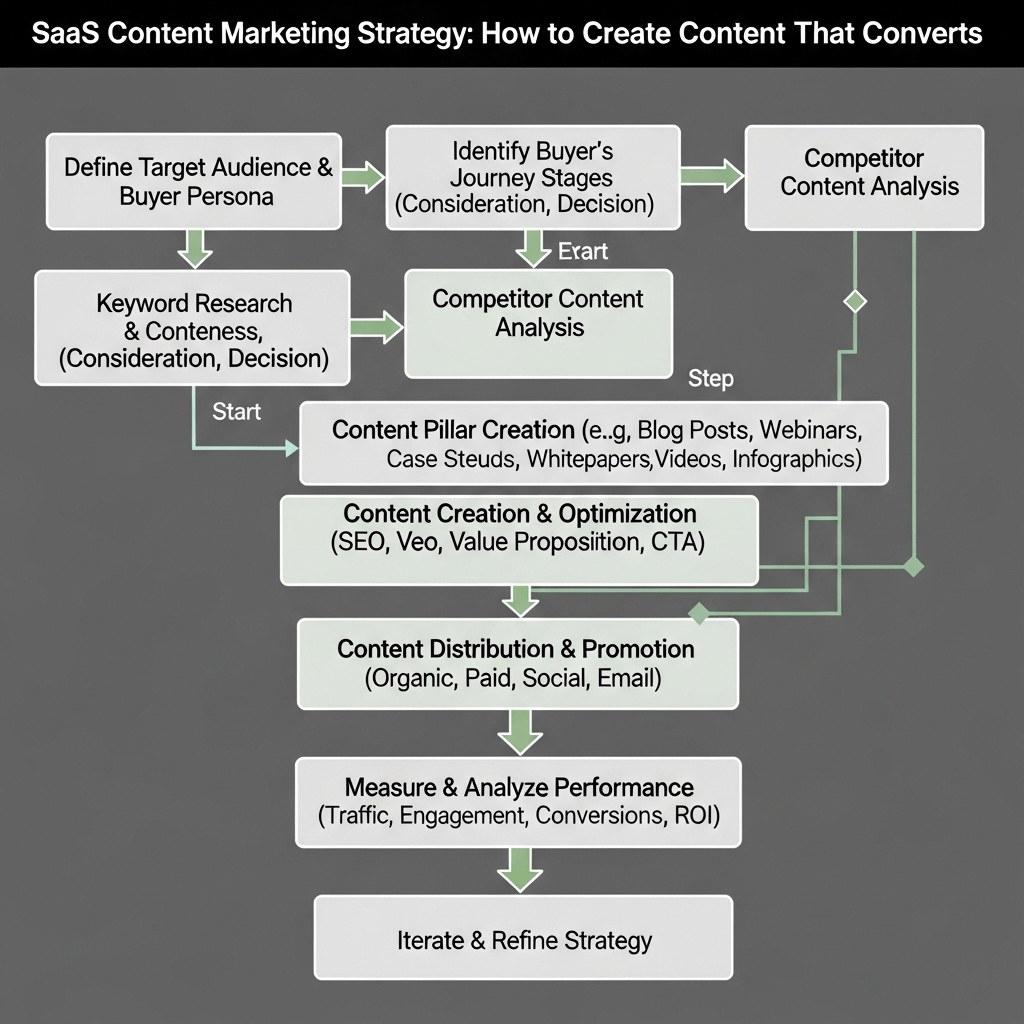
How Do You Build a Content Funnel for SaaS That Converts?
Let’s break down how to map content to buyer journey in SaaS with actual content types that work.
Top of Funnel: Problem-Aware Content
These pieces target prospects who have a pain point but don’t know solutions exist yet.
Best content types:
- Ultimate guides: “The Complete Guide to [Problem Area]”
- Thought leadership: Industry trends, predictions, controversial takes
- Research and data: Original surveys, benchmark reports
- How-to tutorials: “How to [Solve Problem] Without [Expensive Solution]”
Example keywords:
- “why are my customers churning”
- “how to improve sales team collaboration”
- “signs you need better project management”
Goal: Build awareness, establish authority, capture email addresses
Real example: Drift’s “Conversational Marketing” guides taught an entirely new category. They didn’t just rank for “live chat software”—they created the conversation around how businesses should communicate with prospects.
Middle of Funnel: Solution-Aware Content
These pieces target prospects who understand their problem and are exploring solution types.
Best content types:
- Solution comparisons: “CRM vs Spreadsheets: Which is Right for Your Team?”
- Feature guides: “Essential Features Every [Tool Type] Must Have”
- Use case content: “[Solution Type] for [Specific Industry]”
- Buyer’s guides: “How to Choose the Right [Tool] for Your Business”
Example keywords:
- “best project management software for agencies”
- “email marketing platforms with automation”
- “CRM features for small business”
Goal: Position your solution category, capture high-intent leads, enable comparison
Pro Tip: Create content for adjacent solution categories where your product can compete. If you’re a project management tool with time tracking, create content about “time tracking software” even if that’s not your primary category.
Bottom of Funnel: Product-Aware Content
These pieces target prospects actively comparing specific tools—including your competitors.
Best content types:
- Alternative pages: “Top 10 [Competitor] Alternatives”
- Comparison pages: “[Your Tool] vs [Competitor]”
- Customer case studies: “How [Company] Achieved [Result] with [Your Tool]”
- ROI calculators: Interactive tools showing potential savings
- Product demos: Video walkthroughs of specific features
Example keywords:
- “Asana vs Monday comparison”
- “best Mailchimp alternatives for ecommerce”
- “Salesforce pricing vs HubSpot pricing”
Goal: Capture buying intent, address objections, drive trial signups
These bottom-funnel keywords have the lowest volume but highest conversion rates—often 5-10% compared to 0.5% for top-funnel content.
Understanding keyword research strategies helps you identify high-converting opportunities at each funnel stage.
What Are the Best Content Types for B2B Software Marketing?
Not all content formats perform equally. Here are the best content types for B2B software marketing based on actual conversion data.
| Content Type | Funnel Stage | Avg. Conversion Rate | Best For |
|---|---|---|---|
| Comparison Pages | Bottom | 5-10% | Capturing prospects comparing alternatives |
| Case Studies | Bottom | 3-7% | Providing social proof and ROI evidence |
| Ultimate Guides | Top | 0.3-1% | Building authority and email list |
| How-To Posts | Top/Middle | 0.5-2% | Solving specific problems, capturing keywords |
| Webinars | Middle | 2-5% | Deep education, relationship building |
| Product Videos | Bottom | 4-8% | Showing functionality, reducing friction |
| Interactive Tools | Middle/Bottom | 3-6% | Engagement, lead capture, demonstrating value |
| Templates/Resources | Middle | 1-3% | Lead magnets, demonstrating expertise |
In-Depth Guides and Pillar Content
Comprehensive guides (3,000-5,000+ words) targeting high-volume educational keywords.
Why they work: Build topical authority, earn backlinks naturally, rank for dozens of related keywords, serve as content hub for internal linking.
Example: Ahrefs’ “Beginner’s Guide to SEO” ranks for hundreds of keywords and has earned thousands of backlinks. It positions them as the authority even for people not ready to buy SEO tools yet.
When to create: Every SaaS should have 3-5 pillar guides covering core topics in their space.
Comparison and Alternative Pages
Dedicated pages comparing your tool to competitors or listing alternatives.
Why they work: Target high-intent keywords where prospects are actively shopping. These pages convert 5-10x better than educational content.
Format:
- Honest comparison of features
- Side-by-side pricing tables
- Use case recommendations
- Clear CTAs to try your tool
Example: ClickUp has 50+ comparison pages targeting every major competitor. Each page ranks for multiple related keywords and drives consistent trial signups.
Pro Tip: Be genuinely fair in comparisons. Acknowledge where competitors excel and where you shine. Transparency builds trust and actually improves conversion rates compared to obvious sales pitches.
Customer Case Studies
Stories showing how real customers achieved specific results with your product.
Why they work: Provide social proof, demonstrate ROI, help prospects visualize success, overcome objections about whether your tool works for companies like theirs.
Structure:
- Customer background and challenge
- Why they chose your solution
- Implementation process
- Quantifiable results with metrics
- Direct quotes from decision-makers
SEO optimization: Target “[Industry] + [Solution Type] case study” or “[Company Name] + [your tool]” keywords.
Real example: Slack’s case studies rank for company names (like “IBM Slack case study”) and drive traffic from prospects researching whether Slack works for enterprise companies.
Video Content and Demos
Product walkthroughs, feature explanations, and customer testimonials.
Why they work: Reduce friction in buying process, allow prospects to self-educate, improve engagement metrics, rank in both Google and YouTube search.
Types to create:
- Product overview (2-3 minutes)
- Feature deep-dives (5-10 minutes each)
- Customer testimonial videos (1-2 minutes)
- How-to tutorials for common use cases
According to <a href=”https://www.wyzowl.com/video-marketing-statistics/” rel=”nofollow”>Wyzowl’s video marketing research</a>, 89% of people say watching a video has convinced them to buy a product or service.
Interactive Tools and Calculators
Useful tools that provide value while capturing leads.
Examples:
- ROI calculators for your solution
- Assessment tools (“How mature is your [process]?”)
- Comparison generators
- Free versions of your core functionality
Why they work: Provide immediate value, naturally capture email addresses, demonstrate your product’s value proposition, earn backlinks from people referencing the tool.
Real example: HubSpot’s Website Grader has generated millions of leads over the years. It provides genuine value (site analysis) while introducing prospects to inbound marketing concepts and HubSpot’s platform.
How Do You Create a Content Marketing Plan for SaaS Startups?
Let’s get tactical about content marketing plan for SaaS startups with limited resources.
Month 1: Foundation and Research
Week 1: Customer research
- Interview 10+ customers about their buying journey
- Document exact phrases they use to describe problems
- Identify content they consumed before buying
- Map out common objections and questions
Week 2: Competitor analysis
- Identify top 5 competitors’ content strategies
- List their highest-traffic pages (use Ahrefs/SEMrush)
- Find content gaps they’re missing
- Analyze what topics drive their engagement
Week 3: Keyword research
- Build list of 100+ target keywords across all funnel stages
- Prioritize by search intent and difficulty
- Map keywords to content types
- Identify quick-win opportunities
Week 4: Strategic planning
- Define ICP and buyer personas
- Map content to buyer journey stages
- Set KPIs (traffic, leads, trials, not just pageviews)
- Create 90-day content calendar
Understanding technical SEO basics ensures your content can actually rank once published.
Months 2-3: Initial Content Sprint
Publishing cadence for startups:
- 2-3 comprehensive blog posts per week
- 1 bottom-funnel comparison/alternative page per week
- 1 case study per month
- 1 pillar guide every 6-8 weeks
Content priority order:
- Your own comparison pages ([Your Tool] vs competitors)
- Alternative pages (Top alternatives to competitors)
- Use case pages (solution for specific industries/roles)
- Educational content targeting problem-aware keywords
- Pillar guides for long-term authority building
Pro Tip: Start with bottom-funnel content even though it has lower volume. These pages convert immediately and justify continued content investment to stakeholders. Build top-funnel authority content after you’ve proven conversion from content.
Month 4+: Scale and Optimize
Content operations:
- Hire freelance writers for volume (3-5 posts weekly)
- Keep strategic content (comparisons, case studies) in-house
- Implement content review process for quality control
- A/B test headlines, CTAs, and content formats
Optimization:
- Update top-performing posts quarterly
- Improve pages ranking #4-10 (low-hanging fruit)
- Add internal links from new content to older content
- Refresh outdated statistics and examples
Distribution:
- Repurpose blog posts into LinkedIn articles
- Create Twitter threads from key insights
- Turn guides into email courses
- Extract quotes for social media
How Do You Build an Effective SaaS Blog Strategy?
Your blog is the engine of your SaaS blog strategy. Here’s how to make it actually drive results.
Blog Content Mix That Works
40% Educational how-to content:
- Teaches core concepts in your space
- Targets top-funnel keywords
- Builds authority and trust
- Generates backlinks naturally
30% Use case and solution content:
- Industry-specific applications
- Feature explanations
- Problem-solution frameworks
- Captures middle-funnel searches
20% Comparison and alternative content:
- Tool comparisons
- Feature comparisons
- Best alternatives lists
- Highest conversion rates
10% Company updates and thought leadership:
- Product launches
- Company milestones
- Industry predictions
- CEO perspectives
Optimizing Blog Posts for SEO and Conversion
Every blog post needs both SEO optimization (to get traffic) and conversion optimization (to capture leads).
SEO essentials:
- Target one primary keyword per post
- Include keyword in title, first paragraph, and 2-3 subheadings
- Use related keywords naturally throughout
- Add internal links to 2-3 related posts
- Optimize meta description for clicks
- Include relevant images with alt text
Conversion essentials:
- Relevant CTA in first screen (before scroll)
- Content upgrades (downloadable templates, checklists)
- Demo/trial CTAs after showing value
- Exit-intent popups for email capture
- Social proof (customer logos, testimonials)
Pro Tip: Every blog post should have a “next step” that’s relevant to that specific content. Don’t use the same generic “Start Free Trial” CTA on every post. Match the CTA to the content—downloadable template, relevant case study, specific feature page, or tool comparison.
Creating Content Clusters for Authority
Topic clusters organize content around pillar topics, creating stronger SEO signals.
Structure:
- 1 comprehensive pillar page (3,000-5,000 words)
- 8-12 cluster posts (1,500-2,500 words each)
- All cluster posts link to pillar
- Pillar links to all cluster posts
Example cluster:
- Pillar: “The Complete Guide to Customer Retention”
- Cluster 1: “How to Calculate Customer Churn Rate”
- Cluster 2: “10 Proven Customer Retention Strategies”
- Cluster 3: “Customer Retention vs Acquisition: What to Prioritize”
- Cluster 4: “Customer Retention Metrics Every SaaS Should Track”
This structure helps you rank for hundreds of related keywords while establishing topical authority.
Real example: Intercom built comprehensive clusters around “customer engagement,” “customer support,” and “conversational marketing”—ranking for thousands of related terms.
What’s the Best Way to Create a Content Calendar for SaaS?
A strategic content calendar for SaaS balances consistency, relevance, and business goals.
Planning Your Content Calendar
Monthly themes: Organize content around themes that align with business priorities.
- January: New year planning, goal-setting content
- Q1: Budget season, ROI and cost-saving content
- Summer: Use case content (when decision-making slows)
- Q4: Year-end reviews, preparation for next year
Weekly cadence:
- Monday: Educational/how-to post (high traffic potential)
- Wednesday: Use case or feature content (middle funnel)
- Friday: Comparison or thought leadership (conversion or engagement)
Content mix tracking: Monitor your balance across:
- Funnel stages (top/middle/bottom)
- Content types (guides, comparisons, case studies)
- Target personas (end users, managers, executives)
- Keyword difficulty (quick wins vs long-term targets)
Tools for Content Planning
| Tool | Best For | Pricing |
|---|---|---|
| Airtable | Visual content planning | Free – $20/user/mo |
| Notion | Collaborative content workspace | Free – $8/user/mo |
| CoSchedule | Editorial calendar with analytics | $29-999/mo |
| Trello | Simple kanban-style planning | Free – $10/user/mo |
| Asana | Project management for content | Free – $10.99/user/mo |
Pro Tip: Use a simple spreadsheet initially. Add complexity only when your content operation justifies it. Over-engineering your planning process kills momentum.
Measuring Content Performance
Track metrics that actually matter for business outcomes, not vanity metrics.
Awareness stage metrics:
- Organic traffic growth
- Backlinks earned
- Time on page / engagement
- Email list growth
Consideration stage metrics:
- Pages per session
- Return visitor rate
- Resource downloads
- Webinar registrations
Decision stage metrics:
- Trial/demo conversion rate
- Organic traffic to revenue
- CAC from organic channel
- Win rate from content-sourced leads
Learning about measuring SEO success helps you track what actually drives business results.
How Are AI Tools Changing SaaS Content Marketing?
AI is transforming content strategy for SaaS in both opportunities and challenges.
Using AI for Content Creation
What AI does well:
- Generating content outlines and structure
- First drafts for straightforward topics
- Repurposing content into different formats
- Creating variations of headlines and CTAs
- Research and data compilation
What AI does poorly:
- Original insights from experience
- Deep industry expertise
- Authentic case studies and examples
- Strategic thinking about positioning
- Understanding nuanced buyer psychology
Pro Tip: Use AI as a research assistant and draft creator, then add your unique perspective, real examples, and strategic insights. Google’s algorithms can detect thin AI content lacking genuine value. The content that wins has human expertise layered on top of AI efficiency.
Optimizing for AI Search Results
With Google’s Search Generative Experience (SGE) and AI Overviews, SaaS content marketing needs to adapt.
How to optimize for AI search:
- Create content AI can’t replicate (original data, first-hand experience)
- Structure content with clear headings and definitions
- Include FAQs that answer related questions
- Implement comprehensive schema markup
- Go deeper than AI summaries (10x more detailed)
Becoming an AI-referenced source:
- Get mentioned in industry publications AI trains on
- Create authoritative resources others cite
- Publish original research and data
- Build brand recognition in your category
According to research, 82% of B2B buyers still prefer researching on company websites even with AI summaries available—they want depth and specificity AI can’t provide.
Real-World SaaS Content Marketing Examples
Let me break down SaaS content marketing examples that actually drove business results.
Drift’s Category Creation Strategy
What they did:
- Created “Conversational Marketing” as a new category
- Published comprehensive guides defining this approach
- Built content around problems with traditional marketing funnels
- Positioned their live chat as the solution
Results:
- Ranks #1 for “conversational marketing” and hundreds of related terms
- Built a category they dominated
- Grew from startup to acquisition by Vista Equity Partners
Key lesson: Sometimes creating a new category through content is more valuable than competing in existing categories.
Notion’s User-Generated Content Flywheel
What they did:
- Enabled users to create and share templates
- Each template page ranks for long-tail keywords
- Community creates thousands of pages of SEO content
- Templates demonstrate product capabilities
Results:
- Ranks for 400,000+ keywords
- User content creates a self-reinforcing growth loop
- Templates serve as both content and product marketing
Key lesson: Enable your users to create content that serves both their needs and your SEO goals.
HubSpot’s Educational Authority Model
What they did:
- Created comprehensive guides for every stage of inbound marketing
- Published consistently for 10+ years
- Offered free tools (Website Grader, Email Signature Generator)
- Built Academy with free certifications
Results:
- Over 5 million monthly organic visitors
- Became synonymous with inbound marketing
- Content drives 76% of their leads
Key lesson: Long-term commitment to educational content builds unassailable authority that competitors can’t replicate quickly.
Common Questions About SaaS Content Marketing
How much content should we publish per week?
Start with 2-3 high-quality posts weekly. Quality beats quantity always. As you scale, maintain quality while increasing volume to 3-5 weekly posts. Established SaaS companies often publish 5-10 pieces weekly across blog, resources, and video.
Should we outsource content or keep it in-house?
Hybrid approach works best. Keep strategic content in-house (comparisons, case studies, product-focused content) where product knowledge matters. Outsource top-funnel educational content to skilled freelancers with clear briefs. Never outsource without editorial oversight.
How long before content marketing shows ROI?
Realistic timeline: 3-6 months for initial traffic growth, 6-12 months for meaningful lead generation, 12-18 months for content becoming a primary channel. This assumes consistent publishing (2-3 posts weekly) with proper SEO optimization.
What if our niche has low search volume?
Focus on problem-based keywords rather than solution keywords. Create content around adjacent topics. Build thought leadership content for LinkedIn and communities. Use content to enable sales rather than purely for SEO. Low-volume keywords often convert better than high-volume terms.
How do we measure content marketing success?
Track pipeline contribution, not just traffic. Use UTM parameters to attribute leads to specific content. Measure organic traffic to MQLs/SQLs conversion rate. Monitor content-assisted conversions in analytics. Set up revenue attribution to understand which content drives actual customers.
Should every piece of content have a CTA?
Yes, but make CTAs contextually relevant. Educational posts should offer related resources or email signup. Comparison posts should drive to trials or demos. Match the CTA to where the reader is in their journey. Multiple CTA options (download resource OR start trial) can improve overall conversion.
How do we create content for multiple buyer personas?
Tag content by persona in your CMS. Create dedicated content clusters for each persona. Use subheadings to address different perspectives within one piece. Consider persona-specific resource hubs. Track which content resonates with which personas in your analytics.
Final Thoughts: Building a Content Engine That Converts
SaaS content marketing isn’t about publishing more—it’s about publishing smarter.
The companies winning with content understand it’s not a short-term tactic. It’s a long-term asset that compounds in value over years. Every piece you publish can drive traffic and conversions for 2-3+ years with proper optimization.
Start with a clear strategy. Understand your buyer journey. Map content to every stage. Balance quick-win bottom-funnel content with authority-building top-funnel content.
Most importantly, measure what matters. Traffic is vanity. Pipeline contribution is reality. Track how content drives trials, demos, and ultimately revenue.
Your competitors are either already doing this or they’re not. If they’re not, content marketing is your unfair advantage. If they are, you can’t afford to wait.
The SaaS companies dominating organic search today started 2-3 years ago. They committed to consistent content creation and played the long game.
The best time to start your content strategy for SaaS was two years ago. The second-best time is today.
Now stop reading and start creating. Your pipeline depends on it.


