Last updated: April 2026 | Sources reviewed: 7
92.42% of all keywords in Ahrefs’ database get ten or fewer searches per month. (Source: Ahrefs, 2021) The vast majority of search demand lives in specific, longer phrases — not the short, obvious terms every competitor targets first.
That is the long-tail opportunity. Not a loophole. Not a secret. A structural fact about how search volume is distributed.
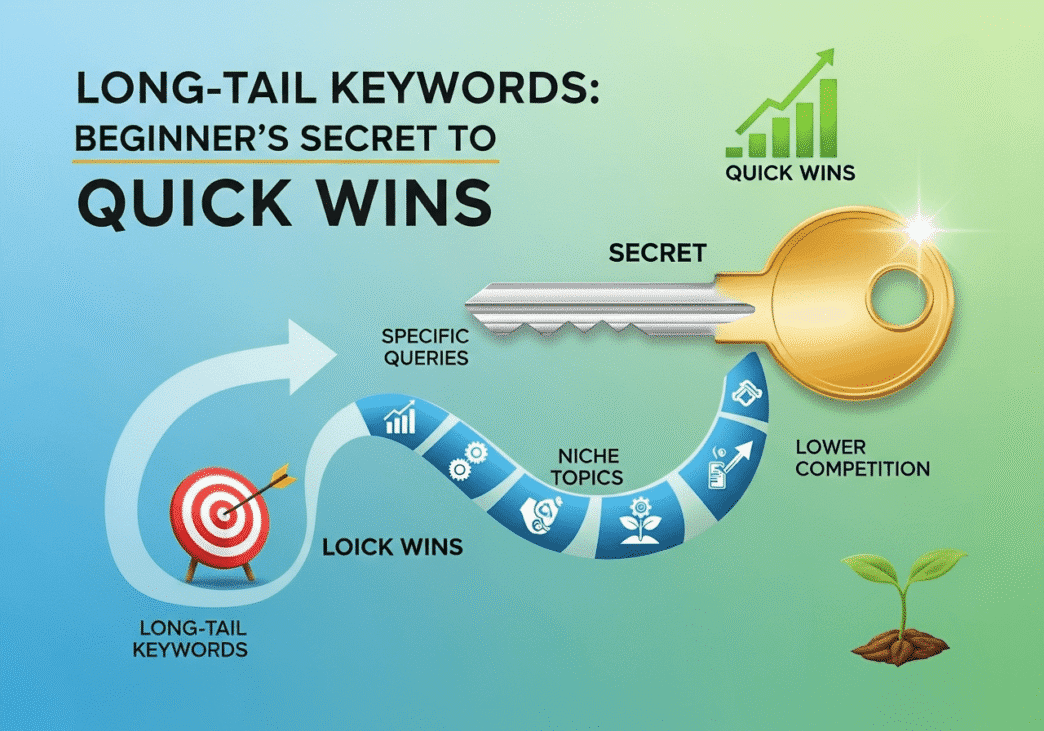
Long-tail keywords are phrases of three or more words that target a narrow, specific user need. Lower search volume. Lower competition. Higher conversion rate. Faster rankings for new sites.
Table of Contents
ToggleWhy Does a New Site Need Long-Tail Keywords First?
Short keywords are dominated by sites with years of authority. “Running shoes” — KD 76 on Ahrefs. Unreachable for a new domain.
“Best running shoes for flat feet under £100 UK” — KD 8. Rankable within weeks on content quality alone.
The competition gap is structural. Fewer sites target specific phrases. Fewer backlinks are required. A new site can win on content depth rather than domain authority.
The counterintuitive reality: Thirty posts targeting KD 5–15 long-tail keywords will produce more total traffic in year one than one post targeting a KD 70 head term that never ranks.
In practice: A six-month-old blog targeting only long-tail variations within one topic cluster accumulated 23 first-page rankings before a single post targeting a head term appeared in the top 50. The cluster authority built by long-tail rankings then accelerated the head term’s ranking — not the reverse.
Pro Tip: Filter your keyword tool to KD 0–20 and minimum volume 50. That filtered list is your entire first-year content plan. Everything above KD 20 goes into a future targets list until topical authority builds.
What Makes a Phrase Long-Tail vs Short-Tail?
Length alone does not define it. Intent specificity does.
“Running shoes” is a head term — broad intent, any audience, high competition.
“Waterproof trail running shoes for overpronation women UK” is long-tail — specific intent, defined audience, low competition.
The specificity is what reduces competition and increases conversion. A user typing seven words knows exactly what they need. They are closer to a decision than someone typing two words.
| Keyword typeExampleMonthly searchesKD rangeTime to rankConversion signal | |||||
|---|---|---|---|---|---|
| Head term | “running shoes” | 90,000+ | 70–90 | 12+ months | Broad — could be anything |
| Body keyword | “trail running shoes women” | 2,000–8,000 | 35–55 | 4–8 months | Narrower — closer to decision |
| Long-tail | “waterproof trail running shoes for overpronation” | 100–500 | 5–20 | 4–10 weeks | Specific — near purchase intent |
| Hyper-specific | “best waterproof trail shoes wide fit under £80” | 10–100 | 0–10 | 1–4 weeks | Very high — problem + budget defined |
How Do You Find Long-Tail Keywords Without Paying for a Tool?
Four free sources produce long-tail keywords that are often better than tool output — because they come from real user language, not database estimates.
Google Autocomplete
Type a seed keyword into Google and stop before pressing Enter. Every autocomplete suggestion is a real phrase real users have searched frequently enough to trigger autocomplete. Use the alphabet method: type your seed keyword followed by “a” and record every suggestion. Then “b.” Then “c.” Fifteen minutes produces 40–60 distinct long-tail phrases per seed keyword.
People Also Ask
Search any seed keyword. Read every PAA question. Click one — it expands and generates additional PAA questions. Three levels deep into a PAA chain produces 15–25 distinct long-tail question-format keywords. Each is phrased exactly as users type it — which is directly usable as an H2 heading or FAQ entry.
Google Search Console
If your site already has published content, GSC’s Queries report shows real phrases generating impressions. Filter for queries in positions 8–20 with more than 30 impressions. Every query on that list is a long-tail keyword your domain already has partial authority for — the fastest available ranking opportunity.
Reddit and community forums
Thread titles in relevant subreddits are long-tail keywords written by users who have the problem. Does anyone know which running shoes work for people with flat feet and bunions” is a long-tail keyword with zero competition in any tool database — because it has not been searched enough to register. But the need is real and the specificity is high.
What most guides get wrong here: They recommend these free sources as a budget alternative to paid tools. They are not a consolation prize. Forum thread titles and PAA questions surface emerging intent before it registers in keyword databases — meaning they identify opportunities with zero published competition.
How Do You Pick Which Long-Tail Keywords to Target First?
Discovery produces more keyword ideas than any site can publish against in a year. Prioritisation is the skill.
Apply these four filters in sequence:
Filter 1 — Minimum volume: Remove any phrase with fewer than 50 monthly searches. Below that threshold, ranking at position one produces negligible traffic regardless of how easy the keyword is.
Filter 2 — KD ceiling: For a new site, remove anything above KD 20. For a site with 10–20 published posts in a cluster, the ceiling rises to KD 30. Do not exceed your domain’s realistic ceiling — it produces wasted content investment.
Filter 3 — Intent alignment: Search each remaining keyword in a private browser window. Read the format of the top three results. If they are guides, publish a guide. If they are product pages, publish a product page. Remove any keyword where the dominant SERP format requires a content type you cannot produce.
Filter 4 — Business relevance: Manually remove any keyword that, even if ranked at position one, would not bring your target audience to the site. A keyword with volume 200 and KD 8 that attracts nobody who needs your product has zero value regardless of how easily it ranks.
What remains after all four filters is your actual content plan.
How Should Long-Tail Keywords Be Used in Content?
One primary long-tail keyword per page. Supporting semantic variants appear naturally in subheadings, FAQ sections, and body paragraphs — not forced.
The primary keyword appears in:
- H1 heading (once, naturally)
- First 100 words of the article
- One H2 subheading
- Meta title (within 60 characters)
- URL slug (shortened if needed)
What it does not mean: Repeating the phrase at a target density. Google’s systems identify topic relevance from entity coverage and semantic completeness — not from keyword frequency. A post about “waterproof trail running shoes for overpronation” that covers cushioning types, pronation mechanics, width fitting, and durability signals more relevance than a post that mentions the exact phrase twelve times.
In practice: The most reliable on-page signal improvement comes from covering the People Also Ask questions associated with the target keyword as H3 subheadings with direct answers. Those questions are sub-intents Google has already confirmed users associate with the primary query. Addressing them in structured form increases topical completeness and featured snippet eligibility simultaneously.
Pro Tip: Check the word count of the top three ranking pages for your target long-tail keyword before deciding how long your post should be. A long-tail targeting a hyper-specific question may rank at 700 words. A long-tail covering a moderately complex topic may need 1,400. Word count should match competitive content length, not a default target.
What Most Guides Get Wrong About Long-Tail Keywords
The dominant beginner framing presents long-tail keywords as temporary training wheels — something to use while the site grows, then abandon in favour of high-volume terms.
That framing is wrong in both directions.
Long-tail keywords do not become irrelevant as a site grows. High-authority sites continue publishing long-tail content because it drives qualified, high-conversion traffic. Ahrefs, SEMrush, and HubSpot — all high-DA domains — publish long-tail targeting content continuously alongside their head term content.
The second error: treating all low-volume keywords as low-value. A long-tail with 80 monthly searches and high commercial intent in a niche where one conversion produces significant revenue is more valuable than an informational long-tail with 800 monthly searches that never converts.
Volume is potential. Intent and business alignment determine actual value.
Frequently Asked Questions
How many long-tail keywords should a new site target in the first three months?
Ten to twenty is the right range for the first quarter. Each keyword requires a dedicated page with enough depth to cover the sub-intents that appear in PAA boxes for that query. Publishing ten focused, high-quality long-tail posts produces more compounding topical authority than fifty thin posts targeting fifty unrelated phrases. Once those ten posts generate rankings and GSC data, use the query report to identify additional long-tail variants the existing posts are already surfacing impressions for — those become the next batch of targets.
Can a long-tail keyword page rank for multiple related phrases?
Yes — this is normal. A well-structured post targeting one primary long-tail keyword will typically rank for 20–50 related query variants once it establishes a position. Google associates the page with the semantic neighbourhood of the primary keyword, not just the exact phrase. This is why covering sub-intents through PAA-based subheadings is more valuable than targeting multiple distinct long-tail phrases on the same page — the former produces natural multi-phrase ranking, the latter creates intent confusion.
Do long-tail keywords still work when AI Overviews appear for the query?
AI Overviews appear most frequently for informational queries — which represent the majority of long-tail keyword targets. (Source: seoClarity, 2025) For informational long-tails, the correct response is to structure content for AI Overview citation rather than standard ranking alone: direct answer in the first paragraph, FAQ schema on sub-questions, clear entity coverage throughout. Pages cited in AI Overviews receive secondary visibility independent of standard position — which means a long-tail post cited in an AI Overview at position six receives more effective traffic than a non-cited post at position three.
Should I create separate pages for closely related long-tail keywords?
Group long-tail keywords that share the same primary intent on one page. Separate keywords that represent genuinely different user goals onto different pages. “Best trail running shoes for flat feet” and “best trail running shoes for flat feet women” share near-identical intent and can coexist on one page. Best trail running shoes for flat feet” and “how to correct flat feet for running” target different user goals — one is commercial investigation, one is informational problem-solving — and belong on separate pages with different content formats.
How do I know if a long-tail keyword is too obscure to target?
Apply the 50-search minimum volume floor and then check GSC if your site is established. If the keyword shows zero impressions in GSC and no volume in any tool, it likely lacks consistent search demand. However, zero-volume keywords from forum threads and PAA chains that describe a genuine user problem are worth a post if one conversion from that traffic justifies the production cost. The break-even question: if this page ranks at position one and receives 20 visitors per month, does your conversion rate and average order value make it worth writing? For most commercial sites with any conversion rate above 2%, the answer for a specific long-tail is yes.
What is the fastest way to find long-tail keywords I can rank for this month?
Open Google Search Console, go to Performance, click Queries, filter by Average Position greater than 8, and sort by Impressions descending. Every query in that list is a long-tail keyword your domain already has partial authority for. Queries with more than 30 impressions and no dedicated page are your fastest available ranking opportunities — they require a new focused post rather than a new domain or backlinks. Publish a post specifically targeting the top five queries from that list before the end of the month.
Conclusion
Long-tail keywords are not a workaround for beginners who cannot compete. They are the structurally correct starting point for any site building topical authority from zero.
Short keywords require authority your site does not yet have. Long-tail keywords require content your site can produce today. That asymmetry is the entire argument for targeting them first.
Specific next step: Open your keyword tool this week, set KD to 0–20 and minimum volume to 50, and filter by your primary topic. Export the results. Apply the four-filter prioritisation process from this article. Identify the ten keywords that pass all four filters. Brief one post per keyword and publish the first one before the end of April 2026. That is your long-tail content plan.
Citations
[1]. Ahrefs — Long-Tail Keywords: What They Are and How to Use Them. https://ahrefs.com/blog/long-tail-keywords/
[2]. Semrush — The Ultimate Keyword Research Checklist. https://www.semrush.com/blog/keyword-research-checklist/
[3]. seoClarity — Impact of Google’s AI Overviews: SEO Research Study. https://www.seoclarity.net/research/ai-overviews-impact
[4]. Surfer SEO — Ranking Factors in 2025: Insights from 1 Million SERPs. https://surferseo.com/blog/ranking-factors-study/
[5]. Mangools — Keyword Research for SEO: The Beginner’s Guide 2025. https://mangools.com/blog/keyword-research/
[6]. Futuristic Marketing Services — Keyword Research for Beginners: Step-by-Step Guide. https://futuristicmarketingservices.com/Blogs/seo/keyword-research-for-beginners/
[7]. Backlinko — Free Keyword Research Tool and Guide. https://backlinko.com/tools/keyword