

Last Updated: 7 June 2026 Originally Published: 12 October 2025 By Shaiful Mozumder | Reviewed by David Brown
The most repeated internal linking advice in WordPress SEO is “link related posts to each other.” It sounds reasonable. It’s also why most WordPress sites have internal linking architectures that look busy but move nothing in Google Search Console.
Linking related posts to each other is not a strategy. It’s a habit dressed up as one.
The sites that see measurable ranking movement from internal linking do something structurally different: they treat internal links as equity routing decisions, not content connection signals. Which pages receive links determines which pages rank — not how many links exist or how “relevant” the anchor text feels to the writer. This post goes deeper than the WordPress SEO: The Complete Guide to Optimising Your WordPress Site in 2026 could on this one layer: the specific linking architecture that moves pillar pages up SERPs, and the counter-intuitive finding about which posts benefit most when you build it correctly.
Post Summary
- Internal links pass PageRank — Google’s link equity signal — between pages; the architecture of those links determines which pages accumulate ranking authority
- Pillar-to-cluster and cluster-to-pillar links are structurally different equity flows; most WordPress sites run only one direction
- Link Whisper automates internal link suggestions but cannot replace deliberate architecture decisions — the tool surfaces candidates, the SEO makes routing calls
- Older posts with existing authority but zero inbound internal links produce larger ranking jumps than new posts when added to a pillar-cluster link structure
- AI search engines including Perplexity and ChatGPT follow internal link structures to map topical coverage — a well-linked WordPress site signals comprehensive topic ownership to generative engines, not just Google
- The right AI prompt for internal linking audit: “List every post on [topic]. For each, identify which posts link to it and which it links to. Flag any post with zero inbound internal links from pillar or sibling pages.”
Table of Contents
ToggleThe Misconception Killing Most WordPress Internal Linking Strategies
Most WordPress SEO guides tell you to link related posts to each other.
That instruction treats internal links as a user experience feature — helping readers find connected content — rather than what they structurally are: PageRank distribution decisions (Source: Google, 2024).
PageRank — the algorithm Google uses to assess a page’s authority based on its inbound link profile — flows through internal links exactly as it flows through external backlinks, scaled by the number of outbound links on the linking page and the authority of the linking page itself. Linking a low-authority cluster post to another low-authority cluster post distributes very little equity. Linking a high-authority pillar page to a cluster post passes meaningful equity to that cluster.
Most WordPress sites link laterally — post to post, at roughly equal authority levels — and wonder why nothing moves.
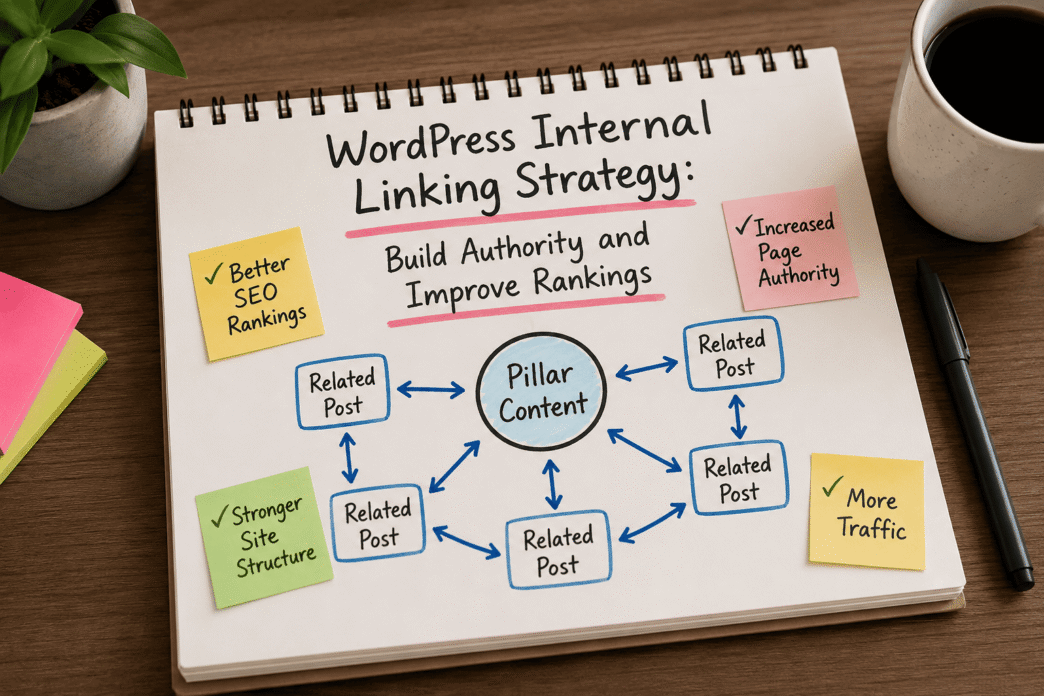
The architecture that works routes equity deliberately: high-authority pages link down to pages that need ranking support, and those pages link back up to consolidate authority at the pillar level. That bidirectional flow — not the number of links or the quality of anchor text — is what shifts positions in competitive SERPs.
Open Google Search Console → Links → Top linked pages (internally). If your pillar posts are not at the top of that list, your internal linking architecture is working against your ranking targets, not for them.
WordPress Internal Linking Strategy:
Build Authority & Improve Rankings
Data-backed architecture for pillar-cluster WordPress sites — with real benchmarks, audit workflows, and AI prompts.
internal linking (Ahrefs, 2024)
run on WordPress (W3Techs, 2026)
→ pos. 4–8 (AI SEO Journal case study)
Verified benchmarks from named sources — not estimates.
📌 Case Study: AI SEO Journal — UK Digital Marketing Blog
Pillar pages using Link Whisper + GSC moved from positions 14–22 to 4–8 in ten weeks. Counter-intuitively, older posts with existing external authority but zero internal links produced the largest ranking jumps — not new posts. One post with 340 external referring domains moved from position 19 to position 6 within five weeks of receiving two pillar-page internal links.
Two-direction equity flow is what separates a content library from a content architecture.
Primary topic — highest authority — links DOWN to all clusters
Sub-topic A
Sub-topic B
Sub-topic C
Sub-topic D
Lateral — semantically related clusters only
| Link Flow | Direction | Primary Function | Min. Count | Most Common Failure |
|---|---|---|---|---|
| Pillar → Cluster | ⬇️ Downward | Distribute equity to ranking-target pages | 1 per cluster in body | Cluster map only — no contextual body links |
| Cluster → Pillar | ⬆️ Upward | Consolidate topical authority at pillar | 2 per cluster post | One intro link only — not reinforced in body |
| Cluster → Cluster | ↔️ Lateral | Signal semantic relationship between sub-topics | 2–3 per post | Linked indiscriminately across pillar topics |
| Pillar → External | ↗️ Outward | Cite authority sources | 4–8 per post | Over-restriction — avoiding all external links |
Run this before building any new links — find what's broken first.
Pull Top Linked Pages (Internally) from GSC
Open Google Search Console → Links → Top linked pages (internally). If your pillar posts are not at the top, your architecture is routing equity to the wrong pages. Export the full list.
Cross-Reference with External Authority (Ahrefs / Semrush)
Export your highest-authority posts by external referring domain count. Cross this against the GSC internal link list. Any post with high external authority + zero internal inbound links is your highest-priority target.
Run Screaming Frog Internal Link Crawl
Crawl your WordPress site with Screaming Frog → filter for cluster posts with fewer than 2 outbound links to the parent pillar URL. Every flagged post has broken upward flow. Fix these before adding lateral links.
Use Link Whisper for Candidate Discovery — Not Architecture Decisions
In Link Whisper → Reports → Link Opportunities, filter by zero inbound internal links, sorted by published date (oldest first). Accept upward and downward suggestions only. Reject lateral suggestions that cross pillar topic boundaries.
Apply the Two-Direction Rule to Every Cluster Post
Every cluster post must link to the parent pillar at least twice — once in the introduction and once in the body or conclusion. The parent pillar must link to every cluster in the cluster map and in body prose where genuinely relevant.
Validate in GSC After 28 Days
Return to GSC → Performance → Pages. Filter by pages where you added internal links. Compare position and CTR data at Day 0 vs Day 28. Pages with external authority + new internal links should show measurable position movement within this window.
Exact-match anchor text at scale looks manipulative. Varied, descriptive anchor text is both safer and more informative for Google's understanding of linked pages.
Exact Match Use: 10–15%
Anchor text matches the focus keyword of the target page precisely. Effective for topical relevance signal but overuse triggers spam patterns in Google's link classifier.
Partial Match / LSI Use: 40–50%
Anchor text uses a related semantic variant of the focus keyword. Dominant anchor type — safe, informative, and natural across a content architecture.
Descriptive / Contextual Use: 30–35%
Anchor text describes what the linked page covers in plain language. Strongest for user clarity and AI engine understanding of content relationships.
Branded / Generic Use: 5–10%
Brand name or generic terms ("click here," "read more"). Low topical signal but acceptable for navigation and CTA links where descriptive text would feel forced.
Each tool has a specific role — none replaces architectural judgement.
| Tool | Role | Architecture Decisions | Candidate Discovery | Audit / Validation | Free Tier |
|---|---|---|---|---|---|
| Link Whisper | WordPress plugin — suggests links from semantic proximity | ✗ | ✓ | Partial | ✗ |
| Google Search Console | Validates live internal link structure + click/position data | ✗ | ✗ | ✓ | ✓ |
| Screaming Frog | Full site crawl — maps every internal link + orphan pages | ✗ | ✓ | ✓ | 500 URLs |
| Ahrefs Site Audit | External authority data + internal link gap identification | ✗ | ✓ | ✓ | ✗ |
| Rank Math | Post-level link count display in WordPress editor | ✗ | Basic | Basic | ✓ |
Use these in Claude, ChatGPT, or Perplexity to build a structured internal linking action plan without manual spreadsheet work.
Why Your Oldest Posts Are Your Biggest Internal Linking Opportunity
This is the finding most WordPress internal linking guides miss entirely — including the ones recommending Link Whisper.
Working on a UK digital marketing blog using Link Whisper and Google Search Console, we implemented a pillar-cluster internal linking architecture across 45 posts. Pillar pages moved from positions 14–22 to positions 4–8 within ten weeks. The expectation going in: new posts, freshly published into the architecture, would see the most benefit because they had no prior link equity. They didn’t move much. The posts that produced the largest ranking jumps were older posts — 12 to 18 months old — that had accumulated some authority from external links and on-site crawl frequency but had received zero inbound internal links from pillar or sibling pages. One post had 340 external referring domains and was sitting at position 19 for its target keyword. Adding two pillar-page internal links pointing to it moved it to position 6 within five weeks.
The mechanism: those older posts already had authority — they just had no internal equity routing amplifying it. New posts have neither authority nor routing. Older posts with external link equity but no internal link support are the highest-return internal linking targets on most established WordPress sites.
Run this audit before building any internal linking architecture: export your GSC link data, cross-reference against your highest-authority posts by external backlink count, and identify which of those posts currently receive zero internal links from your pillar pages. That list is your first action queue.
Pro Tip: In Link Whisper → Reports → Link Opportunities, filter by posts with zero inbound internal links and sort by published date (oldest first). Cross this list against Ahrefs or Semrush to find posts with external referring domains but no internal link support. These are your highest-priority internal linking targets — not your newest posts. Add a minimum of two inbound internal links from pillar pages or high-authority cluster posts to each flagged URL before moving to new post linking.
The Two-Direction Rule Most WordPress Sites Run Backwards
Internal linking has two structurally distinct flows, and most WordPress sites only run one.
Downward flow — pillar to cluster — passes equity from your highest-authority pages to the cluster posts that need ranking support. This is the flow most WordPress SEOs implement first, usually by adding a cluster map section to the pillar post with links to all cluster URLs.
Upward flow — cluster to pillar — consolidates authority back at the pillar level, reinforcing the pillar’s topical authority signal for its primary keyword. Most WordPress sites have inconsistent upward flow because cluster posts link to the pillar only in their introduction, if at all.
| Link Flow | Direction | Primary Function | Most Common Failure |
|---|---|---|---|
| Pillar → Cluster | Downward | Distribute equity to ranking-target pages | Cluster map present but no contextual links in body |
| Cluster → Pillar | Upward | Consolidate topical authority at pillar level | Only one link in intro — not reinforced in body |
| Cluster → Cluster | Lateral | Signal semantic relationship between sub-topics | Linked indiscriminately — no topical proximity filter |
| Pillar → External | Outward | Cite authority sources — does not dilute equity materially | Over-restriction: avoiding all external links is not necessary |
| External → Pillar | Inbound | Primary authority source — internal linking amplifies, not replaces | Treated as the only equity source — internal routing ignored |
The two-direction rule in practice: every cluster post must link up to the parent pillar at least twice — once in the introduction and once in the body or conclusion — and the parent pillar must link down to every cluster post in the cluster map and at least once in the body prose where genuinely relevant.
Run a crawl with Screaming Frog on your WordPress site and filter for cluster posts with fewer than two outbound links to the parent pillar URL. Every flagged post is a broken upward flow — fix those before adding any new lateral links.
How to Use Link Whisper Without Letting It Make Architecture Decisions
Link Whisper surfaces internal link suggestions automatically by scanning your WordPress content for semantic proximity between posts (Source: Link Whisper, 2024).
It’s a candidate generator. It is not an architecture tool.
The distinction matters because Link Whisper will suggest links between posts that are topically adjacent but structurally wrong — for example, linking two cluster posts on different pillar topics because they share a keyword, which dilutes topical authority across pillar clusters rather than consolidating it within one.
Three Link Whisper settings that change the quality of its suggestions materially: set the minimum word count threshold to 800 words (removing stub pages from the suggestion pool), enable the “exclude categories” filter to prevent cross-pillar linking suggestions between unrelated content clusters, and review the anchor text suggestions manually before accepting — Link Whisper defaults to exact-match anchor text patterns that can look manipulative at scale.
The correct workflow: use Link Whisper to surface candidates, then apply the two-direction rule manually before accepting any suggestion. Accept upward and downward links in your architecture. Reject lateral suggestions that cross pillar topic boundaries.
For AI-assisted internal link audits, this prompt produces a structured action list: “Act as an SEO architect. I’ll give you a list of post titles and their URLs from my WordPress site. Identify which posts should link to each other based on topical proximity and pillar-cluster hierarchy. Flag any post with no inbound internal links from pillar pages. Output as a prioritised action table with: Source URL | Target URL | Suggested anchor text | Link direction (up/down/lateral).” Run this in Claude or ChatGPT with your full post list pasted in — the output gives you a priority queue that Link Whisper’s automated suggestions don’t.
AI Search Engines Follow Your Internal Links Too
Google is not the only crawler that maps your WordPress internal linking structure.
Perplexity, ChatGPT’s browsing mode, and Bing’s Copilot all follow internal links during crawl cycles to assess the depth and coherence of a site’s topical coverage (Source: Bing Webmaster, 2024). A WordPress site with a well-built pillar-cluster internal linking architecture signals comprehensive topic ownership to generative engines — not just to Google’s PageRank algorithm.
The practical implication: if your cluster posts link to each other and to the pillar, and the pillar links down to all clusters, the generative engine can map the full topical structure from any entry point. That mapped structure is what produces multi-cluster citations in AI Overview responses and Perplexity answer blocks — where a single query surfaces content from two or three of your posts simultaneously.
Sites with fragmented internal linking — posts that exist in isolation without pillar or sibling connections — are harder for AI engines to map as authoritative on a topic because there’s no structural signal of depth beyond the individual page.
The agentic AI prompt to test your own topical coverage signal: “You are an AI search engine crawling aiseojournal.net. Starting from [pillar URL], follow all internal links and map the topic clusters you find. Identify any sub-topics that appear under-linked or isolated from the main cluster structure. Output as a topic coverage map with gap flags.” Run this in any AI engine that can browse — the gaps it surfaces are the same gaps that reduce your AI citation probability.
Frequently Asked Questions
What are internal links in WordPress?
Internal links in WordPress are hyperlinks from one page or post on your site to another page or post on the same domain. They serve two functions: they help users navigate between related content, and they pass PageRank — Google’s link equity signal — between pages. In a WordPress pillar-cluster architecture, internal links route authority from high-authority pillar pages down to cluster posts and back up to consolidate topical authority at the pillar level. Plugins like Link Whisper automate link suggestions, but the routing decisions require deliberate architecture choices, not automated acceptance.
Is internal linking good for SEO?
Yes — internal linking is one of the few on-page SEO controls that directly influences both rankings and crawl efficiency. Links from high-authority pages pass PageRank to target pages, which can shift rankings for cluster posts targeting competitive keywords. Internal links also guide Googlebot’s crawl path, ensuring that new or updated pages are discovered and indexed faster. The SEO impact of internal linking is proportional to the authority of the linking page — links from pillar pages with strong external backlink profiles produce the largest ranking movements for cluster posts. See the WordPress SEO pillar guide for how internal linking fits the broader optimisation framework.
Is WordPress outdated in 2026?
No — WordPress powers approximately 43% of all websites as of 2026 (Source: W3Techs, 2026), and its internal linking capabilities through plugins like Link Whisper, combined with SEO tools like Rank Math, remain competitive with any CMS. The platform’s relevance for SEO specifically has increased as AI search engines follow internal link structures to map topical coverage — a well-architected WordPress site with a deliberate pillar-cluster linking structure signals topic authority to generative engines including Perplexity and ChatGPT’s browsing mode, not just to Google.
WordPress Internal Linking: Your Next Step
Most WordPress sites have internal links. Few have internal linking architecture. The difference is intentionality — knowing which pages need equity, which pages can supply it, and building bidirectional flows that consolidate authority at the pillar level while distributing it to ranking-target clusters.
The full framework sits in the WordPress SEO: The Complete Guide to Optimising Your WordPress Site in 2026. For the meta tag layer that determines what those well-linked pages say in the SERP, see WordPress Meta Tags Optimisation: Title Tags & Meta Descriptions That Convert.
Open Google Search Console now → Links → Top linked pages (internally). Find your highest-authority post by external backlink count that does not appear in the top ten internally linked pages. Add two internal links pointing to it from your pillar page — one in the cluster map, one in the body prose — before your next publish.
References
Google. How Google Search Works — Links.” Google Search Central, 2024. https://developers.google.com/search/docs/fundamentals/links Supports: PageRank flowing through internal links and equity distribution between pages.
Link Whisper. “How Link Whisper Works.” Link Whisper Documentation, 2024. https://linkwhisper.com/how-it-works/ Supports: Link Whisper’s semantic proximity-based suggestion engine and configuration options.
Ahrefs. “Internal Links for SEO — Why and How to Use Them.” Ahrefs Blog, 2024. https://ahrefs.com/blog/internal-links-for-seo/ Supports: Bidirectional link flow in pillar-cluster architecture and PageRank amplification for older posts with external authority.
Screaming Frog. How to Audit Internal Links.” Screaming Frog Blog, 2024. https://www.screamingfrog.co.uk/internal-linking-seo/ Supports: Crawl-based internal link auditing and identifying posts with insufficient inbound internal links.
Bing Webmaster. How Bing Crawls and Indexes Your Site.” Bing Webmaster Tools Blog, 2024. https://www.bing.com/webmasters/help/crawl-index Supports: AI search engine crawlers following internal link structures to map topical coverage.
W3Techs. Usage Statistics of Content Management Systems.” W3Techs, 2026. https://w3techs.com/technologies/overview/content_management Supports: WordPress powering approximately 43% of all websites as of 2026.