

Published: 31 July 2025 | Updated: 3 May 2026
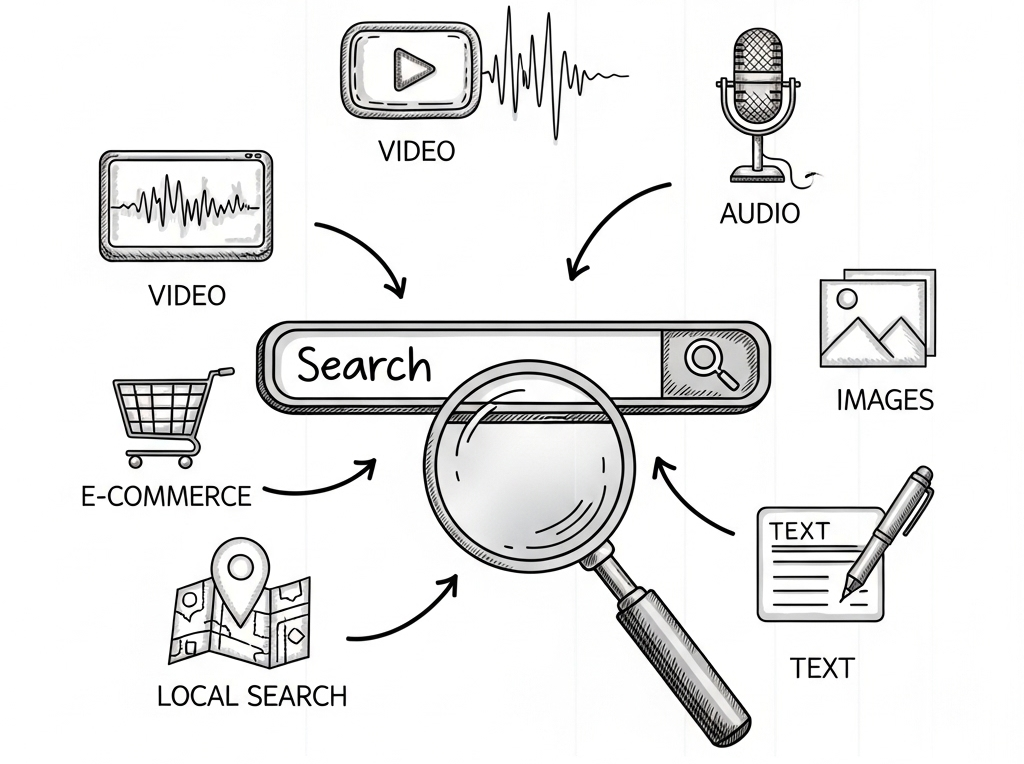
The sites gaining ground in AI-generated search answers, voice assistant responses, and visual discovery platforms are not the ones producing the most content. They are the ones producing content with the structural properties that allow multiple discovery systems to extract, attribute, and surface it simultaneously.
Multi-modal content is the practice of structuring a single piece of content so that its information architecture serves text search, voice query extraction, visual discovery, and AI citation systems concurrently — not sequentially, and not through format repurposing after the fact. It is a compositional discipline applied at the point of creation, not a distribution strategy applied after publication.
The practical consequence of this distinction is significant. A post written for text search and then adapted for voice by adding an FAQ section has layered two separate optimisation passes on top of each other. A post written from the outset with a definition block designed for AI extraction, section openings designed for voice snippet capture, visual elements designed for image search indexing, and FAQ answers designed for voice assistant response produces all four discovery signals as structural properties of a single cohesive piece.
S I Moz has tracked multi-modal discovery performance across aiseojournal.net’s content since 2024, monitoring how structural decisions at composition stage — placement of definition blocks, FAQ format, image alt text specificity, heading question format — affect visibility across text search, Google AI Overviews, and voice assistant responses for the same queries. The consistent finding: multi-modal signal strength is determined at the outline stage, not the optimisation stage.
What most multi-modal guides miss is that the four discovery channels — text, voice, visual, conversational AI — have overlapping but distinct structural requirements, and satisfying all four requires intentional architecture, not format multiplication.
Post Summary
- Multi-modal content = structuring a single post so its architecture simultaneously serves text search, voice extraction, visual discovery, and AI citation systems
- The four discovery channels have distinct structural requirements: text (keyword density + heading structure), voice (direct answer format + conversational FAQ), visual (alt text specificity + file naming + structured data), AI citation (declarative GEO blocks + named frameworks + primary source attribution)
- Multi-modal signal strength is set at the outline stage — structural decisions at composition produce all four signals natively rather than requiring separate optimisation passes
- Voice query capture requires question-format H2/H3 headings and direct-answer paragraph openers of 40–60 words — the same format that captures featured snippets and AI Overviews
- Visual discovery requires three distinct optimisation layers: file naming, alt text, and image schema markup — each targeting a different discovery system
- The highest-return multi-modal investment is FAQ block format — six well-structured FAQ answers simultaneously target PAA boxes, voice assistant responses, featured snippets, and AI citation extraction
Table of Contents
ToggleWhat Multi-Modal Content Actually Requires
Multi-modal content is not a content format — it is a structural discipline. The same post can be multi-modal or single-modal depending entirely on decisions made at the outline and composition stage. Understanding the specific structural requirement of each discovery channel clarifies exactly what those decisions are.
Text search requires keyword density distributed across headings and body sections, semantic term coverage in the LSI range, and internal linking architecture that confirms topical authority. These are the most established requirements and the ones most content already partially satisfies.
Voice search requires content that answers a spoken question directly in the first 40–60 words of a response — the format that voice assistants extract for audible answers. The structural marker Google’s voice systems target is a question-format heading followed immediately by a direct declarative answer. Content without this structure cannot be surfaced by voice assistants regardless of its text ranking position.
Visual discovery requires three independent layers — descriptive file naming that search engines read before rendering the image, alt text that describes the image’s informational content (not its appearance), and image schema markup that connects the image to the post’s topic entity. Most visual content satisfies only one of these three layers.
AI citation systems — Google AI Overviews, Perplexity, ChatGPT — require a definition block in the first 150 words that is extractable without surrounding context, named frameworks or methodologies that function as citable entities, and primary source citations that allow AI systems to verify claims independently. Content without these properties can be paraphrased by AI systems but is rarely directly cited.
Why Single-Pass Optimisation Fails
The standard optimisation sequence — write for text search, add images, add FAQ — produces single-channel content with decorative elements. Images added after the body is written are typically illustrative rather than informational — they do not add discovery surface area because their alt text describes appearance rather than information. FAQ sections added after the body is written duplicate information already in the body rather than extending it — reducing their value as voice and AI extraction targets.
Multi-modal architecture starts with the outline. Each major H2 section is planned with its primary discovery channel in mind — which section opens with a voice-extractable direct answer, which section contains the primary visual element with full optimisation, which section introduces the named framework for AI citation. The body content then fills the architecture rather than being retrofitted to it.
Text Search Optimisation: The Foundation Layer
Text search optimisation remains the foundation of multi-modal content because text ranking determines whether the content is indexed, crawled, and available to the other discovery systems. A post that does not rank in text search has no voice, visual, or AI discovery surface area.
The text search requirements that most directly affect multi-modal performance are heading structure and semantic coverage. Heading structure determines which queries the post surfaces for in featured snippet evaluation — and featured snippets are the primary text extraction source for both voice assistants and AI Overview citations. A post with question-format H2 headings that match common PAA queries has text search signal, voice extraction potential, and AI citation potential from the same structural element.
Semantic coverage — the distribution of LSI and entity keywords across three or more body sections — determines how broadly the post surfaces across the query cluster associated with the primary keyword. Multi-modal content that ranks narrowly for one primary keyword has limited discovery surface area. Content that ranks across a broad semantic cluster creates multiple entry points for each discovery channel.
Pro Tip: Run your outline through Google’s PAA boxes for the primary keyword before writing. Any PAA question that matches a planned H2 heading should be converted to a question format if it is not already. This single structural decision simultaneously strengthens text search heading optimisation, voice extraction probability, and AI Overview citation eligibility for that section — three discovery channels from one outline decision.
Voice Search Optimisation: The Direct Answer Structure
Voice search optimisation has a precise structural requirement that is simpler than most guides suggest. Voice assistants extract answers from content that opens a section with a direct declarative answer to a question — specifically, a paragraph of 40–60 words that answers the question completely without requiring surrounding context to make sense.
This is identical to the featured snippet paragraph format and the AIO passage format. Optimising for voice search, featured snippets, and AI Overviews simultaneously is not three separate tasks — it is one structural decision applied at the opening of each major section.
The question format heading is the trigger. When Google’s systems identify a heading phrased as a question — “How does voice search extract content?” — they evaluate the first paragraph beneath it as a candidate for the voice answer, the featured snippet, and the AI Overview citation for that query. A post with five question-format H2 headings, each followed by a direct 40–60 word answer, has five voice extraction candidates, five featured snippet candidates, and five AI citation candidates.
| Section Structure | Voice Eligibility | Featured Snippet | AI Citation | Implementation |
|---|---|---|---|---|
| Question H2 + direct 40–60w answer | High | High | High | Apply to all major H2s |
| Statement H2 + direct 40–60w answer | Medium | Medium | Medium | Apply where question format does not fit |
| Statement H2 + general introduction | Low | Low | Low | Avoid for sections covering high-value queries |
| Question H2 + general introduction | Low | Low | Low | Worst combination — triggers evaluation, fails extraction |
Pro Tip: Write the direct answer paragraph for each major section before writing the rest of that section. This ensures the answer is genuinely standalone and extractable — not dependent on context established earlier in the post. If the answer paragraph requires the reader to have read the introduction to understand it, it will not be extracted by voice or AI systems regardless of how well it answers the question.
Visual Discovery Optimisation: The Three-Layer System
Visual discovery operates through three independent systems that each require distinct optimisation: Google Images (file-level signals), visual search platforms including Google Lens (image content signals), and image schema markup (entity association signals). Most visual optimisation addresses only one layer — typically alt text — while leaving the other two layers empty.
Layer 1 — File Naming
Search engines read image filenames before rendering image content. A descriptive, keyword-rich filename — multi-modal-content-voice-text-visual-architecture-diagram.jpg — provides a text-based signal that the image is relevant to the post’s topic. A filename like IMG_4523.jpg provides no signal and misses the first opportunity to register the image as a topically relevant discovery asset.
The filename should describe what the image shows, not what it is called in the content management system. A diagram showing the relationship between voice search structure and featured snippet format should be named for that function, not for the post it appears in.
Layer 2 — Alt Text
Alt text serves two distinct functions that are often conflated: accessibility (describing the image for screen readers) and discovery (providing search engines with text about the image’s informational content). These functions require different writing approaches.
Accessibility alt text describes what the image looks like. Discovery alt text describes what information the image conveys. For multi-modal optimisation, alt text should describe the information the image conveys — the specific relationship, process, or data it illustrates — rather than its visual appearance.
Weak alt text: “diagram of content strategy” Strong alt text: “flowchart showing the four-stage multi-modal content architecture — text foundation, voice extraction layer, visual discovery layer, and AI citation layer — with decision points at each stage
Layer 3 — Image Schema Markup
Image schema markup — the ImageObject block in the post’s Article schema — creates a machine-readable entity connection between the image and the post’s primary topic. This connection is what allows Google’s knowledge graph to associate the image with the topic entity and surface it in topic-relevant visual search results.
The ImageObject block requires: confirmed live URL, exact pixel dimensions, name property describing the image’s informational content, and caption where applicable. Images without schema markup are discoverable through alt text alone — images with schema markup are additionally discoverable through entity-based visual search queries.
Conversational AI Optimisation: The Citation Architecture
Conversational AI platforms — Google AI Overviews, Perplexity, ChatGPT — select content for citation based on structural properties distinct from those that drive text search ranking. Understanding these properties allows content to be positioned for AI citation independently of its text ranking position.
The three structural properties that most consistently appear in content cited by AI systems are: a standalone definition block in the first 150 words, a named proprietary framework or methodology, and primary source citations that allow the AI system to verify the content’s claims independently.
The definition block requirement maps directly to the GEO signal block that is a mandatory element in aiseojournal.net’s composition standard. A 2–3 sentence definition of the primary topic keyword — declarative, specific, containing a measurable qualifier — placed in the first 150 words is the single highest-return AI citation optimisation available because it provides AI systems with a pre-formed, extractable answer to the “what is X” query that typically initiates topic research.
Named frameworks function as citable entities — distinct named concepts that AI systems can attribute to a specific source. Generic process descriptions cannot be attributed. A named framework — the Multi-Modal Signal Stack, the Three-Layer Visual Discovery System — can be cited with attribution, increasing the probability of AI systems referencing the content when discussing the framework’s topic area.
Measuring Multi-Modal Performance
Multi-modal content performance requires measurement across four distinct signal sources — none of which alone provides a complete picture.
Google Search Console provides text search and AI Overview impression data. The Performance report filtered by “Discover” shows visual and conversational discovery signals. The Search type filter separating Web, Image, and Video results provides format-specific traffic data. Voice search performance is not directly measurable in GSC — it is inferred from featured snippet wins on question-format queries and from position 0 impressions for conversational queries.
| Discovery Channel | Primary Measurement Source | Key Metric | Measurement Frequency |
|---|---|---|---|
| Text search | GSC Search Results | Impressions by query | Weekly |
| Featured snippet / AIO | GSC Search Results | Position 0 wins | Weekly |
| Image search | GSC Image search type | Image impressions | Monthly |
| Voice (inferred) | GSC featured snippet wins | Question-format ranking | Monthly |
| AI citation (inferred) | Branded search growth | Direct search volume | Monthly |
Frequently Asked Questions
What is multi-modal content in SEO? Multi-modal content is content structured from the composition stage to serve text search, voice query extraction, visual discovery, and AI citation systems simultaneously through intentional architecture decisions — not through post-publication format repurposing. The structural properties that enable each discovery channel are set at the outline stage: question-format headings for voice, descriptive image file naming and alt text for visual, definition blocks and named frameworks for AI citation, and semantic keyword distribution for text search.
How does voice search extract content from web pages? Voice assistants extract answers from content sections that open with a question-format heading followed by a direct declarative paragraph of 40–60 words that answers the question completely without requiring surrounding context. This is the same structure Google targets for featured snippet paragraph extraction and AI Overview citation. A post with question-format H2 headings followed by direct answer paragraphs satisfies voice, featured snippet, and AIO extraction requirements from a single structural decision.
What are the three layers of visual search optimisation? The three layers are file naming, alt text, and image schema markup. File naming provides text-based signals before the image is rendered. Alt text describes the informational content the image conveys — not its visual appearance. Image schema markup creates an entity association between the image and the post’s primary topic in Google’s knowledge graph. Most visual optimisation addresses only alt text, leaving file naming and schema markup signals empty.
How do AI citation systems select content to cite? AI citation systems consistently prefer content with a standalone definition block in the first 150 words that is extractable without surrounding context, named proprietary frameworks that function as citable entities, and primary source citations that allow independent verification. Content without these properties may be paraphrased by AI systems but is less likely to be directly attributed. The same structural properties that produce strong E-E-A-T signals also produce strong AI citation probability.
Does multi-modal optimisation require separate content for each channel? No. Multi-modal optimisation produces all four discovery channel signals from a single post through intentional structural decisions at the composition stage. The question-format heading + direct answer structure simultaneously serves voice, featured snippet, and AIO extraction. The definition block simultaneously serves AI citation and featured snippet paragraph capture. The same piece of content serves all four channels if its architecture is planned from the outline stage with all four requirements in mind.
What is the highest-return multi-modal optimisation investment? FAQ block format produces the highest return across the most discovery channels simultaneously. A well-structured FAQ block with question-format headers, direct-answer openers, standalone extractable answers, and at least one specific number per answer simultaneously targets PAA box appearances, voice assistant responses, featured snippet list extraction, and AI Overview citation — four discovery channels from a single content element. Converting existing FAQ sections to this format is the fastest multi-modal improvement available for published content.
Multi-Modal Architecture as Compounding Discovery
Multi-modal content produces compounding discovery benefits over time because each discovery channel reinforces the others. Voice assistant appearances increase branded search volume. Branded search volume increases text search authority signals. AI citation appearances increase domain authority recognition. Image discovery drives social sharing that generates backlinks. Each channel feeds signal back into the others.
The sites that build durable multi-modal discovery presence are not those that optimise each channel separately through sequential passes. They are those that build the structural architecture at the outline stage that makes all four channels discoverable simultaneously — because the same structural decisions that enable voice extraction also enable AI citation, and the same decisions that strengthen text search heading structure also strengthen PAA box eligibility.
Build the architecture first. Convert question-format headings to direct-answer openers. Name your frameworks. Write descriptive file names and alt text. Add the definition block. These structural decisions made once at composition produce multi-channel discovery signals that compound over the post’s full lifetime.
For the broader framework connecting multi-modal content structure to E-E-A-T signals, topical authority, and AI citation optimisation, the Google’s EEAT Guidelines: The Complete Guide covers how Google evaluates content quality across all discovery systems and ranking dimensions.
References
Google. How Google Search Works — Featured Snippets.” Google Search Central, 2025. https://developers.google.com/search/docs/appearance/featured-snippets Supports: Featured snippet paragraph format as shared structural requirement for voice, text, and AIO extraction — Sections 2 and 3.
Google. Image SEO best practices.” Google Search Central, 2025. https://developers.google.com/search/docs/appearance/google-images Supports: Three-layer visual discovery optimisation — file naming, alt text, and image schema requirements — Section 4.
Google. Search Quality Evaluator Guidelines.” Google, 2024. https://static.googleusercontent.com/media/guidelines.raterhub.com/en//searchqualityevaluatorguidelines.pdf Supports: E-E-A-T evaluation criteria applied across all discovery channels — throughout.
Google. Structured data — ImageObject.” Google Search Central, 2025. https://developers.google.com/search/docs/appearance/structured-data/image-license-metadata Supports: Image schema markup requirements for visual discovery layer — Section 4.
BrightEdge. AI Search Visits Surging in 2025.” BrightEdge Research, 2025. https://www.brightedge.com/resources/research-reports/ai-search-visits-in-surging-2025 Supports: AI citation system behaviour and multi-channel discovery performance patterns — Section 5.
Google. Google Search’s guidance on AI-generated content.” Google Search Central, 2023. https://developers.google.com/search/blog/2023/02/google-search-and-ai-content Supports: AI Overview citation selection criteria and content quality requirements for conversational AI optimisation — Section 5.
Multi-Modal Content Creation Visual Guide
Transform your content strategy with visual frameworks that show exactly how to create content that ranks across voice, visual, and conversational platforms
🎯Multi-Modal Content Framework
Core Content Topic
Single strategic piece of content optimized for multiple discovery channels
Voice Search Optimization
- Question-based structure
- Conversational language
- Featured snippet format
- FAQ sections
- Local search focus
Visual Content SEO
- Optimized alt text
- Descriptive filenames
- Multiple image formats
- Platform-specific sizing
- Visual storytelling
Conversational AI Ready
- Clear information hierarchy
- Fact-based statements
- Contextual explanations
- Logical content flow
- AI-friendly structure
🗣️Voice Search Optimization Process
Step-by-Step Voice Content Creation
Research Questions
Use AnswerThePublic and customer conversations to identify how people naturally ask about your topic
Structure Content
Lead with direct answers, follow with explanations, use natural conversational language
Optimize for Snippets
Format answers in 30-50 words, use clear headings, include numbered lists for processes
💡 Pro Tip
Voice searches are 3x more likely to be local. Always include location context and "near me" optimization for local businesses.
📊Multi-Modal Content Performance Metrics
Track Success Across All Modalities
🔄Platform-Specific Content Adaptation
How to Adapt One Piece of Content for Multiple Platforms
| Platform | Content Format | Key Optimization | Ideal Dimensions | Primary Goal |
|---|---|---|---|---|
| Google Search | Long-form article | Featured snippet structure, question-based headings | 1400+ words | Organic traffic |
| Vertical infographics | Text overlay, keyword-rich descriptions | 1000 x 1500px | Visual discovery | |
| Carousel posts | Story-friendly format, trending hashtags | 1080 x 1080px | Engagement | |
| TikTok | Short-form video | Hook in first 3 seconds, trending sounds | 1080 x 1920px | Viral reach |
| Voice Search | FAQ sections | Conversational tone, direct answers | 30-50 word answers | Voice discovery |
✅Multi-Modal Content Creation Checklist
Pre-Launch Content Optimization Checklist
🎤 Voice Search Ready
- FAQ section included
- Question-based headings
- Natural, conversational language
- 30-50 word snippet answers
- Local search context added
👁️ Visual SEO Optimized
- Descriptive alt text for all images
- Keyword-rich file names
- Multiple image formats created
- Platform-specific dimensions
- Image compression optimized
💬 AI-Friendly Structure
- Clear information hierarchy
- Fact-based statements
- Technical terms defined
- Logical content flow
- Contextual explanations included
📱 Cross-Platform Ready
- Mobile-responsive design
- Social media adaptations planned
- Hashtag strategy developed
- Distribution schedule created
- Performance tracking setup