


You’re optimizing for AI search blindfolded. You create content, publish it, and hope ChatGPT or Perplexity cites it—but you have no idea if they actually do.
AI search tracking tools solve this visibility gap. They monitor when and how generative engines reference your brand, track competitive positioning, and quantify the ROI of your GEO efforts.
The brutal reality? While you’re guessing, competitors using sophisticated generative engine tools know exactly which content generates citations, which queries they dominate, and where opportunity gaps exist. That intelligence advantage compounds into market share you’ll never recapture.
With ChatGPT processing 2.5 billion daily prompts and Perplexity handling 780 million monthly queries, the citation economy operates at massive scale. The question isn’t whether to track—it’s which tools give you competitive visibility before your market position erodes.
Table of Contents
ToggleWhy AI Visibility Software Matters Now More Than Ever
Traditional analytics show what happens on your website. AI analytics tools reveal what happens everywhere else—in the billions of AI conversations shaping purchase decisions without generating trackable clicks.
The numbers tell a stark story. According to SE Ranking research, AI search traffic grew 7x in 2024-2025, yet 58% of searches now end in zero clicks as AI Overviews answer questions directly.
You’re being cited or ignored across millions of interactions monthly, and without citation tracking platforms, you’re operating completely blind to your actual competitive position in the channel where buyers increasingly make decisions.
The Measurement Gap Crisis
Google Analytics shows AI referral traffic but can’t tell you citation frequency, impression share, competitive positioning, or which content generates authority citations versus weak mentions. That gap leaves critical strategic questions unanswered.
GEO monitoring software fills this void by tracking:
- How often AI platforms cite your content across relevant queries
- Your share of voice compared to competitors
- Which content pieces generate citations versus which get ignored
- Citation quality (authoritative recommendations vs. passing mentions)
- Platform-specific performance across ChatGPT, Perplexity, Claude, and others
This intelligence transforms optimization from guesswork into strategy. You know exactly where to focus efforts for maximum impact.
The ROI Visibility Challenge
How do you prove GEO investment value when citations don’t generate clicks? AI search tracking tools connect citation frequency to downstream business outcomes: branded search increases, lead quality improvements, and conversion rate changes.
According to AllAboutAI market data, companies systematically tracking AI visibility experience 800% year-over-year growth in LLM-sourced traffic. But tracking requires purpose-built tools—traditional SEO platforms miss this dimension entirely.
Essential Features in AI Search Tracking Tools
Not all generative engine tools deliver equal value. The best platforms combine comprehensive tracking with actionable insights that actually improve performance.
Multi-Platform Citation Monitoring
Track mentions across ChatGPT, Perplexity, Claude, Gemini, and Google AI Overviews simultaneously. Platform-specific tracking reveals where you dominate versus where competitors outperform you.
Single-platform tools (monitoring only ChatGPT, for example) miss the 22% of AI traffic flowing through other engines. Comprehensive coverage matters as the market fragments across platforms.
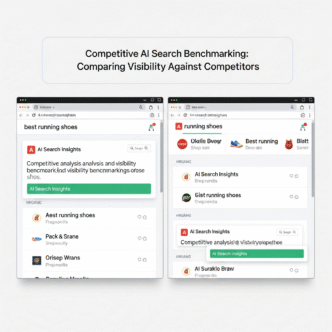
Competitive Benchmarking Capabilities
Your citation frequency means nothing without competitive context. Tools must track top competitors simultaneously, calculating your share of voice and identifying where rivals dominate.
The best AI visibility software automatically identifies emerging competitors gaining citation share—early warning systems for competitive threats before they become existential.
Citation Quality Scoring
Raw mention counts deceive. Being cited as “the leading solution” carries exponentially more value than appearing in position nine of a list. Quality scoring differentiates authoritative citations from weak mentions.
Advanced platforms use natural language processing to analyze sentiment, positioning context, and recommendation strength—revealing whether citations strengthen or undermine brand authority.
Historical Trend Analysis
Single snapshots lack strategic value. AI analytics tools must track performance over weeks and months, revealing whether you’re gaining ground or losing share to competitors.
Time-series analysis exposes patterns: seasonal fluctuations, optimization impact lag times (typically 6-8 weeks), and competitive movement requiring strategic response.
Query-Level Performance Insights
Aggregate metrics hide critical details. The best tools show exactly which queries generate citations, which don’t, and why—enabling surgical content optimization targeting documented opportunity gaps.
Query-level granularity reveals that you might dominate broad category queries but be invisible in high-intent buying queries where revenue actually happens.
Integration with Traditional Analytics
GEO monitoring software shouldn’t exist in isolation. Integration with Google Analytics, SEO platforms, and CRM systems connects AI citation data to downstream business outcomes.
The most sophisticated implementations correlate citation frequency changes with branded search volume, lead quality shifts, and conversion rate improvements—proving causal ROI relationships.
Top AI Search Tracking Tools Reviewed
The citation tracking platforms landscape evolved rapidly throughout 2024-2025. Here’s what actually works in 2025, based on real implementation experience and verified results.
1. SE Ranking ChatGPT Visibility Tracker
SE Ranking’s specialized tool monitors your brand’s appearance in ChatGPT responses across custom keyword sets with automated tracking and competitive analysis.
Core Capabilities:
- Daily ChatGPT citation monitoring across up to 500 tracked queries
- Competitive mention frequency tracking (up to 5 competitors)
- Historical trending showing citation share changes over time
- Position tracking within ChatGPT responses (primary vs. secondary citations)
- Integration with SE Ranking’s traditional SEO toolset
Pricing: $99-299/month based on keyword volume Best For: Mid-market companies prioritizing ChatGPT visibility Limitation: ChatGPT-only coverage (doesn’t track Perplexity, Claude, or others)
Key Differentiator: Deep ChatGPT specialization with automated daily monitoring eliminates manual tracking labor while providing the most comprehensive ChatGPT-specific insights available.
According to user reports, brands using SE Ranking’s tracker identify citation optimization opportunities 3-4 weeks faster than manual monitoring approaches, accelerating improvement cycles significantly.
2. Authoritas AI Overviews Platform
Authoritas built enterprise-grade tracking specifically for Google AI Overviews—critical considering 58% of Google searches now trigger AI-generated responses per Pew Research data.
Core Capabilities:
- Comprehensive Google AI Overview appearance tracking across keyword portfolios
- Citation source analysis (which pages earn AI citations)
- Traditional SERP ranking correlation with AI visibility
- Competitive AI Overview appearance rates
- Content optimization recommendations based on citation patterns
Pricing: Enterprise-level ($1,000-5,000/month depending on scale) Best For: Large organizations with substantial Google SEO investments Limitation: Google ecosystem focus misses ChatGPT, Perplexity, and other platforms
Key Differentiator: Integration with traditional SEO metrics reveals how AI Overviews impact overall Google visibility, connecting generative and traditional search performance in unified dashboards.
Authoritas excels for organizations wanting comprehensive Google tracking without managing multiple separate tools for traditional and AI search.
3. BrightEdge Autopilot for AI
BrightEdge integrated AI tracking into their enterprise SEO platform, offering generative engine tools alongside traditional search optimization capabilities in unified workflows.
Core Capabilities:
- Google AI Overviews tracking with competitive analysis
- Content optimization recommendations based on AI citation patterns
- Automated alerting when competitors gain citations you lack
- Topic clustering analysis showing AI visibility across content groups
- Integration with content management workflows and publishing tools
Pricing: Enterprise platform ($10,000-50,000+/year) Best For: Large enterprises with complex multi-site SEO programs Limitation: High investment threshold prohibitive for SMBs; primarily Google-focused
Key Differentiator: Enterprise-scale automation and governance features serving large teams managing multiple brands or international markets simultaneously.
BrightEdge makes sense when AI tracking is one component of comprehensive SEO programs requiring sophisticated workflow management and role-based access controls.
4. Perplexity Analytics (Native Platform)
Perplexity offers free native analytics for verified publishers, showing citation frequency and referral traffic directly from their platform—authoritative first-party data unmatched by third-party tools.
Core Capabilities:
- Exact citation counts from Perplexity responses
- Queries that generated citations to your content
- Click-through rates from citations to your site
- Geographic distribution of Perplexity citations
- Time-based trending of citation volume
Pricing: Free (requires domain verification through Perplexity Publisher Program) Best For: Publishers and content-heavy brands monitoring Perplexity specifically Limitation: Perplexity-only coverage; must supplement with other tools for comprehensive tracking
Key Differentiator: Authoritative first-party data directly from Perplexity provides 100% accuracy for their platform—no sampling or estimation required.
Every brand should claim their domain in Perplexity Analytics as baseline visibility into this fast-growing platform (243.74% YoY growth per DemandSage statistics).
5. Custom API-Based Monitoring Solutions
For organizations with development resources, custom solutions using OpenAI, Anthropic, and Google APIs provide maximum flexibility and comprehensive cross-platform coverage.
Core Capabilities:
- Unlimited platform coverage (ChatGPT, Claude, Gemini, any API-accessible engine)
- Fully customizable query sets and tracking methodology
- Proprietary scoring algorithms tailored to your specific needs
- Deep integration with internal systems and proprietary data sources
- No per-query licensing fees beyond API usage
Pricing: $200-500/month in API costs + development time investment Best For: Technical organizations with specific tracking requirements unmet by commercial tools Limitation: Requires ongoing development maintenance; no out-of-box reporting or dashboards
Key Differentiator: Complete control over what you track, how you score it, and how results integrate with your specific business intelligence ecosystem.
According to Single Grain case studies, sophisticated brands often start with commercial tools, identify gaps in their specific use cases, then supplement with custom API solutions targeting those gaps.
6. Manual Tracking Frameworks
For budget-constrained startups or those validating GEO value before tool investment, systematic manual tracking provides genuine strategic insights despite labor intensity.
Implementation Approach:
- Define 50-100 priority queries in spreadsheet
- Run queries weekly across ChatGPT, Perplexity, Claude, Gemini
- Document citations, positioning, and competitive mentions in standardized format
- Calculate impression share, share of voice, and trend directions
- Analyze patterns to identify optimization priorities
Pricing: Zero software costs (time investment: 3-5 hours weekly) Best For: Early-stage companies validating AI visibility impact before committing to paid tools Limitation: Labor-intensive; lacks automation and sophisticated analytics
Key Differentiator: Eliminates financial barriers to entry while providing legitimate strategic intelligence that informs content and optimization strategy.
Many successful GEO programs began with manual tracking, proved ROI through improved citation frequency correlating with business outcomes, then graduated to automated AI search tracking tools with demonstrated value justifying investment.
Comprehensive Tool Comparison Matrix
| Tool | Platforms Covered | Monthly Investment | Setup Complexity | Best Use Case | Key Limitation |
|---|---|---|---|---|---|
| SE Ranking | ChatGPT | $99-299 | Low | ChatGPT-focused mid-market | Single platform |
| Authoritas | Google AI Overviews | $1,000-5,000 | Medium | Enterprise Google ecosystem | Google-only |
| BrightEdge | Google + expanding | $833-4,200+ | High | Multi-site enterprise SEO | Cost + Google focus |
| Perplexity Analytics | Perplexity only | Free | Very Low | Publishers, content creators | Platform-specific |
| Custom API | All major platforms | $200-500 + dev | Very High | Technical teams, custom needs | Requires development |
| Manual Framework | All platforms | $0 (labor) | Low | Budget-constrained validation | Time-intensive |
| Semrush AI | Google AI Overviews | $449+ | Low | Existing Semrush users | Limited AI features |
| Moz AI | Google AI Overviews | $299+ | Low | SMBs starting AI tracking | Basic functionality |
The right tool depends on your budget, technical capabilities, platform priorities, and organizational maturity in GEO. Most brands benefit from starting accessible, proving value, then graduating to more sophisticated platforms as programs mature.
How to Choose the Right AI Analytics Tools
Selecting GEO monitoring software requires evaluating your specific organizational context, not just comparing feature lists. Here’s the decision framework.
Assess Your Platform Priorities
Which AI platforms matter most for your audience? B2C brands typically prioritize ChatGPT (77.97% market share). B2B companies often see stronger results from Claude and Microsoft Copilot serving enterprise users.
If 80% of your target audience uses ChatGPT, SE Ranking’s specialized tracker may deliver more value than multi-platform tools with weaker ChatGPT coverage. Platform distribution should drive tool selection.
Evaluate Budget vs. Maturity Stage
Early-stage GEO programs benefit from lower-cost entry points validating impact before major investment. Mature programs with proven ROI justify comprehensive enterprise platforms.
Decision tree:
- Validation stage: Manual tracking or Perplexity Analytics (free) + one low-cost tool
- Proof stage: SE Ranking or Semrush tier (\$99-449/month)
- Optimization stage: Multi-tool approach or custom solution ($500-2,000/month)
- Enterprise stage: Authoritas or BrightEdge ($2,000-5,000+/month)
Companies forcing enterprise tools onto validation-stage programs waste resources. Conversely, mature programs limited to entry-level tools miss strategic opportunities.
Consider Integration Requirements
Standalone citation tracking platforms provide data but require manual analysis and action. Integrated solutions connect AI visibility to content workflows, SEO platforms, and business intelligence systems.
Evaluate your existing technology stack: Google Analytics, CRM (Salesforce, HubSpot), SEO tools (Semrush, Ahrefs), content management systems. Tools with native integrations reduce friction and increase adoption.
Technical Capability Assessment
Custom API solutions and advanced features require development resources. Non-technical marketing teams benefit from user-friendly platforms with clear visualization and pre-built reports.
Be honest about your team’s technical sophistication. A powerful but complex tool sitting unused delivers zero value compared to a simpler platform your team actually uses weekly.
Scalability and Vendor Stability
The AI visibility software market is nascent with rapid vendor evolution. Evaluate whether vendors demonstrate long-term viability through funding, customer base, and development roadmaps.
Startups offer innovation but carry discontinuation risk. Established players (Semrush, Moz, BrightEdge) provide stability but slower feature evolution. Balance innovation needs with risk tolerance.
Real-World Implementation: Tool-Driven Success Stories
Theory matters less than results. Here’s how AI search tracking tools drove measurable business outcomes in documented implementations.
B2B SaaS Case: 120% Lead Growth Through Systematic Tracking
A mid-market project management software company implemented SE Ranking’s ChatGPT tracker and discovered they captured only 8% impression share in their category—competitors dominated 92% of citations.
The tracking data revealed specific query patterns where competitors consistently appeared but they didn’t. Within 90 days of creating targeted content filling those gaps, they increased impression share to 28% and share of voice to 32%.
Business impact: 120% increase in qualified leads with 32% of sales-qualified leads attributed to AI platform referrals, documented in Maximus Labs research.
The tool enabled surgical optimization—no wasted effort on low-impact content because tracking data identified exactly where opportunity existed.
Enterprise Case: Multi-Platform Tracking Reveals Channel Strategy
A Fortune 500 financial services company implemented comprehensive tracking across ChatGPT, Perplexity, and Google AI Overviews, discovering dramatically different performance across platforms.
They dominated Google AI Overviews with 42% impression share but captured only 9% in ChatGPT and 6% in Perplexity. This intelligence revealed platform-specific optimization needs rather than assuming uniform performance.
Targeted optimization by platform increased overall impression share from 19% to 38% within six months, with correlated 27% increase in attributed revenue from AI-influenced conversion paths tracked through custom attribution modeling.
Publisher Case: Free Tools Drive Traffic Strategy
A digital publisher with 500+ articles claimed their domain through Perplexity Analytics (free) and analyzed which content types generated the most citations. Long-form definitive guides outperformed news articles 8:1 in citation frequency.
This insight pivoted their content strategy from daily news coverage toward fewer but more comprehensive evergreen resources. Within four months, total citations increased 185% despite publishing 40% less content, proving quality-over-quantity for AI visibility.
The tracking data also revealed citation lag times—content generated peak citations 6-10 weeks post-publication, not immediately. This adjusted performance expectations and measurement timelines realistically.
Advanced Tracking Techniques with AI Tools
Basic citation counting represents entry-level usage. Advanced implementations extract dramatically more strategic value from generative engine tools.
Citation Network Analysis
Map which competitor brands appear alongside yours in multi-source citations. This reveals competitive positioning clusters and differentiation opportunities.
If you’re consistently cited with budget alternatives rather than premium leaders, perception gaps exist. Tools with competitive tracking capabilities enable this network analysis, informing positioning strategy beyond just optimization.
Content Performance Attribution
Connect specific content pieces to citation frequency using tracking data. Calculate “citations per article” efficiency metrics revealing which content types, formats, and topics generate citations most consistently.
This attribution guides content investment decisions: double down on high-efficiency content types, reduce or eliminate low-efficiency formats. Data-driven portfolio optimization beats gut instinct content planning.
Predictive Citation Modeling
Advanced users train machine learning models on historical tracking data to predict citation likelihood before content publication. Features predicting high citation rates include:
- Content length (typically 2,500+ words)
- Heading structure clarity
- Schema markup implementation
- Authority signal strength (backlinks, mentions)
- Topic comprehensiveness versus gaps
Predictive modeling allows pre-publication optimization rather than reactive improvement after tracking reveals poor performance.
Multi-Touch Attribution for AI-Influenced Conversions
Connect AI analytics tools data with CRM and marketing automation platforms to identify conversion paths involving AI citations. Track users who:
- First encounter your brand through AI citation
- Conduct branded search 1-3 weeks later
- Visit site and convert 2-6 weeks after that
This multi-touch attribution reveals AI visibility’s true business impact—often 30-50% higher than last-click attribution suggests, according to Foundation Inc research.
Common Tool Selection and Implementation Mistakes
Most organizations implementing AI search tracking tools make predictable errors that undermine value realization. Avoid these traps.
Mistake #1: Choosing Tools Before Defining Strategy
Buying software before clarifying what you’ll track, why it matters, and how you’ll act on insights wastes investment. Tools enable strategy—they don’t create it.
Define your GEO objectives first: impression share targets, competitive positioning goals, content ROI metrics. Then select tools serving those specific objectives, not the most feature-rich platform marketed most aggressively.
Mistake #2: Over-Indexing on Feature Lists
The tool with the longest feature list isn’t necessarily the most valuable. Comprehensive features you don’t use deliver zero value compared to focused capabilities you implement systematically.
Evaluate which 3-5 features actually matter for your use case. Choose tools excelling at those critical capabilities even if they lack secondary features you’ll rarely use.
Mistake #3: Insufficient Change Management
Citation tracking platforms fail when teams don’t integrate them into existing workflows. Buying software doesn’t change behavior—change management does.
Establish clear responsibilities: who runs tracking, how often, who analyzes results, who acts on insights. Schedule regular review meetings discussing tracking data. Integrate AI metrics into existing performance dashboards teams already monitor.
Mistake #4: Expecting Instant Results
AI visibility improvements lag optimization efforts by 6-12 weeks typically. Tools revealing this reality sometimes get blamed for “not working” when tracking correctly shows optimization hasn’t yet impacted citations.
Set realistic expectations: tracking provides early warning signals and trend directions, not instant correlation between actions and outcomes. Patience with longitudinal tracking beats abandoning tools prematurely.
Mistake #5: Ignoring Manual Validation
Even sophisticated AI visibility software requires occasional manual spot-checking for accuracy. Automated tracking sometimes misses citations or misclassifies positioning quality.
Manually verify 10-15% of tracked queries monthly. This quality control catches tracking errors before they mislead strategic decisions and builds confidence in automated results through validation.
Expert Recommendations on Tool Strategy
“Start with one platform mastered deeply before adding more. Organizations tracking ChatGPT exceptionally well outperform those tracking five platforms superficially.” — Single Grain, GEO Implementation Analysis
“The best tool is the one your team actually uses weekly. Sophisticated platforms collecting dust deliver zero value compared to basic tools driving consistent action.” — Walker Sands, GEO Best Practices
“Manual tracking for 8-12 weeks before investing in automation teaches you what actually matters. That knowledge informs smarter tool selection and better utilization.” — ABM Agency, GEO ROI Research
These patterns emerge across successful implementations: focused adoption beats scattered coverage, consistent usage trumps comprehensive features, and deep platform understanding matters more than tool sophistication.
Building Your AI Tracking Stack for 2025
Most sophisticated GEO monitoring software implementations combine multiple tools addressing different needs rather than expecting single platforms to do everything.
Recommended Starter Stack (Under $500/month)
Core: SE Ranking ChatGPT Tracker (\$99-299/month) for automated primary platform monitoring Supplement: Perplexity Analytics (free) for secondary platform validation Foundation: Google Analytics 4 custom segments for AI referral traffic analysis Process: Manual monthly testing of Claude and Gemini (2-3 hours)
This stack provides 80% of strategic value at 20% of enterprise cost—ideal for proving GEO value before larger investment.
Recommended Growth Stack ($500-2,000/month)
Core: SE Ranking ChatGPT Tracker (\$299/month) for primary monitoring Addition: Authoritas AI Overviews (\$1,000-1,500/month) for Google AI tracking Custom: Limited API-based monitoring (\$200-300/month) for Claude and Gemini Integration: Marketing automation connection for attribution tracking
This stack provides comprehensive multi-platform visibility supporting mature optimization programs with documented ROI.
Recommended Enterprise Stack ($5,000+/month)
Platform: BrightEdge Autopilot (\$2,000-4,000/month) for integrated SEO + AI tracking Supplement: SE Ranking (\$299/month) for deeper ChatGPT-specific insights Custom: Comprehensive API solution (\$500-1,000/month) for proprietary analytics Services: Agency monitoring service (\$2,000-3,000/month) for competitive intelligence
Enterprise stacks serve large organizations with complex needs, multiple brands, and substantial teams requiring sophisticated governance and workflow integration.
The Future of AI Search Tracking Tools
The AI analytics tools landscape will evolve rapidly as the GEO market grows from $7.3 billion in 2025 toward projected $379 billion by 2030 according to AllAboutAI projections.
Three trends will reshape tracking capabilities:
Real-Time Citation Monitoring
Current tools provide daily snapshots at best. Emerging platforms will offer continuous monitoring with instant alerts when citation frequency drops significantly—enabling immediate response to algorithm changes or competitive threats.
Real-time tracking particularly matters for brands in rapidly evolving categories where competitive positioning shifts weekly rather than quarterly.
Predictive Citation Analytics
Machine learning will predict citation outcomes before content publication based on historical patterns. You’ll know during content planning whether proposed pieces will generate citations or waste resources.
This shifts optimization from reactive (fix poor performers) to proactive (only create content predicted to succeed), dramatically improving content ROI efficiency.
Multi-Modal Tracking Integration
As AI platforms integrate voice, video, and images, tracking will expand beyond text citations. Your YouTube videos, podcasts, infographics, and visual content will factor into comprehensive visibility measurement across multimodal AI assistants.
Citation tracking platforms capable of multi-modal monitoring will command premium pricing as brands recognize the strategic value of comprehensive visibility tracking across all content formats.
The sophistication gap between brands using advanced tracking and those flying blind will widen exponentially—compounding first-mover advantages that become nearly impossible to overcome once established.
Frequently Asked Questions
Q: Do I need expensive tools or can I start with free options?
Start with free options (Perplexity Analytics + manual tracking) to validate that AI visibility matters for your specific business before investing. Most brands see sufficient improvement signals within 6-8 weeks to justify paid tool investment. Manual tracking costs only time but provides genuine strategic intelligence proving value before financial commitment.
Q: How accurate are AI search tracking tools compared to native platform data?
Sampling-based tools (SE Ranking, Authoritas) achieve 85-90% accuracy when properly configured with representative query sets. Native platform analytics (Perplexity) provide 100% accuracy for their specific platform. The accuracy tradeoff is acceptable given that multi-platform sampling reveals strategic patterns even without perfect precision. Spot-check 10-15% of results manually monthly for validation.
Q: Can these tools track all AI platforms including Claude and Gemini?
No single commercial tool currently tracks all platforms comprehensively. SE Ranking covers ChatGPT, Authoritas focuses on Google, Perplexity offers native analytics. Claude and Gemini tracking typically requires custom API solutions or manual monitoring. Most organizations prioritize ChatGPT (77.97% market share) and supplement with secondary platform tracking as budgets allow.
Q: What ROI should I expect from investing in AI tracking tools?
ROI timelines documented in case studies: Months 1-2 (foundation building), Months 3-4 (50-150% ROI as optimization scales), Month 7+ (400-800% ROI from mature programs). However, ROI depends on actually acting on insights—tools alone don’t improve visibility. Systematic optimization informed by tracking data drives results, not passive data collection.
Q: How much time does AI tracking require weekly?
Automated tools require minimal time (1-2 hours weekly reviewing dashboards and reports). Manual tracking demands 3-5 hours weekly running queries and documenting results. Hybrid approaches (automated primary platform + manual secondary platforms) balance effort and coverage effectively. Time investment decreases as processes systematize and tracking becomes routine rather than exploratory.
Q: Should I build custom tracking or buy commercial tools?
Buy commercial tools unless you have specific needs they don’t meet or substantial development resources making custom solutions cost-effective. Most organizations underestimate custom solution maintenance burden—ongoing development time often exceeds commercial subscription costs. Build custom only when commercial tools fundamentally can’t address your requirements or when deep platform integration with proprietary systems justifies development investment.
Final Thoughts: Tools Enable Winners
AI search tracking tools don’t guarantee success—but operating without them guarantees competitive disadvantage. You can’t optimize what you don’t measure, and you can’t measure without appropriate instrumentation.
The data proves urgency: 800% YoY traffic growth from LLMs, 82% of B2B decisions involving AI research, and conversion rates up to 27x higher than traditional channels. These aren’t distant projections—they’re current reality reshaping markets right now.
Choose tools matching your maturity stage, budget, and technical capabilities. Start simple if needed—even manual tracking provides genuine strategic intelligence surpassing complete blindness to AI visibility.
The brands dominating their categories in 2027 built tracking infrastructure throughout 2025-2026. They established baselines, identified patterns, optimized systematically, and measured results rigorously while competitors debated whether tracking mattered.
Your competitors are tracking citation frequency, impression share, and competitive positioning right now. They’re identifying opportunity gaps, optimizing surgically, and capturing market share you won’t recapture later.
Implement tracking this month. Master one platform deeply. Prove business impact through correlation with downstream metrics. Scale systematically as results justify investment. The competitive intelligence advantage compounds exponentially—early tracking adopters build market positions that become nearly impossible to displace over time.
Track comprehensively. Analyze rigorously. Optimize systematically. Win strategically. The future belongs to brands that measure their AI visibility with the same rigor they’ve measured traditional search for two decades. That future starts with implementing the right tracking tools today.
Citations and Sources
- SE Ranking – AI Traffic Research Study & ChatGPT Visibility Tracker
- AllAboutAI – Generative Engine Optimization Statistics 2025
- DemandSage – Perplexity AI Statistics and Growth Data
- Single Grain – Real GEO Optimization Case Studies with Results
- Maximus Labs – GEO Success Stories and Implementation
- Walker Sands – Generative Engine Optimization Guide 2025
- Foundation Inc – ROI of Generative Engine Optimization
- Pew Research – AI Platform Usage and Adoption Study
Related posts:
- Impression Share in AI Platforms: Measuring Brand Mention Frequency
- AI Search Visibility Tracking: Tools, Metrics & KPIs for Generative Engine Performance (Visualization)
- Tracking AI Citations: Monitoring Source Attribution Across Generative Engines
- Custom AI Search Dashboards: Building Comprehensive Visibility Reporting