


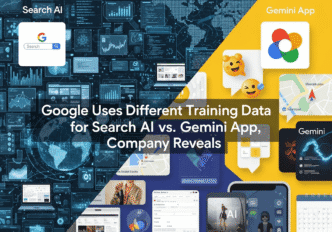

August 13, 2025 – Google representatives have disclosed significant details about how the company handles content for training different AI systems, revealing that AI Overview and AI Mode use separate training approaches from the consumer Gemini app.
Table of Contents
Toggle
Separate Training Pipelines Confirmed
In a candid discussion at an industry event, Google confirmed that blocking “Google Extended” – the company’s AI training crawler – affects only the Gemini app’s training data, not the AI systems powering search features like AI Overview and AI Mode.
“The model that we use for AI overviews and for AI mode is a custom Gemini model and that might mean that it was trained differently,” explained a Google representative. This revelation suggests publishers may have less control over their content’s use in search AI features than previously understood.
All Google AI Systems Rely on Search Index
Despite different training approaches, all of Google’s AI systems – including Gemini, AI Overview, and AI Mode – use Google Search for real-time information grounding rather than fetching content directly from websites. This means regular Googlebot crawling remains crucial for content visibility in AI responses.
Growing Concerns Over AI Training Loops
Google’s Gary Illyes acknowledged emerging challenges with AI-generated content entering training datasets, potentially creating problematic feedback loops. Model training definitely needs to figure out how to exclude content that was generated by AI otherwise you end up in a training loop,” Illyes explained during the session.
However, the company indicated quality matters more than origin. As long as the content quality is high which typically nowadays requires that the human reviews the generated content it is fine for model training,” Illyes noted, shifting the focus from “human created” to “human curated” content. He clarified: “I think the word human created is wrong. Basically it should be human curated.”
Publishers Split on AI Crawler Blocking
The discussion revealed a divide in publisher strategies, with some blocking all AI crawlers while others adopt a wait-and-see approach. Illyes suggested the latter strategy might be wiser, noting that Generation Z users increasingly prefer AI interfaces.
“There’s two schools of thought – one is let’s block all the AI crawlers, second is let’s see where this is going. I tend to fall in the second group personally,” Illyes stated. He emphasized potential future opportunities: “If they [Gen Z] are going to be the next user base large user base then perhaps we need to figure out how to get value out of these results for publishers as well. But if you are not in the results then how are you going to get out that revenue?”
New Standards in Development
Google is participating in an Internet Engineering Task Force (IETF) working group developing “AI preferences” standards that would give publishers more granular control over how their content is used for AI training. However, no timeline was provided for implementation.
Technical Clarifications on SEO Impact
The discussion also clarified several technical points with direct implications for SEO practitioners:
404 Pages and Crawl Budget: Illyes confirmed that “404 pages don’t consume crawl budget” to prevent competitors from manipulating crawling resources. However, he warned about server resource consumption: “My recommendation for those cases is that you basically try the simplest 404 page that you can afford to have and go with that instead of expensive computationally expensive pages.”
AI-Generated Images: When asked about penalties for sites using AI-generated images, Illyes was clear: “Nope… AI generated image doesn’t impact the SEO.” He noted potential benefits: “If anything you might get some traffic out of image search for them.
Social Media Signals: Addressing a common SEO question, Illyes stated definitively: “The answer is no and for the future is also likely no” regarding social media engagement as ranking signals. He explained: “We need to be able to control our own signals and if we are looking at external signals… that’s not in our control.”
Personal Skepticism About Generative AI
In a candid moment, Illyes expressed personal reservations about generative AI: “I don’t like generative AI. I think predictive AI is incredibly valuable.” He praised specific applications like summarization but noted concerns about image generation and hallucinations: “As soon as you get to a topic that the AI is not familiar with, then it will start making really weird hallucinations.”
Revenue Model Uncertainty
When asked about potential advertising in AI Mode, Illyes acknowledged uncertainty about Google’s monetization strategy if AI interfaces replace traditional search: “I don’t know but it’s not my problem. We have people to figure these things out… My job is to answer these kind of questions and to the best of my ability.”
Key SEO Takeaways for Publishers
Based on Illyes’ insights, here are actionable recommendations for SEO practitioners:
Content Strategy
- Focus on human curation: Ensure AI-generated content receives proper editorial oversight and fact-checking
- Maintain content quality: High-quality, accurate content matters more than its origin (human vs. AI)
- Consider blocking implications: Weigh the risks of blocking Google Extended against potential future AI-driven revenue opportunities
Technical Optimization
- Simplify 404 pages: Use lightweight 404 pages to avoid server resource consumption during crawling
- Leverage AI-generated images: No SEO penalty exists; these can potentially drive image search traffic
- Don’t rely on social signals: Social media engagement won’t boost search rankings
Future Planning
- Monitor Gen Z preferences: Prepare for a user base that increasingly prefers AI interfaces
- Stay informed on standards: Watch for IETF AI preferences standards that may provide more content control options
- Maintain crawlability: Ensure Googlebot can access your content for AI grounding purposes
Final Takeaways
The discussion reveals a complex and evolving landscape where traditional SEO strategies must adapt to AI-driven search experiences. Key insights include:
- Control is limited: Publishers have less control over AI training than many assumed, with different Google AI systems using separate approaches
- Quality trumps origin: Google prioritizes content accuracy and value over whether humans or AI created it
- Future opportunity exists: Early blocking of AI crawlers may limit access to emerging revenue streams as user behavior shifts
- Technical fundamentals remain: Core SEO principles around crawlability, server efficiency, and content quality continue to matter
- Standards are coming: Industry-wide solutions for granular AI content control are in development but timing remains uncertain
As Illyes noted about the broader uncertainty: “There’s lots of considerations to be taken into account and we don’t yet know where we are going to go with it, but we are definitely working on it.”
For now, publishers should focus on creating high-quality, human-curated content while maintaining technical best practices and monitoring developments in AI content standards.


, this growth pattern is consistent across multiple industries and represents the fastest adoption of any new digital channel in recent history. To put this in perspective: - **January 2025:** 17,076 AI-sourced sessions - **May 2025:** 107,100 AI-sourced sessions - **Growth Rate:** 527% in just five months One standout example saw ChatGPT traffic alone grow from 600 visits per month in early 2024 to over 22,000 visits per month by May 2025—a 3,567% increase for a single platform. **💡 Pro Tip:** Track AI referral traffic in Google Analytics 4 by setting up custom dimensions for referral sources including "chat.openai.com," "perplexity.ai," and "claude.ai" to monitor your own AI discovery performance. ### Industry Distribution The surge isn't uniform across all sectors. High-consultative industries are leading the charge, as documented in [Search Engine Journal's analysis of AI traffic patterns](https://www.searchenginejournal.com/study-chatgpt-ai-tools-gain-ground-in-search-market/536137/): **Top Performing Industries:** 1. **Legal Services** - Complex regulatory questions drive AI consultations 2. **Finance & Banking** - Users seek personalized financial advice and explanations 3. **Healthcare** - Medical inquiries and symptom research dominate queries 4. **Insurance** - Policy comparisons and coverage explanations 5. **SMB Consulting** - Business strategy and operational guidance These five industries collectively account for **55% of all AI-driven sessions**, highlighting users' preference for AI assistance with complex, high-stakes decisions. **💡 Pro Tip:** If you're in a high-trust industry, prioritize creating comprehensive FAQ sections and expert-authored content, as these formats perform exceptionally well in AI discovery scenarios. ## Platform Landscape Analysis ### ChatGPT's Dominance ChatGPT continues to lead the AI traffic generation, but its monopoly is weakening. The platform benefits from: - First-mover advantage in consumer AI - Superior natural language processing - Broad general knowledge capabilities - Strong brand recognition ### Emerging Competitors **Perplexity** has gained significant traction with its search-focused approach, offering: - Real-time web search integration - Source citations and transparency - Specialized research capabilities **Google's Gemini** leverages integration advantages: - Native Google ecosystem integration - Android device pre-installation - Seamless transition from traditional search **Microsoft Copilot** capitalizes on enterprise relationships: - Office 365 integration - Business-focused use cases - Professional workflow optimization **Anthropic's Claude** appeals to quality-conscious users: - Reputation for accuracy and safety - Longer context windows - Nuanced reasoning capabilities ## User Behavior Transformation ### The "Instant Surfacing Era" Traditional SEO operated on a crawl-index-rank cycle that rewarded patience and authority building. AI discovery operates differently, as explained in [Ahrefs' comprehensive study on AI search behavior](https://ahrefs.com/blog/ai-overviews-reduce-clicks/): **Old Model:** Publish → Wait for crawling → Hope for indexing → Optimize for ranking → Generate traffic **New Model:** Create quality content → Get immediately surfaced by AI → Receive targeted referrals This shift means content can be discovered and drive traffic before it even ranks in traditional search engines. **💡 Pro Tip:** Focus on creating content that directly answers specific questions rather than optimizing for broad keywords. AI models excel at understanding intent and context, making traditional keyword density tactics less effective. ### Quality Over Quantity AI platforms prioritize content that is: - **Clear and structured** - Easy for models to parse and understand - **Authoritative** - From recognized experts or institutions - **Comprehensive** - Covers topics thoroughly rather than superficially - **Current** - Up-to-date information that reflects latest developments ## Business Implications ### For SaaS Companies Some SaaS businesses are already seeing over 1% of total traffic from AI platforms. While this might seem modest, it represents: - **High-intent users** who have actively sought AI assistance - **Qualified prospects** who've engaged with AI to solve specific problems - **Bottom-funnel traffic** with higher conversion potential ### For Content Publishers The implications vary significantly by content type: **Winners:** - Educational content creators - How-to and tutorial publishers - Industry analysis and research firms - Expert commentary and opinion sites **Challenges:** - Breaking news publishers (AI prefers verified information) - Listicle and aggregation sites (AI can synthesize directly) - SEO-optimized but thin content creators ### For E-commerce AI discovery is particularly powerful for complex purchase decisions, as highlighted in [Adobe's recent analysis of AI-driven retail traffic](https://searchengineland.com/generative-ai-surging-online-shopping-report-453312): - **Electronics** - Specification comparisons and recommendations - **Healthcare products** - Safety and efficacy information - **Financial services** - Product feature explanations - **Professional services** - Capability and pricing inquiries **💡 Pro Tip:** Create detailed product comparison guides and technical specification sheets, as AI assistants frequently reference these when helping users make purchase decisions. ## Strategic Recommendations ### Immediate Actions (0-3 months) **Content Optimization:** - Restructure existing content with clear headers and bullet points - Add FAQ sections that directly answer common queries - Include expert credentials and authority signals - Ensure information accuracy and currency **Technical Preparation:** - Implement structured data markup - Optimize for featured snippets - Ensure fast loading times and mobile optimization - Create XML sitemaps with updated lastmod tags ### Medium-term Strategy (3-12 months) **Authority Building:** - Develop thought leadership content - Seek expert citations and backlinks - Build relationships with industry authorities - Create comprehensive resource hubs **AI-First Content Creation:** - Design content specifically for AI consumption - Focus on answering complete questions rather than keyword optimization - Create content that provides context and nuance - Develop expertise-driven content series ### Long-term Vision (12+ months) **Platform Diversification:** - Develop relationships with multiple AI platforms - Create platform-specific content strategies - Monitor emerging AI discovery channels - Build direct AI API integrations where possible **Measurement Evolution:** - Develop new KPIs beyond traditional traffic metrics - Track AI mention frequency and context - Monitor brand authority signals - Measure assisted conversions from AI discovery ## Challenges and Considerations ### Attribution Complexity AI-driven traffic often involves multiple touchpoints, as detailed in [Kevin Indig's user experience study of AI Overviews](https://searchengineland.com/google-ai-overviews-user-behavior-study-455511): - Initial discovery through AI - Verification through traditional search - Social proof seeking on platforms like Reddit - Final conversion on the target website This multi-step journey makes traditional attribution models inadequate. **💡 Pro Tip:** Implement UTM parameters for AI referral traffic and set up custom conversion paths in Google Analytics to better understand the full user journey from AI discovery to conversion. ### Content Investment ROI The shift requires significant content strategy changes: - Higher upfront investment in comprehensive content - Longer content development cycles - Greater emphasis on expertise and authority - Reduced reliance on keyword-driven content ### Competitive Dynamics As more businesses optimize for AI discovery: - Competition for AI attention will intensify - Authority and trust signals will become more valuable - First-mover advantages will compound - Smaller players may struggle to gain AI visibility ## Future Outlook ### Growth Projections If current trends continue, AI-referred traffic could represent: - **5-10% of total website traffic** by end of 2025 - **15-20% for high-trust industries** by 2026 - **Major revenue channel** for information-based businesses ### Technology Evolution Expected developments include: - **Improved accuracy** reducing user verification needs - **Better source attribution** providing clearer traffic attribution - **Industry-specific AI models** creating niche opportunities - **Voice and visual AI search** expanding discovery channels ### Market Maturation The AI discovery market will likely evolve through: - **Platform consolidation** as winners emerge - **Specialized AI services** for specific industries - **Direct publisher partnerships** with AI platforms - **New monetization models** beyond traditional advertising ## Conclusion: Preparing for the AI-First Future The 527% surge in AI-driven traffic is not a temporary spike—it's the beginning of a fundamental shift in how people discover and consume information online. Organizations that recognize this trend early and adapt their content and discovery strategies accordingly will capture disproportionate value in the emerging AI-first digital ecosystem. The companies thriving in this new landscape will be those that prioritize authority, clarity, and genuine expertise over traditional SEO tactics. As AI becomes the primary discovery layer for complex information, the winners will be those who can effectively communicate their knowledge through these new channels while maintaining the trust and credibility that AI platforms increasingly value. The question is no longer whether AI will reshape web discovery—it's whether your organization will be ready to succeed in this new reality. --- ## Additional Resources **Essential Reading:** - [Previsible's 2025 AI Traffic Study](https://previsible.io/seo-strategy/ai-seo-study-2024/) - Complete methodology and findings - [Search Engine Land's AI Search Coverage](https://searchengineland.com/generative-ai-surging-online-shopping-report-453312) - Latest industry trends and analysis - [Ahrefs' AI Overviews Research](https://ahrefs.com/blog/ai-overviews-reduce-clicks/) - Technical insights and click-through rate data **Tools for AI Discovery Tracking:** - [Previsible's Free AI Traffic Dashboard](https://previsible.io/) - Monitor LLM referrals in Looker Studio - [SE Ranking's AI Overview Tracker](https://seranking.com/) - Track AI visibility and citations - Google Analytics 4 - Set up custom dimensions for AI referral sources **💡 Final Pro Tip:** Subscribe to AI platform newsletters and developer updates to stay informed about algorithm changes that could affect your content's discoverability in AI search results. *This report is based on analysis from Previsible's 2025 AI Traffic Study, examining 19 GA4 properties across multiple industries and timeframes.*](https://aiseojournal.net/wp-content/uploads/2025/08/AI-Assistants-Drive-527_-Traffic-Spike-332x332.png)
, this growth pattern is consistent across multiple industries and represents the fastest adoption of any new digital channel in recent history. To put this in perspective: - **January 2025:** 17,076 AI-sourced sessions - **May 2025:** 107,100 AI-sourced sessions - **Growth Rate:** 527% in just five months One standout example saw ChatGPT traffic alone grow from 600 visits per month in early 2024 to over 22,000 visits per month by May 2025—a 3,567% increase for a single platform. **💡 Pro Tip:** Track AI referral traffic in Google Analytics 4 by setting up custom dimensions for referral sources including "chat.openai.com," "perplexity.ai," and "claude.ai" to monitor your own AI discovery performance. ### Industry Distribution The surge isn't uniform across all sectors. High-consultative industries are leading the charge, as documented in [Search Engine Journal's analysis of AI traffic patterns](https://www.searchenginejournal.com/study-chatgpt-ai-tools-gain-ground-in-search-market/536137/): **Top Performing Industries:** 1. **Legal Services** - Complex regulatory questions drive AI consultations 2. **Finance & Banking** - Users seek personalized financial advice and explanations 3. **Healthcare** - Medical inquiries and symptom research dominate queries 4. **Insurance** - Policy comparisons and coverage explanations 5. **SMB Consulting** - Business strategy and operational guidance These five industries collectively account for **55% of all AI-driven sessions**, highlighting users' preference for AI assistance with complex, high-stakes decisions. **💡 Pro Tip:** If you're in a high-trust industry, prioritize creating comprehensive FAQ sections and expert-authored content, as these formats perform exceptionally well in AI discovery scenarios. ## Platform Landscape Analysis ### ChatGPT's Dominance ChatGPT continues to lead the AI traffic generation, but its monopoly is weakening. The platform benefits from: - First-mover advantage in consumer AI - Superior natural language processing - Broad general knowledge capabilities - Strong brand recognition ### Emerging Competitors **Perplexity** has gained significant traction with its search-focused approach, offering: - Real-time web search integration - Source citations and transparency - Specialized research capabilities **Google's Gemini** leverages integration advantages: - Native Google ecosystem integration - Android device pre-installation - Seamless transition from traditional search **Microsoft Copilot** capitalizes on enterprise relationships: - Office 365 integration - Business-focused use cases - Professional workflow optimization **Anthropic's Claude** appeals to quality-conscious users: - Reputation for accuracy and safety - Longer context windows - Nuanced reasoning capabilities ## User Behavior Transformation ### The "Instant Surfacing Era" Traditional SEO operated on a crawl-index-rank cycle that rewarded patience and authority building. AI discovery operates differently, as explained in [Ahrefs' comprehensive study on AI search behavior](https://ahrefs.com/blog/ai-overviews-reduce-clicks/): **Old Model:** Publish → Wait for crawling → Hope for indexing → Optimize for ranking → Generate traffic **New Model:** Create quality content → Get immediately surfaced by AI → Receive targeted referrals This shift means content can be discovered and drive traffic before it even ranks in traditional search engines. **💡 Pro Tip:** Focus on creating content that directly answers specific questions rather than optimizing for broad keywords. AI models excel at understanding intent and context, making traditional keyword density tactics less effective. ### Quality Over Quantity AI platforms prioritize content that is: - **Clear and structured** - Easy for models to parse and understand - **Authoritative** - From recognized experts or institutions - **Comprehensive** - Covers topics thoroughly rather than superficially - **Current** - Up-to-date information that reflects latest developments ## Business Implications ### For SaaS Companies Some SaaS businesses are already seeing over 1% of total traffic from AI platforms. While this might seem modest, it represents: - **High-intent users** who have actively sought AI assistance - **Qualified prospects** who've engaged with AI to solve specific problems - **Bottom-funnel traffic** with higher conversion potential ### For Content Publishers The implications vary significantly by content type: **Winners:** - Educational content creators - How-to and tutorial publishers - Industry analysis and research firms - Expert commentary and opinion sites **Challenges:** - Breaking news publishers (AI prefers verified information) - Listicle and aggregation sites (AI can synthesize directly) - SEO-optimized but thin content creators ### For E-commerce AI discovery is particularly powerful for complex purchase decisions, as highlighted in [Adobe's recent analysis of AI-driven retail traffic](https://searchengineland.com/generative-ai-surging-online-shopping-report-453312): - **Electronics** - Specification comparisons and recommendations - **Healthcare products** - Safety and efficacy information - **Financial services** - Product feature explanations - **Professional services** - Capability and pricing inquiries **💡 Pro Tip:** Create detailed product comparison guides and technical specification sheets, as AI assistants frequently reference these when helping users make purchase decisions. ## Strategic Recommendations ### Immediate Actions (0-3 months) **Content Optimization:** - Restructure existing content with clear headers and bullet points - Add FAQ sections that directly answer common queries - Include expert credentials and authority signals - Ensure information accuracy and currency **Technical Preparation:** - Implement structured data markup - Optimize for featured snippets - Ensure fast loading times and mobile optimization - Create XML sitemaps with updated lastmod tags ### Medium-term Strategy (3-12 months) **Authority Building:** - Develop thought leadership content - Seek expert citations and backlinks - Build relationships with industry authorities - Create comprehensive resource hubs **AI-First Content Creation:** - Design content specifically for AI consumption - Focus on answering complete questions rather than keyword optimization - Create content that provides context and nuance - Develop expertise-driven content series ### Long-term Vision (12+ months) **Platform Diversification:** - Develop relationships with multiple AI platforms - Create platform-specific content strategies - Monitor emerging AI discovery channels - Build direct AI API integrations where possible **Measurement Evolution:** - Develop new KPIs beyond traditional traffic metrics - Track AI mention frequency and context - Monitor brand authority signals - Measure assisted conversions from AI discovery ## Challenges and Considerations ### Attribution Complexity AI-driven traffic often involves multiple touchpoints, as detailed in [Kevin Indig's user experience study of AI Overviews](https://searchengineland.com/google-ai-overviews-user-behavior-study-455511): - Initial discovery through AI - Verification through traditional search - Social proof seeking on platforms like Reddit - Final conversion on the target website This multi-step journey makes traditional attribution models inadequate. **💡 Pro Tip:** Implement UTM parameters for AI referral traffic and set up custom conversion paths in Google Analytics to better understand the full user journey from AI discovery to conversion. ### Content Investment ROI The shift requires significant content strategy changes: - Higher upfront investment in comprehensive content - Longer content development cycles - Greater emphasis on expertise and authority - Reduced reliance on keyword-driven content ### Competitive Dynamics As more businesses optimize for AI discovery: - Competition for AI attention will intensify - Authority and trust signals will become more valuable - First-mover advantages will compound - Smaller players may struggle to gain AI visibility ## Future Outlook ### Growth Projections If current trends continue, AI-referred traffic could represent: - **5-10% of total website traffic** by end of 2025 - **15-20% for high-trust industries** by 2026 - **Major revenue channel** for information-based businesses ### Technology Evolution Expected developments include: - **Improved accuracy** reducing user verification needs - **Better source attribution** providing clearer traffic attribution - **Industry-specific AI models** creating niche opportunities - **Voice and visual AI search** expanding discovery channels ### Market Maturation The AI discovery market will likely evolve through: - **Platform consolidation** as winners emerge - **Specialized AI services** for specific industries - **Direct publisher partnerships** with AI platforms - **New monetization models** beyond traditional advertising ## Conclusion: Preparing for the AI-First Future The 527% surge in AI-driven traffic is not a temporary spike—it's the beginning of a fundamental shift in how people discover and consume information online. Organizations that recognize this trend early and adapt their content and discovery strategies accordingly will capture disproportionate value in the emerging AI-first digital ecosystem. The companies thriving in this new landscape will be those that prioritize authority, clarity, and genuine expertise over traditional SEO tactics. As AI becomes the primary discovery layer for complex information, the winners will be those who can effectively communicate their knowledge through these new channels while maintaining the trust and credibility that AI platforms increasingly value. The question is no longer whether AI will reshape web discovery—it's whether your organization will be ready to succeed in this new reality. --- ## Additional Resources **Essential Reading:** - [Previsible's 2025 AI Traffic Study](https://previsible.io/seo-strategy/ai-seo-study-2024/) - Complete methodology and findings - [Search Engine Land's AI Search Coverage](https://searchengineland.com/generative-ai-surging-online-shopping-report-453312) - Latest industry trends and analysis - [Ahrefs' AI Overviews Research](https://ahrefs.com/blog/ai-overviews-reduce-clicks/) - Technical insights and click-through rate data **Tools for AI Discovery Tracking:** - [Previsible's Free AI Traffic Dashboard](https://previsible.io/) - Monitor LLM referrals in Looker Studio - [SE Ranking's AI Overview Tracker](https://seranking.com/) - Track AI visibility and citations - Google Analytics 4 - Set up custom dimensions for AI referral sources **💡 Final Pro Tip:** Subscribe to AI platform newsletters and developer updates to stay informed about algorithm changes that could affect your content's discoverability in AI search results. *This report is based on analysis from Previsible's 2025 AI Traffic Study, examining 19 GA4 properties across multiple industries and timeframes.*](https://aiseojournal.net/wp-content/uploads/2025/08/AI-Assistants-Drive-527_-Traffic-Spike-688x387.png)
![# Google's AI Summaries Cut Website Clicks by One-Third, New Studies Reveal *Landmark research exposes the dramatic impact of AI Overviews on web traffic, raising existential questions for digital publishing and the open internet* **By [News Reporter] | August 16, 2025** Multiple independent studies released this year reveal that Google's AI Overviews feature is fundamentally reshaping internet traffic patterns, slashing click-through rates to websites by as much as 34.5% and accelerating the shift toward "zero-click" searches that keep users within Google's ecosystem. The findings, based on analysis of millions of search queries and extensive user behavior data, paint a stark picture of disruption across the digital landscape and raise urgent questions about the future sustainability of content creation and journalism in an AI-dominated search environment. ## The Numbers Tell a Stark Story **The most comprehensive study**, conducted by SEO tool provider Ahrefs using Google Search Console data from 300,000 keywords, found that when AI Overviews appear in search results, the click-through rate for the top-ranking result drops by 34.5% compared to traditional search results. In March 2024, the average CTR for the #1 result on AI Overview keywords was 0.073. In March 2025, this had dropped to 0.026, representing a catastrophic decline for websites that previously dominated search traffic. **Performance agency Amsive** corroborated these findings with their analysis of 700,000 keywords across 10 websites and 5 industries, documenting an average 15.49% CTR drop, with much larger losses in specific cases (e.g., -37.04% when combined with featured snippets). **The Pew Research Center** provided the most authoritative user behavior analysis, studying 900 U.S. adults' actual browsing patterns in March 2025. Their findings were unambiguous: Google users who encountered an AI summary were less likely to click on links to other websites than users who did not see one. ## The Zero-Click Revolution Accelerates Perhaps most concerning for content creators is the broader trend toward "zero-click" searches, where users get their answers directly from Google without visiting any external websites. Recent data from SparkToro reveals that 58.5% of Google searches in the U.S. and 59.7% in the EU result in zero clicks. For news publishers specifically, the impact has been devastating. According to Similarweb data, the number of searches for news that result in no click-throughs to news websites has grown from 56% to nearly 69% by May 2025 since Google launched AI Overviews in May 2024. The scope of AI Overviews continues expanding rapidly. Around one-in-five Google searches in March 2025 produced an AI summary, and 13.14% of all queries triggered AI Overviews in March 2025, up from 6.49% in January 2025. ## Publishers Face "Extinction-Level Event" The real-world impact on content creators and news organizations has been severe. Website owner Morgan McBride saw traffic to her crafting website plummet by 70% after AI Overviews launched, with some days making it "hard to even get out of bed" due to the financial devastation. Major news outlets are feeling the squeeze across the board: - 40 of People magazine's top 100 search keywords triggered AI Overviews in May 2025 - 32 keywords for Daily Mail and 21 for The Washington Post now trigger AI summaries - 75% of CBS News' top 100 search keywords that triggered AI Overviews resulted in no click-throughs in May 2025, compared to 54% previously Educational technology company Chegg has gone so far as to sue Google, claiming that AI summaries of search results have hurt Chegg's traffic and revenue, while simultaneously trying to restructure their business model to adapt to the new reality. ## Google's Response: Quality Over Quantity Facing mounting criticism from publishers and content creators, Google has attempted to reframe the narrative around traffic metrics. The company now argues that while overall click volume may decline, the quality of clicks has improved. Google explains that a quality click is one where users don't quickly click back — they stay and read, and claims it is sending "slightly more quality clicks" to websites than a year ago. Elizabeth Reid, Head of Google Search, has positioned AI Overviews as pre-filtering systems, explaining that users clicking through to websites have already consumed introductory information, arriving with specific intent for deeper content or transactions. However, this messaging has been met with skepticism from industry observers. "The fact that Google is pushing this 'AI is not the end of search traffic!' PR now only makes the situation seem more dire," noted TechCrunch's analysis of Google's defensive positioning. ## The Technical Reality Behind the Numbers The studies reveal specific patterns about which types of searches are most affected by AI Overviews: **Query Length Matters**: 8% of one- or two-word searches got a summary, versus 53% of 10+ word searches, indicating that more detailed, informational queries are most likely to trigger AI responses. **Question-Based Searches Hit Hardest**: Question-based searches ("who," "what," "why") generated AI summaries 60% of the time, directly targeting the types of content that have historically driven significant traffic to educational and informational websites. **Informational Content Most Vulnerable**: 88.1% of queries that trigger an AI Overview are informational, affecting blogs, guides, tutorials, and news content more than commercial or transactional searches. ## The Sources Google Prefers Analysis of AI Overview citations reveals Google's content preferences: - Wikipedia, YouTube and Reddit were the most cited sites and accounted for 15% of links in summaries - Government (.gov) sites made up 6% of links in AI summaries vs. 2% in standard results - News sites appeared equally (5%) in both AI summaries and traditional results This data suggests Google's AI system favors authoritative, established platforms over smaller publishers and content creators. ## Industry Response and Adaptation Strategies As the digital marketing industry grapples with this seismic shift, experts are recommending fundamental changes to SEO and content strategies: **Diversification Beyond Google**: "Relying only on Google has always been risky. Look at other ways to drive traffic, including email newsletters, social posts, direct mail campaigns, podcast appearances, and referral programs" advises Burlington Press. **Brand Building Over Traffic**: Industry veterans emphasize that "in a world of zero clicks, visibility doesn't always appear in your analytics, but it still drives influence" and recommend focusing on brand recognition rather than pure traffic metrics. **Content Structure Optimization**: SEO professionals advise "structuring content in a way that makes it easy for Google to feature (such as using clear subheadings, bullet points, and concise answers)" to maintain visibility even without click-throughs. ## Editorial Analysis: A Fundamental Shift in Information Economics The data reveals more than just declining traffic numbers—it exposes a fundamental restructuring of how information flows through the digital economy. For two decades, the internet operated on a symbiotic model: search engines directed users to content creators, who monetized that traffic through advertising, subscriptions, or commerce. AI Overviews represent a profound departure from this model. By synthesizing and presenting information directly, Google essentially becomes both the distributor and the destination, potentially severing the economic relationship between search and content creation. **The Quality vs. Quantity Debate**: Google's argument about "higher quality" clicks deserves scrutiny. While users who do click through after reading an AI summary may indeed be more engaged, this ignores the broader ecosystem effects. If 34.5% fewer people click through, even if the remaining clicks are higher quality, the overall economic impact on publishers remains devastatingly negative. **The Innovation Paradox**: AI Overviews undoubtedly provide value to users seeking quick answers. However, they create a classic free-rider problem: Google benefits from synthesizing others' content while those content creators bear the costs of research, reporting, and fact-checking without receiving proportional compensation through traffic. **Long-term Sustainability Questions**: If content creators can no longer monetize their work through search traffic, what incentives remain for producing high-quality, original information? This could lead to a vicious cycle where the very sources that make AI summaries valuable begin to disappear. ## The Broader Implications The shift toward AI-powered search summaries reflects larger questions about information ownership, attribution, and economic sustainability in the digital age. As "AI-powered searches might be valuable in the short run but they might accelerate the enshittification of the internet in the long run" by undermining the economic incentives for quality content creation. The trend extends beyond Google. General search referral traffic to 1,000 web domains dipped from 12 billion global visits in June 2024 to 11.2 billion in June 2025 — about a 6.7% decline year over year, indicating broader structural changes in how people consume information online. ## What Comes Next Several critical developments will determine the future trajectory of this transformation: **Regulatory Intervention**: As publishers pursue legal action against AI companies, courts and regulators may need to establish new frameworks for content usage and compensation in the AI era. **Alternative Search Adoption**: The decline in Google click-through rates may accelerate adoption of alternative search engines and AI platforms that offer better publisher partnerships. **Business Model Innovation**: Publishers and content creators must rapidly develop new revenue streams that don't depend solely on search traffic, potentially including direct subscriptions, newsletters, and community-building initiatives. **Google's Policy Evolution**: Facing pressure from both users and publishers, Google may need to develop more equitable sharing mechanisms or risk losing the content ecosystem that makes its AI summaries valuable. ## The Bottom Line The data is unambiguous: Google's AI Overviews are fundamentally restructuring internet traffic patterns, with click-through rates declining by one-third or more when AI summaries appear. While users may benefit from faster access to information, the economic model that has sustained content creation for decades is under severe stress. For publishers, content creators, and anyone dependent on search traffic, adaptation is no longer optional—it's existential. The era of optimizing solely for Google rankings is ending, replaced by a more complex landscape requiring diversified strategies, direct audience relationships, and new approaches to value creation. The transformation is still in its early stages, but the trajectory is clear: the age of the click is giving way to the age of the summary, with profound implications for how information is created, distributed, and monetized in the digital economy. --- **Sources and External Links:** - [Ahrefs Study: AI Overviews Reduce Clicks by 34.5%](https://ahrefs.com/blog/ai-overviews-reduce-clicks/) - [Search Engine Land: Google AI Overviews Hurting Click-Through Rates](https://searchengineland.com/google-ai-overviews-hurt-click-through-rates-454428) - [Pew Research Center: Google Users Less Likely to Click When AI Summary Appears](https://www.pewresearch.org/short-reads/2025/07/22/google-users-are-less-likely-to-click-on-links-when-an-ai-summary-appears-in-the-results/) - [Amsive Digital: Google AI Overviews CTR Impact Study](https://www.amsive.com/insights/seo/google-ai-overviews-new-research-reveals-how-to-navigate-click-drop-off/) - [SparkToro: 2024 Zero-Click Search Study](https://searchengineland.com/google-search-zero-click-study-2024-443869) - [Digital Content Next: Google's AI Overviews Linked to Lower Publisher Clicks](https://digitalcontentnext.org/blog/2025/05/06/googles-ai-overviews-linked-to-lower-publisher-clicks/) - [Digiday: AI Platforms Driving More Traffic But Not Offsetting Zero-Click Search](https://digiday.com/media/in-graphic-detail-ai-platforms-are-driving-more-traffic-but-not-enough-to-offset-zero-click-search/) - [Fortune: Google's AI Overviews Quietly Reshaping the Internet](https://fortune.com/2025/07/24/googles-ai-overviews-eating-internet-search-traffic/) - [TechCrunch: Google Denies AI Search Features Are Killing Website Traffic](https://techcrunch.com/2025/08/06/google-denies-ai-search-features-are-killing-website-traffic/) *This report synthesizes data from multiple independent studies conducted throughout 2025, representing the most comprehensive analysis to date of AI Overviews' impact on web traffic and user behavior.*](https://aiseojournal.net/wp-content/uploads/2025/08/Googles-AI-Summaries-Cut-Website-Clicks-332x232.png)
![# Google's AI Summaries Cut Website Clicks by One-Third, New Studies Reveal *Landmark research exposes the dramatic impact of AI Overviews on web traffic, raising existential questions for digital publishing and the open internet* **By [News Reporter] | August 16, 2025** Multiple independent studies released this year reveal that Google's AI Overviews feature is fundamentally reshaping internet traffic patterns, slashing click-through rates to websites by as much as 34.5% and accelerating the shift toward "zero-click" searches that keep users within Google's ecosystem. The findings, based on analysis of millions of search queries and extensive user behavior data, paint a stark picture of disruption across the digital landscape and raise urgent questions about the future sustainability of content creation and journalism in an AI-dominated search environment. ## The Numbers Tell a Stark Story **The most comprehensive study**, conducted by SEO tool provider Ahrefs using Google Search Console data from 300,000 keywords, found that when AI Overviews appear in search results, the click-through rate for the top-ranking result drops by 34.5% compared to traditional search results. In March 2024, the average CTR for the #1 result on AI Overview keywords was 0.073. In March 2025, this had dropped to 0.026, representing a catastrophic decline for websites that previously dominated search traffic. **Performance agency Amsive** corroborated these findings with their analysis of 700,000 keywords across 10 websites and 5 industries, documenting an average 15.49% CTR drop, with much larger losses in specific cases (e.g., -37.04% when combined with featured snippets). **The Pew Research Center** provided the most authoritative user behavior analysis, studying 900 U.S. adults' actual browsing patterns in March 2025. Their findings were unambiguous: Google users who encountered an AI summary were less likely to click on links to other websites than users who did not see one. ## The Zero-Click Revolution Accelerates Perhaps most concerning for content creators is the broader trend toward "zero-click" searches, where users get their answers directly from Google without visiting any external websites. Recent data from SparkToro reveals that 58.5% of Google searches in the U.S. and 59.7% in the EU result in zero clicks. For news publishers specifically, the impact has been devastating. According to Similarweb data, the number of searches for news that result in no click-throughs to news websites has grown from 56% to nearly 69% by May 2025 since Google launched AI Overviews in May 2024. The scope of AI Overviews continues expanding rapidly. Around one-in-five Google searches in March 2025 produced an AI summary, and 13.14% of all queries triggered AI Overviews in March 2025, up from 6.49% in January 2025. ## Publishers Face "Extinction-Level Event" The real-world impact on content creators and news organizations has been severe. Website owner Morgan McBride saw traffic to her crafting website plummet by 70% after AI Overviews launched, with some days making it "hard to even get out of bed" due to the financial devastation. Major news outlets are feeling the squeeze across the board: - 40 of People magazine's top 100 search keywords triggered AI Overviews in May 2025 - 32 keywords for Daily Mail and 21 for The Washington Post now trigger AI summaries - 75% of CBS News' top 100 search keywords that triggered AI Overviews resulted in no click-throughs in May 2025, compared to 54% previously Educational technology company Chegg has gone so far as to sue Google, claiming that AI summaries of search results have hurt Chegg's traffic and revenue, while simultaneously trying to restructure their business model to adapt to the new reality. ## Google's Response: Quality Over Quantity Facing mounting criticism from publishers and content creators, Google has attempted to reframe the narrative around traffic metrics. The company now argues that while overall click volume may decline, the quality of clicks has improved. Google explains that a quality click is one where users don't quickly click back — they stay and read, and claims it is sending "slightly more quality clicks" to websites than a year ago. Elizabeth Reid, Head of Google Search, has positioned AI Overviews as pre-filtering systems, explaining that users clicking through to websites have already consumed introductory information, arriving with specific intent for deeper content or transactions. However, this messaging has been met with skepticism from industry observers. "The fact that Google is pushing this 'AI is not the end of search traffic!' PR now only makes the situation seem more dire," noted TechCrunch's analysis of Google's defensive positioning. ## The Technical Reality Behind the Numbers The studies reveal specific patterns about which types of searches are most affected by AI Overviews: **Query Length Matters**: 8% of one- or two-word searches got a summary, versus 53% of 10+ word searches, indicating that more detailed, informational queries are most likely to trigger AI responses. **Question-Based Searches Hit Hardest**: Question-based searches ("who," "what," "why") generated AI summaries 60% of the time, directly targeting the types of content that have historically driven significant traffic to educational and informational websites. **Informational Content Most Vulnerable**: 88.1% of queries that trigger an AI Overview are informational, affecting blogs, guides, tutorials, and news content more than commercial or transactional searches. ## The Sources Google Prefers Analysis of AI Overview citations reveals Google's content preferences: - Wikipedia, YouTube and Reddit were the most cited sites and accounted for 15% of links in summaries - Government (.gov) sites made up 6% of links in AI summaries vs. 2% in standard results - News sites appeared equally (5%) in both AI summaries and traditional results This data suggests Google's AI system favors authoritative, established platforms over smaller publishers and content creators. ## Industry Response and Adaptation Strategies As the digital marketing industry grapples with this seismic shift, experts are recommending fundamental changes to SEO and content strategies: **Diversification Beyond Google**: "Relying only on Google has always been risky. Look at other ways to drive traffic, including email newsletters, social posts, direct mail campaigns, podcast appearances, and referral programs" advises Burlington Press. **Brand Building Over Traffic**: Industry veterans emphasize that "in a world of zero clicks, visibility doesn't always appear in your analytics, but it still drives influence" and recommend focusing on brand recognition rather than pure traffic metrics. **Content Structure Optimization**: SEO professionals advise "structuring content in a way that makes it easy for Google to feature (such as using clear subheadings, bullet points, and concise answers)" to maintain visibility even without click-throughs. ## Editorial Analysis: A Fundamental Shift in Information Economics The data reveals more than just declining traffic numbers—it exposes a fundamental restructuring of how information flows through the digital economy. For two decades, the internet operated on a symbiotic model: search engines directed users to content creators, who monetized that traffic through advertising, subscriptions, or commerce. AI Overviews represent a profound departure from this model. By synthesizing and presenting information directly, Google essentially becomes both the distributor and the destination, potentially severing the economic relationship between search and content creation. **The Quality vs. Quantity Debate**: Google's argument about "higher quality" clicks deserves scrutiny. While users who do click through after reading an AI summary may indeed be more engaged, this ignores the broader ecosystem effects. If 34.5% fewer people click through, even if the remaining clicks are higher quality, the overall economic impact on publishers remains devastatingly negative. **The Innovation Paradox**: AI Overviews undoubtedly provide value to users seeking quick answers. However, they create a classic free-rider problem: Google benefits from synthesizing others' content while those content creators bear the costs of research, reporting, and fact-checking without receiving proportional compensation through traffic. **Long-term Sustainability Questions**: If content creators can no longer monetize their work through search traffic, what incentives remain for producing high-quality, original information? This could lead to a vicious cycle where the very sources that make AI summaries valuable begin to disappear. ## The Broader Implications The shift toward AI-powered search summaries reflects larger questions about information ownership, attribution, and economic sustainability in the digital age. As "AI-powered searches might be valuable in the short run but they might accelerate the enshittification of the internet in the long run" by undermining the economic incentives for quality content creation. The trend extends beyond Google. General search referral traffic to 1,000 web domains dipped from 12 billion global visits in June 2024 to 11.2 billion in June 2025 — about a 6.7% decline year over year, indicating broader structural changes in how people consume information online. ## What Comes Next Several critical developments will determine the future trajectory of this transformation: **Regulatory Intervention**: As publishers pursue legal action against AI companies, courts and regulators may need to establish new frameworks for content usage and compensation in the AI era. **Alternative Search Adoption**: The decline in Google click-through rates may accelerate adoption of alternative search engines and AI platforms that offer better publisher partnerships. **Business Model Innovation**: Publishers and content creators must rapidly develop new revenue streams that don't depend solely on search traffic, potentially including direct subscriptions, newsletters, and community-building initiatives. **Google's Policy Evolution**: Facing pressure from both users and publishers, Google may need to develop more equitable sharing mechanisms or risk losing the content ecosystem that makes its AI summaries valuable. ## The Bottom Line The data is unambiguous: Google's AI Overviews are fundamentally restructuring internet traffic patterns, with click-through rates declining by one-third or more when AI summaries appear. While users may benefit from faster access to information, the economic model that has sustained content creation for decades is under severe stress. For publishers, content creators, and anyone dependent on search traffic, adaptation is no longer optional—it's existential. The era of optimizing solely for Google rankings is ending, replaced by a more complex landscape requiring diversified strategies, direct audience relationships, and new approaches to value creation. The transformation is still in its early stages, but the trajectory is clear: the age of the click is giving way to the age of the summary, with profound implications for how information is created, distributed, and monetized in the digital economy. --- **Sources and External Links:** - [Ahrefs Study: AI Overviews Reduce Clicks by 34.5%](https://ahrefs.com/blog/ai-overviews-reduce-clicks/) - [Search Engine Land: Google AI Overviews Hurting Click-Through Rates](https://searchengineland.com/google-ai-overviews-hurt-click-through-rates-454428) - [Pew Research Center: Google Users Less Likely to Click When AI Summary Appears](https://www.pewresearch.org/short-reads/2025/07/22/google-users-are-less-likely-to-click-on-links-when-an-ai-summary-appears-in-the-results/) - [Amsive Digital: Google AI Overviews CTR Impact Study](https://www.amsive.com/insights/seo/google-ai-overviews-new-research-reveals-how-to-navigate-click-drop-off/) - [SparkToro: 2024 Zero-Click Search Study](https://searchengineland.com/google-search-zero-click-study-2024-443869) - [Digital Content Next: Google's AI Overviews Linked to Lower Publisher Clicks](https://digitalcontentnext.org/blog/2025/05/06/googles-ai-overviews-linked-to-lower-publisher-clicks/) - [Digiday: AI Platforms Driving More Traffic But Not Offsetting Zero-Click Search](https://digiday.com/media/in-graphic-detail-ai-platforms-are-driving-more-traffic-but-not-enough-to-offset-zero-click-search/) - [Fortune: Google's AI Overviews Quietly Reshaping the Internet](https://fortune.com/2025/07/24/googles-ai-overviews-eating-internet-search-traffic/) - [TechCrunch: Google Denies AI Search Features Are Killing Website Traffic](https://techcrunch.com/2025/08/06/google-denies-ai-search-features-are-killing-website-traffic/) *This report synthesizes data from multiple independent studies conducted throughout 2025, representing the most comprehensive analysis to date of AI Overviews' impact on web traffic and user behavior.*](https://aiseojournal.net/wp-content/uploads/2025/08/Googles-AI-Summaries-Cut-Website-Clicks-688x387.png)
![# Mystery Google Crawlers Spark Security Concerns as Unidentified Bots Hit Websites *Surge in unverified crawler activity and sophisticated impersonation attacks prompts urgent calls for enhanced verification protocols as malicious actors exploit trust in search engine bots* **By [News Reporter] | August 16, 2025** Website administrators worldwide are reporting alarming increases in mysterious crawler activity claiming to originate from Google, sparking widespread security concerns as experts warn that sophisticated impersonation attacks are becoming increasingly difficult to detect and potentially devastating for website operators. Recent investigations reveal that over 16.3% of websites suffer from some form of Googlebot impersonation attacks, with malicious actors leveraging the trusted reputation of Google's crawlers to bypass security measures, steal content, and launch sophisticated cyber attacks that can overwhelm servers and compromise sensitive data. ## The Growing Threat of Fake Googlebots **Security researchers have documented a dramatic escalation** in fake Googlebot activity, with some studies revealing that 34.3% of all identified impersonators engage in explicitly malicious activities, including distributed denial-of-service (DDoS) attacks, content theft, and spam injection. The threat has reached such proportions that DataDome, a leading bot detection service, reports identifying "more than one million hits per day coming from fake Googlebots" across their customer websites. This represents a staggering volume of malicious activity masquerading as legitimate search engine crawling. **Key Statistics Paint an Alarming Picture:** - Over 23% of Googlebot impersonators are used specifically for DDoS attacks - Fake Googlebots have become the third most common type of DDoS bot - Malicious crawler traffic has increased 18% from May 2024 to May 2025 - Security firms report processing over 50 million fake Googlebot visits in recent monitoring periods ## Sophisticated Impersonation Techniques The evolution of fake Googlebot attacks has moved far beyond simple user-agent spoofing. Modern impersonators employ increasingly sophisticated techniques that can fool even experienced website administrators: **Advanced Behavioral Mimicry**: Security experts report encountering bots that "mimic Google's crawling behavior, fetching the robots.txt first and taking a crawler-like method of browsing through the website," making detection significantly more challenging. **IP Address Spoofing**: While basic attacks simply copy Googlebot's user agent string, sophisticated actors now attempt to route traffic through IP ranges that appear to belong to Google's network, though proper verification can still expose these attempts. **Legitimate Service Abuse**: Perhaps most concerning, researchers have documented cases where attackers actually abuse legitimate Googlebot services to deliver malicious payloads, with F5 Labs discovering crypto-mining malware delivered through real Googlebot servers exploiting vulnerabilities like the Apache Struts 2 CVE-2018-11776. ## The Security Verification Crisis The challenge of distinguishing legitimate Google crawlers from imposters has intensified as Google's crawler ecosystem has become more complex. The search giant now operates multiple specialized crawlers, including: - **Googlebot** (main search crawler) - **Google-InspectionTool** (for Search Console testing) - **Google-Extended** (for AI training data collection) - **Google-Safety** (for malware detection) - **GoogleOther** (for various Google products) This proliferation of legitimate crawlers has created confusion among website operators and provided additional cover for malicious actors to hide their activities. **Google's Response**: Recognizing the severity of the verification problem, Google has enhanced its crawler verification processes, implementing daily IP range refreshes instead of weekly updates. As announced by Google's Gary Illyes, this change addresses feedback from "large network operators" and provides more current information for verification purposes. ## Real-World Impact and Case Studies The consequences of fake Googlebot attacks extend far beyond simple security breaches: **Infrastructure Overload**: Wikipedia reported in April 2025 that a massive surge of visits from AI crawlers—including fake ones—forced the site to spend more money and scramble to remain online for users. The University of North Carolina at Chapel Hill experienced AI crawlers driving "five times the usual number of simultaneous searches of its online library catalogue, overloading the system and triggering glitches." **Content Theft and Spam**: Legitimate websites report fake Googlebots "littering blogs with comment spam and copying website content to be published elsewhere." SEO tools and competitor analysis services often employ Googlebot impersonation to scrape competitor information. **Economic Damage**: For content-dependent businesses, the impact can be devastating. As one security expert noted: "Website operators are often challenged by harsh 'all or nothing' dilemmas: they can block all Googlebot agents and risk loss of traffic, or allow all Googlebots in and risk fakes and downtime." ## Geographic Distribution of Threats Analysis of fake Googlebot attack origins reveals concerning global patterns: **Primary Sources:** - United States: 25% of fake Googlebot traffic - China: 15% of malicious crawler activity - Turkey: 14% of impostor attacks - Brazil: 13.49% (emerging as a significant threat source) - India: Consistent presence in top threat origins These attacks typically originate from botnets—clusters of compromised devices including Trojan-infected personal computers—that are exploited for various malicious purposes beyond simple impersonation. ## The Technical Challenge of Detection Detecting fake Googlebots requires sophisticated verification techniques that many website operators lack the resources to implement effectively: **Basic Verification Methods:** 1. **User Agent Analysis**: Checking for typos and inconsistencies in claimed Googlebot user agent strings 2. **IP Range Verification**: Comparing crawler IP addresses against Google's published IP ranges 3. **Reverse DNS Lookup**: Verifying that IP addresses resolve to genuine Google domains **Advanced Detection Requirements:** - Real-time behavioral analysis - Traffic pattern recognition - Cross-referencing multiple verification points - Machine learning algorithms for anomaly detection As security researchers note: "Because malicious bots can fake the UA strings of legitimate ones, you need a decent bot detection system to sort the good players out from the bad ones." ## Industry Response and Solutions The cybersecurity industry has responded to the fake Googlebot crisis with increasingly sophisticated detection and prevention tools: **Enterprise Solutions**: Companies like DataDome employ "three layers of detection, each increasing in complexity, executed in real time, thanks to the power of machine learning algorithms" to identify imposters. **Load Balancer Integration**: HAProxy Enterprise has introduced crawler verification capabilities that automatically validate bot authenticity, storing client IP addresses and status to remember legitimate crawlers for future visits. **Behavioral Analysis**: Modern bot detection systems analyze traffic patterns, request frequency, and crawling behavior to identify suspicious activity that deviates from legitimate Googlebot patterns. ## The Broader AI Crawler Explosion The fake Googlebot problem exists within a broader explosion of AI-powered crawling activity that has complicated the security landscape: **AI Crawler Growth**: From May 2024 to May 2025, AI crawler traffic rose 18%, with GPTBot growing 305% and legitimate Googlebot traffic increasing 96%. This surge has created additional cover for malicious actors and increased the overall complexity of bot traffic management. **New Player Dynamics**: The AI crawler landscape has seen significant shifts, with GPTBot emerging as the dominant force at 30% share, while Meta-ExternalAgent entered at 19%, creating new patterns that security systems must learn to recognize. ## Editorial Analysis: The Trust Economy Under Attack The fake Googlebot crisis represents a fundamental attack on the trust economy that underlies the modern web. For over two decades, the relationship between search engines and websites has been built on mutual benefit: search engines provide traffic in exchange for content access, with clear protocols governing the interaction. **The VIP Problem**: As security experts note, "Google ID is as close as a bot can get to having a VIP backstage pass for every show in town." This privileged access, essential for legitimate search engine operation, creates an irresistible target for malicious actors seeking to exploit the same trust relationships. **The Verification Dilemma**: The complexity of modern crawler ecosystems has created a fundamental asymmetry: while sophisticated attackers can employ multiple layers of deception, most website operators lack the technical resources to implement correspondingly sophisticated verification systems. **Economic Warfare**: The use of fake Googlebots for DDoS attacks represents a particularly insidious form of economic warfare, forcing website operators into "all or nothing" decisions that can be devastating regardless of which option they choose. ## Technical Recommendations for Website Operators Security experts recommend a multi-layered approach to fake Googlebot detection and prevention: **Immediate Actions:** - Implement reverse DNS verification for all claimed Googlebot traffic - Cross-reference crawler IP addresses against Google's daily-updated IP range lists - Monitor traffic patterns for anomalies inconsistent with legitimate crawling behavior - Deploy rate limiting specifically calibrated for known Googlebot patterns **Advanced Protections:** - Invest in enterprise-grade bot detection services with machine learning capabilities - Implement behavioral analysis to identify suspicious crawling patterns - Use multi-factor verification combining IP, user agent, and behavioral analysis - Deploy real-time cluster-wide tracking to identify coordinated attacks **Ongoing Monitoring:** - Regularly review server logs for unusual crawler activity - Track bandwidth consumption patterns associated with claimed Googlebot traffic - Monitor for content theft or unauthorized access following crawler visits - Maintain updated blacklists of known malicious IP ranges ## The Future of Web Crawler Security Several trends will shape the future of crawler security and verification: **Enhanced Verification Protocols**: Google's move to daily IP range updates represents just the beginning of more sophisticated verification systems that may eventually include cryptographic authentication for legitimate crawlers. **AI-Powered Detection**: The same artificial intelligence technologies driving the crawler explosion will increasingly be deployed for detection and prevention, creating an arms race between attackers and defenders. **Industry Standards**: The cybersecurity industry is moving toward standardized protocols for crawler verification that could reduce the current fragmentation and confusion in the space. **Regulatory Response**: As the economic impact of fake crawler attacks grows, regulatory bodies may eventually mandate specific security standards for bot traffic management. ## Looking Ahead: An Escalating Arms Race The fake Googlebot crisis shows no signs of abating. As one security researcher noted, "Seventeen years after the opportunity for abuse was made public, attackers are finding new ways to make use of this unpatched web crawler service." The fundamental challenge remains that while legitimate crawlers must identify themselves to serve their purpose, this same identification creates opportunities for impersonation that sophisticated attackers continue to exploit. **The Bottom Line**: The mystery Google crawler problem represents more than a technical security issue—it's a fundamental challenge to the trust relationships that enable the modern web to function. As the line between legitimate and malicious crawler activity becomes increasingly blurred, website operators must invest in sophisticated detection capabilities or risk becoming victims of an escalating cyber conflict. For website administrators, the message is clear: not every crawler claiming to be Googlebot actually is Googlebot, and the cost of failing to distinguish between friends and foes has never been higher. The web's future may depend on how successfully the industry can solve the crawler verification challenge while preserving the open access that makes the internet valuable in the first place. --- **Sources and External Links:** - [Imperva: Fake Googlebot Impersonators Analysis](https://www.imperva.com/blog/was-that-really-a-google-bot-crawling-my-site/) - [Google's Enhanced Crawler Verification Processes](https://ppc.land/google-updates-crawler-verification-processes-with-daily-ip-range-refreshes/) - [Cloudflare: From Googlebot to GPTBot - Who's Crawling Your Site in 2025](https://blog.cloudflare.com/from-googlebot-to-gptbot-whos-crawling-your-site-in-2025/) - [DataDome: How to Stop Fake Googlebots From Stealing Your Content](https://datadome.co/learning-center/scrapers-bad-bots-steal-content/) - [Human Security: The Ultimate List of Crawlers and Known Bots for 2025](https://www.humansecurity.com/learn/blog/crawlers-list-known-bots-guide/) - [F5 Labs: Abusing Googlebot Services to Deliver Crypto-Mining Malware](https://www.f5.com/labs/articles/threat-intelligence/abusing-googlebot-services-to-deliver-crypto-mining-malware) - [Search Engine Journal: Google Warns - Beware Of Fake Googlebot Traffic](https://www.searchenginejournal.com/google-warns-beware-of-fake-googlebot-traffic/535462/) - [Google Developers: Googlebot and Other Google Crawler Verification](https://developers.google.com/search/docs/crawling-indexing/verifying-googlebot) - [Washington Post: How AI Bots Are Threatening Your Favorite Websites](https://www.washingtonpost.com/technology/2025/07/01/ai-crawlers-reddit-wikipedia-fight/) *This report synthesizes data from multiple cybersecurity firms, academic institutions, and industry analyses documenting the growing threat of fake Google crawlers and sophisticated bot impersonation attacks.](https://aiseojournal.net/wp-content/uploads/2025/08/Google_AI_Studio_2025-08-15T19_23_55.598Z-332x232.png)
![# Mystery Google Crawlers Spark Security Concerns as Unidentified Bots Hit Websites *Surge in unverified crawler activity and sophisticated impersonation attacks prompts urgent calls for enhanced verification protocols as malicious actors exploit trust in search engine bots* **By [News Reporter] | August 16, 2025** Website administrators worldwide are reporting alarming increases in mysterious crawler activity claiming to originate from Google, sparking widespread security concerns as experts warn that sophisticated impersonation attacks are becoming increasingly difficult to detect and potentially devastating for website operators. Recent investigations reveal that over 16.3% of websites suffer from some form of Googlebot impersonation attacks, with malicious actors leveraging the trusted reputation of Google's crawlers to bypass security measures, steal content, and launch sophisticated cyber attacks that can overwhelm servers and compromise sensitive data. ## The Growing Threat of Fake Googlebots **Security researchers have documented a dramatic escalation** in fake Googlebot activity, with some studies revealing that 34.3% of all identified impersonators engage in explicitly malicious activities, including distributed denial-of-service (DDoS) attacks, content theft, and spam injection. The threat has reached such proportions that DataDome, a leading bot detection service, reports identifying "more than one million hits per day coming from fake Googlebots" across their customer websites. This represents a staggering volume of malicious activity masquerading as legitimate search engine crawling. **Key Statistics Paint an Alarming Picture:** - Over 23% of Googlebot impersonators are used specifically for DDoS attacks - Fake Googlebots have become the third most common type of DDoS bot - Malicious crawler traffic has increased 18% from May 2024 to May 2025 - Security firms report processing over 50 million fake Googlebot visits in recent monitoring periods ## Sophisticated Impersonation Techniques The evolution of fake Googlebot attacks has moved far beyond simple user-agent spoofing. Modern impersonators employ increasingly sophisticated techniques that can fool even experienced website administrators: **Advanced Behavioral Mimicry**: Security experts report encountering bots that "mimic Google's crawling behavior, fetching the robots.txt first and taking a crawler-like method of browsing through the website," making detection significantly more challenging. **IP Address Spoofing**: While basic attacks simply copy Googlebot's user agent string, sophisticated actors now attempt to route traffic through IP ranges that appear to belong to Google's network, though proper verification can still expose these attempts. **Legitimate Service Abuse**: Perhaps most concerning, researchers have documented cases where attackers actually abuse legitimate Googlebot services to deliver malicious payloads, with F5 Labs discovering crypto-mining malware delivered through real Googlebot servers exploiting vulnerabilities like the Apache Struts 2 CVE-2018-11776. ## The Security Verification Crisis The challenge of distinguishing legitimate Google crawlers from imposters has intensified as Google's crawler ecosystem has become more complex. The search giant now operates multiple specialized crawlers, including: - **Googlebot** (main search crawler) - **Google-InspectionTool** (for Search Console testing) - **Google-Extended** (for AI training data collection) - **Google-Safety** (for malware detection) - **GoogleOther** (for various Google products) This proliferation of legitimate crawlers has created confusion among website operators and provided additional cover for malicious actors to hide their activities. **Google's Response**: Recognizing the severity of the verification problem, Google has enhanced its crawler verification processes, implementing daily IP range refreshes instead of weekly updates. As announced by Google's Gary Illyes, this change addresses feedback from "large network operators" and provides more current information for verification purposes. ## Real-World Impact and Case Studies The consequences of fake Googlebot attacks extend far beyond simple security breaches: **Infrastructure Overload**: Wikipedia reported in April 2025 that a massive surge of visits from AI crawlers—including fake ones—forced the site to spend more money and scramble to remain online for users. The University of North Carolina at Chapel Hill experienced AI crawlers driving "five times the usual number of simultaneous searches of its online library catalogue, overloading the system and triggering glitches." **Content Theft and Spam**: Legitimate websites report fake Googlebots "littering blogs with comment spam and copying website content to be published elsewhere." SEO tools and competitor analysis services often employ Googlebot impersonation to scrape competitor information. **Economic Damage**: For content-dependent businesses, the impact can be devastating. As one security expert noted: "Website operators are often challenged by harsh 'all or nothing' dilemmas: they can block all Googlebot agents and risk loss of traffic, or allow all Googlebots in and risk fakes and downtime." ## Geographic Distribution of Threats Analysis of fake Googlebot attack origins reveals concerning global patterns: **Primary Sources:** - United States: 25% of fake Googlebot traffic - China: 15% of malicious crawler activity - Turkey: 14% of impostor attacks - Brazil: 13.49% (emerging as a significant threat source) - India: Consistent presence in top threat origins These attacks typically originate from botnets—clusters of compromised devices including Trojan-infected personal computers—that are exploited for various malicious purposes beyond simple impersonation. ## The Technical Challenge of Detection Detecting fake Googlebots requires sophisticated verification techniques that many website operators lack the resources to implement effectively: **Basic Verification Methods:** 1. **User Agent Analysis**: Checking for typos and inconsistencies in claimed Googlebot user agent strings 2. **IP Range Verification**: Comparing crawler IP addresses against Google's published IP ranges 3. **Reverse DNS Lookup**: Verifying that IP addresses resolve to genuine Google domains **Advanced Detection Requirements:** - Real-time behavioral analysis - Traffic pattern recognition - Cross-referencing multiple verification points - Machine learning algorithms for anomaly detection As security researchers note: "Because malicious bots can fake the UA strings of legitimate ones, you need a decent bot detection system to sort the good players out from the bad ones." ## Industry Response and Solutions The cybersecurity industry has responded to the fake Googlebot crisis with increasingly sophisticated detection and prevention tools: **Enterprise Solutions**: Companies like DataDome employ "three layers of detection, each increasing in complexity, executed in real time, thanks to the power of machine learning algorithms" to identify imposters. **Load Balancer Integration**: HAProxy Enterprise has introduced crawler verification capabilities that automatically validate bot authenticity, storing client IP addresses and status to remember legitimate crawlers for future visits. **Behavioral Analysis**: Modern bot detection systems analyze traffic patterns, request frequency, and crawling behavior to identify suspicious activity that deviates from legitimate Googlebot patterns. ## The Broader AI Crawler Explosion The fake Googlebot problem exists within a broader explosion of AI-powered crawling activity that has complicated the security landscape: **AI Crawler Growth**: From May 2024 to May 2025, AI crawler traffic rose 18%, with GPTBot growing 305% and legitimate Googlebot traffic increasing 96%. This surge has created additional cover for malicious actors and increased the overall complexity of bot traffic management. **New Player Dynamics**: The AI crawler landscape has seen significant shifts, with GPTBot emerging as the dominant force at 30% share, while Meta-ExternalAgent entered at 19%, creating new patterns that security systems must learn to recognize. ## Editorial Analysis: The Trust Economy Under Attack The fake Googlebot crisis represents a fundamental attack on the trust economy that underlies the modern web. For over two decades, the relationship between search engines and websites has been built on mutual benefit: search engines provide traffic in exchange for content access, with clear protocols governing the interaction. **The VIP Problem**: As security experts note, "Google ID is as close as a bot can get to having a VIP backstage pass for every show in town." This privileged access, essential for legitimate search engine operation, creates an irresistible target for malicious actors seeking to exploit the same trust relationships. **The Verification Dilemma**: The complexity of modern crawler ecosystems has created a fundamental asymmetry: while sophisticated attackers can employ multiple layers of deception, most website operators lack the technical resources to implement correspondingly sophisticated verification systems. **Economic Warfare**: The use of fake Googlebots for DDoS attacks represents a particularly insidious form of economic warfare, forcing website operators into "all or nothing" decisions that can be devastating regardless of which option they choose. ## Technical Recommendations for Website Operators Security experts recommend a multi-layered approach to fake Googlebot detection and prevention: **Immediate Actions:** - Implement reverse DNS verification for all claimed Googlebot traffic - Cross-reference crawler IP addresses against Google's daily-updated IP range lists - Monitor traffic patterns for anomalies inconsistent with legitimate crawling behavior - Deploy rate limiting specifically calibrated for known Googlebot patterns **Advanced Protections:** - Invest in enterprise-grade bot detection services with machine learning capabilities - Implement behavioral analysis to identify suspicious crawling patterns - Use multi-factor verification combining IP, user agent, and behavioral analysis - Deploy real-time cluster-wide tracking to identify coordinated attacks **Ongoing Monitoring:** - Regularly review server logs for unusual crawler activity - Track bandwidth consumption patterns associated with claimed Googlebot traffic - Monitor for content theft or unauthorized access following crawler visits - Maintain updated blacklists of known malicious IP ranges ## The Future of Web Crawler Security Several trends will shape the future of crawler security and verification: **Enhanced Verification Protocols**: Google's move to daily IP range updates represents just the beginning of more sophisticated verification systems that may eventually include cryptographic authentication for legitimate crawlers. **AI-Powered Detection**: The same artificial intelligence technologies driving the crawler explosion will increasingly be deployed for detection and prevention, creating an arms race between attackers and defenders. **Industry Standards**: The cybersecurity industry is moving toward standardized protocols for crawler verification that could reduce the current fragmentation and confusion in the space. **Regulatory Response**: As the economic impact of fake crawler attacks grows, regulatory bodies may eventually mandate specific security standards for bot traffic management. ## Looking Ahead: An Escalating Arms Race The fake Googlebot crisis shows no signs of abating. As one security researcher noted, "Seventeen years after the opportunity for abuse was made public, attackers are finding new ways to make use of this unpatched web crawler service." The fundamental challenge remains that while legitimate crawlers must identify themselves to serve their purpose, this same identification creates opportunities for impersonation that sophisticated attackers continue to exploit. **The Bottom Line**: The mystery Google crawler problem represents more than a technical security issue—it's a fundamental challenge to the trust relationships that enable the modern web to function. As the line between legitimate and malicious crawler activity becomes increasingly blurred, website operators must invest in sophisticated detection capabilities or risk becoming victims of an escalating cyber conflict. For website administrators, the message is clear: not every crawler claiming to be Googlebot actually is Googlebot, and the cost of failing to distinguish between friends and foes has never been higher. The web's future may depend on how successfully the industry can solve the crawler verification challenge while preserving the open access that makes the internet valuable in the first place. --- **Sources and External Links:** - [Imperva: Fake Googlebot Impersonators Analysis](https://www.imperva.com/blog/was-that-really-a-google-bot-crawling-my-site/) - [Google's Enhanced Crawler Verification Processes](https://ppc.land/google-updates-crawler-verification-processes-with-daily-ip-range-refreshes/) - [Cloudflare: From Googlebot to GPTBot - Who's Crawling Your Site in 2025](https://blog.cloudflare.com/from-googlebot-to-gptbot-whos-crawling-your-site-in-2025/) - [DataDome: How to Stop Fake Googlebots From Stealing Your Content](https://datadome.co/learning-center/scrapers-bad-bots-steal-content/) - [Human Security: The Ultimate List of Crawlers and Known Bots for 2025](https://www.humansecurity.com/learn/blog/crawlers-list-known-bots-guide/) - [F5 Labs: Abusing Googlebot Services to Deliver Crypto-Mining Malware](https://www.f5.com/labs/articles/threat-intelligence/abusing-googlebot-services-to-deliver-crypto-mining-malware) - [Search Engine Journal: Google Warns - Beware Of Fake Googlebot Traffic](https://www.searchenginejournal.com/google-warns-beware-of-fake-googlebot-traffic/535462/) - [Google Developers: Googlebot and Other Google Crawler Verification](https://developers.google.com/search/docs/crawling-indexing/verifying-googlebot) - [Washington Post: How AI Bots Are Threatening Your Favorite Websites](https://www.washingtonpost.com/technology/2025/07/01/ai-crawlers-reddit-wikipedia-fight/) *This report synthesizes data from multiple cybersecurity firms, academic institutions, and industry analyses documenting the growing threat of fake Google crawlers and sophisticated bot impersonation attacks.](https://aiseojournal.net/wp-content/uploads/2025/08/Google_AI_Studio_2025-08-15T19_23_55.598Z-688x387.png)