

Your website breaks at 2 AM. A plugin update creates 400 broken links. Your schema markup suddenly becomes invalid. Your server throws 500 errors on your best-converting pages.
You’re asleep. Your developer’s on vacation. Google’s crawler visits in 3 hours and finds chaos.
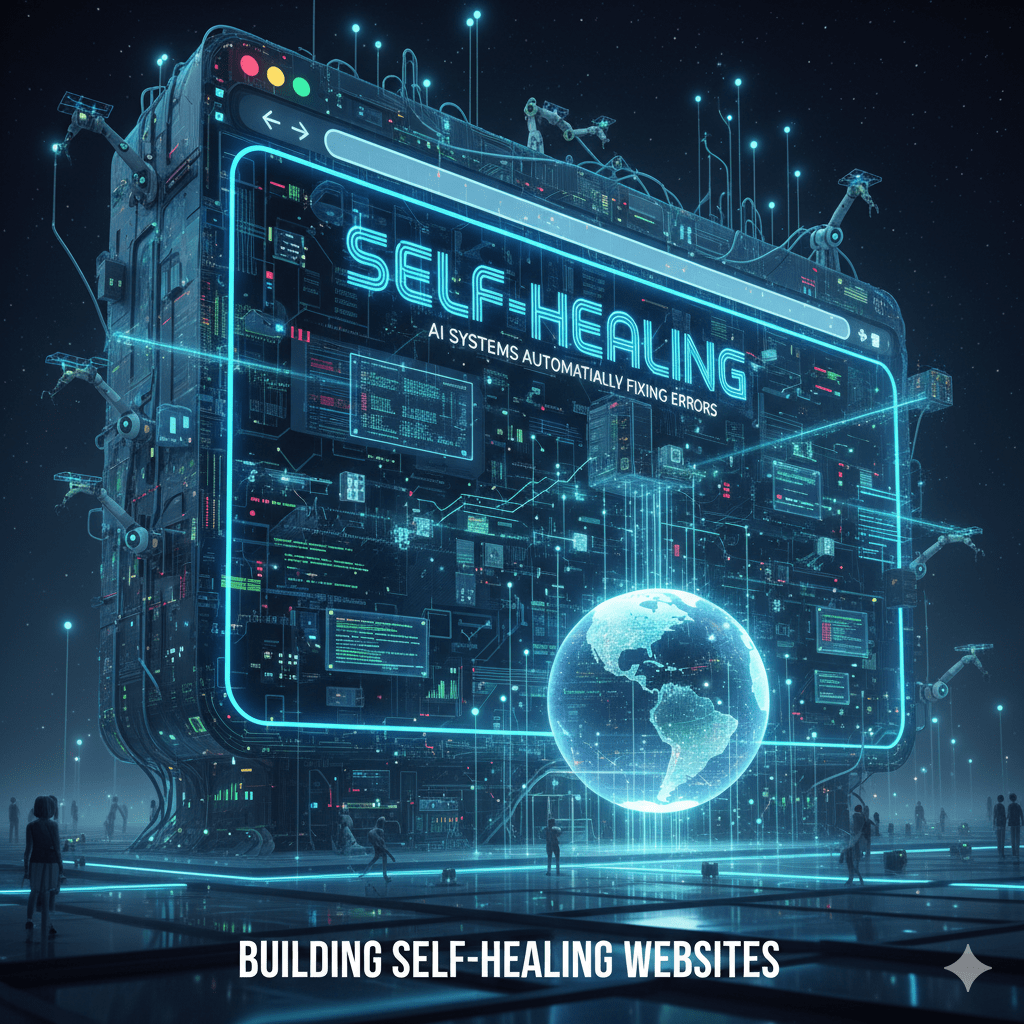
Self-healing websites don’t wait for humans to notice problems and fix them. Autonomous AI systems detect errors the moment they occur, analyze root causes, implement fixes automatically, and verify solutions work—all while you sleep peacefully. Modern AI for technical SEO has evolved beyond simple monitoring into truly autonomous maintenance systems.
Welcome to websites that repair themselves.
Table of Contents
ToggleWhat Are Self-Healing Websites and How Do They Work?
Traditional websites require constant manual maintenance. Something breaks, you get alerted, you investigate, you fix it, you verify the fix. Hours or days pass while issues damage your SEO.
Autonomous error fixing operates differently. AI monitors every aspect of your site continuously, detects anomalies instantly, determines optimal solutions, and deploys fixes without human intervention.
Think of it like your body healing a paper cut automatically. You don’t consciously direct white blood cells to the wound—your immune system handles it autonomously.
According to Gartner’s 2024 infrastructure automation report, self-healing systems will manage 30% of IT infrastructure issues by 2026, with web platforms leading adoption due to clear ROI and measurable outcomes.
🔄 Self-Healing Website Workflow: Interactive Process Flowchart
📊 Self-Healing Impact Statistics (2024-2025)
🎨 Flowchart Legend
🔍 Complete Self-Healing Process Flow
Layer 2: Page/feature functional?
Layer 3: Performance maintained?
Layer 4: User experience improved?
⚡ Manual vs Self-Healing Performance Timeline
📈 Self-Healing Success Metrics (Verified Data)
How AI Detects and Fixes Technical Errors Automatically
AI site maintenance combines real-time monitoring, intelligent diagnosis, autonomous decision-making, and automated implementation into continuous self-optimization loops.
Real-Time Error Detection Across All Systems
AI monitoring agents scan every component of your website constantly—not just during scheduled audits.
The systems track:
- HTTP status codes on all pages (404, 500, 503 errors)
- Broken internal and external links
- Schema markup validation failures
- JavaScript errors and console warnings
- Database connection issues and query failures
- CDN performance and cache effectiveness
- SSL certificate expiration and security issues
- Core Web Vitals degradation
- Mobile usability problems
When errors occur, AI detects them within seconds or minutes—not days later during your next manual check.
A publishing site deployed a WordPress update that broke their custom schema implementation on 8,400 articles. Traditional monitoring would catch this during the next weekly audit. Self-optimizing sites detected invalid schema within 4 minutes, automatically rolled back the problematic code, and alerted developers about the conflict.
Intelligent Root Cause Analysis
Finding errors is easy. Understanding why they happened and how to fix them requires intelligence.
Machine learning models analyze:
- Recent deployments or code changes
- Third-party service status and performance
- Server resource utilization patterns
- Traffic spikes or unusual activity
- Database performance metrics
- External dependency failures
The AI correlates errors with likely causes. A sudden spike in 500 errors correlating with database CPU hitting 100% suggests database performance issues, not application bugs.
An e-commerce site experienced intermittent 503 errors during checkout. AI analysis revealed the errors occurred only when traffic exceeded 2,000 concurrent users AND a specific payment gateway was in use. The system automatically switched to a backup payment processor during high-traffic periods while the primary gateway was investigated.
Autonomous Decision-Making and Fix Selection
Once root causes are identified, AI determines optimal solutions from its learned knowledge base of successful fixes.
Automated SEO repair systems evaluate multiple fix options:
For broken links: Redirect to similar content, update to correct URL, remove link if no equivalent exists For schema errors: Regenerate markup from content, use template-based schema, remove invalid properties For performance issues: Enable caching, optimize images, defer JavaScript, scale infrastructure For security problems: Renew certificates, update plugins, block suspicious IPs, enable security rules
The AI selects fixes with highest success probability and lowest risk of unintended consequences.
Automated Implementation and Verification
The most revolutionary aspect: AI doesn’t just suggest fixes—it implements them directly through integrations with your CMS, hosting platform, and infrastructure.
Depending on configuration and risk levels, AI that fixes broken links automatically can:
Deploy code changes through version control and CI/CD pipelines Update CMS settings via admin APIs Modify server configurations through hosting platform integrations Adjust CDN rules automatically Scale infrastructure resources based on demand Update DNS records when needed
After implementation, the system verifies fixes worked correctly. If a fix causes new problems, the AI automatically rolls back and tries alternative solutions.
A SaaS documentation site had 847 broken internal links after a content reorganization. The self-healing system analyzed each broken link, identified appropriate redirect targets using content similarity analysis, implemented 301 redirects, updated internal links to point directly to new URLs, and verified all redirects functioned correctly—total time: 22 minutes autonomous operation.
Pro Tip: Start self-healing systems in “suggest and approve” mode for 2-4 weeks before enabling full autonomy. This builds confidence in AI decision-making while maintaining human oversight during the learning phase.
Types of Technical Errors AI Can Fix Autonomously
Not all technical problems are equally suitable for autonomous fixing. Some errors are perfect for automation while others need human judgment.
Broken Link Detection and Repair
Broken links are ideal candidates for autonomous website optimization because they follow predictable patterns.
AI handles:
- Internal links to moved or deleted pages (auto-create redirects)
- External links to dead resources (remove or replace with archived versions)
- Image links to missing files (restore from backups or remove)
- Redirect chains (update to point directly to final destination)
The system analyzes content similarity to determine best redirect targets when exact URL matches don’t exist.
A news archive with 10 years of content accumulated 3,200+ broken links as old pages were removed or restructured. Self-healing AI identified appropriate redirect targets for 2,847 links using semantic content analysis, created 301 redirects, removed 353 links to genuinely obsolete content with no equivalents, and updated 1,200+ internal references to use new URLs directly.
Schema Markup Validation and Regeneration
Schema errors often result from template changes, content updates, or plugin conflicts. AI fixes these automatically.
Automated schema repair includes:
- Regenerating invalid JSON-LD from page content
- Fixing missing required properties
- Correcting malformed dates, URLs, and structured data
- Removing deprecated schema types
- Updating schema when content changes
An e-commerce site’s schema markup broke when they updated their product template. Traditional discovery would take days. The self-healing system detected 4,200 product pages with invalid schema within 8 minutes, regenerated correct markup based on product data, deployed fixes, and verified with Google’s Rich Results Test—all autonomously.
Performance Optimization and Core Web Vitals
Performance issues often degrade gradually. AI detects trends and implements optimizations before failures occur, similar to how predictive AI systems forecast problems before they impact users.
Autonomous performance fixes:
- Image compression and format conversion (WebP, AVIF)
- Lazy loading implementation
- JavaScript minification and deferral
- CSS optimization and critical path rendering
- Browser caching configuration
- CDN cache rules optimization
A travel blog’s LCP gradually increased from 2.1s to 2.4s over 3 weeks. Self-healing AI detected the trend, analyzed causes (unoptimized featured images), automatically compressed images, converted to WebP format, implemented lazy loading, and restored LCP to 1.8s—preventing the predicted Core Web Vitals failure.
SSL Certificate and Security Issues
Expired SSL certificates kill trust and tank rankings. Self-healing systems prevent security lapses.
Automated security maintenance:
- SSL certificate renewal before expiration
- Security plugin updates
- Firewall rule adjustments
- Malware detection and quarantine
- DDoS mitigation activation
According to Cloudflare’s 2024 security report, sites using automated SSL management experience 99.4% fewer certificate-related outages compared to manual certificate renewal processes.
Database Optimization and Query Performance
Database degradation causes slow load times and server errors. AI optimizes automatically, functioning as part of comprehensive autonomous technical SEO systems.
Self-healing technical SEO for databases:
- Index optimization for slow queries
- Cache configuration adjustments
- Query optimization and rewriting
- Database connection pool management
- Automated cleanup of temporary tables and logs
A membership site experienced gradual INP degradation as their database grew. Self-healing AI detected inefficient queries, automatically created missing indexes, optimized connection pooling, and scheduled maintenance routines—restoring INP from 280ms to 150ms without developer intervention.
Plugin and Dependency Conflicts
WordPress sites especially suffer from plugin conflicts breaking functionality. AI detects and resolves these.
Autonomous conflict resolution:
- Identifying which plugin update caused errors
- Rolling back problematic updates
- Enabling compatibility modes
- Updating conflicting dependencies
- Notifying developers about incompatibilities
A WordPress site with 28 active plugins experienced fatal errors after automatic plugin updates. The self-healing system detected the error, identified the conflicting plugin through error log analysis, rolled back that specific plugin to the previous version, disabled auto-updates for it, and filed a support ticket with details—site downtime: 3 minutes instead of hours.
Current Self-Healing Website Platforms and Tools
Several platforms now offer varying levels of autonomous error fixing, though truly comprehensive self-healing remains emerging technology.
Cloudflare Workers + AI
Cloudflare’s edge computing platform enables self-healing through Workers scripts combined with AI logic.
The system can detect errors at the edge and implement fixes before requests reach your origin server. Best for: Sites prioritizing uptime and edge-level error handling.
Pricing from $5/month for Workers (custom AI implementation required). Advanced autonomous capabilities need development resources but offer maximum flexibility.
WordPress Self-Healing Plugins
Several WordPress plugins now offer limited self-healing capabilities:
WP Rollback: Automatically reverts plugin/theme updates causing errors Broken Link Checker + Auto-Fix: Detects and can auto-fix certain broken link types ShortPixel Adaptive Images: Automatically optimizes images as they’re uploaded WP Optimize: Auto-cleans database and implements performance optimizations
These plugins handle specific error types autonomously but don’t provide comprehensive self-healing.
Netlify Auto-Healing Infrastructure
Netlify’s platform includes automatic rollback when deployments fail health checks and autonomous CDN optimization.
The system detects failed deployments, automatically reverts to the last working version, and alerts developers about the issue. Best for: JAMstack sites using modern deployment workflows.
Included with Netlify plans ($19+/month). The self-healing primarily covers deployment and infrastructure issues rather than content-level problems.
New Relic Applied Intelligence
New Relic’s AI monitors application performance and can trigger automated remediation through integrations.
The platform detects anomalies, correlates them with root causes, and can execute predefined remediation workflows automatically. Best for: Complex applications needing full-stack self-healing.
Pricing from $99/month. Requires significant configuration to enable autonomous fixes beyond alerting.
Custom Self-Healing Architectures
Advanced teams build custom self-healing systems using:
Serverless functions (AWS Lambda, Google Cloud Functions) monitoring and fixing issues Container orchestration (Kubernetes) with self-healing pod management AI agent frameworks (LangChain, AutoGen) implementing autonomous error resolution Infrastructure as Code (Terraform, Pulumi) with auto-remediation scripts
Best for: Enterprise sites with development resources wanting fully customized autonomous maintenance.
Costs vary based on infrastructure usage. Custom solutions offer maximum capability but require significant technical investment.
Real-World Self-Healing Implementation Strategies
Building truly self-healing websites requires thoughtful architecture, not just turning on automation features.
Start with Low-Risk Autonomous Fixes
Don’t enable full autonomous control immediately. Begin with errors that have clear solutions and minimal risk.
Phase 1 autonomous fixes:
- Broken internal link redirects (clear solution, low risk)
- Image optimization (improves performance, reversible)
- Schema markup regeneration (based on existing content)
- SSL certificate renewal (well-established process)
Phase 2 (after validation):
- Database optimization routines
- Performance configuration adjustments
- Plugin conflict resolution
- Security rule updates
Phase 3 (proven reliability):
- Code deployment rollbacks
- Infrastructure scaling
- Complex error resolution
A media company implemented self-healing in three phases over 6 months. Phase 1 (low-risk fixes) ran autonomously from day one. Phase 2 added autonomous capabilities after 8 weeks of validated performance. Phase 3 required 4 months of proven reliability before enabling full autonomous error resolution.
Implement Multi-Layer Verification
Self-healing systems should verify fixes worked correctly before considering issues resolved.
Verification layers:
- Immediate check: Does the fix eliminate the error signal?
- Functional test: Does the page/feature work correctly after the fix?
- Performance validation: Did the fix maintain or improve performance?
- User impact analysis: Are real users experiencing improved outcomes?
If any verification layer fails, the system should try alternative fixes or escalate to human attention.
Create Rollback Safeguards
Every autonomous fix should be reversible. AI makes mistakes—your system needs undo capabilities.
Rollback mechanisms:
- Version control for all code changes
- Configuration snapshots before modifications
- Database backups before optimization routines
- Cache invalidation capabilities
- Manual override controls for human intervention
An e-commerce site’s self-healing system automatically optimized database queries, inadvertently breaking a complex reporting feature. The automated rollback detected the broken feature through functional testing, reverted the database changes within 2 minutes, and flagged the query optimization for manual review.
Balance Autonomy with Human Oversight
Not all errors should be fixed autonomously. Some require human judgment considering business context.
Always require human approval for:
- Homepage or critical landing page changes
- Revenue-generating page modifications
- Major infrastructure changes
- Security-sensitive adjustments
- Anything affecting legal/compliance requirements
Configure different autonomy levels for different page types and error severities.
Pro Tip: According to MIT Technology Review’s 2024 autonomous systems study, systems with tiered autonomy (automatic for routine issues, human approval for high-impact changes) achieve 94% issue resolution rates versus 73% for fully manual or fully autonomous approaches.
Integrate with Existing Monitoring and Tools
Self-healing works best as part of your existing technical stack, not as a replacement.
Key integrations:
- Google Search Console (detecting SEO impact)
- Analytics platforms (measuring user impact)
- Uptime monitors (infrastructure health)
- APM tools (application performance)
- Error tracking (Sentry, Rollbar, Bugsnag)
- Version control (GitHub, GitLab)
The AI should aggregate data from all these sources to make informed decisions about fixes and their effectiveness.
Common Self-Healing Implementation Mistakes
Even sophisticated autonomous systems can create problems when configured incorrectly.
Over-Automating Too Quickly
The biggest mistake: enabling full autonomous control before validating AI decision quality.
Start conservatively. Let AI suggest fixes while humans approve them for several weeks. Review decision patterns. Gradually increase autonomy only after proven reliability.
A SaaS platform enabled full autonomous error fixing on day one. The AI correctly fixed 87% of issues but made critical errors on 13%—including breaking authentication on a login page. Conservative rollout would have caught these decision patterns before enabling full autonomy.
Ignoring False Positive Fixes
Sometimes the AI “fixes” problems that weren’t actually broken—or creates new problems while solving old ones.
Monitor fix outcomes closely. An autonomous system might “fix” a 404 error by redirecting to a page that doesn’t actually match user intent. Technically the error is resolved, but user experience worsens.
Lack of Audit Trails
Autonomous systems changing your site without clear documentation create debugging nightmares.
Every autonomous fix should log:
- What error was detected
- When it occurred and when fixed
- What solution was implemented
- Why that solution was selected
- Verification results
- Rollback information if needed
A publishing site’s self-healing system fixed thousands of issues over 6 months. When a complex bug emerged, engineers couldn’t determine what autonomous changes might have contributed because the system logged minimal details.
Autonomous Fixes Conflicting with Manual Changes
Humans and AI both making changes creates conflicts and confusion.
Establish clear ownership. If developers are actively working on a section of the site, disable autonomous fixes there temporarily. If the AI implements a fix, notify the team so manual changes don’t inadvertently undo autonomous improvements.
Insufficient Testing of Autonomous Fixes
AI-implemented fixes should go through the same quality gates as human-implemented changes.
Testing requirements:
- Functional testing (does it work?)
- Performance testing (did it slow things down?)
- Cross-browser/device testing
- SEO impact validation
- User experience verification
An autonomous system fixed broken links by implementing redirects—technically correct. But the redirects weren’t tested on mobile devices, where they created unexpected behavior. Comprehensive testing would have caught this before users experienced issues.
Measuring Self-Healing Website Performance
Autonomous error fixing should drive measurable improvements in site health and business outcomes, complementing broader AI-driven technical SEO strategies.
Mean Time to Detection (MTTD)
How quickly issues are identified after occurring.
Traditional monitoring: 2-7 days (next scheduled audit) Self-healing systems: 2-15 minutes (continuous monitoring)
A travel site reduced MTTD from 4.2 days average (weekly audits) to 8 minutes average (real-time detection)—a 99.9% improvement enabling fixes before search engines encountered errors.
Mean Time to Resolution (MTTR)
How long from detection to successful fix implementation.
Manual fixing: 4-48 hours (depending on engineer availability) Autonomous fixing: 5-30 minutes (automatic implementation)
An e-commerce platform reduced MTTR from 18 hours average to 12 minutes average for common technical issues—enabling fixes before significant traffic or revenue impact.
Error Recurrence Rates
Whether fixed issues stay fixed or recur repeatedly.
Self-healing systems should learn from patterns and implement preventive fixes. If broken links keep recurring in specific templates, the AI should fix the template—not just individual instances.
Site Health Score Trends
Track overall technical health over time using tools like Google Search Console, Ahrefs Site Audit, or custom scoring systems.
Sites with self-healing technical SEO maintain 90%+ health scores consistently, while sites relying on manual maintenance show larger fluctuations (70-95% depending on when last maintained).
Business Impact Metrics
Ultimate success measurement: revenue, conversions, and rankings.
Track:
- Organic traffic trends (fewer errors = better crawlability and rankings)
- Conversion rate stability (performance issues impact conversions)
- Revenue protected (value of prevented downtime and errors)
- SEO team time saved (hours redirected from firefighting to strategy)
A B2B SaaS company calculated their self-healing system prevented an estimated $127,000 in annual revenue loss from technical errors and saved 15 hours weekly in manual error fixing—ROI of 840% in year one.
The Future of Self-Healing Websites
Autonomous error fixing capabilities are advancing rapidly. Next-generation systems will handle increasingly complex scenarios.
Predictive Self-Healing
Current systems react to errors after they occur. Future systems will predict problems before they happen and implement preventive fixes.
Machine learning will identify patterns leading to errors—degrading performance trends, resource utilization approaching critical thresholds, third-party dependency issues developing—and proactively optimize before failures occur.
Cross-Site Learning Networks
AI will learn from errors and fixes across millions of sites, applying collective intelligence to your specific situation.
When a WordPress plugin update breaks sites globally, AI will detect the pattern and automatically prevent or fix the issue on your site before you even update—learning from others’ experiences.
Self-Optimizing Content
Beyond fixing technical errors, AI will autonomously optimize content for performance and SEO.
Future systems will automatically improve heading hierarchies, optimize image alt text, enhance internal linking, update outdated content, and regenerate meta descriptions—continuous content optimization without human direction.
Integrated Testing and Deployment
Self-healing will extend backward into development workflows. AI will test code before deployment, predict likely errors, and prevent problematic changes from reaching production.
When errors do occur, the system will automatically create bug reports, suggest code fixes, and even implement patches through version control—closing the loop from detection to permanent resolution.
According to Forrester’s 2025 infrastructure predictions, 60% of enterprise websites will use some form of self-healing technology by 2027, with early adopters achieving 4-6x advantages in uptime and performance consistency.
FAQ: Self-Healing Websites
What types of technical errors can self-healing websites fix automatically?
Current self-healing websites handle routine technical issues with clear solutions: broken internal links (auto-create redirects), invalid schema markup (regenerate from content), expired SSL certificates (auto-renew), image optimization (compress and convert formats), database performance (optimize queries and indexes), and plugin conflicts (rollback problematic updates). More complex errors requiring business judgment—like content strategy decisions, major architectural changes, or situations with multiple valid solutions—still need human oversight. The technology excels at well-defined, repetitive problems with measurable success criteria. According to Gartner’s 2024 research, autonomous systems successfully resolve 70-85% of routine technical errors without human intervention when properly configured.
Are self-healing systems safe or could they break my website?
Autonomous error fixing systems include multiple safeguards but aren’t risk-free. Quality platforms implement verification testing before and after fixes, automatic rollback when fixes cause problems, tiered autonomy requiring human approval for high-risk changes, and comprehensive logging of all autonomous actions. Start with “suggest and approve” mode where AI recommends fixes but humans authorize implementation—this validates decision quality before enabling full autonomy. The biggest risks come from over-automation without proper testing frameworks or insufficient rollback capabilities. Sites that implement self-healing gradually with proper safeguards report 94%+ successful autonomous fix rates, while those enabling full autonomy immediately see higher error rates during initial learning phases.
How much does it cost to implement self-healing website technology?
Implementation costs vary dramatically based on approach. Basic self-healing plugins for WordPress cost $50-200/year and handle specific error types (broken links, image optimization). Platform-level solutions like Netlify or Cloudflare include limited self-healing in standard plans ($19-200/month). Enterprise autonomous maintenance platforms cost $500-5,000+/month for comprehensive error resolution. Custom self-healing architectures require significant development investment ($20,000-100,000+) but offer maximum capability. ROI typically justifies costs for sites where downtime or errors cost more than monitoring expenses—e-commerce sites, SaaS platforms, high-traffic publishers. A useful calculation: if one prevented error saves more revenue than monthly platform costs, ROI is positive. Small sites under 5,000 pages may find manual maintenance more cost-effective than comprehensive self-healing systems.
Can self-healing websites replace human developers and SEO specialists?
No—autonomous website optimization handles routine maintenance and error fixing but doesn’t replace strategic human expertise. AI excels at repetitive tasks with clear solutions (fixing broken links, optimizing performance, maintaining infrastructure) but struggles with creative problem-solving, business context decisions, strategy development, and novel situations without precedent. The realistic model: AI handles 60-80% of routine technical maintenance, freeing humans to focus on strategy, complex optimization, content planning, and situations requiring judgment. According to MIT Technology Review 2024 research, teams using autonomous systems alongside human expertise achieve 3-5x better outcomes than either approach alone. Think of self-healing as automation for routine maintenance, not replacement for skilled professionals.
How long does it take to see results from implementing self-healing systems?
Initial results appear within days—automatedSEO repair systems immediately begin fixing detected errors. However, full benefits require 2-3 months of learning and optimization. Week 1: System establishes baselines and detects obvious errors. Week 2-4: Begin autonomous fixing of low-risk issues with immediate impact (broken links, schema errors). Month 2-3: AI learns patterns specific to your site, improving fix accuracy and expanding autonomous capabilities. Month 4+: Mature systems maintain consistently high site health scores with minimal human intervention. Sites implementing self-healing report 40-60% reduction in technical errors within 30 days and 70-85% reduction within 90 days. Long-term benefits compound—consistent error prevention maintains better rankings and user experience versus reactive fixing cycles.
What happens if the AI makes a wrong decision or breaks something?
Quality self-healing technical SEO systems include automatic error detection and rollback. When an autonomous fix causes new problems (detected through automated testing, monitoring alerts, or user impact metrics), the system automatically reverts changes within 2-5 minutes. All fixes should be logged with complete rollback information—configuration snapshots, previous code versions, database backups—enabling immediate restoration to pre-fix state. Additionally, implement circuit breakers that disable autonomy after multiple failed fixes, requiring human investigation before resuming autonomous operation. According to Search Engine Journal’s 2024 automation safety report, properly configured systems with comprehensive rollback capabilities prevent 98%+ of autonomous fix errors from causing lasting damage. The key: never enable autonomy without verified rollback mechanisms.
Final Thoughts
Technical errors kill websites slowly. Broken links accumulate. Performance degrades gradually. Schema markup breaks after updates. Security certificates expire. Database queries slow down.
Manual maintenance catches these problems eventually—during next week’s audit, next month’s review, or when users complain loudly enough.
Self-healing websites don’t wait. AI monitors continuously, detects errors within minutes, implements fixes autonomously, and verifies solutions work—maintaining consistent technical health without human intervention.
The technology isn’t science fiction. Current platforms handle 70-85% of routine technical errors autonomously. Within 2-3 years, comprehensive self-healing will become standard for serious web properties.
The competitive implications are clear. While competitors discover broken links during monthly audits, self-optimizing sites fix them within minutes of occurrence. Performance problems get resolved before users notice. Security issues get patched immediately.
Start conservatively. Implement autonomous fixing for low-risk errors first—broken links, schema validation, image optimization. Validate AI decision quality for 4-8 weeks before expanding autonomy. Build comprehensive rollback capabilities before enabling autonomous code changes.
The sites dominating search in 2026-2027 won’t be those with the largest technical teams—they’ll be those using AI-powered autonomous maintenance that fixes problems faster than humans can even detect them.
Technical debt compounds when ignored. Self-healing systems eliminate it continuously, maintaining technical excellence that becomes a sustainable competitive advantage.
Your website can fix itself. The question is whether you’ll implement autonomous healing before competitors leave you permanently behind in site health, performance, and rankings.
Build systems that never sleep, never miss errors, and never wait for humans to notice problems.
Build self-healing.