


Table of Contents
ToggleExecutive Summary
- Core Shift: Being ranked in search is no longer enough—AI systems prioritize trusted, authoritative brands for citations
- New Visibility Landscape: Discovery happens across ChatGPT, Claude, Gemini, Perplexity, and Bing Copilot before users reach websites
- E-E-A-T Redefined: Experience, Expertise, Authoritativeness, and Trustworthiness are now AI retrieval factors, not just quality guidelines
- Invisible Traffic Problem: Brand mentions in AI answers don’t show in analytics but drive branded searches and direct visits
- Four Major Risks: Zero-click exposure, entity confusion, reputation bleed, and trust dilution threaten unprepared brands
- Future Requirement: Universal verifiers will soon measure content credibility as an inclusion standard for AI answers
- Action Required: Implement schema markup, maintain author transparency, update content regularly, and build external validation
The Search Paradigm Has Fundamentally Changed
AI-generated answers are spreading across search with Google and Bing presenting synthesized responses alongside regular results. These answers are not replacing traditional SERPs yet, but they are taking up attention, and as usage of ChatGPT, Claude, Perplexity, and other platforms continues to expand, user habits will shift toward more engagement with synthesized answers with no traditional SERPs in sight at all.
The implications are profound for every brand competing for visibility online.
The new reality of search visibility:
Being ranked is no longer enough. When machines decide which brands to cite or quote, the deciding factor is trust. The brands that become part of AI-generated answers are those seen as authoritative and credible.
This fundamental shift means traditional SEO tactics—keyword optimization, link building, and technical performance—remain necessary but are no longer sufficient for comprehensive visibility.
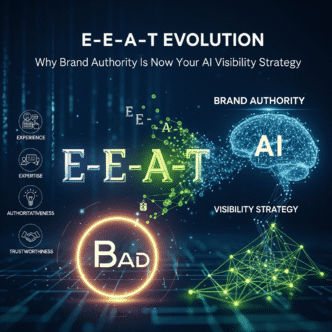
Understanding E-E-A-T: The Framework That Matters
E-E-A-T is not a single ranking factor but a framework used by Google’s search evaluators to judge how credible, useful, and accurate a page appears.
Breaking Down the Four Pillars
1. Experience
Experience refers to first-hand involvement, the signal that you have actually done or tested what you are writing about. This isn’t theoretical knowledge—it’s proof you’ve been in the trenches.
2. Expertise
Expertise is the skill or background that ensures accuracy. Credentials, qualifications, and demonstrated knowledge in your field matter more than ever.
3. Authoritativeness
Authoritativeness reflects recognition from others through citations, backlinks, and mentions that confirm your credibility. It’s what the industry says about you when you’re not in the room.
4. Trustworthiness (The Foundation)
The most critical element:
Trustworthiness is the foundation built through transparency, consistency, and honesty. In Google’s guidelines, trust is described as the single most important quality of a high-value page, with the other three factors existing to reinforce it.
AI Systems Are Adopting These Same Principles
These same principles are now emerging in AI systems. Models trained to generate answers rely on reliable, verifiable information. The more your brand appears in credible environments, the stronger your statistical trust signal becomes.
The Two-Tiered Visibility System
Today’s marketers must navigate an entirely new discovery environment.
Search results still look familiar, but discovery no longer begins and ends with a search box. AI-generated answers now appear in Gemini, Perplexity, Bing Copilot, ChatGPT, and Claude, each shaping what people learn before they ever visit a website.
The dual visibility challenge:
For SEOs, this creates two overlapping visibility systems. The first is still the structured web: ranking pages through links, metadata, and relevance. The second is the interpretive layer of AI retrieval and synthesis. Visibility no longer depends only on ranking high; it depends on being known, cited, and semantically retrievable.
How Different Platforms Handle Citations
Google Gemini & Bing Copilot:
These platforms remain closest to classic search, combining web results with AI-generated summaries, still referencing source domains and showing linked citations. This gives marketers some feedback on what content is being surfaced.
Perplexity:
Perplexity acts as a bridge between web and conversation, routinely citing the domains it draws from, often favoring pages with structured data, clear headings, and current publication dates. This platform rewards well-structured, authoritative content.
ChatGPT & Claude:
These platforms represent a different kind of discovery where users often never see the open web. Answers are drawn from model knowledge, premium connectors, or browsing results, sometimes citing, sometimes not.
Yet even without direct citations, these platforms shape brand perception and awareness in powerful ways.
The Invisible Visibility Challenge
One of the most disruptive aspects of AI-driven search is the measurement gap.
The analytics blind spot:
Visibility now extends beyond what typical analytics can track. People are discovering, comparing, and deciding inside AI tools that don’t register as traffic sources. A mention in ChatGPT or Claude may not show up in referral logs, but it builds brand familiarity that can resurface later as a direct visit or branded search.
The New Customer Journey
A user might start with an AI conversation, remember a brand name that sounded credible, and later search for it manually. In both cases, awareness grows without a single traceable referral.
This creates attribution challenges that traditional analytics tools weren’t designed to handle.
Early warning indicators to watch:
Rising branded search volume, increased direct traffic, and mentions across AI surfaces are early indicators of AI-driven visibility. If you’re seeing unexplained increases in these metrics, your brand may be appearing in AI-generated responses.
Four Critical Threats to Brand Visibility
1. Zero-Click Exposure Without Attribution
Your insights might appear inside an AI answer without attribution if your brand identity is unclear or your phrasing too generic, expanding the footprint of zero-click scenarios noticeably.
This means you’re doing the work to create valuable content, but AI systems are harvesting that value without sending recognition or traffic back to you.
2. Entity Confusion
If your structured data or naming conventions are inconsistent, AI systems can mix your brand with similar ones.
Imagine your expertise being attributed to a competitor simply because your entity definitions aren’t clear enough for machines to parse correctly.
3. Reputation Bleed
Old or inaccurate content about your brand lingering on third-party sites can be scraped by AI engines and presented as fact.
That outdated blog post from 2015 or the incorrect information on a review site could become the “truth” that AI systems repeat about your brand.
4. Trust Dilution
The AI content flood problem:
The flood of AI-generated content is making it harder for systems to separate credible human work from synthetic filler. In response, they will likely narrow the pool of trusted domains.
Brands that haven’t established strong trust signals may find themselves excluded from this narrowing circle of credibility.
Six Strategies to Build Verifiable Authority
1. Establish Clear Content Ownership
Every piece of content should identify who created it and why that person is qualified to speak on the topic. When authorship is transparent, credibility becomes traceable.
Gone are the days when anonymous or vaguely attributed content could compete effectively. AI systems look for verifiable human expertise.
2. Maintain Content Freshness
Outdated information, dead links, or references to old data quietly undermine trust. Keeping content current shows ongoing involvement in your subject and helps both users and search systems recognize that your knowledge is active, not archived.
Regular content audits and updates are no longer optional—they’re essential trust signals.
3. Implement Comprehensive Schema Markup
Make your authority machine-readable:
Schema markup for articles, authors, and organizations gives machines a way to verify what they’re seeing, clarifying relationships between who wrote the piece, what company they represent, and how it fits into a larger body of work.
Without structured data, even excellent content can be invisible to AI systems trying to verify authority.
4. Build External Validation
When reputable outlets cite or reference your work, it strengthens your perceived authority. Media mentions, partnerships, and collaborations all act as third-party endorsements that reinforce your brand’s credibility.
This creates the network effect that AI systems interpret as trustworthiness.
5. Create Proprietary, Original Assets
Proprietary data, firsthand experience, and in-depth case studies show real expertise. These are the assets that set your content apart from AI-generated summaries because they contain knowledge that isn’t available elsewhere on the web.
Original research, unique datasets, and exclusive insights become your competitive moat against synthetic content.
6. Ensure Cross-Platform Consistency
Alignment builds trust:
The version of your brand that appears on your website, LinkedIn profile, YouTube channel, and review sites should all align. Inconsistent bios, mismatched tone, or outdated information create friction that weakens perceived trust.
AI systems look for consistent signals across multiple sources to validate credibility.
The Coming Verification Revolution
The next evolution in AI search is already being developed.
In the near future, trust will not just be a guideline but will become a measurable inclusion standard. Major AI platforms are developing universal verifiers, systems that check the accuracy and reliability of content before it is included in an answer.
The winners and losers will be decided early:
When this arrives, brands that already display strong trust cues will pass verification more easily. Those without structured data, transparent authorship, or verifiable sourcing will struggle to appear.
Technical SEO Gets a New Definition
It will not be enough for your site to be fast and crawlable. It will need to be verifiable. That means clear author data, factual sourcing, and strong entity ties that confirm ownership.
Page speed and mobile-friendliness remain important, but verifiability becomes the new technical requirement for visibility.
Measuring Success in the AI Era
Traditional metrics tell only part of the story.
The new measurement framework:
New forms of visibility require new measurement. Track whether your brand appears in AI-generated answers using new tools/platforms available, chatbots, and answer engines to test your visibility. Monitor branded search volume over time as it reflects whether your exposure in AI summaries is driving awareness. Audit your structured data and author markup regularly, and track external mentions and citations in high-trust environments.
Metrics That Matter Now:
- AI Presence: Manual testing across ChatGPT, Claude, Gemini, Perplexity for brand mentions
- Branded Search Growth: Tracking upward trends in brand-specific queries
- Direct Traffic Patterns: Monitoring unexplained increases in direct visits
- Citation Frequency: Measuring how often authoritative sources reference your content
- Schema Completeness: Regular audits of structured data implementation
- Author Authority Signals: Tracking contributor credentials and external validation
Your Current Rankings Are a Warning Signal
If you consistently fail to rank well for key terms in traditional search, that could be a clue that AI systems will see your content as “less than” when compared to competing pieces of content. If you consistently struggle to meet the requirements of traditional search trust gates, it’s unlikely you’ll get a pass from AI systems as they ramp up their focus on trust.
In other words, if you’re not competitive in traditional search, you’re probably already invisible in AI search.
The Strategic Imperative
E-E-A-T has evolved from quality checklist to survival strategy:
E-E-A-T was once a quality checklist. Now it is a visibility strategy. Search systems and AI models are moving toward the same destination – finding reliable information faster.
What Success Looks Like
The ultimate goal:
The brands that live these principles will be the ones cited, quoted, and remembered. In a world of AI-generated answers, your reputation becomes your ranking signal.
This isn’t about gaming algorithms or finding shortcuts. It’s about building genuine authority that both humans and machines can verify and trust.
Action Plan for Immediate Implementation
Week 1-2: Audit Current State
- Test brand mentions across major AI platforms
- Review all structured data implementation
- Audit author bios and credentials across all platforms
- Identify inconsistencies in brand messaging
Week 3-4: Fix Foundation Issues
- Implement or update schema markup for articles, authors, and organization
- Standardize author information across all content
- Update outdated content with fresh data and sources
- Remove or redirect dead links
Month 2: Build External Validation
- Develop PR strategy for authoritative media mentions
- Create partnership opportunities with recognized brands
- Publish original research or proprietary data
- Seek speaking opportunities and expert features
Month 3+: Monitor and Optimize
- Track branded search volume trends
- Monitor AI platform citations
- Continue content freshness program
- Build ongoing external validation
Frequently Asked Questions (FAQ)
Q: What exactly is E-E-A-T and why does it matter for AI search?
A: E-E-A-T stands for Experience, Expertise, Authoritativeness, and Trustworthiness. It’s not a single ranking factor but a framework used by Google’s search evaluators to judge how credible, useful, and accurate a page appears. These same principles are now emerging in AI systems, as models trained to generate answers rely on reliable, verifiable information.
Q: How is AI search different from traditional search?
A: For SEOs, this creates two overlapping visibility systems. The first is still the structured web: ranking pages through links, metadata, and relevance. The second is the interpretive layer of AI retrieval and synthesis. Visibility no longer depends only on ranking high; it depends on being known, cited, and semantically retrievable.
Q: Why can’t I see AI-driven traffic in my analytics?
A: Visibility now extends beyond what typical analytics can track. People are discovering, comparing, and deciding inside AI tools that don’t register as traffic sources. A mention in ChatGPT or Claude may not show up in referral logs, but it builds brand familiarity that can resurface later as a direct visit or branded search.
Q: What are the biggest threats to my brand in AI search?
A: There are four major risks: Zero-click exposure where your insights appear without attribution if your brand identity is unclear; entity confusion if your structured data or naming conventions are inconsistent; reputation bleed when old or inaccurate content about your brand can be scraped by AI engines and presented as fact; and trust dilution as the flood of AI-generated content makes it harder for systems to separate credible human work from synthetic filler.
Q: What is schema markup and why is it so important now?
A: Schema markup for articles, authors, and organizations gives machines a way to verify what they’re seeing, clarifying relationships between who wrote the piece, what company they represent, and how it fits into a larger body of work. Without it, even well-written content can get lost in the noise.
Q: How do I measure if my brand is appearing in AI answers?
A: Track whether your brand appears in AI-generated answers using new tools/platforms available, chatbots, and answer engines to test your visibility. Monitor branded search volume over time as it reflects whether your exposure in AI summaries is driving awareness, and track external mentions and citations in high-trust environments.
Q: What are universal verifiers and when are they coming?
A: Major AI platforms are developing universal verifiers, systems that check the accuracy and reliability of content before it is included in an answer. When this arrives, brands that already display strong trust cues will pass verification more easily. Those without structured data, transparent authorship, or verifiable sourcing will struggle to appear.
Q: Does my current search ranking predict my AI visibility?
A: Yes, it’s a strong indicator. If you consistently fail to rank well for key terms in traditional search, that could be a clue that AI systems will see your content as “less than” when compared to competing pieces of content. If you consistently struggle to meet the requirements of traditional search trust gates, it’s unlikely you’ll get a pass from AI systems as they ramp up their focus on trust.
Q: What’s the most important thing I should focus on first?
A: Trustworthiness is the foundation built through transparency, consistency, and honesty. In Google’s guidelines, trust is described as the single most important quality of a high-value page, with the other three factors existing to reinforce it. Start with transparent authorship, accurate information, and consistent brand messaging across all platforms.
Q: Is traditional SEO still relevant?
A: Absolutely. Traditional SEO remains essential for discoverability, but it’s no longer sufficient alone. You need both traditional ranking factors and AI-retrieval factors working together. Your content must be both searchable and citable, both findable and trustworthy.
Q: How often should I update my content to maintain trust signals?
A: Keeping content current shows ongoing involvement in your subject and helps both users and search systems recognize that your knowledge is active, not archived. Outdated information, dead links, or references to old data quietly undermine trust. Implement regular quarterly audits at minimum, with more frequent updates for rapidly changing topics.
Q: Can I still succeed if I’m a small business competing against major brands?
A: Yes, but your approach must be strategic. Proprietary data, firsthand experience, and in-depth case studies show real expertise. These are the assets that set your content apart from AI-generated summaries because they contain knowledge that isn’t available elsewhere on the web. Focus on niche expertise and original insights that larger competitors can’t easily replicate.