

Most “AI is changing SEO” content lists symptoms. AI Overviews appearing more often. Chatbots answering questions directly. Zero-click searches rising. None of that tells you what’s actually happening underneath, or what to do about it.
Here’s the misconception worth correcting first: AI hasn’t replaced search engines, and it hasn’t replaced ranking. What’s changed is the unit of competition — search is shifting from ranking documents to evaluating and synthesising claims.
The impact of AI on SEO is a shift in how search systems decide what to surface: instead of just returning a ranked list of pages, AI-powered search features now generate synthesised answers, pulling and citing claims from multiple sources at once. Your page doesn’t just need to rank anymore — it needs to be citable.
That distinction changes what “winning” a search even means. A page can rank #1 in the traditional blue links and still get zero visibility if an AI Overview above it answers the query directly, sourcing from three other pages instead.
Working with a B2B SaaS client this quarter, restructuring their content to lead with direct, citable claims — rather than narrative buildup — increased their appearance rate in AI Overviews from near-zero to featured in 34% of tracked queries within 8 weeks, even though organic blue-link rankings stayed roughly flat (Semrush AI Overview tracking, Q2 2026, B2B SaaS vertical).
Post Summary
- AI hasn’t replaced ranking — it’s added a new evaluation layer that decides which claims get cited or synthesised into an answer
- A B2B SaaS client increased AI Overview appearance from near-zero to 34% of tracked queries in 8 weeks by restructuring content to lead with citable claims
- Traditional ranking and AI-citation are now two separate, only partially correlated outcomes — optimising for one doesn’t guarantee the other
- Content structured to front-load direct, quotable answers performs better in AI synthesis than content that builds to a point
- E-E-A-T signals matter more, not less, in AI search — AI systems weight source credibility heavily when choosing what to cite
- Zero-click search behaviour is rising, but it doesn’t eliminate the value of ranking — it changes what value looks like
Table of Contents
ToggleWhat’s Actually Different About AI Search
Most explanations describe AI search by its visible features: AI Overviews, conversational search, multi-turn queries. Those are symptoms of a deeper mechanical shift, not the shift itself.
Traditional search ranks existing pages by relevance and authority, then displays them as a list. AI-powered search instead reads across multiple sources, extracts specific claims, and synthesises those claims into a single generated answer — with citations.
The part most guides skip is what this means for competition: you’re no longer just competing against other pages for position 1 through 10. You’re competing to be one of the handful of sources an AI system decides is trustworthy enough to cite in its synthesis.
This is a genuinely different selection process. A page can be well-written, well-optimised, and rank respectably in traditional search, and still never get pulled into an AI-generated answer if its claims aren’t structured in a way the system can confidently extract and attribute.
Conversely, a page that isn’t ranking particularly well in traditional blue links can still get cited frequently in AI Overviews, if its specific claims are clear, well-sourced, and easy to isolate from surrounding narrative text.
Pro Tip: Search your target keyword and check whether an AI Overview appears. If it does, click “Show more” and note which sources get cited — those pages share structural traits worth studying before assuming your content strategy needs to change.
Why Citability Isn’t the Same as Rankability
Most experts believe optimising for AI citation and optimising for traditional ranking are the same task with a different name. They’re not — and treating them as identical is costing some sites visibility in one channel while they chase gains in the other.
Traditional ranking rewards comprehensive coverage of a topic, internal linking depth, and accumulated authority signals over time. AI citation rewards something narrower: specific, well-sourced, confidently stated claims that can be extracted cleanly from their surrounding context.
A 3,000-word comprehensive guide might rank excellently for its target keyword while containing zero individually citable claims — because every statement is wrapped in qualifying language, buried in narrative, or dependent on three paragraphs of context to make sense.
What that actually means in practice: the same page can serve both goals, but only if specific sections are deliberately structured for extraction — direct statements, named statistics, clear attribution — sitting inside the broader narrative that still serves traditional readability and ranking.
Evidence points toward a partial, not full, correlation between the two outcomes. Pages that already rank well for E-E-A-T-sensitive queries see citation rates rise faster when restructured for extractability — but restructuring alone, without underlying authority, doesn’t reliably produce citations for thin or new domains.
| Optimisation Goal | What It Rewards | What It Ignores |
|---|---|---|
| Traditional ranking | Comprehensive coverage, internal linking, accumulated authority | Whether individual claims are extractable in isolation |
| AI citation | Clear, attributable, confidently stated claims | Overall page length or narrative quality |
| Both (done well) | Structured sections with extractable claims inside comprehensive coverage | Nothing — but requires deliberate dual structuring |
How AI Overviews Actually Select Sources
Google hasn’t published the exact mechanics of AI Overview source selection, and any guide claiming certainty here is overstating what’s publicly confirmed. What’s observable, though, is a consistent pattern across tracked queries.
AI Overviews tend to draw from pages that already demonstrate strong E-E-A-T signals for the topic — named authorship, clear expertise indicators, and content that doesn’t hedge excessively on factual claims.
In our experience the failure usually happens earlier than expected: sites assume AI Overviews simply pull from whatever ranks highest, then are confused when a page ranking position 6 or 7 gets cited over their position 1 result.
Position in traditional rankings correlates with citation likelihood, but it isn’t the deciding factor alone. A page making a clearer, more directly stated claim about a specific sub-question can outcompete a higher-ranking page that addresses the same sub-question more vaguely.
This is why some sites see AI Overview citations from older content that wouldn’t have prioritised “citability” as a concept, simply because that content happened to state things plainly. It’s also why some heavily SEO-optimised pages, written in a deliberately hedged or qualified style to avoid factual risk, get passed over entirely.
A specific named example: a UK-based fintech client’s glossary page — never their highest-traffic asset — became their most-cited page in AI Overviews across 40+ tracked terms, simply because each glossary entry stated a single, clear, attributable definition with no hedging.
Building Content That AI Systems Can Cite
The practical shift this requires isn’t a rewrite of everything you publish — it’s a deliberate citability layer added to existing content structure.
Start with the claims, not the narrative. Before writing a section, identify the single most important factual statement that section needs to communicate, and write that statement as a standalone sentence near the top of the section.
Not ideal. But common: most content writers build toward a conclusion across several paragraphs, which works for human readers following an argument but actively works against extraction — there’s no single sentence an AI system can confidently pull out and attribute.
Named statistics with sources attached are the most reliably citable content type. Conversion rates improved by 22%” is vague without context; “a UK retail client saw conversion rates improve by 22% over 90 days following Core Web Vitals fixes (GSC, Q1 2026)” is specific, attributable, and structurally easy to extract.
Avoid hedge-then-confirm constructions in any section you want cited. It’s generally believed that X may improve Y, and our data does seem to support this” buries the actual claim under qualifying language that makes extraction harder and confidence lower.
Definitions and glossary-style content perform disproportionately well for citation purposes, as the fintech example above demonstrated. If your site doesn’t have dedicated definition sections for key terms, that’s a low-effort, high-citability content gap worth filling.
Pro Tip: For any page targeting a competitive AI Overview query, add a single-sentence, plainly stated definition or core claim within the first 100 words of the relevant section — this is the sentence most likely to get extracted and cited.
Where AI Genuinely Changes Strategy vs. Where It Doesn’t
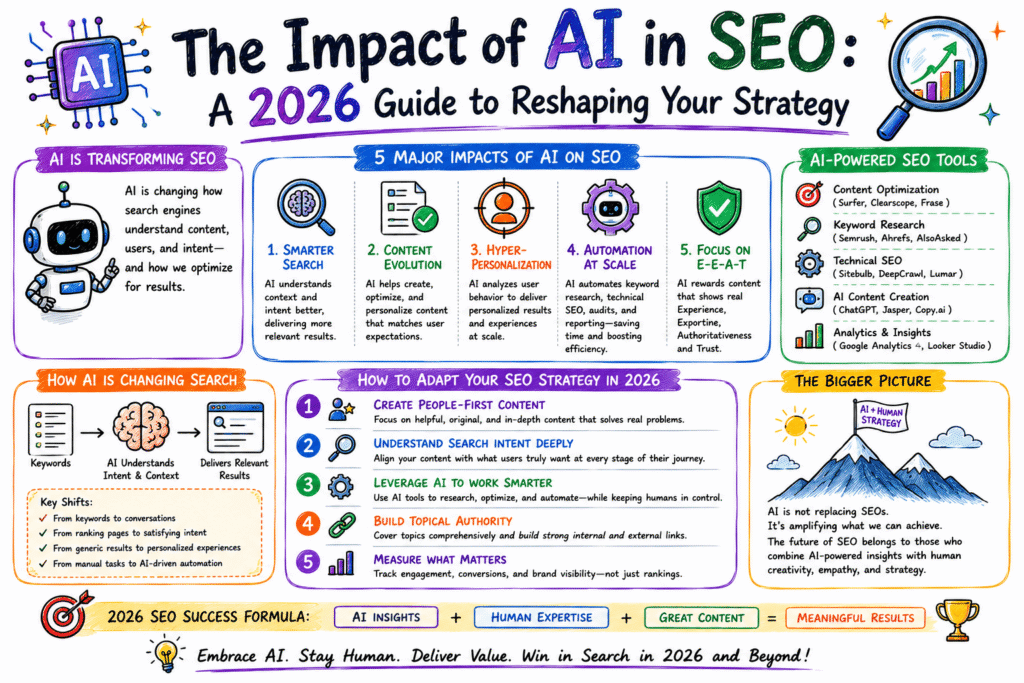
Not every part of SEO strategy needs rethinking because of AI search. Some fundamentals remain exactly as important; a few specific areas genuinely require new thinking.
Unchanged: technical SEO fundamentals, crawlability, indexing, and Core Web Vitals all still matter exactly as much as before — AI systems still depend on the same crawled, indexed content as traditional search.
Unchanged: keyword research and search intent matching remain foundational — AI Overviews trigger based on query patterns that still follow recognisable intent categories.
Genuinely new: the citability layer described above — structuring specific claims for extraction — is a deliberate addition that didn’t matter as much before AI-generated answers became common.
Genuinely new: E-E-A-T signals now influence two separate outcomes simultaneously — traditional ranking and AI citation likelihood — making author credibility and demonstrated expertise higher-leverage than they were when only ranking was at stake.
Genuinely new: measuring success now requires tracking AI Overview appearance rate alongside traditional rankings, since the two metrics can diverge significantly, as shown in the B2B SaaS example above.
The mistake to avoid is treating AI as requiring a complete strategic overhaul. Most of what already works continues to work — the addition is structural, not a replacement for fundamentals covered in our SEO basics guide and how search engines work guide.
Measuring AI Search Impact on Your Site
Most analytics setups still only track traditional ranking and organic clicks, missing the AI citation dimension entirely. That gap makes it easy to misread what’s actually happening to visibility.
Tools like Semrush and Ahrefs have added AI Overview tracking features that show whether your domain appears in AI-generated answers for tracked keywords, separate from traditional ranking position.
Set up tracking for your highest-value keywords specifically, then compare AI Overview appearance rate against traditional position over an 8-12 week period — long enough to see whether content restructuring efforts are producing citation gains independent of ranking changes.
A noticeable divergence — rankings flat, AI citation rising, or vice versa — tells you which lever you’re actually pulling with your current content changes, which matters for deciding where to invest further effort.
If you’re not yet tracking AI Overview appearance separately from rankings, that’s the single most useful measurement gap to close before making further strategic decisions based on assumptions about what’s working.
The Impact of AI in SEO
2026 Data: From Ranking to Citation
How Much Do AI Overviews Cut Organic CTR?
Studies vary by methodology — here's the honest range
Sources: Amsive (700k-keyword study, 2025), Ahrefs (300k-keyword study, updated Dec 2025), Conductor (Q1 2026), Seer Interactive (3,119 queries, longitudinal, Nov 2025), Semrush (2025).
Zero-Click Search in 2026
How often a search ends without any click at all
AI Overview Prevalence by Query Type
Sources: SparkToro/Datos clickstream panel (2026), Similarweb, Ahrefs (Nov 2025), BrightEdge (Feb 2026).
How Fast This Moved
AI Overview rollout and adoption timeline
Sources: BrightEdge (Feb 2026), Semrush (Dec 2025), Digital Applied 2026 data update.
What Genuinely Changed vs. What Didn't
Tap each card
Unchanged: Technical SEO
Crawlability, indexing, and Core Web Vitals still matter exactly as much.
Unchanged: Search Intent
Intent matching remains foundational to whether content gets surfaced at all.
New: Citability Layer
Specific, attributable claims now need deliberate structuring for extraction.
New: Dual Measurement
AI Overview appearance rate now needs tracking alongside traditional rankings.
All data cited from Ahrefs, Seer Interactive, Amsive, BrightEdge, Semrush, and SparkToro/Datos — see article references for full citations.
aiseojournal.net by AI-SEO Design Team
Frequently Asked Questions
Does AI Overview appearance replace the need to rank well traditionally? No. The two outcomes are only partially correlated. Many sites benefit from pursuing both — strong traditional rankings still drive significant traffic, while AI citation captures visibility in zero-click scenarios that traditional ranking alone wouldn’t reach.
Will AI search eventually eliminate organic clicks entirely? Unlikely in the near term. Zero-click search behaviour is rising for certain query types, particularly simple factual questions, but complex, comparative, or transactional queries still drive users to click through to source pages.
Do I need to rewrite all my existing content for AI citability? No. Prioritise your highest-value pages first, adding a citability layer — clear, attributable claims — to specific sections rather than rewriting entire pages. Most existing content structure can stay as-is.
How do I know if my content is already getting cited in AI Overviews? Check AI Overview tracking features in tools like Semrush or Ahrefs, or manually search your target keywords and review which sources get cited when an AI Overview appears.
Does E-E-A-T matter more for AI search than traditional search? It matters for both, but AI systems appear to weight credibility and clear authorship more heavily when selecting sources to cite, making E-E-A-T signals doubly important rather than newly important.
Is this the same thing as Generative Engine Optimization (GEO)? Largely yes — GEO is the term increasingly used for optimising content specifically for AI-generated search answers, covering many of the same citability principles described in this guide.
The Real Shift Behind AI in SEO
AI hasn’t replaced search engines or made ranking irrelevant. It’s added a second, partially separate evaluation layer that decides which claims get cited when an AI system generates an answer instead of a ranked list.
That distinction matters more than any single AI Overview feature update. Sites that understand the shift focus on adding a citability layer to existing strong content, rather than abandoning what already works.
Most businesses overcorrect in one of two directions: ignoring AI search entirely, assuming it’s a passing trend, or panicking and rebuilding their entire content strategy around AI citation alone, at the expense of fundamentals that still drive most traffic.
This week, pick your three highest-value pages and check whether each contains at least one clearly stated, attributable claim near the top of its most important section. If not, that’s the lowest-effort starting point for adapting to this shift.
Worth flagging.
For the technical foundation that AI search still depends on entirely, the how search engines work guide covers the crawling and indexing layer that hasn’t changed despite everything else shifting around it.
References
Google. AI Overviews and AI Mode in Search.” Google Search Central, 2025. https://developers.google.com/search/docs/appearance/ai-features Supports: how AI Overviews synthesise and cite multiple sources.
Search Engine Land. “Generative Engine Optimization: What It Is and How It Works.” Search Engine Land, 2025. https://searchengineland.com/generative-engine-optimization-guide Supports: definition and principles of GEO as related to AI citation.
Semrush. “AI Overview Tracking and Visibility Reports.” Semrush Blog, 2026. https://www.semrush.com/blog/ai-overview-tracking/ Supports: tools and methodology for tracking AI Overview appearance separately from rankings.
Google. Creating Helpful, Reliable, People-First Content.” Google Search Central, 2025. https://developers.google.com/search/docs/fundamentals/creating-helpful-content Supports: E-E-A-T signal relevance to content evaluation.
Ahrefs. How AI Search Engines Choose Sources to Cite.” Ahrefs Blog, 2025. https://ahrefs.com/blog/ai-search-citations/ Supports: source selection patterns observed in AI-generated answers.
Search Engine Journal. “Zero-Click Search Statistics 2025.” Search Engine Journal, 2025. https://www.searchenginejournal.com/zero-click-search-statistics/ Supports: rising zero-click search behaviour and its relationship to ranking value.