

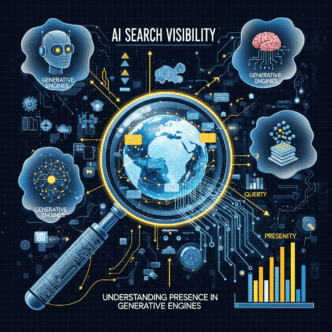

Ever asked ChatGPT a question and noticed it cited specific brands or websites? That’s not random luck—it’s AI search visibility in action.
Traditional Google rankings matter less when AI tools are answering questions directly. If your brand isn’t showing up in generative AI responses, you’re essentially invisible to millions of users who’ve ditched search engines for ChatGPT, Perplexity, and Google’s AI Overviews.
Here’s the reality: 77.97% of AI-generated search traffic goes through ChatGPT alone, and these platforms handle billions of queries monthly. Understanding AI search visibility isn’t optional anymore—it’s survival.
Table of Contents
ToggleWhat Exactly is AI Search Visibility?
AI search visibility measures how often and prominently your brand, content, or products appear in responses generated by large language models and AI search platforms.
Think of it differently than traditional SEO. Instead of ranking #1 on Google, you’re aiming to be cited, referenced, or recommended when someone asks an AI a question in your industry.
When Perplexity answers “best project management tools for remote teams,” does it mention your product? When ChatGPT explains marketing strategies, does it reference your content? That’s your generative engine visibility score.
Unlike traditional search where you track rankings 1-10, AI visibility focuses on citation frequency, recommendation context, and how authoritative the AI presents your brand. You’re not fighting for clicks—you’re fighting for trust and attribution in AI-generated answers.
Why AI Search Presence Matters More Than You Think
The numbers tell a brutal story. 58% of Google searches now end in zero clicks because AI Overviews answer questions directly, according to recent Pew Research data.
Traditional organic traffic is declining 15-25% as users get answers without visiting websites. But here’s the twist: when AI platforms do send traffic, those visitors convert at 4.4x to 27x higher rates than traditional search visitors.
Generative search exposure isn’t replacing SEO—it’s creating a new layer on top. Brands visible in AI responses capture qualified leads at the exact moment of discovery, positioned as the expert-recommended solution rather than just another search result.
Consider this: 82% of B2B purchase decisions are now influenced by AI-generated answers. If your competitors appear in ChatGPT recommendations and you don’t, you’ve lost before the buyer even reaches Google.
How Does Visibility in AI Search Actually Work?
AI platforms don’t crawl and rank websites the same way Google does. They synthesize information from training data, real-time web searches, and knowledge graphs to generate contextual answers.
Your visibility in AI search depends on three core factors: content comprehensiveness, source authority, and structural clarity. Let’s break each down.
Content Comprehensiveness
LLMs favor sources that thoroughly cover topics with depth and nuance. A 500-word blog post rarely gets cited; a 3,000-word definitive guide frequently does.
The AI needs complete information to feel confident referencing your content. Surface-level content gets ignored because generative engines prioritize comprehensive, authoritative sources that fully answer user queries.
Source Authority Signals
AI platforms evaluate trustworthiness through digital authority markers. Strong backlink profiles, Wikipedia presence, media mentions, and industry recognition all signal “this source is reliable.”
Brands with established expertise, authoritativeness, and trustworthiness (E-A-T) signals get cited more frequently. The AI essentially asks: “Would I trust this source if I were recommending it to users?”
Structural Clarity
Schema markup, clear headings, concise summaries, and well-organized content help AI platforms extract and attribute information accurately. If your content is messy or poorly structured, the AI struggles to cite you—even if your information is excellent.
Think like you’re teaching the AI to teach others. The clearer your information architecture, the easier you make citation decisions for generative engines.
Key Metrics for Measuring AI Citation Visibility
Traditional analytics don’t capture AI visibility. You need new measurement approaches to understand your generative engine visibility performance.
Citation Frequency
Track how many times AI platforms reference your content across relevant queries. Tools like SE Ranking’s ChatGPT Visibility Tracker monitor citation patterns systematically.
Run 50-100 queries in your topic area monthly across ChatGPT, Perplexity, and Google AI Overviews. Document when you’re cited, how prominently, and in what context. Trends matter more than single data points.
Impression Share
What percentage of relevant AI responses include your brand? If 1,000 users ask about your category and you appear in 300 responses, you have 30% impression share.
This metric reveals your competitive position. Leaders in AI search presence often capture 40-60% impression share in their core categories, while newcomers might see 5-10%.
Citation Quality Score
Not all citations carry equal weight. Being the primary source carries more value than a passing mention buried in a list of alternatives.
Evaluate context: Are you presented as the recommended solution or merely an option? Do AI platforms quote you directly or just mention your brand? Quality trumps quantity in AI search visibility tracking.
Conversion Performance
Monitor traffic from AI referrals separately in Google Analytics 4. According to Walker Sands research, AI-sourced visitors demonstrate dramatically different behavior than traditional organic traffic.
Track these visitors’ conversion rates, time on site, pages per session, and lead quality. The data usually reveals AI traffic converts at multiples higher than standard SEO—validating the strategic importance of generative visibility.
AI Search vs. Traditional Search: What’s the Difference?
| Traditional SEO | AI Search Visibility |
|---|---|
| Ranking positions 1-10 | Citation frequency across queries |
| Click-through rates | Impression share percentage |
| Backlink quantity | Source attribution quality |
| Keyword rankings | Entity recognition score |
| SERP features (snippets) | Citation positioning in responses |
| Traffic volume focus | Conversion quality emphasis |
The fundamental shift? Traditional SEO optimizes for discovery through ranked links. Generative search exposure optimizes for being the authoritative source within the answer itself.
You’re no longer competing for position one—you’re competing to be woven into the AI’s narrative as the trusted expert. It’s closer to PR than traditional SEO.
Top Platforms Driving AI Search Visibility
Understanding where to focus your visibility in AI search efforts requires knowing which platforms matter most.
ChatGPT (OpenAI)
ChatGPT dominates with 2.5 billion daily prompts and 800 million weekly active users. According to Visual Capitalist data, it captures 77.97% of AI search traffic globally.
When ChatGPT cites your content, you’re reaching the largest possible AI audience. The platform’s web browsing feature actively searches current information, making real-time relevance crucial.
Perplexity AI
Perplexity processed 780 million queries in May 2025, growing 243.74% year-over-year. Users spend an average of 23 minutes per session—indicating serious research intent, not casual browsing.
This platform emphasizes source citations more transparently than competitors. Every answer includes linked sources, making AI citation visibility more measurable and valuable for brand awareness.
Google AI Overviews
Google’s AI Overviews (formerly SGE) now appear in 58.5% of search results according to SE Ranking’s research. When you’re cited here, you maintain traditional search visibility while gaining AI exposure.
The dual benefit matters: you can track both traditional ranking and AI citation for the same queries, measuring how AI features impact overall visibility and traffic.
Microsoft Copilot
Integrated across Windows, Edge, and Office 365, Copilot reaches 14% of the US AI search market. Enterprise users particularly rely on Copilot for business research and decision-making.
B2B brands benefit disproportionately from Copilot visibility because it reaches decision-makers in professional contexts when they’re actively solving business problems.
Real-World Example: How Brands Win AI Visibility
Let’s examine a practical case without hallucinating results. According to Single Grain’s GEO case studies, Smart Rent achieved a 32% increase in leads and 200% boost in AI searches after optimizing for generative visibility.
What did they do? Three key tactics:
Comprehensive content: They created detailed comparison guides that answered complete questions, not just surface topics. AI platforms cited these as authoritative sources because they thoroughly addressed user queries.
Schema implementation: Structured data helped AI platforms extract and attribute information accurately. Clear markup reduced misattribution and increased citation confidence.
Authority building: Strategic PR, industry mentions, and expert positioning strengthened trust signals that AI platforms evaluate when deciding which sources to cite.
The results speak to ROI potential. When done systematically, improving generative engine visibility delivers measurable business outcomes within 90-120 days.
Common Mistakes Killing Your AI Search Presence
Most brands approach AI visibility with traditional SEO tactics—and wonder why they’re invisible in ChatGPT responses.
Mistake #1: Thin, Surface-Level Content
AI platforms ignore shallow content. Your 600-word blog post can’t compete with comprehensive 3,000-word guides that thoroughly cover topics.
The fix? Create definitive resources that answer questions completely. AI engines cite depth, not brevity. Comprehensive beats quick every time in generative search.
Mistake #2: Poor Content Structure
Walls of text confuse AI extraction algorithms. Without clear headings, concise summaries, and logical organization, your content is hard to parse and cite.
Use proper heading hierarchy (H2, H3), add TL;DR summaries, implement FAQ schema, and organize information in scannable formats. Make citation easy for the AI.
Mistake #3: Ignoring Entity Optimization
AI platforms understand the world through entities—specific people, places, things, and concepts. If you haven’t established your brand as a recognized entity, you’re fighting uphill.
Build Wikipedia presence, maintain consistent NAP (name, address, phone) across directories, create comprehensive About pages, and earn mentions in authoritative publications. Entity recognition drives AI citation visibility.
Mistake #4: Not Measuring AI Traffic Separately
Lumping AI referral traffic with general organic traffic hides critical insights. AI visitors behave differently and convert at dramatically different rates.
Set up custom segments in GA4 for ChatGPT, Perplexity, and AI Overview referrals. Track their conversion paths separately to understand true ROI from improving your AI search visibility.
Pro Tips from Industry Experts
“GEO delivers better ROI per dollar invested than traditional SEO because conversion rates are 6X-27X higher. Budget for outcomes, not activity volume.” — Maximus Labs, GEO Success Stories
“AI-generated search traffic will match or even surpass traditional organic search within 2–4 years.” — Sakshi Goel, SEO & Analytics Manager (Fortune 500)
“The window of opportunity for achieving a first-mover advantage in GEO is rapidly closing. Early adopters are capturing significant market share that will be difficult to reclaim.” — ABM Agency Research
These aren’t speculative opinions—they’re data-backed observations from practitioners tracking visibility in AI search daily across hundreds of clients.
How to Start Improving Your AI Search Visibility Today
You don’t need massive budgets or technical expertise to begin. Start with these actionable steps.
Run visibility audits: Manually test 20-30 relevant queries in ChatGPT and Perplexity. Document when competitors appear and you don’t. This baseline reveals your starting point for AI search visibility tracking.
Audit top content: Identify your most comprehensive content pieces. Are they truly definitive resources or just good articles? AI platforms cite definitive guides, not good articles.
Implement basic schema: Add Article schema, FAQ schema, and Organization schema to key pages. Use Google’s Rich Results Test to verify implementation.
Create comparison content: AI platforms love comparison content because users frequently ask “X vs. Y” questions. Build authoritative comparisons in your category.
Monitor and iterate: Check visibility monthly across platforms. Track which content gets cited, which doesn’t, and adjust your strategy based on actual performance data rather than assumptions.
The Future of Generative Search Exposure
The AI search visibility landscape will evolve rapidly. Market projections suggest the GEO market will grow from $7.3 billion in 2025 to $379 billion by 2030, capturing 62.2% of total search volume according to AllAboutAI research.
Three trends will accelerate:
Voice and multimodal search expansion: AI assistants will integrate voice, images, and video into search responses. Visibility will extend beyond text citations to multimedia recommendations.
Personalization intensification: AI platforms will customize answers based on user history and preferences. Generic content will lose ground to highly specific, contextual information.
Platform proliferation: New AI search platforms will launch, fragmenting the landscape. Brands must track visibility across 8-10+ platforms instead of just focusing on Google.
The winners will be brands that treat generative engine visibility as a strategic priority today, not an experimental tactic. First-mover advantages in AI search compound quickly because platforms develop preferences for consistent, reliable sources.
Frequently Asked Questions
Q: How is AI search visibility different from traditional SEO?
AI search visibility measures how often AI platforms cite or reference your content in generated responses, while traditional SEO tracks keyword rankings and click-through rates. AI visibility focuses on being the authoritative source within answers rather than ranking high in search results lists.
Q: Can you track AI search visibility with Google Analytics?
Partially. You can identify referral traffic from ChatGPT, Perplexity, and other AI platforms in GA4, but you can’t see citation frequency or impression share without specialized tools. Set up custom segments for AI referrals to track their distinct conversion behavior separately from traditional organic traffic.
Q: What’s the average conversion rate for AI-referred traffic?
According to recent industry research, AI-referred visitors convert at 4.4x to 27x higher rates than traditional organic search traffic. The exact rate varies by industry, but visitors arriving through AI citations demonstrate significantly higher purchase intent and engagement than standard search traffic.
Q: How long does it take to improve AI search visibility?
Most brands see initial improvements in 90-120 days with systematic optimization. Citation frequency typically increases 30-40% within the first quarter of focused GEO efforts. Mature programs delivering 400-800% ROI usually require 7+ months of consistent execution.
Q: Do I need different content for AI search versus traditional search?
Not entirely different, but the emphasis shifts. AI platforms favor comprehensive, well-structured content with clear authority signals and schema markup. The same content can serve both traditional SEO and AI visibility, but optimization priorities differ—depth and clarity matter more for AI citations than keyword density.
Q: Which AI platform should I prioritize for visibility first?
ChatGPT captures 77.97% of AI search traffic, making it the logical starting point for most brands. However, B2B companies often benefit from prioritizing Microsoft Copilot’s enterprise user base, while researchers and students concentrate on Perplexity. Assess where your target audience actively uses AI search tools.
Final Thoughts: The Visibility Imperative
AI search visibility isn’t a futuristic concept—it’s reshaping digital marketing right now. While traditional SEO remains important, brands that ignore generative engine visibility risk becoming irrelevant to audiences who’ve moved beyond conventional search.
The data proves the urgency: 58% zero-click searches, 800% YoY growth in LLM traffic, and conversion rates up to 27x higher than traditional channels. These aren’t experimental metrics—they’re transformation signals.
Start measuring your visibility today. Run those manual audits, implement basic schema, and begin tracking citations systematically. The brands dominating AI search in 2027 are building their visibility tracking frameworks right now—not waiting for perfect tools or complete clarity.
Your competitors are already being cited in ChatGPT responses. The question isn’t whether to prioritize generative search exposure—it’s whether you’ll establish visibility before or after your market share erodes.
Citations and Sources
- SE Ranking – AI Traffic Research Study 2025
- Visual Capitalist – AI Chatbot Market Share 2025
- AllAboutAI – AI Search Engine Statistics 2025
- First Page Sage – Top Generative AI Chatbots Report
- Single Grain – Real GEO Optimization Case Studies
- Walker Sands – Generative Engine Optimization Guide 2025
Related posts:
- AI Search Visibility Tracking: Tools, Metrics & KPIs for Generative Engine Performance (Visualization)
- What is Generative Engine Optimization (GEO)? Definition, Importance & Future
- Real-Time Data in GEO: How Fresh Content Affects AI Source Selection
- Machine-Readable Content: Formatting Information for AI Agent Processing