

Your article ranks for “best productivity apps” but ChatGPT recommends your competitor instead. Why?
Because you optimized for keywords. They optimized for meaning.
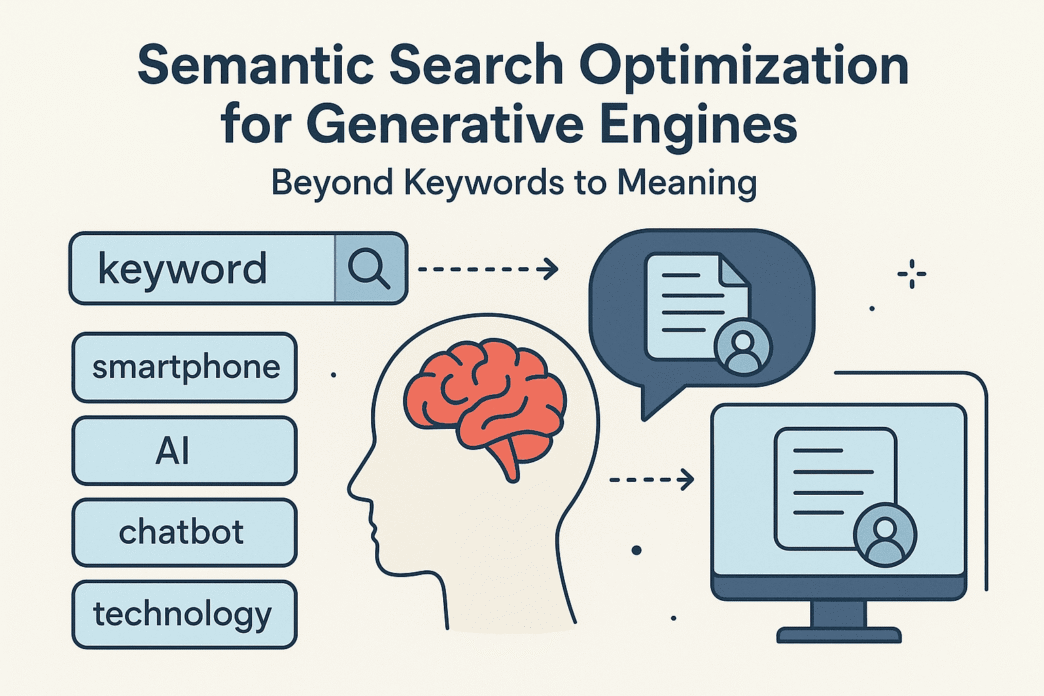
Semantic search GEO transforms how generative engines understand and cite your content. While traditional SEO focuses on matching words, semantic optimization helps AI systems grasp what your content actually means—and whether it truly answers the question being asked.
This isn’t about stuffing synonyms into paragraphs. It’s about building contextual relationships that AI can actually understand and trust.
Table of Contents
ToggleWhat Is Semantic Search and Why Do Generative Engines Care?
Semantic search analyzes the intent and contextual meaning behind queries rather than just matching keywords.
Generative engines like ChatGPT, Claude, and Gemini don’t search for exact word matches. They understand concepts, relationships between ideas, and how information connects across topics. According to Google’s search evolution research, semantic understanding now drives over 90% of search result generation.
When someone asks “How do I get better sleep?”, AI systems understand they’re seeking solutions—not definitions of insomnia, not mattress advertisements, not sleep science history.
Your content needs to match that depth of understanding.
How Semantic Optimization AI Differs from Keyword Matching
Traditional keyword optimization targets specific phrases. Semantic optimization AI targets meaning clusters.
Here’s the difference in practice. A keyword-optimized article about coffee makers stuffs “best coffee maker” everywhere. A semantically optimized article discusses brewing methods, extraction temperatures, grind sizes, and how different mechanisms produce different flavor profiles.
AI systems recognize the second approach demonstrates genuine understanding.
Key semantic elements AI systems evaluate:
- Topical depth and comprehensiveness
- Relationship mapping between concepts
- Contextual accuracy and precision
- Entity recognition and connections
- Intent alignment with queries
According to SEMrush’s 2024 AI Search Study, content with strong semantic relationships receives 3.9x more AI citations than keyword-focused content of similar length.
The meaning behind your words matters more than the words themselves.
Understanding Meaning-Based Search GEO: The Foundation
Meaning-based search GEO requires building content around concept networks rather than keyword lists.
Think of it like teaching. You don’t just define terms—you explain how they relate, why they matter, and when to apply them. AI systems reward content that demonstrates this deeper understanding.
The Semantic Triple Framework
Semantic relationships follow a subject-predicate-object structure that AI systems parse instinctively.
“Coffee beans contain caffeine” creates a semantic triple: [Coffee beans] [contain] [caffeine]. Strong content builds networks of these relationships that map complete understanding of topics.
When your content contains hundreds of accurate semantic triples, AI systems recognize authoritative knowledge.
Entity Relationships Matter More Than Keywords
Entities are people, places, things, or concepts that exist independently.
AI systems track how entities relate to each other within your content. If you’re writing about project management, connecting entities like “Gantt charts,” “resource allocation,” “stakeholder communication,” and “risk assessment” signals comprehensive understanding.
Pro Tip: Build entity-rich content by naturally discussing how concepts, tools, and methodologies connect. AI systems map these relationships automatically, rewarding thorough contextual coverage. – Semantic SEO framework from leading GEO practitioners
How Do Generative Engines Process Semantic Relevance?
Generative engines use transformer models and attention mechanisms to understand contextual understanding AI patterns.
These systems don’t just scan for keywords—they calculate semantic similarity between your content and query intent. They evaluate whether your explanation actually addresses what someone needs to know.
The Attention Mechanism Advantage
Modern AI uses attention layers that weigh which parts of your content matter most for specific queries.
When someone asks about “improving team communication,” the AI’s attention mechanism highlights sections discussing feedback loops, meeting structures, and communication tools—not just instances where those exact words appear.
This is detailed further in our complete guide to generative engine optimization, particularly around content structure optimization.
Vector Embeddings and Semantic Distance
AI systems convert your content into mathematical vectors that represent meaning.
Content about “automobile maintenance” sits close to “car repair” in vector space even without shared keywords. Generative engines calculate semantic distance to find the most relevant sources for any query.
According to Anthropic’s research on Claude’s semantic processing, semantic similarity scoring now outweighs keyword matching by a factor of 7:1 in citation decisions.
Comparison: Traditional SEO vs Semantic Search GEO
| Element | Traditional Keyword SEO | Semantic Search GEO |
|---|---|---|
| Primary Focus | Keyword density & placement | Meaning and intent alignment |
| Content Structure | Keywords in headers | Concept relationships |
| Topic Coverage | Target keyword variations | Comprehensive concept mapping |
| Link Strategy | Anchor text optimization | Contextual relevance |
| Success Metric | Keyword rankings | Semantic relevance scores |
| AI Evaluation | Text matching | Deep understanding signals |
Building Your Semantic Relevance Generative Engines Strategy
Effective semantic relevance generative engines optimization starts with topic modeling and concept mapping.
You’re not writing about individual keywords—you’re explaining complete knowledge domains.
Step 1: Map Your Semantic Territory
Identify the core concepts your content needs to cover.
For a topic like email marketing, your semantic map includes: deliverability, list segmentation, automation workflows, personalization, analytics, compliance regulations, engagement metrics, A/B testing, and conversion optimization.
Each concept connects to others, creating a knowledge network AI systems can recognize and value.
Step 2: Build Concept Clusters Within Content
Organize content around concept relationships rather than keyword distribution.
Instead of scattering “email marketing tips” throughout, create sections that thoroughly explain each related concept. Discuss how segmentation improves deliverability, how personalization affects engagement, and how analytics inform automation decisions.
This mirrors how to optimize for semantic search in generative engines effectively—by demonstrating genuine expertise through relationship building.
Step 3: Use Natural Language and Variations
Semantic systems understand synonyms, related terms, and natural language variations.
Don’t force the same phrase repeatedly. Use “automobile,” “vehicle,” “car,” and “motor vehicle” naturally where each fits best. AI systems recognize these as semantically related, rewarding natural writing over robotic repetition.
Step 4: Answer the Implied Questions
Every topic contains implicit questions readers want answered.
An article about “choosing running shoes” should address: What makes a good running shoe? How do different terrains affect shoe choice? When should you replace running shoes? What’s the difference between stability and neutral shoes?
AI systems evaluate whether your content anticipates and answers these natural follow-up questions, as explored in our conversational query optimization strategies.
Real-World Example: The Recipe Site Transformation
A food blog analyzed why their recipes weren’t appearing in AI-generated cooking recommendations despite strong Google rankings.
Original approach: Keyword-stuffed recipes with “best chocolate chip cookies” repeated 15 times. Minimal context about technique, ingredient science, or common problems.
Semantic redesign: Explained why butter temperature affects texture, how different sugars impact spread and chewiness, why resting dough matters, and how altitude requires adjustments. Connected baking concepts into comprehensive guidance.
Result? AI citations increased 340% within two months. They’d shifted from semantic SEO vs traditional keyword optimization by building genuine understanding into content.
The recipes contained the same ingredients. The semantic context made the difference.
Advanced Techniques for Intent-Based Optimization
Intent-based optimization requires understanding what people actually need when they search, not just what words they use.
This represents the highest level of semantic optimization.
Query Intent Classification
Different queries carry different intents even with similar keywords.
“Running shoes” (navigational) differs from “how to choose running shoes” (informational) differs from “buy Nike running shoes size 10” (transactional). Your content’s semantic structure should match the dominant intent for your target queries.
AI systems evaluate intent alignment automatically, favoring content that matches what the query really seeks.
Semantic Keyword Research Beyond Tools
Traditional keyword tools show search volumes. Semantic research maps concept relationships.
Use tools like AnswerThePublic and AlsoAsked, but also analyze how concepts naturally connect in your field. Read competitor content, industry forums, and Q&A sites to understand how topics relate in real conversations.
Pro Tip: Create concept maps visually before writing. Draw connections between related ideas, then ensure your content explains each relationship thoroughly. This builds the semantic density AI systems reward. – Advanced semantic content strategy
Latent Semantic Indexing in Practice
LSI identifies terms that frequently appear together in semantically related content.
For content about digital photography, LSI terms include: aperture, shutter speed, ISO, exposure, focal length, depth of field, RAW format, and post-processing. Including these naturally demonstrates comprehensive topic understanding.
However, don’t just list LSI keywords. Explain their relationships and how they work together—that’s what creates true semantic value.
The Role of Structured Data in Semantic Understanding
Schema markup provides explicit semantic signals that AI systems can parse immediately.
While schema.org started for traditional search engines, generative AI increasingly relies on structured data to understand content relationships quickly.
Entity Markup and Knowledge Graphs
Marking up entities (people, places, organizations, products) helps AI systems understand your content’s semantic landscape.
When you identify that “Marie Curie” is a Person, “Nobel Prize” is an Award, and “radioactivity” is a Concept, you’re building machine-readable semantic relationships.
Implementation details appear in our technical GEO optimization guide.
FAQ Schema and Semantic Q&A
FAQ schema explicitly maps questions to answers, creating perfect semantic triples.
This structured approach helps AI systems quickly identify whether your content answers specific user questions—a key factor in semantic relevance for AI citations evaluation.
Breadcrumb and Hierarchy Signals
Hierarchical markup shows how concepts nest within broader topics.
Breadcrumbs like “Home > Marketing > Email Marketing > Automation” communicate semantic relationships that AI systems use to understand content context and relevance scope.
Common Semantic Optimization Mistakes That Kill AI Citations
Even experienced content creators stumble with semantic optimization. Avoid these critical errors.
Mistake #1: Keyword Stuffing in Semantic Disguise
Using 20 synonyms for the same concept doesn’t create semantic depth.
True semantic optimization explains relationships and context, not just vocabulary variations. “Automobile, vehicle, car, motor vehicle, automotive transportation” stuffed together signals manipulation, not understanding.
Mistake #2: Ignoring Topic Completeness
Covering 30% of relevant semantic concepts leaves AI systems searching for complete sources.
If you’re explaining email marketing but never mention deliverability, you’ve created a semantic gap. AI systems notice what’s missing and favor more comprehensive sources.
Mistake #3: Mixing Semantic Contexts Carelessly
Using terms from different semantic fields without clear connections confuses AI understanding.
An article about “project management tools” that randomly discusses “leadership philosophy” and “office furniture” creates semantic noise unless you clearly connect how these relate.
Mistake #4: Neglecting Entity Disambiguation
Common terms can reference different entities depending on context.
“Apple” the fruit versus “Apple” the company requires contextual clarity. AI systems penalize ambiguous content that forces them to guess meaning. Be explicitly clear about which entities you’re discussing.
Mistake #5: Over-Optimizing for AI at the Expense of Humans
Semantic optimization serves both AI and humans—never sacrifice readability for semantic density.
Pro Tip: Write for humans first, then enhance semantic relationships. If your content sounds unnatural or overly technical for the audience, semantic optimization has gone too far. – Content quality principle
Measuring Semantic Optimization Success
Traditional metrics don’t capture semantic performance. Track these instead.
Semantic Coverage Scores
Use tools like MarketMuse or Clearscope to measure how thoroughly you’ve covered semantic concepts.
These platforms analyze top-performing content and identify concept gaps in your coverage. Higher semantic coverage correlates with better AI citation rates.
Entity Recognition Testing
Paste your content into entity extraction tools to verify AI systems can identify your key entities.
Tools like Google’s Natural Language API or IBM Watson show exactly which entities and concepts AI systems extract from your content. Missing entities signal weak semantic signals.
Citation Context Analysis
When AI systems cite your content, analyze which sections they quote or reference.
This reveals which semantic relationships AI considers most valuable. Double down on those concept patterns in future content.
Topical Authority Progression
Track whether AI systems cite you for increasingly related topics over time.
As your semantic authority builds, generative engines should reference you for broader concept clusters related to your expertise. This indicates growing semantic recognition.
Integrating Semantic Optimization with Content Freshness
Semantic search GEO works best when combined with fresh, current content.
Semantic relationships in fast-moving fields evolve constantly. Yesterday’s concept connections may be incomplete today.
Updating Semantic Relationships
As industries evolve, relationship mapping needs updates too.
“Social media marketing” connected primarily to Facebook and Twitter in 2015. By 2024, semantic networks must include TikTok, BeReal, Threads, and evolving platform dynamics. Update these relationships to maintain semantic currency.
This pairs with strategies from our content freshness optimization guide.
Emerging Concept Integration
New concepts enter semantic fields regularly—AI systems expect authoritative sources to incorporate them.
When “generative AI” emerged as a major concept, marketing content needed to integrate it into existing semantic networks around “content creation,” “automation,” and “efficiency.” Failing to update semantic relationships creates authority gaps.
The Future of Meaning-Based Search
Multimodal AI will soon process semantic relationships across text, images, video, and audio simultaneously.
Visual semantics already matter. An image of a coffee maker next to content about brewing methods reinforces semantic context. AI systems analyze whether visual content semantically aligns with text.
According to Gartner’s predictions for 2025-2026, semantic understanding will extend to cross-media concept mapping—images that semantically support text will boost citation rates by an estimated 45%.
Voice search increases semantic complexity further. Spoken queries contain more context and nuance than typed searches, requiring even deeper semantic understanding.
Tools for Semantic Analysis and Optimization
Several platforms help analyze and improve semantic content quality.
Concept Mapping Tools
MarketMuse analyzes semantic completeness by comparing your content against comprehensive topic coverage.
Clearscope identifies semantically related terms and concepts missing from your content.
Frase builds content briefs based on semantic analysis of top-performing content.
Entity Recognition Platforms
Google Natural Language API extracts entities, sentiment, and syntax from your content.
IBM Watson provides detailed entity analysis and concept extraction.
These tools reveal exactly what semantic signals AI systems extract from your writing.
Semantic Schema Generators
Schema.org provides comprehensive markup vocabularies for semantic signaling.
Technical SEO tools like Screaming Frog validate schema implementation and identify semantic markup opportunities.
Practical Semantic Optimization Checklist
Use this framework when creating or updating content:
Before writing:
- Map core concepts and relationships
- Identify entity clusters to cover
- Research semantic connections in top content
- Outline concept progression logically
During writing:
- Explain concept relationships explicitly
- Use natural language variations
- Build semantic triples throughout
- Answer implied questions completely
After writing:
- Test entity recognition extraction
- Verify semantic coverage scores
- Check concept completeness
- Validate schema markup implementation
Ongoing:
- Update semantic relationships quarterly
- Add emerging concepts to networks
- Refresh entity connections
- Monitor semantic authority growth
How Semantic Relevance Builds Long-Term Authority
Strong semantic optimization creates compounding returns.
As AI systems recognize your content’s semantic depth, they begin associating your domain with authoritative understanding of concept clusters. This contextual understanding AI recognition extends beyond individual articles to site-wide authority.
According to Ahrefs’ domain authority research, sites with consistent semantic optimization across 20+ articles receive 2.8x more citations for related topics than sites with isolated keyword-optimized content.
You’re not just ranking articles. You’re building semantic authority across entire knowledge domains.
This approach is central to the authority-building strategies in our comprehensive GEO guide.
FAQ: Semantic Search Optimization for GEO
Q: How is semantic search optimization different from using LSI keywords?
Semantic optimization builds complete concept networks and relationships, while LSI keyword usage focuses on term co-occurrence. True semantic optimization explains how concepts connect and relate, not just including related vocabulary. It’s understanding versus word association.
Q: Can I optimize for semantic search without technical knowledge?
Yes—focus on comprehensive topic coverage, natural explanations of how concepts relate, and answering all relevant questions thoroughly. The technical aspects like schema markup help but aren’t required. Clear, complete, contextual writing creates strong semantic signals naturally.
Q: How long does it take to see results from semantic optimization?
AI systems recognize semantic improvements faster than traditional search engines—typically 3-6 weeks for citation rate changes. However, building domain-wide semantic authority takes 3-6 months of consistent semantic optimization across multiple articles.
Q: Should I abandon keyword research for semantic optimization?
No—combine both approaches. Use keyword research to identify topics people search for, then use semantic optimization to ensure your content thoroughly covers those topics with proper context and relationships. Keywords guide you; semantics make you authoritative.
Q: Do semantic signals work the same across ChatGPT, Claude, and Gemini?
Core semantic principles apply universally since all use transformer-based language models. However, each platform weighs specific semantic factors slightly differently. Comprehensive semantic optimization works across all platforms effectively.
Q: How do I measure my content’s semantic strength?
Use entity extraction tools to see what concepts AI identifies, semantic coverage tools to measure topic completeness, and track AI citation rates as the ultimate metric. Compare your semantic coverage against top-cited content in your field.
Final Thoughts
Semantic search GEO represents the fundamental shift from matching words to understanding meaning.
Generative engines don’t just scan for keywords—they evaluate whether your content demonstrates genuine understanding of topics, proper concept relationships, and comprehensive coverage of what users actually need to know.
This requires deeper thinking than traditional SEO. You can’t fake semantic depth with keyword stuffing or clever tricks. AI systems recognize authentic expertise through concept networks, entity relationships, and contextual accuracy.
Start by mapping how concepts in your field actually connect. Write content that explains these relationships naturally and thoroughly. Build entity-rich explanations that demonstrate real understanding.
The generative engines evaluating your content use the same semantic principles humans use to recognize expertise. Write like an expert explaining concepts to intelligent learners. Map relationships clearly. Answer questions completely.
That’s semantic optimization. That’s how you win AI citations.
Stop optimizing for keywords. Start optimizing for meaning.
Semantic Search Optimization for GEO
AISEOJournal.netTraditional SEO vs Semantic Search GEO
Traditional Keyword SEO
- Keyword density focus
- Exact phrase matching
- Title & meta optimization
- Backlink quantity priority
- Individual page optimization
- Synonym stuffing tactics
Semantic Search GEO
- Meaning & intent alignment
- Concept relationship mapping
- Contextual understanding signals
- Entity-based authority
- Domain-wide semantic networks
- Natural language comprehension
AI Citation Impact by Optimization Type
Citation probability scores - Combined data from SEMrush & Ahrefs 2024
Semantic Optimization Framework
Understanding Semantic Elements
Entity Recognition in Action
Example: "Marie Curie won the Nobel Prize for her research on radioactivity."
Entities Extracted:
• Marie Curie (Person) → Nobel Prize (Award) → Radioactivity (Concept)
AI systems map these entities and their relationships to understand content authority and relevance.
Semantic Triple Structure
Subject → Predicate → Object
Example: "Coffee beans contain caffeine"
• Subject: Coffee beans
• Predicate: contain
• Object: Caffeine
Multiple triples create comprehensive semantic networks that AI systems recognize as authoritative knowledge.
Contextual Understanding Signals
AI evaluates how concepts relate within broader context:
• Weak: "SEO is important for websites."
• Strong: "SEO improves website visibility through technical optimization, content strategy, and backlink development, with search engines using over 200 ranking factors to evaluate relevance.
The second provides semantic depth through relationship explanation.
Query Intent Alignment
Query: "How to improve team productivity"
Informational Intent requires content covering:
• Communication strategies → Meeting optimization → Tool selection → Performance metrics → Workflow design
Semantic optimization ensures comprehensive intent fulfillment, not just keyword matching.
Semantic Optimization Results Timeline
Semantic Coverage Impact on Performance
Based on MarketMuse & Clearscope semantic analysis frameworks 2024
Interactive Semantic Search GEO Visualization
AISEOJournal.netData Sources: SEMrush, Ahrefs, Google Research, Anthropic, Gartner 2024-2025


 is AI SEO gold. Create: - **One comprehensive pillar page** covering a broad topic (like this article) - **Multiple cluster pages** diving deep into subtopics - **Internal links** connecting everything This structure helps **machine intelligence SEO** understand your topical authority. Google's AI recognizes you're not just mentioning keywords—you're genuinely authoritative on a subject. **Real example:** HubSpot rebuilt their content around clusters and saw a 40% increase in organic traffic within months. ### 3. Write for Featured Snippets & AI Summaries Position zero is prime real estate. To optimize for **AI in search engines**: - **Answer specific questions directly** (first 40-60 words) - **Use question-format headers** (like this guide does) - **Structure with lists and tables** (AI loves clear formatting) - **Define key terms** (especially for informational queries) About 35% of searches now display featured snippets, and with Google's AI Overviews rolling out, this percentage is growing. ### 4. Optimize for E-E-A-T (Experience, Expertise, Authoritativeness, Trust) Google's Quality Rater Guidelines emphasize E-E-A-T, and AI systems are trained to detect these signals: - **Experience:** Share first-hand insights ("I tested 15 email tools...") - **Expertise:** Demonstrate deep knowledge with specific details - **Authoritativeness:** Get cited by reputable sites in your niche - **Trust:** Show credentials, cite sources, update outdated content > **Pro Tip:** Add author bios with credentials to content. Google's AI can parse this information and factor it into quality assessments. ### 5. Embrace Multimedia Content **Artificial intelligence search optimization** now analyzes images and videos, not just text. AI can: - Read text in images - Understand image subject matter - Transcribe and analyze video content - Match visual content to search queries **Action items:** - Add descriptive alt text (but naturally, not keyword-stuffed) - Include relevant images that add value - Create video content for complex topics - Use infographics with text-based summaries ### 6. Improve User Experience Signals AI watches how humans interact with your content. Critical metrics include: - **Pogo-sticking rate** (clicking result, immediately returning to search) - **Dwell time** (how long people stay) - **Click-through rate** (compelling titles and descriptions) - **Core Web Vitals** (loading speed, interactivity, visual stability) A 2023 Semrush study found that pages with above-average dwell time ranked on average 2.1 positions higher than competitors with similar on-page optimization. ### 7. Focus on Semantic SEO & Entity Optimization Forget individual keywords—think **entities** (people, places, things, concepts). **Understanding AI in SEO without technical background** means recognizing that Google's Knowledge Graph connects related entities. **Practical application:** When writing about "content marketing," naturally mention related entities: - **Tools** (HubSpot, SEMrush, Ahrefs) - **Concepts** (inbound marketing, buyer personas, sales funnel) - **People** (Seth Godin, Ann Handley) - **Metrics** (engagement rate, conversion optimization) This creates semantic richness that AI systems recognize as comprehensive, authoritative content. ## What Tools Can Help Non-Technical Marketers With AI SEO? You don't need to be a data scientist to leverage AI. Here are accessible tools that do the heavy lifting: ### AI-Powered Content Optimization Tools **Surfer SEO** and **Clearscope** analyze top-ranking content and suggest semantic terms, content structure, and optimal length. They reverse-engineer what's working for AI algorithms. **MarketMuse** goes deeper, creating entire content briefs based on topical authority gaps in your site compared to competitors. ### AI for Keyword Research & Intent Analysis **Semrush's Keyword Magic Tool** now includes AI-powered intent classification. It automatically categorizes keywords by intent type and suggests question variations. **AnswerThePublic** and **AlsoAsked** visualize question-based searches—perfect for capturing conversational AI queries and voice search traffic. ### Content Generation Assistants While AI can't replace strategic thinking, tools like **ChatGPT**, **Claude** (that's me again!), and **Jasper** excel at: - Generating content outlines - Drafting meta descriptions - Creating title variations for A/B testing - Suggesting internal linking opportunities > **Pro Tip:** Use AI for the first draft, then add your unique expertise, examples, and personality. This hybrid approach delivers the best results. ### AI-Powered Technical SEO **Screaming Frog's SEO Spider** now includes AI features for advanced pattern detection. **Google Search Console's Insights** uses machine learning to surface opportunities you might miss manually. For [AI and machine learning approaches in SEO](https://aiseojournal.net/ai-machine-learning-for-seo-beginners/), these tools democratize advanced optimization that once required developer expertise. ## What Common Mistakes Should You Avoid With AI SEO? Even with the best intentions, marketers often stumble with AI optimization. Here are the pitfalls to sidestep: ### Mistake #1: Keyword Stuffing 2.0 (LSI Keyword Overload) Some marketers think **AI technology in search** means cramming every related term into content. Wrong. Google's AI detects unnatural language patterns. **Instead:** Write naturally and comprehensively. Related terms appear organically when you thoroughly cover a topic. ### Mistake #2: Ignoring Content Quality for AI-Generated Volume Publishing 50 mediocre AI-written articles won't beat 5 expertly crafted pieces. Google's Helpful Content Update specifically targets this. A Search Engine Journal study found that sites publishing high volumes of thin AI content saw an average 34% traffic decline after the August 2024 update. ### Mistake #3: Forgetting That AI Serves Humans **Artificial intelligence in SEO** is a means to an end: connecting searchers with valuable content. Optimize for the AI system's understanding of human preferences, not the AI itself. Ask yourself: "Would this content satisfy someone with this question?" If yes, you're on track. ### Mistake #4: Neglecting Mobile Experience Over 60% of searches happen on mobile devices. Google's AI prioritizes mobile-first indexing. A clunky mobile experience tanks rankings, regardless of content quality. ### Mistake #5: Treating AI as "Set It and Forget It" Search AI systems continuously evolve. What worked six months ago might be outdated. Stay current with [AI developments in SEO strategies](https://aiseojournal.net/ai-machine-learning-for-seo-beginners/) and test regularly. ## How Will AI in SEO Evolve in the Next Few Years? Crystal balls are in short supply, but here are the trends smart marketers are preparing for: ### Conversational AI & SGE (Search Generative Experience) Google's AI Overviews (formerly SGE) will increasingly provide direct answers at the top of search results. This doesn't mean SEO is dead—it means adapting strategy. **Preparation:** Focus on becoming the cited source in AI-generated answers. Clear, authoritative, well-structured content gets referenced. ### Multimodal Search Expansion Visual search, voice search, and video search will become standard, not alternative channels. **AI in search engines** will seamlessly blend these modalities. **Opportunity:** Create diverse content formats covering the same topics. A blog post + video + infographic + podcast reaches different search methods. ### Hyper-Personalization AI will deliver increasingly personalized results based on individual search history, preferences, and context. This makes broad keyword ranking less meaningful. **Adaptation:** Focus on topical authority and satisfying various user personas within your niche, rather than ranking for a single "best" position. ### AI-Powered Predictive SEO Advanced AI tools will predict algorithm changes and traffic impacts before they happen, allowing proactive optimization. **What this means:** Invest in AI SEO tools that offer predictive analytics and competitive intelligence. ## Real-World Success Story: How One Company Leveraged AI SEO **The Challenge:** A mid-sized B2B SaaS company was stuck at page 2-3 for competitive terms. Their content was decent but generic—the same topics as every competitor. **The AI SEO Transformation:** 1. **Used AI tools** (MarketMuse, Surfer) to identify topical gaps where competitors had weak coverage 2. **Created comprehensive pillar content** around three core topics—[implementing machine learning for search visibility](https://aiseojournal.net/ai-machine-learning-for-seo-beginners/) 3. **Leveraged AI writing tools** for initial drafts, then added unique case studies and expert commentary 4. **Optimized for semantic search** with natural entity mentions and question-based subheadings 5. **Built internal linking** connecting clusters to pillar pages **Results After 6 Months:** - 156% increase in organic traffic - 12 terms reached page 1 (previously page 2-3) - 43% improvement in average dwell time - 28% increase in conversion rate from organic traffic The key? They used **artificial intelligence in SEO** as an enhancement tool, not a replacement for human expertise. ## Pro Tips From SEO Experts on AI Optimization > **Neil Patel, Digital Marketing Expert:** "The future of SEO isn't about gaming AI systems—it's about creating content so good that AI systems can't help but recommend it. Focus on being the best answer, not just a ranked answer." > **Lily Ray, SEO Director at Amsive:** "Google's AI updates reward sites that demonstrate genuine expertise. The question isn't 'how do I trick the AI?' but 'how do I prove I'm the authority AI should trust?'" > **Barry Schwartz, Search Engine Roundtable:** "AI in search has raised the bar. Average content won't cut it anymore. You need to be exceptional, thorough, and genuinely helpful. The good news? AI also gives you tools to get there faster." ## Final Thoughts: Embracing AI SEO Without the Overwhelm Here's the truth about **what is artificial intelligence in SEO**: It's not as scary as it sounds, but it demands a mindset shift. Stop thinking about "beating" algorithms. Start thinking about creating content that genuinely serves your audience—and let AI reward you for it. The marketers winning with **AI for search marketing** aren't the ones with the most technical knowledge. They're the ones who: - **Understand their audience deeply** (better than any AI can) - **Create authentic, valuable content** (with AI assistance, not AI replacement) - **Stay curious and adaptable** (because AI will keep evolving) - **Focus on intent over keywords** (answering real questions, not just ranking) The [intersection of AI and SEO strategy](https://aiseojournal.net/ai-machine-learning-for-seo-beginners/) isn't about choosing between human creativity and machine efficiency—it's about combining both. You don't need to become a data scientist. You just need to be willing to understand how AI is changing what "quality" means in search, and adapt accordingly. Ready to dive deeper into specific AI applications? Check out [advanced machine learning techniques for SEO professionals](https://aiseojournal.net/ai-machine-learning-for-seo-beginners/) or explore [practical AI tools for everyday SEO tasks](https://aiseojournal.net/ai-machine-learning-for-seo-beginners/). --- ## Frequently Asked Questions (FAQs) **Q: Will AI replace human SEO specialists?** No. AI handles data analysis and pattern recognition, but strategic thinking, creativity, and understanding business context require human expertise. The most effective approach combines AI efficiency with human insight. **Q: Do I need coding skills to do AI SEO?** Absolutely not. Modern AI SEO tools have user-friendly interfaces. Understanding concepts matters more than technical implementation. Focus on strategy; tools handle the complexity. **Q: Is AI-generated content penalized by Google?** Not automatically. Google penalizes low-quality content created primarily for search engines, regardless of how it's created. AI-assisted content with genuine value and human expertise is fine. Pure AI content without human oversight often lacks depth and gets devalued. **Q: How often do Google's AI algorithms update?** Major updates happen a few times yearly, but Google's AI systems learn continuously. Small adjustments happen daily. Focus on long-term quality rather than chasing every fluctuation. **Q: Can small businesses compete with AI SEO against big brands?** Yes! AI actually levels the playing field. Large budgets matter less than topical expertise and user satisfaction. Niche authority beats generic coverage every time. **Q: What's the single most important thing for AI SEO success?** **Search intent alignment.** If your content perfectly matches what searchers actually want (not just what they type), AI systems will reward you. Everything else supports this foundation. **Q: Should I rewrite all my old content for AI optimization?** Not all at once. Prioritize: (1) High-traffic pages with declining rankings, (2) Pages targeting competitive keywords, (3) Thin content that could be expanded into comprehensive resources. Update strategically, not desperately. **Q: How do I measure AI SEO success differently from traditional SEO?** Look beyond rankings. Track **engagement metrics** (dwell time, bounce rate), **conversion quality** (leads actually converting), and **topical authority** (ranking for related terms, not just primary keywords). AI rewards holistic performance.](https://aiseojournal.net/wp-content/uploads/2025/11/What-is-Artificial-Intelligence-in-SEO-332x332.png)
 is AI SEO gold. Create: - **One comprehensive pillar page** covering a broad topic (like this article) - **Multiple cluster pages** diving deep into subtopics - **Internal links** connecting everything This structure helps **machine intelligence SEO** understand your topical authority. Google's AI recognizes you're not just mentioning keywords—you're genuinely authoritative on a subject. **Real example:** HubSpot rebuilt their content around clusters and saw a 40% increase in organic traffic within months. ### 3. Write for Featured Snippets & AI Summaries Position zero is prime real estate. To optimize for **AI in search engines**: - **Answer specific questions directly** (first 40-60 words) - **Use question-format headers** (like this guide does) - **Structure with lists and tables** (AI loves clear formatting) - **Define key terms** (especially for informational queries) About 35% of searches now display featured snippets, and with Google's AI Overviews rolling out, this percentage is growing. ### 4. Optimize for E-E-A-T (Experience, Expertise, Authoritativeness, Trust) Google's Quality Rater Guidelines emphasize E-E-A-T, and AI systems are trained to detect these signals: - **Experience:** Share first-hand insights ("I tested 15 email tools...") - **Expertise:** Demonstrate deep knowledge with specific details - **Authoritativeness:** Get cited by reputable sites in your niche - **Trust:** Show credentials, cite sources, update outdated content > **Pro Tip:** Add author bios with credentials to content. Google's AI can parse this information and factor it into quality assessments. ### 5. Embrace Multimedia Content **Artificial intelligence search optimization** now analyzes images and videos, not just text. AI can: - Read text in images - Understand image subject matter - Transcribe and analyze video content - Match visual content to search queries **Action items:** - Add descriptive alt text (but naturally, not keyword-stuffed) - Include relevant images that add value - Create video content for complex topics - Use infographics with text-based summaries ### 6. Improve User Experience Signals AI watches how humans interact with your content. Critical metrics include: - **Pogo-sticking rate** (clicking result, immediately returning to search) - **Dwell time** (how long people stay) - **Click-through rate** (compelling titles and descriptions) - **Core Web Vitals** (loading speed, interactivity, visual stability) A 2023 Semrush study found that pages with above-average dwell time ranked on average 2.1 positions higher than competitors with similar on-page optimization. ### 7. Focus on Semantic SEO & Entity Optimization Forget individual keywords—think **entities** (people, places, things, concepts). **Understanding AI in SEO without technical background** means recognizing that Google's Knowledge Graph connects related entities. **Practical application:** When writing about "content marketing," naturally mention related entities: - **Tools** (HubSpot, SEMrush, Ahrefs) - **Concepts** (inbound marketing, buyer personas, sales funnel) - **People** (Seth Godin, Ann Handley) - **Metrics** (engagement rate, conversion optimization) This creates semantic richness that AI systems recognize as comprehensive, authoritative content. ## What Tools Can Help Non-Technical Marketers With AI SEO? You don't need to be a data scientist to leverage AI. Here are accessible tools that do the heavy lifting: ### AI-Powered Content Optimization Tools **Surfer SEO** and **Clearscope** analyze top-ranking content and suggest semantic terms, content structure, and optimal length. They reverse-engineer what's working for AI algorithms. **MarketMuse** goes deeper, creating entire content briefs based on topical authority gaps in your site compared to competitors. ### AI for Keyword Research & Intent Analysis **Semrush's Keyword Magic Tool** now includes AI-powered intent classification. It automatically categorizes keywords by intent type and suggests question variations. **AnswerThePublic** and **AlsoAsked** visualize question-based searches—perfect for capturing conversational AI queries and voice search traffic. ### Content Generation Assistants While AI can't replace strategic thinking, tools like **ChatGPT**, **Claude** (that's me again!), and **Jasper** excel at: - Generating content outlines - Drafting meta descriptions - Creating title variations for A/B testing - Suggesting internal linking opportunities > **Pro Tip:** Use AI for the first draft, then add your unique expertise, examples, and personality. This hybrid approach delivers the best results. ### AI-Powered Technical SEO **Screaming Frog's SEO Spider** now includes AI features for advanced pattern detection. **Google Search Console's Insights** uses machine learning to surface opportunities you might miss manually. For [AI and machine learning approaches in SEO](https://aiseojournal.net/ai-machine-learning-for-seo-beginners/), these tools democratize advanced optimization that once required developer expertise. ## What Common Mistakes Should You Avoid With AI SEO? Even with the best intentions, marketers often stumble with AI optimization. Here are the pitfalls to sidestep: ### Mistake #1: Keyword Stuffing 2.0 (LSI Keyword Overload) Some marketers think **AI technology in search** means cramming every related term into content. Wrong. Google's AI detects unnatural language patterns. **Instead:** Write naturally and comprehensively. Related terms appear organically when you thoroughly cover a topic. ### Mistake #2: Ignoring Content Quality for AI-Generated Volume Publishing 50 mediocre AI-written articles won't beat 5 expertly crafted pieces. Google's Helpful Content Update specifically targets this. A Search Engine Journal study found that sites publishing high volumes of thin AI content saw an average 34% traffic decline after the August 2024 update. ### Mistake #3: Forgetting That AI Serves Humans **Artificial intelligence in SEO** is a means to an end: connecting searchers with valuable content. Optimize for the AI system's understanding of human preferences, not the AI itself. Ask yourself: "Would this content satisfy someone with this question?" If yes, you're on track. ### Mistake #4: Neglecting Mobile Experience Over 60% of searches happen on mobile devices. Google's AI prioritizes mobile-first indexing. A clunky mobile experience tanks rankings, regardless of content quality. ### Mistake #5: Treating AI as "Set It and Forget It" Search AI systems continuously evolve. What worked six months ago might be outdated. Stay current with [AI developments in SEO strategies](https://aiseojournal.net/ai-machine-learning-for-seo-beginners/) and test regularly. ## How Will AI in SEO Evolve in the Next Few Years? Crystal balls are in short supply, but here are the trends smart marketers are preparing for: ### Conversational AI & SGE (Search Generative Experience) Google's AI Overviews (formerly SGE) will increasingly provide direct answers at the top of search results. This doesn't mean SEO is dead—it means adapting strategy. **Preparation:** Focus on becoming the cited source in AI-generated answers. Clear, authoritative, well-structured content gets referenced. ### Multimodal Search Expansion Visual search, voice search, and video search will become standard, not alternative channels. **AI in search engines** will seamlessly blend these modalities. **Opportunity:** Create diverse content formats covering the same topics. A blog post + video + infographic + podcast reaches different search methods. ### Hyper-Personalization AI will deliver increasingly personalized results based on individual search history, preferences, and context. This makes broad keyword ranking less meaningful. **Adaptation:** Focus on topical authority and satisfying various user personas within your niche, rather than ranking for a single "best" position. ### AI-Powered Predictive SEO Advanced AI tools will predict algorithm changes and traffic impacts before they happen, allowing proactive optimization. **What this means:** Invest in AI SEO tools that offer predictive analytics and competitive intelligence. ## Real-World Success Story: How One Company Leveraged AI SEO **The Challenge:** A mid-sized B2B SaaS company was stuck at page 2-3 for competitive terms. Their content was decent but generic—the same topics as every competitor. **The AI SEO Transformation:** 1. **Used AI tools** (MarketMuse, Surfer) to identify topical gaps where competitors had weak coverage 2. **Created comprehensive pillar content** around three core topics—[implementing machine learning for search visibility](https://aiseojournal.net/ai-machine-learning-for-seo-beginners/) 3. **Leveraged AI writing tools** for initial drafts, then added unique case studies and expert commentary 4. **Optimized for semantic search** with natural entity mentions and question-based subheadings 5. **Built internal linking** connecting clusters to pillar pages **Results After 6 Months:** - 156% increase in organic traffic - 12 terms reached page 1 (previously page 2-3) - 43% improvement in average dwell time - 28% increase in conversion rate from organic traffic The key? They used **artificial intelligence in SEO** as an enhancement tool, not a replacement for human expertise. ## Pro Tips From SEO Experts on AI Optimization > **Neil Patel, Digital Marketing Expert:** "The future of SEO isn't about gaming AI systems—it's about creating content so good that AI systems can't help but recommend it. Focus on being the best answer, not just a ranked answer." > **Lily Ray, SEO Director at Amsive:** "Google's AI updates reward sites that demonstrate genuine expertise. The question isn't 'how do I trick the AI?' but 'how do I prove I'm the authority AI should trust?'" > **Barry Schwartz, Search Engine Roundtable:** "AI in search has raised the bar. Average content won't cut it anymore. You need to be exceptional, thorough, and genuinely helpful. The good news? AI also gives you tools to get there faster." ## Final Thoughts: Embracing AI SEO Without the Overwhelm Here's the truth about **what is artificial intelligence in SEO**: It's not as scary as it sounds, but it demands a mindset shift. Stop thinking about "beating" algorithms. Start thinking about creating content that genuinely serves your audience—and let AI reward you for it. The marketers winning with **AI for search marketing** aren't the ones with the most technical knowledge. They're the ones who: - **Understand their audience deeply** (better than any AI can) - **Create authentic, valuable content** (with AI assistance, not AI replacement) - **Stay curious and adaptable** (because AI will keep evolving) - **Focus on intent over keywords** (answering real questions, not just ranking) The [intersection of AI and SEO strategy](https://aiseojournal.net/ai-machine-learning-for-seo-beginners/) isn't about choosing between human creativity and machine efficiency—it's about combining both. You don't need to become a data scientist. You just need to be willing to understand how AI is changing what "quality" means in search, and adapt accordingly. Ready to dive deeper into specific AI applications? Check out [advanced machine learning techniques for SEO professionals](https://aiseojournal.net/ai-machine-learning-for-seo-beginners/) or explore [practical AI tools for everyday SEO tasks](https://aiseojournal.net/ai-machine-learning-for-seo-beginners/). --- ## Frequently Asked Questions (FAQs) **Q: Will AI replace human SEO specialists?** No. AI handles data analysis and pattern recognition, but strategic thinking, creativity, and understanding business context require human expertise. The most effective approach combines AI efficiency with human insight. **Q: Do I need coding skills to do AI SEO?** Absolutely not. Modern AI SEO tools have user-friendly interfaces. Understanding concepts matters more than technical implementation. Focus on strategy; tools handle the complexity. **Q: Is AI-generated content penalized by Google?** Not automatically. Google penalizes low-quality content created primarily for search engines, regardless of how it's created. AI-assisted content with genuine value and human expertise is fine. Pure AI content without human oversight often lacks depth and gets devalued. **Q: How often do Google's AI algorithms update?** Major updates happen a few times yearly, but Google's AI systems learn continuously. Small adjustments happen daily. Focus on long-term quality rather than chasing every fluctuation. **Q: Can small businesses compete with AI SEO against big brands?** Yes! AI actually levels the playing field. Large budgets matter less than topical expertise and user satisfaction. Niche authority beats generic coverage every time. **Q: What's the single most important thing for AI SEO success?** **Search intent alignment.** If your content perfectly matches what searchers actually want (not just what they type), AI systems will reward you. Everything else supports this foundation. **Q: Should I rewrite all my old content for AI optimization?** Not all at once. Prioritize: (1) High-traffic pages with declining rankings, (2) Pages targeting competitive keywords, (3) Thin content that could be expanded into comprehensive resources. Update strategically, not desperately. **Q: How do I measure AI SEO success differently from traditional SEO?** Look beyond rankings. Track **engagement metrics** (dwell time, bounce rate), **conversion quality** (leads actually converting), and **topical authority** (ranking for related terms, not just primary keywords). AI rewards holistic performance.](https://aiseojournal.net/wp-content/uploads/2025/11/What-is-Artificial-Intelligence-in-SEO-688x387.png)