

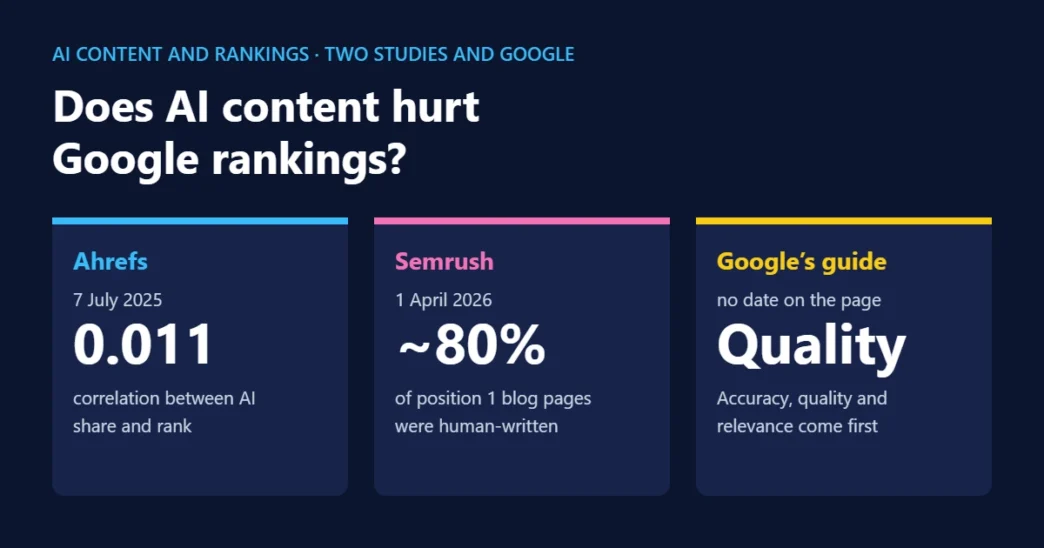
On 1 April 2026, Semrush published a study of 42,000 blog pages from Google’s top 10. It found human-written pages at position 1 about 80% of the time, against about 9 to 10% for AI-generated pages [2]. It landed nine months after an Ahrefs study of 600,000 pages found almost no link between a page’s AI share and its rank [1]. The two look like they disagree. Both are correlations, they measure different things, and Google’s own guide cares about accuracy and added value [3]. This page lays the evidence out in date order. For a practical follow-up, see our guide to AI content briefs.
What / Who / When
| Item | Detail |
|---|---|
| What | A study of 42,000 blog pages found human-written pages lead at position 1. An earlier Ahrefs study found almost no link between AI share and rank. |
| Who | Semrush (Margarita Loktionova) and Ahrefs (Si Quan Ong). Google's guide gives the policy side. |
| When | Ahrefs on 7 July 2025. Semrush on 1 April 2026, with data from November 2025. |
Editor’s note, 10 November 2026: this page replaces an earlier news item with a longer, checked read of the evidence. We opened each source on 10 November 2026.
Table of Contents
ToggleDoes AI content hurt Google rankings?
The data does not show that AI use alone hurts rankings. It does show that human-written blog pages lead at position 1 in one large sample. Neither study proves cause, and we found no Google statement that AI-written pages rank worse for being AI-written.
The evidence in date order
Read the workflow as text
- 7 July 2025, Ahrefs: about 600,000 pages from the top 20. 86.5% had some AI. Correlation between AI share and position: 0.011.
- 1 April 2026, Semrush: 42,000 blog pages from the top 10. At position 1, about 80% were human-written and about 9 to 10% AI-generated.
- Google's guide, undated on the page: many AI pages with no added value may break the scaled content abuse policy. Fact-check before you publish.
- 10 November 2026: we opened all three sources. Both studies find a link, not a cause.
7 July 2025: the Ahrefs study
Ahrefs took 100,000 random keywords and listed the top 20 results for each. That gave about 600,000 pages. It scored each page with its own AI content detector [1].
- 4.6% of pages were pure AI, 13.5% pure human and 81.9% a mix.
- So 86.5% held some AI content. That is Ahrefs’ own sum: 100% minus the pure-human share.
- The correlation between AI share and ranking position was 0.011.
- Pages at position 1 tended to have slightly less AI content. Ahrefs calls this a very weak link.
How to read 0.011. A correlation runs from -1 to 1. Near zero means that a page’s AI share tells you almost nothing about where it ranks. It does not say AI pages are better. Ahrefs also notes that no AI detector is perfect [1].
1 April 2026: the Semrush study
Semrush collected the top 10 Google results for 20,000 keywords in November 2025. That was 200,000 URLs. It kept only URLs containing “/blog/”, which left 42,000 pages. It then classified each page with GPTZero as human-written, AI-generated or mixed [2].
- At position 1, human-written pages appeared about 80% of the time and AI-generated pages about 9 to 10%.
- Human-written content led across all top 10 positions. From position 5 on, the gap was relatively narrow.
- Semrush also surveyed 224 SEO professionals. Of those who use AI content, 72% said AI-assisted content ranks as well as or better than human-written content. Thirteen per cent said worse.
Worth knowing
Semrush gives the position 1 split as 80% against 9% in its introduction, and 80.5% against 10% in a later section. We use the ranges "about 80%" and "about 9 to 10%".
The article does not state the detector’s accuracy. It does not discuss cause, and it limits the sample to blog URLs.
Google’s guide, undated on the page
Google’s guide says generative AI can help with researching a topic and adding structure to original content [3].
- Scaled content abuse. Using AI to generate many pages without adding value for users may break Google’s spam policy.
- Accuracy. Models predict likely word sequences rather than retrieve facts, so output can be wrong. A manual fact-check before publishing is “critical”.
- Metadata. Review titles, meta descriptions, structured data and image alt text too.
- Raters. The guide points to sections 4.6.5 and 4.6.6 of the Search Quality Rater Guidelines. It says rater ratings do not directly influence ranking.
The page does not use the term E-E-A-T.
Compare the two studies
Switch between the two studies, or show them together, to see how they differ.
| Point | Ahrefs, 2025 | Semrush, 2026 |
|---|---|---|
| Sample | About 600,000 pages: the top 20 for 100,000 keywords. | 42,000 blog URLs: the top 10 for 20,000 keywords. |
| Detector | Ahrefs' own AI content detector. | GPTZero. |
| Question asked | Does a page's AI share track its position? | Which content type is likelier at each position? |
| Main result | Correlation 0.011. 86.5% of pages had some AI content. | Position 1: about 80% human-written, about 9 to 10% AI-generated. |
| Limits the article states | No AI detector is perfect. It names no crawl window and does not discuss cause. | Detector accuracy not stated. Correlational. Blog URLs only. |
Watch out
Both studies are correlational. Neither shows why a page ranks first. A page may rank first because of its links, its brand or its depth, and also be human-written.
What we found on our own site
From our own site
On 9 November 2026 we scanned all 569 published posts on this site. 193 had no link to an outside source. Only 21% had a first-hand box and 29% had an interactive tool.
Method: a script read every live page and counted outside links and page widgets. Limit: it counts links. It cannot tell whether a source backs the claim.
So the risk Google describes is not abstract here. We are fixing the lowest-scoring posts first.
What to do with this
| If you... | Risk, going by Google's guide | Do this |
|---|---|---|
| Use AI for research or an outline, then write and edit by hand | Low. Matches the use Google names. | Check each fact against a source you opened. |
| Publish an AI draft after an expert edits and adds data | Moderate. Depends on what you added. | Add one thing the top results lack. Review the metadata. |
| Generate many near-identical pages from a template | High. Scaled content abuse. | Do not. Publish fewer, better pages. |
| Publish an unchecked draft with statistics | High. Models can state wrong facts. | Remove or source every number before it goes live. |
Frequently asked questions
Does Google penalise AI-written content?
We found no Google statement that pages rank worse for being AI-written. Google’s guide warns about scaled content abuse and about inaccurate output.
Did the Ahrefs study prove AI content is safe?
No. It found a correlation of 0.011 between AI share and position. That is a weak link, not proof of cause.
Why do human-written pages lead at position 1 in the Semrush data?
Semrush says the finding is correlational. We cannot say why. Links, brand and depth may all play a part.
Should I disclose that I used AI?
Google’s guide says explaining how content was made can help readers, where it suits your audience. It does not make it a rule for every page.
Check each fact, add what the top results lack, then publish
Decide on the page, not the tool. Check each fact, add something the top results lack, review the metadata, and publish fewer, better pages.
Sources
- Ahrefs, "AI-Generated Content Does Not Hurt Your Google Rankings (600,000 Pages Analyzed)", Si Quan Ong, 7 July 2025. Read on 10 November 2026.
- Semrush, "Does AI content rank well in search?", Margarita Loktionova, 1 April 2026. Read on 10 November 2026.
- Google Search Central, "Google Search's guidance on using generative AI content on your website". Read on 10 November 2026.