

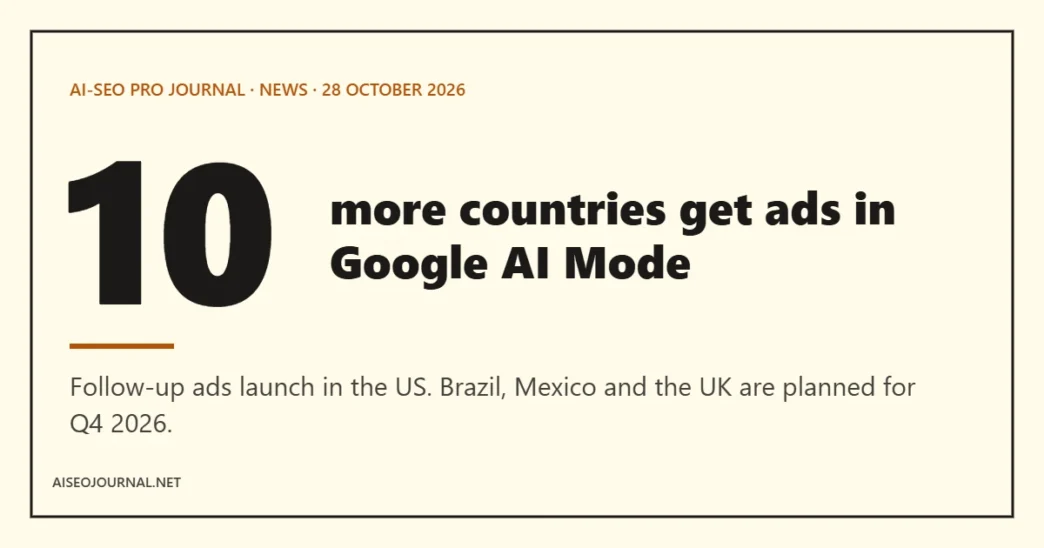
Yes, Google is putting more ads into AI Mode. On 28 October 2026 it said ads in AI Mode are scaling to ten more countries. It also said follow-up ads are launching in the US [1]. The ads are labelled “Sponsored” [1].
This matters if you run Google Ads, and it matters if you rely on organic traffic. Here is what Google said, what its help page now adds, and what you can do about it.
Updated 17 November 2026: we added how Google matches ads to AI answers and what “AI explainers” are. We also added a short timeline and the country list as it stands today. Google’s help page has moved to a new address.
The announcement at a glance
| Question | Answer |
|---|---|
| What | Ads in AI Mode scale to ten more countries. Follow-up (multiturn) ads launch in the US [1] |
| Who | Advertisers running Search, Shopping or Performance Max campaigns [2] |
| When | Announced 28 October 2026. Brazil, Mexico and the UK are planned for Q4 2026 [1] |
| Status on 17 November 2026 | The UK, Brazil and Mexico are not yet on Google’s list of countries [2] |
| Can you opt out? | No. Advertisers cannot opt out of AI Mode separately from Search [2] |
Table of Contents
ToggleWhat did Google announce?
Shashi Thakur published the post on 28 October 2026 [1]. He is VP and GM of Google Search Ads and Ads on Google Experiences. The post makes two points:
- Ads in AI Mode are now scaling to more countries.
- Multiturn ads are launching in the US. These let an ad appear in a follow-up question, not just in the first answer.
Google gave no date for the US rollout of follow-up ads. It also named no new ad formats in this post. It said only that it will keep testing them [1].
Expert quote: “people are comfortable with ads in AI Mode and find them highly relevant” — Shashi Thakur, VP and GM, Google Search Ads and Ads on Google Experiences, Google [1]
That line is Google’s own reading of its research. The post does not publish the research itself, and we found no independent data on how people react to these ads yet.
How did ads in AI Mode get here?
This is the third step since May 2025. Here is the sequence, using Google’s own posts:
- 21 May 2025. Google said it was starting to test ads in AI Mode. Where relevant, ads could appear below and inside AI Mode answers [4].
- 20 May 2026. Google said it was testing two new ad formats in AI Mode, built with Gemini: Conversational Discovery ads and Highlighted Answers [5].
- 28 October 2026. Ads in AI Mode scale to ten more countries, and multiturn ads launch in the US [1].
- Q4 2026 (planned). Brazil, Mexico and the United Kingdom are next, with no exact date [1].
Each step widened where ads appear. None of them changed the basic rule: existing campaigns take part through the normal auction [2].
Which countries get ads in AI Mode?
Google’s post names ten countries where ads are scaling now: Australia, Canada, India, Kenya, Malaysia, New Zealand, Nigeria, Pakistan, the Philippines and Singapore [1]. In Q4 2026 it plans to add more places, including Brazil, Mexico and the United Kingdom [1].
The Google Ads help page gives a slightly longer list. It covers the US plus the countries above, and it adds Indonesia. Two limits apply: Indonesia gets ads in AI Overviews only, and Pakistan gets text ads only. The language is English [2].
One more detail is easy to miss. Ads above or below an AI Overview are a different placement. Google says those can show in all 200+ countries and territories where AI Overviews are available, in all their languages [2].
Watch out: The help page and the blog post do not list identical countries. When we checked on 17 November 2026, the UK was still not on the help page list. Check it for your market before you plan around it. Google can change it at any time.
How does Google decide which ad to show?
The help page now explains two kinds of matching [2]:
- Direct query matching. The search already shows clear buying intent, such as “pool vacuum cleaners”. Google matches ads to the query, as on a normal results page.
- Contextual matching. The question is broader, such as how to clean a green pool. Google matches ads to both the question and the AI answer, for example a vacuum or an algae treatment kit.
Your targeting decides which of the two you can win. This table sums up the help page:
| Targeting | Direct query matching | Contextual matching |
|---|---|---|
| AI Max for Search campaigns | Yes | Yes |
| Broad match on Search | Yes | Yes |
| Shopping campaigns | Yes | Yes |
| Performance Max | Yes | Yes |
| Exact and phrase match | Yes, when the query shows direct buying intent | No |
Source: Google Ads Help, checked 17 November 2026 [2].
What are AI explainers?
Some ads in AI Overviews and AI Mode now come with an “AI explainer”. Google describes it as short, independent text written by its Gemini models. It explains how an ad, or a group of ads, relates to what the person asked [2].
The explainer can draw on the person’s query, the AI answer and public sources, including your website. It is not part of your headline or description. Google says advertisers cannot write, edit, approve or opt out of it [2].
The two formats Google started testing in May 2026 both use this idea. Conversational Discovery ads answer a person’s specific question. Highlighted Answers can place an ad inside a list of recommendations in AI Mode [5].
Can advertisers opt out?
No. Existing Search, Shopping and Performance Max campaigns can serve in AI Mode through the normal auction. You need no new campaign and no separate budget [2].
You also cannot aim only at AI Mode, and you cannot turn it off on its own. What you can still use: negative keywords, brand exclusions and asset pinning [2]. Results are folded into your normal campaign and search terms reports. There is no separate AI Mode report [2].
Billing works the same way as other Search ads. Google says the same auction and cost-per-click or conversion-based bidding apply, with no extra charge. Your ad can show above an AI Overview and inside it on the same search. It cannot show inside it and directly below it [2].
Text ads and Shopping ads can appear. Google says it is also testing local inventory ads and vehicle ads [2].
What do Google’s click numbers mean?
Google shared two figures in the post [1]:
- AI Mode queries are on average three times longer than traditional searches. The source is Google’s own AI Mode Report for the US, from May 2026.
- Click-through rates are “already similar” between sponsored and organic product list items in AI Mode. The source is Google internal data from the US, 20 August to 3 September 2026.
Treat both as Google’s claims. We could not check the data behind them. The click-through figure is also about product listings only, not every kind of ad.
Our analysis: what could go wrong
This section is our own judgement, based on the sources above.
Exact-match accounts may see less of AI Mode. The help page says exact and phrase match cannot win contextual placements [2]. Those are the longer, exploratory questions that Google says are common in AI Mode [2]. An account built mostly on exact match may simply not show there.
Your website now feeds your ad. AI explainers can use public sources, including your site [2]. If a product page is out of date, the explainer may repeat the old facts. You cannot edit the explainer, so the page is the only thing you control.
Measurement stays blurred. AI Mode results sit inside your normal reports [2]. So you can see that long queries convert, but not cleanly whether they came from AI Mode.
What should advertisers do?
- Check your market. Look at the help page list for your country and language.
- Decide on match types on purpose. If you want contextual placements, you need broad match, AI Max, Shopping or Performance Max [2]. If you want tight control, accept that exact match will show less.
- Review your negative keywords and brand exclusions. They are your main controls.
- Keep your site and product data accurate. Explainers can draw on your website, and Shopping ads draw on your Merchant Center feed [2].
- Watch your search terms report. It is the only place these queries show up.
Quick check: Open your search terms report and look for long, question-style queries. If you see them, AI Mode may already be a source. Google does not label it for you.
What does it mean for SEOs and publishers?
The announcement is about paid ads. Google’s help page says paid ads do not influence the organic answers in AI Overviews and AI Mode. It also says being cited organically does not affect your ad eligibility [2].
What changes is the space around organic results. More ads in the answer can mean fewer clicks for pages that sit below. That is our judgement, not a figure Google has published.
So keep two things in view. First, track AI Mode and AI Overviews traffic in Search Console, where Google reports it inside the “Web” search type [3]. Second, work on being cited, not only ranked. Our Google AI Overviews guide covers how.
From our own site: We checked Search Console on 17 November 2026. We looked at the queries that earned aiseojournal.net impressions over the last three months. There were 116. They averaged 3.5 words: 81 had one to three words, 22 had four to six and 13 had seven or more. Limit: Search Console counts AI Mode inside the “Web” search type [3], so we cannot tell which queries came from it. We run no ads, so we have no ad data.
What we still don’t know
- The UK date. Google says Q4 2026 and nothing more precise [1].
- Multiturn ads outside the US. Google has only announced them for the US [1].
- The new Gemini formats. Conversational Discovery ads and Highlighted Answers were announced as tests in May 2026 [5]. We found no date for a wider launch.
- A separate AI Mode report. Google’s help page lists none [2].
Frequently asked questions
Are ads in AI Mode live in the UK?
Not yet, as far as Google’s own pages show. Google says it plans to expand to the UK, Brazil and Mexico in Q4 2026. On 17 November 2026 the UK was not yet on its help page list.
Can I turn off my ads in AI Mode?
No. Google says advertisers cannot opt out of AI Overviews or AI Mode separately from Search. You can use negative keywords and brand exclusions to limit when ads show.
What are multiturn ads?
They are ads that can appear in follow-up questions inside an AI Mode conversation. Google says they are launching in the US. It gave no exact date.
Do ads change what Google's AI says?
Google says no. Its help page says organic AI Overviews and AI Mode answers are generated independently, and buying ads does not influence them.
Why are my exact match keywords not showing in AI Mode?
Exact and phrase match can serve when a query shows direct buying intent. Google says they are not eligible for contextual matching on broader questions.
Where to go next
If organic traffic is your main concern, start with our guide to Google AI Overviews. To measure how often AI answers mention your site, read our guide to AI search visibility tracking.
Sources
How we checked this: we opened every source below on 17 November 2026. Google’s figures come from Google, and we could not check the data behind them. We found no independent study of ads in AI Mode to compare.
- Google — Ads in AI Mode expand to new markets, Shashi Thakur, 28 October 2026
- Google Ads Help — About ads in AI-powered experiences in Google Search (checked 17 November 2026)
- Google Search Central — AI features and your website
- Google — More opportunities for your business on Google Search, 21 May 2025
- Google — A new generation of ads for the AI era of Search, 20 May 2026