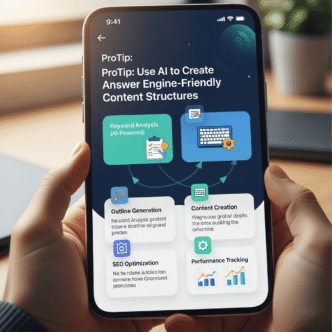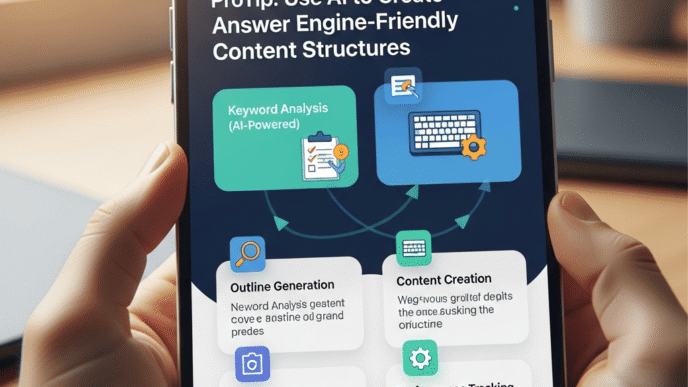



ProTip: Use AI to Create Answer Engine-Friendly Content Structures
Master the future of search optimization. Learn how to leverage AI tools to create content structures that answer engines love to cite and reference.
Table of Contents
ToggleThe Answer Engine Revolution is Here
Sources: Microsoft, SEO.com, Gartner, Acquia, Pew Research Center (2025)
The Shift from SEO to AEO
If SEO focused on driving clicks, AEO is focused on driving clarity with enriched, real-time data. Only 32% of enterprise marketers feel confident diagnosing when their brand disappears from an AI answer block.
Essential Answer Engine-Friendly Content Structures
AI engines look for specific content formats that are concise, sound like answers, contain data, and frontload important details. Here are the proven structures that maximize citation rates:
FAQ Format
Q&A structures perform exceptionally well because they match conversational query patterns.
- Direct question-based headers
- Concise 2-3 sentence answers
- FAQ schema markup implementation
- One focused question per section
- Natural language phrasing
Definition Blocks
Clear, encyclopedic definitions that AI can extract and cite as authoritative sources.
- "What is..." header format
- 40-60 word paragraphs
- Self-contained explanations
- Avoid jargon in core definition
- Include context and examples
Step-by-Step Guides
Procedural content that AI engines can parse and present as actionable instructions.
- Numbered sequential steps
- Action-oriented language
- How-To schema markup
- 120-180 words per section
- Clear headings for each step
Comparative Lists
Comparison content shows 32.5% citation rate - highest among all formats.
- Side-by-side feature comparisons
- Pros and cons lists
- Data-driven comparisons
- Table format when possible
- Objective evaluation criteria
Summary Sections
Quick overviews that AI can extract for instant answers without full article reading.
- TL;DR at the beginning
- Key takeaways section
- Bullet point summaries
- Main points upfront
- 2-3 sentence distillation
Data-Rich Content
Content with 19+ statistical data points averages 5.4 citations vs 2.8 without.
- Specific statistics and metrics
- Cited data from .edu/.gov
- Expert quotes with credentials
- Original research findings
- Verifiable data points
AI Tools for Creating AEO-Optimized Content
Leverage these AI-powered tools to structure, optimize, and test your content for maximum answer engine visibility:
5-Step AI-Powered AEO Implementation
Research Current AI Answers
Before creating content, understand how AI engines currently answer questions in your domain. This reveals gaps and opportunities.
Prompt for ChatGPT/Claude:"Analyze how AI answer engines currently respond to these questions:
1. [Your target question 1]
2. [Your target question 2]
3. [Your target question 3]For each, identify:
- What sources are cited
- What information is missing
- How the answer is structured
- Data points included"
Key Actions: Query your target keywords in Perplexity, ChatGPT, and Google AI Overviews. Document citation patterns, content gaps, and answer formats that dominate your niche.
Generate FAQ Content Structures
Use AI to create comprehensive FAQ sections based on real user queries and conversational search patterns.
Prompt for Content Generation:"Create a comprehensive FAQ section for [your topic].Requirements:
- 10-15 questions in natural language
- 2-3 sentence answers per question
- Include specific data points where possible
- Structure for FAQ schema markup
- Use conversational 'how', 'what', 'why' phrasing
- Ensure each answer can stand alone"
Optimization Tip: AI-generated FAQs should be reviewed by human experts, enriched with proprietary data, and updated with recent statistics to establish authority.
Restructure Content for AI Parsing
Transform existing content into AI-friendly formats with clear hierarchy, optimal paragraph lengths, and self-contained sections.
Restructuring Prompt:"Restructure this content for answer engine optimization:[Paste your content]Requirements:
- Add clear H2/H3 headers that mirror search queries
- Break into 40-60 word paragraphs
- Lead each section with direct answers
- Create self-contained sections
- Add a 'Key Takeaways' summary at top
- Include 5-7 verifiable data points"
Focus Areas: Ensure 120-180 words between headings, include expert quotes, add comparative elements, and frontload conclusions in each section.
Generate Schema Markup
Implement structured data to make content machine-readable. Pages with FAQ schema are more likely to appear in AI search experiences.
Schema Generation Prompt:"Generate FAQ schema markup for these questions:[List your FAQ questions and answers]Format: JSON-LD
Requirements: Follow schema.org standards
Include: Question, answer, author if applicable"
Implementation: Use schema types including FAQPage, HowTo, Article, and Organization. Validate with Google's Rich Results Test before deployment.
Test and Iterate Based on Citations
Monitor how AI engines respond after publishing. Most LLM citations occur within 2-3 days of publishing, representing up to 2% of niche citations initially.
Testing Protocol:Week 1: Search target queries in ChatGPT, Perplexity, Gemini
Week 2: Check for citations using AEO tracking tools
Week 4: Analyze referral traffic from AI platforms
Monthly: Update content with fresh data and statisticsCitation decay: 2% → 0.5% over 1-2 months
Action: Regular updates maintain visibility
Tracking: Monitor perplexity.ai and chat.openai.com referrals in Google Analytics. Use tools like Profound or HubSpot AEO Grader for comprehensive citation tracking.
AEO Best Practices for Maximum Citations
Lead with direct answers in the first paragraph. Opening paragraphs that answer queries upfront get cited 67% more often.
Write in natural, question-based phrasing that matches how people speak to AI assistants, not keyword-stuffed SEO copy.
Pages with expert quotes average 4.1 citations vs 2.4 without. Add author schema for expert contributors.
Pages updated within 3 months average 6 citations vs 3.6 for outdated content. Add "Last Updated" dates prominently.
Write concise, standalone statements that AI can extract without editing. These become citation magnets.
Use descriptive, query-aligned URL slugs. AI models scan URLs to determine relevance for citation decisions.
Establish presence on Wikidata, Wikipedia (if notable), and 4+ third-party platforms for 2.8x citation likelihood.
40-60% monthly citation drift means ongoing optimization is required. AEO is not a one-time implementation.
AEO Impact Metrics & Performance Indicators
Sources: Amsive, Digital Bloom, Acquia, BrightEdge (2025)
The AEO Imperative
Gartner predicts classic web-search traffic will drop 25% by 2026 as users shift to conversational answers. Brands that delay AEO implementation face increasingly expensive catch-up requirements as competitors establish authoritative positions in AI training data.
Content Optimization Checklist
- ☐ Create FAQ sections with natural language questions
- ☐ Add definition blocks with "What is..." headers
- ☐ Structure paragraphs at 40-60 words for AI extraction
- ☐ Include 19+ verifiable data points per article
- ☐ Implement FAQ, How-To, and Article schema markup
- ☐ Add expert quotes with credential attribution
- ☐ Create comparative lists and side-by-side comparisons
- ☐ Lead sections with direct answers upfront
- ☐ Use 120-180 words between H2/H3 headings
- ☐ Add "Key Takeaways" or summary sections
- ☐ Optimize for 8th-11th grade reading level
- ☐ Update content within 3 months with fresh data
Your strategic partner for AI search optimization and answer engine visibility.
© 2025 All rights reserved. Data from Gartner, Microsoft, Acquia, Pew Research, eMarketer, and industry research.