


The debate over site silos vs topic clusters is often framed as discipline versus flexibility. The operational problem is deciding which page owns a subject, which page supports it and when a cross-topic link helps a reader.
Google does not prescribe an SEO silo model. It advises logical organisation, crawlable links and connections to relevant resources. Choose an architecture your team can maintain without isolated pages, competing hubs or indiscriminate link networks.
This page-level comparison complements the broader internal linking strategy guide.
Table of Contents
ToggleWhat Is an Internal-Linking Architecture?
An internal-linking architecture defines how pages relate through links. It is not identical to a menu, folder structure or URL pattern. The editorial relationships matter here:
which page acts as the main reference for a topic;
which supporting pages answer narrower questions;
which pages may connect across topics;
which destination should receive a link when several pages appear relevant; and
who decides when an existing relationship should change.
Google uses links to discover pages and as a relevance signal. It recommends descriptive anchors and contextual internal links that clarify the destination, without requiring a named architecture model.
Taxonomy and linking architecture perform different jobs. A taxonomy labels content groups; contextual links connect related reader tasks. A page can carry one primary category while linking to a useful resource elsewhere.
The SEO Silo Model
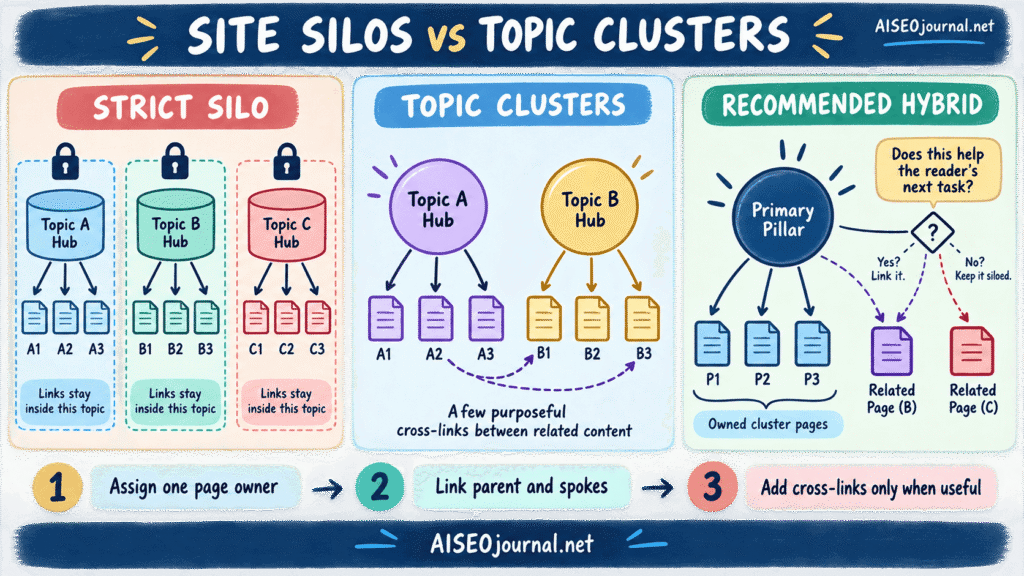
An SEO silo groups closely related pages beneath a defined topical section. The strict version concentrates links within that section and limits links to other sections. Each page normally has one clear topical home.
flowchart TD
    A["Silo hub: Email marketing"] --> B["Email strategy"]
    A --> C["Email deliverability"]
    B --> D["Campaign planning"]
    C --> E["Sender reputation"]
The appeal is control. Editors can see which hub owns each page, and restrained linking may prevent unrelated recommendations. This works best where subjects and reader journeys remain stable.
The weakness appears when a useful page crosses a boundary. An email-analytics article may support both an email hub and an analytics hub. A strict rule can hide one relationship, prompt duplication or require an exception.
Strict isolation can conflict with user needs. If a reader needs consent guidance before applying an email tactic, withholding that cross-link fragments the journey.
When a silo-like model fits
A restrained, silo-like pattern may suit:
a compact site with distinct services and little topical overlap;
a controlled knowledge base where each article has one accountable owner;
a catalogue whose sections represent separate product families; or
a regulated publishing process that needs explicit review boundaries.
Even in these cases, the useful principle is clear ownership, not absolute isolation. Cross-links should remain available when they resolve a real reader need.
The Topic-Cluster Model
A topic cluster has a broad hub or pillar page supported by narrower spoke pages. The pillar organises the cluster; each spoke handles a distinct question or task. The pages link where the relationship helps readers move between overview and detail.
flowchart TD
    P["Pillar: Internal linking"] --> S1["Anchor text"]
    P --> S2["Link equity"]
    P --> S3["Architecture"]
    S1 -. "related task" .-> S3
    S2 -. "supporting concept" .-> S3
This model is more flexible than a strict silo. A spoke normally has one primary pillar, but it can link to another cluster when the destination advances the current task. The links form a connected editorial graph instead of a set of sealed compartments.
Flexibility does not mean every cluster page should link to every other page. A complete mesh creates noise and maintenance work. The hub should expose the main routes; spokes should link where the destination resolves a question, supplies evidence or enables the next action.
For example, this architecture article belongs to the internal-linking pillar. It can still point to a focused guide on writing descriptive internal anchor text because the wording and surrounding sentence determine whether an architectural relationship is clear to readers.
Site Silos vs Topic Clusters: Direct Comparison
| Decision area | Strict silo | Topic cluster | Practical interpretation |
|---|---|---|---|
| Primary organising unit | Self-contained topical section | Pillar with focused spokes | Both need an identifiable subject owner |
| Cross-topic links | Restricted or exceptional | Allowed when context supports them | Judge the reader task, not the category boundary alone |
| Page membership | Usually one silo | One primary cluster, with secondary relationships | Record one owner and permit relevant connections |
| Editorial control | High | Moderate to high | Written rules matter more than the label |
| Adaptability | Lower when topics overlap | Higher as the content library grows | Clusters fit changing editorial programmes better |
| Main failure mode | Useful pages become isolated | Links proliferate without purpose | Audit both reachability and relevance |
| Best fit | Stable, distinct subject areas | Interconnected knowledge and content hubs | Many sites benefit from a hybrid |
Neither structure produces rankings by itself. Google says logical organisation can help users and search engines understand page relationships, while existing sites may not need wholesale reorganisation. Architecture aids comprehension and maintenance; it is not a ranking guarantee.
Page Ownership Comes Before Cross-Linking
The hardest architectural question is not “May these pages link?” It is “Which page owns the main intent?” Without an answer, teams create overlapping pillars, assign the same spoke to several hubs or use internal links to compensate for duplicated content.
A page-ownership record can remain short:
| Page role | Owns | Links primarily to | Example |
|---|---|---|---|
| Pillar or hub | Broad subject and orientation | Its core spokes and selected adjacent hubs | Internal Linking Strategy |
| Spoke | One focused question or task | Parent pillar and relevant supporting pages | Internal Anchor Text and Link Context |
| Reference | Reusable definition, data or tool | Pages that apply the reference | Anchor-text checklist |
| Conversion page | A service, product or action | Evidence and guidance that support the decision | SEO audit service |
Assign one primary owner for each target intent. Secondary relevance does not require secondary ownership. An email-analytics article may belong to the email cluster while linking to an analytics glossary. The primary owner governs updates, canonical intent and its place in the editorial map; contextual links express useful relationships beyond that map.
This distinction also prevents two hubs from competing to summarise the same material. One may own the subject, while the other provides a concise explanation and links to the owner for depth.
Can One Page Belong to Two Topic Clusters?
A page can support two clusters, but it should normally have one primary role. “Belong” can mean three different things:
Editorial ownership: the team responsible for accuracy and updates.
Taxonomy membership: the category or label applied in the CMS.
Link relevance: the hubs and articles from which the page deserves a contextual link.
These do not need to match perfectly. One editorial owner keeps accountability clear. Several relevant pages may link to the article if each link serves its surrounding reader task.
Trouble begins when two pillars target the same broad query, repeat the same explanation and both claim the page as a core spoke. Resolve that conflict by selecting one canonical owner, narrowing the other pillar’s scope and rewriting links so their destinations are unambiguous.
When Should Topic Clusters Link Together?
Two clusters should connect when the destination supplies something the current cluster cannot cover without drifting from its purpose. Before adding a cross-link, test it against five criteria.
1. The reader has a plausible next task
The destination should answer a question raised by the current passage. A cross-link from internal-link architecture to anchor-text guidance is plausible because readers must label the connections they design.
2. The destination is the recognised owner
Choose the page that most directly owns the destination intent. Do not link to a broad hub if a focused guide resolves the question better, and do not distribute near-identical anchors among competing pages.
3. The surrounding sentence explains the relationship
Google advises writers to make anchor text descriptive, concise and relevant, and notes that the words around a link provide context. The sentence should tell the reader why the destination belongs at that point. The internal anchor-text guide gives a focused method for writing that cue.
4. The link adds information, evidence or action
A link earns its place if it expands a definition, provides proof, enables a task or moves the reader to a suitable next stage. Shared keywords alone are weak justification.
5. The relationship can be maintained
Links create editorial dependencies. If a destination changes role, sources may need new wording or a replacement URL. Prefer intentional links over a graph no one reviews.
Google says there is no magical ideal number of links on a page. Count is therefore a quality-control signal, not a target. Review whether each link remains distinguishable, useful and supported by its context.
Cross-Links That Clarify or Weaken Architecture
| Situation | Link? | Reason |
|---|---|---|
| A spoke refers to the broader process explained by its parent pillar | Yes | Restores orientation and offers wider context |
| A page introduces a specialist term owned by another cluster | Usually | Avoids duplicating a full explanation |
| Two hubs serve consecutive stages of one user journey | Yes, selectively | Helps readers move between related tasks |
| Two pages share a keyword but answer different audiences | Only with a stated need | Lexical overlap is not enough |
| A template inserts links to every post in a category | Review or remove | Category membership does not prove contextual value |
| Two pillars compete for the same intent | Fix ownership first | More links will not resolve duplication |
| A spoke links to every other spoke | No default rule | Full interlinking creates noise and maintenance cost |
Architecture weakens when a link contradicts the page map. Suppose a beginner guide repeatedly sends readers to three competing “complete” guides. The links fail to identify the authoritative destination. By contrast, one broad pillar can direct the reader to distinct spokes for definitions, implementation and analysis.
For link-equity questions, keep architecture decisions separate from numerical modelling. The companion guide to internal PageRank analysis examines how links change a site graph. This article focuses on why a relationship should exist and which page should own it.
A Decision Framework for Choosing the Model
Use the following sequence before naming your architecture.
Step 1: Map page roles
List pillars, spokes, references and conversion pages. Give each important intent one owner. If ownership is disputed, settle scope before drawing links.
Step 2: Trace real user journeys
Identify the questions readers ask before and after each page. Journeys often cross departmental or category boundaries. Record those transitions as candidate cross-links.
Step 3: Measure topical overlap
If topics rarely overlap and remain stable, a silo-like pattern may be easy to govern. If readers combine concepts across a growing knowledge base, connected clusters are more realistic.
Step 4: Set a cross-link rule
A usable rule might read: “A page may link outside its primary cluster when the destination owns a concept, evidence source or next action required by the current passage.” This is clearer than either “never cross-link” or “link anything related.”
Step 5: Choose the least complicated workable structure
Choose a silo-like structure when boundaries are stable, ownership is strict and cross-topic journeys are uncommon.
Choose topic clusters when a pillar-and-spoke publishing model fits the content and useful journeys regularly cross topics.
Choose a hybrid when you need primary topical ownership with controlled contextual cross-links. This is often the workable choice for an editorial site.
Step 6: Review relationships, not link totals
Check whether every important page receives at least one crawlable internal link, as Google recommends. Then inspect whether the source, anchor and destination form a coherent statement. A graph can be dense yet confusing, or sparse yet clear.
Implementation Examples
Editorial SEO publication
An SEO publication gives each pillar a defined hub and each cluster article one primary parent. An architecture guide links to anchor-text or PageRank analysis only where those concepts become necessary: cluster ownership with selective cross-links.
B2B software knowledge base
A knowledge base separates administration, reporting and integrations. Most links remain within each area; a reporting article crosses to integrations when the user must connect a data source. This resembles silos with task-based exceptions.
Ecommerce learning centre
A buying guide belongs to a product hub, while one materials reference serves several product families. The reference has a primary owner and receives contextual links from multiple hubs.
Across all three examples, the deciding factor is not a diagram shape. It is whether editors can explain each page’s role and each cross-link’s purpose.
Questions People Ask
What is an SEO silo?
An SEO silo is a group of closely related pages organised beneath a topical section, usually with most internal links kept inside that group. It is an industry architecture model, not a structure required by Google.
How does a topic cluster differ from a content silo?
A topic cluster centres on a pillar page and supporting spokes, with contextual links permitted across clusters when they help the reader. A strict silo places more emphasis on section boundaries and limits cross-topic links.
Does Google require websites to use silos?
No. Google recommends logical site organisation, crawlable links and relevant internal connections. Its published guidance does not require an architecture called a silo.
Can one page belong to two topic clusters?
It can support more than one cluster, but assigning one primary owner usually prevents overlap and unclear maintenance responsibility. Other clusters can link to it when it supplies a relevant concept or next step.
Should topic clusters link to each other?
Yes, when the destination advances a plausible reader task and clearly owns the information being referenced. Clusters should not be fully interlinked by default.
Choose Ownership First, Then Permit Useful Connections
Site silos offer strong boundaries; topic clusters offer adaptable relationships. Most content-led sites need elements of both: one primary owner for each page, an identifiable hub-and-spoke structure and controlled cross-links that follow genuine reader journeys.
Do not isolate a useful resource to preserve a theoretical silo. Do not connect every related page to manufacture a cluster. Define the job of each page, link to the recognised owner and make the relationship clear in the sentence around the anchor.