



Your title tag says “10 Best Running Shoes for 2025.” So does everyone else’s.
You rank on page one. Your competitors rank on page one. But they’re getting 8% click-through rates while you’re stuck at 2.3%. Same keywords, same positions, wildly different traffic.
The difference? They understand title tag optimization isn’t just about pleasing algorithms—it’s about hacking human psychology.
According to Backlinko’s analysis of 5 million Google search results, the #1 organic result gets a 27.6% click-through rate on average. But titles using emotional triggers can boost that by 20-40%. That’s the difference between 1,000 visitors and 1,400 from the same ranking position.
SEO title writing is where search engine requirements collide with human decision-making. Master both, and you don’t just rank—you dominate the clicks.
Table of Contents
ToggleWhat Makes Someone Click Your Title Instead of the Next One?
Imagine standing in a bookstore aisle. Fifty books on the same topic stare back at you. Which one do you pull off the shelf?
The one with the most intriguing title. The one that promises a solution, sparks curiosity, or triggers an emotion you’re already feeling.
Search results work exactly the same way. Users scan titles in 0.2 seconds per result (according to Nielsen Norman Group eye-tracking research). In that microsecond, your title either hooks them or they scroll past.
The Neuroscience Behind Clickable Titles
Our brains are pattern-recognition machines hunting for:
- Relevance: Does this solve my exact problem?
- Credibility: Can I trust this source?
- Value: What will I gain by clicking?
- Emotion: Does this trigger curiosity, fear, hope, or urgency?
Headline optimization that ignores these triggers leaves traffic on the table—even when you rank first.
Pro Tip: Open incognito mode and Google your target keyword. Study the top 10 titles. If yours blends in, you’re losing clicks to more psychologically optimized competitors.
The Core Elements of High-CTR Title Tags
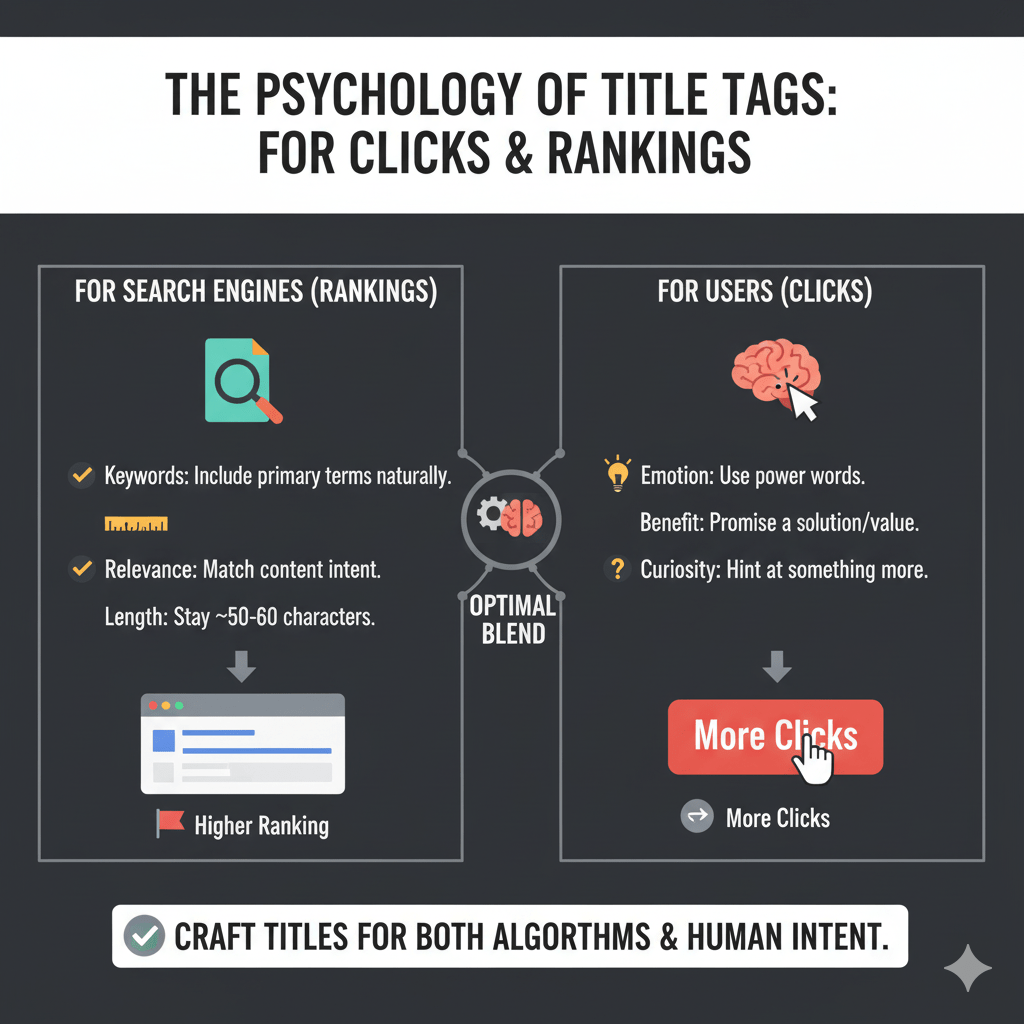
Great title tags balance two masters: search engines and humans. Here’s the formula.
1. Front-Load Your Primary Keyword
Google bolds matching keywords in search results. Bolded text = instant attention magnet.
Weak: “Learn About Optimization Techniques for Your Meta Titles
Strong: “Title Tag Optimization: 7 Psychological Triggers That Double Clicks”
The second example puts title tag optimization front and center, immediately signaling relevance.
Research from Moz’s title tag study shows titles with keywords in the first 65 characters perform 15-20% better in CTR than back-loaded alternatives.
2. Create a Curiosity Gap (Without Clickbait)
Curiosity gaps work because human brains hate incomplete information. We click to close the loop.
Generic: “How to Write Good Title Tags”
Curiosity-driven: “The Title Tag Formula 94% of SEOs Get Wrong”
The second creates a knowledge gap: What are 94% missing? The brain demands closure.
But here’s the line: curiosity gaps must deliver on the promise. Clickbait (“You Won’t Believe…”) triggers clicks but also immediate bounces—which tanks rankings.
3. Use Power Words That Trigger Emotion
Certain words light up our limbic system like a Christmas tree. They bypass logic and trigger instant emotional responses.
Emotional triggers for different intents:
- Urgency: Now, Today, Fast, Instant, Limited
- Fear/Loss Aversion: Avoid, Mistake, Warning, Risk, Danger
- Achievement: Proven, Guaranteed, Results, Success, Ultimate
- Curiosity: Secret, Hidden, Revealed, Exposed, Truth
- Authority: Expert, Professional, Science-Backed, Research
Before: “Guide to Writing Better Titles”
After: “The Proven Title Tag Formula That Doubled Our Organic Traffic”
The second uses “Proven” (authority) and specific results (credibility) to trigger trust and desire.
According to CoSchedule’s headline analysis of 1 million articles, headlines with power words get 13.9% higher CTRs than neutral alternatives.
4. Add Numbers and Specificity
Our pattern-seeking brains love concrete information. Specificity signals substance over fluff.
Vague: “Tips for Better Title Tags”
Specific: “7 Title Tag Formulas That Increased CTR by 34%”
Numbers work because they:
- Promise quick scanning (listicles are digestible)
- Suggest comprehensive coverage
- Imply research-backed content
- Stand out visually in search results
Odd numbers (7, 9, 13) perform slightly better than even numbers—probably because they feel less manufactured.
5. Match Search Intent Perfectly
If someone searches “how to write title tags,” they want a tutorial. If they search “best title tag examples,” they want inspiration.
Mismatched intent kills CTR even when you rank well.
For informational queries: Use “How to,” “Guide,” “What is,” “Why”
For commercial queries: Use “Best,” “Top,” “Review,” “vs,” “Comparison”
For transactional queries: Use “Buy,” “Price,” “Discount,” “Deal,” “Order”
Learn more about aligning content with search intent in our guide to mastering on-page SEO elements.
Title Tag Formulas That Psychologically Outperform
Stop reinventing the wheel. These battle-tested formulas work because they tap into universal psychological triggers.
Formula 1: The Number + Adjective + Keyword + Promise
Pattern: [Number] [Adjective] [Keyword] to [Desired Outcome]
Example: “7 Proven Title Tag Strategies to Double Your Click-Through Rate
Why it works: Combines specificity (7), authority (proven), relevance (title tag strategies), and outcome (double CTR).
Formula 2: The “How to” with Specificity
Pattern: How to [Achieve Specific Result] Without [Common Pain Point]
Example: “How to Write Title Tags That Rank Without Keyword Stuffing”
Why it works: Addresses the goal AND preemptively solves a common objection.
Formula 3: The Mistake/Warning Angle
Pattern: [Number] [Keyword] Mistakes That [Negative Outcome]
Example: “5 Title Tag Mistakes Killing Your Organic Traffic”
Why it works: Fear of loss is more motivating than potential gain (loss aversion bias). Users click to avoid the mistake.
Formula 4: The Ultimate Authority Piece
Pattern: The Ultimate Guide to [Keyword]: [Specific Promise]
Example: “The Ultimate Guide to Title Tag Optimization: From Psychology to Ranking
Why it works: “Ultimate” signals comprehensive coverage. Users know they’ll get everything in one place.
Formula 5: The Case Study/Proof Format
Pattern: How [We/I/They] [Achieved Result] with [Method]
Example: “How We Increased CTR by 127% Using Psychological Title Triggers”
Why it works: Specific results + social proof + replicable method = instant credibility.
The Character Count Sweet Spot (And Why It Matters)
Google displays approximately 50-60 characters of title tags on desktop, 50-55 on mobile before cutting off with “…”
But here’s the psychological twist: truncated titles with ellipses can actually increase CTR by creating accidental curiosity gaps.
Full title (62 chars): “Title Tag Optimization Guide: Psychology and Best Practices”
Truncated display: “Title Tag Optimization Guide: Psychology and Best…”
The truncation triggers: What are the best practices? Some users click specifically to find out.
That said, aim for 50-55 characters to ensure full display across devices. Front-load the most compelling elements.
According to data from SISTRIX analyzing 80 million keywords, titles between 15-40 characters get the highest average CTR.
Real-World Example: How Psychology-Driven Titles Boosted CTR by 89%
A B2B SaaS client had solid rankings but abysmal click-through rates. Their titles were keyword-accurate but emotionally flat.
Original title (ranking #3): “Project Management Software Features and Benefits”
Problems:
- Generic and corporate
- No emotional hooks
- Doesn’t stand out from competitors
- Buries the value proposition
Optimized title (same #3 ranking): “Project Management Software That Actually Saves Time (Not Adds Work)”
Psychological elements:
- Addresses core pain point (time waste)
- Negative phrasing in parentheses (acknowledges objections)
- “Actually” adds authenticity
- Implies competitive differentiation
Results after 4 weeks:
- CTR increased from 4.7% to 8.9% (89% improvement)
- Same ranking position (#3)
- Organic traffic from that keyword up 91%
- Lower bounce rate (53% → 41%)
The ranking didn’t change. The traffic nearly doubled. That’s the power of headline optimization.
Emotional Triggers That Move the Click Needle
Different psychological buttons work for different audiences and intents. Here’s your targeting guide.
For B2B/Professional Audiences
Effective triggers:
- Efficiency: “Save 15 Hours Per Week with These Title Tag Shortcuts”
- Authority: “The SEO Director’s Guide to High-Converting Title Tags
- Risk avoidance: “Title Tag Mistakes That Cost You Rankings”
- ROI focus: “Title Tags That Increased Organic Revenue by 34%”
For Consumer/General Audiences
Effective triggers:
- Curiosity: “The Title Tag Secret Most Websites Miss”
- Simplicity: “Title Tags Explained in 5 Minutes (With Examples)”
- Instant gratification: “Quick Title Tag Fixes That Work Today”
- Social proof: “1,847 SEOs Swear By This Title Tag Formula”
For Technical/Expert Audiences
Effective triggers:
- Depth: “Advanced Title Tag Optimization: Beyond the Basics”
- Data: “We Analyzed 100K Title Tags—Here’s What Ranked”
- Innovation: “Unconventional Title Tag Strategies That Actually Work”
- Specificity: “Title Tag CTR Optimization Using A/B Testing Data”
Expert Opinion: “The best title tags feel like they were written specifically for the searcher’s exact problem—not for search engines. That personalization is what triggers the click.” — Rand Fishkin, Founder of SparkToro
Common Title Tag Psychology Mistakes
Mistake #1: Optimizing for Bots, Not Humans
Bad: “Title Tag Optimization SEO Best Practices Tips 2025
This keyword soup might check SEO boxes, but it’s unreadable and emotionally flat. Humans bounce right past it.
Mistake #2: Using Clickbait That Doesn’t Deliver
Bad: “This Title Tag Trick Changed Everything!!!”
If your content doesn’t match the sensational promise, bounce rates skyrocket. Google notices and adjusts your rankings accordingly.
Mistake #3: Ignoring Brand Recognition
For high-traffic pages, adding your brand name builds recognition and trust over time.
Pattern: [Compelling Title] | [Brand Name]
Example: “7 Title Tag Formulas That Double Clicks | SEOProJournal”
Users who’ve seen your brand before are 2-3x more likely to click.
Mistake #4: Copying Competitor Titles
If three titles say “Best Running Shoes 2025,” the fourth needs differentiation to win clicks.
Everyone else: “Best Running Shoes 2025”
You: “Best Running Shoes for Marathons: Tested by 47 Runners”
Specificity and social proof = instant differentiation.
Mistake #5: Forgetting Mobile Display
Titles that work beautifully on desktop get butchered on mobile. Always preview in mobile search results.
For comprehensive title tag technical requirements, check out our mastering on-page SEO elements guide.
How to A/B Test Your Title Tags (Without Tanking Rankings)
You can’t optimize what you don’t measure. Here’s how to test title tag psychology safely.
Step 1: Identify pages with solid rankings (#3-#7) but low CTR compared to position average.
Step 2: Create 2-3 title variants with different psychological triggers.
Step 3: Use Google Search Console to track CTR before changes (4-week baseline).
Step 4: Implement new title, wait 2-3 weeks for Google to re-index.
Step 5: Compare CTR performance in Search Console.
Step 6: Keep the winner, iterate on losers.
Pro Tip: Test one variable at a time—power words, numbers, or structure—so you know what actually moved the needle.
According to Ahrefs’ CTR study, titles optimized based on GSC testing data see average CTR improvements of 20-35% within 8 weeks.
Tools to Analyze and Improve Title Tag Psychology
- CoSchedule Headline Analyzer: Scores headlines on emotional impact and power words
- Google Search Console: Track CTR by query and identify underperforming titles
- SERP preview tools: See how your title displays before publishing
- Emotional Marketing Value Analyzer: Measures emotional trigger density
- Moz Title Tag Preview Tool: Check length and display formatting
FAQ: Title Tag Optimization Psychology
Q: Can psychological titles hurt my rankings if they’re too “marketing-y”?
No, as long as they’re accurate and match search intent. Google cares about user satisfaction—if your psychologically optimized title gets more clicks AND lower bounce rates, rankings improve.
Q: Should every title tag use emotional triggers?
Not necessarily. Highly technical queries (API documentation, legal terms) often perform better with straightforward, descriptive titles. Match the tone to audience expectations.
Q: How do I balance keywords with psychological hooks?
Front-load keywords for relevance, then add the psychological element. Example: “Title Tag Optimization [keyword]: The Psychology Behind 8% CTR [hook]”
Q: Do brackets and parentheses in titles help or hurt?
Studies by HubSpot show brackets increase CTR by 33% on average. They visually stand out and often contain bonus value propositions.
Q: Can I test title changes without hurting current rankings?
Yes. Title changes alone rarely cause ranking drops if the content remains relevant. Google re-evaluates based on user behavior—if CTR improves, rankings often follow.
Q: How often should I update title tags?
Audit quarterly. Update titles that: (1) have low CTR vs. position average, (2) use outdated year markers, (3) lack differentiation from competitors.
Final Thoughts: Stop Writing for Robots, Start Writing for Humans
Title tag optimization isn’t about gaming algorithms—it’s about understanding why humans click one blue link instead of another.
Your title tag is a promise. Make it specific. Make it emotional. Make it impossible to scroll past.
Use power words. Create curiosity gaps. Match intent perfectly. Test relentlessly.
The sites dominating organic traffic aren’t just ranking well—they’re converting rankings into clicks using psychology that your competitors ignore.
Want to master every element of on-page optimization? Dive into our comprehensive guide on mastering on-page SEO elements for strategies that move the needle.
Now open your Google Search Console. Find your best-ranking pages with mediocre CTR. Rewrite those titles using the formulas above.
That’s not just SEO—that’s psychology-driven traffic growth.