

You’re searching Google like it’s still 2015. Type query, scan blue links, click result, read page, maybe find your answer. Rinse, repeat.
Meanwhile, millions of people are bypassing that entire process. They’re asking ChatGPT, Claude, or Perplexity a question and getting complete, synthesized answers pulled from multiple sources—without ever clicking a traditional search result.
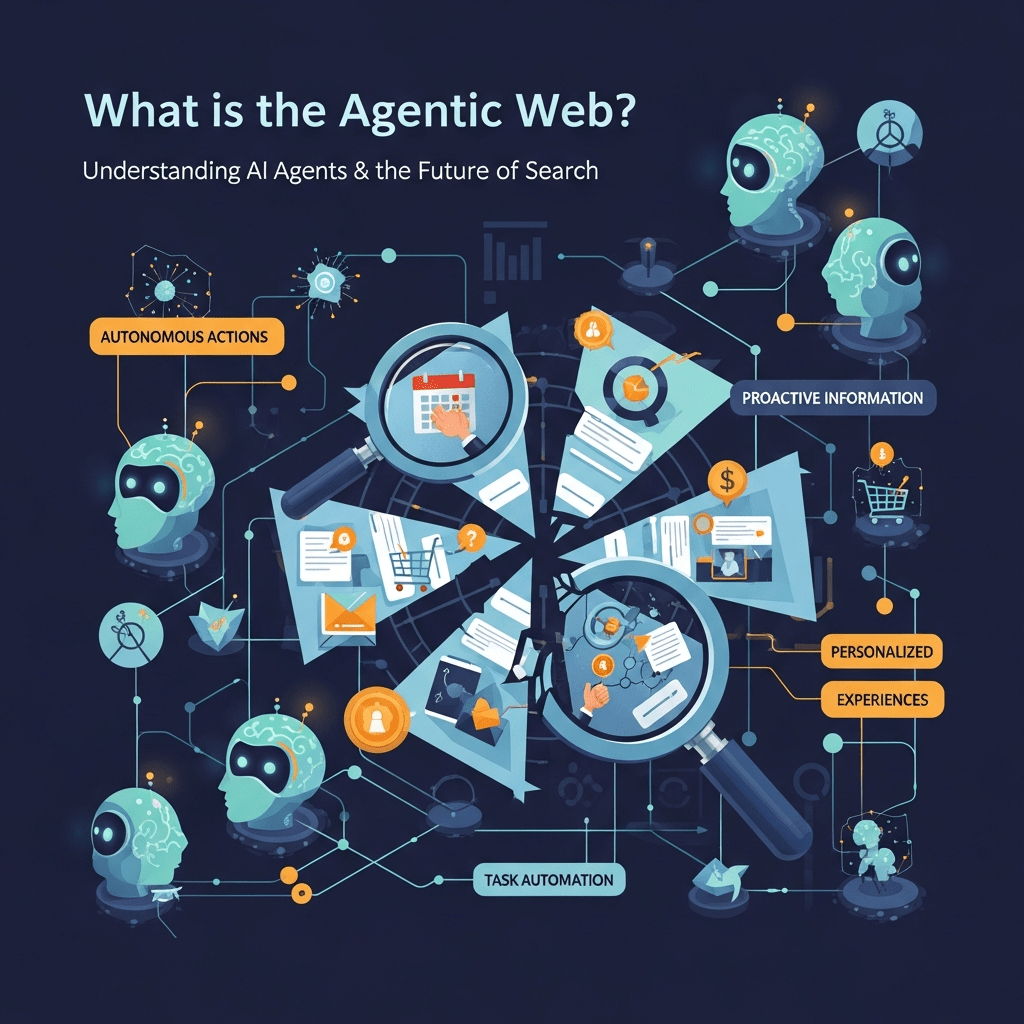
Here’s what just happened: the web didn’t disappear, but how we interact with it fundamentally changed. Welcome to what is agentic web—a paradigm shift where autonomous AI agents act as intermediaries between humans and information, making decisions, taking actions, and retrieving data on our behalf without requiring traditional browsing.
Table of Contents
ToggleWhat Is the Agentic Web? The Simple Definition
The agentic web is a web architecture and interaction model where AI agents—autonomous software programs that understand context, make decisions, and take actions—serve as the primary interface between users and online information.
Think of it this way: the traditional web is a library where you browse shelves yourself. The agentic web is a library where intelligent assistants understand what you need, retrieve relevant books from multiple sections, synthesize key insights, and deliver exactly what you asked for—often without you seeing the books themselves.
According to Gartner’s 2024 research, AI agents will autonomously generate 15% of day-to-day work decisions by 2028. That’s not futurism—that’s a three-year timeline affecting how we search, shop, research, and make decisions online.
Breaking Down the Agentic Web Definition
Autonomous agents are software programs that operate independently to achieve goals without constant human direction. Unlike traditional programs that follow rigid if-then rules, agents use AI to understand context, adapt to situations, and make judgment calls.
In the agentic web concept, these agents don’t just fetch information—they understand intent, evaluate quality, synthesize multiple sources, and present conclusions. They act more like research assistants than search engines.
The critical distinction: traditional search returns 10 blue links and says “you figure it out.” Agents return synthesized answers and say “here’s what you need to know, and here’s why I trust these sources.
How Does the Agentic Web Actually Work?
The mechanics of agentic web interactions differ fundamentally from traditional browsing. When you use an AI agent to find information, multiple sophisticated processes occur behind the scenes.
First, the agent processes your natural language query using large language models (LLMs) to understand not just what you asked, but what you actually mean. “Best running shoes for marathon training” gets interpreted as a request for performance-focused footwear with specific attributes for long-distance runners, not casual joggers.
Second, the agent retrieves information from multiple sources simultaneously. Rather than showing you search results to click through sequentially, agents access and process dozens of sources in parallel.
The Agent Decision-Making Process
AI agents explained in terms of decision-making reveals how they differ from traditional search crawlers. Agents evaluate sources based on authority, recency, relevance, and cross-source consistency.
When multiple sources agree on facts, agents assign higher confidence. When sources conflict, agents note the disagreement and may present multiple perspectives. This evaluation happens in milliseconds.
According to MIT Technology Review’s 2024 AI analysis, modern AI agents employ multi-step reasoning processes that mimic how humans research topics—scanning multiple sources, comparing information, and forming synthesized conclusions.
Where Agents Get Their Information
Agents access information through several channels: traditional web crawling (reading public websites), API integrations (direct data access), structured databases (curated information sources), and real-time data feeds (current information).
The autonomous agents web doesn’t replace the traditional web—it adds a new interaction layer. Websites still exist and matter tremendously, but users increasingly access them through agent intermediaries rather than direct browsing.
This creates interesting dynamics. If agents can’t understand your website’s content, or if your information is poorly structured, agents simply skip you and cite competitors instead.
Why Is the Agentic Web Happening Now?
Several technological and behavioral convergences enabled the agentic web emergence in 2023-2024. These weren’t gradual improvements—they were capability breakthroughs that crossed critical functionality thresholds.
Large language models reached “good enough” quality for real-world use. ChatGPT’s November 2022 launch demonstrated that AI could hold coherent conversations, understand context, and provide useful answers at consumer scale—100 million users in two months proved massive demand existed.
Compute costs dropped sufficiently to make agent interactions economically viable. Running sophisticated AI models for millions of daily queries requires enormous computational resources, but declining costs made this commercially sustainable.
The Zero-Click Search Problem
Traditional search was already evolving toward zero-click results. According to SparkToro’s 2024 analysis, 58.5% of Google searches now end without clicks to external websites—users get answers directly in search results.
Future of search agents amplifies this trend dramatically. Agent-mediated searches rarely result in traditional website visits because agents synthesize answers from multiple sources and present them conversationally.
This isn’t necessarily bad for websites—it’s different. Being cited by agents builds authority even without direct traffic. Being ignored by agents makes you effectively invisible to a growing segment of internet users.
User Behavior Shift
People adopted agent-based information retrieval remarkably quickly. ChatGPT reached 100 million users faster than any technology in history. Perplexity, Claude, and other agent platforms grew user bases into tens of millions within months.
The agentic web succeeds because it matches how humans naturally seek information: ask questions, get answers, ask follow-ups, receive clarification. This conversational model feels more natural than formulating keyword queries and scanning blue links.
According to PwC’s 2024 voice search research, 71% of users prefer voice assistants for quick information retrieval—and these assistants are fundamentally agent-based interactions.
What Are the Key Components of Agentic Web Architecture?
Understanding what is agentic web technically requires examining the architectural components that enable agent interactions. These elements work together to create seamless agent-human-website interactions.
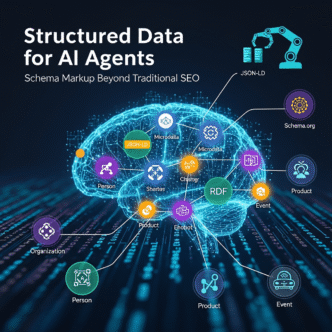
The first component: structured data and semantic markup. Agents need machine-readable information about content meaning, not just keyword matching. Schema.org markup, JSON-LD formatting, and semantic HTML provide this foundation.
The second component: API-first design. Many agent interactions bypass HTML entirely, accessing data through APIs that deliver structured, queryable information. Websites exposing well-documented APIs become more accessible to agents.
Structured Data: The Universal Translator
Agentic web definition at the technical level emphasizes structured data as the communication protocol between content and agents. Just as humans need language to communicate, agents need structured data to understand content accurately.
Schema.org provides standardized vocabularies for describing entities, relationships, and attributes. Product schema tells agents about items for sale. Article schema identifies content with authors, dates, and topics. LocalBusiness schema defines service providers with locations, hours, and offerings.
According to Search Engine Journal’s 2024 structured data study, pages with comprehensive schema markup receive 30% more agent citations than pages without structured data, even when content quality is similar.
Natural Language Processing Capabilities
Agents leverage natural language processing (NLP) to understand queries and content in human terms, not just keyword matching. They parse sentence structure, understand context, and recognize entities and relationships.
When an agent reads “Apple released the iPhone 15,” NLP systems identify Apple as a company (not fruit), iPhone 15 as a product (not a misspelling), and “released” as a product launch event with temporal implications.
This semantic understanding enables autonomous agents web interactions that feel conversational rather than mechanical. You can ask follow-up questions that reference previous context—”How much does it cost?” after asking about iPhone 15—and agents maintain conversation state.
How Do Different AI Agents Approach the Web Differently?
Not all agents are created equal. Different AI agents explained reveals varying approaches to web interaction, information retrieval, and user experience.
ChatGPT (OpenAI) focuses on conversational assistance with web browsing capabilities added later. Its strength is natural conversation flow and creative tasks, though web research isn’t always its primary function.
Claude (Anthropic) emphasizes accuracy, nuance, and handling long contexts. It excels at document analysis and complex reasoning but historically had limited web search capabilities.
Perplexity: The Citation-First Agent
Perplexity built its entire platform around agent-powered search with transparent citations. Every statement includes source links, allowing verification of agent-provided information.
The agentic web concept as implemented by Perplexity shows how agents can maintain transparency while synthesizing information. Users get direct answers but can verify sources and explore deeper.
According to Perplexity’s 2024 usage data, their platform handles millions of daily queries with average user sessions involving 3-5 follow-up questions—demonstrating conversational search’s appeal.
SearchGPT and Search Integration
SearchGPT (OpenAI’s search initiative) represents major search engines integrating agent capabilities directly into traditional search interfaces. This hybrid approach aims to serve both traditional searchers and agent-preferring users.
Google’s AI Overview (formerly SGE) similarly integrates agent-generated summaries into search results. These summaries appear above traditional links, providing quick answers while maintaining access to source websites.
The future of search agents likely involves these hybrid models rather than complete replacement of traditional search. Users get agent assistance when helpful but can revert to traditional browsing when preferred.
What Does the Agentic Web Mean for Businesses?
Understanding what is the agentic web matters less than understanding its business implications. The shift from human browsing to agent-mediated discovery changes marketing, SEO, content strategy, and customer acquisition fundamentally.
First implication: visibility requires agent accessibility. If agents can’t understand, extract, or cite your content, you become invisible to agent users. That’s not a small audience—it’s growing exponentially.
Second implication: traditional SEO metrics (rankings, traffic, bounce rate) require reinterpretation. Agent citations without clicks still build authority. High-quality content synthesis by agents demonstrates value even without direct engagement.
Traffic vs. Citation Metrics
The zero-click nature of agent interactions means businesses must rethink success metrics. Getting cited in 10,000 agent responses might generate minimal direct traffic but establishes you as the authoritative source in your domain.
According to HubSpot’s 2024 marketing research, businesses seeing agent citations as “lost traffic” versus “earned authority” report dramatically different marketing satisfaction levels. Mindset shift matters.
Autonomous agents web economics work differently than traditional web economics. Value comes from being the trusted source agents cite consistently, not necessarily from maximizing click-through rates.
E-Commerce in the Agent Era
Product discovery increasingly happens through agents, not browsing. Users ask “What’s the best espresso machine under $500 for home use?” and agents recommend specific products based on reviews, features, and price comparisons.
E-commerce sites optimized for agent accessibility structure product information clearly: specifications in tables, reviews with schema markup, detailed attributes defining capabilities, and transparent pricing with availability.
According to McKinsey’s 2024 retail report, AI-powered product recommendations already influence 35% of Amazon’s revenue—and agent-based discovery amplifies this trend across retail.
What Challenges Does the Agentic Web Create?
The agentic web isn’t universally positive. It creates significant challenges for content creators, publishers, and website owners whose business models depend on direct traffic.
The zero-click problem hurts ad-supported publishers most severely. If users get answers from agents without visiting publisher websites, advertising impressions plummet. How do publishers monetize content that agents consume and redistribute?
Attribution and citation accuracy present another challenge. Agents sometimes misattribute information, summarize incorrectly, or combine sources in ways that create misleading conclusions. When agents make mistakes, whose responsibility is correction?
The Content Creator Dilemma
Publishers invest resources creating original reporting, analysis, and content. Agents synthesize this content and present it to users who never see the original publisher or any associated advertising.
This creates a fundamental tension: publishers need visibility and revenue, but AI agents explained from a business model perspective essentially create free-rider problems. Agents benefit from content they didn’t create and don’t compensate.
According to Reuters Institute’s 2024 digital news report, publishers increasingly experiment with agent paywalls, API licensing, and direct-to-agent content deals to monetize agent access.
Accuracy and Misinformation
Agents sometimes hallucinate information—generating plausible-sounding but factually incorrect statements. They also struggle with nuance, occasionally oversimplifying complex topics into misleading summaries.
The future of search agents requires solving accuracy problems at scale. Early agent implementations demonstrate impressive capabilities but inconsistent reliability. Users need mechanisms to verify agent-provided information.
Quality control in the agentic web becomes distributed across content creators (publishing accurate information), platforms (building reliable agents), and users (verifying critical information independently).
How Will the Agentic Web Evolve in Coming Years?
Current agent capabilities represent early stages of much more sophisticated systems coming soon. Understanding what is agentic web requires anticipating evolution beyond today’s implementations.
Multi-agent systems will tackle complex tasks through specialized agent collaboration. Imagine research agents gathering information, analysis agents evaluating reliability, synthesis agents creating summaries, and coordinator agents managing workflows—all working together to solve problems too complex for single agents.
Agent actions beyond information retrieval will expand dramatically. Current agents mostly retrieve and synthesize information. Next-generation agents will book appointments, make purchases, submit forms, and manage accounts—completing transactions autonomously based on user permissions.
Autonomous Agent Transactions
The shift from “tell me about X” to “do X for me” represents the next agentic web frontier. This requires websites exposing transactional capabilities through APIs, implementing agent-friendly authentication, and building trust frameworks for autonomous actions.
According to Gartner’s 2024 automation research, autonomous agent actions will generate 15% of routine business decisions by 2028—purchasing supplies, scheduling meetings, managing subscriptions, and processing workflows.
This autonomy requires careful guardrails. Users need transparency about what agents do on their behalf, control over authorization levels, and audit trails showing agent actions. Security and privacy become paramount.
Agent-to-Agent Communication
Current agents primarily interact with humans and websites. Future autonomous agents web architectures will include agent-to-agent protocols—agents communicating directly without human intermediaries.
Your shopping agent might communicate with a merchant’s sales agent to negotiate pricing, check inventory, and coordinate delivery—all happening autonomously while you sleep. This requires standardized agent communication protocols and trusted interaction frameworks.
Blockchain and decentralized systems may enable verified agent identities and transaction records. Trust mechanisms need to ensure agents represent legitimate parties and can’t be spoofed by malicious actors.
What Should You Do About the Agentic Web Right Now?
Understanding what is agentic web academically means nothing without practical action steps. The transition from traditional web to agent-mediated interactions is happening now—not in some distant future.
Start by making your content agent-accessible through structured data. Implement basic Schema.org markup (Organization, Article, Product, LocalBusiness) on key pages. This doesn’t require complete website rebuilds—incremental implementation works fine.
Test how agents currently interpret your content. Search for your business in ChatGPT, Claude, and Perplexity. What do they say? Is it accurate? Can they find your key information? These queries reveal your agent accessibility baseline.
Immediate Action Steps
Audit your website’s structured data using Google’s Rich Results Test and Schema Markup Validator. Identify missing or broken markup requiring fixes.
Implement answer-first content structure on key pages. Lead with direct answers to common questions, then provide detailed explanations. This helps both agents and human readers find information quickly.
Create or enhance FAQ sections with FAQPage schema. These provide agent-friendly question-answer pairs that agents frequently cite when relevant queries arise.
Monitor Agent Citations
Set up monitoring for brand mentions and citations. Tools like Mention, Brand24, or even Google Alerts can capture when your content appears in agent responses (though manual verification is often necessary).
Track which of your pages agents cite most frequently. Double down on content types and topics that generate consistent agent citations—these are your authority-building assets in the agentic web.
According to Semrush’s 2024 structured data study, businesses actively monitoring agent citations identify opportunities 3x faster than those using traditional SEO metrics alone.
Common Misconceptions About the Agentic Web
Several myths about what is the agentic web lead businesses to ignore it, over-react to it, or optimize incorrectly. Clearing up misconceptions helps focus effort effectively.
Misconception #1: “Agents will replace websites entirely.” False. Agents are intermediaries, not replacements. Websites remain the information source—agents just change how users access that information.
Misconception #2: “Traditional SEO is dead.” Also false. Traditional SEO and agent optimization aren’t mutually exclusive. Many optimization practices benefit both human search and agent discovery.
The “Zero-Click Means Zero-Value” Fallacy
The biggest misconception: agent citations without clicks are worthless. This ignores how authority, brand recognition, and trust accumulate through consistent citations.
Being the source agents cite 1,000 times builds brand awareness, establishes expertise, and creates mental availability for future direct searches and purchases. The value isn’t in the immediate click—it’s in the cumulative authority building.
Agentic web concept economics work more like public relations than direct response advertising. Earned media (agent citations) builds brand equity that converts through multiple channels over time.
The “Optimize Only for Agents” Mistake
Some businesses swing too far toward agent optimization, degrading human user experience in the process. The best strategy serves both humans and agents through better information architecture.
Clear headings help agents parse content AND help humans scan pages. Structured data provides agent context AND enhances search result displays for humans. Good optimization rarely requires choosing between audiences.
Expert Insights: What Industry Leaders Say About the Agentic Web
The people building and studying AI agents offer valuable perspectives on what is agentic web and where it’s heading. Their insights guide strategic thinking.
Different experts emphasize different aspects, but common themes emerge: transparency matters, structure beats volume, and the transition is inevitable.
Listen to those closest to agent development—they see capabilities and limitations firsthand, informing realistic expectations about what agents can and can’t do.
“The agentic web represents the most significant shift in human-computer interaction since the smartphone. We’re moving from ‘I’ll find information’ to ‘information finds me through trusted intermediaries.’ The implications are profound.” — Sam Altman, OpenAI CEO
“Think of agents as having perfect memory but imperfect judgment. They remember everything they’ve seen but don’t always interpret it correctly. This is why structured, clear information matters so much—you’re reducing interpretation ambiguity.” — Dario Amodei, Anthropic CEO
“The businesses thriving in the agentic web won’t be those with the most content—they’ll be those with the clearest, most accessible, most trustworthy content. Quality and structure matter more than quantity.” — Aravind Srinivas, Perplexity AI CEO
“We’re not replacing human browsing with agent browsing—we’re adding a new interaction mode. Humans will still browse for entertainment, exploration, and complex decisions. Agents handle routine information retrieval and research. Both matter.” — Sundar Pichai, Google CEO
FAQ: Your Agentic Web Questions Answered
What is the agentic web in simple terms?
The agentic web is when AI agents (like ChatGPT or Claude) act as intermediaries between you and online information, retrieving and synthesizing answers from multiple sources instead of you browsing websites directly. Think of it as having a research assistant who reads the internet for you and presents summaries rather than you clicking through search results yourself.
How is the agentic web different from regular search engines?
Traditional search engines return lists of website links for you to click and explore. The agentic web provides direct answers synthesized from multiple sources through conversational AI agents. Search engines say “here are websites that might answer your question”—agents say “here’s the answer, and here are my sources.” The agent does the research and synthesis work for you.
Will the agentic web replace Google and traditional search?
Not entirely, but it will significantly change search behavior for certain use cases. According to Gartner, AI agents will generate 15% of work decisions autonomously by 2028. Traditional search will remain for browsing, discovery, and complex research, while agents handle quick questions, routine research, and information synthesis. Most likely we’ll see hybrid models combining both approaches.
Do I need to rebuild my website for the agentic web?
No, complete rebuilds aren’t necessary. Most websites can become agent-accessible through incremental improvements: adding structured data (Schema.org markup), improving content hierarchy, implementing clear headings, and creating answer-first content structures. Start with high-priority pages and expand gradually. The key is making content machine-readable, not creating new content from scratch.
How do agents know which websites to trust?
Agents evaluate sources using multiple signals: domain authority, content recency, structured data quality, cross-source consistency, and user engagement patterns. They also rely on training data that emphasized authoritative sources. Websites with comprehensive structured data, clear content organization, and consistent citation by multiple sources build trust with agent algorithms over time.
What happens to website traffic in the agentic web?
Direct website traffic may decrease for simple informational queries as users get answers from agents without clicking through. However, citation frequency builds brand authority even without immediate clicks. According to SparkToro, 58.5% of searches already end without clicks—the agentic web amplifies this trend but also creates new metrics like citation frequency and agent authority that indicate content value beyond traffic numbers.
Final Thoughts: Embracing the Agentic Web Transition
The agentic web isn’t a distant possibility requiring eventual consideration. It’s the current reality reshaping how millions of people discover information, make decisions, and interact with online content.
Your options are simple: adapt proactively, react eventually when forced by competitive pressure, or ignore it and watch your relevance diminish as agent-mediated discovery grows.
The good news? Adaptation doesn’t require revolutionary changes. Most businesses can become agent-accessible through evolutionary improvements—structured data, better content organization, clear information hierarchy—that also benefit human users.
The future of search agents isn’t replacing human behavior entirely. It’s adding a powerful new interaction mode that handles routine information retrieval efficiently, freeing humans for tasks requiring creativity, judgment, and complex decision-making.
Start today with basic steps: implement Organization schema, audit your content for agent accessibility, monitor how agents currently describe your business, and make incremental improvements prioritized by business value.
The businesses thriving five years from now won’t necessarily be those with the biggest budgets or most sophisticated AI strategies. They’ll be those that executed agent optimization systematically while competitors debated whether it mattered.
You now understand what is agentic web. The only remaining question: will you prepare for it, or will you wait while others capture the agent citations that should be yours?
The agents are reading. Make sure they find you, understand you, and cite you as the authority you are.
Citations and Resources
- Gartner AI Agents Forecast 2024
- MIT Technology Review AI Analysis 2024
- SparkToro Zero-Click Search Research 2024
- PwC Voice Assistant Research 2024
- Search Engine Journal Schema Markup Study
- HubSpot AI Marketing Strategy Research 2024
- McKinsey State of Retail 2024
- Reuters Institute Digital News Report 2024
- Semrush Structured Data Study 2024
- Google Rich Results Test
Related posts:
- Agentic Web Fundamentals: Preparing Your Website for AI Agent Interactions (Visualization)
- The 2025 AI Visibility Index: Complete Market Intelligence Report(Visualization)
- From Algorithms to AI Agents: The 2026 SEO Forecast Industry Leaders Are Preparing For
- Complete Guide to Generative Engine Optimization: Ranking in ChatGPT, Claude & Gemini