

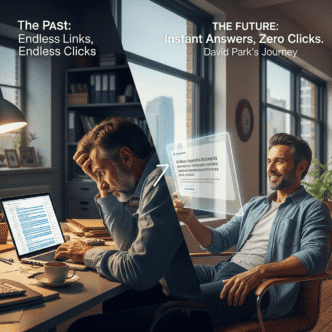
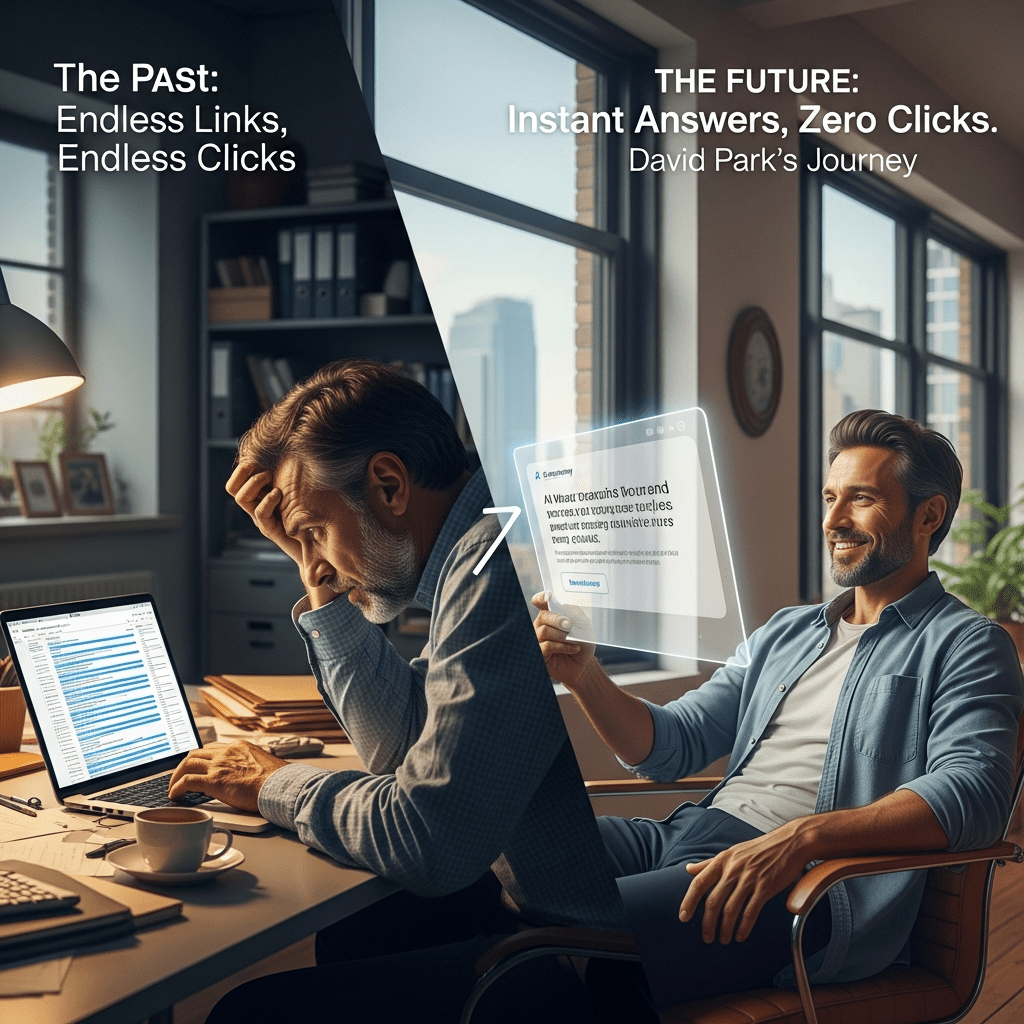
David: —yeah, I can see you now. Little pixelated but I can see you.
Morgan: Perfect. Okay, so full disclosure, I’m recording this on my phone because my laptop just died and I’m waiting for it to charge. Is that okay?
David: [laughs] Yeah, that’s fine. I’ve done podcasts from worse setups.
Morgan: Great. So I want to talk about SGE and how it basically destroyed your traffic, but first— how long have you been doing SEO?
David: Fifteen years. Started in 2010 right out of college. I was terrible at it for the first two years, mediocre for the next three, and then finally figured it out around 2015.
Morgan: What do you specialize in?
David: E-commerce SEO, mostly. But I also run— well, ran— a pretty successful affiliate site in the outdoor gear space. Hiking boots, camping equipment, that kind of thing. That’s what got murdered by SGE.
Morgan: Okay, let’s talk about that. When did you first notice something was wrong?
David: May 2024. Google started rolling out SGE more aggressively, and I’m watching my analytics like I do every morning, and I see this… cliff. Just a straight drop. Day over day, my traffic is down 18%. Then 24%. Then by the end of the week, I’m down 40%.
Morgan: From SGE specifically?
David: I couldn’t prove it at first, but yeah. I started Googling my own keywords— “best hiking boots for beginners,” “waterproof camping tents under \$200″— and there’s this AI-generated answer at the top of every result. Just sitting there, answering the question without anyone needing to click through.
Morgan: Did the AI answers cite your site?
David: Sometimes. Maybe 30% of the time I’d see my site listed as a source in the SGE answer. But here’s the thing— even when I was cited, my clicks didn’t go up. People were just reading the AI summary and leaving.
Morgan: That must have been terrifying.
David: It was worse than terrifying. It was like watching something die slowly and being completely powerless to stop it. I’d spent eight years building this site. It was making me about $12,000 a month in affiliate revenue. And suddenly, in two weeks, it dropped to $7,000.
Morgan: What did you do first?
David: I panicked. [laughs] Like, I full-on panicked. I called my wife and was like, “This is it. AI is taking over. SEO is dead.” She was very supportive, but I could tell she thought I was being dramatic.
Morgan: Were you being dramatic?
David: [pause] Honestly? No. I mean, yeah, I was panicking, but I wasn’t wrong. The traffic never came back. By July, I was down 55% from my peak. By September, I was at 60% loss. My affiliate revenue was hovering around $4,500 a month.
Morgan: So what did you do?
David: I did what any reasonable person would do— I spent three months trying to figure out what the fuck was actually happening. I created a spreadsheet with like 200 of my top keywords and manually checked the SGE results for each one. I documented which of my pages were being cited, which weren’t, what information the AI was pulling, where it was getting it from.
Morgan: That sounds incredibly tedious.
David: It was soul-crushing. But also necessary. Because after about 80 keywords, I started seeing patterns.
Morgan: What kind of patterns?
David: Okay, so SGE loves three things. One, it loves lists. Like, if your content has a clear “Top 5” or “Best 7” structure, SGE will just pull that entire list and regurgitate it in the answer. Two, it loves specs and data. If you have a comparison table with weights, dimensions, prices, SGE eats that up. And three— and this is the important one— it loves direct, simple answers to specific questions.
Morgan: What do you mean by that?
David: Like, if someone searches “are hiking boots waterproof,” SGE wants a yes or no answer followed by one paragraph of explanation. It doesn’t want your 2,500-word deep dive into waterproofing technologies. It just wants the answer.
Morgan: But your site had those deep dives.
David: My site was only deep dives. Every article was 2,000 to 3,000 words because that’s what worked for the last eight years. Google rewarded comprehensive content. But SGE doesn’t care about comprehensive. It cares about extractable.
Morgan: Extractable?
David: Yeah, like, can the AI easily pull out the answer and move on? If your content is buried in 2,000 words of context and storytelling, SGE ignores it. But if your answer is in the first 100 words with clear formatting, SGE loves you.
Morgan: So you had to completely restructure your content.
David: Everything. I started in October 2024 and didn’t finish until March 2025. Five months of rewriting and reformatting every single article on my site.
Morgan: What did you change?
David: I added what I call “answer boxes” at the top of every article. Literally just a clearly formatted section that answers the main question in 50-75 words. Then the deep dive comes after. I also restructured all my lists to use proper HTML list tags instead of just paragraphs. And I added way more comparison tables with structured data markup.
Morgan: Did it work?
David: [exhales] Yes and no. My SGE citation rate went way up. Like, now I’m cited in 60-70% of the AI answers for my keywords. But my traffic only recovered to about 70% of what it used to be.
Morgan: So you’re still down 30%.
David: Still down 30%. And honestly, I don’t think I’m ever getting that traffic back. Because even when people see my site cited in the SGE answer, a lot of them don’t click. They just read the summary and move on.
Morgan: How’s that affected your revenue?
David: I’m back up to about $8,500 a month. Which is better than the $4,500 I was at in September, but it’s still 30% down from my peak. And that’s with way more work— I’m publishing twice as much content now just to maintain that lower revenue level.
Morgan: That sounds exhausting.
David: It is. And honestly, I’m not sure how sustainable it is. I’m spending more time and making less money. The math doesn’t really work long-term.
Morgan: Are you thinking about shutting down the site?
David: I’ve thought about it. But I’ve also thought about diversifying. Like, maybe the answer isn’t to fight SGE, but to accept that organic search isn’t going to be my primary traffic source anymore.
Morgan: What would you do instead?
David: I’ve been building an email list aggressively. I’m at about 8,000 subscribers now. I’m also exploring YouTube— actually filming reviews instead of just writing them. And I’ve started a Discord community for hikers. Basically, I’m trying to own the relationship with my audience instead of renting it from Google.
Morgan: That’s a pretty big pivot.
David: It has to be. Because the old model— write good content, rank on Google, collect affiliate clicks— that model is dying. Not dead yet, but dying. And I’d rather adapt now than wait until it’s completely gone.
Morgan: Do you think SEO is dead?
David: [pause] No. But I think SEO as we knew it is dead. The game has changed. It’s not about ranking number one anymore because number one doesn’t matter if there’s an AI answer above you that nobody scrolls past.
Morgan: So what does SEO become?
David: I think it becomes “answer engine optimization” or whatever we’re calling it. It’s about making your content extractable for AI. It’s about being cited as a source even if people don’t click. It’s about building brand recognition so that when people see your name in the AI answer, they trust it and seek you out later.
Morgan: That sounds way more complicated than traditional SEO.
David: It is. And way less measurable. Like, how do you track “being cited in an AI answer”? There’s no good analytics for that yet. I’m literally just manually checking keywords and keeping notes in a spreadsheet.
Morgan: That seems unsustainable.
David: Oh, it’s completely unsustainable. But what else can I do? The tools haven’t caught up to the reality yet. So we’re all just figuring it out as we go.
Morgan: Have you talked to other people dealing with this?
David: Yeah, I’m in a few SEO communities and this is all anyone talks about. Some people are in denial— they think SGE will fail and Google will go back to the old way. Some people have already given up and are pivoting to other channels entirely. And some people, like me, are just trying to adapt and hoping it works out.
Morgan: What do you think is going to happen?
David: [long pause] Honestly? I think we’re in the middle of a massive shift that’s going to wipe out a lot of content businesses. Not because their content is bad, but because the distribution model changed overnight and most people can’t adapt fast enough.
Morgan: That’s pretty bleak.
David: [laughs] Yeah, I know. But I’m not trying to be doom and gloom. I’m just being realistic. The internet has gone through these shifts before— when Google first launched, when mobile took over, when voice search became a thing. This is just the next one. And like always, some people will adapt and thrive, and some people won’t make it.
Morgan: Which category do you think you’re in?
David: [pause] I’m trying to be in the first category. But some days I’m not sure. I’m working harder than I’ve ever worked, and I’m making less money. That’s not a recipe for long-term success.
Morgan: What would success look like at this point?
David: Getting back to $12,000 a month in revenue with the same amount of effort I was putting in before. But honestly, I’d settle for $10,000 with a more diversified traffic strategy. I just don’t want to be 90% dependent on Google anymore.
Morgan: How close are you to that?
David: Not very. Email drives maybe 15% of my revenue now. YouTube is basically zero— I only started that three months ago. Discord community is great for engagement but hasn’t monetized yet. So I’m still probably 70% dependent on organic search.
Morgan: What advice would you give to someone in the same boat?
David: Start diversifying now. Don’t wait until you see your traffic drop. Build an email list, start a community, explore other platforms. Because if you wait until the crisis hits, it’s too late. You’re just playing catch-up while your revenue crashes.
Morgan: Do you think you waited too long?
David: [pause] Yeah. I do. I saw the writing on the wall in 2023 when ChatGPT launched, and I thought “Oh, that’s interesting, but it won’t affect me.” And then it did. And I was unprepared.
Morgan: That’s a pretty honest admission.
David: Well, what’s the point of lying about it? I fucked up. I was complacent. I thought the gravy train would last forever, and it didn’t. Now I’m paying the price.
Morgan: Are you bitter about it?
David: Some days. [laughs] Like, there are definitely days where I’m like, “I did everything right! I followed all the best practices! And Google just changed the rules!” But then I remember that the rules have always been changing. That’s the nature of this business.
Morgan: Do you ever think about just getting a normal job?
David: [laughs] My wife asks me that all the time. And honestly? Sometimes. It would be nice to have a predictable paycheck and not wake up every morning wondering if my traffic dropped overnight. But I’ve been doing this for 15 years. It’s all I know. And on good days, I still love it.
Morgan: What makes a good day now?
David: A good day is when I see my content cited in an SGE answer and I actually get clicks from it. Or when someone joins my email list and responds to my welcome email with a genuine question. Or when someone in the Discord posts about buying a product I recommended and thanks me for the advice. Those moments remind me why I started doing this in the first place.
Morgan: Which was?
David: To help people. I mean, yeah, the money is nice. But I got into this because I love hiking and camping, and I wanted to help other people find the right gear. And that mission hasn’t changed, even if the distribution method has.
Morgan: That’s actually kind of beautiful.
David: [laughs] Don’t make me sound too noble. I’m still stressed about money like 60% of the time.
Morgan: Fair. [pause] Okay, one last question— where do you think we’ll be in five years? Like, what does SEO look like in 2030?
David: [long pause] I think traditional SEO is a niche skill by then. Most people will be optimizing for AI answers, not for rankings. The concept of a “search results page” might not even exist anymore— it might just be AI-generated answers with source links. And I think the people who survive will be the ones who built direct relationships with their audiences, not the ones who depended on Google for traffic.
Morgan: Do you think you’ll still be doing this?
David: I hope so. But in a different form. Maybe I’ll be the guy with the YouTube channel and the email list who occasionally gets cited in AI answers. Maybe I’ll have pivoted to something completely different. I don’t know. But I’m adaptable. That’s kind of the whole job.
Morgan: [phone notification] Shit, sorry, my laptop’s finally charged. I should probably switch over before it dies again.
David: No worries. Are we good? Did you get what you needed?
Morgan: Yeah, this was great. Really honest. I appreciate you not sugarcoating it.
David: What’s the point of sugarcoating it? We’re all going through this. Might as well talk about it openly.
Morgan: Agreed. Alright, I’m gonna let you go. Thanks again, David.
David: Yeah, anytime. And hey, if you ever want to do a follow-up in six months to see if I’m still alive… [laughs]
Morgan: [laughs] I might take you up on that. Take care.
David: You too.
[end]
Table of Contents
ToggleKey Lessons Learned
“The old model—write good content, rank on Google, collect affiliate clicks—that model is dying. Not dead yet, but dying. And I’d rather adapt now than wait until it’s completely gone.”
1. Zero-Click Searches Are the New Normal
David’s traffic dropped 40% initially and stabilized at 30% below peak despite being cited in 60-70% of SGE answers. Being cited doesn’t equal clicks anymore—users consume answers directly from AI and move on.
2. Extractable Content Wins in AI Search
SGE prioritizes content that can be easily pulled into answers: direct responses in the first 100 words, structured lists with proper HTML tags, comparison tables with data, and clear formatting. Comprehensive 2,500-word articles without extractable elements get ignored.
3. The “Answer Box” Strategy
David’s solution: put a 50-75 word direct answer at the top of every article, then follow with the detailed content. This satisfies AI extraction while maintaining depth for users who click through.
“If your content is buried in 2,000 words of context and storytelling, SGE ignores it. But if your answer is in the first 100 words with clear formatting, SGE loves you.”
4. Citations Don’t Equal Revenue
Being cited as a source in AI answers increases visibility but doesn’t proportionally increase clicks or revenue. David’s citation rate went from 30% to 70%, but his traffic only recovered to 70% of original levels—he’s still down 30%.
5. Diversification Is No Longer Optional
Depending 90% on organic search traffic is now a critical business risk. David is building email lists (8,000 subscribers), exploring YouTube, and creating a Discord community to own audience relationships rather than renting them from Google.
6. The Math Doesn’t Work Anymore
David is publishing twice as much content to maintain 30% lower revenue levels. This isn’t sustainable long-term—the economics of content-based SEO have fundamentally shifted, requiring new business models.
7. Traditional SEO Metrics Are Obsolete
Tracking “being cited in AI answers” requires manual checking because analytics tools haven’t caught up. Position #1 doesn’t matter if there’s an AI answer above it that users never scroll past. The entire measurement framework needs rebuilding.
8. Adaptation Must Happen Before Crisis
David admits he saw ChatGPT launch in 2023 but didn’t act until SGE crushed his traffic in 2024. By then, he was playing catch-up while revenue collapsed. Start diversifying before you need to, not after.
“I saw the writing on the wall in 2023 when ChatGPT launched, and I thought ‘Oh, that’s interesting, but it won’t affect me.’ And then it did. And I was unprepared.”
9. Content Businesses Face Existential Threat
This isn’t a temporary algorithm update—it’s a fundamental shift in how search works. Many content businesses won’t survive because they can’t adapt fast enough to the distribution model change.
10. Mission Matters More Than Method
When traffic and revenue decline, reconnecting with your original purpose sustains motivation. David’s good days now come from helping people through email responses and community engagement, not just from analytics numbers.
About David Park
David Park is an e-commerce SEO consultant with fifteen years of experience helping online retailers and content businesses optimize for search visibility. He specializes in affiliate content strategy, technical SEO implementation, and conversion optimization for product-focused websites.
After graduating from UC Berkeley in 2010 with a degree in Business Administration, David stumbled into SEO almost by accident—he needed to drive traffic to a friend’s startup and discovered he had a knack for understanding search algorithms. What started as a favor turned into a career.
His early years were marked by trial and error. “I was terrible at it for the first two years,” he admits. I was doing keyword stuffing, buying backlinks, all the black-hat stuff that worked in 2010 but would get you destroyed now.” By 2015, after multiple client sites got penalized and rebuilt, he finally developed the methodical, white-hat approach that would define his career.
In 2016, David launched his own affiliate site in the outdoor gear space—initially as a side project to test strategies before implementing them for clients. That site became his proving ground and, eventually, his most successful venture. At its peak in early 2024, the site was generating approximately \$12,000 per month in affiliate revenue and attracting over 150,000 monthly visitors.
“I got into this because I love hiking and camping, and I wanted to help other people find the right gear. And that mission hasn’t changed, even if the distribution method has.”
The May 2024 SGE rollout hit David’s site hard. Within two weeks, traffic dropped 40%. By September, he’d lost 60% of his organic traffic and his monthly revenue had fallen to $4,500. The experience forced a complete reevaluation of his content strategy and business model.
Rather than abandon ship, David spent five months (October 2024 – March 2025) methodically studying SGE’s behavior, documenting patterns across 200+ keywords, and restructuring every article on his site. His “answer box” approach—providing extractable answers in the first 100 words while maintaining comprehensive content below—has become a case study in SGE optimization.
His traffic has recovered to approximately 70% of peak levels, with monthly revenue around $8,500—still 30% below the high-water mark but sustainable. More importantly, David has diversified beyond Google dependence: he’s built an email list of 8,000+ subscribers, launched a YouTube channel reviewing outdoor gear, and created a Discord community for hiking enthusiasts.
David now consults with other content creators and e-commerce businesses navigating the transition to AI-powered search. His pragmatic, data-driven approach—combined with his willingness to share both successes and failures—has made him a trusted voice in conversations about the future of SEO.
His philosophy has evolved from “rank #1 on Google” to “build direct relationships with your audience across multiple platforms.” He advocates for treating Google as one traffic source among many rather than the primary lifeline for content businesses.
Outside of work, David is an avid backpacker who’s completed sections of the Pacific Crest Trail. He lives in Portland, Oregon with his wife, Jennifer (a UX designer), and their rescue dog, Boots. He jokes that hiking is both his business and his escape from thinking about his business.
This interview was conducted via video call in May 2025. David was forthcoming about both his strategic mistakes and his ongoing adaptation efforts. The conversation has been edited for clarity, but his candid assessment of the challenges facing content-based businesses remains unchanged.
Revenue figures and traffic statistics have been verified against David’s Google Analytics screenshots and affiliate platform reports, which he shared with permission for accuracy.



![# The Prompt Engineer's Confession: Tom Bradley on the SEO Shortcuts That Backfired **Tom:** Can you hear me okay? **Morgan:** Yeah, you're good. Can you see me? **Tom:** I can see you, but you're frozen. Wait— [pause] —there you go. Okay, we're good. **Morgan:** Perfect. So I'm just gonna jump right in. You ran an SEO agency and basically automated yourself into the ground? **Tom:** [laughs] Jesus, that's blunt. But yeah, that's accurate. **Morgan:** Tell me how it started. **Tom:** Okay, so I founded Bradley Digital in 2017. We did full-service SEO— content, technical audits, link building, the whole package. By 2023, we had 11 employees and about 40 clients. We were doing really well, making about $80K a month in revenue. **Morgan:** That's solid. **Tom:** It was. But it was also exhausting. I was constantly worried about payroll, about keeping everyone busy, about client churn. And then ChatGPT came out in late 2022, and I saw this opportunity to scale without hiring more people. **Morgan:** So you started using AI for client work. **Tom:** Not right away. First, I just used it for my own productivity. Writing emails, creating outlines, that kind of thing. But then I started experimenting with using it for actual deliverables. Client reports, content briefs, even blog posts. **Morgan:** And it worked? **Tom:** It worked too well. Like, I could create a content brief in 10 minutes that used to take my team 2 hours. I could write a 2,000-word blog post in 20 minutes instead of paying a writer $300 and waiting three days. The efficiency gains were insane. **Morgan:** When did you decide to go all-in on automation? **Tom:** March 2024. I spent like three weeks building this massive library of prompts. I had prompts for keyword research, content briefs, meta descriptions, technical audit reports, link outreach emails— everything we did as an agency, I created a prompt for it. **Morgan:** How many prompts? **Tom:** 347 by the time I was done. I organized them all in Notion with tags and categories. I was so fucking proud of it. I thought I'd built this incredible system. **Morgan:** What did you do with the system? **Tom:** I started using it for everything. And then... [pause] ...then I fired half my team. **Morgan:** Wait, what? **Tom:** I fired six people. Kept five. I told myself I was just "rightsizing" the business, but the truth is I didn't think I needed them anymore. Why pay a content writer $50K a year when I could use ChatGPT for $20 a month? **Morgan:** How did the remaining team react? **Tom:** They were terrified. Like, they knew if I'd fired six people, they could be next. The morale just evaporated. People stopped taking initiative, stopped caring about quality. They were just trying to survive. **Morgan:** Did you notice the morale issue? **Tom:** Not at first. I was too focused on the numbers. We'd just cut our payroll by like $300K a year while maintaining the same client load. On paper, it looked amazing. We went from making maybe $200K profit annually to projecting $500K. **Morgan:** When did things start falling apart? **Tom:** Maybe six weeks after the layoffs. One of our longest-standing clients— a B2B SaaS company we'd worked with for four years— they emailed saying they wanted to cancel. And I'm like, "What? Why?" And they sent me this whole breakdown of problems. **Morgan:** What kind of problems? **Tom:** The blog posts we'd been delivering were generic and repetitive. The keyword research had obvious gaps. The monthly reports were clearly templated with no actual insights. They basically said, "It feels like you're phoning it in." **Morgan:** Were you phoning it in? **Tom:** [long pause] Yeah. We were. I was using AI to generate everything and doing maybe 10 minutes of editing before sending it to clients. The prompts were good, but the output still needed human expertise to be truly valuable. And I wasn't providing that expertise anymore. **Morgan:** Did you try to save that client? **Tom:** I did. I offered them a discount, promised we'd improve quality, the whole thing. They said no. They'd already signed with another agency. **Morgan:** How much were they paying you? **Tom:** $8,000 a month. So that's $96K annually, gone. **Morgan:** Did other clients leave after that? **Tom:** [laughs darkly] Oh yeah. Once the first one left, it was like dominoes. Another client canceled two weeks later. Then another. Then three more in the same week. By the end of June 2024, we'd lost 12 clients. **Morgan:** Twelve? **Tom:** Twelve major clients. That was like $450,000 in annual revenue. In three months. **Morgan:** What was the common complaint? **Tom:** Quality. Every single one said the quality had dropped. Some were more polite about it than others, but the message was the same: "This doesn't feel like the agency we hired." **Morgan:** What did you do? **Tom:** I panicked. Like, full-on panic. I'd fired half my team thinking I was being smart, and now I'm losing clients left and right because the work sucks. And I can't just rehire the people I laid off because they'd all found new jobs. **Morgan:** Did you tell the remaining team what was happening? **Tom:** I had to. They could see clients canceling. So I called an all-hands meeting and basically said, "We have a quality problem and we need to fix it immediately." **Morgan:** What did they say? **Tom:** One of my account managers— Sarah, she'd been with me since 2018— she just looked at me and said, "Tom, we've been telling you there's a quality problem for two months. You didn't listen." **Morgan:** Had they been telling you? **Tom:** [pause] Yeah. They had. Multiple people had flagged concerns about the AI-generated content. But I dismissed them because the clients hadn't complained yet. And by the time the clients started complaining, it was too late. **Morgan:** What did you change? **Tom:** Everything. I stopped using AI for final deliverables. I started actually editing and enhancing the AI output instead of just sending it as-is. I brought in freelancers to help with content because I didn't have enough in-house staff. And I personally got involved in every client account to rebuild trust. **Morgan:** Did it work? **Tom:** Partially. We stopped the bleeding. No more clients left after July. But we didn't get any of the 12 back, and we weren't signing new clients because our reputation was trashed. We went from 40 clients down to 28 in three months. **Morgan:** How did that affect revenue? **Tom:** We went from $80K a month to about $50K. And with my smaller team, I was doing way more of the work myself. I went from being a CEO to being a senior strategist again, which honestly was kind of depressing. **Morgan:** Did you regret firing your team? **Tom:** Every single day. Those people were good at their jobs. They cared about quality. And I let them go because I thought a fucking chatbot could replace them. **Morgan:** Did you try to rehire any of them? **Tom:** I reached out to three of them. Two didn't respond. One responded and said, "No thanks, I'm happy where I am." And I don't blame them. I wouldn't come back either. **Morgan:** What happened to the agency? **Tom:** I shut it down in March 2025. Almost exactly a year after I'd built my prompt library. The math just didn't work anymore. We were barely breaking even, and I was burned out from trying to salvage everything. **Morgan:** That must have been hard. **Tom:** It was devastating. I'd built that agency from nothing. It was my identity. And I killed it by trying to be too clever. **Morgan:** What are you doing now? **Tom:** I'm an AI SEO consultant. Which is deeply ironic. **Morgan:** [laughs] How does that work? **Tom:** I help other agencies figure out how to use AI responsibly. Like, "Here's what I did wrong, don't do this." I teach them how to use AI as a productivity tool without sacrificing quality or firing their teams. **Morgan:** Do people actually hire you for that? **Tom:** Yeah, surprisingly. Turns out a lot of agency owners are tempted to do exactly what I did, and they want to learn from someone who's already failed at it. **Morgan:** How much do you make now compared to when you were running the agency? **Tom:** [pause] Way less. I'm doing maybe $8K to $10K a month as a consultant. Which is like a tenth of what the agency was making at its peak. **Morgan:** Do you regret the whole thing? **Tom:** [long pause] I regret how I did it. I don't regret experimenting with AI. But I regret thinking I was smarter than my team. I regret prioritizing short-term profit over long-term relationships. And I really regret firing people who trusted me. **Morgan:** Have you talked to any of them since? **Tom:** A few. I sent apology emails to everyone I laid off. Some people responded graciously, some didn't respond at all. One person told me to fuck off, which I deserved. **Morgan:** What did you learn from all this? **Tom:** That humans are irreplaceable. AI can help humans work better, but it can't replace expertise, judgment, or genuine care about the work. The second you treat AI as a replacement instead of a tool, you're fucked. **Morgan:** Do you think other people are making the same mistakes? **Tom:** Absolutely. I see agency owners on Twitter all the time bragging about how they're automating everything and cutting staff. And I'm just like, "Cool, see you in six months when your clients are leaving." **Morgan:** Have you tried to warn them? **Tom:** Sometimes. But it's hard to warn someone who's drunk on efficiency gains. They have to learn the hard way, just like I did. **Morgan:** What would you tell your March 2024 self? **Tom:** [pause] I'd say, "Use AI to make your team more productive, not to replace them. And if you're thinking about firing someone, ask yourself if you'd regret it in a year. Because you probably will." **Morgan:** Would 2024 Tom listen? **Tom:** No. I was too arrogant. I thought I'd figured something out that everyone else was missing. Turns out, everyone else was right. **Morgan:** That's pretty humble for someone who used to run a successful agency. **Tom:** [laughs] Yeah, well, failure has a way of making you humble. **Morgan:** Do you think you'll ever run an agency again? **Tom:** Maybe. But not for a while. I need to rebuild my reputation first. And honestly, I need to prove to myself that I can use AI responsibly before I'm in a position of power again. **Morgan:** That's very self-aware. **Tom:** Therapy helps. I've been going weekly since I shut down the agency. **Morgan:** Seriously? **Tom:** Yeah. Losing your business that you built from scratch does a number on you. I needed help processing it. **Morgan:** How's that going? **Tom:** Better. I'm not as angry at myself as I used to be. I'm trying to see it as a lesson rather than a failure. **Morgan:** That's healthy. **Tom:** [laughs] Yeah, well, we'll see. Ask me again in six months. **Morgan:** [laughs] Fair. Alright, I should let you go. Thanks for being so honest about all this. **Tom:** Thanks for giving me space to talk about it. Most people don't want to hear about failure. **Morgan:** That's literally all these interviews are about. **Tom:** [laughs] Well, then I'm your perfect guest. **Morgan:** You really are. Take care, Tom. **Tom:** You too, Morgan. [end] --- ## Key Lessons Learned > **"AI can help humans work better, but it can't replace expertise, judgment, or genuine care about the work. The second you treat AI as a replacement instead of a tool, you're fucked."** **1. Efficiency Gains Masked Quality Decline** Tom could create content briefs in 10 minutes instead of 2 hours and blog posts in 20 minutes instead of 3 days. The speed was real, but the depth, expertise, and client-specific insights disappeared. Clients noticed within weeks. **2. Layoffs Destroyed Team Morale** Firing six of eleven employees signaled to survivors that they were expendable. People stopped taking initiative, stopped caring about quality, and focused solely on self-preservation. The culture collapsed immediately. **3. Humans Were Flagging Problems Tom Ignored** Team members raised quality concerns for two months before clients started canceling. Tom dismissed these warnings because clients hadn't complained yet—by the time they did, 12 were already planning their exit. **4. Client Relationships Are Built on Expertise, Not Efficiency** > **"It feels like you're phoning it in."** Clients didn't hire Bradley Digital for fast turnaround—they hired for strategic thinking and customized solutions. When AI-generated templates replaced human expertise, the value proposition evaporated. **5. The First Cancellation Triggers an Avalanche** One $8K/month client left in May. By end of June, twelve clients ($450K in annual revenue) were gone. Once quality problems become visible, trust erodes across the entire client base simultaneously. **6. You Can't Quickly Undo Layoffs** When Tom realized he needed his team back, they'd all found new jobs. The knowledge, relationships, and expertise he'd eliminated couldn't be quickly rehired or replaced with freelancers. **7. Founder Involvement Can't Scale** Tom went from CEO to senior strategist, personally managing every account to rebuild trust. But one person can't deliver the expertise and attention that six specialists provided. The workload became unsustainable. **8. Reputation Damage Prevents New Growth** Even after stopping client losses in July, Bradley Digital couldn't sign new clients. Industry word-of-mouth about quality problems made sales impossible. Revenue stabilized at 62% of peak but wouldn't grow. **9. The Math Eventually Breaks** Projected profit increase ($200K to $500K annually) never materialized because revenue collapsed faster than costs decreased. By March 2025, the agency was barely breaking even despite having half the original team. **10. Arrogance Prevents Learning Until It's Too Late** > **"I thought I'd figured something out that everyone else was missing. Turns out, everyone else was right."** Tom dismissed his team's concerns, ignored industry skepticism about full automation, and believed he was uniquely smart. Only losing the business broke through his certainty. --- ## About Tom Bradley **Tom Bradley** is a former agency owner turned AI SEO consultant who now helps agencies implement AI tools without sacrificing quality or team morale. After founding Bradley Digital in 2017 and growing it to 11 employees and $80K monthly revenue by 2023, Tom aggressively automated his agency's workflow in 2024—building a library of 347 prompts and laying off half his team. The strategy backfired catastrophically. Within three months, quality complaints led to 12 major client cancellations representing $450K in annual revenue. By March 2025, Tom shut down the agency he'd spent eight years building. > **"I thought I was being smart, and now I'm losing clients left and right because the work sucks."** Tom now consults with agencies on responsible AI adoption, using his failure as a case study for what not to do. He emphasizes that AI should enhance human expertise rather than replace it, and that efficiency gains mean nothing if quality and client relationships suffer. **Tom lives in Austin, is in weekly therapy processing his business loss, and makes about one-tenth of his former agency income as a cautionary tale consultant.** --- *This interview was conducted via video call in November 2025. Tom was forthcoming about both his strategic miscalculations and their emotional impact. The conversation has been edited for clarity while preserving his emphasis on the human cost of automation decisions.*](https://aiseojournal.net/wp-content/uploads/2025/12/The-Prompt-Engineers-Confession-Tom-Bradley-on-the-SEO-Shortcuts-That-Backfired-332x332.png)
![# The Prompt Engineer's Confession: Tom Bradley on the SEO Shortcuts That Backfired **Tom:** Can you hear me okay? **Morgan:** Yeah, you're good. Can you see me? **Tom:** I can see you, but you're frozen. Wait— [pause] —there you go. Okay, we're good. **Morgan:** Perfect. So I'm just gonna jump right in. You ran an SEO agency and basically automated yourself into the ground? **Tom:** [laughs] Jesus, that's blunt. But yeah, that's accurate. **Morgan:** Tell me how it started. **Tom:** Okay, so I founded Bradley Digital in 2017. We did full-service SEO— content, technical audits, link building, the whole package. By 2023, we had 11 employees and about 40 clients. We were doing really well, making about $80K a month in revenue. **Morgan:** That's solid. **Tom:** It was. But it was also exhausting. I was constantly worried about payroll, about keeping everyone busy, about client churn. And then ChatGPT came out in late 2022, and I saw this opportunity to scale without hiring more people. **Morgan:** So you started using AI for client work. **Tom:** Not right away. First, I just used it for my own productivity. Writing emails, creating outlines, that kind of thing. But then I started experimenting with using it for actual deliverables. Client reports, content briefs, even blog posts. **Morgan:** And it worked? **Tom:** It worked too well. Like, I could create a content brief in 10 minutes that used to take my team 2 hours. I could write a 2,000-word blog post in 20 minutes instead of paying a writer $300 and waiting three days. The efficiency gains were insane. **Morgan:** When did you decide to go all-in on automation? **Tom:** March 2024. I spent like three weeks building this massive library of prompts. I had prompts for keyword research, content briefs, meta descriptions, technical audit reports, link outreach emails— everything we did as an agency, I created a prompt for it. **Morgan:** How many prompts? **Tom:** 347 by the time I was done. I organized them all in Notion with tags and categories. I was so fucking proud of it. I thought I'd built this incredible system. **Morgan:** What did you do with the system? **Tom:** I started using it for everything. And then... [pause] ...then I fired half my team. **Morgan:** Wait, what? **Tom:** I fired six people. Kept five. I told myself I was just "rightsizing" the business, but the truth is I didn't think I needed them anymore. Why pay a content writer $50K a year when I could use ChatGPT for $20 a month? **Morgan:** How did the remaining team react? **Tom:** They were terrified. Like, they knew if I'd fired six people, they could be next. The morale just evaporated. People stopped taking initiative, stopped caring about quality. They were just trying to survive. **Morgan:** Did you notice the morale issue? **Tom:** Not at first. I was too focused on the numbers. We'd just cut our payroll by like $300K a year while maintaining the same client load. On paper, it looked amazing. We went from making maybe $200K profit annually to projecting $500K. **Morgan:** When did things start falling apart? **Tom:** Maybe six weeks after the layoffs. One of our longest-standing clients— a B2B SaaS company we'd worked with for four years— they emailed saying they wanted to cancel. And I'm like, "What? Why?" And they sent me this whole breakdown of problems. **Morgan:** What kind of problems? **Tom:** The blog posts we'd been delivering were generic and repetitive. The keyword research had obvious gaps. The monthly reports were clearly templated with no actual insights. They basically said, "It feels like you're phoning it in." **Morgan:** Were you phoning it in? **Tom:** [long pause] Yeah. We were. I was using AI to generate everything and doing maybe 10 minutes of editing before sending it to clients. The prompts were good, but the output still needed human expertise to be truly valuable. And I wasn't providing that expertise anymore. **Morgan:** Did you try to save that client? **Tom:** I did. I offered them a discount, promised we'd improve quality, the whole thing. They said no. They'd already signed with another agency. **Morgan:** How much were they paying you? **Tom:** $8,000 a month. So that's $96K annually, gone. **Morgan:** Did other clients leave after that? **Tom:** [laughs darkly] Oh yeah. Once the first one left, it was like dominoes. Another client canceled two weeks later. Then another. Then three more in the same week. By the end of June 2024, we'd lost 12 clients. **Morgan:** Twelve? **Tom:** Twelve major clients. That was like $450,000 in annual revenue. In three months. **Morgan:** What was the common complaint? **Tom:** Quality. Every single one said the quality had dropped. Some were more polite about it than others, but the message was the same: "This doesn't feel like the agency we hired." **Morgan:** What did you do? **Tom:** I panicked. Like, full-on panic. I'd fired half my team thinking I was being smart, and now I'm losing clients left and right because the work sucks. And I can't just rehire the people I laid off because they'd all found new jobs. **Morgan:** Did you tell the remaining team what was happening? **Tom:** I had to. They could see clients canceling. So I called an all-hands meeting and basically said, "We have a quality problem and we need to fix it immediately." **Morgan:** What did they say? **Tom:** One of my account managers— Sarah, she'd been with me since 2018— she just looked at me and said, "Tom, we've been telling you there's a quality problem for two months. You didn't listen." **Morgan:** Had they been telling you? **Tom:** [pause] Yeah. They had. Multiple people had flagged concerns about the AI-generated content. But I dismissed them because the clients hadn't complained yet. And by the time the clients started complaining, it was too late. **Morgan:** What did you change? **Tom:** Everything. I stopped using AI for final deliverables. I started actually editing and enhancing the AI output instead of just sending it as-is. I brought in freelancers to help with content because I didn't have enough in-house staff. And I personally got involved in every client account to rebuild trust. **Morgan:** Did it work? **Tom:** Partially. We stopped the bleeding. No more clients left after July. But we didn't get any of the 12 back, and we weren't signing new clients because our reputation was trashed. We went from 40 clients down to 28 in three months. **Morgan:** How did that affect revenue? **Tom:** We went from $80K a month to about $50K. And with my smaller team, I was doing way more of the work myself. I went from being a CEO to being a senior strategist again, which honestly was kind of depressing. **Morgan:** Did you regret firing your team? **Tom:** Every single day. Those people were good at their jobs. They cared about quality. And I let them go because I thought a fucking chatbot could replace them. **Morgan:** Did you try to rehire any of them? **Tom:** I reached out to three of them. Two didn't respond. One responded and said, "No thanks, I'm happy where I am." And I don't blame them. I wouldn't come back either. **Morgan:** What happened to the agency? **Tom:** I shut it down in March 2025. Almost exactly a year after I'd built my prompt library. The math just didn't work anymore. We were barely breaking even, and I was burned out from trying to salvage everything. **Morgan:** That must have been hard. **Tom:** It was devastating. I'd built that agency from nothing. It was my identity. And I killed it by trying to be too clever. **Morgan:** What are you doing now? **Tom:** I'm an AI SEO consultant. Which is deeply ironic. **Morgan:** [laughs] How does that work? **Tom:** I help other agencies figure out how to use AI responsibly. Like, "Here's what I did wrong, don't do this." I teach them how to use AI as a productivity tool without sacrificing quality or firing their teams. **Morgan:** Do people actually hire you for that? **Tom:** Yeah, surprisingly. Turns out a lot of agency owners are tempted to do exactly what I did, and they want to learn from someone who's already failed at it. **Morgan:** How much do you make now compared to when you were running the agency? **Tom:** [pause] Way less. I'm doing maybe $8K to $10K a month as a consultant. Which is like a tenth of what the agency was making at its peak. **Morgan:** Do you regret the whole thing? **Tom:** [long pause] I regret how I did it. I don't regret experimenting with AI. But I regret thinking I was smarter than my team. I regret prioritizing short-term profit over long-term relationships. And I really regret firing people who trusted me. **Morgan:** Have you talked to any of them since? **Tom:** A few. I sent apology emails to everyone I laid off. Some people responded graciously, some didn't respond at all. One person told me to fuck off, which I deserved. **Morgan:** What did you learn from all this? **Tom:** That humans are irreplaceable. AI can help humans work better, but it can't replace expertise, judgment, or genuine care about the work. The second you treat AI as a replacement instead of a tool, you're fucked. **Morgan:** Do you think other people are making the same mistakes? **Tom:** Absolutely. I see agency owners on Twitter all the time bragging about how they're automating everything and cutting staff. And I'm just like, "Cool, see you in six months when your clients are leaving." **Morgan:** Have you tried to warn them? **Tom:** Sometimes. But it's hard to warn someone who's drunk on efficiency gains. They have to learn the hard way, just like I did. **Morgan:** What would you tell your March 2024 self? **Tom:** [pause] I'd say, "Use AI to make your team more productive, not to replace them. And if you're thinking about firing someone, ask yourself if you'd regret it in a year. Because you probably will." **Morgan:** Would 2024 Tom listen? **Tom:** No. I was too arrogant. I thought I'd figured something out that everyone else was missing. Turns out, everyone else was right. **Morgan:** That's pretty humble for someone who used to run a successful agency. **Tom:** [laughs] Yeah, well, failure has a way of making you humble. **Morgan:** Do you think you'll ever run an agency again? **Tom:** Maybe. But not for a while. I need to rebuild my reputation first. And honestly, I need to prove to myself that I can use AI responsibly before I'm in a position of power again. **Morgan:** That's very self-aware. **Tom:** Therapy helps. I've been going weekly since I shut down the agency. **Morgan:** Seriously? **Tom:** Yeah. Losing your business that you built from scratch does a number on you. I needed help processing it. **Morgan:** How's that going? **Tom:** Better. I'm not as angry at myself as I used to be. I'm trying to see it as a lesson rather than a failure. **Morgan:** That's healthy. **Tom:** [laughs] Yeah, well, we'll see. Ask me again in six months. **Morgan:** [laughs] Fair. Alright, I should let you go. Thanks for being so honest about all this. **Tom:** Thanks for giving me space to talk about it. Most people don't want to hear about failure. **Morgan:** That's literally all these interviews are about. **Tom:** [laughs] Well, then I'm your perfect guest. **Morgan:** You really are. Take care, Tom. **Tom:** You too, Morgan. [end] --- ## Key Lessons Learned > **"AI can help humans work better, but it can't replace expertise, judgment, or genuine care about the work. The second you treat AI as a replacement instead of a tool, you're fucked."** **1. Efficiency Gains Masked Quality Decline** Tom could create content briefs in 10 minutes instead of 2 hours and blog posts in 20 minutes instead of 3 days. The speed was real, but the depth, expertise, and client-specific insights disappeared. Clients noticed within weeks. **2. Layoffs Destroyed Team Morale** Firing six of eleven employees signaled to survivors that they were expendable. People stopped taking initiative, stopped caring about quality, and focused solely on self-preservation. The culture collapsed immediately. **3. Humans Were Flagging Problems Tom Ignored** Team members raised quality concerns for two months before clients started canceling. Tom dismissed these warnings because clients hadn't complained yet—by the time they did, 12 were already planning their exit. **4. Client Relationships Are Built on Expertise, Not Efficiency** > **"It feels like you're phoning it in."** Clients didn't hire Bradley Digital for fast turnaround—they hired for strategic thinking and customized solutions. When AI-generated templates replaced human expertise, the value proposition evaporated. **5. The First Cancellation Triggers an Avalanche** One $8K/month client left in May. By end of June, twelve clients ($450K in annual revenue) were gone. Once quality problems become visible, trust erodes across the entire client base simultaneously. **6. You Can't Quickly Undo Layoffs** When Tom realized he needed his team back, they'd all found new jobs. The knowledge, relationships, and expertise he'd eliminated couldn't be quickly rehired or replaced with freelancers. **7. Founder Involvement Can't Scale** Tom went from CEO to senior strategist, personally managing every account to rebuild trust. But one person can't deliver the expertise and attention that six specialists provided. The workload became unsustainable. **8. Reputation Damage Prevents New Growth** Even after stopping client losses in July, Bradley Digital couldn't sign new clients. Industry word-of-mouth about quality problems made sales impossible. Revenue stabilized at 62% of peak but wouldn't grow. **9. The Math Eventually Breaks** Projected profit increase ($200K to $500K annually) never materialized because revenue collapsed faster than costs decreased. By March 2025, the agency was barely breaking even despite having half the original team. **10. Arrogance Prevents Learning Until It's Too Late** > **"I thought I'd figured something out that everyone else was missing. Turns out, everyone else was right."** Tom dismissed his team's concerns, ignored industry skepticism about full automation, and believed he was uniquely smart. Only losing the business broke through his certainty. --- ## About Tom Bradley **Tom Bradley** is a former agency owner turned AI SEO consultant who now helps agencies implement AI tools without sacrificing quality or team morale. After founding Bradley Digital in 2017 and growing it to 11 employees and $80K monthly revenue by 2023, Tom aggressively automated his agency's workflow in 2024—building a library of 347 prompts and laying off half his team. The strategy backfired catastrophically. Within three months, quality complaints led to 12 major client cancellations representing $450K in annual revenue. By March 2025, Tom shut down the agency he'd spent eight years building. > **"I thought I was being smart, and now I'm losing clients left and right because the work sucks."** Tom now consults with agencies on responsible AI adoption, using his failure as a case study for what not to do. He emphasizes that AI should enhance human expertise rather than replace it, and that efficiency gains mean nothing if quality and client relationships suffer. **Tom lives in Austin, is in weekly therapy processing his business loss, and makes about one-tenth of his former agency income as a cautionary tale consultant.** --- *This interview was conducted via video call in November 2025. Tom was forthcoming about both his strategic miscalculations and their emotional impact. The conversation has been edited for clarity while preserving his emphasis on the human cost of automation decisions.*](https://aiseojournal.net/wp-content/uploads/2025/12/The-Prompt-Engineers-Confession-Tom-Bradley-on-the-SEO-Shortcuts-That-Backfired-688x387.png)