

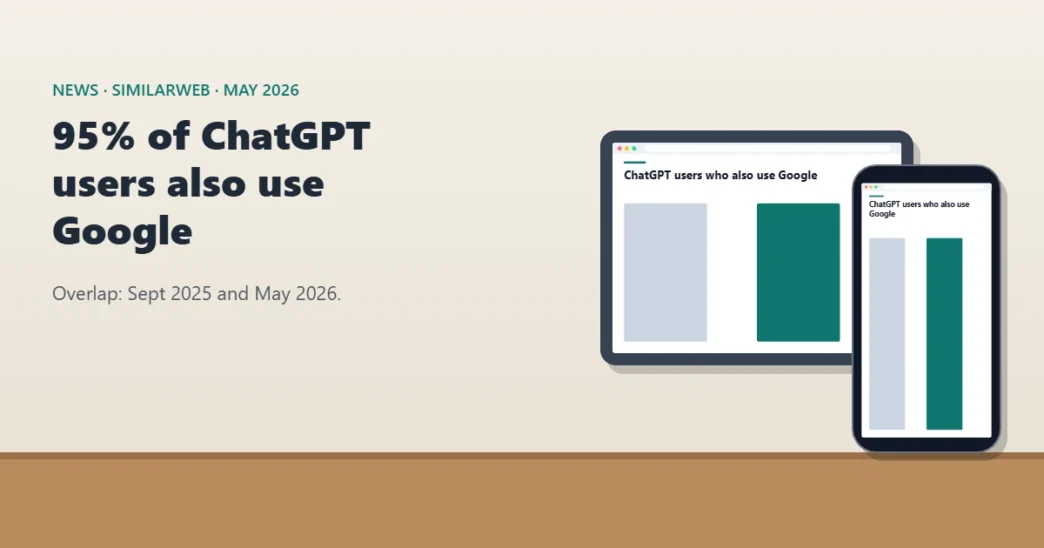
Audience overlap is the share of one product’s users who also use another in the same period. In the ChatGPT vs Google comparison, it was 95.3% in August 2025 [2]. Similarweb’s 2026 report puts it at 95% in September 2025 and still 95% in May 2026 [1]. So almost everyone who uses ChatGPT also uses Google. This page sets out the figures, what the overlap measures and what it misses, including a second study that points the other way. For tracking AI traffic on your own site, see our AI search visibility tracking guide.
In short
Almost all ChatGPT users also use Google, and that has held from August 2025 to May 2026. But the figure counts people, not searches. A separate study, as reported by Search Engine Journal, found fewer traditional searches in households that gained ChatGPT Search. Both can be true.
Updated 11 November 2026: this page was first published on 10 September 2025 with the August 2025 figures. We added the 2026 data and the caveats, and checked each figure against the pages we opened.
Table of Contents
ToggleChatGPT vs Google: the figures for August 2025 and May 2026
Read the cards as text
- August 2025, Similarweb data shared on X: 95.3% of ChatGPT users visited Google and 14.3% of Google users visited ChatGPT. ChatGPT had 5.8 billion visits against Google's 83.8 billion.
- May 2026, Similarweb's 2026 report: the overlap is 95%, as in September 2025. 461 million of 494 million ChatGPT users also used Google from March to May 2026.
- What overlap misses: it counts people, not queries. A Bocconi University study, reported by Search Engine Journal, found 9.4% fewer traditional search queries in households that gained ChatGPT Search.
- August 2025. Brodie Clark posted Similarweb data on X: 95.3% of ChatGPT users visited Google that month, and 14.3% of Google users visited ChatGPT [2]. Aleyda Solis added that ChatGPT had 5.8 billion visits in August 2025, against 83.8 billion for Google [2].
- May 2026. Similarweb’s 2026 Generative AI Landscape report puts the overlap at 95% in May 2026, the same as in September 2025 [1]. Search Engine Journal’s review of the report says 461 million of ChatGPT’s 494 million users also used Google between March and May 2026 [3].
- Search is still large. The same review puts search at 3.3 billion average monthly unique visitors worldwide [3].
Expert quote
"While ChatGPT continues to grow, people are very much still using Google." — Brodie Clark, who shared the Similarweb data on X, as quoted by Search Engine Roundtable, 9 September 2025 [2]
What the overlap measures, and what it does not
Similarweb is plain about the limit: overlap measures whether the same people show up in both audiences, not what happens inside any single research session. A person can still count as a Google user while sending a growing share of some query types to ChatGPT instead, and the report does not break out query-level substitution [1].
Watch out
Do not write "95% of people use Google instead of ChatGPT". The figure says 95% of ChatGPT users also use Google. Similarweb says overlap does not show what happens inside any single research session [1].
The same report says ChatGPT’s share of worldwide generative AI web traffic slid from roughly 76% a year earlier to around 53%, as Gemini, Claude, Perplexity and DeepSeek picked up the difference [1]. That is a shift within AI tools, not away from search, in Similarweb’s reading.
The second study: fewer searches, same audience
Search Engine Journal’s Matt G. Southern, writing on 4 September 2026, set the Similarweb overlap beside a study from Bocconi University. The study found a 9.4% drop in traditional search queries among households that gained access to ChatGPT Search, and the gap grew the longer they had it [4]. Southern’s explanation of why both can be true: overlap counts people, whereas the Bocconi study counts queries per household [4].
What else Similarweb’s 2026 report measured
The overlap figure is one row in a wider table. Similarweb’s own summary, for June 2025 to May 2026, gives these worldwide figures [1]:
- Generative AI web visits. An average of 9.5 billion a month, up 70% year on year.
- Generative AI app downloads. 4.4 billion, up 58% year on year, across iOS and Android.
- ChatGPT-Google overlap. 95%, flat against September 2025.
- Ads in ChatGPT chats. On US desktop, 26% of chats, up from 14% in May.
Two more points matter for a site owner. First, Similarweb says AI Overviews now appear on more than 40% of US searches, up from roughly a third a year earlier [1]. Second, it says the pages an AI answer cites and the pages that receive the resulting click are frequently different pages [1]. Presence in an answer and traffic from it are separate things.
Quick check
Our arithmetic: 461 million divided by 494 million is 93.3%, not 95%. Search Engine Journal gives both numbers for March to May 2026 [3]. We cannot tell whether the counts are rounded or come from different windows. Treat 95% as Similarweb's headline figure and 93% as what the two counts give.
Similarweb also states a limit that cuts against its own headline. The report excludes generative AI API usage, desktop applications and in-app AI features [1]. Those are the places where search-like work is most likely to happen without a visit to Google or to chatgpt.com, so they would not show up in the overlap figure.
Switch between the two studies, or show them together, to see what each one measures.
| Point | Similarweb overlap | Bocconi query study |
|---|---|---|
| Question asked | Do people who use ChatGPT also use Google? | Do households search less once they have ChatGPT Search? |
| What is counted | People who appear in both audiences. | Traditional search queries per household. |
| Period | September 2025 and May 2026. Also March to May 2026. | Not stated in the part we read. |
| Main result | 95% overlap both times. 461M of 494M in March to May 2026. | 9.4% fewer traditional queries, a gap that grew the longer households had access. |
| Limits | Shows the same people in both audiences, not what happens in one session. No query-level breakdown. | Reported by Search Engine Journal. We did not open the paper. |
Worth knowing
The Search Engine Roundtable headline says "15%" of Google users use ChatGPT, but the figure Brodie Clark posted is 14.3% [2]. We use 14.3%.
Our analysis: both can be true, and the second is the one to watch
Our analysis: the 95% figure answers “are people leaving Google?”. It does not answer “are people searching Google less?”. Those are different questions, and the evidence on the second is thinner. We read the Bocconi result as reported by Search Engine Journal. It is one study and we did not open the paper, so we hold it loosely.
For a site owner, the useful reading is that Google is still where nearly everyone starts, and that some of their questions may now go elsewhere. Plan for both.
What to do now
- Check your own trend. In Search Console, compare clicks for informational queries year on year. That is your evidence, not an industry average.
- Track AI referrals separately. Segment traffic from chatgpt.com in your analytics so it does not hide in “referral”.
- Quote the figure correctly. Say “95% of ChatGPT users also use Google”, name Similarweb and give the period.
- Keep earning clicks. Our piece on ranking without the clicks covers what to do when impressions hold and clicks fall.
What we do not know yet
- The 2026 figure for Google users who visit ChatGPT. The 14.3% figure is from August 2025. We found no matching 2026 figure in the pages we opened.
- Query-level substitution. Similarweb’s report does not break it out [1].
- Usage the report leaves out. API usage, desktop applications and in-app AI features are excluded [1], so we cannot say how much search-like work happens there.
- The 93% against 95% gap. The counts in the Search Engine Journal review give 93.3%, and the review states 95% [3].
- The Bocconi study’s details. We did not open the paper, so its sample, period and limits are unchecked by us [4].
Frequently asked questions
What does "95% of ChatGPT users also use Google" mean?
Of the people who used ChatGPT in a period, 95% also appeared in Google’s audience in the same period. It is an overlap of audiences, not a share of searches.
Does the 95% prove AI is not replacing search?
No. Similarweb says overlap does not show what happens in a single session. A separate study, as reported by Search Engine Journal, found 9.4% fewer traditional search queries in households with ChatGPT Search.
How many visits did ChatGPT and Google get in August 2025?
Aleyda Solis, citing Similarweb, put ChatGPT at 5.8 billion visits and Google at 83.8 billion.
Is ChatGPT's share of AI traffic growing?
Not in Similarweb’s data. It says ChatGPT’s share of worldwide generative AI web traffic slid from roughly 76% to around 53% over a year.
How big is generative AI traffic overall?
Similarweb’s summary for June 2025 to May 2026 gives an average of 9.5 billion web visits a month worldwide, up 70% year on year, and 4.4 billion app downloads, up 58%.
How often do AI Overviews appear?
Similarweb says on more than 40% of US searches, up from roughly a third a year earlier.
Treat ChatGPT vs Google overlap as the start of the picture, then check your own data
Use the overlap to explain why Google still matters, and your own Search Console data to see whether people are searching less. Our AI search visibility tracking guide shows how to measure the AI side.
Sources
- Similarweb, "Is AI Replacing Search? What The 2026 Numbers Actually Reveal", Maayan Zohar Basteker, 4 August 2026 (updated 17 September 2026). Read on 11 November 2026.
- Search Engine Roundtable, "Report: Almost All ChatGPT Users Also Use Google", Barry Schwartz, 9 September 2025. Read on 11 November 2026.
- Search Engine Journal, "AI Search Isn't Replacing Google, It's Layering On Top: Similarweb Data", Greg Jarboe, 30 July 2026. Read on 11 November 2026.
- Search Engine Journal, "People Aren't Leaving Google For AI. They're Using Both.", Matt G. Southern, 4 September 2026. Read on 11 November 2026.