


The digital marketing rulebook has been rewritten. In a seismic shift that has left traditional publishers scrambling, new data from SEMrush reveals that Quora has taken the #1 spot as Google AI’s most cited source, with Reddit following closely in second place. This isn’t just a ranking change—it’s a fundamental shift in how authority is established online, signaling the rise of community-driven expertise over corporate content.
Table of Contents
ToggleThe Numbers Don’t Lie: User-Generated Content Dominates AI Citations
SEMrush’s analysis shatters traditional notions of online authority with these key findings:
The New Digital Hierarchy:
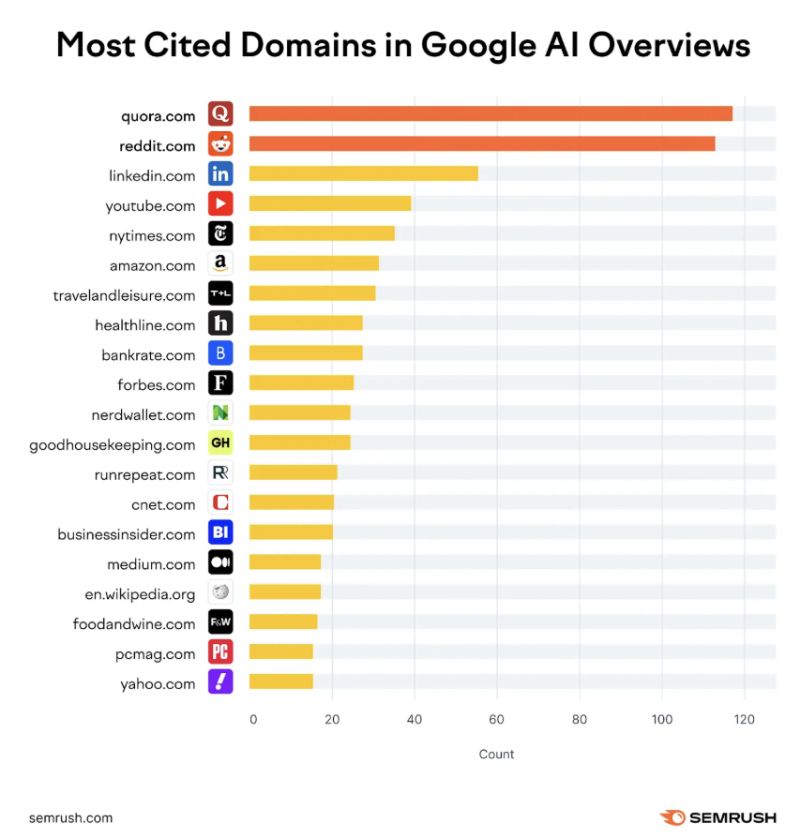
Quora leads with ~120 citations—outperforming all traditional media outlets
Reddit follows with ~110 citations—more trusted than The New York Times
LinkedIn takes third place with roughly 60 citations
Traditional publishers fall behind: Forbes, Business Insider, and even Wikipedia trail significantly
But here’s the real shocker: AI Overviews are skyrocketing. In March 2025, they appeared in 13.14% of all queries, up from just 6.49% in January 2025. This explosive growth means community-driven content now influences billions of search results every month.
The $32.6 Billion Wake-Up Call: The UGC Market Boom
The shift toward community-driven content isn’t just changing citations—it’s fueling an entirely new economy.
The global UGC market is currently worth \$5.36 billion but is projected to surge to \$32.6 billion by 2030.
In the U.S. alone, spending on UGC content is expected to exceed $10 billion in 2025, up 11% from $9 billion in 2024.
Pro Tip #1: Start treating user-generated content as a strategic asset, not just social media filler. Brands investing in UGC now will dominate search visibility in the AI era.
The Trust Factor: Why AI Systems Prefer Community Content
This shift isn’t accidental—it’s a reflection of what users already know:
93% of marketers say UGC performs better than traditional branded content.
6 in 10 consumers believe UGC is the most authentic form of marketing.
92% of consumers trust UGC more than traditional ads.
40% of shoppers say UGC is critical in their purchase decisions.
The Conversational Advantage
Google’s AI prioritizes informational content, with 88.1% of AI Overviews triggered by informational queries. Forums like Quora and Reddit excel because their content mirrors real human questions and answers, making them ideal for AI responses.
Strategic Intelligence: How Industry Leaders Are Adapting
Forward-thinking brands aren’t waiting—they’re already pivoting:
1. The LinkedIn Professional Play
LinkedIn articles have become the fourth most cited source, proving professional platform content is gaining traction with AI.
2. The Multi-Platform Approach
50% of links in ChatGPT 4o responses point to business websites, even though Quora and Reddit dominate individually.
Pro Tip #2: Don’t abandon owned content—instead, adopt a hub-and-spoke model, distributing expertise across both owned properties and community platforms.
The Plot Twist: Reddit & Quora’s Declining AI Citations
The story takes an unexpected turn:
Reddit citations have dropped by ~85%
Quora citations have nearly vanished, down 99%
This reversal stems from Google’s “pizza glue” fiasco, where AI Overviews pulled bizarre advice (like eating glue) from these platforms, forcing Google to reduce reliance on them.
What This Means for Your Strategy:
The decline doesn’t negate UGC’s value—it refines it. Google still cites Reddit/Quora 2-5% of the time, while ChatGPT avoids them (<0.5%).
Pro Tip #3: Focus on high-quality, moderated platforms with strong fact-checking.
The New SEO Reality: From Keywords to Community Authority
Traditional SEO metrics are becoming obsolete. Success now depends on:
Quality of Community Engagement
Cross-Platform Authority
AI Mention Rate
Who Wins & Who Loses in the UGC Era?
Winners:
✔ Community platforms (Reddit, Quora, LinkedIn)
✔ Brands leveraging authentic UGC
✔ Subject matter experts engaging across forums
✔ Content curators synthesizing community insights
Losers:
❌ Traditional publishers stuck in old models
❌ SEO agencies still fixated on 2020 tactics
❌ Corporate blogs pushing promotional fluff
❌ Link-building services (backlinks matter less now)
The Millennial & Gen Z Effect: Fueling UGC Dominance
Millennials find UGC 35% more memorable and 50% more trustworthy than other media.
People over 25 create 70% of all UGC.
35% of Gen Z believes UGC will grow even more credible in the next 3-5 years.
Pro Tip #4: Craft short, authentic, question-answering content tailored for community platforms.
The AI Search Fragmentation: Beyond Google
The search landscape is diversifying:
Google still leads with 139.9 billion visits
ChatGPT’s weekly active users grew 8x (Oct 2023–Apr 2025), now exceeding 800M
Perplexity AI’s monthly visits hit 160M in March 2025 (up 205% YoY)
The Multi-Engine Strategy
ChatGPT leans on Wikipedia
Google’s AI favors Reddit
Perplexity prefers expert sites (NerdWallet, ConsumerReports)
Your 90-Day Community Authority Plan
Phase 1 (Days 1-30): Foundation
Audit where your audience asks questions
Identify unanswered questions in your niche
Build expert profiles on key platforms
Restructure content for Q&A formats
Phase 2 (Days 31-60): Engagement
Spend 30 mins daily in community discussions
Create content answering specific questions
Syndicate content across platforms
Track AI citations of your expertise
Phase 3 (Days 61-90): Scaling Authority
Become a recognized community leader
Publish original research
Partner with other experts
Optimize content for AI quotability
Pro Tip #5: Be helpful, not promotional—communities spot (and reject) marketing fluff instantly.
The Bottom Line: Adapt or Become Irrelevant
The UGC revolution isn’t coming—it’s already here. Brands clinging to old-school content marketing will fade into obscurity in the AI-driven search landscape.
The New Success Formula:
✅ Authentic engagement > Link building
✅ Q&A content > Generic blog posts
✅ Cross-platform authority > Single-site SEO
✅ AI citation rate > Traditional rankings
The Urgency Factor:
With AI Overviews now reaching 1.5 billion users monthly, the window to establish authority is closing fast.
The future belongs to brands that can genuinely contribute to the communities where their customers seek answers. The age of interruption marketing is over—the era of helpful participation has begun.
Visual guide
🚀 The UGC Revolution
How Community Content Conquered Google AI Citations
🏆 Google AI's Most Cited Sources
Quora
~110 citations - Community discussions win
~60 citations - Professional insights
YouTube, NY Times, Amazon
40-50 citations each - Traditional media trails
📊 Market Intelligence
💰 Investment Surge
US spending on UGC content expected to exceed $10 billion in 2025, up 11% from $9 billion in 2024. Overall growth since 2021: 100%
🎯 Consumer Behavior
40% of shoppers say UGC is "extremely" or "very" important when making purchase decisions - more than product videos (37%)
🔄 The Platform Shift
88.1% of queries that trigger AI Overviews are informational - exactly what community platforms excel at providing
📈 ROI Impact
Brands utilizing effective UGC report conversion rates increasing by up to 41%
🔥 Trending Insights
👥 Generational Impact
Millennials find UGC 35% more memorable than other media and trust it 50% more. People over 25 create over 70% of all UGC.
🤖 AI System Preferences
Google's engines show strong appetite for UGC (2-5% of citations), while ChatGPT avoids it almost entirely (<0.5%)
📱 Platform Evolution
Reddit citations have plummeted 85% due to quality concerns, while LinkedIn articles became the 4th most cited source
🎨 Content Format Shift
UGC in email marketing drives 78% higher click-through rates. 33% of all online content will be user-generated by 2033
💡 Strategic Takeaways
🎯 Community-First Strategy
Focus on authentic community engagement over traditional link building. The brands establishing community authority now will dominate search visibility tomorrow.
📝 Question-Answering Content
Create content that directly answers specific questions in conversational language. Structure content for AI quotability and community sharing.
📊 New Success Metrics
Track citation frequency in AI responses, community engagement quality, and cross-platform authority rather than just traditional rankings.
🚀 Multi-Platform Authority
Optimize for all AI systems (Google, ChatGPT, Perplexity) with platform-specific content strategies. Each system has unique source preferences.
📈 The UGC Revolution: From $5.36B to $32.6B by 2030 | 🤖 13.14% of searches now use AI Overviews | 🏆 Community content beats traditional media
Source: Semrush | Analysis by: aiseojournal.net



, this growth pattern is consistent across multiple industries and represents the fastest adoption of any new digital channel in recent history. To put this in perspective: - **January 2025:** 17,076 AI-sourced sessions - **May 2025:** 107,100 AI-sourced sessions - **Growth Rate:** 527% in just five months One standout example saw ChatGPT traffic alone grow from 600 visits per month in early 2024 to over 22,000 visits per month by May 2025—a 3,567% increase for a single platform. **💡 Pro Tip:** Track AI referral traffic in Google Analytics 4 by setting up custom dimensions for referral sources including "chat.openai.com," "perplexity.ai," and "claude.ai" to monitor your own AI discovery performance. ### Industry Distribution The surge isn't uniform across all sectors. High-consultative industries are leading the charge, as documented in [Search Engine Journal's analysis of AI traffic patterns](https://www.searchenginejournal.com/study-chatgpt-ai-tools-gain-ground-in-search-market/536137/): **Top Performing Industries:** 1. **Legal Services** - Complex regulatory questions drive AI consultations 2. **Finance & Banking** - Users seek personalized financial advice and explanations 3. **Healthcare** - Medical inquiries and symptom research dominate queries 4. **Insurance** - Policy comparisons and coverage explanations 5. **SMB Consulting** - Business strategy and operational guidance These five industries collectively account for **55% of all AI-driven sessions**, highlighting users' preference for AI assistance with complex, high-stakes decisions. **💡 Pro Tip:** If you're in a high-trust industry, prioritize creating comprehensive FAQ sections and expert-authored content, as these formats perform exceptionally well in AI discovery scenarios. ## Platform Landscape Analysis ### ChatGPT's Dominance ChatGPT continues to lead the AI traffic generation, but its monopoly is weakening. The platform benefits from: - First-mover advantage in consumer AI - Superior natural language processing - Broad general knowledge capabilities - Strong brand recognition ### Emerging Competitors **Perplexity** has gained significant traction with its search-focused approach, offering: - Real-time web search integration - Source citations and transparency - Specialized research capabilities **Google's Gemini** leverages integration advantages: - Native Google ecosystem integration - Android device pre-installation - Seamless transition from traditional search **Microsoft Copilot** capitalizes on enterprise relationships: - Office 365 integration - Business-focused use cases - Professional workflow optimization **Anthropic's Claude** appeals to quality-conscious users: - Reputation for accuracy and safety - Longer context windows - Nuanced reasoning capabilities ## User Behavior Transformation ### The "Instant Surfacing Era" Traditional SEO operated on a crawl-index-rank cycle that rewarded patience and authority building. AI discovery operates differently, as explained in [Ahrefs' comprehensive study on AI search behavior](https://ahrefs.com/blog/ai-overviews-reduce-clicks/): **Old Model:** Publish → Wait for crawling → Hope for indexing → Optimize for ranking → Generate traffic **New Model:** Create quality content → Get immediately surfaced by AI → Receive targeted referrals This shift means content can be discovered and drive traffic before it even ranks in traditional search engines. **💡 Pro Tip:** Focus on creating content that directly answers specific questions rather than optimizing for broad keywords. AI models excel at understanding intent and context, making traditional keyword density tactics less effective. ### Quality Over Quantity AI platforms prioritize content that is: - **Clear and structured** - Easy for models to parse and understand - **Authoritative** - From recognized experts or institutions - **Comprehensive** - Covers topics thoroughly rather than superficially - **Current** - Up-to-date information that reflects latest developments ## Business Implications ### For SaaS Companies Some SaaS businesses are already seeing over 1% of total traffic from AI platforms. While this might seem modest, it represents: - **High-intent users** who have actively sought AI assistance - **Qualified prospects** who've engaged with AI to solve specific problems - **Bottom-funnel traffic** with higher conversion potential ### For Content Publishers The implications vary significantly by content type: **Winners:** - Educational content creators - How-to and tutorial publishers - Industry analysis and research firms - Expert commentary and opinion sites **Challenges:** - Breaking news publishers (AI prefers verified information) - Listicle and aggregation sites (AI can synthesize directly) - SEO-optimized but thin content creators ### For E-commerce AI discovery is particularly powerful for complex purchase decisions, as highlighted in [Adobe's recent analysis of AI-driven retail traffic](https://searchengineland.com/generative-ai-surging-online-shopping-report-453312): - **Electronics** - Specification comparisons and recommendations - **Healthcare products** - Safety and efficacy information - **Financial services** - Product feature explanations - **Professional services** - Capability and pricing inquiries **💡 Pro Tip:** Create detailed product comparison guides and technical specification sheets, as AI assistants frequently reference these when helping users make purchase decisions. ## Strategic Recommendations ### Immediate Actions (0-3 months) **Content Optimization:** - Restructure existing content with clear headers and bullet points - Add FAQ sections that directly answer common queries - Include expert credentials and authority signals - Ensure information accuracy and currency **Technical Preparation:** - Implement structured data markup - Optimize for featured snippets - Ensure fast loading times and mobile optimization - Create XML sitemaps with updated lastmod tags ### Medium-term Strategy (3-12 months) **Authority Building:** - Develop thought leadership content - Seek expert citations and backlinks - Build relationships with industry authorities - Create comprehensive resource hubs **AI-First Content Creation:** - Design content specifically for AI consumption - Focus on answering complete questions rather than keyword optimization - Create content that provides context and nuance - Develop expertise-driven content series ### Long-term Vision (12+ months) **Platform Diversification:** - Develop relationships with multiple AI platforms - Create platform-specific content strategies - Monitor emerging AI discovery channels - Build direct AI API integrations where possible **Measurement Evolution:** - Develop new KPIs beyond traditional traffic metrics - Track AI mention frequency and context - Monitor brand authority signals - Measure assisted conversions from AI discovery ## Challenges and Considerations ### Attribution Complexity AI-driven traffic often involves multiple touchpoints, as detailed in [Kevin Indig's user experience study of AI Overviews](https://searchengineland.com/google-ai-overviews-user-behavior-study-455511): - Initial discovery through AI - Verification through traditional search - Social proof seeking on platforms like Reddit - Final conversion on the target website This multi-step journey makes traditional attribution models inadequate. **💡 Pro Tip:** Implement UTM parameters for AI referral traffic and set up custom conversion paths in Google Analytics to better understand the full user journey from AI discovery to conversion. ### Content Investment ROI The shift requires significant content strategy changes: - Higher upfront investment in comprehensive content - Longer content development cycles - Greater emphasis on expertise and authority - Reduced reliance on keyword-driven content ### Competitive Dynamics As more businesses optimize for AI discovery: - Competition for AI attention will intensify - Authority and trust signals will become more valuable - First-mover advantages will compound - Smaller players may struggle to gain AI visibility ## Future Outlook ### Growth Projections If current trends continue, AI-referred traffic could represent: - **5-10% of total website traffic** by end of 2025 - **15-20% for high-trust industries** by 2026 - **Major revenue channel** for information-based businesses ### Technology Evolution Expected developments include: - **Improved accuracy** reducing user verification needs - **Better source attribution** providing clearer traffic attribution - **Industry-specific AI models** creating niche opportunities - **Voice and visual AI search** expanding discovery channels ### Market Maturation The AI discovery market will likely evolve through: - **Platform consolidation** as winners emerge - **Specialized AI services** for specific industries - **Direct publisher partnerships** with AI platforms - **New monetization models** beyond traditional advertising ## Conclusion: Preparing for the AI-First Future The 527% surge in AI-driven traffic is not a temporary spike—it's the beginning of a fundamental shift in how people discover and consume information online. Organizations that recognize this trend early and adapt their content and discovery strategies accordingly will capture disproportionate value in the emerging AI-first digital ecosystem. The companies thriving in this new landscape will be those that prioritize authority, clarity, and genuine expertise over traditional SEO tactics. As AI becomes the primary discovery layer for complex information, the winners will be those who can effectively communicate their knowledge through these new channels while maintaining the trust and credibility that AI platforms increasingly value. The question is no longer whether AI will reshape web discovery—it's whether your organization will be ready to succeed in this new reality. --- ## Additional Resources **Essential Reading:** - [Previsible's 2025 AI Traffic Study](https://previsible.io/seo-strategy/ai-seo-study-2024/) - Complete methodology and findings - [Search Engine Land's AI Search Coverage](https://searchengineland.com/generative-ai-surging-online-shopping-report-453312) - Latest industry trends and analysis - [Ahrefs' AI Overviews Research](https://ahrefs.com/blog/ai-overviews-reduce-clicks/) - Technical insights and click-through rate data **Tools for AI Discovery Tracking:** - [Previsible's Free AI Traffic Dashboard](https://previsible.io/) - Monitor LLM referrals in Looker Studio - [SE Ranking's AI Overview Tracker](https://seranking.com/) - Track AI visibility and citations - Google Analytics 4 - Set up custom dimensions for AI referral sources **💡 Final Pro Tip:** Subscribe to AI platform newsletters and developer updates to stay informed about algorithm changes that could affect your content's discoverability in AI search results. *This report is based on analysis from Previsible's 2025 AI Traffic Study, examining 19 GA4 properties across multiple industries and timeframes.*](https://aiseojournal.net/wp-content/uploads/2025/08/AI-Assistants-Drive-527_-Traffic-Spike-332x332.png)
, this growth pattern is consistent across multiple industries and represents the fastest adoption of any new digital channel in recent history. To put this in perspective: - **January 2025:** 17,076 AI-sourced sessions - **May 2025:** 107,100 AI-sourced sessions - **Growth Rate:** 527% in just five months One standout example saw ChatGPT traffic alone grow from 600 visits per month in early 2024 to over 22,000 visits per month by May 2025—a 3,567% increase for a single platform. **💡 Pro Tip:** Track AI referral traffic in Google Analytics 4 by setting up custom dimensions for referral sources including "chat.openai.com," "perplexity.ai," and "claude.ai" to monitor your own AI discovery performance. ### Industry Distribution The surge isn't uniform across all sectors. High-consultative industries are leading the charge, as documented in [Search Engine Journal's analysis of AI traffic patterns](https://www.searchenginejournal.com/study-chatgpt-ai-tools-gain-ground-in-search-market/536137/): **Top Performing Industries:** 1. **Legal Services** - Complex regulatory questions drive AI consultations 2. **Finance & Banking** - Users seek personalized financial advice and explanations 3. **Healthcare** - Medical inquiries and symptom research dominate queries 4. **Insurance** - Policy comparisons and coverage explanations 5. **SMB Consulting** - Business strategy and operational guidance These five industries collectively account for **55% of all AI-driven sessions**, highlighting users' preference for AI assistance with complex, high-stakes decisions. **💡 Pro Tip:** If you're in a high-trust industry, prioritize creating comprehensive FAQ sections and expert-authored content, as these formats perform exceptionally well in AI discovery scenarios. ## Platform Landscape Analysis ### ChatGPT's Dominance ChatGPT continues to lead the AI traffic generation, but its monopoly is weakening. The platform benefits from: - First-mover advantage in consumer AI - Superior natural language processing - Broad general knowledge capabilities - Strong brand recognition ### Emerging Competitors **Perplexity** has gained significant traction with its search-focused approach, offering: - Real-time web search integration - Source citations and transparency - Specialized research capabilities **Google's Gemini** leverages integration advantages: - Native Google ecosystem integration - Android device pre-installation - Seamless transition from traditional search **Microsoft Copilot** capitalizes on enterprise relationships: - Office 365 integration - Business-focused use cases - Professional workflow optimization **Anthropic's Claude** appeals to quality-conscious users: - Reputation for accuracy and safety - Longer context windows - Nuanced reasoning capabilities ## User Behavior Transformation ### The "Instant Surfacing Era" Traditional SEO operated on a crawl-index-rank cycle that rewarded patience and authority building. AI discovery operates differently, as explained in [Ahrefs' comprehensive study on AI search behavior](https://ahrefs.com/blog/ai-overviews-reduce-clicks/): **Old Model:** Publish → Wait for crawling → Hope for indexing → Optimize for ranking → Generate traffic **New Model:** Create quality content → Get immediately surfaced by AI → Receive targeted referrals This shift means content can be discovered and drive traffic before it even ranks in traditional search engines. **💡 Pro Tip:** Focus on creating content that directly answers specific questions rather than optimizing for broad keywords. AI models excel at understanding intent and context, making traditional keyword density tactics less effective. ### Quality Over Quantity AI platforms prioritize content that is: - **Clear and structured** - Easy for models to parse and understand - **Authoritative** - From recognized experts or institutions - **Comprehensive** - Covers topics thoroughly rather than superficially - **Current** - Up-to-date information that reflects latest developments ## Business Implications ### For SaaS Companies Some SaaS businesses are already seeing over 1% of total traffic from AI platforms. While this might seem modest, it represents: - **High-intent users** who have actively sought AI assistance - **Qualified prospects** who've engaged with AI to solve specific problems - **Bottom-funnel traffic** with higher conversion potential ### For Content Publishers The implications vary significantly by content type: **Winners:** - Educational content creators - How-to and tutorial publishers - Industry analysis and research firms - Expert commentary and opinion sites **Challenges:** - Breaking news publishers (AI prefers verified information) - Listicle and aggregation sites (AI can synthesize directly) - SEO-optimized but thin content creators ### For E-commerce AI discovery is particularly powerful for complex purchase decisions, as highlighted in [Adobe's recent analysis of AI-driven retail traffic](https://searchengineland.com/generative-ai-surging-online-shopping-report-453312): - **Electronics** - Specification comparisons and recommendations - **Healthcare products** - Safety and efficacy information - **Financial services** - Product feature explanations - **Professional services** - Capability and pricing inquiries **💡 Pro Tip:** Create detailed product comparison guides and technical specification sheets, as AI assistants frequently reference these when helping users make purchase decisions. ## Strategic Recommendations ### Immediate Actions (0-3 months) **Content Optimization:** - Restructure existing content with clear headers and bullet points - Add FAQ sections that directly answer common queries - Include expert credentials and authority signals - Ensure information accuracy and currency **Technical Preparation:** - Implement structured data markup - Optimize for featured snippets - Ensure fast loading times and mobile optimization - Create XML sitemaps with updated lastmod tags ### Medium-term Strategy (3-12 months) **Authority Building:** - Develop thought leadership content - Seek expert citations and backlinks - Build relationships with industry authorities - Create comprehensive resource hubs **AI-First Content Creation:** - Design content specifically for AI consumption - Focus on answering complete questions rather than keyword optimization - Create content that provides context and nuance - Develop expertise-driven content series ### Long-term Vision (12+ months) **Platform Diversification:** - Develop relationships with multiple AI platforms - Create platform-specific content strategies - Monitor emerging AI discovery channels - Build direct AI API integrations where possible **Measurement Evolution:** - Develop new KPIs beyond traditional traffic metrics - Track AI mention frequency and context - Monitor brand authority signals - Measure assisted conversions from AI discovery ## Challenges and Considerations ### Attribution Complexity AI-driven traffic often involves multiple touchpoints, as detailed in [Kevin Indig's user experience study of AI Overviews](https://searchengineland.com/google-ai-overviews-user-behavior-study-455511): - Initial discovery through AI - Verification through traditional search - Social proof seeking on platforms like Reddit - Final conversion on the target website This multi-step journey makes traditional attribution models inadequate. **💡 Pro Tip:** Implement UTM parameters for AI referral traffic and set up custom conversion paths in Google Analytics to better understand the full user journey from AI discovery to conversion. ### Content Investment ROI The shift requires significant content strategy changes: - Higher upfront investment in comprehensive content - Longer content development cycles - Greater emphasis on expertise and authority - Reduced reliance on keyword-driven content ### Competitive Dynamics As more businesses optimize for AI discovery: - Competition for AI attention will intensify - Authority and trust signals will become more valuable - First-mover advantages will compound - Smaller players may struggle to gain AI visibility ## Future Outlook ### Growth Projections If current trends continue, AI-referred traffic could represent: - **5-10% of total website traffic** by end of 2025 - **15-20% for high-trust industries** by 2026 - **Major revenue channel** for information-based businesses ### Technology Evolution Expected developments include: - **Improved accuracy** reducing user verification needs - **Better source attribution** providing clearer traffic attribution - **Industry-specific AI models** creating niche opportunities - **Voice and visual AI search** expanding discovery channels ### Market Maturation The AI discovery market will likely evolve through: - **Platform consolidation** as winners emerge - **Specialized AI services** for specific industries - **Direct publisher partnerships** with AI platforms - **New monetization models** beyond traditional advertising ## Conclusion: Preparing for the AI-First Future The 527% surge in AI-driven traffic is not a temporary spike—it's the beginning of a fundamental shift in how people discover and consume information online. Organizations that recognize this trend early and adapt their content and discovery strategies accordingly will capture disproportionate value in the emerging AI-first digital ecosystem. The companies thriving in this new landscape will be those that prioritize authority, clarity, and genuine expertise over traditional SEO tactics. As AI becomes the primary discovery layer for complex information, the winners will be those who can effectively communicate their knowledge through these new channels while maintaining the trust and credibility that AI platforms increasingly value. The question is no longer whether AI will reshape web discovery—it's whether your organization will be ready to succeed in this new reality. --- ## Additional Resources **Essential Reading:** - [Previsible's 2025 AI Traffic Study](https://previsible.io/seo-strategy/ai-seo-study-2024/) - Complete methodology and findings - [Search Engine Land's AI Search Coverage](https://searchengineland.com/generative-ai-surging-online-shopping-report-453312) - Latest industry trends and analysis - [Ahrefs' AI Overviews Research](https://ahrefs.com/blog/ai-overviews-reduce-clicks/) - Technical insights and click-through rate data **Tools for AI Discovery Tracking:** - [Previsible's Free AI Traffic Dashboard](https://previsible.io/) - Monitor LLM referrals in Looker Studio - [SE Ranking's AI Overview Tracker](https://seranking.com/) - Track AI visibility and citations - Google Analytics 4 - Set up custom dimensions for AI referral sources **💡 Final Pro Tip:** Subscribe to AI platform newsletters and developer updates to stay informed about algorithm changes that could affect your content's discoverability in AI search results. *This report is based on analysis from Previsible's 2025 AI Traffic Study, examining 19 GA4 properties across multiple industries and timeframes.*](https://aiseojournal.net/wp-content/uploads/2025/08/AI-Assistants-Drive-527_-Traffic-Spike-688x387.png)
![# Google's AI Summaries Cut Website Clicks by One-Third, New Studies Reveal *Landmark research exposes the dramatic impact of AI Overviews on web traffic, raising existential questions for digital publishing and the open internet* **By [News Reporter] | August 16, 2025** Multiple independent studies released this year reveal that Google's AI Overviews feature is fundamentally reshaping internet traffic patterns, slashing click-through rates to websites by as much as 34.5% and accelerating the shift toward "zero-click" searches that keep users within Google's ecosystem. The findings, based on analysis of millions of search queries and extensive user behavior data, paint a stark picture of disruption across the digital landscape and raise urgent questions about the future sustainability of content creation and journalism in an AI-dominated search environment. ## The Numbers Tell a Stark Story **The most comprehensive study**, conducted by SEO tool provider Ahrefs using Google Search Console data from 300,000 keywords, found that when AI Overviews appear in search results, the click-through rate for the top-ranking result drops by 34.5% compared to traditional search results. In March 2024, the average CTR for the #1 result on AI Overview keywords was 0.073. In March 2025, this had dropped to 0.026, representing a catastrophic decline for websites that previously dominated search traffic. **Performance agency Amsive** corroborated these findings with their analysis of 700,000 keywords across 10 websites and 5 industries, documenting an average 15.49% CTR drop, with much larger losses in specific cases (e.g., -37.04% when combined with featured snippets). **The Pew Research Center** provided the most authoritative user behavior analysis, studying 900 U.S. adults' actual browsing patterns in March 2025. Their findings were unambiguous: Google users who encountered an AI summary were less likely to click on links to other websites than users who did not see one. ## The Zero-Click Revolution Accelerates Perhaps most concerning for content creators is the broader trend toward "zero-click" searches, where users get their answers directly from Google without visiting any external websites. Recent data from SparkToro reveals that 58.5% of Google searches in the U.S. and 59.7% in the EU result in zero clicks. For news publishers specifically, the impact has been devastating. According to Similarweb data, the number of searches for news that result in no click-throughs to news websites has grown from 56% to nearly 69% by May 2025 since Google launched AI Overviews in May 2024. The scope of AI Overviews continues expanding rapidly. Around one-in-five Google searches in March 2025 produced an AI summary, and 13.14% of all queries triggered AI Overviews in March 2025, up from 6.49% in January 2025. ## Publishers Face "Extinction-Level Event" The real-world impact on content creators and news organizations has been severe. Website owner Morgan McBride saw traffic to her crafting website plummet by 70% after AI Overviews launched, with some days making it "hard to even get out of bed" due to the financial devastation. Major news outlets are feeling the squeeze across the board: - 40 of People magazine's top 100 search keywords triggered AI Overviews in May 2025 - 32 keywords for Daily Mail and 21 for The Washington Post now trigger AI summaries - 75% of CBS News' top 100 search keywords that triggered AI Overviews resulted in no click-throughs in May 2025, compared to 54% previously Educational technology company Chegg has gone so far as to sue Google, claiming that AI summaries of search results have hurt Chegg's traffic and revenue, while simultaneously trying to restructure their business model to adapt to the new reality. ## Google's Response: Quality Over Quantity Facing mounting criticism from publishers and content creators, Google has attempted to reframe the narrative around traffic metrics. The company now argues that while overall click volume may decline, the quality of clicks has improved. Google explains that a quality click is one where users don't quickly click back — they stay and read, and claims it is sending "slightly more quality clicks" to websites than a year ago. Elizabeth Reid, Head of Google Search, has positioned AI Overviews as pre-filtering systems, explaining that users clicking through to websites have already consumed introductory information, arriving with specific intent for deeper content or transactions. However, this messaging has been met with skepticism from industry observers. "The fact that Google is pushing this 'AI is not the end of search traffic!' PR now only makes the situation seem more dire," noted TechCrunch's analysis of Google's defensive positioning. ## The Technical Reality Behind the Numbers The studies reveal specific patterns about which types of searches are most affected by AI Overviews: **Query Length Matters**: 8% of one- or two-word searches got a summary, versus 53% of 10+ word searches, indicating that more detailed, informational queries are most likely to trigger AI responses. **Question-Based Searches Hit Hardest**: Question-based searches ("who," "what," "why") generated AI summaries 60% of the time, directly targeting the types of content that have historically driven significant traffic to educational and informational websites. **Informational Content Most Vulnerable**: 88.1% of queries that trigger an AI Overview are informational, affecting blogs, guides, tutorials, and news content more than commercial or transactional searches. ## The Sources Google Prefers Analysis of AI Overview citations reveals Google's content preferences: - Wikipedia, YouTube and Reddit were the most cited sites and accounted for 15% of links in summaries - Government (.gov) sites made up 6% of links in AI summaries vs. 2% in standard results - News sites appeared equally (5%) in both AI summaries and traditional results This data suggests Google's AI system favors authoritative, established platforms over smaller publishers and content creators. ## Industry Response and Adaptation Strategies As the digital marketing industry grapples with this seismic shift, experts are recommending fundamental changes to SEO and content strategies: **Diversification Beyond Google**: "Relying only on Google has always been risky. Look at other ways to drive traffic, including email newsletters, social posts, direct mail campaigns, podcast appearances, and referral programs" advises Burlington Press. **Brand Building Over Traffic**: Industry veterans emphasize that "in a world of zero clicks, visibility doesn't always appear in your analytics, but it still drives influence" and recommend focusing on brand recognition rather than pure traffic metrics. **Content Structure Optimization**: SEO professionals advise "structuring content in a way that makes it easy for Google to feature (such as using clear subheadings, bullet points, and concise answers)" to maintain visibility even without click-throughs. ## Editorial Analysis: A Fundamental Shift in Information Economics The data reveals more than just declining traffic numbers—it exposes a fundamental restructuring of how information flows through the digital economy. For two decades, the internet operated on a symbiotic model: search engines directed users to content creators, who monetized that traffic through advertising, subscriptions, or commerce. AI Overviews represent a profound departure from this model. By synthesizing and presenting information directly, Google essentially becomes both the distributor and the destination, potentially severing the economic relationship between search and content creation. **The Quality vs. Quantity Debate**: Google's argument about "higher quality" clicks deserves scrutiny. While users who do click through after reading an AI summary may indeed be more engaged, this ignores the broader ecosystem effects. If 34.5% fewer people click through, even if the remaining clicks are higher quality, the overall economic impact on publishers remains devastatingly negative. **The Innovation Paradox**: AI Overviews undoubtedly provide value to users seeking quick answers. However, they create a classic free-rider problem: Google benefits from synthesizing others' content while those content creators bear the costs of research, reporting, and fact-checking without receiving proportional compensation through traffic. **Long-term Sustainability Questions**: If content creators can no longer monetize their work through search traffic, what incentives remain for producing high-quality, original information? This could lead to a vicious cycle where the very sources that make AI summaries valuable begin to disappear. ## The Broader Implications The shift toward AI-powered search summaries reflects larger questions about information ownership, attribution, and economic sustainability in the digital age. As "AI-powered searches might be valuable in the short run but they might accelerate the enshittification of the internet in the long run" by undermining the economic incentives for quality content creation. The trend extends beyond Google. General search referral traffic to 1,000 web domains dipped from 12 billion global visits in June 2024 to 11.2 billion in June 2025 — about a 6.7% decline year over year, indicating broader structural changes in how people consume information online. ## What Comes Next Several critical developments will determine the future trajectory of this transformation: **Regulatory Intervention**: As publishers pursue legal action against AI companies, courts and regulators may need to establish new frameworks for content usage and compensation in the AI era. **Alternative Search Adoption**: The decline in Google click-through rates may accelerate adoption of alternative search engines and AI platforms that offer better publisher partnerships. **Business Model Innovation**: Publishers and content creators must rapidly develop new revenue streams that don't depend solely on search traffic, potentially including direct subscriptions, newsletters, and community-building initiatives. **Google's Policy Evolution**: Facing pressure from both users and publishers, Google may need to develop more equitable sharing mechanisms or risk losing the content ecosystem that makes its AI summaries valuable. ## The Bottom Line The data is unambiguous: Google's AI Overviews are fundamentally restructuring internet traffic patterns, with click-through rates declining by one-third or more when AI summaries appear. While users may benefit from faster access to information, the economic model that has sustained content creation for decades is under severe stress. For publishers, content creators, and anyone dependent on search traffic, adaptation is no longer optional—it's existential. The era of optimizing solely for Google rankings is ending, replaced by a more complex landscape requiring diversified strategies, direct audience relationships, and new approaches to value creation. The transformation is still in its early stages, but the trajectory is clear: the age of the click is giving way to the age of the summary, with profound implications for how information is created, distributed, and monetized in the digital economy. --- **Sources and External Links:** - [Ahrefs Study: AI Overviews Reduce Clicks by 34.5%](https://ahrefs.com/blog/ai-overviews-reduce-clicks/) - [Search Engine Land: Google AI Overviews Hurting Click-Through Rates](https://searchengineland.com/google-ai-overviews-hurt-click-through-rates-454428) - [Pew Research Center: Google Users Less Likely to Click When AI Summary Appears](https://www.pewresearch.org/short-reads/2025/07/22/google-users-are-less-likely-to-click-on-links-when-an-ai-summary-appears-in-the-results/) - [Amsive Digital: Google AI Overviews CTR Impact Study](https://www.amsive.com/insights/seo/google-ai-overviews-new-research-reveals-how-to-navigate-click-drop-off/) - [SparkToro: 2024 Zero-Click Search Study](https://searchengineland.com/google-search-zero-click-study-2024-443869) - [Digital Content Next: Google's AI Overviews Linked to Lower Publisher Clicks](https://digitalcontentnext.org/blog/2025/05/06/googles-ai-overviews-linked-to-lower-publisher-clicks/) - [Digiday: AI Platforms Driving More Traffic But Not Offsetting Zero-Click Search](https://digiday.com/media/in-graphic-detail-ai-platforms-are-driving-more-traffic-but-not-enough-to-offset-zero-click-search/) - [Fortune: Google's AI Overviews Quietly Reshaping the Internet](https://fortune.com/2025/07/24/googles-ai-overviews-eating-internet-search-traffic/) - [TechCrunch: Google Denies AI Search Features Are Killing Website Traffic](https://techcrunch.com/2025/08/06/google-denies-ai-search-features-are-killing-website-traffic/) *This report synthesizes data from multiple independent studies conducted throughout 2025, representing the most comprehensive analysis to date of AI Overviews' impact on web traffic and user behavior.*](https://aiseojournal.net/wp-content/uploads/2025/08/Googles-AI-Summaries-Cut-Website-Clicks-332x232.png)
![# Google's AI Summaries Cut Website Clicks by One-Third, New Studies Reveal *Landmark research exposes the dramatic impact of AI Overviews on web traffic, raising existential questions for digital publishing and the open internet* **By [News Reporter] | August 16, 2025** Multiple independent studies released this year reveal that Google's AI Overviews feature is fundamentally reshaping internet traffic patterns, slashing click-through rates to websites by as much as 34.5% and accelerating the shift toward "zero-click" searches that keep users within Google's ecosystem. The findings, based on analysis of millions of search queries and extensive user behavior data, paint a stark picture of disruption across the digital landscape and raise urgent questions about the future sustainability of content creation and journalism in an AI-dominated search environment. ## The Numbers Tell a Stark Story **The most comprehensive study**, conducted by SEO tool provider Ahrefs using Google Search Console data from 300,000 keywords, found that when AI Overviews appear in search results, the click-through rate for the top-ranking result drops by 34.5% compared to traditional search results. In March 2024, the average CTR for the #1 result on AI Overview keywords was 0.073. In March 2025, this had dropped to 0.026, representing a catastrophic decline for websites that previously dominated search traffic. **Performance agency Amsive** corroborated these findings with their analysis of 700,000 keywords across 10 websites and 5 industries, documenting an average 15.49% CTR drop, with much larger losses in specific cases (e.g., -37.04% when combined with featured snippets). **The Pew Research Center** provided the most authoritative user behavior analysis, studying 900 U.S. adults' actual browsing patterns in March 2025. Their findings were unambiguous: Google users who encountered an AI summary were less likely to click on links to other websites than users who did not see one. ## The Zero-Click Revolution Accelerates Perhaps most concerning for content creators is the broader trend toward "zero-click" searches, where users get their answers directly from Google without visiting any external websites. Recent data from SparkToro reveals that 58.5% of Google searches in the U.S. and 59.7% in the EU result in zero clicks. For news publishers specifically, the impact has been devastating. According to Similarweb data, the number of searches for news that result in no click-throughs to news websites has grown from 56% to nearly 69% by May 2025 since Google launched AI Overviews in May 2024. The scope of AI Overviews continues expanding rapidly. Around one-in-five Google searches in March 2025 produced an AI summary, and 13.14% of all queries triggered AI Overviews in March 2025, up from 6.49% in January 2025. ## Publishers Face "Extinction-Level Event" The real-world impact on content creators and news organizations has been severe. Website owner Morgan McBride saw traffic to her crafting website plummet by 70% after AI Overviews launched, with some days making it "hard to even get out of bed" due to the financial devastation. Major news outlets are feeling the squeeze across the board: - 40 of People magazine's top 100 search keywords triggered AI Overviews in May 2025 - 32 keywords for Daily Mail and 21 for The Washington Post now trigger AI summaries - 75% of CBS News' top 100 search keywords that triggered AI Overviews resulted in no click-throughs in May 2025, compared to 54% previously Educational technology company Chegg has gone so far as to sue Google, claiming that AI summaries of search results have hurt Chegg's traffic and revenue, while simultaneously trying to restructure their business model to adapt to the new reality. ## Google's Response: Quality Over Quantity Facing mounting criticism from publishers and content creators, Google has attempted to reframe the narrative around traffic metrics. The company now argues that while overall click volume may decline, the quality of clicks has improved. Google explains that a quality click is one where users don't quickly click back — they stay and read, and claims it is sending "slightly more quality clicks" to websites than a year ago. Elizabeth Reid, Head of Google Search, has positioned AI Overviews as pre-filtering systems, explaining that users clicking through to websites have already consumed introductory information, arriving with specific intent for deeper content or transactions. However, this messaging has been met with skepticism from industry observers. "The fact that Google is pushing this 'AI is not the end of search traffic!' PR now only makes the situation seem more dire," noted TechCrunch's analysis of Google's defensive positioning. ## The Technical Reality Behind the Numbers The studies reveal specific patterns about which types of searches are most affected by AI Overviews: **Query Length Matters**: 8% of one- or two-word searches got a summary, versus 53% of 10+ word searches, indicating that more detailed, informational queries are most likely to trigger AI responses. **Question-Based Searches Hit Hardest**: Question-based searches ("who," "what," "why") generated AI summaries 60% of the time, directly targeting the types of content that have historically driven significant traffic to educational and informational websites. **Informational Content Most Vulnerable**: 88.1% of queries that trigger an AI Overview are informational, affecting blogs, guides, tutorials, and news content more than commercial or transactional searches. ## The Sources Google Prefers Analysis of AI Overview citations reveals Google's content preferences: - Wikipedia, YouTube and Reddit were the most cited sites and accounted for 15% of links in summaries - Government (.gov) sites made up 6% of links in AI summaries vs. 2% in standard results - News sites appeared equally (5%) in both AI summaries and traditional results This data suggests Google's AI system favors authoritative, established platforms over smaller publishers and content creators. ## Industry Response and Adaptation Strategies As the digital marketing industry grapples with this seismic shift, experts are recommending fundamental changes to SEO and content strategies: **Diversification Beyond Google**: "Relying only on Google has always been risky. Look at other ways to drive traffic, including email newsletters, social posts, direct mail campaigns, podcast appearances, and referral programs" advises Burlington Press. **Brand Building Over Traffic**: Industry veterans emphasize that "in a world of zero clicks, visibility doesn't always appear in your analytics, but it still drives influence" and recommend focusing on brand recognition rather than pure traffic metrics. **Content Structure Optimization**: SEO professionals advise "structuring content in a way that makes it easy for Google to feature (such as using clear subheadings, bullet points, and concise answers)" to maintain visibility even without click-throughs. ## Editorial Analysis: A Fundamental Shift in Information Economics The data reveals more than just declining traffic numbers—it exposes a fundamental restructuring of how information flows through the digital economy. For two decades, the internet operated on a symbiotic model: search engines directed users to content creators, who monetized that traffic through advertising, subscriptions, or commerce. AI Overviews represent a profound departure from this model. By synthesizing and presenting information directly, Google essentially becomes both the distributor and the destination, potentially severing the economic relationship between search and content creation. **The Quality vs. Quantity Debate**: Google's argument about "higher quality" clicks deserves scrutiny. While users who do click through after reading an AI summary may indeed be more engaged, this ignores the broader ecosystem effects. If 34.5% fewer people click through, even if the remaining clicks are higher quality, the overall economic impact on publishers remains devastatingly negative. **The Innovation Paradox**: AI Overviews undoubtedly provide value to users seeking quick answers. However, they create a classic free-rider problem: Google benefits from synthesizing others' content while those content creators bear the costs of research, reporting, and fact-checking without receiving proportional compensation through traffic. **Long-term Sustainability Questions**: If content creators can no longer monetize their work through search traffic, what incentives remain for producing high-quality, original information? This could lead to a vicious cycle where the very sources that make AI summaries valuable begin to disappear. ## The Broader Implications The shift toward AI-powered search summaries reflects larger questions about information ownership, attribution, and economic sustainability in the digital age. As "AI-powered searches might be valuable in the short run but they might accelerate the enshittification of the internet in the long run" by undermining the economic incentives for quality content creation. The trend extends beyond Google. General search referral traffic to 1,000 web domains dipped from 12 billion global visits in June 2024 to 11.2 billion in June 2025 — about a 6.7% decline year over year, indicating broader structural changes in how people consume information online. ## What Comes Next Several critical developments will determine the future trajectory of this transformation: **Regulatory Intervention**: As publishers pursue legal action against AI companies, courts and regulators may need to establish new frameworks for content usage and compensation in the AI era. **Alternative Search Adoption**: The decline in Google click-through rates may accelerate adoption of alternative search engines and AI platforms that offer better publisher partnerships. **Business Model Innovation**: Publishers and content creators must rapidly develop new revenue streams that don't depend solely on search traffic, potentially including direct subscriptions, newsletters, and community-building initiatives. **Google's Policy Evolution**: Facing pressure from both users and publishers, Google may need to develop more equitable sharing mechanisms or risk losing the content ecosystem that makes its AI summaries valuable. ## The Bottom Line The data is unambiguous: Google's AI Overviews are fundamentally restructuring internet traffic patterns, with click-through rates declining by one-third or more when AI summaries appear. While users may benefit from faster access to information, the economic model that has sustained content creation for decades is under severe stress. For publishers, content creators, and anyone dependent on search traffic, adaptation is no longer optional—it's existential. The era of optimizing solely for Google rankings is ending, replaced by a more complex landscape requiring diversified strategies, direct audience relationships, and new approaches to value creation. The transformation is still in its early stages, but the trajectory is clear: the age of the click is giving way to the age of the summary, with profound implications for how information is created, distributed, and monetized in the digital economy. --- **Sources and External Links:** - [Ahrefs Study: AI Overviews Reduce Clicks by 34.5%](https://ahrefs.com/blog/ai-overviews-reduce-clicks/) - [Search Engine Land: Google AI Overviews Hurting Click-Through Rates](https://searchengineland.com/google-ai-overviews-hurt-click-through-rates-454428) - [Pew Research Center: Google Users Less Likely to Click When AI Summary Appears](https://www.pewresearch.org/short-reads/2025/07/22/google-users-are-less-likely-to-click-on-links-when-an-ai-summary-appears-in-the-results/) - [Amsive Digital: Google AI Overviews CTR Impact Study](https://www.amsive.com/insights/seo/google-ai-overviews-new-research-reveals-how-to-navigate-click-drop-off/) - [SparkToro: 2024 Zero-Click Search Study](https://searchengineland.com/google-search-zero-click-study-2024-443869) - [Digital Content Next: Google's AI Overviews Linked to Lower Publisher Clicks](https://digitalcontentnext.org/blog/2025/05/06/googles-ai-overviews-linked-to-lower-publisher-clicks/) - [Digiday: AI Platforms Driving More Traffic But Not Offsetting Zero-Click Search](https://digiday.com/media/in-graphic-detail-ai-platforms-are-driving-more-traffic-but-not-enough-to-offset-zero-click-search/) - [Fortune: Google's AI Overviews Quietly Reshaping the Internet](https://fortune.com/2025/07/24/googles-ai-overviews-eating-internet-search-traffic/) - [TechCrunch: Google Denies AI Search Features Are Killing Website Traffic](https://techcrunch.com/2025/08/06/google-denies-ai-search-features-are-killing-website-traffic/) *This report synthesizes data from multiple independent studies conducted throughout 2025, representing the most comprehensive analysis to date of AI Overviews' impact on web traffic and user behavior.*](https://aiseojournal.net/wp-content/uploads/2025/08/Googles-AI-Summaries-Cut-Website-Clicks-688x387.png)