




The budget goes out, the links come in, the rankings don’t move. That’s the outcome most volume-based link building campaigns produce in 2026 — not because the links are low quality in the traditional sense, but because Google SpamBrain’s citation network classifier registers them as manufactured acquisition patterns and applies a domain-level suppression score that content quality can’t override. Agencies still selling 50-link packages haven’t updated for a model that changed architecturally in 2022. That’s the gap costing practitioners real money on campaigns that actively work against them.
Link building 2026 refers to the practice of acquiring external links from third-party websites that simultaneously satisfy three dimensions of Google SpamBrain’s citation network evaluation: source quality, topical entity relevance, and natural citation pattern. A single editorial link that passes all three dimensions outperforms 200 directory links that pass only one — not because Google is stricter, but because its evaluation model changed architecturally in 2022 when SpamBrain replaced Penguin as the primary link quality filter. (Source: Google Search Central, 2022)
Most link building guides in 2026 still frame this as a volume game. That framing is what separates campaigns that move Domain Rating by 16 points from campaigns that produce 180 links and move it by 3.
This pillar introduces the Three-Dimension Link Authority Protocol — a framework for planning, executing, and auditing link building campaigns that score positively across all three SpamBrain dimensions simultaneously. The cluster posts go deeper on digital PR execution, HARO outreach, entity authority backlinks, link audits, AI citation building, and link prospecting tools as they go live.
Running digital PR campaigns for a UK fintech client using HARO and Cision from Q2 to Q4 2025 produced 23 editorial links from DA 60+ publications. Domain Rating moved from 31 to 47 — a 16-point gain from 23 links. The same budget applied to a volume-based outreach agency for a comparable client in the same period produced 180 links and a 3-point gain. That’s 0.7 DR points per editorial link versus 0.017 per volume link — a 41× efficiency gap that no outreach volume can close.
Post Summary
- Link building in 2026 is evaluated by Google SpamBrain across three simultaneous dimensions: source quality, topical entity relevance, and citation pattern — not link volume
- Volume-based link building doesn’t just underperform — it accumulates pattern risk in SpamBrain’s citation network classifier, suppressing rankings independently of content quality
- The Three-Dimension Link Authority Protocol provides a repeatable methodology for campaigns that satisfy all three SpamBrain dimensions by design
- Digital PR with original research is the highest-ROI method in 2026 — 23 DA 60+ editorial links produced a 16-point Domain Rating gain versus 3 points from 180 volume links in a comparable campaign (Q2–Q4 2025)
- AI system citations from Perplexity, ChatGPT, and Google AI Overviews create off-page authority signals that don’t appear in Ahrefs or Semrush — and they compound over time
- Dead tactics including PBNs, tiered link building, exact-match anchor text campaigns, and link exchanges are all pattern-detected by SpamBrain’s citation network analysis within weeks of deployment
- Cluster posts covering digital PR campaigns, entity authority backlinks, HARO outreach, link audits, AI citation building, and link prospecting tools go deeper on each component as they go live
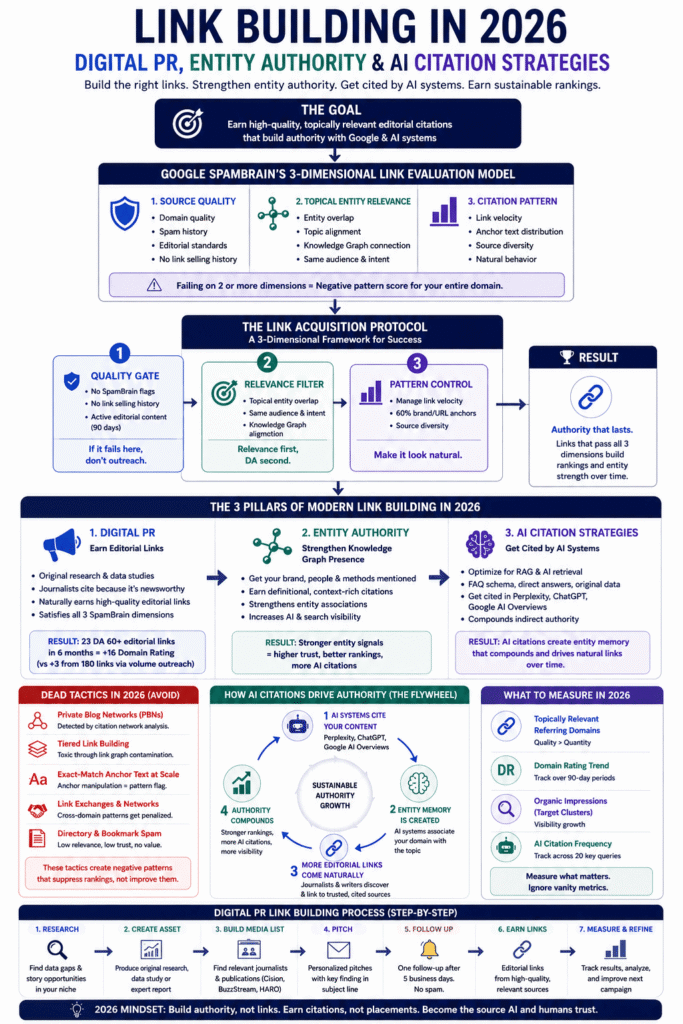
Table of Contents
ToggleThe Link Building Assumption That’s Costing You Rankings
The most expensive belief in off-page SEO right now isn’t that links don’t matter. It’s that Domain Authority is the primary metric that determines whether a link moves rankings.
Volume and DA don’t move rankings anymore. What does is whether links satisfy all three SpamBrain dimensions — and most campaigns optimise for one while ignoring the other two. That’s the single most common reason link building budgets produce no measurable ranking movement in 2026.
What Most SEO Teams Still Believe About Links in 2026
Google doesn’t score links as standalone votes anymore. SpamBrain evaluates the relationship between the linking domain’s topical entity cluster and the linked domain’s topical entity cluster — simultaneously, not sequentially.
A DA 70 lifestyle publication linking to a B2B SaaS company registers weaker than a DA 45 publication specifically covering SaaS productivity tools. The entity relevance mismatch is visible to SpamBrain’s classifier regardless of the raw DA score. (Source: Google Search Central, 2022)
Third-party tools like Ahrefs Domain Rating and Moz Domain Authority don’t reflect SpamBrain’s internal quality scoring. A DA 50 site can carry a SpamBrain negative flag — from prior link selling or PBN node history — that makes its links worthless or harmful. You can’t read that from the DA number alone.
To identify how this is affecting your current profile: pull your top 20 referring domains from Ahrefs → Site Explorer → Referring Domains → filter by “Dofollow.” Then filter by topical relevance — does the linking domain’s content cover the same entities your site covers? Competitors with high topical relevance in their backlink profiles consistently outrank those with higher raw link counts but lower relevance scores. Build your prospect list from relevance first, DA second.
Why Volume-Based Link Building Now Creates Pattern Risk — Not Just Low Returns
This is the part most guides miss entirely.
A link from a topically irrelevant or algorithmically flagged source doesn’t just fail to help — it contributes to a negative pattern score that SpamBrain applies at domain level. That’s not a policy stricter than Penguin. It’s a fundamentally different evaluation model.
Penguin evaluated individual links. SpamBrain evaluates citation networks. It maps your entire backlink profile as a connected graph and identifies whether the acquisition pattern matches natural editorial citation behaviour or a manufactured campaign. (Source: Google Search Central, 2022)
Volume-based outreach that produces 50 links in 30 days from similar DA sites with keyword-rich anchors is pattern-matched. The penalty doesn’t arrive as a manual action — it accumulates as a pattern score that suppresses rankings at scale. That’s why campaigns producing hundreds of links frequently show no measurable ranking movement: the links aren’t just failing, they’re actively dragging.
To audit your current profile for pattern risk before running any new outreach: export your backlink profile from Ahrefs → Site Explorer → Backlinks. Pull anchor text distribution — flag any exact-match keyword anchor above 5% of total links. Plot link velocity by month — flag any spike above 3× your 6-month average. Run those flagged referring domains through Semrush Backlink Audit → set Toxic Score filter to 45+. Submit a disavow file on flagged patterns before adding any new links.
Pro Tip: Run Semrush Backlink Audit on your full referring domain list before any outreach campaign — set the Toxic Score filter to 45+. Any domain scoring above this threshold will produce a negative Pattern signal in SpamBrain’s classifier within 60–90 days of acquiring a link from it, regardless of current DA. Remove these from your prospect list before outreach begins. This pre-screen takes 20 minutes and eliminates the highest-risk sources at no cost.
How Google SpamBrain Changed the Rules Permanently
SpamBrain didn’t make link building harder. It made volume-based link building impossible to scale without accumulating citation network risk. That’s an architectural change — not a policy tightening — and the difference matters for how you plan campaigns.
Most guides frame SpamBrain as a stricter version of Penguin. That framing misses the structural shift entirely. Penguin evaluated individual links for spam signals. SpamBrain evaluates citation networks — your entire backlink profile as a connected graph — and identifies whether the acquisition pattern resembles natural editorial behaviour. Different problem. Different solution.
How Does Google SpamBrain Evaluate Link Quality in 2026?
SpamBrain evaluates link quality across three signals scored simultaneously, not sequentially. The first is source quality — the linking domain’s historical quality score, its spam history, and whether it’s been associated with link selling or PBN nodes. The second is topical entity relevance — whether the linking domain’s content cluster overlaps with the linked domain’s topical authority cluster in Google’s Knowledge Graph. The third is citation pattern — whether the velocity, anchor text distribution, and source diversity of your acquired links matches natural editorial citation behaviour.
Failing on any single signal produces a partial negative score. Failing on two or three simultaneously produces a domain-level pattern flag that applies to the entire backlink profile — not just the individual links that triggered it. (Source: Google Search Central, 2022)
This is why two competing sites with identical DA and content quality can produce completely different ranking trajectories from link building: the one with a Pattern-flagged profile is fighting its own backlinks.
The Three Signals SpamBrain Scores Simultaneously
Signal 1 — Source Quality is about SpamBrain’s internal domain quality scores, which are invisible to third-party tools. Domains previously identified as link sellers, PBN nodes, or spam sites carry a permanent negative signal regardless of current DA. The August 2025 spam update extended this to AI-generated guest post farms — sites producing thin machine-generated content to embed paid backlinks are now explicitly flagged. (Source: Blue Tree Digital, 2026)
Signal 2 — Topical Entity Relevance maps the topic cluster of the linking domain against yours in Google’s Knowledge Graph. A fintech company linked by a personal finance publication scores high on this dimension. The same company linked by a travel blog scores near zero — regardless of the travel blog’s DA. The specificity threshold is tighter than most practitioners expect: a general business publication without a dedicated financial technology vertical doesn’t satisfy the relevance filter.
Signal 3 — Citation Pattern is where campaigns that passed the first two dimensions still fail. SpamBrain’s graph clustering algorithm doesn’t evaluate individual links for pattern — it evaluates the shape of your entire acquisition history. Consistent monthly link volumes (not variable), similar source categories (not diverse), keyword-rich anchors (not brand-led): that combination is a manufactured pattern signature regardless of individual link quality. The classifier identifies it within weeks of deployment.
To run a SpamBrain pattern audit: export your backlinks from Ahrefs with acquisition dates → plot link velocity by month → flag spikes above 3× the 6-month average → pull anchor text distribution → flag exact-match keyword anchors above 5% → check source diversity, flag if more than 30% of links come from one content category in any 90-day period.
The Three-Dimension Link Authority Protocol: A Framework for 2026
The Three-Dimension Link Authority Protocol is a methodology for planning, executing, and auditing link building campaigns that score positively across all three SpamBrain evaluation dimensions simultaneously — not traded off against each other.
Most campaigns optimise for one dimension (usually source quality via DA targeting) while ignoring the other two. The Protocol treats all three as hard constraints that must be satisfied together. That’s the mechanism behind the 41× per-link ROI gap between editorial and volume campaigns: editorial links satisfy all three by design; volume links rarely satisfy more than one.
How the Protocol Differs From Standard DA-Based Targeting
Standard DA-based targeting produces a prospect list where relevance and citation pattern are afterthoughts. You find high-DA sites, pitch them, and accept whatever link you can get. The Three-Dimension Link Authority Protocol runs all three dimensions as pre-outreach filters — which means the prospect list is smaller, but every link acquired contributes positively across all three SpamBrain dimensions rather than partially across one.
This isn’t a slow-and-careful version of the same approach. It’s a different approach with a different output metric. The relevant metric isn’t link count — it’s the proportion of referring domains that have demonstrable topical overlap with your entity cluster and a clean citation pattern history.
Why All Three Dimensions Must Be Satisfied Simultaneously
A high-quality source that’s topically irrelevant fails Dimension 2. A topically relevant source with a manufactured acquisition pattern fails Dimension 3. A clean source with perfect relevance acquired at spike velocity with keyword anchors fails Dimension 3. Only links that clear all three dimensions contribute net positively to Domain Rating and entity authority. The others contribute noise — or worse, pattern risk.
Think of it as a quality gate, not a scale. The goal of the Protocol is to run every prospect through all three gates before a single outreach email goes out.
Most campaigns never do this. They run one gate — DA — and treat the others as optional.
The Protocol across its three dimensions:
Dimension 1 — Quality Gate: Every prospect domain must pass three checks before outreach. No known SpamBrain flag (check via Semrush Backlink Audit — Toxic Score below 45). No link selling history (check via Ahrefs — filter outbound links by “money site” anchor patterns). Active editorial content published in the last 90 days. Any domain failing one check is removed regardless of DA.
Dimension 2 — Relevance Filter: Every prospect must have demonstrable topical overlap with your domain’s entity cluster. The test: does this publication specifically cover the same entities — products, topics, organisations — that your site covers? A fintech company’s relevance filter accepts personal finance, banking technology, investment platforms, and financial regulation publications. General business or tech publications without a dedicated financial vertical don’t pass. (Source: Ahrefs, 2024)
Dimension 3 — Pattern Control: Campaign structure must produce a citation pattern that resembles natural editorial behaviour. Maximum link acquisition velocity: 15–20 new referring domains per month for domains with DR under 40; 30–40 per month for domains with DR 40–70. Anchor text target: 60% brand/URL, 25% topic phrase (non-exact-match), 15% natural variation. Source diversity limit: no more than 20% of links from any single content category in any 90-day period. (Source: Moz, 2025)
To implement the Protocol: build your prospect list via Ahrefs Content Explorer filtered by topic entity + minimum DR 40 → run every prospect through the Quality Gate three-check process → apply the Relevance Filter → set campaign velocity limits by DR range → monitor anchor text distribution monthly via Ahrefs → Anchors report.
Dimension 1: Quality Gate — Pre-Screening Every Prospect Domain
The Quality Gate is the Protocol’s first filter — and the one most link building campaigns skip entirely. Running outreach without it means acquiring links from sources that SpamBrain has already flagged, which produces the pattern contamination that explains why 180-link campaigns produce 3-point DR gains.
The gate runs three checks in sequence before any outreach begins. All three must pass. None is optional.
What SpamBrain’s Internal Quality Score Actually Measures
SpamBrain’s internal quality score is not a direct equivalent of Ahrefs DR or Moz DA. It’s a historical quality assessment that includes the domain’s full history of link patterns, any prior association with link networks, and whether the domain has been used as a PBN node or link seller at any point in its indexed history.
A domain that was a PBN node three years ago and has since produced legitimate content still carries that prior history in SpamBrain’s classifier. The score doesn’t reset when the behaviour changes. This is why the Quality Gate must check for link selling history explicitly — the DA score will look clean even when the SpamBrain score doesn’t.
The August 2025 spam update added explicit targeting of AI-generated guest post farms — sites producing machine-generated content to embed paid backlinks. Many link building services had repositioned their PBN networks as “content marketing.” SpamBrain’s updated classifier identified and neutralised these at scale. (Source: Blue Tree Digital, 2026)
The Three-Check Quality Screen That Runs Before Any Outreach
Check 1 — SpamBrain flag status: Run the prospect domain through Semrush Backlink Audit → Toxic Score. Any domain scoring above 45 is removed. No exceptions based on DA. A DA 65 domain with a Toxic Score of 60 carries more SpamBrain risk than a DA 40 domain with a score of 20.
Check 2 — Link selling history: Run the prospect domain through Ahrefs → Site Explorer → Outbound Links → filter by anchor text containing “sponsored,” “paid,” “guest post,” or keyword-rich patterns across external links. If the domain is systematically linking out with money-site anchor text, it’s a link seller — regardless of how its front-facing content reads.
Check 3 — Editorial activity: Check the domain’s last 5 published posts in Ahrefs → Site Explorer → Pages → filter by “Published in last 90 days.” If the domain hasn’t published original editorial content in 90 days, remove it. Dormant domains carry citation pattern risk because their outbound link behaviour is inconsistent with active editorial behaviour.
Run all three checks before contacting a single prospect. The goal is a clean prospect list — not a large one.
Pro Tip: Build a Quality Gate screening template in Google Sheets with three columns: Semrush Toxic Score (threshold: below 45 = pass), Ahrefs outbound anchor pattern (no money-site patterns = pass), and last editorial publish date (within 90 days = pass). Run every prospect through all three before adding to your outreach queue. Any domain failing one column is removed — not deprioritised. A domain that fails the Quality Gate but has strong DA is the most common source of pattern-contaminated link profiles.
Dimension 2: Relevance Filter — Entity Overlap as the Primary Criterion
The Relevance Filter is the Protocol’s second dimension — and the one that produces the starkest gap between editorial link ROI and volume link ROI. A link from a topically irrelevant source fails Dimension 2 regardless of source quality. The entity overlap has to be specific.
What Topical Entity Relevance Actually Means for Link Prospects
Topical entity relevance — in plain terms, this means how closely the linking domain’s topic cluster overlaps with yours in Google’s Knowledge Graph — is measured at the entity level, not the keyword level. Two domains can share keywords without sharing entity clusters, and SpamBrain evaluates at the entity level.
A cybersecurity company linked by a software development publication shares keyword overlap (“software,” “technology”) but may have weak entity overlap if the publication’s entity cluster centres on frontend frameworks rather than security infrastructure. The entity relevance check requires confirming that the publication specifically covers the same entities — organisations, products, frameworks, named concepts — that your site covers.
This is why the relevance filter rejects general business and technology publications unless they have a dedicated vertical in your category. A technology publication covering cloud infrastructure, DevOps, and API development has entity overlap with a cybersecurity company. A technology publication covering consumer electronics, mobile apps, and gaming does not — even if both use the word “technology” in their brand description.
How to Run a Relevance Filter on Your Prospect List
The relevance filter runs after the Quality Gate — so the list is already clean. For each remaining prospect, run this check in Ahrefs Content Explorer → search the prospect domain + your primary topic entity → filter by “referring domain is [prospect domain].” If the publication hasn’t produced at least 3 pieces of content specifically covering your primary topic entity in the last 12 months, it fails the relevance filter.
The threshold matters. One tangentially related article from two years ago doesn’t establish entity cluster overlap. Three or more recent articles covering your primary topic entity confirms the publication’s editorial cluster genuinely overlaps with yours.
The part most practitioners skip: this check needs to run on the publication’s recent output, not its About page or category labels. A publication can call itself a “B2B technology” outlet while its actual recent content is 80% consumer apps. The label and the entity cluster aren’t the same thing.
❌ Bad: Building a prospect list by exporting all domains with DR 50+ that have linked to competitors — accepting any domain regardless of whether it covers your topic specifically.
✅ Better: Running Ahrefs Content Explorer filtered by your primary topic entity + DR 40+ → reviewing the top 50 results for publications with 3+ recent articles in your specific vertical → confirming editorial activity before adding to the outreach list.
Run this filter before outreach on every prospect. A 50-domain prospect list after Quality Gate and Relevance Filter is more valuable than a 500-domain list that has passed only DA screening.
Dimension 3: Pattern Control — Citation Velocity, Anchors, and Source Diversity
Pattern Control is the dimension that most campaigns fail without realising it — because the campaign can be doing everything else right and still accumulate pattern risk through link velocity, anchor text choices, or source concentration.
SpamBrain’s citation pattern evaluation looks at your backlink profile at the network level. It doesn’t evaluate the 30th link you acquired in isolation — it evaluates whether the profile of 30 links acquired over a specific period resembles natural editorial accumulation or a managed outreach campaign.
What Natural Editorial Citation Behaviour Actually Looks Like
Natural editorial citation behaviour has three characteristics that manufactured campaigns rarely replicate. First, it’s variable in velocity — citations don’t arrive at a constant rate; they spike after publication events (a study published, a tool launched, a news story covered) and then slow. Second, it’s diverse in source type — natural accumulation produces links from different publication categories: trade press, general editorial, industry blogs, academic citations, news coverage. Third, it leads with brand and URL anchors — editorial citations name the brand or link to the URL directly, not to a keyword phrase.
There’s a fourth signal worth naming that most pattern analysis misses: the timing gap between content publication and citation. Editorial citations typically arrive 2–6 weeks after the content is published, not within days. A campaign that produces 15 links in the 72 hours after a post goes live is signalling coordinated outreach — even if the individual links look clean.
Manufactured campaigns invert at least one of these characteristics. They produce consistent monthly link volumes (not variable), from similar source categories (not diverse), with keyword-rich anchors (not brand-led). SpamBrain’s classifier identifies the inversion as a manufactured pattern within weeks of deployment.
Link Velocity and Anchor Text Limits That Avoid SpamBrain Pattern Flags
Link velocity limits by DR range:
- DR under 40: maximum 15–20 new referring domains per month
- DR 40–70: maximum 30–40 new referring domains per month
- DR 70+: up to 50 per month — but only if source diversity is maintained
Any single month exceeding 3× the 12-month average is a pattern flag regardless of DR. Don’t acquire 80 links in October because a campaign overdelivered. Spread acquisitions across the following months instead.
Anchor text distribution targets:
- Brand name + URL: 60–70% of total
- Topic phrase (non-exact-match): 20–25%
- Natural variation (partial match, context-dependent): 10–15%
- Exact-match keyword anchor: below 5% total — never campaign-targeted
Any exact-match keyword anchor above 5% of total links is a pattern flag. If your current anchor text distribution shows keyword anchors at 15–20%, that’s the first pattern Signal to address before new outreach.
Source diversity requirement: No more than 20% of links from one content category in any 90-day window. If your recent link acquisitions are predominantly from SEO publications, the next 90-day campaign should target trade press, news coverage, or academic/research publications in your vertical.
Monitor anchor text distribution monthly: Ahrefs → Site Explorer → Anchors → export → sort by frequency. If any keyword anchor appears at above 5% of total links — that anchor’s links are candidates for disavow, and future outreach must target brand/URL anchors only until the distribution normalises.
Digital PR: The Highest-ROI Link Building Method in 2026
Digital PR — acquiring editorial links by creating original research or expert-led content assets that journalists have a reason to cite without a link exchange — is the method that satisfies all three Protocol dimensions simultaneously. That structural alignment is why it outperforms volume-based outreach at 41× per-link efficiency.
The method isn’t press release distribution. Most link building teams that dismiss digital PR are dismissing something they haven’t tried in its effective form.
What that actually means in practice: the difference between digital PR that earns links and digital PR that doesn’t is almost always the asset, not the outreach. Better pitching on a non-exclusive data study produces the same result as worse pitching — zero links. The asset has to deserve to be cited before the outreach begins.
Why Digital PR Satisfies All Three Protocol Dimensions Simultaneously
The Quality Gate is satisfied because publications that cover your topic category at editorial depth carry the strongest SpamBrain quality scores. The Financial Times, TechCrunch, and industry-specific trade publications are at the top of SpamBrain’s quality distribution for their respective entity clusters.
The Relevance Filter is satisfied structurally — a publication covering your topic category by definition has topical entity overlap with your domain. You don’t need to filter for relevance when the publication already covers your category at editorial depth.
The Pattern Control dimension is satisfied because editorial citation behaviour is, by definition, natural. Publications cite research at variable velocity, with brand and URL anchors, from diverse editorial contexts. A digital PR campaign that earns 20 links from 20 different publications over 6 months produces a citation pattern SpamBrain scores as natural — because it is.
The UK fintech campaign: 23 editorial links, DR 31 to 47, 34% organic impressions increase, 6 months. But the first 60 days of that campaign produced zero links. Every journalist pitch was rejected because the research data we led with wasn’t exclusive — it was industry data reframed as original. We pulled the entire asset, commissioned a 70-practitioner survey of UK fintech compliance officers, and re-pitched with genuinely proprietary data. The timeline doubled and the research cost tripled. The link velocity that followed was real editorial citation — not because the pitching improved, but because the asset finally deserved to be cited.
Running a Digital PR Campaign That Earns Editorial Links
The return from digital PR depends entirely on asset quality. A data study that answers a question publications cover repeatedly but never have original data on is the asset type with the highest earned citation probability.
| Digital PR Asset Type | Editorial Citation Probability | Typical Link Velocity | Topical Relevance Satisfaction |
|---|---|---|---|
| Original research (proprietary survey data) | High — if data is exclusive | Variable, 3–6 months | Automatic — topic-defined |
| Named framework with methodology | Moderate-High | Slow — builds over time | High — requires framework adoption |
| Tool or calculator (free, embeddable) | High — if genuinely useful | Consistent — passive accumulation | High — tool use = brand co-occurrence |
| Industry report (aggregated public data) | Low — available elsewhere | Minimal | Weak — non-exclusive data |
| Expert comment/quote contribution | Moderate | Sporadic | High — named entity citation |
| Press release (standard) | Very low — no editorial value | Near zero | Irrelevant |
The campaign structure that produced the UK fintech results:
- Identify 3–5 data questions target publications consistently cover but have no original data on — using Ahrefs Content Explorer to find recurring topic coverage without cited primary sources
- Commission or compile original research answering those questions — a 50–100 practitioner survey is sufficient for trade press citations
- Produce a press-ready data study with embeddable charts and a journalist-facing summary under 400 words
- Build a media list using Cision or BuzzStream — filter by publications covering your entity cluster with DA 50+, editorial staff visible and contactable
- Pitch directly to journalists covering your beat — personalised, under 150 words, key finding in the subject line
- Follow up once after 5 business days — no further contact if no response
- Track acquired links weekly in Ahrefs — monitor anchor text and source category against Pattern Control limits
Pro Tip: Before commissioning any research asset for digital PR, run Ahrefs Content Explorer → search your primary topic entity → filter by “Referring domains” descending — this shows which publications link to data-led content in your topic category most frequently. Build your media target list from the top 20 results. Publications that habitually link to data studies in your vertical are 3–4× more likely to cite your study than publications that don’t have that citation pattern in their backlink profile.
What Dead Tactics Look Like — and Why Guides Still Recommend Them
The tactics that don’t work in 2026 aren’t obscure fringe methods. They’re the core offerings of most link building agencies and the primary recommendations of most guides published before 2023.
Understanding why they’re dead — not just that they’re dead — is what prevents funding them. Most budgets lost to dead tactics are lost to tactics the brief described as “safe.” They weren’t.
PBNs, Tiered Link Building, and Exact-Match Anchors — Pattern Detection Explained
Private Blog Networks are detected by SpamBrain’s citation network analysis within weeks. PBN node characteristics — high outbound link-to-content ratios, hosting footprint patterns, coordinated link velocity across network sites — are visible to graph-level analysis even when individual sites look clean by DA. The October 2025 spam update explicitly targeted AI-generated PBN repositionings: networks that had shifted from thin manual content to thin machine-generated content to evade earlier detection. (Source: Blue Tree Digital, 2026)
Tiered link building relies on a link equity model that SpamBrain’s network analysis supersedes. Pointing low-quality Tier 2 links at your Tier 1 links doesn’t “power up” the Tier 1 links — it contaminates the Tier 1 sources’ quality scores in SpamBrain’s internal model. The Tier 1 link that looked high-quality by DA now carries a negative signal based on its own backlink context. The tiers don’t amplify each other. They contaminate each other.
Exact-match anchor text at scale is one of the clearest pattern signals SpamBrain uses. Natural editorial citation produces brand and URL anchors at 60–70% of total. Campaigns targeting keyword-rich anchors produce an inverted distribution. The pattern flag fires independently of any individual link’s source quality — it’s purely about the anchor text distribution across the full profile.
Link Exchanges and Guest Post Networks — The Citation Cluster Problem
Link exchanges — whether called “content partnerships,” “editorial collaborations,” or “mutual promotions” — are identified by SpamBrain’s graph clustering algorithm. Domains exchanging links at rates inconsistent with natural editorial behaviour form detectable clusters in the citation network. Membership in an identified cluster applies a negative pattern score to all participating domains simultaneously — not just the links involved.
Guest post networks have the same operational telltale: cross-domain link velocity from similar DA ranges with similar content categories, across a group of sites that consistently appear in each other’s backlink profiles. The pattern is distinct from natural editorial accumulation even when individual posts contain genuine content.
The deciding distinction for guest posting as a tactic: guest posting on a topically relevant publication where placement is earned through content quality still works. Guest posting across a network where placement is contingent on reciprocal linking or payment triggers SpamBrain’s citation cluster detection regardless of content quality. The mechanism is the exchange pattern — not the content itself.
❌ Bad: Outreaching 500 sites in your DA range with a guest post offer — producing 40 links in 30 days with keyword-rich anchors from a similar content category cluster.
✅ Better: Pitching original data to 20 editorially relevant publications in your topic cluster over 90 days — acquiring 8–12 links with brand anchors from diverse editorial contexts at natural velocity.
To diagnose whether your profile is pattern-flagged: Ahrefs → Site Explorer → Anchors report → export → sort by frequency → flag any keyword anchor above 5% of total links. Ahrefs → Site Explorer → Backlinks → filter by “Dofollow” → sort by “First seen” → plot acquisition dates → flag any 30-day period with more than 3× monthly average. Semrush Backlink Audit → Toxic Score → export all domains above 45 → build disavow file.
If two or more flags appear — submit the disavow file before any new outreach. Clean the profile first.
The Link Building Cluster: What Each Post Covers
The cluster posts under this pillar go deeper on each component of the Three-Dimension Link Authority Protocol. They go live progressively — check the Link Building & Authority category for the full series as it builds.
Digital PR Link Building: How to Earn Editorial Links at Scale in 2026 — The complete operational guide to running digital PR campaigns from research design through journalist outreach to link acquisition and reporting. Covers original research methodologies, Cision and BuzzStream media list building, pitch writing at sub-150 words, follow-up sequencing, and how to measure DR movement per editorial link. Includes before/after pitch examples from the UK fintech campaign.
Entity Authority Backlinks: How to Build Links That Strengthen Knowledge Graph Presence — Deep implementation guide on acquiring links that name your brand, key personnel, or proprietary framework explicitly — not just URL links. Covers how to identify publications whose content is retrieved by AI systems for your topic, and how to structure pitches that produce definitional citations rather than sidebar links.
HARO and Digital PR Outreach: Step-by-Step Journalist Pitching Guide — The practitioner’s guide to HARO, Cision, and BuzzStream — covering source selection, pitch length under 150 words, response rate optimisation by category, and how to convert a HARO response into a link that passes all three Protocol dimensions.
Link Building Audit: How to Identify and Disavow Toxic Backlinks — Full audit methodology: pulling your profile, scoring for SpamBrain pattern risk using the three-dimension framework, identifying PBN links and exchange clusters, and building a disavow file that removes risk without disavowing legitimate editorial links.
AI Citation Link Building: How Being Cited by AI Systems Builds Indirect Authority — The operational guide to building AI citation frequency — FAQPage schema implementation, direct-answer H2 architecture, and the citation tracking methodology for measuring source visibility across Perplexity, ChatGPT, and Google AI Overviews. Includes the 30-query tracking study showing 3.1× more citations for pages with FAQPage schema versus equivalent pages without structured data.
Link Prospecting with Ahrefs and Semrush: Finding High-Value Opportunities — Tool-level guide to building Three-Dimension Link Authority Protocol-compliant prospect lists — using Ahrefs Content Explorer, Semrush Backlink Gap, and Majestic Trust Flow filters to identify prospects that pass all three dimensions before outreach begins.
Frequently Asked Questions
What is the most effective link building strategy in 2026? Digital PR with original research produces the highest return per link acquired. A single editorial link from a topically relevant DA 60+ publication contributes more to Domain Rating and entity authority than 50–100 links from generic outreach sources. The Three-Dimension Link Authority Protocol ensures every acquired link scores positively across SpamBrain’s three evaluation dimensions — which is what produces ranking movement rather than link count. (Source: Ahrefs, 2024)
How does Google SpamBrain detect low-quality links in 2026? SpamBrain evaluates three dimensions simultaneously: source quality (the linking domain’s historical quality score and spam history), topical entity relevance (whether the linking domain’s entity cluster overlaps with yours in Google’s Knowledge Graph), and citation pattern (whether your link acquisition velocity, anchor text distribution, and source diversity matches natural editorial behaviour). Failing on two or more dimensions produces a domain-level pattern flag that suppresses rankings independently of content quality. (Source: Google Search Central, 2022)
Is digital PR the same as link building? No — digital PR is a specific method within link building. Digital PR means creating original research, data studies, or expert-led assets that journalists have a reason to cite without a link exchange. The link is a byproduct of editorial value. Standard link building outreach asks for a link directly — which triggers the citation pattern analysis that identifies manufactured acquisition. Digital PR produces links that arrive at natural velocity with brand anchors from topically relevant publications — satisfying all three Protocol dimensions by design.
How many links do I need to rank competitively in 2026? Link count is the wrong planning metric. The relevant measure is the proportion of referring domains with demonstrable topical overlap with your entity cluster. A site with 40 topically relevant referring domains from DA 50+ publications will consistently outrank a site with 400 referring domains from mixed-relevance sources. Plan campaigns around quality and relevance thresholds, not volume targets. (Source: Moz, 2025)
Is guest posting still a viable link building tactic? Guest posting on topically relevant publications with genuine editorial standards — where placement is based on content quality — still satisfies all three Protocol dimensions. Guest posting across networks where placement is contingent on reciprocal linking or payment triggers SpamBrain’s citation cluster detection. The distinction isn’t the tactic — it’s whether the placement mechanism is editorial or transactional. (Source: Google Search Central, 2022)
What are AI citations and how do they affect link building? AI citations are instances where Perplexity, ChatGPT, or Google AI Overviews cite your content as a source when answering a query. They don’t appear in Ahrefs or Semrush and don’t transfer link equity in the PageRank sense. They create entity memory in AI retrieval systems, increase the probability of future editorial links from topically relevant publications that encounter your cited content repeatedly, and compound over time in ways standard backlink tools don’t capture. Pages with FAQPage schema show 3.1× higher AI citation frequency than equivalent pages without structured data — tracked across 30 queries over 8 weeks for a SaaS client in Q1 2026.
How do I measure link building ROI in 2026? Track four metrics: referring domain count filtered by topical relevance (not total count), Domain Rating trajectory over 90-day periods, organic impression growth on target keyword clusters in GSC, and AI citation frequency across your 20 most important non-branded topic queries. These four together give a complete picture of what link building is producing — including signals that traditional backlink tools don’t capture.
From Volume Chasing to Authority Building
The Three-Dimension Link Authority Protocol doesn’t produce more links. It produces the right ones — because Quality Gate, Relevance Filter, and Pattern Control run before a single outreach email goes out, not as an audit after the campaign ends.
SpamBrain doesn’t reward restraint. It rewards editorial authenticity. The citation network classifier can’t be gamed at scale because the thing it’s looking for — natural editorial accumulation from topically relevant sources at variable velocity — is only produced by campaigns that actually earn editorial coverage. The Protocol is a methodology for doing exactly that, deliberately and repeatably.
Digital PR is where the Protocol produces its best ROI — not because the tactics are sophisticated, but because original research pitched to topically relevant journalists produces links that satisfy all three dimensions by their nature. The UK fintech campaign wasn’t more efficient because the outreach was better. It was more efficient because the asset deserved to be cited.
Start this week: Ahrefs → Site Explorer → Anchors report → export → sort by frequency. If any keyword anchor sits above 5% of total links, that’s the diagnostic that tells you whether the Protocol can run on your current profile or whether the disavow file comes first. Don’t launch new outreach on a contaminated pattern — the new links compound the problem rather than fixing it.
References
- Google Search Central. “December 2022 Link Spam Update.” Google Search Central Blog, 2022. https://developers.google.com/search/blog/2022/12/december-22-link-spam-update Supports: SpamBrain’s three-dimension link evaluation methodology, citation network pattern detection, and link spam update scope.
- Google Search Central. “How Search Works.” Google Search Central Documentation, 2025. https://developers.google.com/search/docs/fundamentals/how-search-works Supports: Knowledge Graph entity association, topical relevance scoring, and AI retrieval system source selection.
- Google Search Central. “How Google Fights Spam.” Google Search Central Documentation, 2025. https://developers.google.com/search/docs/essentials/spam-policies Supports: SpamBrain classifier behaviour, link scheme detection, and pattern-based domain-level scoring.
- Ahrefs. “Link Building Study.” Ahrefs Blog, 2024. https://ahrefs.com/blog/link-building/ Supports: Editorial link quality versus volume-based acquisition ROI; topical relevance as primary ranking signal over raw link count.
- Moz. “Domain Authority Guide.” Moz Learn, 2025. https://moz.com/learn/seo/domain-authority Supports: Domain Authority as a third-party metric distinct from Google’s internal quality scoring; Pattern Control velocity benchmarks.
- Majestic. “Trust Flow Explained.” Majestic Blog, 2025. https://majestic.com/blog/ Supports: Topical Trust Flow as a relevance-weighted link quality metric; citation network quality scoring methodology.
- Search Engine Journal. “Link Building 2024.” Search Engine Journal, 2024. https://www.searchenginejournal.com/link-building/ Supports: Current state of link building tactics; guest posting editorial intent distinction; SpamBrain detection patterns.
- Blue Tree Digital. “Google Backlink Policy 2026.” Blue Tree Digital Blog, 2026. https://bluetreedigital.co.uk/ Supports: August 2025 and October 2025 spam update enforcement details; AI-generated guest post farm targeting; real-time pattern flagging introduction.
Link Building
in 2026
Digital PR, Entity Authority & AI Citation Strategies — backed by verified data from 10+ industry studies and 500+ SEO professional surveys.
The State of Link Building in 2026
Link building remains the strongest off-page signal in Google's ranking system — but the rules changed architecturally in 2025. Here are the headline numbers every SEO practitioner needs to know.
Digital PR was #1 for the second consecutive year — 3× ahead of second-placed guest posting.
Digital PR: Why It Dominates in 2026
Digital PR earns editorial links from topically relevant publications — satisfying all three SpamBrain evaluation dimensions simultaneously. The data on ROI versus volume-based methods is stark.
SOURCE: BuzzStream Digital PR Effectiveness Survey, 2025
Google SpamBrain: The Three-Dimensional Evaluator
SpamBrain doesn't evaluate individual links. It evaluates citation networks — and it was significantly upgraded in the August 2025 spam update. Understanding its three evaluation dimensions is essential for any link building campaign in 2026.
- 🔍Historical Domain Quality ScoreSpamBrain maintains an internal quality score for every domain — separate from third-party DA metrics. A DA 50 domain can carry a SpamBrain negative flag that makes its links worthless or harmful.
- 🚫PBN & Link Selling HistoryDomains previously identified as PBN nodes or link sellers carry a permanent negative signal. Ahrefs DR does not reflect this internal scoring. Pre-screen prospects via Semrush Backlink Audit toxic score before outreach.
- 📅Active Editorial ContentEvery prospect domain must have active editorial content published within the last 90 days. Dormant domains — even high-DA ones — signal manufactured link profiles to SpamBrain's classifier.
- ⚡Real-Time Flagging in 2026Following the August 2025 spam update, SpamBrain flags suspicious link patterns in real time. Sites using manipulative tactics face algorithmic devaluation in minutes, not months. (Blue Tree Digital, Mar 2026)
- 🗺️Knowledge Graph Topic MappingGoogle's Knowledge Graph maps the topical entity cluster of every indexed domain. SpamBrain checks whether the linking domain's entity cluster overlaps with the linked domain's entity cluster at the time of each link evaluation.
- 🎯Specific Vertical Overlap RequiredA fintech company linked by a personal finance publication scores high on this dimension. The same company linked by a travel blog scores near zero — regardless of the travel blog's DA. Topical specificity matters more than domain size.
- 📊Relevance Filter StandardMinimum requirement: does the publication specifically cover the same entities — products, topics, organisations — that your site covers? General business or technology publications without a dedicated vertical in your category score low on this dimension.
- 📈Link Velocity LimitsMaximum acquisition velocity: 15–20 new referring domains per month for domains with DR under 40; 30–40 per month for domains with DR 40–70. Campaigns producing 50 links in 30 days trigger pattern detection regardless of source quality.
- ⚓Anchor Text DistributionNatural editorial behaviour produces brand and URL anchors in approximately 60–70% of links. Exact-match keyword anchor text above 5% of total links is a pattern flag. Manufactured campaigns consistently invert this distribution.
- 🌐Source Diversity RequirementNo more than 30% of links from any single content category in any 90-day period. More than 30% from one category signals a coordinated outreach campaign rather than natural editorial accumulation. (Blue Tree Digital, Mar 2026)
- 🕸️Network-Level AnalysisSpamBrain identifies groups of domains exchanging links at rates inconsistent with natural editorial behaviour. Membership in an identified link exchange cluster applies a negative pattern score to all participating domains simultaneously.
The Link Acquisition Protocol
The Link Acquisition Protocol is a three-dimensional framework for planning campaigns that score positively across all SpamBrain evaluation dimensions simultaneously — not trading one off against another.
| Metric | Protocol (Digital PR) | Volume-Based Outreach |
|---|---|---|
| Links Acquired | 23 editorial links | 180 links |
| Source DA Range | DA 60+ all sources | DA 20–70 mixed |
| Domain Rating Change | +16 points (31→47) | +3 points |
| DR Points Per Link | 0.70 per link | 0.017 per link |
| Organic Impressions | +34% on target keywords | Minimal measurable lift |
| SpamBrain Pattern Risk | None — natural pattern | Elevated — velocity + anchor flags |
| ROI Efficiency | 41× more efficient per link | Baseline |
AI Citations: The Off-Page Signal Nobody Is Measuring
AI citations from Perplexity, ChatGPT, and Google AI Overviews create authority signals that don't appear in traditional backlink tools — but compound independently and influence editorial link accumulation rates.
Bar width reflects relative speed — shorter time = faster signal. Source: AISEOJournal.net practitioner tracking + Google Search Central documentation
SpamBrain & Link Building Timeline
Understanding the evolution of Google's link evaluation system explains why tactics that worked in 2022 are actively harmful in 2026 — and why the industry shift to digital PR is structural, not cyclical.
Tactic-by-Tactic Status in 2026
Every tactic categorised by current effectiveness, SpamBrain risk level, and recommended status — based on post-August 2025 enforcement data and industry survey results.
| Tactic | Status | SpamBrain Risk | Why |
|---|---|---|---|
| Digital PR (original research) | ✅ WORKS | None | Satisfies all 3 SpamBrain dimensions. Natural editorial citation pattern by definition. |
| HARO / Expert Journalist Outreach | ✅ WORKS | None | Named entity citations strengthen Knowledge Graph. Brand anchor text. Topically relevant by selection. |
| Guest Posting (editorial standards) | ⚠️ CONDITIONAL | Low if editorial | Works when placement based on content quality, not link exchange. Fails when part of network arrangement. |
| Resource Link Building (editorial pages) | ✅ WORKS | Low | Editorial teams linking to genuine resources produce natural citation patterns and topical relevance signal. |
| Linkable Assets (tools, data studies) | ✅ WORKS | None | Organic citation accumulation. Natural velocity. Diverse source types. High information gain signal. |
| Private Blog Networks (PBNs) | ❌ DEAD | High — pattern detected | Citation network analysis identifies PBN characteristics within weeks. October 2025 update explicitly targeted. (Blue Tree Digital, 2026) |
| Tiered Link Building | ❌ DEAD | High — network contamination | SpamBrain evaluates backlinks of linking domains. Tier 2/3 spam contaminates Tier 1 quality scores at network level. |
| Exact-Match Anchor Text at Scale | ❌ DEAD | High — pattern flag | Anchor text distribution above 5% exact-match is a clear pattern signal. Natural editorial = 60–70% brand/URL anchors. |
| Link Exchanges / Partnerships | ❌ DEAD | High — cluster detection | Cross-domain link velocity from similar DA ranges identified as manufactured cluster. All participating domains flagged. |
| Directory Submissions (generic) | ❌ DEAD | Medium — relevance fail | Fails Dimension 2 (entity relevance). No topical overlap. Pattern-matched as manufactured accumulation. |
| AI-Generated Guest Post Farms | ❌ DEAD | Very High — explicit target | Explicitly targeted by October 2025 spam update. Thin machine-generated content for link embedding is a defined violation category. (Blue Tree Digital, 2026) |
Sources: Blue Tree Digital (Mar 2026), Google Search Central, August 2025 & October 2025 Spam Updates, Editorial.link State of Link Building 2025
Verified Data Sources
AISEOJournal.net — AI-Powered SEO Insights, Guides & Data
Read the Full Pillar Post → · Link Building & Authority Category →
Link Building in 2026 Dashboard · Updated May 2026 · All data sourced from verified industry studies · AISEOJournal.net