



You’ve invested six months and $50,000 into your international SEO expansion. Your agency sends you beautiful reports with charts and graphs showing “progress.”
But when you ask “Are we actually making money in Germany?” they dodge the question.
Here’s the brutal truth: Most international SEO metrics reports are vanity metrics disguised as insights. They show rankings that don’t convert, traffic that doesn’t buy, and “improvements” that don’t impact revenue.
Global SEO analytics gets complicated because you’re juggling multiple markets, currencies, languages, and customer behaviors. What success looks like in Japan is completely different from Brazil.
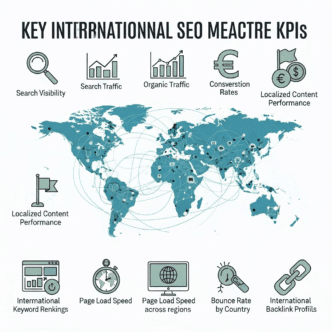
This guide cuts through the noise. I’ll show you how to measure international SEO success using best KPIs for tracking global SEO performance—the metrics that actually tell you which markets work and which are burning your budget.
No vanity metrics. No agency BS. Just the numbers that matter.
Let’s fix your international tracking.
Table of Contents
ToggleWhy Do Standard SEO Metrics Fail for International Sites?
Multi-market tracking requires different approaches than single-country SEO.
The Core Problem
Standard SEO dashboards treat all traffic equally. But 1,000 visitors from Germany converting at 8% is worth more than 10,000 from a market converting at 0.5%.
Common failures:
- Aggregating all international traffic into one number
- Comparing countries with vastly different market sizes
- Ignoring currency and purchasing power differences
- Tracking rankings without revenue context
- Celebrating traffic growth in unprofitable markets
What’s Different About International Metrics?
Market Maturity Stages Your UK market might be established (focus on efficiency), while your Brazilian market is new (focus on awareness).
KPIs change by stage:
- Launch phase (Months 0-6): Indexation, ranking movement, traffic
- Growth phase (Months 6-18): Traffic volume, engagement, assisted conversions
- Mature phase (18+ months): Conversion rate, revenue, ROI, customer lifetime value
Currency and Economic Factors €1,000 revenue from Germany ≠ ₹1,000 revenue from India. Purchasing power and margins differ.
Competitive Landscapes Ranking #3 in a competitive US market might deliver more than #1 in a smaller, less mature market.
Pro Tip: According to Aleyda Solis, international SEO expert, the biggest mistake companies make is using the same success metrics across all markets. She recommends creating market-specific KPI frameworks based on business goals, competitive landscape, and market maturity.
For comprehensive international strategy foundations, check out our complete guide.
What Are Essential International SEO Metrics to Track?
Let’s break down international KPIs into categories that actually matter.
Category 1: Technical Foundation Metrics
Before worrying about traffic and revenue, ensure your technical setup works.
Indexation by Country
What to measure: Pages indexed vs pages submitted per market
Tools: Google Search Console (separate properties or filtered views)
Targets:
- Mature markets: 95%+ indexation rate
- New markets: 80%+ within 3 months
- Problem threshold: <70% requires investigation
How to track:
- Navigate to Coverage report
- Filter by country version (subdirectory/ccTLD)
- Compare “Valid” vs “Submitted” in sitemap
Red flags:
- Country pages not indexed after 4+ weeks
- Declining indexation rate
- High “Excluded” counts
Hreflang Implementation Status
What to measure: Hreflang errors and coverage
Critical metrics:
- Number of pages with hreflang errors
- Percentage of international pages with proper hreflang tags
- Hreflang return tag validation (bidirectional)
GSC International Targeting Report: Check “Language” section for:
- Pages without return tags
- Incorrect language codes
- Conflicting signals
Target: Zero critical hreflang errors
Crawl Budget Allocation
What to measure: How Googlebot distributes crawling across country versions
In GSC Settings → Crawl Stats:
- Requests per day by property
- Download time by country version
- Crawl response time
Healthy distribution: Crawl budget roughly proportional to page count and update frequency per market.
Warning signs:
- New markets getting <100 crawls/day
- Mature markets with declining crawl rate
- High “Not Found” error rates
Category 2: Visibility and Rankings Metrics
Track how visible you are in each market’s search results.
Rankings by Country and Language
What to measure: Keyword positions in specific countries
Tools:
- SEMrush Position Tracking (set location per campaign)
- Ahrefs Rank Tracker (country-specific)
- Google Search Console Performance (filter by country)
Metric framework:
| Metric | What It Shows | Target |
|---|---|---|
| Average position | Overall visibility trend | Improving month-over-month |
| Top 3 keywords | High-value visibility | 20%+ of tracked terms |
| Top 10 keywords | Competitive presence | 50%+ of tracked terms |
| Featured snippets | Premium visibility | 5-10% in mature markets |
| Ranking distribution | Portfolio health | Balanced across positions |
Don’t just track rankings—track the RIGHT keywords:
Branded keywords: Should rank #1 (measures brand awareness) Commercial intent: “buy X”, “best X” (measures revenue potential) Informational: “how to”, “what is” (measures content visibility)
Organic Visibility Score
What to measure: Estimated share of voice in each market
Calculation: Sum of (search volume × position factor) for all tracked keywords
Position factors:
- Position 1: 1.0
- Position 2: 0.7
- Position 3: 0.5
- Positions 4-10: 0.3
- Positions 11-20: 0.1
Use: Compare visibility across markets of different sizes
SERP Feature Ownership
What to measure: Presence in special search features by country
Track:
- Featured snippets captured
- People Also Ask appearances
- Image pack inclusions
- Video carousels
- Local pack (if applicable)
- Shopping results
Why it matters: SERP features often have higher CTR than organic #1.
Learn more about international visibility optimization in our comprehensive SEO guide.
Category 3: Traffic and Engagement Metrics
Now we get to actual users. But avoid vanity metrics.
Organic Traffic by Country
What to measure: Sessions, users, new users per country
- Create country-specific segments
- Filter Acquisition reports by geography
- Compare organic channel performance across countries
Key dimensions:
- Sessions by country
- Users by country
- New vs returning users
- Landing pages by country
Analysis framework:
Don’t just look at totals. Calculate:
- Growth rate (month-over-month, year-over-year)
- Traffic share (each country as % of total)
- Efficiency (traffic per ranking keyword)
Traffic Quality Indicators
Raw traffic numbers lie. Quality matters more.
Engagement metrics by country:
| Metric | What It Reveals | Good Benchmark |
|---|---|---|
| Bounce rate | Content relevance | <50% for commercial pages |
| Pages/session | User interest | >2.5 for content sites |
| Avg session duration | Engagement depth | >90 seconds for content |
| Scroll depth | Content consumption | >50% scroll on key pages |
Segment by device: Mobile behavior differs dramatically by country.
Example analysis:
- Germany: 65% mobile, 3.2 pages/session
- US: 55% mobile, 2.8 pages/session
- India: 85% mobile, 2.1 pages/session
This tells you India needs better mobile UX, not just more traffic.
Landing Page Performance by Country
What to measure: How different pages perform in each market
Google Analytics 4 Path: Engagement → Pages and screens → Add country dimension
Analyze:
- Top entry pages per country
- Bounce rate by landing page and country
- Conversion rate by landing page and country
- Exit rate on key pages
Action items:
- Pages with high traffic but high bounce = relevance problem
- Pages with low traffic but high conversion = optimization opportunity
- Pages performing well in one market but not others = localization issue
Branded vs Non-Branded Traffic
What to measure: Ratio of brand searches to generic searches by country
Why it matters: Branded searches indicate market awareness and trust.
Segmentation:
Google Analytics 4:
- Create segment: Organic + contains [brand name]
- Compare branded vs total organic by country
Healthy ratios:
- Mature markets: 30-50% branded
- Growing markets: 15-30% branded
- New markets: <15% branded (normal in first year)
Trend to watch: Increasing branded search % = successful brand building
For detailed traffic analysis strategies, visit our international analytics guide.
Category 4: Conversion and Revenue Metrics
The metrics that actually matter for business decisions.
Conversion Rate by Country
What to measure: Percentage of visitors completing desired actions per market
Primary conversions:
- Purchases (e-commerce)
- Lead submissions (B2B)
- Sign-ups (SaaS)
- Downloads (content)
Google Analytics 4 Setup:
- Define conversion events
- Create Exploration with country dimension
- Calculate conversion rate = (conversions/sessions) × 100
Analysis framework:
| Country | Sessions | Conversions | Conv Rate | Assessment |
|---|---|---|---|---|
| Germany | 50,000 | 4,000 | 8.0% | Excellent |
| UK | 45,000 | 2,700 | 6.0% | Good |
| France | 30,000 | 1,200 | 4.0% | Needs optimization |
| Spain | 25,000 | 500 | 2.0% | Major issues |
Don’t compare conversion rates directly across markets. Instead:
Normalize by stage: New markets naturally have lower conversion Consider purchasing power: Lower-income markets may browse more before buying Account for trust: New brands convert lower until trust builds
Revenue by Country
What to measure: Actual revenue generated from organic search per market
E-commerce tracking: Google Analytics 4 Monetization reports → Filter by country + organic traffic source
Critical metrics:
- Total revenue by country
- Revenue per session
- Average order value
- Transactions by country
B2B/Lead Generation: Assign pipeline value to leads by country, track through CRM.
Revenue Attribution by Market
What to measure: Which markets actually contribute to revenue growth
Calculate:
- Revenue growth rate by country
- Revenue share (each country as % of total)
- Revenue per visitor (revenue ÷ organic sessions)
- Customer acquisition cost by country
Real Example Analysis:
Country A: $100K revenue, 50K visitors = $2 per visitor Country B: $50K revenue, 10K visitors = $5 per visitor
Country B is more valuable despite lower total revenue.
Assisted Conversions by Country
What to measure: Role of organic search in multi-touch conversions
Google Analytics 4: Advertising → Attribution → Path analysis
Questions to answer:
- What percentage of conversions have organic search in the path?
- How many touches before conversion per market?
- Is organic primarily first-touch (awareness) or last-touch (conversion)?
Market patterns:
- High consideration purchases: 5-7 touches typical
- Low consideration: 1-2 touches
- B2B: 10+ touches common
Emerging markets may show more research touches before conversion.
Category 5: ROI and Business Impact Metrics
Connect SEO to business outcomes.
Cost Per Acquisition by Market
What to measure: Investment required to acquire customers per country
Calculate: CPA = (SEO investment in market) ÷ (customers acquired)
SEO investment includes:
- Content creation costs
- Translation/localization
- Link building expenses
- Technical development
- Agency/freelancer fees
- Tools allocated to market
Benchmark against:
- Paid search CPA
- Other channel CPAs
- Customer lifetime value (must be lower than LTV)
Return on Investment by Country
What to measure: Revenue generated vs investment per market
Formula: ROI = [(Revenue – Investment) ÷ Investment] × 100
Example calculation:
Germany:
- Revenue from organic: €500,000
- SEO investment: €75,000
- ROI: [(500,000 – 75,000) ÷ 75,000] × 100 = 567%
France:
- Revenue from organic: €200,000
- SEO investment: €75,000
- ROI: [(200,000 – 75,000) ÷ 75,000] × 100 = 167%
Germany is clearly performing better despite France getting similar investment.
Market Efficiency Score
What to measure: Output relative to investment and opportunity
Custom metric formula: (Revenue from market ÷ Investment) ÷ (Market size factor)
Market size factor: Relative search volume for your primary keywords
Use case: Identify underperforming markets that should be doing better given their size and investment.
Customer Lifetime Value by Country
What to measure: Long-term value of customers acquired through organic search per market
Track:
- Repeat purchase rate by country
- Average customer lifespan
- Total revenue per customer over time
Critical insight: A market with lower initial conversion but higher LTV may be more valuable long-term.
Example:
- Market A: 5% conversion, $100 average order, $150 LTV
- Market B: 3% conversion, $80 average order, $300 LTV
Market B is more valuable despite lower conversion rate.
Learn about ROI optimization in our international business guide.
How to Set Up Cross-Country Reporting Systems?
Regional performance tracking requires proper infrastructure.
Google Analytics 4 Configuration
Property setup:
Option 1: Single property with country segmentation (recommended for most)
- Easier management
- Unified data model
- Requires consistent tagging
Option 2: Separate properties per country
- Cleaner data separation
- More complex management
- Better for distinct brands per market
Essential custom dimensions:
- Market (US, UK, DE, FR, etc.)
- Language (en, de, fr, es, etc.)
- Currency (USD, EUR, GBP, etc.)
- Region (Europe, Asia, Americas, etc.)
Google Search Console Segmentation
ccTLD structure: Automatic separation (example.de, example.fr)
Subdirectory structure: Filter by URL prefix
- Performance report → “+ New”
- Page → URL contains “/de/”
- Save filter for recurring use
Create saved filters for:
- Each country version
- Each language version
- Mobile vs desktop per country
Looker Studio International Dashboards
Create unified reporting combining multiple data sources.
Dashboard structure:
Page 1: Executive Summary
- Revenue by country (bar chart)
- Traffic distribution (pie chart)
- Conversion rates comparison (table)
- ROI by market (scorecard)
Page 2: Traffic Deep Dive
- Organic traffic trends by country (line chart)
- Landing page performance (table)
- Device breakdown per market
- Engagement metrics comparison
Page 3: Rankings & Visibility
- Average position by market
- Featured snippet wins
- Top gaining/losing keywords per country
Page 4: Technical Health
- Indexation rates by country
- Core Web Vitals by market
- Hreflang error tracking
Data sources:
- Google Analytics 4
- Google Search Console (multiple properties if needed)
- SEMrush/Ahrefs API
- BigQuery (for advanced analysis)
Automated Reporting Setup
Weekly reports (automated):
- Traffic changes >10% by country
- New indexation issues
- Ranking changes for priority keywords
Monthly reports (manual review):
- Full KPI dashboard review
- Conversion and revenue analysis
- ROI calculation updates
- Budget allocation recommendations
Quarterly reports (strategic):
- Market performance scoring
- Competitive analysis by country
- Market expansion recommendations
- Budget reallocation proposals
What Tools Are Essential for International SEO Metrics?
The right tools make multi-market tracking manageable.
| Tool | Primary Use | Key Features | Pricing |
|---|---|---|---|
| Google Analytics 4 | Traffic & conversion tracking | Country filtering, custom dimensions | Free |
| Google Search Console | Technical health, rankings | Country-specific properties/filters | Free |
| SEMrush | Rankings, competitors | Multi-location tracking, 200+ countries | $129-499/mo |
| Ahrefs | Backlinks, rankings | Country-specific rank tracking | $99-999/mo |
| Looker Studio | Unified reporting | Multi-source dashboards | Free |
| Supermetrics | Data aggregation | Connect multiple sources to sheets/studio | $99-999/mo |
| BigQuery | Advanced analysis | Store unlimited GA4 data, custom queries | Pay per query |
| Screaming Frog | Technical audits | Hreflang validation, crawl analysis | Free-£149/year |
Advanced Analytics Setup
BigQuery + GA4 Integration
Export GA4 data to BigQuery for:
- Unlimited historical data retention
- Custom SQL queries across markets
- Advanced attribution modeling
- Cost data integration
Setup:
- GA4 Admin → BigQuery Linking
- Select daily or streaming export
- Query data for custom reports
Sample query (revenue by country and source):
SELECT
  geo.country,
  traffic_source.source,
  SUM(ecommerce.purchase_revenue) as revenue
FROM `project.dataset.events_*`
WHERE event_name = 'purchase'
GROUP BY country, source
ORDER BY revenue DESC
For advanced tracking setups, visit our technical analytics guide.
How to Compare International Performance Fairly?
Best KPIs for tracking global SEO performance require context-aware comparison.
Market Maturity Indexing
Don’t compare new markets to mature ones. Create maturity index:
Maturity Score Components:
- Time in market (0-24+ months)
- Investment level (low/medium/high)
- Competition intensity (weak/moderate/strong)
- Market size (small/medium/large)
Score calculation: Weighted average → 1-100 scale
Compare markets within similar maturity ranges.
Normalized Performance Metrics
Adjust for market size and opportunity:
Normalized traffic: (Actual traffic ÷ Total search volume) × 1000
Normalized revenue: (Actual revenue ÷ Market GDP per capita) × 100
Efficiency score: (Revenue ÷ Investment) ÷ (Competition index)
Benchmark Creation
Internal benchmarks: Use your best-performing market as baseline.
Example: If Germany converts at 8%, set as 100% baseline. Other markets expressed as % of Germany performance.
External benchmarks: Industry averages vary by country. Research:
- Statista industry reports
- SimilarWeb market data
- Trade association statistics
Competitive Context Scoring
Measure:
- Your visibility vs top 3 competitors per market
- Share of voice in each country
- Competitive gap (difference between your visibility and #1)
Market priority calculation:
High opportunity = Large market + Low competition + Low current performance Low opportunity = Small market + High competition + Already performing well
Common International Metrics Mistakes
Avoid these errors that lead to bad decisions.
Mistake 1: Aggregating All International Data
The Problem: Mixing performance across markets hides individual market issues.
Example:
- Combined international traffic: Up 15%
- Reality: UK up 50%, Germany down 30%, new market negligible
You celebrate growth while missing Germany’s collapse.
The Fix: Always segment reporting by market first, then aggregate if needed.
Mistake 2: Ignoring Currency in Revenue Reporting
The Problem: Comparing €1,000 from Germany to ₹1,000 from India as equal.
The Fix:
- Convert to single currency (usually HQ currency) for comparison
- Track in local currency for tactical optimization
- Note exchange rate fluctuations in reports
Mistake 3: Focusing Only on Rankings
The Problem: Rankings without traffic or revenue context are meaningless.
Example: Ranking #1 for “cheap widgets” in a market where nobody searches that term.
The Fix: Always tie rankings to:
- Search volume (opportunity size)
- Click-through rate (actual traffic)
- Conversion rate (revenue impact)
Mistake 4: Not Accounting for Seasonality
The Problem: Comparing January performance to December without seasonal context.
Example: E-commerce traffic drops 40% in January vs December in most markets—that’s normal, not failure.
The Fix:
- Compare year-over-year (Jan 2025 vs Jan 2024)
- Track seasonal index for each market
- Set seasonally-adjusted targets
Mistake 5: Celebrating Vanity Metrics
The Problem: Reporting metrics that look good but don’t drive business value.
Vanity metrics:
- Keyword ranking improvements without traffic
- Traffic growth without conversion
- Impressions without clicks
- Backlinks without ranking impact
Value metrics:
- Revenue growth
- Conversion rate improvement
- Customer acquisition cost reduction
- ROI increase
Pro Tip: According to Rand Fishkin, founder of SparkToro, the best international SEO reports answer three questions: (1) Are we making money? (2) Which markets are working? (3) Where should we invest more? If your reports don’t answer these, they’re just pretty distractions.
Creating Your International SEO Measurement Framework
Build a custom framework matching your business model.
Step 1: Define Business Goals by Market
Not all markets have same goals:
Market A (Mature): Improve ROI, increase efficiency Market B (Growth): Expand traffic, build awareness Market C (New): Establish presence, test product-market fit
Step 2: Select 5-7 KPIs Per Market
Don’t track 50 metrics. Focus on what matters for each market’s stage.
Launch phase KPIs:
- Indexation rate
- Ranking for priority keywords
- Organic traffic growth rate
- Bounce rate (quality check)
- Brand search volume
Growth phase KPIs:
- Organic traffic volume
- Conversion rate
- Revenue from organic
- Cost per acquisition
- Customer acquisition rate
Mature phase KPIs:
- ROI
- Customer lifetime value
- Market share of voice
- Efficiency metrics (revenue per visitor)
- Retention and repeat rate
Step 3: Set SMART Targets
Specific: “Increase organic traffic from Germany by 25%” Measurable: Trackable in GA4 Achievable: Based on resources and competition Relevant: Tied to business goals Time-bound: “by Q3 2025”
Step 4: Create Review Cadence
Weekly: Spot checks for anomalies Monthly: Full KPI review, tactical adjustments Quarterly: Strategic review, budget reallocation Annually: Market portfolio assessment, expansion planning
Learn about comprehensive international strategy in our complete SEO guide.
Final Thoughts: Measuring What Matters
International SEO metrics should drive decisions, not decorate reports.
The best measurement frameworks:
✅ Focus on business outcomes (revenue, ROI) over vanity metrics
✅ Segment data by market before aggregating
✅ Account for market maturity and context
✅ Connect SEO metrics to business KPIs
✅ Enable quick identification of problems and opportunities
✅ Support budget allocation decisions
Your measurement checklist:
Technical foundation: Indexation, hreflang, crawl budget Visibility: Rankings, SERP features, organic share of voice Traffic quality: Engagement metrics, landing page performance Conversions: Rate by market, assisted conversions Business impact: Revenue, ROI, CAC, LTV
Remember: You can’t optimize what you don’t measure. But measuring the wrong things wastes time and leads to bad decisions.
Measure what matters. Optimize what works. Kill what doesn’t.
That’s how you turn international SEO from a cost center into a profit engine.
Frequently Asked Questions
What are the most important metrics for measuring international SEO success?
The most critical international SEO metrics are: (1) revenue by country from organic search, (2) ROI per market, (3) organic traffic quality (conversion rate, engagement), (4) market-specific rankings for commercial keywords, (5) indexation rates by country, (6) customer acquisition cost per market, and (7) customer lifetime value by geography. Avoid vanity metrics like total traffic or rankings without conversion context. Always segment data by market before aggregating.
How do I track SEO performance across multiple countries in Google Analytics?
In Google Analytics 4, create country-specific segments by filtering the Country dimension. Set up custom Explorations with country as primary dimension, comparing traffic, conversions, and revenue across markets. Create separate views or use filters for subdirectory structures (/de/, /fr/). For ccTLDs, you can use separate GA4 properties or roll up data with subproperties. Add custom dimensions for market, language, and currency to enable detailed cross-country analysis.
What tools are essential for tracking global SEO performance?
Essential tools include Google Analytics 4 (traffic and conversions), Google Search Console (technical health and rankings by country), SEMrush or Ahrefs (rank tracking in multiple locations), Looker Studio (unified dashboards), and BigQuery (advanced analysis). For international sites with 5+ markets, add Supermetrics for data aggregation and Screaming Frog for technical audits including hreflang validation. Budget $200-500/month minimum for comprehensive international tracking.
How do I compare SEO performance fairly across different markets?
Compare markets within similar maturity levels—don’t compare new markets (0-6 months) to mature ones (18+ months). Use normalized metrics: divide actual performance by market size and opportunity. Calculate market efficiency scores: (Revenue ÷ Investment) ÷ (Market size factor). Account for purchasing power differences by converting all revenue to single currency. Set context-aware benchmarks using your best-performing similar market as baseline. Consider competitive intensity when evaluating performance.
What conversion rate should I expect for international organic traffic?
Conversion rates vary dramatically by market, industry, and maturity. Benchmarks: mature B2C e-commerce markets (US, UK, Germany) typically see 2-5% conversion rates, emerging markets often start at 1-2% and improve with trust building, B2B lead generation ranges 2-10% depending on offer value, and SaaS trial signups average 3-7%. New markets naturally convert 40-60% lower than established ones during first 6-12 months as brand awareness and trust develop.
How do I measure ROI for international SEO by country?
Calculate ROI by market: [(Revenue from organic – SEO Investment) ÷ SEO Investment] × 100. SEO investment includes content creation, translation, link building, technical development, and allocated tool costs per market. Track in both local currency and converted to HQ currency for comparison. Include assisted conversions in revenue calculation. For meaningful ROI, markets typically need 12-18 months of investment before reaching positive returns. Compare ROI against other acquisition channels and customer lifetime value.
Should I use separate Google Search Console properties for each country?
For ccTLDs (example.de, example.fr), create separate GSC properties—they’re automatically separate sites to Google. For subdirectories (example.com/de/, example.com/fr/), use a single Domain property and filter by URL prefix to segment country data. For subdomains (de.example.com, fr.example.com), create separate properties. Single property with filtering is more efficient for management but requires disciplined segmentation. Separate properties provide cleaner data but require checking multiple dashboards.
What are common mistakes when tracking international SEO metrics?
Major mistakes include: (1) aggregating all international data without country segmentation, hiding individual market problems, (2) ignoring currency differences when comparing revenue, (3) focusing on rankings without traffic or conversion context, (4) not accounting for seasonality and comparing wrong time periods, (5) celebrating vanity metrics (impressions, rankings) over business outcomes (revenue, ROI), (6) comparing new markets to mature ones without context, and (7) tracking too many metrics instead of focusing on 5-7 KPIs that drive decisions.
International SEO Metrics Dashboard
Track and Measure Your Global Performance with Key KPIs
Revenue Performance by Market
Conversion Rate Comparison Across Markets
| Market | Organic Traffic | Conversion Rate | Revenue | ROI | Performance |
|---|---|---|---|---|---|
| Germany | 50,000 | 8.0% | €500,000 | 567% | Excellent |
| United Kingdom | 45,000 | 6.0% | £350,000 | 412% | Good |
| France | 30,000 | 4.0% | €200,000 | 167% | Average |
| Spain | 25,000 | 2.0% | €80,000 | 7% | Needs Work |
| Netherlands | 20,000 | 7.5% | €180,000 | 360% | Good |
International SEO ROI Calculator
Calculate your return on investment for each market
567%
Return on Investment
5.0%
Conversion Rate
$16.00
Cost Per Acquisition
$5.00
Revenue Per Visit
84%
Profit Margin
Traffic Growth Trends (6-Month View)
KPI Framework by Market Maturity
🚀 Launch Phase (Months 0-6)
- Indexation Rate: 80%+ pages indexed
- Ranking Movement: Top 20 for priority keywords
- Organic Traffic Growth: 50%+ month-over-month
- Bounce Rate: <60% (quality check)
- Brand Search Volume: Establish baseline
📈 Growth Phase (Months 6-18)
- Organic Traffic: 10,000+ visitors/month
- Conversion Rate: 2-4% (building trust)
- Revenue from Organic: Positive contribution
- Rankings: Top 10 for 30%+ priority keywords
- Engagement: 2+ pages/session, 90+ sec duration
💎 Mature Phase (18+ Months)
- ROI: 300%+ return on investment
- Conversion Rate: 4-8% (market dependent)
- Customer Lifetime Value: Tracked and optimized
- Market Share of Voice: Top 3 in category
- Efficiency: Revenue per visitor optimized


