

You type a question into Google. Before you even click a link, an AI-generated answer appears at the top, complete with sources and follow-up suggestions.
That’s Google AI Overviews in action—and it’s changing everything about how we search.
What is AI Overview technology? It’s Google’s answer to ChatGPT, Claude, and other conversational AI systems. Instead of just listing ten blue links, Google now generates comprehensive, AI-powered summaries that directly answer your questions using information synthesized from multiple sources across the web.
This isn’t a small tweak. It’s a revolution in how search works.
Table of Contents
ToggleWhat Exactly Are Google AI Overviews?
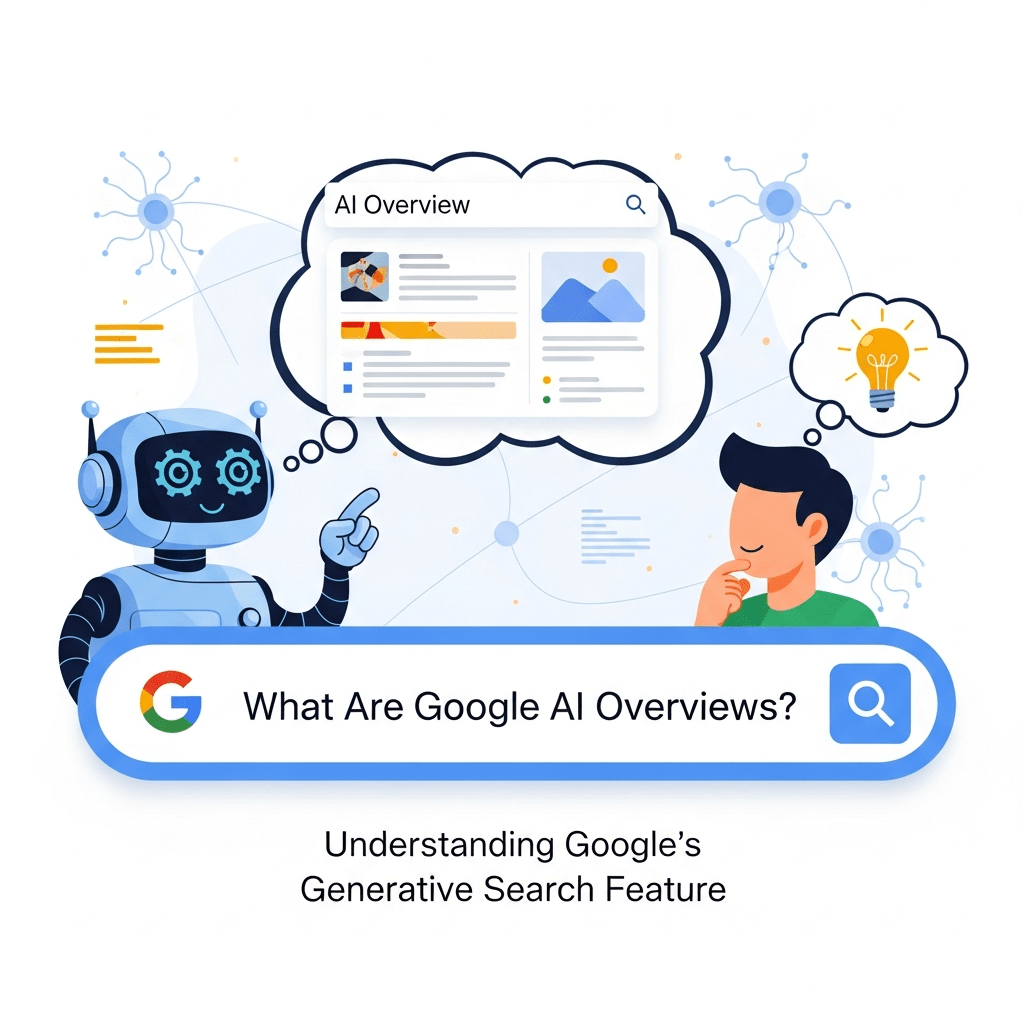
Google AI Overviews are AI-generated summaries that appear at the top of search results, providing instant answers by synthesizing information from multiple web sources.
Think of them as a hyper-intelligent research assistant. You ask a question, and Google’s AI reads dozens of relevant pages, extracts key information, and creates an original summary with citations.
The Evolution from Traditional Search
Traditional search gave you links. AI Overviews give you answers.
Before, you’d search “how to lower cholesterol naturally,” click through five different websites, and piece together information yourself. Now, Google generative search does that work for you, presenting a comprehensive answer immediately.
According to BrightEdge’s 2024 research, AI Overviews now appear in 84% of searches across major query categories. That’s massive reach in just over a year of broader rollout.
How Google AI Overviews Differ from Featured Snippets
Featured snippets pulled content from one source. AI snapshots Google creates synthesize information from multiple sources.
A featured snippet might quote a single paragraph from one website. An AI Overview reads content from 3-8 different sources, understands the relationships between information, and generates an entirely new response that combines insights from all those sources.
It’s the difference between copying someone’s homework and actually understanding the material well enough to write your own paper.
Understanding Google SGE (Search Generative Experience)
Google SGE was the original name for what’s now called AI Overviews.
Google launched the Search Generative Experience as an experiment in May 2023, testing how generative AI could transform search. The name changed, but the technology remained essentially the same—just more refined and widely deployed.
The Rebranding to AI Overviews
Why the name change? Simplicity.
“Search Generative Experience” sounded like corporate jargon. “AI Overviews” clearly describes what users see: an AI-generated overview of their search topic. Google made the switch in May 2024 as the feature rolled out more broadly.
The functionality stayed consistent—generate comprehensive answers using AI—but the branding became more accessible.
How the Technology Actually Works
What are Google AI Overviews and how do they work behind the scenes? It’s sophisticated but understandable.
Google’s AI (powered by their Gemini model) analyzes your search query to understand intent. It then identifies relevant, authoritative sources across the web, evaluates content quality, extracts key information, and synthesizes everything into a coherent response.
The process happens in seconds:
- Query understanding and intent analysis
- Source identification and quality evaluation
- Information extraction from multiple pages
- Synthesis into coherent, original response
- Citation generation for transparency
- Relevance checking and accuracy verification
This isn’t just keyword matching. The AI understands context, relationships between concepts, and what information actually answers your question.
What Types of Searches Trigger Google AI Overviews?
Not every search generates an AI Overview. Google deploys them strategically.
AI Overviews appear most frequently for:
- Complex questions requiring multi-source answers
- How-to queries and instructional searches
- Comparison questions (X vs Y)
- Informational searches about topics, concepts, or processes
- Product research and buying guidance
- Health and wellness questions (with careful review)
Simple navigational searches (finding a website) or transactional searches (buying a specific product) typically don’t trigger AI Overviews.
Queries That Don’t Get AI Overviews
Google deliberately limits AI Overviews in certain categories.
Highly commercial queries with clear purchase intent often skip AI Overviews, showing shopping results instead. Queries seeking real-time information like sports scores or stock prices get specialized panels rather than AI summaries.
According to Search Engine Land’s 2024 analysis, local searches (“restaurants near me”) rarely trigger AI Overviews, preferring map-based results that better serve location-based intent.
Pro Tip: AI Overviews work best for educational and informational queries where users genuinely want to learn or understand something deeply, not just find a quick fact or make a purchase. – Search behavior insight from Google’s documentation
How Do Google AI Generated Search Results Actually Appear?
Understanding Google AI generated search results starts with recognizing their visual format.
AI Overviews sit at the top of search results, above traditional organic listings. They feature a distinctive design with a multi-paragraph AI-generated response, citations linking to source websites, and follow-up questions users commonly ask next.
The Anatomy of an AI Overview
Let’s break down what you actually see.
Header: Usually says “AI Overview” or similar designation, clearly identifying the AI-generated nature.
Main Content: 2-5 paragraphs (typically 100-300 words) directly answering the query with synthesized information.
Source Citations: Clickable links to 3-8 websites that contributed information, usually displayed as small thumbnail cards below the text.
Follow-Up Questions: Suggested related questions users typically ask next, helping extend the research journey.
“Show More” Option: Many AI Overviews can be expanded to reveal additional information or detail.
This format prioritizes immediate answer delivery while maintaining transparency about sources and encouraging deeper exploration.
Mobile vs Desktop Experience
The experience varies slightly across devices.
On desktop, AI Overviews display prominently with source thumbnails clearly visible. On mobile, the format compresses to fit smaller screens, sometimes requiring scrolling to see all citations.
Mobile users see condensed versions more frequently, optimized for quick scanning on-the-go. Desktop versions tend to provide more expansive responses with additional context.
Real-World Example: Google AI Overviews in Action
Let’s walk through an actual use case to see how this works.
Search Query: “How to start a podcast in 2025”
Traditional Results: You’d see a mix of blog posts, equipment reviews, and hosting platform landing pages. You’d click through multiple links to gather comprehensive information.
With AI Overview: Google generates a comprehensive response covering essential steps: choosing a topic and format, selecting equipment (microphone, software), recording and editing basics, choosing a hosting platform, distribution to podcast directories, and promotion strategies.
The AI Overview synthesizes information from podcasting guides, equipment reviews, and platform documentation—presenting everything cohesively in one place. Source citations link to each contributing website.
Users can immediately understand the full process without clicking anything, or click specific citations if they want deeper detail on particular aspects.
Impact on User Behavior
This changes how people interact with search results.
According to SEMrush’s 2024 AI Overview study, users spend 40% more time engaging with AI Overviews compared to traditional featured snippets. However, click-through rates to websites drop by 18-34% for queries where AI Overviews appear.
The trade-off? Users get faster answers, but websites receive less traffic from search. This creates new challenges for content creators and businesses relying on organic search traffic.
More on addressing these challenges appears in our complete Google AI Overviews optimization guide.
How Are Sources Selected for AI Overviews?
Google doesn’t randomly pick sources. There’s a sophisticated selection process.
The AI evaluates potential sources based on:
- Content quality and comprehensiveness
- Site authority and reputation
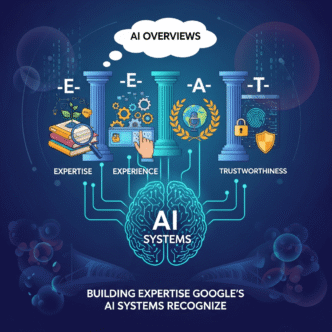
- E-E-A-T signals (Experience, Expertise, Authoritativeness, Trustworthiness)
- Content freshness and recency
- Relevance to the specific query
- Technical factors like page speed and mobile-friendliness
High-quality, authoritative content from recognized sources gets cited most frequently.
The E-E-A-T Factor
E-E-A-T matters more than ever with AI Overviews.
Google’s AI specifically looks for content demonstrating genuine expertise—verified credentials, practical experience, and authoritative presentation. Generic content written without deep knowledge rarely makes the cut.
Medical information? The AI prefers content from healthcare professionals or medical institutions. Financial advice? Certified financial planners and established financial publications get priority.
This appears extensively in strategies for optimizing content for AI Overviews.
Multi-Source Synthesis
Unlike featured snippets, AI Overviews typically cite 3-8 sources.
This multi-source approach creates more balanced, comprehensive answers. If one source emphasizes technique A while another highlights technique B, the AI Overview might present both perspectives, noting different expert opinions.
Pro Tip: Getting cited in AI Overviews isn’t about being the only source—it’s about being one of the authoritative sources Google’s AI considers definitive for specific aspects of topics. – Content strategy insight
Comparison: AI Overviews vs Traditional Search Features
Understanding differences helps clarify what AI Overviews actually are.
| Feature | Traditional Results | Featured Snippets | AI Overviews |
|---|---|---|---|
| Source Count | Multiple separate results | Single source | 3-8 synthesized sources |
| Content Type | Direct website excerpts | Quoted text block | AI-generated summary |
| Length | Varies by page | 40-60 words typical | 100-300 words typical |
| Update Method | Manual by site owners | Extracted from top result | AI synthesis from multiple sources |
| Citations | Each result separate | One backlink | Multiple source links |
| Customization | None | Limited | Contextual to query nuance |
What Are the Benefits of Google AI Overviews?
For users, AI Overviews deliver clear advantages.
Time Savings: Get comprehensive answers immediately without clicking through multiple websites. Research that used to take 10-15 minutes now takes 30 seconds.
Information Quality: Multi-source synthesis provides more balanced perspectives than single-source answers. You’re not relying on one website’s potentially biased viewpoint.
Context and Depth: AI Overviews often provide more context than traditional snippets, explaining not just “what” but “why” and “how.”
Follow-Up Discovery: Suggested questions help users explore topics more thoroughly, leading to deeper understanding.
Benefits for Content Creators
It’s not all traffic loss. There are opportunities.
Getting cited in AI Overviews builds credibility and brand recognition. Users see your site as an authoritative source even without clicking immediately. This “awareness traffic” often converts better long-term.
Citations also generate referral traffic from users wanting deeper detail on specific aspects. These visitors typically engage more meaningfully than average organic traffic.
Strategies for maximizing these benefits appear in our AI Overviews optimization strategies.
What Are the Challenges with Google AI Overviews?
Not everything about AI Overviews is perfect. Issues exist.
Accuracy Concerns: Early rollouts included some hilariously wrong answers—like suggesting adding glue to pizza sauce. Google quickly improved quality controls, but occasional errors still surface.
Traffic Impact: Websites lose clicks when AI Overviews answer questions completely. According to Search Engine Journal’s traffic analysis, sites in positions 1-3 experience 18-34% traffic declines for queries with AI Overviews.
Commercial Displacement: Publishers and content creators who monetize through ads lose revenue when users don’t visit their sites.
Bias and Perspective: AI synthesis might inadvertently favor certain perspectives or miss important nuances that human researchers would catch.
The Misinformation Risk
Google AI Overviews explained for beginners must include accuracy discussions.
AI systems can confidently present incorrect information synthesized from poor sources. While Google implements quality controls, no system is perfect.
The company added disclaimers encouraging users to verify important information, particularly for health, financial, and legal queries. Citation links allow users to check sources themselves.
Google continues refining algorithms to improve accuracy, but users should maintain healthy skepticism with all AI-generated content.
How Will Google AI Overviews Evolve?
The technology keeps advancing rapidly.
Near-term developments include:
- Enhanced multimodal integration (images, videos directly in overviews)
- More personalized responses based on user history and context
- Real-time information integration for current events
- Improved local search integration
- Voice search optimization for conversational queries
According to Google’s official announcements, they’re testing features like AI-generated visual content, interactive elements, and more sophisticated follow-up question handling.
Impact on SEO and Content Strategy
AI Overviews fundamentally change SEO.
Traditional optimization focused on ranking in top positions. Now, optimization must target AI Overview citations while maintaining traditional rankings. This dual approach appears extensively in our complete optimization guide.
Content needs greater depth, stronger authority signals, and clearer structure for AI extraction. Thin content no longer competes effectively.
The shift favors genuine expertise over keyword manipulation—which arguably makes the internet better for everyone.
Common Mistakes Understanding Google AI Overviews
Misconceptions abound about this technology. Let’s clear them up.
Mistake #1: Thinking AI Overviews Are Just Advanced Featured Snippets
They’re completely different technologies.
Featured snippets extract existing content. AI Overviews generate new content by synthesizing multiple sources. The technical process, source selection, and content creation work entirely differently.
Treating them the same leads to ineffective optimization strategies.
Mistake #2: Assuming AI Overviews Appear for All Searches
Google deploys AI Overviews selectively based on query type and quality considerations.
Only certain categories of searches trigger AI Overviews. Navigational, transactional, and simple factual queries often skip them entirely. Understanding which searches trigger AI Overviews helps set realistic expectations.
Mistake #3: Believing You Can “Opt Out” of AI Overviews
There’s no opt-out for content owners.
If Google’s AI finds your content valuable for answering queries, it may cite you in AI Overviews. You can’t block this specifically while maintaining normal search visibility.
The only “opt-out” is removing content from Google’s index entirely—which obviously isn’t practical for most sites.
Mistake #4: Thinking Traditional SEO Is Dead
Traditional SEO remains essential.
AI Overviews supplement traditional search results, they don’t replace them. Users still click through to websites for deeper information, transactions, and specific details.
Effective strategies combine traditional SEO with AI Overview optimization rather than choosing one over the other.
Mistake #5: Expecting Immediate Traffic Recovery
Adaptation takes time and strategic effort.
Sites experiencing traffic declines from AI Overviews won’t recover overnight. Building the authority, content depth, and optimization necessary for consistent AI Overview citations requires months of focused work.
Quick fixes don’t exist. Sustainable success requires comprehensive strategy adjustments.
How to Check If Your Content Appears in Google AI Overviews
Monitoring AI Overview appearances helps track performance.
Manual Checking: Search your target keywords in Google (use incognito mode to avoid personalization). Document when AI Overviews appear and whether your site gets cited.
Track Competitor Citations: Note which competitors consistently appear in AI Overviews. Analyze what makes their content cite-worthy.
Google Search Console: While GSC doesn’t specifically track AI Overview impressions yet, monitor overall impression and click-through rate changes for queries likely triggering AI Overviews.
Third-Party Tools: SEO platforms like SEMrush and Ahrefs now include AI Overview tracking features showing visibility trends.
Systematic tracking reveals patterns about which content types and topics generate citations most effectively. More detailed measurement strategies appear in our optimization guide.
The Future of Search: What AI Overviews Mean for You
Search generative experience technology represents search’s future direction.
Google invested billions into generative AI because they see it as essential to remaining competitive. ChatGPT, Perplexity, and other AI search tools created existential threats to Google’s search dominance.
AI Overviews are Google’s defensive and offensive strategy—keeping users within Google’s ecosystem while providing the conversational AI experience users increasingly expect.
For Everyday Users
Search becomes faster and more intuitive.
You’ll spend less time clicking through multiple websites for basic information. Complex questions get comprehensive answers immediately. Research that used to require significant effort becomes nearly effortless.
The trade-off? Less exposure to diverse sources and perspectives unless you actively click through citations.
For Content Creators and Businesses
The game changed. Adapt or fall behind.
Success now requires demonstrating genuine expertise, building comprehensive content, and establishing authority signals AI systems recognize. Surface-level content won’t cut it.
But opportunities exist. Early adopters establishing strong positions in AI Overviews gain significant competitive advantages as this technology becomes standard.
Comprehensive strategies for adaptation appear in our complete Google AI Overviews optimization guide.
FAQ: Google AI Overviews Explained
Q: Are Google AI Overviews the same as ChatGPT?
No—they serve different purposes. ChatGPT is a conversational AI you interact with directly through chat. Google AI Overviews appear automatically in search results, synthesizing web content to answer specific search queries. ChatGPT generates responses from its training data; AI Overviews cite current web sources.
Q: Can I turn off Google AI Overviews in my search results?
Not directly. Google doesn’t provide a user setting to disable AI Overviews. They appear based on query type and Google’s determination of when AI-generated summaries add value. Some browser extensions claim to hide them, but this requires third-party tools.
Q: Do websites get credit when cited in AI Overviews?
Yes—citations include visible links to source websites. Users can click these to visit the original content. However, many users get sufficient information from the AI Overview without clicking through, potentially reducing overall traffic to cited sites.
Q: How accurate are Google AI Overviews?
Generally accurate but not perfect. Google implements quality controls and primarily cites authoritative sources, but errors occasionally occur. Always verify critical information—especially for health, financial, or legal decisions—by checking original sources or consulting professionals.
Q: Will AI Overviews completely replace traditional search results?
Unlikely. AI Overviews supplement traditional results rather than replace them. Many queries—navigational, transactional, local—work better with traditional result formats. Google will likely continue offering both, adapting which format serves each query type best.
Q: How can I get my content featured in Google AI Overviews?
Focus on comprehensive, authoritative content demonstrating genuine expertise. Implement proper schema markup, build strong E-E-A-T signals, maintain content freshness, and cover topics thoroughly. Detailed optimization strategies appear in our complete optimization guide.
Final Thoughts
Google AI Overviews represent more than a new search feature—they’re a fundamental transformation in how information discovery works online.
Understanding what AI Overviews are, how they function, and what they mean for your search behavior or business strategy matters more every day. This technology isn’t going away; it’s expanding.
For users, embrace the convenience while maintaining critical thinking about AI-generated information. For content creators and businesses, adapt strategies to thrive in this new landscape rather than resisting inevitable change.
The future of search is here. Those who understand it and adapt strategically will succeed. Those who ignore it risk irrelevance.
Start learning, start optimizing, and start building for the AI-powered search ecosystem. The competitive advantages go to early movers who master this technology before it becomes standard practice.
Welcome to the new era of search.