

Health is the clearest example of what Google calls “Your Money or Your Life” content: topics that can significantly affect people’s health, financial stability or safety. For these topics, Google says its systems give even more weight to signals of strong experience, expertise, authoritativeness and trust [1]. A medical page that would be fine as an ordinary blog post can fail here, because the standard is whether the information is accurate and safe to act on.
Healthcare websites also carry legal duties that most sites do not, from patient privacy rules to accessibility law. This guide covers what changes for medical sites in search, how to build trust, the technical and privacy issues that are specific to healthcare, local search for practices, and how to measure results without exposing patient data. It is the hub for our healthcare SEO guides.
This guide explains search practice, not law. It uses US rules (HIPAA and the ADA) as examples because they are the most widely documented; check your obligations, and those in other countries such as the UK, with a qualified adviser.
Key takeaways
- Health content is “Your Money or Your Life”: Google gives extra weight to signs of expertise and trust, and trust matters most.
- E-E-A-T is not a single ranking factor; it is what the signals Google uses are trying to identify. Show it with named, qualified authors, medical review and sources.
- Analytics and advertising tags on patient portals and booking flows can expose protected health information; check every tracking tool before it goes live.
- Doctors who see patients at a public location can have their own Business Profile, alongside the practice’s.
- No special schema type gives medical sites a rich result; use accurate Organization, LocalBusiness and Physician markup to describe the practice.
- Accessibility is a legal requirement for many medical offices in the US, not an optional extra.
Read the workflow as text
- Trust: medical E-E-A-T; healthcare content writing guidelines.
- Privacy: HIPAA, analytics and SEO.
- Local: local SEO for medical practices; healthcare reputation management.
- Technical: medical website accessibility; medical schema markup.
- Content: condition and treatment pages; telehealth SEO.
- At scale: hospital and health system SEO.
- Note: this hub explains search practice, not law. Check obligations with a qualified adviser.
Table of Contents
ToggleWhat makes healthcare SEO different?
Three things: a higher bar for content quality, legal limits on data and marketing, and a strong local element. Google’s guidance on helpful content says that for topics affecting health, financial stability, safety or society’s welfare, its systems give even more weight to content that shows strong E-E-A-T [1]. In practice that means content written or reviewed by qualified people, consistent with established medical consensus, and clear about who is responsible for it.
The same guidance makes two points that are often misreported. E-E-A-T itself is not a specific ranking factor; Google uses a mix of signals that identify content with good E-E-A-T. And the ratings from Google’s search quality raters are not used directly in its ranking algorithms [1]. There is no “YMYL penalty” to escape: there is a higher standard to meet.
Which terms do you need to know?
Healthcare SEO borrows words from search, law and medicine. This is a short glossary, built from the sources in this guide.
| Term | What it means here |
|---|---|
| YMYL (“Your Money or Your Life”) | Google’s name for topics that can significantly affect health, financial stability or safety. Its systems give extra weight to strong signs of experience, expertise, authoritativeness and trust for them [1] |
| E-E-A-T | Experience, expertise, authoritativeness and trust. Google says it is not a specific ranking factor, and that trust is the most important part [1] |
| Regulated entity | In the HHS bulletin, a HIPAA covered entity or business associate [2] |
| Protected health information (PHI) | Individually identifiable health information that a regulated entity handles. The bulletin says such information collected on a regulated entity’s website generally is PHI [2] |
| Business associate | A vendor that creates, receives, maintains or transmits PHI for a regulated entity. The bulletin says a tracking vendor in that position needs a business associate agreement (BAA) [2] |
How do you show E-E-A-T on medical pages?
Answer Google’s three questions on every page: who created it, how it was created, and why [1]. Of the four parts of E-E-A-T, Google says trust is the most important [1].
- Who: a named author with their qualification and role, and, for clinical content, a named medical reviewer. Link each name to a profile page that lists registration or licensing details your readers can check.
- How: say how the page was produced and reviewed, and when it was last reviewed. If AI tools helped draft it, say so; Google’s guidance expects that kind of disclosure where readers would want it [1].
- Why: the page should exist to help a patient understand or decide something, not to target a keyword.
- Evidence: cite clinical guidelines, peer-reviewed research or official health bodies for every medical claim, with live links.
Our guides to medical E-E-A-T and healthcare content writing cover these in detail.
From our own site: In November 2026 we reviewed the healthcare section of aiseojournal.net. None of its ten cluster posts linked to a single external source. The previous version of this guide did cite three, but the links had been saved with typographic quotation marks, so they never worked and appeared on the page as raw code. For a section about trust in medical content, that was the first thing to fix. On 9 November 2026 we counted again. All nine of our healthcare guides now list at least four sources, between four and fourteen. Earlier that day seven of them listed three. We also re-read the HHS bulletin in a browser, because our automated fetcher is blocked by hhs.gov. The privacy paragraph in this guide matches it, and the notice of the June 2024 court order and “HHS is evaluating its next steps” are still on the page. This counts listed sources. It does not judge their quality.
How do privacy rules affect healthcare SEO?
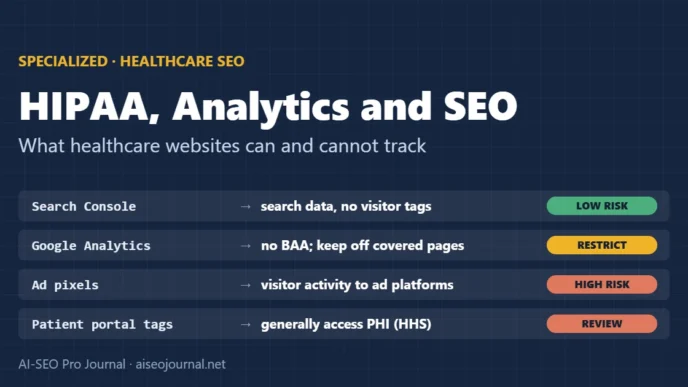
Mostly through tracking. Analytics, advertising pixels, session recorders and chat widgets send data to third parties, and on a healthcare site that data can include protected health information. The US Department of Health and Human Services (HHS) bulletin on online tracking technologies says that tracking on user-authenticated pages, such as patient portals and telehealth platforms, generally has access to protected health information, including details like IP addresses and appointment dates [2].
The guidance is in flux. On 20 June 2024 a US federal court vacated part of the bulletin: the part saying HIPAA obligations are triggered when a technology connects a person’s IP address with a visit to an unauthenticated public page about specific health conditions or providers. HHS says it is evaluating its next steps [2]. The bulletin also notes that health data handled by organisations outside HIPAA may fall under the US Federal Trade Commission’s Health Breach Notification Rule [2].
For SEO work, that leads to a simple rule: treat tracking on logged-in areas, booking flows and symptom or condition forms as high risk, and get your compliance lead to approve every tag before it goes live. Our HIPAA and analytics guide goes further.
Professional tip: Before adding any new tool, open your site’s tag manager and list every tag that fires on appointment, portal and contact pages. Most privacy problems on medical sites come from tags added for marketing years ago and never reviewed.
What does the HHS bulletin say about each kind of page?
These points come from the HHS Office for Civil Rights bulletin [2]. We re-read it on 9 November 2026. The page says its contents do not have the force and effect of law, and it is aimed at HIPAA-regulated entities. Ask your compliance lead how it applies to you.
| Kind of page | What the bulletin says |
|---|---|
| A page behind a login, such as a patient portal or telehealth platform | Tracking technologies there generally have access to protected health information [2] |
| A portal login or registration page | If tracking collects the login or registration details someone enters, that is a disclosure of protected health information [2] |
| A booking or symptom-checker page that needs no login | Tracking there may have access to protected health information in certain circumstances, such as an email address or a reason for seeking care [2] |
| A page about hours, jobs or general information | Tracking on many such pages does not have access to protected health information [2] |
| A condition or provider page, IP address linked to the visit | A court vacated this part of the bulletin on 20 June 2024. HHS says it is evaluating its next steps [2] |
How do you audit your tracking?
Work in this order.
- List every tag. Open your tag manager and list what fires on portal, booking, symptom-checker and contact pages.
- Sort the pages by risk, using the table above.
- Ask for a decision on each tag on the higher-risk pages: keep, restrict or remove.
- Check the vendor. The bulletin says a vendor that handles protected health information is a business associate and needs a signed agreement. A vendor agreeing to strip the data is not enough [2].
- Do not rely on a banner. The bulletin says banners asking visitors to accept or reject tracking are not a valid HIPAA authorisation [2].
- Write down the decision and set a date to audit again.
How does local SEO work for medical practices?
Through the Business Profile, consistent practice details and reviews, as for any local business, with one healthcare-specific rule about individual practitioners. Google’s Business Profile guidelines say a practitioner, such as a doctor or dentist, should have their own profile if they work in a public-facing role and can be contacted directly at the verified location during stated hours [3]. Support staff should not have their own profiles, and a practitioner should not have several profiles for different specialisms [3].
- Group practice: the practice has its own location profile, and each public-facing practitioner’s profile uses only their name [3].
- Solo practitioner at a branded practice: one profile, named “[practice name]: [practitioner name]” [3].
Reviews need extra care: never confirm in a public reply that the reviewer is a patient or mention their care. Our guides to local SEO for medical practices and healthcare reputation management cover the details.
What technical SEO matters most for healthcare sites?
The same fundamentals as any site, plus accessibility and accurate structured data.
- Accessibility. The US Department of Justice says the ADA applies to businesses open to the public, naming hospitals and medical offices, and that this includes what they offer on the web. It points to the Web Content Accessibility Guidelines (WCAG) as helpful technical guidance [4]. Fix accessibility in the site itself rather than relying on an overlay widget. See our medical website accessibility guide.
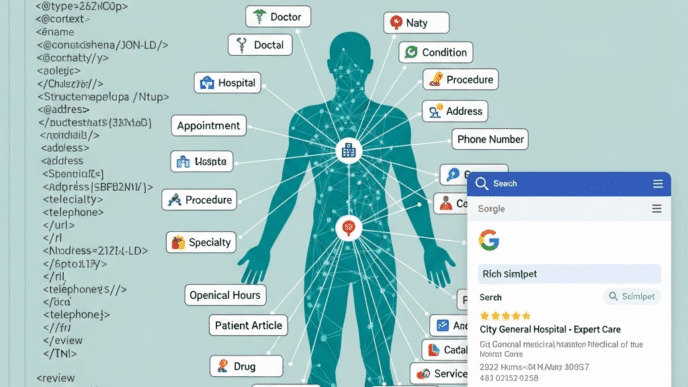
- Structured data. Google’s list of supported rich results has no medical-specific type [6]. Use Organization or LocalBusiness markup for the practice, and Schema.org’s
MedicalClinicorPhysiciantypes, which are kinds of medical business and organisation, where they describe it accurately [5].MedicalWebPageexists for pages that provide medical information [5]. Our medical schema guide shows examples. - Fast, mobile-friendly booking. Test the whole booking flow on a phone, from search result to confirmation.
What healthcare content should you publish?
Pages that answer what patients actually ask, at each stage: symptoms and conditions, treatments and what to expect, practical details (costs, insurance, preparation, recovery), and how to book. Start from real questions: front-desk calls, consultation notes stripped of personal details, and Search Console queries.
Prioritise depth on the conditions and treatments you actually provide over broad health news. Each condition or treatment page should have a named clinical reviewer, a review date, and sources. Our guide to condition and treatment pages sets out a structure, and our telehealth SEO guide covers virtual care.
Trust checklist for a medical page
- Named authorQualification and role, linked profile
- Medical reviewerNamed clinician and review date
- SourcesGuidelines, research or official bodies, working links
- PrivacyNo unreviewed tracking on forms, portals or booking
- AccessibleBuilt to WCAG, not patched with an overlay
What about the UK and other countries?
This guide uses US rules as examples. Other countries have their own. We can only speak to what we have read, so here is what we can and cannot say.
UK public sector websites. GOV.UK says public sector bodies must meet WCAG 2.2 level AA, publish an accessibility statement, and review it regularly. It covers central and local government organisations and some other bodies. The page does not name the NHS or any health body, so check with your legal adviser whether it applies to you [9].
UK data protection. The UK Information Commissioner’s Office (ico.org.uk) publishes the guidance. We could not read its pages on health data and online tracking for this review, because its site blocked our checker. So we do not summarise them. Read the ICO’s guidance yourself, and ask a UK adviser.
The advice that travels well is the practical part: list your tracking tags, get each one approved before it goes live, and show who wrote and reviewed every medical page.
Do AI answers change the approach?
Not the basics. Google says there are no additional requirements to appear in AI Overviews or AI Mode, and that indexing and serving are not guaranteed [10]. It also says traffic from these features is counted in the Web search type in Search Console [10]. For health topics, Google says content must be highly accurate and consistent with expert consensus [1]. So the work is the same: accurate pages, named reviewers and real sources.
What are the most common healthcare SEO mistakes?
- Unsourced medical claims. Every claim about symptoms, risks or outcomes needs a source a clinician would accept.
- Anonymous content. No named author or reviewer on pages that give health information.
- Unreviewed tracking on portals, forms and booking pages.
- Review replies that disclose patient information.
- Duplicate location pages that change only the town name.
- Out-of-date pages with no review date, especially on treatments and guidelines that change.
Review this page from a medical website for trust and accuracy signals.
Page text: [paste]
1. List every medical claim (symptoms, risks, outcomes, treatments, statistics) and say whether a source is cited for it.
2. Say whether the page names an author and a medical reviewer with qualifications, and shows a last-reviewed date.
3. Flag any statement that sounds like personal medical advice or a guarantee of results.
4. Flag any patient details, testimonials or review quotes that could identify a patient.
Do not supply medical facts or sources yourself; only report what is on the page and what is missing.
How do you measure results without exposing patient data?
Start with the data Google already reports on your site’s search performance. The Performance report shows clicks, impressions, click-through rate and average position [7]. Google says its tables are aggregated by property or by page, and that the newest data is preliminary and can change within hours [8].
- Measure search visibility in Search Console. Filter to your service and condition pages.
- Keep identifiers out of web analytics. This is our editorial advice. Do not pass names, emails or reasons for care in page addresses or event names.
- Count bookings through a method your compliance team has approved.
- Compare periods, not single days, and write down what you expected.
Set no timeline promises. Results depend on your competition, your market and your site.
In what order should you work?
This order is our editorial suggestion. Each step links to the guide that covers it.
- Trust signals on your most important pages. Start with medical E-E-A-T.
- A tracking audit. Read HIPAA, analytics and SEO.
- Profiles and reviews. See local SEO for medical practices.
- Accessibility and structured data. See the accessibility guide and medical schema markup.
- Condition and treatment pages. See the page plan.
What did our own audit change?
We audited our nine healthcare guides in November 2026. Every one listed only three sources before. This table shows what we listed after, and what we added. It is a count of listed sources, not a judgement of their quality.
| Guide | Sources before | Sources after | What we added |
|---|---|---|---|
| Medical E-E-A-T | 3 | 6 | A review workflow, a claims table, and a trust-block template |
| Content writing guidelines | 3 | 6 | A brief and source log, and risky-versus-safer wording |
| Local SEO for practices | 3 | 7 | Duplicate-profile steps and review-request wording |
| Medical schema markup | 3 | 9 | A JSON-LD checker and broken-markup examples |
| Telehealth SEO | 3 | 4 | A Google Business Profile decision path |
| Hospital and health system SEO | 3 | 7 | A master-record template and a listing checker |
| Condition and treatment pages | 3 | 12 | A page plan and NHS page structures |
| Reputation management | 3 | 5 | A reply checker and Google-versus-FTC rules |
| Website accessibility | 3 | 14 | A workflow, a self-check tool and code examples |
The lesson for your own site is the same. Start by counting what each medical page actually cites.
Healthcare SEO guides on this site
- Medical E-E-A-T
- Healthcare content writing guidelines
- Condition and treatment pages
- Local SEO for medical practices
- Hospital and healthcare system SEO
- Healthcare reputation management
- Medical schema markup
- HIPAA, analytics and SEO
- Medical website accessibility
- Telehealth and virtual care SEO
These guides are being reviewed and given sources one by one, starting in November 2026.
Tick what is already true for your site. The tool counts your ticks and links to the guide for each area with a gap. It does not scan your site, give legal advice or store anything. Nothing leaves this page.
Frequently asked questions
Does Google penalise medical websites?
No. There is no medical penalty, but Google gives extra weight to signals of expertise and trust for health topics, so the bar is higher. Pages need to be accurate, consistent with expert consensus, and clear about who wrote and reviewed them.
Is E-E-A-T a ranking factor?
Not as a single factor. Google says E-E-A-T itself isn’t a specific ranking factor; its systems use a mix of signals that help identify content with good experience, expertise, authoritativeness and trust, and trust is the most important part.
Can I use Google Analytics on a healthcare website?
Possibly, but with care. HHS guidance says tracking on logged-in pages such as patient portals generally has access to protected health information. Have your compliance lead review every tracking tool, especially on portals, forms and booking pages.
Can a doctor have their own Google Business Profile?
Yes, if they are public-facing and can be contacted directly at the verified location during stated hours. In a group practice, the practice and each practitioner have separate profiles; a solo practitioner at a branded practice has one combined profile.
Is there special schema markup for medical websites?
No rich result is specific to medical sites in Google Search. Use accurate Organization or LocalBusiness markup, and Schema.org types such as MedicalClinic or Physician where they fit, to describe the practice.
Does a cookie banner make tracking HIPAA-compliant?
No. The HHS bulletin says website banners that ask visitors to accept or reject tracking do not constitute a valid HIPAA authorisation. Ask your compliance lead.
What does the HHS bulletin say about login and registration pages?
It says that if tracking on a patient portal login or registration page collects the login or registration details someone enters, that is a disclosure of protected health information.
Start with the trust signals on your most important pages
Pick your ten most visited condition, treatment and practitioner pages. Add a named author and medical reviewer, a review date and working sources to each, then list every tracking tag that fires on them and on your booking flow. Those two changes address the biggest risks first. For the wider trust framework, see our guide to E-E-A-T.
Sources
- Google Search Central — Creating helpful, reliable, people-first content
- US Department of Health and Human Services — Use of online tracking technologies by HIPAA covered entities and business associates (last reviewed 26 June 2024)
- Google Business Profile Help — Guidelines for representing your business on Google
- US Department of Justice — Guidance on web accessibility and the ADA, 18 March 2022
- Schema.org — Physician, MedicalClinic and MedicalWebPage types
- Google Search Central — Structured data markup that Google Search supports
- Google Search Console Help — Performance report (Search results): Overview and basic setup (checked 9 November 2026)
- Google Search Console Help — About the data in the Performance report (checked 9 November 2026)
- GOV.UK — Understanding accessibility requirements for public sector bodies (last updated 30 September 2024; checked 9 November 2026)
- Google Search Central — AI features and your website (checked 9 November 2026)