

The State of Business Buying 2026 is Forrester’s annual report on how companies buy products and services. It draws on a survey of nearly 18,000 business buyers worldwide [2]. Forrester published the headline findings on 21 January 2026 [1].
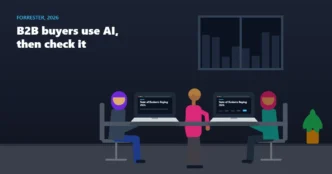
Its central finding matters to anyone doing SEO for a B2B company. Generative AI is now where many buyers start, but they do not trust it alone. They check what AI tells them with colleagues and outside experts [1] [2].
Updated 18 November 2026: expanded with Forrester’s own blog posts on the report and its 2024 edition. We added the survey size, which the press release does not give, and a comparison with 2024.
If you only do one thing: make sure the claims on your key pages can be checked. Forrester says buyers validate AI answers against trusted sources [1]. A page that names its evidence, its customers and its date is the page a buyer can forward to a colleague.
Table of Contents
ToggleWhat does the State of Business Buying 2026 report find?
Here are the main figures Forrester has made public. They come from the press release and two blog posts by Forrester staff [1] [2] [3].
- 94% of business buyers use AI somewhere in their buying process [2]. A year earlier the figure was 89% [3].
- Twice as many buyers named generative AI or conversational search as a more important source of information than any other source [3].
- 13 internal stakeholders and nine external influencers take part in a typical buying decision [1].
- Buying groups double for purchases that include generative AI features: 14 members against seven [2].
- Procurement is a decision-maker in 53% of buying cycles, and gets involved from the start [1].
- More than 60% of buyers use a trial. For purchases of $10 million or more, 78% trial first [1]. Just over a third plan to convert the trial to a paid version with the same provider [2].
The figures at a glance are in the graphic below. You can zoom and pan it, or expand it. The same points are written out above.
Read the workflow as text
- GenAI is the starting point Buyers start with generative AI searches, then lean on their own networks.
- 13 + 9 stakeholders The typical decision involves 13 internal stakeholders and nine external influencers.
- AI answers need checking AI tools often give incomplete or unreliable information. Buyers seek validation.
- Procurement: 53% Procurement professionals are decision-makers in 53% of business buying cycles.
- Trials: 60%+ (78% at $10M+) More than 60% of buyers use a trial. 78% of buyers of $10 million or more do a trial first.
- Source and limits Forrester release, 21 January 2026. Survey: nearly 18,000 business buyers (Forrester blog, 21 January 2026).
Who is in the buying group, and which AI do they use?
Large groups slow things down, but buyers say they are worth it. In Forrester’s release, 94% of buyers with groups of six or more report clear benefits [1]. They name broader perspectives, shared work in checking solutions, a better chance of securing budget and a greater chance of approval [1].
Procurement is one of the most active members. Forrester says procurement staff look beyond price, at features, functions and performance. They also talk to sales representatives more often than other buyer roles [1] [2].
The AI tools buyers use are often supplied at work. Buten wrote that 61% use private AI tools from their organisation. He added that business buyers are twice as likely as consumers to use ChatGPT, and four times as likely to use Microsoft Copilot [3]. More than half of those users run private versions behind their company firewall [3].
Why buyers check what AI tells them
Forrester’s release puts it plainly. AI search tools, which it also calls answer engines, “often deliver incomplete or unreliable information, creating mistrust” [1]. Buyers make up for this by checking with trusted sources.
Forrester’s blog names who those sources are: peers, product experts, industry analysts and others in the buyer’s network. It adds that buyers are more likely to contact a provider because of information from industry experts than because of AI tools [2].
Expert quote: “B2B buyers are under immense pressure to justify investments and minimize risk” — Barbara Winters, vice president and principal analyst, Forrester [1]
Winters also wrote Forrester’s blog on the report. She describes a climate of high interest rates, trade tension and budget pressure, where almost every purchase is a high-stakes decision [2]. In that setting, buyers want proof, not promises.
How does 2026 compare with Forrester’s 2024 report?
Forrester’s report for 2024, released on 4 December 2024, already pointed in this direction [4]. Comparing the public figures shows what has changed and what has not.
- AI use. In 2024, almost 95% of buyers expected to use generative AI within 12 months [4]. By the 2026 report, 94% said they used AI in their buying [2].
- Buying groups. The 2024 report counted 13 people inside the organisation on average [4]. The 2026 report keeps 13 internal stakeholders and adds nine external influencers [1].
- Friction. In 2024, 86% of purchases stalled during the process and 81% of buyers were dissatisfied with the provider they chose [4]. The public 2026 material does not repeat these figures.
The two reports use different wording, so treat this as a direction of travel rather than a like-for-like trend.
Watch out: This is a survey of buyers, not a study of AI tools. It tells you how buyers say they behave. It does not say how ChatGPT, Gemini or any other tool chooses which vendors to show.
What does the State of Business Buying 2026 mean for SEO?
Forrester’s John Buten drew the marketing conclusion himself. He wrote that providers will need to move “from driving traffic” through SEO to “driving visibility” through answer engine optimisation [3]. He also noted that 61% of buyers use private AI tools supplied by their own organisation [3].
This is our analysis. We agree with the direction but would put it differently. Visibility in AI answers is only the first step. Forrester’s own data says buyers then check those answers with people [1]. So the page the buyer lands on, and the page a colleague is sent, still has to carry the proof.
That gives four practical jobs for a B2B site.
- Write for the checker. Put a short, quotable summary near the top that a stakeholder can forward.
- Show your evidence. Name sources, customers you are allowed to name, and dates. Buyers trust validated claims [2].
- Explain the trial. Most buyers trial before they buy, so say what a trial includes and how to start [1].
- Answer procurement. Pricing model, security and contract terms are what procurement asks about [1].
These suggestions are ours. Forrester’s public material does not make them in this form.
Is your page ready for these buyers?
This checklist turns the findings into questions about one page. It is our own checklist, not Forrester’s, and it is not a ranking tool. Tick what is true for your page.
Tick the statements that are true for one page on your site. The tool scores the page out of eight and lists what is left. It is our own checklist, not Forrester's.
Quick check: Ask an AI assistant to compare you with two competitors. Then open the page it cites for you. Would a sceptical colleague find proof there within a minute?
What does Forrester’s public material not say?
- How AI tools pick vendors. Nothing in the release or blogs explains this.
- Results by market. The public pages give global figures. The full report, for clients only, breaks them down by role, industry and region [2].
- Stalled deals in 2026. The 2024 stall and dissatisfaction figures are not repeated in the 2026 public material [4].
Frequently asked questions
What is the State of Business Buying 2026?
It is Forrester’s annual report on how businesses buy, based on a survey of nearly 18,000 global business buyers. Forrester published the main findings on 21 January 2026.
How many B2B buyers use AI?
Forrester says 94% of business buyers use AI in their buying process, up from 89% a year earlier.
How big are B2B buying groups in 2026?
Forrester says a typical decision involves 13 internal stakeholders and nine external influencers. Groups double for purchases with generative AI features.
Do B2B buyers trust AI answers?
Not fully. Forrester says AI search tools often give incomplete or unreliable information, so buyers validate them with trusted sources.
What should B2B marketers do about it?
Forrester suggests shifting from driving traffic to driving visibility in AI answers. We add that the pages buyers land on must carry checkable proof.
Where to go next
To make pages easy to quote, read our tip on answer-engine-friendly content structures and our guide to answer quality optimisation. For the B2B side, see SaaS SEO: the complete guide. On visibility without clicks, read our zero-click search statistics and learn how to measure it with AI search visibility tracking. For the wider shift, see 2026 content strategy shifts and our guide to generative engine optimisation.
Sources
How we checked this: on 18 November 2026 we read Forrester’s 2026 press release, two Forrester blog posts about the report and its 2024 press release. We did not read the full report, which is for Forrester clients only. We have no relationship with Forrester.
- Forrester — Forrester’s 2026 Buyer Insights: GenAI Is Upending B2B Buying, press release, 21 January 2026
- Forrester — The State Of Business Buying: Risk-Averse Buyers Demand Proof, Not Promises, Barbara Winters, 21 January 2026
- Forrester — B2B Buyers Make Zero-Click Buying Number One, John Buten, 22 January 2026
- Forrester — To Master B2B Buying Mayhem, Providers Must Prioritize Buyers’ Needs, press release, 4 December 2024