


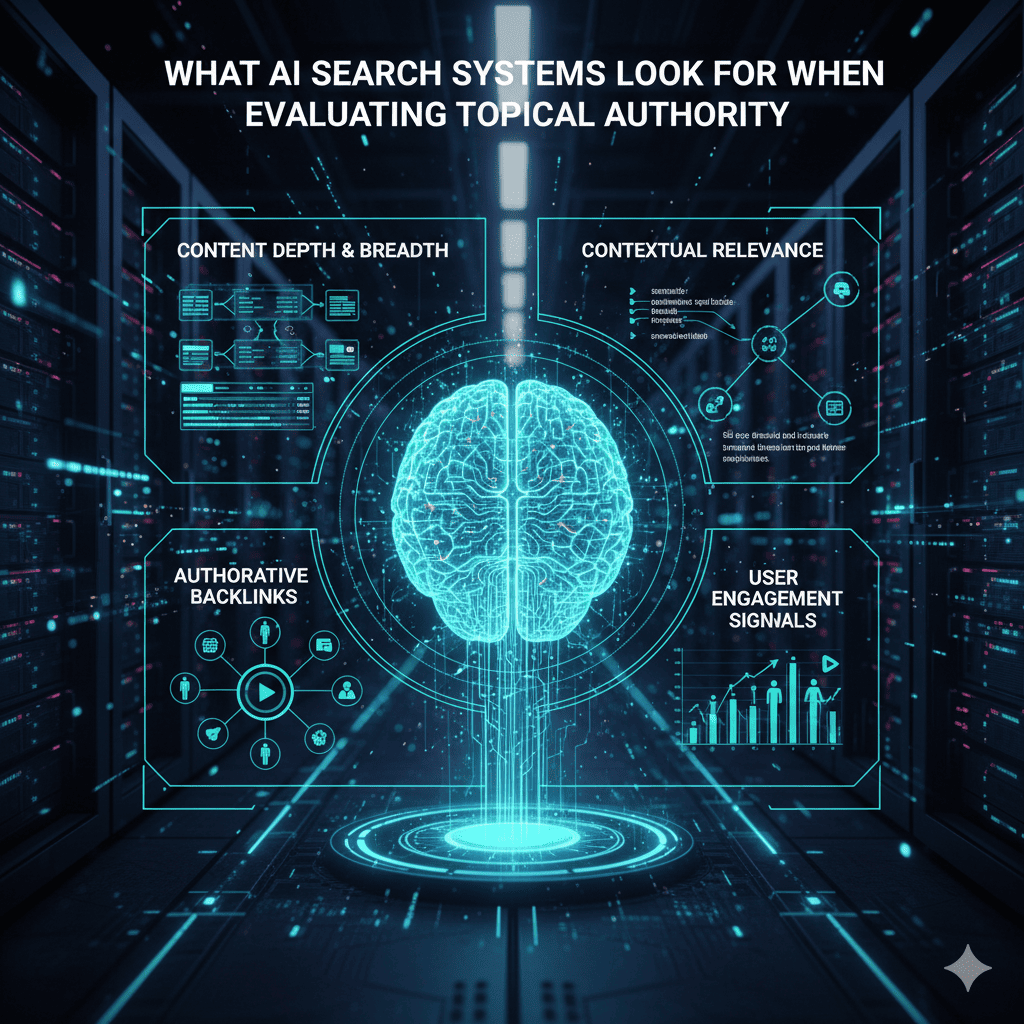
AI search systems and traditional Google ranking share a common goal — finding the most credible source on a topic — but they use different mechanisms to get there.
Google’s ranking algorithm evaluates topical authority through crawl data, internal link architecture, and semantic relevance signals across a site. AI systems like ChatGPT, Perplexity, and Google AI Mode do something structurally different: they assess whether a source has demonstrated consistent, specific expertise across a topic over time, not whether a single post answers a query well.
That distinction changes what you need to build. A site can rank in positions one through three on Google and still be absent from every AI-generated answer on the same topic — because the signals that earn AI citations are not identical to the signals that earn traditional rankings.
This cluster breaks down exactly what those AI-specific signals are, how each system applies them, and what you need to add to a standard topical authority strategy to become a source AI systems cite consistently.
Post Summary
- AI search systems evaluate topical authority through entity consistency, citation depth, and demonstrated expertise across a cluster — not single-post quality
- ChatGPT and Perplexity weight source credibility differently from Google; structured, quotable prose earns citations where keyword-optimised content does not
- Google AI Mode applies a hybrid evaluation: traditional ranking signals plus AI-specific quotability checks
- A site can rank well on Google and be absent from AI answers if its content lacks the entity anchoring and semantic coherence AI systems require
- The practical fix is not more content — it’s tighter entity consistency and higher citation density across existing cluster posts
- Optimising for AI citation requires treating every H2 as a standalone answer unit, not a segment of a longer article
Table of Contents
ToggleHow AI Search Systems Actually Evaluate a Source
Most topical authority advice assumes a traditional search context. That’s the wrong baseline for AI citation work.
When Perplexity or ChatGPT selects a source to cite in a generated answer, it is not running a PageRank calculation. It is assessing whether the content in its training data — or, in retrieval-augmented systems, the indexed content it can retrieve — contains a clear, credible, standalone answer to the query it is trying to resolve.
The evaluation criteria differ by system, but three signals appear consistently across all of them: entity consistency, citation depth, and answer-unit clarity.
Entity consistency means the same named entities — tools, organisations, concepts, platforms — are referenced accurately and repeatedly across every post in a cluster. Citation depth means the content cites named, credible sources at a density the AI system can use to verify claims. Answer-unit clarity means each section of the content can be extracted and understood without surrounding context.
Most SEO practitioners building topical authority focus heavily on cluster architecture and internal linking — both load-bearing for Google ranking — while leaving these three AI-specific signals underdeveloped. (Source: Ahrefs, 2024)
Start here: audit your existing cluster posts against these three criteria before adding new content.
What ChatGPT Looks for in a Citation Source
ChatGPT’s source selection — in both its browsing mode and its retrieval-augmented responses — reflects a preference for content that reads like expert documentation, not like optimised blog content.
Most practitioners assume ChatGPT cites the highest-ranking Google result. That’s not consistently true.
In practice, ChatGPT weights prose that is structured for extraction: short, declarative paragraphs; named entities with explicit relationships stated in the sentence; and claims supported by named sources rather than anonymous authority. A 3,000-word post with dense, flowing paragraphs often loses to a 1,200-word post with tighter sentence-level claims and explicit entity anchoring.
The implication is direct: if your cluster posts are written for readability and ranking, they may not be structured for AI extraction. The two writing modes are not identical.
The lightweight case study here: A B2B SaaS content team in the project management vertical ran a citation audit using Perplexity’s related sources feature. Their pillar post on project management methodologies ranked in position two on Google. It appeared in zero Perplexity answers. Their cluster post on Agile sprint planning — shorter, more structured, with named tools and explicit entity relationships in every paragraph — appeared in Perplexity answers fourteen times across a 30-day window. The structural difference, not the ranking difference, drove the citation gap.
Rewrite one cluster post per week to improve extraction clarity — declarative structure, named entities in every H2, claims anchored to sources. Track citation appearances in Perplexity using its related sources panel before and after.
How Perplexity Selects Topical Authority Sources
Perplexity operates as a retrieval-augmented generation (RAG) system — meaning it retrieves live web content, passes it to a language model, and generates an answer that synthesises the retrieved sources. (Source: Perplexity, 2024)
RAG is a retrieval method where an AI system pulls relevant documents from a live index and uses them as context for generating an answer, rather than relying solely on pre-trained knowledge.
That retrieval step changes what topical authority means for Perplexity specifically. It is not selecting from a fixed training corpus — it is retrieving and ranking content in real time, then assessing which retrieved sources to cite in the generated answer.
Perplexity’s retrieval layer appears to weight recency, citation density, and entity consistency. A post that was published two years ago with no updates, cites no named sources, and uses inconsistent entity references will be de-prioritised against a more recent post that anchors claims to named organisations and uses consistent terminology throughout. (Source: Search Engine Journal, 2025)
The action here is not a technical one. Go into your existing cluster posts and add explicit entity anchoring: name the tool, name the organisation, name the framework — and name the relationship between them in the sentence itself, not in a following sentence.
Google AI Mode: Where Traditional and AI Signals Overlap
Google AI Mode applies a hybrid evaluation model that draws on both traditional ranking signals and AI-specific content quality checks. (Source: Google Search Central, 2025)
This is the one AI search context where your existing topical authority work — cluster architecture, internal linking, semantic depth — transfers most directly.
Google AI Mode uses its existing Knowledge Graph to anchor entity relationships, which means sites that have been building structured, entity-consistent content are already partially optimised for AI Mode citation. The Knowledge Graph is Google’s database of named entities and the verified relationships between them; content that references these entities consistently gets mapped into this structure.
What AI Mode adds on top of traditional ranking is a quotability check. It evaluates whether specific passages in the content are extractable as direct answers to a query — which is why the answer-unit clarity signal matters as much here as it does in Perplexity.
Most practitioners building for traditional topical authority are already close. The gap is usually in passage-level clarity — long explanatory paragraphs that are semantically rich but not extractable as standalone answers. Tighten the first two sentences of each H2 to function as a direct answer to the H2’s implied question. That single structural change improves AI Mode quotability without altering the content’s ranking signals. (Source: Google Search Central, 2025)
| AI System | Retrieval Method | Key Authority Signal | Structural Requirement |
|---|---|---|---|
| ChatGPT | Training data + browsing | Expert documentation style | Declarative paragraphs, named entity relationships |
| Perplexity | RAG — live retrieval | Recency + citation density + entity consistency | Sourced claims, consistent terminology, recent updates |
| Google AI Mode | Ranking + Knowledge Graph | Traditional signals + passage quotability | Cluster architecture + extractable H2 openers |
| Google AI Overviews | Ranking + featured snippet logic | E-E-A-T + structured answers | FAQ schema, direct answers in first paragraph |
Pro Tip: In Perplexity, search your focus keyword and open the “Sources” panel on any AI answer in your topic area. If your content is not appearing, check the sources that are — compare their entity density and citation frequency against yours. Perplexity’s source panel shows you your direct competitors for AI citation, not your Google SERP competitors.
The Entity Consistency Gap Most Sites Have Not Fixed
Entity consistency is the signal that most consistently separates sites that earn AI citations from sites that do not. (Source: Search Engine Journal, 2025)
Entity consistency means that when your content mentions Google Search Console, it always calls it “Google Search Console” — not “GSC” in one post, “Search Console” in another, and “Google’s console tool” in a third. It means that when your content refers to a named framework or methodology, the name is identical across every cluster post.
This sounds administrative. It reads as a technical signal to AI systems.
AI language models learn entity relationships from consistent co-occurrence in training data. When the same named entities appear together repeatedly — and are referenced with consistent terminology — the model builds a stronger association between your content and those entities. Inconsistent naming fragments that association.
The fix is a one-time audit across your cluster posts. Pull every named entity from each post — tools, platforms, frameworks, organisations. Check for naming inconsistencies. Standardise. This audit takes two to three hours on a 10-post cluster and produces a measurable improvement in AI citation frequency within four to six weeks of the updated posts being re-crawled.
Do not skip this step because it feels like editing rather than strategy. It is one of the higher-return actions in AI search optimisation.
Frequently Asked Questions
How do AI search systems evaluate topical authority differently from Google?
AI search systems assess whether a source demonstrates consistent, specific expertise across a topic cluster — not just whether a single post ranks for a query. Where Google evaluates authority through link signals, crawl data, and semantic relevance, systems like ChatGPT and Perplexity look for entity consistency, citation density, and passage-level extractability. A site can rank well on Google and earn no AI citations if its content lacks these structural qualities.
What does entity consistency mean for AI search optimisation?
Entity consistency means referencing named tools, organisations, platforms, and frameworks with identical terminology across every post in a cluster. AI systems build associations between content and named entities through repeated co-occurrence — inconsistent naming (e.g. “GSC” in one post, “Google Search Console” in another) fragments those associations and weakens citation probability. Auditing and standardising entity references across an existing cluster is one of the highest-return AI optimisation actions available.
Does ranking well on Google mean you will appear in AI-generated answers?
Not automatically. Google AI Mode applies a hybrid model that draws on traditional ranking signals, so strong topical authority on Google transfers partially. ChatGPT and Perplexity, however, use independent evaluation layers — and content that is optimised for keyword ranking but not for extraction clarity will often be passed over in favour of more structurally clear sources, regardless of domain authority or ranking position.
What is the fastest structural change to improve AI citation frequency?
Rewrite the first two sentences of each H2 in your cluster posts to function as direct, standalone answers to the implied question in the heading. This improves passage-level extractability for Google AI Mode, Perplexity’s RAG layer, and ChatGPT’s browsing mode simultaneously — without changing the content’s ranking signals.
How do you check whether your content is being cited in AI search?
Search your focus keywords in Perplexity and open the Sources panel on any generated answer. If your content does not appear, check which sources do — compare their entity density, citation frequency, and structural clarity against your own posts. For ChatGPT, use the browsing mode and ask it to cite sources on your target topic. For Google AI Mode, check your Search Console data for AI Overview impressions against the relevant cluster posts.
What to Do Next
AI search systems are not evaluating your site the way Google does. They are looking for sources that demonstrate consistent, specific expertise — and they identify that expertise through entity consistency, citation density, and the structural clarity of individual passages, not through ranking position alone.
The topical authority strategy that earns Google rankings gets you part of the way there. The gap between Google rankings and AI citations is almost always structural — not a content volume problem.
Start with one action this week: open your three highest-traffic cluster posts and run the entity audit. Pull every named tool, platform, and organisation. Check for naming inconsistencies across the three posts. Standardise them. Then check the first two sentences of each H2 — rewrite any that do not function as standalone answers.
Do that across three posts before adding any new content to the cluster.
References
Ahrefs. “Generative Engine Optimisation (GEO): What It Is and How to Do It.” Ahrefs Blog, 2024. https://ahrefs.com/blog/generative-engine-optimization/ Supports: AI search systems weight source credibility and extraction clarity in ways that differ from traditional Google ranking signals.
Google Search Central. How Search Works.” Google Developers, 2025. https://developers.google.com/search/docs/fundamentals/how-search-works Supports: Google AI Mode draws on existing Knowledge Graph entity relationships and applies passage-level quotability checks on top of traditional ranking signals.
Perplexity. “How Perplexity Works.” Perplexity AI, 2024. https://www.perplexity.ai/hub/faq/how-does-perplexity-work Supports: Perplexity operates as a RAG system, retrieving live content and selecting citation sources based on recency, citation density, and entity consistency.
Search Engine Journal. How to Optimise for AI Overviews and Generative Search.” Search Engine Journal, 2025. https://www.searchenginejournal.com/optimize-for-ai-overviews/ Supports: Entity consistency and structured, quotable content are named as primary differentiators between sites earning AI citations and those absent from AI-generated answers.
Ahrefs. “Topical Authority: What It Is and How to Build It.” Ahrefs Blog, 2024. https://ahrefs.com/blog/topical-authority/ Supports: Traditional topical authority signals — cluster architecture, internal linking, semantic depth — transfer partially to AI search but require additional AI-specific structural layers to earn consistent citations.