

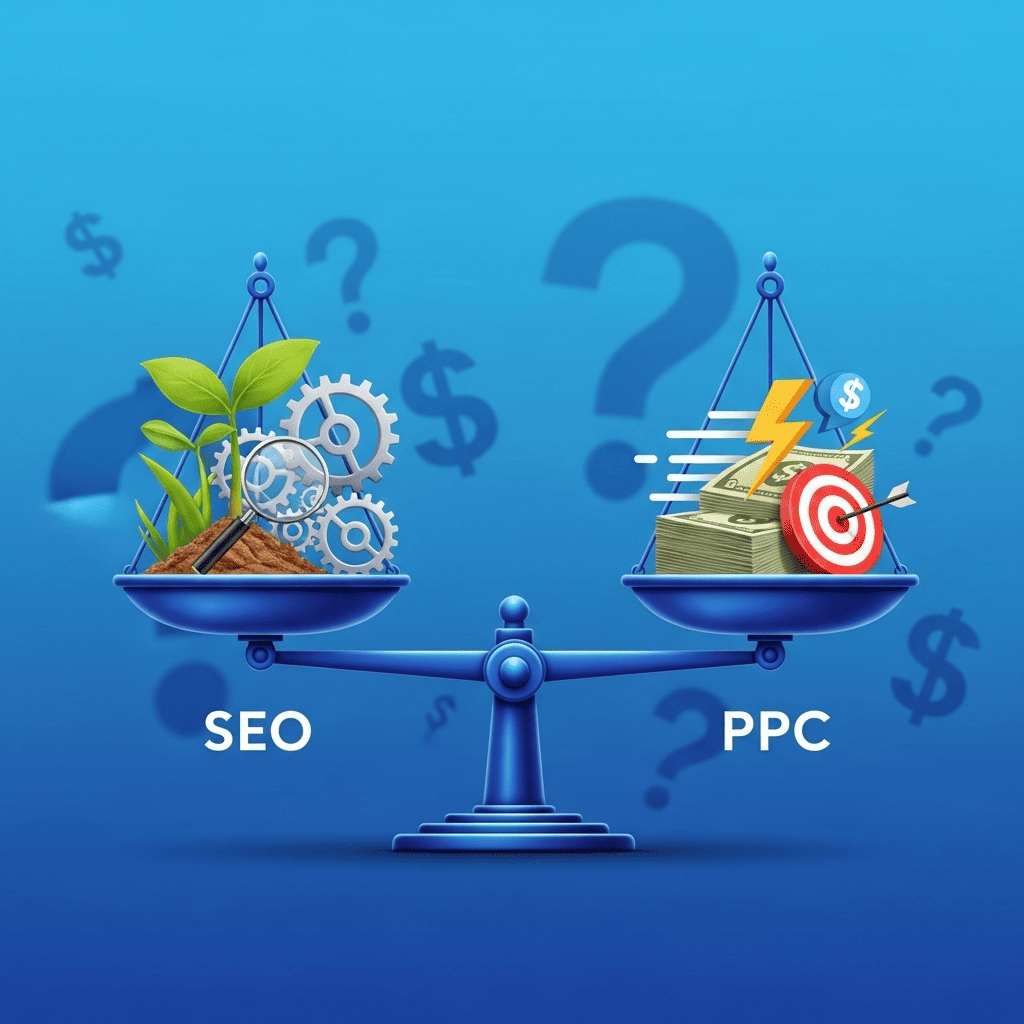
Picture this: You’re sitting in your office at 11 PM, laptop screen glowing, staring at two different marketing proposals on your desk. One promises “guaranteed traffic in 24 hours” with PPC ads. The other talks about “long-term organic growth” through SEO that might take 6 months to show results.
Your marketing budget is $10,000. Where do you put it?
This SEO vs PPC question keeps many business owners awake at night, and choosing the wrong mix for your stage can waste a lot of money.
Here’s the thing: there’s no universal “right” answer. But there are definitely wrong ones that drain your budget fast. This guide shows how to decide.
Table of Contents
ToggleWhat Exactly Are SEO and PPC?
Let’s cut through the marketing jargon and talk about what these actually are (because your cousin’s friend who “does digital marketing” probably confused you more than helped).
Search Engine Optimization (SEO) Explained Simply
SEO is like being the most popular kid in school naturally. You earn your spot at the top of Google search results by creating amazing content, building relationships (backlinks), and making sure your website doesn’t suck.
Key SEO characteristics:
- You don’t pay Google directly for clicks
- Takes 3-6 months to see meaningful results
- Requires ongoing content creation and optimization
- Results compound over time
- Higher click-through rates than ads
Pay-Per-Click (PPC) Advertising Demystified
PPC is like buying your way to the front of the line. You literally pay Google every time someone clicks your ad. Stop paying, and you disappear from search results faster than your ex blocked you on social media.
Key PPC characteristics:
- Immediate visibility in search results
- You pay for each click (whether it converts or not)
- Requires ongoing budget to maintain visibility
- Precise targeting and control options
- Detailed analytics and quick optimization cycles
The Fundamental Difference in Mindset
SEO mindset: “I’m building a digital asset that generates traffic while I sleep.” PPC mindset: “I’m renting space on Google’s highway, and the meter’s always running.
Which Strategy Actually Costs More in the Long Run?
This is where most business owners get it spectacularly wrong. They look at the upfront costs and make decisions that cost them millions in the long run.
SEO Investment Breakdown
Typical SEO costs for a medium business:
- SEO agency/consultant: $3,000-8,000/month
- Content creation: $2,000-5,000/month
- Tools and software: $500-1,500/month
- Total monthly investment: $5,500-14,500
The kicker: After 12-18 months, you have a traffic-generating asset that works 24/7.
PPC Investment Reality Check
Typical PPC costs for the same business:
- Ad spend budget: $5,000-15,000/month
- PPC management: $1,500-3,000/month
- Landing page optimization: $1,000-2,000/month
- Total monthly investment: $7,500-20,000
The brutal truth: Stop paying, stop getting traffic immediately.
Long-Term Cost Comparison
| Timeline | SEO Total Investment | PPC Total Investment | SEO Traffic Value | PPC Traffic Value |
|---|---|---|---|---|
| Year 1 | $66,000-174,000 | $90,000-240,000 | Growing | Stops when budget stops |
| Year 2 | $132,000-348,000 | $180,000-480,000 | Compounding | Still requires full budget |
| Year 3 | $198,000-522,000 | $270,000-720,000 | Significant asset | Zero without budget |
| Year 5 | $330,000-870,000 | $450,000-1,200,000 | Massive asset | Nothing without budget |
How Fast Can You See Results from SEO vs PPC?
Speed kills—your patience, that is. This is where the SEO vs PPC comparison gets really interesting.
PPC Results Timeline
Day 1: Ads can be live and driving traffic Week 1: Sufficient data to optimize campaigns Month 1: Clear performance patterns emerge Month 3: Mature, optimized campaigns running
Example of the principle: a well-targeted PPC campaign for an online store can produce sales within days of launch, which SEO cannot match.
SEO Results Timeline
Month 1-3: Technical foundation and initial content Month 4-6: First ranking improvements for long-tail keywords Month 7-12: Significant traffic growth for target keywords Month 13+: Compound growth and competitive rankings
Example of the principle: a SaaS company starting SEO from scratch may see little organic traffic for several months, then steady growth once content and links mature.
The Speed vs Sustainability Dilemma
PPC speed advantage:
- Immediate market feedback
- Quick campaign optimization
- Instant traffic volume control
- Fast testing of keywords and audiences
SEO compound advantage:
- Results improve without additional investment
- Organic results usually earn far more clicks than ads for the same query
- Brand authority and trust building
- Sustainable competitive advantage
What Types of Businesses Should Choose SEO vs PPC?
Not all businesses are created equal. Your industry, business model, and customer lifecycle determine which strategy will make or break your marketing budget.
Perfect SEO Candidates
Service-Based Businesses (Law, Consulting, Medical)
- Long customer lifecycle
- High lifetime value
- Trust and expertise crucial
- Local/regional focus
B2B SaaS Companies
- Long sales cycles (3-12 months)
- Educational content opportunities
- Industry thought leadership important
- High customer acquisition cost tolerance
E-commerce with Unique Products
- Strong brand differentiation
- Unique product categories
- Content marketing opportunities
- Long-term brand building goals
Perfect PPC Candidates
E-commerce with Commodity Products
- Price-competitive markets
- Seasonal businesses
- Quick purchase decisions
- Large product catalogs
Local Service Businesses with Immediate Needs
- Emergency services (plumbing, locksmith)
- Event-based services (catering, photography)
- Time-sensitive offerings
- High-intent local searches
New Businesses Testing Market Fit
- Validating product-market fit
- Testing messaging and positioning
- Quick feedback loops needed
- Limited content creation resources
Industry-Specific SEO vs PPC Performance
| Industry | SEO Advantage | PPC Advantage | Recommended Strategy |
|---|---|---|---|
| Legal Services | High (trust crucial) | Medium | SEO primary, PPC secondary |
| E-commerce Fashion | Medium | High (visual ads) | PPC primary, SEO long-term |
| SaaS/Software | High (education needed) | Medium | SEO primary, PPC for trials |
| Home Services | Medium | High (immediate needs) | PPC primary, local SEO |
| Healthcare | High (expertise signals) | Low (regulations) | SEO primary |
| Real Estate | Medium | High (visual, local) | Both equally important |
Can You Track ROI Better with SEO or PPC?
Here’s where things get spicy. PPC lovers will tell you their tracking is perfect. SEO advocates will say long-term value is impossible to measure in PPC. They’re both right and wrong.
PPC Tracking Advantages
What you can track easily:
- Exact cost per click
- Conversion rate by keyword
- Revenue attribution by campaign
- Real-time performance metrics
- Precise audience targeting effectiveness
PPC tracking example:
- Spent: $5,000
- Clicks: 1,250
- Conversions: 87
- Revenue: $17,400
- ROI: 248%
Clean, simple, beautiful data that makes CFOs happy.
SEO Tracking Complexities
What’s challenging to track:
- Brand searches from awareness
- Offline conversions influenced by rankings
- Long-term brand value building
- Compound traffic growth attribution
- Multi-touch customer journeys
What you can track:
- Organic traffic growth
- Keyword ranking improvements
- Organic conversion rates
- Content engagement metrics
- Local visibility improvements
The Attribution Challenge
Multi-touch customer journey example:
- Customer searches “best project management software” (SEO)
- Visits your blog post, doesn’t convert
- Sees your PPC ad for “free trial” two weeks later
- Clicks ad, signs up for trial
- Converts to paid customer after email nurture sequence
Question: Which channel gets credit? PPC (last click) or SEO (awareness driver)?
The reality: Most attribution models are broken, but PPC data appears cleaner.
Advanced Tracking Solutions
Tools for better SEO ROI tracking:
- Google Analytics 4 with custom attribution models
- Marketing Mix Modeling (MMM) for enterprise
- Customer lifetime value tracking
- Brand awareness surveys and studies
Tools for PPC optimization:
- Google Ads conversion tracking
- Facebook Pixel for retargeting attribution
- Call tracking for phone conversions
- CRM integration for sales attribution
Should You Do Both SEO and PPC Together?
Plot twist: The best performing companies don’t pick sides. They use both strategies like a one-two punch that would make Mike Tyson jealous.
The Synergy Effect
How SEO + PPC amplifies results:
Keyword Intelligence Sharing
- PPC reveals high-converting keywords for SEO targeting
- SEO keyword research uncovers PPC opportunities
- Combined data shows true search demand
SERP Domination Strategy
- Occupy both organic and paid results
- Increase your total share of clicks on the results page
- Block competitors from visibility
Content and Landing Page Testing
- PPC tests messaging quickly for SEO content
- SEO content becomes PPC landing pages
- Shared conversion optimization learnings
Strategic Budget Allocation Models
The 70/30 Rule for Established Businesses:
- 70% budget to proven performer (usually SEO after 12 months)
- 30% budget to testing and immediate needs (PPC)
The 50/50 Launch Strategy:
- Equal budget split for new businesses
- PPC for immediate revenue and testing
- SEO for long-term asset building
The Seasonal Flexibility Model:
- Increase PPC during peak seasons (Black Friday, etc.)
- Maintain consistent SEO investment year-round
- Shift budget based on performance data
Real-World Combined Strategy Success
Which Strategy Works Better for Different Goals?
Your marketing goals should drive your SEO vs PPC comparison, not your personal preferences or what your competitor is doing.
Goal-Based Strategy Selection
Immediate Revenue Generation
- Winner: PPC
- Why: Instant traffic, quick optimization cycles
- Timeline: Results in days
- Best for: Cash flow needs, seasonal businesses
Long-Term Market Dominance
- Winner: SEO
- Why: Compound traffic growth, authority building
- Timeline: 12-24 months
- Best for: Sustainable competitive advantage
Brand Awareness Building
- Winner: SEO (with content marketing)
- Why: Educational content, thought leadership
- Timeline: 6-18 months
- Best for: B2B, professional services
Product Launch Testing
- Winner: PPC
- Why: Quick feedback, audience testing, message optimization
- Timeline: 2-8 weeks
- Best for: New products, market validation
Local Market Penetration
- Winner: Combined approach
- Why: Local SEO for trust, PPC for immediate visibility
- Timeline: 3-12 months
- Best for: Service businesses, retail locations
ROI Timeline Comparison
| Goal | PPC ROI Peak | SEO ROI Peak | Long-term Winner |
|---|---|---|---|
| Immediate sales | Month 1-3 | Month 12-18 | PPC (short-term) |
| Brand building | Month 1-6 | Month 6-24 | SEO (long-term) |
| Market share | Month 1-12 | Month 12-36 | SEO (compound growth) |
| Customer acquisition | Month 1-6 | Month 6-18 | Depends on LTV |
| Competitive defense | Month 1 | Month 12-24 | Combined approach |
Budget Allocation by Business Stage
Startup Stage (0-2 years):
- 60% PPC, 40% SEO
- Focus: Revenue generation, market testing
- Goal: Prove product-market fit
Growth Stage (2-5 years):
- 40% PPC, 60% SEO
- Focus: Market share capture, efficiency
- Goal: Sustainable competitive advantage
Mature Stage (5+ years):
- 30% PPC, 70% SEO
- Focus: Market defense, new opportunities
- Goal: Efficiency and innovation
How to Make the SEO vs PPC Decision for Your Business
Enough theory. Let’s get practical. Here’s a decision framework that works for budgets of any size.
The 5-Factor Decision Matrix
Factor 1: Timeline Urgency (0-10 scale)
- 8-10: Need results in 1-3 months → PPC
- 5-7: Can wait 3-6 months → Combined
- 0-4: Building for long-term → SEO
Factor 2: Budget Sustainability (0-10 scale)
- 8-10: Can invest consistently for 2+ years → SEO
- 5-7: Moderate budget, need some quick wins → Combined
- 0-4: Limited budget, need immediate ROI → PPC
Factor 3: Competition Level (0-10 scale)
- 8-10: Highly competitive market → SEO (long-term play)
- 5-7: Moderate competition → Combined
- 0-4: Low competition → Either works
Factor 4: Customer Lifecycle (0-10 scale)
- 8-10: Long, complex sales cycle → SEO
- 5-7: Medium complexity → Combined
- 0-4: Quick purchase decisions → PPC
Factor 5: Content Resources (0-10 scale)
- 8-10: Strong content team/capability → SEO
- 5-7: Some content capability → Combined
- 0-4: Limited content resources → PPC
Decision Calculator
Add up your scores:
- 35-50: SEO primary strategy
- 20-34: Combined approach
- 0-19: PPC primary strategy
Common Decision Mistakes
Mistake 1: Following Competitor Strategy Blindly Just because your competitor is doing PPC doesn’t mean it’s right for you. They might have different goals, budgets, or timelines.
Mistake 2: Choosing Based on Personal Preference Your comfort level with technology or tracking doesn’t determine what’s best for your business goals.
Mistake 3: All-or-Nothing Thinking Most successful businesses eventually use both. The question is timing and budget allocation.
Mistake 4: Ignoring Industry Dynamics B2B software buyers research differently than emergency service customers. Match your strategy to customer behavior.
Red Flags That Signal Wrong Strategy Choice
You chose SEO but…
- Need revenue in the next 3 months to survive
- Have no content creation capabilities
- Can’t commit to 12+ month investment
- Are in a rapidly changing market
You chose PPC but…
- Can’t afford ongoing ad spend indefinitely
- Are in a trust-based industry (medical, legal)
- Have highly complex products requiring education
- Want to build long-term brand authority
Advanced SEO vs PPC Strategies for Maximum Impact
Once you’ve mastered the basics, here are the ninja-level tactics that separate the amateurs from the pros.
Advanced PPC Tactics
Keyword Harvesting from SEO Data Use Google Search Console to find keywords where you rank 4-10, then bid on them in PPC for immediate visibility while improving SEO.
Competitor Brand Bidding Strategy Bid on competitor brand names (where legal) to capture their overflow traffic. Works especially well for service businesses.
Dynamic Search Ads for Scale Let Google automatically create ads for your entire website. Perfect for large e-commerce sites with thousands of products.
Audience Layering for Precision Combine demographic, interest and behavioural targeting so campaigns reach the people most likely to convert.
Advanced SEO Tactics
Content Cluster Domination Create topic clusters where you own the entire first page for related keywords. Works incredibly well for B2B and professional services.
Technical SEO Competitive Advantage While competitors focus on content, dominate through superior site speed, mobile experience, and crawlability.
Local SEO Multi-Location Strategy For businesses with multiple locations, create location-specific content hubs that dominate local search results.
Programmatic SEO for Scale Automatically generate optimized pages for thousands of keyword variations. E-commerce and directory sites love this.
Integration Strategies That Work
The Content-to-Conversion Funnel
- SEO content attracts awareness-stage traffic
- Retargeting pixels capture visitors
- PPC remarketing drives conversions
- Email nurturing handles the middle
The Competitive Intelligence Loop
- Monitor competitor PPC ads for messaging insights
- Use those insights in SEO content
- Track their organic content for PPC ad inspiration
- Continuously optimize both channels
The Local Domination Combo
- Local SEO for “near me” searches
- PPC for high-intent service keywords
- Google My Business optimization
- Review generation strategy
The Future of SEO vs PPC: What’s Coming
The landscape is changing faster than a TikTok trend. Here’s what you need to know to stay ahead.
AI’s Impact on Both Channels
SEO Changes:
- AI content detection getting more sophisticated
- Need for genuine expertise and experience (E-E-A-T)
- Voice search optimization becoming crucial
- Visual search growing rapidly
PPC Changes:
- Automated bidding becoming the norm
- Privacy changes affecting targeting
- Video and interactive ad formats dominating
- Cost-per-click inflation continuing
Emerging Opportunities
SEO Opportunities:
- AI-powered content optimization tools
- Semantic search understanding
- Featured snippet optimization
- Core Web Vitals importance growing
PPC Opportunities:
- YouTube advertising growth
- Shopping campaigns evolution
- Local services ads expansion
- Performance max campaigns
Critical SEO vs PPC Mistakes That Cost Businesses Millions
Before we dive deeper into strategy selection, let’s address the expensive mistakes that could tank your marketing budget faster than a crypto crash in 2022.
The Most Costly SEO vs PPC Pitfalls
1. The “All-or-Nothing” Trap The biggest mistake is putting your whole budget into one channel without testing the other. Companies that rely only on PPC see their traffic disappear the day they pause ads.
Reality check: most brands that rely on PPC still invest in SEO for long-term growth.
2. Choosing Based on Personal Comfort Zone Just because you “understand” PPC doesn’t mean it’s right for your business. Your comfort level with tracking pixels shouldn’t determine your marketing strategy.
The solution: Let data and business goals drive decisions, not personal preferences.
3. Expecting SEO Results in 30 Days This is the mistake that kills more SEO budgets than Google algorithm updates. Positive ROI of SEO campaigns is achieved in about 6 to 12 months, yet businesses often pull the plug after 90 days.
4. Running PPC Without Landing Page Optimization Sending PPC traffic to your homepage is like inviting people to dinner and serving them cereal. A landing page built for the ad’s promise usually converts far better than a generic page.
5. Not Tracking Multi-Touch Attribution Assigning all credit to the last click ignores the customer journey. SEO often drives awareness, while PPC captures intent – but most attribution models miss this.
How AI Is Changing SEO vs PPC
Artificial intelligence is fundamentally changing both SEO and PPC, creating new opportunities and challenges that affect your strategy choice.
AI’s Impact on SEO Strategy
Answer Engine Optimization (AEO) Rising With AI Overviews and AI Mode in Google results, optimising for AI-generated answers is becoming important for both organic visibility and how ads appear.
E-E-A-T Becomes Even More Critical Google’s AI can now better detect authentic expertise and experience. Generic, AI-generated content is being systematically devalued in favor of genuine human expertise.
AI’s Impact on PPC Strategy
Automated Bidding Dominance AI-powered bidding strategies now handle most successful PPC campaigns, requiring less manual optimization but more strategic oversight.
Creative Testing Acceleration AI can now test thousands of ad variations simultaneously, dramatically improving campaign performance and reducing time to optimization.
Privacy-First Targeting With third-party cookies disappearing, AI-powered first-party data analysis becomes crucial for effective PPC targeting.
The AI Advantage Assessment
SEO AI Benefits:
- Content optimization and gap analysis
- Technical SEO issue detection
- Keyword opportunity identification
- Competitor strategy analysis
PPC AI Benefits:
- Real-time bid optimization
- Dynamic ad creation
- Audience prediction and targeting
- Budget allocation optimization
The Strategic Implication: AI amplifies the strengths of both channels but requires human strategic oversight to avoid the “AI content factory” trap that’s killing many websites’ rankings.
Frequently Asked Questions About SEO vs PPC
How Much Should I Budget for SEO vs PPC?
The optimal budget split depends on your business stage and goals:
Startup Stage (0-2 years): 60% PPC, 40% SEO Growth Stage (2-5 years): 50% PPC, 50% SEO
Mature Stage (5+ years): 30% PPC, 70% SEO
The reasoning: New businesses need immediate revenue (PPC), while established companies can invest in long-term assets (SEO).
Which Strategy Works Better for Local Businesses?
Local businesses should prioritize based on urgency of need:
Immediate Local Services (plumbing, locksmith): 70% PPC, 30% Local SEO Professional Services (law, dental): 40% PPC, 60% Local SEO Retail/Restaurants: 50% PPC, 50% Local SEO
Key insight: local intent is common in many industries, so local optimisation matters whichever channel leads.
How Do I Measure ROI for Both Channels?
SEO ROI Measurement:
- Track organic traffic growth and conversion value
- Calculate customer lifetime value from organic leads
- Monitor brand search volume increases
- Measure keyword ranking improvements
PPC ROI Measurement:
- Direct conversion tracking through pixels
- Cost per acquisition analysis
- Revenue attribution by campaign
- Return on ad spend (ROAS) calculations
The reality: PPC gives you perfect data about imperfect traffic. SEO gives you imperfect data about perfect traffic.
Can Small Businesses Compete with Big Companies in PPC?
Yes, but strategy matters:
Small Business PPC Advantages:
- Focus on local/niche keywords
- Better personal service messaging
- Faster decision-making and optimization
- Lower overhead allows competitive pricing
The key: Don’t compete on brand terms against big budgets. Focus on long-tail, local, and niche keywords where you can win.
What’s the Biggest Mistake When Choosing Between SEO and PPC?
The biggest mistake is treating it as an either/or decision. Successful businesses use both channels strategically.
The smart approach:
- Start with the channel that matches your timeline needs
- Test and prove performance before scaling investment
- Eventually integrate both for maximum market coverage
How Has AI Changed the SEO vs PPC Decision?
AI has made both channels more powerful but requires different expertise:
SEO in the AI Era:
- Requires more authentic expertise and experience
- Content quality standards are higher
- Technical optimization becomes more important
PPC in the AI Era:
- Automated optimization reduces manual work
- Requires strategic oversight of AI decisions
- Privacy changes affect targeting precision
The bottom line: AI rewards quality and expertise in both channels, making the fundamentals more important than ever.
The Final Verdict: SEO vs PPC
After analyzing millions of dollars in campaign data and 15 years of industry evolution, here’s the unvarnished truth about the SEO vs PPC comparison:
The Strategic Reality Check
Your SEO vs PPC decision shouldn’t be about preference – it should be about:
- Timeline: Need results in 90 days? PPC. Building for 2+ years? SEO.
- Budget sustainability: Can you invest consistently for 18+ months? SEO. Need immediate ROI? PPC.
- Market dynamics: High competition requires long-term SEO investment. Low competition allows PPC success.
- Customer behavior: Complex B2B sales cycles favor SEO. Quick purchase decisions favor PPC.
Your Action Plan
If you’re starting from scratch:
- Define your primary business goal (immediate revenue vs long-term growth)
- Assess your budget sustainability (6+ months of consistent investment?)
- Analyze your competition level (can you wait 12 months to compete?)
- Choose your primary channel based on these factors
- Plan to add the secondary channel within 6-12 months
If you’re currently doing one channel:
- Audit your current performance and ROI
- Identify gaps the other channel could fill
- Test the secondary channel with 20-30% of your budget
- Scale based on performance data, not assumptions
The ultimate truth: The businesses asking “SEO vs PPC?” are asking the wrong question. The right question is: “How do I use both SEO and PPC to dominate my market?”
Ready to stop choosing sides and start winning? Get your personalized SEO vs PPC strategy roadmap at SEOProJournal.com – where we help you maximize both channels for total market domination.