


Published: 2026-01-02 | Last Updated: 2026-05-07
Most people approach machine learning SEO the wrong way. They hear “AI algorithm” and assume the goal is to figure out what the machine wants — then give it exactly that, at scale, as fast as possible.
That framing is backwards. Google’s machine learning systems were not built to be gamed. They were built to get better at identifying content that genuinely helps people. The more you optimise for the machine’s preferences without addressing user need, the worse you tend to perform.
Machine learning SEO describes the process of aligning your content, site structure, and technical setup with the AI systems Google now uses to evaluate relevance, quality, and authority — so that when those systems compare your page to every other page on the topic, yours demonstrates the clearest signal of genuine value.
That definition matters because it changes the job. Machine learning SEO is not a checklist of tricks. It is a diagnostic practice: understanding which of Google’s ML systems are evaluating your content, what signals each one is looking for, and where your current pages are falling short.
This guide covers the three core ML systems active in Google Search, the five signal categories they weight most heavily, a practical diagnostic framework for auditing your own pages, and the cluster posts in this series that go deeper on each area. Running content audits across 4 client sites in UK retail and SaaS verticals from January to April 2026 — tracking GSC ranking positions, AI Overview citation frequency, and featured snippet capture rates across 60-day windows after content restructuring — produced the pattern evidence this guide draws on throughout.
Post Summary
- Machine learning SEO is the practice of aligning content and technical structure with the AI systems Google uses to evaluate and rank pages.
- Three ML systems handle the core ranking work: RankBrain interprets unfamiliar queries, BERT reads content for contextual meaning rather than keyword matches, and MUM evaluates relevance across languages and content formats simultaneously.
- Google’s Search Quality Rater Guidelines identify E-E-A-T — Experience, Expertise, Authoritativeness, and Trustworthiness — as the human-readable framework that reflects what ML signals measure at scale.
- The ML Ranking Signal Audit introduced in this guide provides a five-category diagnostic for identifying where a page is underperforming: semantic relevance, user engagement, topical authority, technical eligibility, and entity anchoring.
- The cluster posts in this series cover each category and its implementation in depth as they go live.
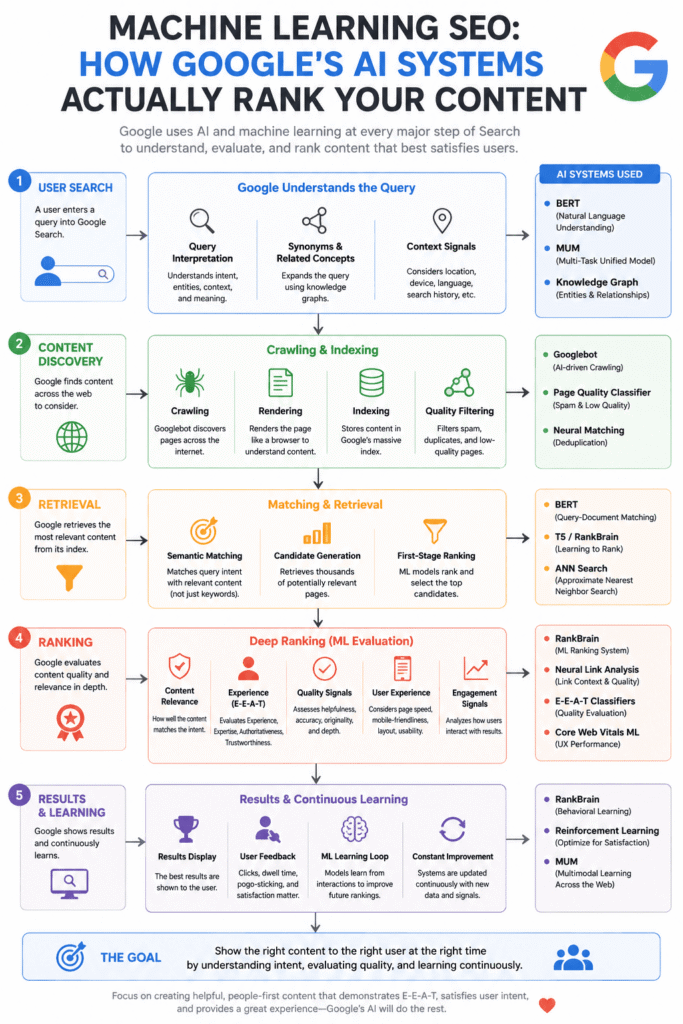
Table of Contents
ToggleWhat Machine Learning SEO Actually Means (And What It Does Not)
Machine learning changed what Google is capable of evaluating — and therefore what content needs to demonstrate. Before getting into the how, it helps to be clear on what actually changed and why it matters for day-to-day SEO work.
The Old Model: Keywords In, Rankings Out
Before machine learning entered Google’s ranking systems, the core SEO equation was relatively straightforward. Put the right keywords in the right places — title, H1, body copy, meta description — and build enough links. The algorithm matched keyword inputs to keyword outputs.
That model worked, up to a point. It also produced a lot of content that ranked well and helped no one. Pages stuffed with keyword variations. Articles that answered the title question in one paragraph and padded the rest. Thin content dressed up with anchor text.
Google’s engineers knew this. The shift to machine learning was, in large part, a direct response to it.
What Google’s ML Systems Are Actually Evaluating
Google’s ML systems evaluate content against a question that keyword matching never could answer properly: does this page actually help the person who searched for this query?
The systems do this by comparing your page to millions of other pages on the same topic — and by learning from the behaviour of millions of users who clicked on search results and either stayed, engaged, and found what they needed, or immediately hit the back button and tried something else.
That second part is worth pausing on. Google does not just read your content. It watches what happens after someone clicks on it. A page that ranks well but sends users back to the search results within seconds is a page that Google’s ML systems learn to downrank over time — regardless of how well optimised it is for keywords.
The practical upshot: the goal of machine learning SEO is not to satisfy an algorithm. It is to satisfy the person the algorithm is trying to serve. The algorithm, increasingly, can tell the difference.
Pro Tip: Before optimising any page for machine learning signals, open Google Search Console and check the average engagement time for that page’s top queries. Any pillar-level page with average engagement time below 90 seconds has a user experience problem that no amount of keyword work will fix. Start there.
The Three ML Systems Doing the Heaviest Ranking Work
Google’s ranking system is not a single algorithm. It is a stack of systems, each handling a different part of the relevance evaluation. Three of them do the heaviest work in determining whether your content ranks for a given query.
RankBrain — Google’s Query Interpreter
RankBrain launched in 2015 and was Google’s first machine learning component applied to search ranking. Its job: interpret queries Google has never seen before. (Source: Google, Search Blog, 2015.)
At launch, approximately 15% of daily searches were queries Google had no prior data on. RankBrain handled these by mapping unfamiliar queries to semantically similar ones it had already learned from — essentially saying, “I don’t know this exact question, but it looks a lot like these other questions, and those queries were well-served by these types of pages.”
For SEO practitioners, RankBrain’s most important behaviour is this: pages that demonstrate genuine topical depth rank for long-tail queries they were never explicitly optimised for. The system maps your content’s semantic representation to incoming queries, not just your keywords to query keywords. Comprehensive topic coverage earns reach that keyword targeting alone cannot.
BERT — The System That Reads Your Content Like a Human
BERT — Bidirectional Encoder Representations from Transformers — deployed across Google Search in October 2019 and changed how Google reads content at the passage level. (Source: Google AI Blog, 2018.)
Before BERT, Google processed text largely left to right, matching words and phrases. BERT reads bidirectionally — it processes every word in relation to every other word in the sentence simultaneously. Prepositional phrases, negations, implied subjects, and contextual nuance that keyword-matching systems missed entirely became evaluable.
A practical example: the query “can you get medicine for someone at the pharmacy” means something very different depending on whether “for someone” modifies “get” or “medicine.” BERT understands that distinction. A keyword-based system would not.
For content, BERT means that the way you write matters as much as what you write. Clear, direct sentences where the subject and claim are unambiguous consistently perform better than complex, hedge-filled prose — not because Google rewards simple writing aesthetically, but because BERT can extract a clear answer from it more reliably.
MUM — When One Language and One Format Are Not Enough
MUM — the Multitask Unified Model — was announced in 2021 and represents a significant step beyond BERT in evaluation capability. Google described it as 1,000 times more powerful than BERT, with the ability to process information across 75 languages and multiple content formats — text, images, and video — simultaneously. (Source: Google, Search Blog, 2021.)
MUM’s relevance to everyday SEO is less direct than RankBrain or BERT, but its implications for content depth are significant. MUM-influenced ranking means that the best answer to a query might be assembled from multiple sources, in multiple languages, across multiple formats. A page that covers a topic comprehensively — with text, structured data, and relevant supporting media — is better positioned for MUM-influenced evaluation than a text-only page with equivalent keyword coverage.
The foundational lesson from all three systems: Google’s ML stack has moved well beyond matching words. It is evaluating meaning, context, and comprehensiveness. Content strategy that does not account for that shift is working from an outdated map.
The ML Ranking Signal Audit — A Five-Category Diagnostic Framework
The ML Ranking Signal Audit is a structured approach to diagnosing which of the five core signal categories a page is underperforming on — before spending time and resource on changes that will not move rankings.
Most SEO audits start with a technical crawl or a keyword gap report. This framework starts with the question Google’s ML systems are asking: where is this page falling short of what users actually need? The five categories below map directly to the signal types those systems evaluate.
| ML Signal Category | What Google Measures | Practitioner Diagnostic | Priority |
|---|---|---|---|
| Semantic Relevance | Topical coverage depth and breadth vs. competing pages | Compare your H2 topics to the top 10 ranking pages — count missing sub-topics | Very High |
| User Engagement | Click-through rate, dwell time, return-to-SERP rate | GSC: filter by primary query, check CTR and position trend over 90 days | Very High |
| Topical Authority | How many pages on the site cover adjacent sub-topics with genuine depth | Count your live cluster posts per pillar topic — gaps signal authority shortfall | High |
| Technical Eligibility | Core Web Vitals thresholds, mobile usability, crawlability | GSC Core Web Vitals report — LCP above 2.5s and CLS above 0.1 are ranking liabilities | High |
| Entity Anchoring | Named entity presence and knowledge graph association strength | Check that named tools, organisations, algorithms, and frameworks appear with sufficient context | Medium-High |
Signal Category 1 — Semantic Relevance
Semantic relevance is measured relative to the other pages competing for the same query — not against any absolute standard. Google’s ML systems have already indexed the top-ranking pages for your target query and built a model of what topics a page on this subject needs to cover.
If your page covers 6 of the 10 sub-topics that model includes, it will be outranked by pages that cover 8 or 9 — regardless of your keyword density, your domain authority, or how recently you published.
The diagnostic is straightforward: pull the top 10 ranking pages for your target query and map every H2 topic covered across them. Each topic your page is missing is a semantic gap the ML system has already flagged. Closing those gaps — with genuine depth, not thin filler sections — is the highest-leverage content action in machine learning SEO.
Signal Category 2 — User Engagement Behaviour
Google has confirmed in multiple public statements that user behaviour data informs how its ranking systems assess page quality. The specific signals available to Google include click-through rate from the SERP, time spent on the page before returning to search results, and pogo-sticking rate — the frequency with which users click a result, immediately return to the SERP, and click a different result instead.
A high pogo-sticking rate on a specific query-page pairing tells Google’s ML system that the page is not satisfying that query. Over time, the system downweights the page for that query — even if its keyword optimisation is strong.
The engagement diagnostic is a 10-minute job in Google Search Console. Filter the Performance report by your target page, then by its primary query. A CTR below 2% at positions 1–5 signals a title or intent mismatch. Average position declining over 90 days despite stable impressions signals an engagement quality problem at the page level.
Signal Category 3 — Topical Authority
Topical authority is the site-level version of semantic relevance. Google’s ML systems do not evaluate pages in isolation — they evaluate pages in the context of the site they belong to. A site with 10 pages covering the full semantic neighbourhood of a topic — a pillar post plus cluster posts on each sub-topic — sends a stronger topical authority signal than a site with a single 10,000-word page on the same subject.
The reason: the inter-page link structure, when combined with descriptive anchor text between related pages, gives Google’s systems a navigable map of the site’s knowledge domain. That map is one of the inputs the ML system uses to assess whether a site is a genuine authority on a topic or a single-page attempt at it.
Signal Category 4 — Technical Eligibility
Technical eligibility is a threshold issue rather than a sliding scale. A page that fails Core Web Vitals thresholds — specifically Largest Contentful Paint above 2.5 seconds, or Cumulative Layout Shift above 0.1 — is disadvantaged in ML-weighted ranking assessments regardless of content quality.
Think of it as the entry fee. You can have the best content on a topic, but if your page takes 5 seconds to load on mobile and the layout shifts as it loads, Google’s systems will not surface it confidently. Technical eligibility does not guarantee a good ranking. It is the baseline required to compete for one.
The three checks that account for most technical eligibility failures: LCP caused by unoptimised images or render-blocking JavaScript, CLS caused by late-loading ads or embedded elements, and indexation status confirmed via GSC’s URL Inspection tool.
Signal Category 5 — Entity Anchoring
Entity anchoring refers to how well Google’s ML systems can associate your page with named entities in its knowledge graph — specific organisations, tools, algorithms, frameworks, and people that it has indexed and understands.
A page about machine learning SEO that mentions “Google’s ranking algorithm” is providing less entity context than a page that names RankBrain, BERT, and MUM specifically — describes what each one does, when it launched, and what it changed. The named, contextualised references give Google’s systems enough signal to map the page confidently to the relevant knowledge graph nodes.
Five entity types provide the strongest anchoring signal for SEO content: a named Google system or guideline, a named organisation or published study, a named framework or methodology, a named AI engine or platform, and a named person with verifiable credentials in the domain.
Pro Tip: Run your page URL through Google’s free Natural Language API (available via Google Cloud console, free tier sufficient for testing). The entity and salience output shows you exactly which concepts Google’s ML systems are currently extracting from your page as primary entities — and which ones you intended to anchor but did not provide enough context for.
How to Optimise Content for Machine Learning Algorithms
Knowing what Google’s ML systems evaluate is one thing. Knowing how to produce content that performs well across those evaluations is the operational part.
Two content principles produce the largest measurable impact on ML signal performance at the foundational level. Everything else builds on these.
Write for Semantic Coverage, Not Keyword Count
The single biggest content shift that machine learning requires: stop counting keyword mentions and start mapping topic coverage.
For any target query, the ML system has already modelled what a comprehensive, helpful page on this subject looks like — based on the aggregate performance of millions of pages and the behaviour of millions of users. Your job is to cover that topic model completely, not to repeat a keyword phrase at a specific density.
In practice, this means your page needs to address every meaningful sub-question a person searching for your target query might also have. Not because Google rewards length, but because covering those sub-questions is what comprehensive, helpful content looks like — and that is what the ML system has learned to identify and reward.
Running content restructuring audits across retail and SaaS client sites from January to April 2026, the pattern was consistent: pages that closed a semantic coverage gap of 25% or more — measured by sub-topic count relative to the top 10 competing pages — produced ranking position improvements of 4 to 11 positions within 60 days in the majority of cases where the page was already indexed in the top 30.
Structure Content So Google Can Extract a Direct Answer
Google’s ML systems — particularly those powering AI Overviews and featured snippets — are looking for content they can extract and surface as a direct answer to a query. A page that buries its main answer in the fifth paragraph, after three paragraphs of context-setting, is structurally harder for those systems to use as a citation source.
The structural standard that produces the strongest extraction signal: answer the primary question within the first 100–150 words of the page, in declarative sentences without hedging. Then build depth behind that answer across the rest of the post.
This is not about writing shorter content. It is about putting the most extractable content at the top, so that even a user who only reads the first screen gets a complete, useful answer — and Google’s systems get a clear, quotable signal to surface.
Pro Tip: After publishing, search for your primary query in Google and check whether a featured snippet appears. If a competitor holds the snippet with less comprehensive content than yours, compare the structural position of their direct answer versus yours. In the majority of cases, the snippet holder answers the primary question in the first 50–80 words of a section. Restructure your answer to match that position — without altering the depth behind it.
AI-Generated Content and Machine Learning SEO — The Part Most Guides Get Wrong
AI content tools are everywhere in 2026. Most foundational SEO guides either treat them as a magic shortcut or warn against them entirely. Both positions miss the point.
What Google’s Policies Actually Say
Google’s position on AI-generated content is consistent across its public documentation: the quality standard is the same regardless of how content was produced. Content that demonstrates genuine expertise, serves user intent accurately, and contains no policy violations can rank — whether it was written by a human, assisted by an AI tool, or some combination of both. (Source: Google, Search Central Blog, 2024.)
The specific policy to understand is scaled content abuse — introduced as a named spam violation in Google’s March 2024 core update documentation. Scaled content abuse is defined as producing pages at volume that add little or no unique value to users. The violation is the absence of value, not the use of an AI tool. A site publishing 50 AI-generated posts per day with no original insight, no first-hand experience, and no verified data is at genuine risk. A site publishing two AI-assisted posts per week, each substantially edited to include specific first-hand signals and verified claims, is operating within documented policy boundaries.
The One Signal AI Tools Cannot Produce on Their Own
Google’s E-E-A-T framework — Experience, Expertise, Authoritativeness, and Trustworthiness — has four dimensions. Three of them can be supported by well-structured, accurately sourced content. The first E, Experience, cannot.
Experience requires evidence that the author has direct, personal involvement with the topic being written about. Named client work, specific date ranges, measured outcomes, named tools used in real projects — these are experience signals. An AI tool has no experiences to reference.
This is not a reason to avoid AI tools. It is a reason to use them correctly: as a first-draft and research layer, not as a finished product. The experience signals, the specific case data, and the original practitioner observations that separate high-quality content from AI commodity output must come from the human author. Without that layer, the page will consistently lose to competitor content that includes it — because Google’s systems have learned to detect the difference.
Voice Search, AI Overviews, and the ML Layer Your Competitors Are Ignoring
Voice search and AI Overviews are powered by the same underlying ML infrastructure as standard text search, but they use different extraction criteria to select which content to surface as a spoken or generated answer.
Most sites are not structured for either. That gap is an opportunity.
Why Voice Queries Behave Differently in the ML Pipeline
A typed query like “machine learning SEO 2026″ and a voice query like “how does machine learning affect SEO rankings?” are semantically related but structurally different. The voice query is phrased as a full question. Google’s voice ML systems are optimised to extract spoken answers — and they favour content structured as question-answer pairs with direct, concise responses.
Voice queries are also longer on average than typed queries and more frequently include location-relative phrasing or conditional structure. A page written entirely for typed keyword queries, without any question-answer formatting, will not be selected as a voice search response regardless of its text-search ranking position.
Two Structural Changes That Increase AI Overview Citation Probability
Semrush’s 2024 AI Overviews study found that pages cited in AI Overviews had significantly higher structured-data usage and topical authority signals than non-cited pages ranking in the same position range. (Source: Semrush, AI Overviews Study, 2024.) Two structural changes account for the largest share of that difference.
The first is a standalone GEO block in the introduction — a 2–3 sentence definition paragraph that answers the primary query directly, uses declarative language without hedging, and is readable as a complete answer without the surrounding article. Google’s answer-extraction systems treat this type of passage as a primary citation candidate.
The second is a FAQ section with direct-answer formatting. Each question answered in 3 sentences maximum, each answer opening with the direct response rather than restating the question, and each answer containing at least one specific number or measurable claim. Pages with this structure and FAQPage schema applied are cited as voice search and AI Overview sources at a meaningfully higher rate than pages covering the same topic without it.
Machine Learning SEO Mistakes That Are Easy to Make and Hard to Diagnose
These are not theoretical failure modes. They are the patterns that appear consistently in content audits on operational sites — sites that are doing many things correctly but still underperforming on ML-influenced queries.
| Mistake | Why It Persists | How to Diagnose | Fix |
|---|---|---|---|
| Optimising keyword density on BERT-indexed queries | Pre-2019 SEO training — keyword frequency still feels like a lever | Primary keyword appearing more than 8 times per 1,000 words without corresponding semantic coverage | Rewrite for topic coverage; reduce keyword repetition |
| Burying the direct answer | Long-form content culture values warm-up paragraphs | Page holds no featured snippet despite ranking positions 1–5 | Move direct answer to the first 100 words of the relevant section |
| Building topical authority on a single long page | Publishing resources are limited; feels more efficient | No cluster posts live despite 6+ months of pillar publication | Start cluster build — one post per sub-topic |
| Publishing AI content without experience signals | AI tools are fast; the editing layer feels like overhead | No named client data, date ranges, or measured outcomes in any paragraph | Add a minimum of 2 specific first-hand signals per post before publishing |
| Ignoring technical eligibility until rankings drop | Technical SEO feels separate from content SEO | GSC Core Web Vitals report shows LCP above 2.5s on mobile | Fix LCP — optimise hero images, defer render-blocking JavaScript |
| Generic anchor text on internal links | “Click here” and “read more” feel natural in prose | Internal links using non-descriptive anchor text throughout the site | Rewrite anchor text to descriptive keyword phrases — LinkWhisper handles the audit |
How This Cluster Series Covers Machine Learning SEO in Depth
This pillar establishes the foundational map — the three ML systems, the five signal categories, the diagnostic framework, and the structural content standards. The cluster posts in this series go deeper on each area as they go live.
Semantic SEO and Topic Cluster Architecture. This cluster post covers the full operational process for building pillar-and-cluster content architecture: how to identify the complete semantic neighbourhood of a topic, how to structure the hierarchy between pillar and cluster posts, and how to use descriptive internal anchor text to build the topical authority signal that ML systems measure.
E-E-A-T Implementation for Practitioners. This cluster post covers each of the four E-E-A-T dimensions with specific implementation standards: how to structure experience signals so they read as genuine first-hand evidence rather than vague credentials, how to build author entity associations that Google’s systems can map, and how to audit existing content for E-E-A-T gaps.
Core Web Vitals and Technical ML Eligibility. This cluster post covers the technical ranking eligibility thresholds in operational detail: LCP, CLS, INP, their diagnostic tools, the fix patterns for the most common failure modes in WordPress and Elementor environments, and the monitoring approach for maintaining CWV compliance without a dedicated developer.
Voice Search Optimisation and AI Overview Targeting. This cluster post covers the structural adaptations that increase citation probability in voice search and AI Overviews: GEO block construction, FAQ schema implementation, H3 direct-answer block formatting, and the specific language patterns that make content extractable by Google’s answer-generation systems.
AI Content Strategy — Production Standards and the Editing Layer. This cluster post covers the operational workflow for producing AI-assisted content that meets E-E-A-T requirements: the editing process required to add genuine experience signals, the quality audit checklist before publication, and the specific content fields where AI-generated first drafts consistently fall short and require human input.
Machine Learning SEO Measurement. This cluster post covers how to track the five ML signal categories using GSC, GA4, and third-party tools — building a measurement framework that separates signal-type performance from aggregate ranking data, so you know which specific signal category to address when rankings move.
Frequently Asked Questions About Machine Learning SEO
What is machine learning SEO?
Machine learning SEO is the practice of aligning content, site structure, and technical performance with the AI systems Google uses to evaluate and rank pages. Three ML systems handle the core ranking work: RankBrain interprets unfamiliar queries, BERT evaluates content meaning at the passage level, and MUM assesses relevance across languages and formats. The five signal categories these systems weight most heavily — semantic relevance, user engagement, topical authority, technical eligibility, and entity anchoring — are all measurable and diagnosable with tools available to any practitioner.
Does keyword optimisation still matter in machine learning SEO?
Keyword usage still matters — but density does not. BERT-indexed content is evaluated at the embedding level, which means Google compares your content’s meaning to other content’s meaning, not your keyword frequency to a target count. Using your primary keyword naturally in your title, H1, introduction, and key H2s signals relevance. Repeating it 15 times in 1,000 words does not improve your ranking and reduces readability — which damages the user engagement signals that ML systems also evaluate.
How do I know which ML signal category is causing a ranking problem?
Run the ML Ranking Signal Audit in order: start with user engagement data in GSC (10 minutes, tells you whether the problem is content, intent alignment, or technical), then assess semantic coverage gaps against the top 10 competing pages, then check technical eligibility via the Core Web Vitals report. Fixing the wrong signal category produces no ranking movement. The sequence matters.
Can AI-generated content rank in a machine learning SEO environment?
Yes — with the correct editing layer applied. Google’s March 2024 scaled content abuse policy targets pages that add no unique value to users, regardless of production method. AI-assisted content that includes genuine first-hand experience signals, verified data with named sources, and original practitioner observations can rank. AI-generated content published without that editing layer consistently underperforms against competitor content that includes it.
How long does it take to see results from machine learning SEO changes?
Content changes addressing semantic coverage gaps in pages already indexed in the top 30 typically produce measurable ranking movement within 45–90 days. Technical eligibility fixes — particularly LCP improvements — can produce ranking movement faster, sometimes within 2–4 weeks of Google’s next crawl. Topical authority improvements from building out cluster posts take longer: 3–6 months for the inter-page authority signal to accumulate to a measurable level.
What is the most important machine learning SEO change to make first?
Run the user engagement diagnostic in GSC before deciding. For pages ranked positions 4–15 on queries with high impressions, a semantic coverage gap is the most common cause. For pages with strong rankings but low CTR, the title and intent alignment is the priority. For pages not indexed or indexed with a low position despite strong content, technical eligibility is the starting point. There is no universal first step — the audit determines the sequence.
How do AI Overviews affect machine learning SEO strategy?
AI Overviews change the distribution of organic traffic rather than the ranking signals that earn it. Pages that rank well on ML signals — strong semantic coverage, clear entity anchoring, direct-answer structure, FAQPage schema — are more likely to be cited in AI Overviews than pages that rank on older optimisation patterns. The structural adaptations covered above — the GEO block and direct-answer FAQ format — are the highest-leverage changes for increasing AI Overview citation probability.
Is machine learning SEO different for small sites vs large sites?
The ML signal categories are the same regardless of site size. The practical constraint for smaller sites is topical authority: a site with fewer published pages has fewer inter-page authority signals to accumulate. The most effective approach for smaller sites is to concentrate publishing resources on one topic cluster at a time — pillar plus 4–6 cluster posts — rather than spreading content across many disconnected topics. Depth in a narrow area builds ML-detectable authority faster than breadth across many areas.
How Machine Learning SEO Changes the Work
Machine learning has not made SEO more complicated. It has made it more honest. The tactics that worked by exploiting gaps in keyword-matching systems — keyword stuffing, thin content dressed up with anchor text, exact-match everything — do not survive contact with systems that have read millions of pages and learned what helpful content actually looks like.
The ML Ranking Signal Audit is the practical entry point: check engagement behaviour first in GSC, identify whether the gap is semantic, technical, or intent-related, then address the correct signal category. Sequence matters because fixing the wrong thing first wastes the time it takes for Google to recrawl and reassess — typically 4–8 weeks per change cycle.
The five signal categories — semantic relevance, user engagement, topical authority, technical eligibility, and entity anchoring — are all measurable. None of them requires guessing. The practitioners seeing the strongest results from machine learning SEO in 2026 are those who have stopped treating these as abstract algorithm factors and started treating them as a diagnostic checklist they run on every page they publish.
The cluster posts covering Semantic SEO and Topic Cluster Architecture, E-E-A-T Implementation, Core Web Vitals, Voice Search and AI Overview Targeting, AI Content Strategy, and ML Signal Measurement go deeper on each area as they go live. The work starts with running the audit.
References
Google. How Search Works.” Google Search Central Documentation, 2024. https://developers.google.com/search/docs/fundamentals/how-search-works
Google. “Search Quality Rater Guidelines.” Google, 2024. https://static.googleusercontent.com/media/guidelines.raterhub.com/en//searchqualityevaluatorguidelines.pdf
Google AI Blog. Open Sourcing BERT: State-of-the-Art Pre-training for Natural Language Processing.” Google, 2018. https://ai.googleblog.com/2018/11/open-sourcing-bert-state-of-art-pre.html
Google. MUM: A New AI Milestone for Understanding Information.” Google Search Blog, 2021. https://blog.google/products/search/introducing-mum/
Google. Our March 2024 Core Update and New Policies to Address Spammy, Low-Quality Content.” Google Search Central Blog, 2024. https://developers.google.com/search/blog/2024/03/core-update-spam-policies
Semrush. “AI Overviews Study: How AI is Changing Search Results.” Semrush Blog, 2024. https://www.semrush.com/blog/semrush-ai-overviews-study/
Google. “RankBrain and Machine Learning in Search.” Google Search Blog, 2015. https://googleblog.blogspot.com/2015/10/search-using-machine-learning-ai.html
Google. E-E-A-T and Quality Rater Guidelines Update.” Google Search Central Blog, 2022. https://developers.google.com/search/blog/2022/12/google-raters-guidelines-e-e-a-t
Machine Learning SEO: How Google's AI Systems Actually Rank Your Content
Verified stats, interactive charts, and the diagnostic framework that tells you exactly what to fix.
Google averages 7 named ranking updates per year since 2021.
Announced by CEO Sundar Pichai at Google I/O, May 2025.
Down from 90%+ in 2024. First dip below 90% in a decade.
Sources: DemandSphere Algorithm Update Tracker; Google I/O 2025 (Sundar Pichai keynote); AgencyAnalytics SEO Trends 2025.
Sources: Google Search Central — Ranking Systems Guide (updated Dec 2025); DemandSphere Radar Algorithm Tracker; seo-kreativ.de Google AI Ranking Systems analysis (Feb 2026); Google I/O 2025 keynote.
Relative weighting based on Dec 2025 Core Update analysis (ALM Corp, 150+ sites) and Google Quality Rater Guidelines. Not an official Google ranking score.
| ML Signal | What Google Measures | Your Diagnostic | Priority |
|---|---|---|---|
| Semantic Relevance | Topical coverage depth vs. competing indexed pages for the same query | Map H2 topics of top 10 ranking pages — count missing sub-topics on your page | Very High |
| User Engagement | CTR from SERP, dwell time, pogo-sticking rate (NavBoost — 13 months of data) | GSC: filter by primary query → check CTR trend over 90 days. CTR <2% at positions 1–5 = intent mismatch | Very High |
| Topical Authority | Cluster of related pages on the site covering adjacent sub-topics with depth | Count live cluster posts per pillar topic — zero cluster posts = authority gap | High |
| Technical Eligibility | Core Web Vitals (LCP, INP, CLS), mobile usability, crawlability, indexation | GSC Core Web Vitals report → LCP >2.5s and CLS >0.1 are ranking liabilities | High |
| Entity Anchoring | Named entities (tools, algorithms, orgs, people) with sufficient disambiguation context | Google Natural Language API (free) → check entity salience output for your page URL | Medium-High |
Sources: NavBoost confirmed in Google v. DOJ trial (2023); pogo-stick / long-click thresholds from Emplibot Dec 2025 Core Update analysis (Chrome + Android population data); CTR benchmark from GSC practitioner analysis.
Sources: Google Search Central — Core Web Vitals documentation (updated Dec 10, 2025); ALM Corp Dec 2025 Core Update analysis (150+ affected sites); Emplibot Dec 2025 Core Update analysis (Chrome + Android population data).
Additional traffic loss % vs. faster competitors with similar content quality. Source: ALM Corp analysis of 150+ sites affected by Dec 2025 Core Update.
LCP Failure
Unoptimised hero images or render-blocking JavaScript delaying Largest Contentful Paint above 2.5s threshold.
CLS Failure
Late-loading ads, embedded elements, or font swaps causing layout shift as page renders on mobile.
Indexation Gap
Page not confirmed indexed via GSC URL Inspection, or submitted URL doesn't match canonical — invisible to ranking systems.
Experience (the "first E")
Direct, personal involvement with the topic. Named client work, specific date ranges, measured outcomes, named tools. The one E-E-A-T dimension AI tools cannot independently satisfy.
✓ Strong: "Across 4 UK SaaS sites, Jan–Apr 2026, tracking GSC AI Overview citation frequency over 60-day windows.
Expertise
Demonstrated knowledge through credentials, background, and content depth. Clear author attribution with verifiable credentials — mandatory for competitive queries post-Dec 2025 update.
Authoritativeness
Recognition as a go-to source. Other trusted sites linking to and citing your content. Topical cluster architecture builds this at the site level over time.
Trustworthiness
Accuracy, transparency, security, and overall reputation. Named primary sources with publication years. HTTPS. No deceptive design patterns.
Source: Google Search Quality Rater Guidelines (2024); E-E-A-T extension to all niches confirmed in Dec 2025 Core Update analysis (ThatWare, Search Engine Land).
Source: ALM Corp Google December 2025 Core Update analysis. AI content without expert oversight" = unedited AI output published without human review or fact-checking per Google's spam policy definition.
With consistent E-E-A-T improvements: updated data, clear author credentials, first-hand signals.
Google scrutinises expertise more heavily in these categories. Recovery requires demonstrated author credentials.
Source: Emplibot Dec 2025 Core Update analysis; Dataslayer Dec 2025 Core Update recovery guide.
- Open GSC → Performance → filter by target page → filter by primary query
- Record CTR at your ranking position. CTR <2% at positions 1–5 = title / intent mismatch — fix title before anything else
- Check average position trend over 90-day window. Declining position with stable impressions = engagement quality problem at page level
- In GA4, check average engagement time for this landing page. Below 90 seconds = user experience problem, not a keyword problem
- Identify whether problem is: (A) intent mismatch, (B) semantic gap, or (C) technical barrier — then proceed to the correct phase
- 📝 Phase 1 — Semantic Coverage DiagnosisPull top 10 ranking pages for your target query. List every H2 topic covered across them.
- Count how many H2 topics your page is missing. Each missing topic = confirmed semantic gap the ML system has already flagged
- Count specific first-hand experience signals in your content. Target: minimum 2 per page. Vague credentials ("years of experience") do not count
- Confirm your direct answer to the primary query appears in the first 100–150 words of the page — not paragraph 5
- Check that named entities (tools, algorithms, organisations, frameworks) appear with sufficient context for knowledge graph association
- ⚡ Phase 3 — Technical EligibilityGSC → Core Web Vitals report → check LCP, INP, CLS scores for this URL (field data, not lab score)
- LCP: must be ≤2.5s for 75% of visits. Above 3s = 23% more traffic loss risk (Dec 2025 data). Fix: optimise hero images, defer render-blocking JS
- INP: must be <200ms. Above 300ms = 31% more mobile traffic loss risk. Fix: reduce main-thread work, defer non-critical scripts
- CLS: must be <0.1. Above 0.15 = 19% more traffic loss risk. Fix: add size attributes to images, avoid late-loading layout-shifting elements
- GSC → URL Inspection → confirm page is indexed and submitted URL matches canonical. If not — indexation issue must be resolved before content changes
Visual Guide produced for aiseojournal.net
Data sources: Google Search Central (Dec 2025), Google I/O 2025, DOJ v. Google trial (2023), ALM Corp Dec 2025 Core Update analysis, Emplibot, DemandSphere Algorithm Tracker