

Your content ranks #3 on Google. You’re getting traffic. You feel good about it. Then voice search happens, and suddenly that #3 ranking might as well be #300.
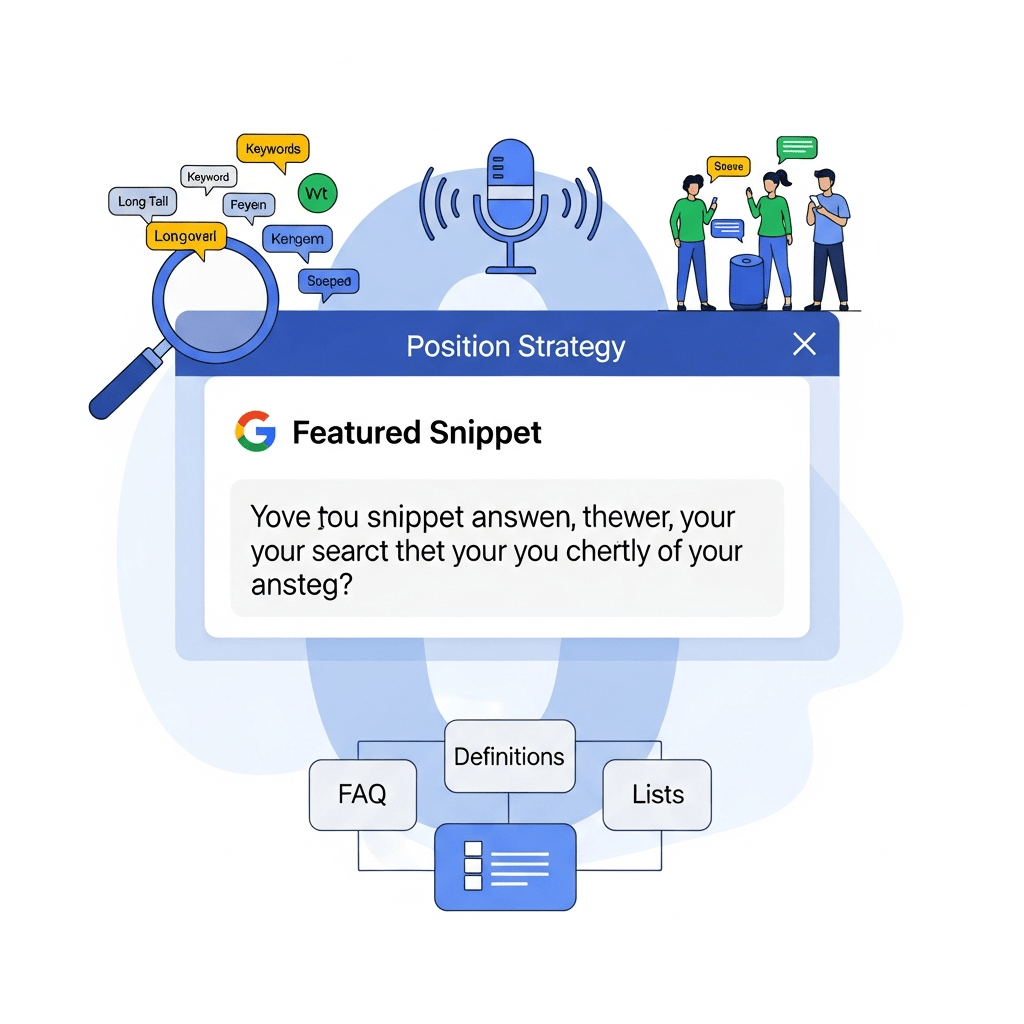
Featured snippets voice search optimization isn’t just another SEO tactic—it’s the difference between being the one answer voice assistants read aloud and being completely ignored. With 40.7% of all voice search results coming directly from position zero according to Stone Temple research, featured snippets represent the single most valuable ranking position in voice SEO.
This guide reveals exactly how to capture position zero and dominate voice search results across Google Assistant, Alexa, and Siri.
Table of Contents
ToggleWhat Are Featured Snippets and Why Do They Control Voice Search?
Featured snippets are the answer boxes appearing above traditional search results—position zero. Google extracts content directly from web pages and displays it prominently to answer user queries immediately.
Position zero voice search dominance happens because voice assistants need single, authoritative answers to read aloud. They can’t read ten blue links. They need one definitive response.
According to Ahrefs’ featured snippet study, pages ranking in featured snippets get an average 8.6% increase in click-through rate. For voice search, that advantage multiplies exponentially since snippets often represent the only result users hear.
Google’s algorithm selects featured snippets based on content structure, answer quality, domain authority, and relevance matching. Understanding these factors transforms snippet acquisition from random luck to systematic strategy.
How Do Featured Snippets Work for Voice Assistants?
When someone asks Google Assistant a question, the algorithm follows a predictable pattern:
- Interpret the spoken query’s intent
- Search for pages ranking well for that query
- Identify content formatted as clear, concise answers
- Extract the featured snippet content
- Read it aloud to the user
Voice search snippets must pass both text search ranking filters AND voice-specific quality checks. Content needs proper structure, appropriate length, and natural language flow when read aloud.
According to Backlinko’s voice search analysis, the average Google voice search result is 29 words long—remarkably close to typical featured snippet length of 40-60 words.
Alexa and Siri follow similar patterns but pull from their respective data sources (Bing for both, plus Amazon’s ecosystem for Alexa and Apple Maps/Yelp for Siri). Cross-platform snippet optimization requires understanding each platform’s preferences.
For comprehensive cross-platform strategies, see our complete voice search optimization guide.
What Types of Featured Snippets Exist?
Google displays several distinct snippet formats. Each triggers for different query types and requires specific optimization approaches.
Paragraph Snippets
The most common type—text blocks answering definition, explanation, or “what is” queries.
Optimal characteristics:
- 40-60 words (voice-friendly length)
- Direct answer in first sentence
- Simple, clear language
- Placed immediately after H2/H3 heading
Example structure:
H2: What is voice search optimization?

Voice search optimization is the process of improving your content's visibility in voice search results by using conversational keywords, implementing structured data, and creating featured snippet-friendly answers that smart assistants can extract and read aloud.
Paragraph snippets account for approximately 82% of all featured snippets according to SEMrush data.
List Snippets
Numbered or bulleted lists answering “how to,” “best,” “top,” or step-by-step queries.
Optimal characteristics:
- 5-8 list items (sweet spot for completeness without overwhelming)
- One clear sentence per item
- Logical sequential or priority order
- Descriptive list item text
Example structure:
H2: How do you optimize for featured snippets?

1. Research question keywords with featured snippet opportunities
2. Structure content with question-format headings
3. Write 40-60 word answers immediately after headings
4. Use clear formatting (lists, tables, paragraphs)
5. Implement FAQ and speakable schema markup
Voice assistants read list snippets naturally: “Here are the steps to optimize for featured snippets. First, research question keywords…”
Table Snippets
Comparison tables triggered by “versus,” “comparison,” “difference between” queries.
Optimal characteristics:
- 3-5 columns maximum
- 4-8 rows for voice readability
- Clear, concise cell content
- Descriptive headers
Example structure:
| Feature | Voice Search | Text Search |
|---|---|---|
| Query Length | 29 words | 2-3 words |
| Format | Questions | Keywords |
| Results | 1 answer | 10 results |
Tables work brilliantly for voice when assistants have screens (Google Nest Hub, Echo Show) but can also be read comparatively for audio-only devices.
For detailed snippet type strategies, explore our voice search fundamentals guide.
How Do You Find Featured Snippet Opportunities?
Strategic snippet targeting beats random optimization every time. Focus efforts where you have realistic chances of winning.
Using SEMrush for Snippet Research
SEMrush’s Position Tracking reveals snippet opportunities where you rank 1-10 but don’t own position zero.
Research process:
- Add your domain to Position Tracking
- Filter for keywords ranking positions 1-10
- Identify queries with existing featured snippets
- Note which competitors own those snippets
- Analyze their content structure
- Create better-formatted answers
Keywords where you rank #2-5 represent your highest-probability snippet wins. You already have topical authority—you just need better formatting.
Ahrefs Snippet Gap Analysis
Ahrefs’ Site Explorer shows which keywords trigger snippets and who owns them.
Analysis steps:
- Enter your domain in Site Explorer
- Go to “Organic Keywords” report
- Filter by SERP features → Featured snippets
- Identify keywords where competitors own snippets
- Examine their snippet content structure
- Create superior, better-formatted answers
According to Ahrefs data, 12.3% of search queries trigger featured snippets—that’s billions of monthly opportunities.
Google Search Console Query Mining
Search Console reveals actual queries driving your traffic—including those triggering snippets you might already own unknowingly.
Process:
- Open Performance report
- Filter for questions (contains: what, how, when, where, why, who)
- Sort by impressions
- Manually search high-impression queries
- Check if snippets appear
- Optimize content for unowned snippet opportunities
Manual SERP Analysis
Sometimes old-fashioned searching beats automation. Enter your target keywords and analyze:
- Does a featured snippet appear?
- What format (paragraph, list, table)?
- What content structure does Google prefer?
- How long is the snippet text?
- Which domain owns it?
- Can you create a better answer?
Take screenshots of successful snippets in your niche. Build a swipe file revealing pattern commonalities.
What’s the Optimal Featured Snippet Format for Voice Search?
Answer box voice optimization requires specific content structures maximizing voice assistant selection probability.
The Perfect Snippet Formula
Length: 40-60 words for paragraph snippets Reading Level: 9th grade or below (use Hemingway Editor to test) Structure: Answer in first paragraph, elaboration in subsequent paragraphs Formatting: Clear heading hierarchy, proper HTML structure Language: Conversational, natural when read aloud
Question-Answer Structure
The most reliable snippet format:
<h2>How does featured snippet optimization work?</h2>
<p>Featured snippet optimization involves structuring your content to answer specific questions in 40-60 words, using clear formatting, implementing schema markup, and matching user intent precisely. Google extracts these well-formatted answers to display in position zero and voice search results.</p>
The question becomes your H2/H3 heading. The answer comes immediately in the first paragraph. Elaboration follows in subsequent content.
List Structure for Steps
For process and ranking queries:
<h2>What are the steps to optimize for voice search?</h2>
<ol>
  <li>Research conversational question keywords</li>
  <li>Create content answering questions directly</li>
  <li>Implement FAQ and speakable schema markup</li>
  <li>Optimize for mobile page speed</li>
  <li>Build topical authority through content clusters</li>
</ol>
Use ordered lists (<ol>) for sequential processes, unordered lists (<ul>) for collections without specific order.
Comparison Table Structure
For versus and comparison queries:
<h2>What's the difference between voice search and text search?</h2>
<table>
  <thead>
    <tr>
      <th>Factor</th>
      <th>Voice Search</th>
      <th>Text Search</th>
    </tr>
  </thead>
  <tbody>
    <tr>
      <td>Query Length</td>
      <td>29 words</td>
      <td>2-3 words</td>
    </tr>
    <!-- Additional rows -->
  </tbody>
</table>
Proper HTML table structure with <thead> and <tbody> helps Google extract content correctly.
Our main voice optimization resource covers advanced formatting techniques.
How Does Schema Markup Improve Featured Snippet Selection?
Featured snippet strategy dramatically improves with proper structured data implementation. Schema tells Google exactly what your content means.
FAQ Schema for Question Content
FAQ schema explicitly marks up question-answer pairs:
{
  "@context": "https://schema.org",
  "@type": "FAQPage",
  "mainEntity": [{
    "@type": "Question",
    "name": "How do featured snippets help voice search?",
    "acceptedAnswer": {
      "@type": "Answer",
      "text": "Featured snippets provide the single answer voice assistants read aloud to users. Ranking in position zero gives you exclusive voice search visibility since assistants typically read only one result, not multiple options."
    }
  }]
}
Implement FAQ schema on pages with multiple questions answered. This structure appears in search results as expandable FAQ rich results AND feeds voice search responses.
Validate implementation using Google’s Rich Results Test.
Speakable Schema for Voice Sections
Google’s proprietary speakable schema identifies voice-friendly content sections:
{
  "@context": "https://schema.org/",
  "@type": "WebPage",
  "name": "Featured Snippet Optimization Guide",
  "speakable": {
    "@type": "SpeakableSpecification",
    "cssSelector": [".intro-answer", ".main-steps", ".key-takeaway"]
  }
}
The cssSelector property identifies which page elements are optimized for text-to-speech. Target your best snippet-formatted content.
According to Google’s speakable documentation, this markup prioritizes content for Google Assistant’s news and article reading features.
HowTo Schema for Instructional Content
For step-by-step guides and processes:
{
  "@context": "https://schema.org",
  "@type": "HowTo",
  "name": "How to Optimize for Featured Snippets",
  "step": [
    {
      "@type": "HowToStep",
      "name": "Research Keywords",
      "text": "Identify question keywords where featured snippets already appear"
    },
    {
      "@type": "HowToStep",
      "name": "Structure Content",
      "text": "Write 40-60 word answers immediately after question headings"
    }
  ]
}
HowTo schema can trigger special step-by-step rich results and feeds voice assistant instructional responses.
What Content Strategies Win Featured Snippets for Voice?
Beyond formatting, content quality and strategic approach determine snippet success.
The Inverted Pyramid Approach
Journalism’s classic structure works perfectly for snippets:
- Most important information first: Direct answer in opening
- Supporting details second: Context and elaboration
- Background information last: Additional resources and depth
This structure lets Google extract the answer without requiring users to read entire articles.
Answer Variations and Synonyms
One question has multiple phrasings. Target all variations:
Core question: “What is voice search optimization?”
Variations to include naturally:
- “Voice search optimization is…
- “Voice SEO involves…”
- “Optimizing for voice search means…
- When you optimize content for voice assistants…”
Use variations as subheadings or paragraph openers throughout content. This captures different query formulations.
Comprehensive Depth with Concise Answers
Featured snippets favor authoritative, comprehensive content—but extract only brief answers.
Strategy:
- Write 40-60 word snippet-perfect answer
- Support with 1,500-3,000+ word comprehensive content
- Build topical authority through thoroughness
- Keep snippet answer crisp and voice-friendly
According to Backlinko’s analysis, average voice search result pages contain 2,312 words despite Google reading only 29 words aloud. Depth builds authority; brevity wins snippets.
Intent Matching Precision
Google selects snippets matching query intent exactly. Understand what users truly want:
Informational queries (“what is”) need definitions Procedural queries (“how to”) need step lists Comparison queries (“X vs Y”) need tables Statistical queries (“how many”) need numbers
Match format to intent or Google won’t select your content regardless of quality.
How Do You Optimize for Multiple Featured Snippet Types?
Why position zero matters for voice SEO becomes clear when you realize different queries trigger different snippet formats. Versatile optimization captures more opportunities.
Creating Multi-Format Content
Structure pages to target multiple snippet types simultaneously:
Paragraph section: Definition or explanation List section: Steps or rankings Table section: Comparisons or specifications FAQ section: Related questions with brief answers
This approach gives Google multiple extraction options depending on query nuance.
Example structure:
H2: What is voice search optimization? [Paragraph snippet]
[40-60 word definition]

H2: How do you optimize for voice search? [List snippet]
1. Research conversational keywords
2. Create question-based content
3. Implement schema markup
[etc.]

H2: Voice Search vs Text Search [Table snippet]
[Comparison table]

H2: Frequently Asked Questions [FAQ rich results]
H3: Do I need different content for voice?
[Answer]
Topic Clustering for Snippet Dominance
Build comprehensive topic clusters with pillar and cluster content:
Pillar page: Broad topic overview targeting high-volume keywords Cluster pages: Specific subtopic pages targeting question variations
Each cluster page targets specific snippet opportunities while linking back to the pillar. This architecture builds topical authority and captures snippets across the entire topic spectrum.
According to HubSpot’s pillar page research, topic clusters improve organic traffic by 54% on average. Combined with snippet optimization, results multiply.
What Common Featured Snippet Mistakes Kill Voice Search Visibility?
Even experienced SEOs stumble with snippet optimization. Avoid these costly errors.
Writing Answers That Are Too Long
Google’s featured snippets rarely exceed 60 words. Writing 150-word “answers” guarantees Google will skip your content for more concise competitors.
Poor: Three-paragraph answer rambling through context before reaching the actual answer Better: 40-60 word direct answer, followed by elaboration in subsequent paragraphs
Track snippet word counts in your niche. Different industries and query types have different optimal lengths.
Burying the Answer
Placing answers in the middle or end of content after lengthy introductions wastes Google’s extraction efforts.
Poor:
[500 words of introduction]
The answer is: [actual answer]
[More content]
Better:
H2: [Question]
[40-60 word answer]
[Supporting details]
Google extracts from the beginning. Make extraction effortless.
Ignoring Mobile Optimization
Voice searches happen on mobile devices. Slow-loading mobile pages won’t win snippets regardless of content quality.
Test with Google PageSpeed Insights. Aim for green scores (90+) on mobile. Sites loading in 3+ seconds dramatically reduce snippet selection probability.
Using Complex Vocabulary
Academic or technical language reduces voice search suitability. Remember: content gets read aloud to users.
Poor: “Voice search optimization necessitates implementing conversational lexicon paradigms” Better: “Voice search optimization requires using natural, spoken language
Test readability with Hemingway Editor. Target 9th grade or below for maximum voice accessibility.
Neglecting Visual Elements
Featured snippets often include images. Pages without relevant, high-quality images miss selection opportunities.
Image optimization for snippets:
- Relevant image near the answer text
- Descriptive alt text
- Appropriate file size (fast loading)
- High quality but compressed
- Properly sized (1200×675 minimum for sharing)
According to Moz research, 30% of featured snippets include images—often from different sources than the text. Optimizing images creates dual snippet opportunities.
Pro Tip: According to SEMrush’s featured snippet research, pages ranking in position 1-5 have the highest probability of winning featured snippets. If you’re ranking below #5, improve traditional rankings before focusing exclusively on snippet optimization.
How Do Different Platforms Handle Featured Snippets?
Featured snippet tactics for smart assistants vary by platform. Understanding differences optimizes cross-platform performance.
Google Assistant Snippet Preferences
Google Assistant pulls almost exclusively from Google’s featured snippets and Knowledge Graph.
Optimization priorities:
- Featured snippet acquisition for target keywords
- Knowledge Graph entity establishment
- Comprehensive, authoritative content
- Fast mobile page speed
- Proper schema implementation
Google Assistant also references “People Also Ask” boxes—optimize for PAA appearance alongside snippets.
Amazon Alexa and Bing Featured Snippets
Alexa uses Bing’s search index for general queries. Bing featured snippets work similarly to Google but with nuances.
Bing snippet differences:
- Slightly longer optimal answer length (50-70 words)
- Greater emphasis on exact keyword matching
- Less sophisticated natural language understanding
- More weight on social signals
Optimize for both Google and Bing to maximize cross-platform snippet coverage. The strategies overlap significantly.
Siri and Indirect Snippet Usage
Siri pulls from multiple sources (Bing, Wikipedia, Wolfram Alpha, Yelp) without a unified snippet system.
Siri optimization:
- Optimize for Bing featured snippets
- Create/maintain Wikipedia entries where relevant
- Complete Yelp profiles for local businesses
- Structure content for easy extraction
Siri’s fragmented approach makes traditional snippet optimization less directly impactful, but structured, easily extractable content still helps.
For platform-specific details, see our complete voice search guide.
What Tools Help with Featured Snippet Optimization?
Specialized tools make snippet research and optimization systematic rather than guesswork.
SEMrush Position Tracking
SEMrush tracks which keywords trigger snippets and who owns them.
Key features:
- Snippet tracking for your keywords
- Competitor snippet ownership analysis
- Historical snippet changes
- Snippet opportunity identification
Monitor snippet losses—if you lose a snippet, competitors gained it. Analyze their content and reclaim position zero.
Ahrefs SERP Features Filter
Ahrefs identifies snippet opportunities across your entire keyword universe.
Usage:
- Site Explorer → Organic Keywords
- Filter by “Featured snippet” SERP feature
- Identify gaps where you rank but don’t have snippets
- Prioritize high-volume opportunities
Ahrefs also shows snippet keyword difficulty, helping prioritize realistic targets.
AnswerThePublic for Question Discovery
AnswerThePublic reveals questions people ask about your topics—the exact queries triggering snippets.
Generate hundreds of question variations to target with snippet-optimized content. Visual maps reveal question relationships and natural content clustering.
AlsoAsked for Question Relationships
AlsoAsked maps “People Also Ask” questions showing how queries relate and branch.
This reveals:
- Follow-up questions users ask
- Related topics to cover comprehensively
- Natural content flow and structure
- Opportunity gaps competitors miss
How Do You Measure Featured Snippet Success?
Tracking snippet performance reveals what’s working and where to focus optimization efforts.
Google Search Console Snippet Tracking
Search Console shows impression and click data for queries where you appear in snippets.
Analysis process:
- Performance report → Search results
- Filter by query
- Compare impressions/CTR before and after snippet acquisition
- Note CTR increase (typically 8%+ for snippets)
Snippet ownership dramatically increases impressions even at similar ranking positions.
Rank Tracking with Snippet Monitoring
Use rank trackers flagging snippet ownership:
- SEMrush Position Tracking: Shows snippet acquisition/loss
- Ahrefs Rank Tracker: Tracks snippet features
- AccuRanker: Dedicated snippet tracking
- SERPWatcher: Visual snippet monitoring
Monitor weekly. Snippets are volatile—you can gain or lose them as competitors optimize.
Voice Search Traffic Attribution
Measuring voice-driven traffic specifically requires inference:
Indicators:
- Mobile traffic increases correlated with snippet acquisition
- Direct traffic spikes (voice often appears as direct)
- Longer-than-average session duration from mobile
- Queries matching question formats in Search Console
While perfect attribution is impossible, pattern recognition reveals voice impact.
Conversion Rate Analysis
Featured snippets don’t just drive traffic—they drive qualified traffic.
According to Search Engine Journal data, traffic from featured snippets converts 40% better than traditional organic traffic due to higher intent matching and authority perception.
Track conversion rates segmented by landing pages with/without snippets to quantify business impact.
Real-World Featured Snippet Optimization Success Stories
HubSpot restructured their blog content with snippet-focused formatting: question headings, 40-60 word answers, comprehensive depth, and FAQ schema.
Result: Featured snippet acquisition increased 157% year-over-year, driving a corresponding voice search traffic increase of 94% according to their published case study.
Their strategy: Identify pages ranking 1-5 without snippets, restructure with question-format headings and direct answers, implement FAQ schema, and monitor results weekly.
Backlinko analyzed their snippet performance and discovered their longer, more comprehensive content won snippets more consistently than shorter articles.
They doubled down on 3,000+ word comprehensive guides with multiple snippet-optimized sections. Voice search referrals increased 73% as featured snippet acquisition grew.
How Will AI and Generative Search Affect Featured Snippets?
Google’s Search Generative Experience (SGE) and AI Overviews change how featured content appears, but don’t eliminate position zero’s importance.
SGE and Featured Snippets Coexistence
Early SGE rollouts show AI-generated summaries alongside traditional snippets for many queries. Both formats cite sources, creating dual visibility opportunities.
Optimization for both:
- Continue snippet optimization (still appears)
- Create comprehensive, authoritative content (SGE sources)
- Implement proper citations and sources
- Build E-E-A-T signals (Experience, Expertise, Authoritativeness, Trust)
According to Google’s SGE documentation, traditional search features including snippets will persist alongside AI-generated content.
Voice Search in the AI Era
AI-powered voice assistants synthesize information from multiple sources but still prioritize structured, easily extractable content.
Future-proofing snippet strategy:
- Focus on genuine helpfulness over keyword gaming
- Create depth and authority in content
- Structure for easy extraction regardless of format
- Build brand recognition and trust
The fundamentals remain: answer questions clearly, structure content logically, demonstrate expertise.
Frequently Asked Questions About Featured Snippets and Voice Search
How long does it take to win a featured snippet?
Featured snippet acquisition typically takes 2-8 weeks for pages already ranking in positions 1-5 with proper restructuring. New content ranking from scratch requires 60-90 days to build sufficient authority for snippet consideration. Competitive keywords may take 3-6 months of consistent optimization and authority building.
Can you have a featured snippet without ranking #1?
Yes—approximately 30% of featured snippets come from pages ranking #2-5 according to Ahrefs research. Google prioritizes content structure and answer quality over traditional ranking position for snippet selection. This creates opportunities for smaller sites to outcompete larger competitors through superior formatting.
Do featured snippets increase or decrease overall traffic?
Featured snippets typically increase total traffic despite some “zero-click” searches. Studies show 8.6% average CTR increase for snippet-owning pages (Ahrefs), with additional brand visibility benefits. Voice search amplifies this advantage by making snippets the exclusive result heard by users.
What’s the ideal featured snippet length for voice search?
40-60 words represents the sweet spot for paragraph snippets—long enough to be useful but short enough for voice assistants to read comfortably. Backlinko data shows average voice search answers are 29 words. Lists should contain 5-8 items, tables should have 3-5 columns and 4-8 rows for voice readability.
How do you optimize for both featured snippets and traditional rankings?
Create comprehensive content with snippet-optimized sections. Write 40-60 word direct answers followed by detailed elaboration. This structure captures snippets while maintaining depth for traditional ranking. Use proper heading hierarchy, internal linking, and schema markup supporting both objectives simultaneously.
Can you lose a featured snippet after winning it?
Yes—snippets are volatile. Google continuously reevaluates snippet quality, and competitors optimize to steal position zero. Monitor snippet ownership weekly and refresh content quarterly to maintain position. If you lose a snippet, analyze the new owner’s content structure and create superior answers to reclaim it.
Final Thoughts on Featured Snippet Voice Search Optimization
Featured snippets represent the single most valuable ranking position in voice search. The 40.7% of voice results coming from position zero makes snippet optimization non-negotiable for serious voice SEO.
Featured snippets voice search success requires systematic approaches: identify opportunities where you rank well, restructure content with question-format headings and direct answers, implement proper schema markup, and monitor results continuously.
Start with low-hanging fruit—keywords where you rank #2-5 without snippets. Restructure those pages first for quick wins while building comprehensive content targeting competitive opportunities.
The businesses dominating voice search share one trait: they own featured snippets for their core topics. Position zero isn’t optional—it’s essential.
Your customers are asking questions right now. Make sure voice assistants are reading your answers.
For comprehensive platform-specific tactics and advanced optimization strategies, explore our complete voice search optimization framework.
Citations & Sources
- Stone Temple (Perficient Digital) – “Digital Assistant Voice Search Study” – https://www.stonetemple.com/digital-assistant-study/
- Ahrefs – “Featured Snippets Study” – https://ahrefs.com/blog/featured-snippets-study/
- Backlinko – “Voice Search SEO Study” – https://backlinko.com/voice-search-seo-study
- SEMrush – “Featured Snippets Guide” – https://www.semrush.com/blog/featured-snippets/
- Google Search Central – “Rich Results Test” – https://search.google.com/test/rich-results
- Google Developers – “Speakable Structured Data” – https://developers.google.com/search/docs/appearance/structured-data/speakable
- HubSpot – “Pillar Page Strategy & Results” – https://blog.hubspot.com/marketing/pillar-page-conversions
- Moz – “Featured Snippets and Images Study” – https://moz.com/blog/featured-snippets-images
- Search Engine Journal – “Featured Snippets & Voice Search” – https://www.searchenginejournal.com/featured-snippets-voice-search/
- Google Blog – “Generative AI in Search” – https://blog.google/products/search/generative-ai-search/
Related posts:
- Google Assistant SEO: Voice Search Optimization for Android & Google Home
- Question-Based Content for AI Overviews: Targeting Query Types That Trigger AI
- What is Voice Search SEO? Understanding Voice Search Optimization Fundamentals
- Natural Language Patterns in Voice Search: Understanding How People Speak to Devices (Visualization)