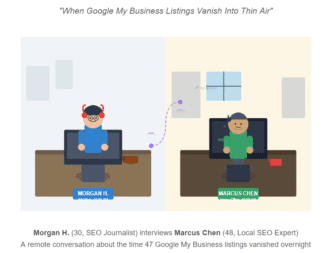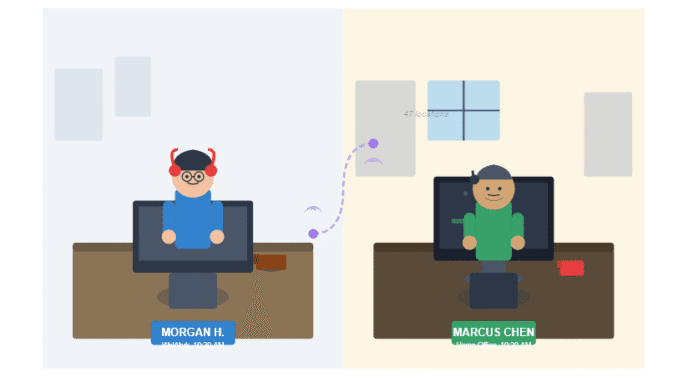


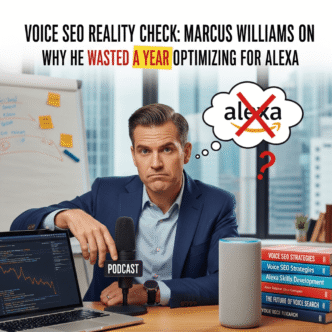
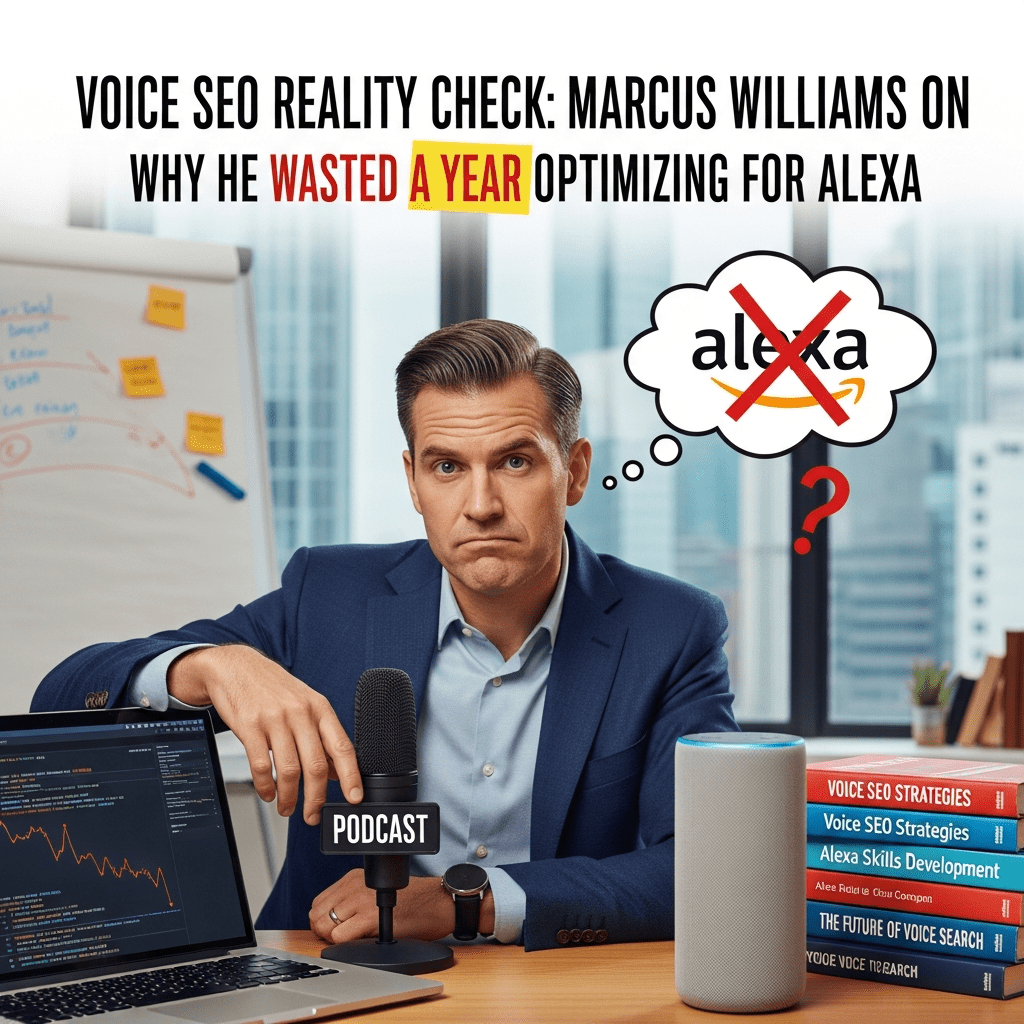
Marcus: —can you see my screen? No? Hold on.
Morgan: I can’t see anything yet. Are you sharing?
Marcus: I thought I clicked… [clicking sounds] …okay, how about now?
Morgan: Still nothing. You know what, we don’t need screen share. Let’s just talk.
Marcus: [laughs] Thank god. I hate Zoom. Okay, I’m ready.
Morgan: Perfect. So I want to talk about voice search, but first— how long have you been doing local SEO?
Marcus: Twelve years. Started in 2013 after I helped my brother’s HVAC company get on the first page of Google. He went from getting maybe three calls a week to getting three calls a day. I was like, “Wait, I can make money doing this?”
Morgan: And now you work with local businesses exclusively?
Marcus: Pretty much, yeah. Restaurants, home services, medical practices, retail stores. If you’re a brick-and-mortar business that needs customers to walk through your door or call you, I’m your guy.
Morgan: Okay, so tell me about voice search. When did you decide that was going to be the next big thing?
Marcus: 2019. Every SEO conference I went to that year had at least three sessions on voice search optimization. The future is voice!” “50% of searches will be voice by 2020!” Everyone was buying Echo Dots and Google Homes, and all the data suggested voice was about to explode.
Morgan: You believed it.
Marcus: I didn’t just believe it— I went all in. Like, embarrassingly all in.
Morgan: What does “all in” mean?
Marcus: Okay, so in early 2019, I pitched this new service to all my existing clients. “Voice Search Optimization Package.” I told them that within two years, most people would be searching for local businesses using voice assistants instead of typing, and if they didn’t optimize for it now, they’d get left behind.
Morgan: How many clients bought it?
Marcus: [laughs] Way too many. I signed up like 200 businesses across 14 months. The package was $400 a month per client, which seemed reasonable for what I was promising. I told them we’d restructure their content to answer conversational queries, optimize for question-based keywords, improve their local structured data— the whole nine yards.
Morgan: That sounds legitimate though.
Marcus: It was legitimate! The strategy was sound. The problem was that the opportunity didn’t exist.
Morgan: What do you mean?
Marcus: I mean, nobody was actually using voice search to find local businesses. Or at least, not enough people to make any measurable difference. But I didn’t know that yet. So I spent 14 months restructuring websites, rewriting content, building FAQ pages, implementing speakable schema markup—
Morgan: Wait, speakable schema?
Marcus: [groans] Oh god, yes. Speakable schema. It was this markup that was supposed to tell voice assistants which parts of your content were good for reading aloud. I implemented it on like 180 websites. Total waste of time.
Morgan: When did you realize it wasn’t working?
Marcus: Slowly, then all at once. Like, after six months, I started noticing that none of my clients were reporting increases in phone calls or foot traffic. And when I asked them directly, “Have you noticed more customers mentioning they found you through Alexa or Google Home?” they’d be like, “No, not really.”
Morgan: What did you tell them?
Marcus: I told them it was still early. That voice adoption was slower than predicted but it was definitely coming. And I believed that! I really did. So I kept optimizing.
Morgan: For how long?
Marcus: Another eight months. I was in denial, basically. I’d read articles about voice search growth and convince myself that my clients just needed more time to see results. Meanwhile, I’m spending hours every week creating voice-optimized content that nobody’s consuming.
Morgan: When did you finally accept it wasn’t working?
Marcus: December 2020. I was doing my end-of-year review, looking at all my clients’ analytics, and I decided to actually track voice search traffic. Like, really track it. I went into Google Analytics for all 200 clients and looked for any indication of voice search traffic.
Morgan: How did you identify voice traffic?
Marcus: Long-tail, conversational queries. Things like “where can I find Italian food near me” instead of “Italian restaurant Chicago.” Questions that start with “how,” “what,” “where.” The kind of queries people would speak out loud.
Morgan: And what did you find?
Marcus: Almost nothing. Across 200 businesses, voice-style queries accounted for maybe 2-3% of total search traffic. And even that was probably people typing conversational queries, not speaking them. There was no way to prove actual voice device usage.
Morgan: How did you feel when you realized this?
Marcus: Like an idiot. Like I’d just spent 14 months— 14 months— selling a service that didn’t deliver results. I’d taken $80,000 from small businesses who trusted me, and I had nothing to show for it.
Morgan: Did you tell your clients?
Marcus: Not right away. I was too embarrassed. I just quietly started phasing out the voice search optimization package. When clients would ask about renewing, I’d say something like, “Let’s focus on traditional SEO for now and revisit voice later.
Morgan: Did anyone push back?
Marcus: A few. I had one client— owner of a plumbing company in Milwaukee— he called me up and was like, “Marcus, I’ve been paying you \$400 a month for voice optimization for over a year. Has it done anything?” And I just… [long pause] …I told him the truth. I said, “No. It hasn’t. And I’m sorry I sold you on something that didn’t deliver.”
Morgan: How did he react?
Marcus: He was actually pretty cool about it. He said, “I appreciate the honesty. Let’s just do regular SEO from now on.” But I still refunded him for six months of services. Felt like the right thing to do.
Morgan: Did you refund other clients?
Marcus: I offered refunds to everyone who’d been on the voice package for more than a year. About 30 clients took me up on it. That was like $72,000 out of my pocket. Nearly wiped out my savings.
Morgan: Jesus. Why did you refund so much?
Marcus: Because I felt guilty! These are small business owners. A plumber, a dentist, a woman who runs a bakery. They’re not making a ton of money. And I took their hard-earned cash and spent it optimizing for something that didn’t matter.
Morgan: But you didn’t know it wouldn’t work when you started.
Marcus: I should have known sooner. The data was there. I just didn’t want to see it because admitting I was wrong meant admitting I’d wasted everyone’s time and money.
Morgan: What did you do after you stopped offering voice optimization?
Marcus: I went back to basics. Traditional local SEO. GMB optimization, local citations, review management, on-page SEO. The boring stuff that actually works. And you know what? My clients’ results got better almost immediately.
Morgan: Better how?
Marcus: More calls, more website traffic, higher rankings. Because I was focusing on what actually moved the needle instead of chasing some hypothetical future.
Morgan: Do you think voice search will ever become important?
Marcus: [pause] Not in the way we thought it would. Like, people use voice assistants for timers and weather and playing music. But for commercial queries— finding a business, making a purchase decision— people still type. They want to see options, read reviews, compare prices. Voice doesn’t work for that.
Morgan: What about now with ChatGPT and Claude? Do you think AI search is different?
Marcus: Yes and no. AI search is definitely changing things, but it’s not voice. People are typing queries into ChatGPT, not speaking them. And the optimization strategy is completely different from what we were doing in 2019.
Morgan: How is it different?
Marcus: In 2019, we were optimizing for question-answer format. Where’s the best pizza near me?” Now with AI search, it’s more about being a cited source. The AI scrapes information from multiple sources and synthesizes an answer. So you want your business to be included in that synthesis, which means having clear, factual information that AI can extract.
Morgan: Are you offering AI search optimization now?
Marcus: [laughs] Hell no. I learned my lesson. I’m not selling services based on emerging technology until I can prove ROI. Right now, I’m just monitoring how AI search affects my clients and adapting as needed.
Morgan: That seems wise.
Marcus: It’s the lesson I should have learned in 2019. Don’t build your business around predictions. Build it around what’s actually working today.
Morgan: Do you think you were a victim of hype?
Marcus: Absolutely. The whole industry was hyping voice search. Every blog post, every conference talk, every expert was saying the same thing. And I got swept up in it because I didn’t want to be left behind.
Morgan: Do you feel like the industry misled you?
Marcus: I don’t think it was intentional. I think everyone genuinely believed voice search was going to explode. The data suggested it. The technology was there. It just… didn’t happen the way we expected.
Morgan: Why do you think it didn’t happen?
Marcus: Because speaking to a device is awkward. Like, think about it. You’re sitting in your living room and you want to find a plumber. Are you going to yell “Alexa, find me a plumber near me!” or are you going to just pull out your phone and Google it? Most people choose the phone.
Morgan: That makes sense.
Marcus: Yeah. And it seems obvious in retrospect, but at the time, we were all convinced that convenience would trump awkwardness. We were wrong.
Morgan: What would you tell someone today who’s thinking about going all-in on AI search optimization?
Marcus: Test first. Don’t sell services based on what you think will happen. Wait until you can show actual results. Because if you’re wrong, you’re not just losing your own money— you’re losing your clients’ money and your reputation.
Morgan: That’s pretty conservative for an SEO.
Marcus: [laughs] Yeah, well, I used to be aggressive. Now I’m cautious. Getting burned once will do that to you.
Morgan: Do you still work with local businesses?
Marcus: Yeah, that’s still all I do. I’m just way more focused on proven strategies now. Less about what’s coming next, more about what works today.
Morgan: Do your clients know about the voice search thing?
Marcus: Some do. The ones who were around for it definitely know. New clients don’t usually hear about it unless it comes up naturally. It’s not something I advertise.
Morgan: [laughs] I bet.
Marcus: Yeah. Hi, I’m Marcus, and I once wasted \$80,000 of my clients’ money on voice search optimization” isn’t a great elevator pitch.
Morgan: [laughs] But it’s honest.
Marcus: It is. And honestly, I think the clients who stuck with me after that whole debacle trust me more now. Because they know I’ll admit when I’m wrong and I’ll make it right.
Morgan: That’s actually kind of beautiful.
Marcus: [laughs] Don’t make me sound too noble. I fucked up and I fixed it. That’s all.
Morgan: Fair enough. Alright, last question— if you could go back to 2019 and give yourself advice, what would you say?
Marcus: [pause] I’d say, “Test it on ten clients for six months before selling it to 200. And if you can’t show measurable ROI after six months, kill it and move on.”
Morgan: Would 2019 Marcus listen?
Marcus: [laughs] Probably not. But at least I’d have tried.
Morgan: [laughs] Alright, I should let you go. This was really good though. Thanks for being so honest about the whole thing.
Marcus: Thanks for letting me vent about it. It’s actually kind of therapeutic.
Morgan: Good. That’s the whole point. Alright, take care Marcus.
Marcus: You too, Morgan.
[end]
Table of Contents
ToggleKey Lessons Learned
“Don’t build your business around predictions. Build it around what’s actually working today.”
1. Industry Hype Doesn’t Equal Market Reality
Every 2019 conference promised “50% of searches will be voice by 2020.” The technology existed, the predictions were confident, but actual consumer behavior never followed. Marcus sold 200 packages based on industry consensus, not verified demand.
2. Test Before You Scale
Marcus went from zero voice clients to 200 in 14 months without ever proving ROI. A six-month pilot with ten clients would have revealed the problem before $80K was committed.
3. Speaking to Devices Is Socially Awkward
The fatal flaw nobody predicted: people don’t want to yell commercial queries at voice assistants in public or at home. Pulling out a phone to type is less awkward than asking Alexa for a plumber while your family listens.
4. Conversational Queries ≠ Voice Queries
Marcus found 2-3% of traffic used conversational phrasing, but couldn’t prove it came from voice devices. People type conversational questions too—the query format doesn’t indicate the input method.
5. Slow Realization Is Expensive
“After six months, none of my clients were reporting increases. But I told them it was still early… I kept optimizing for another eight months.”
Marcus knew something was wrong at month six but didn’t investigate thoroughly until month 14. Denial cost an extra eight months of wasted work and client fees.
6. Small Businesses Deserved Better
These weren’t Fortune 500 companies—they were plumbers, dentists, bakery owners. Marcus refunded $72,000 because taking money from small businesses without delivering results felt morally wrong, even if it was an honest mistake.
7. Speakable Schema Was Theater
Implementing specialized markup for voice assistants across 180 websites consumed hundreds of hours and delivered zero value. The technology infrastructure existed, but the user behavior never materialized.
8. Traditional SEO Works Because It’s Proven
After abandoning voice optimization and returning to “boring” tactics (GMB optimization, citations, reviews), client results improved immediately. Fundamentals outperform speculative strategies.
9. Honesty Rebuilds Trust
When the Milwaukee plumber asked point-blank if voice optimization had worked, Marcus told the truth and refunded six months. That client stayed. Transparency after failure can strengthen relationships.
10. AI Search ≠ Voice Search 2.0
ChatGPT and Claude represent a different paradigm—typed queries with synthesized answers from multiple sources. The optimization strategy (being a citable source) differs entirely from voice’s question-answer format. Marcus won’t repeat 2019’s mistake by jumping on AI search prematurely.
About Marcus Williams
Marcus Williams is a local business SEO expert with twelve years of experience helping brick-and-mortar businesses improve their search visibility. He specializes in Google Business Profile optimization, local citation management, and on-page SEO for restaurants, home service companies, medical practices, and retail stores.
After helping his brother’s HVAC company triple their call volume through basic SEO in 2013, Marcus discovered he had a talent for local search and turned it into a full-time career. His approach focuses on measurable results—more phone calls, more foot traffic, more revenue—rather than vanity metrics like rankings and impressions.
In 2019, swept up in industry predictions that voice search would dominate local queries, Marcus launched a voice optimization service and sold it to 200 clients over 14 months at \$400/month. He spent countless hours restructuring content for conversational queries, implementing speakable schema, and building FAQ pages optimized for Alexa and Google Home.
“I didn’t just believe it—I went all in. Like, embarrassingly all in.”
By late 2020, the uncomfortable truth became unavoidable: voice search traffic remained negligible. After tracking analytics across 200 businesses, Marcus found conversational queries accounted for only 2-3% of traffic, with no way to prove actual voice device usage. He’d spent 14 months and approximately $80,000 in client fees pursuing a future that never materialized.
Marcus offered refunds to every client who’d paid for voice optimization for over a year. Thirty clients accepted, costing him $72,000 and nearly wiping out his savings. He returned to traditional local SEO tactics and saw immediate improvement in client results.
The experience transformed Marcus from an aggressive early adopter into a cautious pragmatist. He now refuses to sell services based on emerging technology until he can demonstrate consistent ROI. When ChatGPT launched and AI search became the new industry obsession, Marcus declined to offer AI optimization packages—applying the lesson he learned from voice search.
Marcus lives in Chicago and now focuses exclusively on proven local SEO strategies that deliver measurable business results today, not hypothetical gains tomorrow.
This interview was conducted via video call in June 2025. Marcus spoke candidly about both the financial impact and emotional weight of selling services that didn’t deliver. The conversation has been edited for clarity while preserving his honest reflection on industry hype and personal accountability.

![# The Prompt Engineer's Confession: Tom Bradley on the SEO Shortcuts That Backfired **Tom:** Can you hear me okay? **Morgan:** Yeah, you're good. Can you see me? **Tom:** I can see you, but you're frozen. Wait— [pause] —there you go. Okay, we're good. **Morgan:** Perfect. So I'm just gonna jump right in. You ran an SEO agency and basically automated yourself into the ground? **Tom:** [laughs] Jesus, that's blunt. But yeah, that's accurate. **Morgan:** Tell me how it started. **Tom:** Okay, so I founded Bradley Digital in 2017. We did full-service SEO— content, technical audits, link building, the whole package. By 2023, we had 11 employees and about 40 clients. We were doing really well, making about $80K a month in revenue. **Morgan:** That's solid. **Tom:** It was. But it was also exhausting. I was constantly worried about payroll, about keeping everyone busy, about client churn. And then ChatGPT came out in late 2022, and I saw this opportunity to scale without hiring more people. **Morgan:** So you started using AI for client work. **Tom:** Not right away. First, I just used it for my own productivity. Writing emails, creating outlines, that kind of thing. But then I started experimenting with using it for actual deliverables. Client reports, content briefs, even blog posts. **Morgan:** And it worked? **Tom:** It worked too well. Like, I could create a content brief in 10 minutes that used to take my team 2 hours. I could write a 2,000-word blog post in 20 minutes instead of paying a writer $300 and waiting three days. The efficiency gains were insane. **Morgan:** When did you decide to go all-in on automation? **Tom:** March 2024. I spent like three weeks building this massive library of prompts. I had prompts for keyword research, content briefs, meta descriptions, technical audit reports, link outreach emails— everything we did as an agency, I created a prompt for it. **Morgan:** How many prompts? **Tom:** 347 by the time I was done. I organized them all in Notion with tags and categories. I was so fucking proud of it. I thought I'd built this incredible system. **Morgan:** What did you do with the system? **Tom:** I started using it for everything. And then... [pause] ...then I fired half my team. **Morgan:** Wait, what? **Tom:** I fired six people. Kept five. I told myself I was just "rightsizing" the business, but the truth is I didn't think I needed them anymore. Why pay a content writer $50K a year when I could use ChatGPT for $20 a month? **Morgan:** How did the remaining team react? **Tom:** They were terrified. Like, they knew if I'd fired six people, they could be next. The morale just evaporated. People stopped taking initiative, stopped caring about quality. They were just trying to survive. **Morgan:** Did you notice the morale issue? **Tom:** Not at first. I was too focused on the numbers. We'd just cut our payroll by like $300K a year while maintaining the same client load. On paper, it looked amazing. We went from making maybe $200K profit annually to projecting $500K. **Morgan:** When did things start falling apart? **Tom:** Maybe six weeks after the layoffs. One of our longest-standing clients— a B2B SaaS company we'd worked with for four years— they emailed saying they wanted to cancel. And I'm like, "What? Why?" And they sent me this whole breakdown of problems. **Morgan:** What kind of problems? **Tom:** The blog posts we'd been delivering were generic and repetitive. The keyword research had obvious gaps. The monthly reports were clearly templated with no actual insights. They basically said, "It feels like you're phoning it in." **Morgan:** Were you phoning it in? **Tom:** [long pause] Yeah. We were. I was using AI to generate everything and doing maybe 10 minutes of editing before sending it to clients. The prompts were good, but the output still needed human expertise to be truly valuable. And I wasn't providing that expertise anymore. **Morgan:** Did you try to save that client? **Tom:** I did. I offered them a discount, promised we'd improve quality, the whole thing. They said no. They'd already signed with another agency. **Morgan:** How much were they paying you? **Tom:** $8,000 a month. So that's $96K annually, gone. **Morgan:** Did other clients leave after that? **Tom:** [laughs darkly] Oh yeah. Once the first one left, it was like dominoes. Another client canceled two weeks later. Then another. Then three more in the same week. By the end of June 2024, we'd lost 12 clients. **Morgan:** Twelve? **Tom:** Twelve major clients. That was like $450,000 in annual revenue. In three months. **Morgan:** What was the common complaint? **Tom:** Quality. Every single one said the quality had dropped. Some were more polite about it than others, but the message was the same: "This doesn't feel like the agency we hired." **Morgan:** What did you do? **Tom:** I panicked. Like, full-on panic. I'd fired half my team thinking I was being smart, and now I'm losing clients left and right because the work sucks. And I can't just rehire the people I laid off because they'd all found new jobs. **Morgan:** Did you tell the remaining team what was happening? **Tom:** I had to. They could see clients canceling. So I called an all-hands meeting and basically said, "We have a quality problem and we need to fix it immediately." **Morgan:** What did they say? **Tom:** One of my account managers— Sarah, she'd been with me since 2018— she just looked at me and said, "Tom, we've been telling you there's a quality problem for two months. You didn't listen." **Morgan:** Had they been telling you? **Tom:** [pause] Yeah. They had. Multiple people had flagged concerns about the AI-generated content. But I dismissed them because the clients hadn't complained yet. And by the time the clients started complaining, it was too late. **Morgan:** What did you change? **Tom:** Everything. I stopped using AI for final deliverables. I started actually editing and enhancing the AI output instead of just sending it as-is. I brought in freelancers to help with content because I didn't have enough in-house staff. And I personally got involved in every client account to rebuild trust. **Morgan:** Did it work? **Tom:** Partially. We stopped the bleeding. No more clients left after July. But we didn't get any of the 12 back, and we weren't signing new clients because our reputation was trashed. We went from 40 clients down to 28 in three months. **Morgan:** How did that affect revenue? **Tom:** We went from $80K a month to about $50K. And with my smaller team, I was doing way more of the work myself. I went from being a CEO to being a senior strategist again, which honestly was kind of depressing. **Morgan:** Did you regret firing your team? **Tom:** Every single day. Those people were good at their jobs. They cared about quality. And I let them go because I thought a fucking chatbot could replace them. **Morgan:** Did you try to rehire any of them? **Tom:** I reached out to three of them. Two didn't respond. One responded and said, "No thanks, I'm happy where I am." And I don't blame them. I wouldn't come back either. **Morgan:** What happened to the agency? **Tom:** I shut it down in March 2025. Almost exactly a year after I'd built my prompt library. The math just didn't work anymore. We were barely breaking even, and I was burned out from trying to salvage everything. **Morgan:** That must have been hard. **Tom:** It was devastating. I'd built that agency from nothing. It was my identity. And I killed it by trying to be too clever. **Morgan:** What are you doing now? **Tom:** I'm an AI SEO consultant. Which is deeply ironic. **Morgan:** [laughs] How does that work? **Tom:** I help other agencies figure out how to use AI responsibly. Like, "Here's what I did wrong, don't do this." I teach them how to use AI as a productivity tool without sacrificing quality or firing their teams. **Morgan:** Do people actually hire you for that? **Tom:** Yeah, surprisingly. Turns out a lot of agency owners are tempted to do exactly what I did, and they want to learn from someone who's already failed at it. **Morgan:** How much do you make now compared to when you were running the agency? **Tom:** [pause] Way less. I'm doing maybe $8K to $10K a month as a consultant. Which is like a tenth of what the agency was making at its peak. **Morgan:** Do you regret the whole thing? **Tom:** [long pause] I regret how I did it. I don't regret experimenting with AI. But I regret thinking I was smarter than my team. I regret prioritizing short-term profit over long-term relationships. And I really regret firing people who trusted me. **Morgan:** Have you talked to any of them since? **Tom:** A few. I sent apology emails to everyone I laid off. Some people responded graciously, some didn't respond at all. One person told me to fuck off, which I deserved. **Morgan:** What did you learn from all this? **Tom:** That humans are irreplaceable. AI can help humans work better, but it can't replace expertise, judgment, or genuine care about the work. The second you treat AI as a replacement instead of a tool, you're fucked. **Morgan:** Do you think other people are making the same mistakes? **Tom:** Absolutely. I see agency owners on Twitter all the time bragging about how they're automating everything and cutting staff. And I'm just like, "Cool, see you in six months when your clients are leaving." **Morgan:** Have you tried to warn them? **Tom:** Sometimes. But it's hard to warn someone who's drunk on efficiency gains. They have to learn the hard way, just like I did. **Morgan:** What would you tell your March 2024 self? **Tom:** [pause] I'd say, "Use AI to make your team more productive, not to replace them. And if you're thinking about firing someone, ask yourself if you'd regret it in a year. Because you probably will." **Morgan:** Would 2024 Tom listen? **Tom:** No. I was too arrogant. I thought I'd figured something out that everyone else was missing. Turns out, everyone else was right. **Morgan:** That's pretty humble for someone who used to run a successful agency. **Tom:** [laughs] Yeah, well, failure has a way of making you humble. **Morgan:** Do you think you'll ever run an agency again? **Tom:** Maybe. But not for a while. I need to rebuild my reputation first. And honestly, I need to prove to myself that I can use AI responsibly before I'm in a position of power again. **Morgan:** That's very self-aware. **Tom:** Therapy helps. I've been going weekly since I shut down the agency. **Morgan:** Seriously? **Tom:** Yeah. Losing your business that you built from scratch does a number on you. I needed help processing it. **Morgan:** How's that going? **Tom:** Better. I'm not as angry at myself as I used to be. I'm trying to see it as a lesson rather than a failure. **Morgan:** That's healthy. **Tom:** [laughs] Yeah, well, we'll see. Ask me again in six months. **Morgan:** [laughs] Fair. Alright, I should let you go. Thanks for being so honest about all this. **Tom:** Thanks for giving me space to talk about it. Most people don't want to hear about failure. **Morgan:** That's literally all these interviews are about. **Tom:** [laughs] Well, then I'm your perfect guest. **Morgan:** You really are. Take care, Tom. **Tom:** You too, Morgan. [end] --- ## Key Lessons Learned > **"AI can help humans work better, but it can't replace expertise, judgment, or genuine care about the work. The second you treat AI as a replacement instead of a tool, you're fucked."** **1. Efficiency Gains Masked Quality Decline** Tom could create content briefs in 10 minutes instead of 2 hours and blog posts in 20 minutes instead of 3 days. The speed was real, but the depth, expertise, and client-specific insights disappeared. Clients noticed within weeks. **2. Layoffs Destroyed Team Morale** Firing six of eleven employees signaled to survivors that they were expendable. People stopped taking initiative, stopped caring about quality, and focused solely on self-preservation. The culture collapsed immediately. **3. Humans Were Flagging Problems Tom Ignored** Team members raised quality concerns for two months before clients started canceling. Tom dismissed these warnings because clients hadn't complained yet—by the time they did, 12 were already planning their exit. **4. Client Relationships Are Built on Expertise, Not Efficiency** > **"It feels like you're phoning it in."** Clients didn't hire Bradley Digital for fast turnaround—they hired for strategic thinking and customized solutions. When AI-generated templates replaced human expertise, the value proposition evaporated. **5. The First Cancellation Triggers an Avalanche** One $8K/month client left in May. By end of June, twelve clients ($450K in annual revenue) were gone. Once quality problems become visible, trust erodes across the entire client base simultaneously. **6. You Can't Quickly Undo Layoffs** When Tom realized he needed his team back, they'd all found new jobs. The knowledge, relationships, and expertise he'd eliminated couldn't be quickly rehired or replaced with freelancers. **7. Founder Involvement Can't Scale** Tom went from CEO to senior strategist, personally managing every account to rebuild trust. But one person can't deliver the expertise and attention that six specialists provided. The workload became unsustainable. **8. Reputation Damage Prevents New Growth** Even after stopping client losses in July, Bradley Digital couldn't sign new clients. Industry word-of-mouth about quality problems made sales impossible. Revenue stabilized at 62% of peak but wouldn't grow. **9. The Math Eventually Breaks** Projected profit increase ($200K to $500K annually) never materialized because revenue collapsed faster than costs decreased. By March 2025, the agency was barely breaking even despite having half the original team. **10. Arrogance Prevents Learning Until It's Too Late** > **"I thought I'd figured something out that everyone else was missing. Turns out, everyone else was right."** Tom dismissed his team's concerns, ignored industry skepticism about full automation, and believed he was uniquely smart. Only losing the business broke through his certainty. --- ## About Tom Bradley **Tom Bradley** is a former agency owner turned AI SEO consultant who now helps agencies implement AI tools without sacrificing quality or team morale. After founding Bradley Digital in 2017 and growing it to 11 employees and $80K monthly revenue by 2023, Tom aggressively automated his agency's workflow in 2024—building a library of 347 prompts and laying off half his team. The strategy backfired catastrophically. Within three months, quality complaints led to 12 major client cancellations representing $450K in annual revenue. By March 2025, Tom shut down the agency he'd spent eight years building. > **"I thought I was being smart, and now I'm losing clients left and right because the work sucks."** Tom now consults with agencies on responsible AI adoption, using his failure as a case study for what not to do. He emphasizes that AI should enhance human expertise rather than replace it, and that efficiency gains mean nothing if quality and client relationships suffer. **Tom lives in Austin, is in weekly therapy processing his business loss, and makes about one-tenth of his former agency income as a cautionary tale consultant.** --- *This interview was conducted via video call in November 2025. Tom was forthcoming about both his strategic miscalculations and their emotional impact. The conversation has been edited for clarity while preserving his emphasis on the human cost of automation decisions.*](https://aiseojournal.net/wp-content/uploads/2025/12/The-Prompt-Engineers-Confession-Tom-Bradley-on-the-SEO-Shortcuts-That-Backfired-332x332.png)
![# The Prompt Engineer's Confession: Tom Bradley on the SEO Shortcuts That Backfired **Tom:** Can you hear me okay? **Morgan:** Yeah, you're good. Can you see me? **Tom:** I can see you, but you're frozen. Wait— [pause] —there you go. Okay, we're good. **Morgan:** Perfect. So I'm just gonna jump right in. You ran an SEO agency and basically automated yourself into the ground? **Tom:** [laughs] Jesus, that's blunt. But yeah, that's accurate. **Morgan:** Tell me how it started. **Tom:** Okay, so I founded Bradley Digital in 2017. We did full-service SEO— content, technical audits, link building, the whole package. By 2023, we had 11 employees and about 40 clients. We were doing really well, making about $80K a month in revenue. **Morgan:** That's solid. **Tom:** It was. But it was also exhausting. I was constantly worried about payroll, about keeping everyone busy, about client churn. And then ChatGPT came out in late 2022, and I saw this opportunity to scale without hiring more people. **Morgan:** So you started using AI for client work. **Tom:** Not right away. First, I just used it for my own productivity. Writing emails, creating outlines, that kind of thing. But then I started experimenting with using it for actual deliverables. Client reports, content briefs, even blog posts. **Morgan:** And it worked? **Tom:** It worked too well. Like, I could create a content brief in 10 minutes that used to take my team 2 hours. I could write a 2,000-word blog post in 20 minutes instead of paying a writer $300 and waiting three days. The efficiency gains were insane. **Morgan:** When did you decide to go all-in on automation? **Tom:** March 2024. I spent like three weeks building this massive library of prompts. I had prompts for keyword research, content briefs, meta descriptions, technical audit reports, link outreach emails— everything we did as an agency, I created a prompt for it. **Morgan:** How many prompts? **Tom:** 347 by the time I was done. I organized them all in Notion with tags and categories. I was so fucking proud of it. I thought I'd built this incredible system. **Morgan:** What did you do with the system? **Tom:** I started using it for everything. And then... [pause] ...then I fired half my team. **Morgan:** Wait, what? **Tom:** I fired six people. Kept five. I told myself I was just "rightsizing" the business, but the truth is I didn't think I needed them anymore. Why pay a content writer $50K a year when I could use ChatGPT for $20 a month? **Morgan:** How did the remaining team react? **Tom:** They were terrified. Like, they knew if I'd fired six people, they could be next. The morale just evaporated. People stopped taking initiative, stopped caring about quality. They were just trying to survive. **Morgan:** Did you notice the morale issue? **Tom:** Not at first. I was too focused on the numbers. We'd just cut our payroll by like $300K a year while maintaining the same client load. On paper, it looked amazing. We went from making maybe $200K profit annually to projecting $500K. **Morgan:** When did things start falling apart? **Tom:** Maybe six weeks after the layoffs. One of our longest-standing clients— a B2B SaaS company we'd worked with for four years— they emailed saying they wanted to cancel. And I'm like, "What? Why?" And they sent me this whole breakdown of problems. **Morgan:** What kind of problems? **Tom:** The blog posts we'd been delivering were generic and repetitive. The keyword research had obvious gaps. The monthly reports were clearly templated with no actual insights. They basically said, "It feels like you're phoning it in." **Morgan:** Were you phoning it in? **Tom:** [long pause] Yeah. We were. I was using AI to generate everything and doing maybe 10 minutes of editing before sending it to clients. The prompts were good, but the output still needed human expertise to be truly valuable. And I wasn't providing that expertise anymore. **Morgan:** Did you try to save that client? **Tom:** I did. I offered them a discount, promised we'd improve quality, the whole thing. They said no. They'd already signed with another agency. **Morgan:** How much were they paying you? **Tom:** $8,000 a month. So that's $96K annually, gone. **Morgan:** Did other clients leave after that? **Tom:** [laughs darkly] Oh yeah. Once the first one left, it was like dominoes. Another client canceled two weeks later. Then another. Then three more in the same week. By the end of June 2024, we'd lost 12 clients. **Morgan:** Twelve? **Tom:** Twelve major clients. That was like $450,000 in annual revenue. In three months. **Morgan:** What was the common complaint? **Tom:** Quality. Every single one said the quality had dropped. Some were more polite about it than others, but the message was the same: "This doesn't feel like the agency we hired." **Morgan:** What did you do? **Tom:** I panicked. Like, full-on panic. I'd fired half my team thinking I was being smart, and now I'm losing clients left and right because the work sucks. And I can't just rehire the people I laid off because they'd all found new jobs. **Morgan:** Did you tell the remaining team what was happening? **Tom:** I had to. They could see clients canceling. So I called an all-hands meeting and basically said, "We have a quality problem and we need to fix it immediately." **Morgan:** What did they say? **Tom:** One of my account managers— Sarah, she'd been with me since 2018— she just looked at me and said, "Tom, we've been telling you there's a quality problem for two months. You didn't listen." **Morgan:** Had they been telling you? **Tom:** [pause] Yeah. They had. Multiple people had flagged concerns about the AI-generated content. But I dismissed them because the clients hadn't complained yet. And by the time the clients started complaining, it was too late. **Morgan:** What did you change? **Tom:** Everything. I stopped using AI for final deliverables. I started actually editing and enhancing the AI output instead of just sending it as-is. I brought in freelancers to help with content because I didn't have enough in-house staff. And I personally got involved in every client account to rebuild trust. **Morgan:** Did it work? **Tom:** Partially. We stopped the bleeding. No more clients left after July. But we didn't get any of the 12 back, and we weren't signing new clients because our reputation was trashed. We went from 40 clients down to 28 in three months. **Morgan:** How did that affect revenue? **Tom:** We went from $80K a month to about $50K. And with my smaller team, I was doing way more of the work myself. I went from being a CEO to being a senior strategist again, which honestly was kind of depressing. **Morgan:** Did you regret firing your team? **Tom:** Every single day. Those people were good at their jobs. They cared about quality. And I let them go because I thought a fucking chatbot could replace them. **Morgan:** Did you try to rehire any of them? **Tom:** I reached out to three of them. Two didn't respond. One responded and said, "No thanks, I'm happy where I am." And I don't blame them. I wouldn't come back either. **Morgan:** What happened to the agency? **Tom:** I shut it down in March 2025. Almost exactly a year after I'd built my prompt library. The math just didn't work anymore. We were barely breaking even, and I was burned out from trying to salvage everything. **Morgan:** That must have been hard. **Tom:** It was devastating. I'd built that agency from nothing. It was my identity. And I killed it by trying to be too clever. **Morgan:** What are you doing now? **Tom:** I'm an AI SEO consultant. Which is deeply ironic. **Morgan:** [laughs] How does that work? **Tom:** I help other agencies figure out how to use AI responsibly. Like, "Here's what I did wrong, don't do this." I teach them how to use AI as a productivity tool without sacrificing quality or firing their teams. **Morgan:** Do people actually hire you for that? **Tom:** Yeah, surprisingly. Turns out a lot of agency owners are tempted to do exactly what I did, and they want to learn from someone who's already failed at it. **Morgan:** How much do you make now compared to when you were running the agency? **Tom:** [pause] Way less. I'm doing maybe $8K to $10K a month as a consultant. Which is like a tenth of what the agency was making at its peak. **Morgan:** Do you regret the whole thing? **Tom:** [long pause] I regret how I did it. I don't regret experimenting with AI. But I regret thinking I was smarter than my team. I regret prioritizing short-term profit over long-term relationships. And I really regret firing people who trusted me. **Morgan:** Have you talked to any of them since? **Tom:** A few. I sent apology emails to everyone I laid off. Some people responded graciously, some didn't respond at all. One person told me to fuck off, which I deserved. **Morgan:** What did you learn from all this? **Tom:** That humans are irreplaceable. AI can help humans work better, but it can't replace expertise, judgment, or genuine care about the work. The second you treat AI as a replacement instead of a tool, you're fucked. **Morgan:** Do you think other people are making the same mistakes? **Tom:** Absolutely. I see agency owners on Twitter all the time bragging about how they're automating everything and cutting staff. And I'm just like, "Cool, see you in six months when your clients are leaving." **Morgan:** Have you tried to warn them? **Tom:** Sometimes. But it's hard to warn someone who's drunk on efficiency gains. They have to learn the hard way, just like I did. **Morgan:** What would you tell your March 2024 self? **Tom:** [pause] I'd say, "Use AI to make your team more productive, not to replace them. And if you're thinking about firing someone, ask yourself if you'd regret it in a year. Because you probably will." **Morgan:** Would 2024 Tom listen? **Tom:** No. I was too arrogant. I thought I'd figured something out that everyone else was missing. Turns out, everyone else was right. **Morgan:** That's pretty humble for someone who used to run a successful agency. **Tom:** [laughs] Yeah, well, failure has a way of making you humble. **Morgan:** Do you think you'll ever run an agency again? **Tom:** Maybe. But not for a while. I need to rebuild my reputation first. And honestly, I need to prove to myself that I can use AI responsibly before I'm in a position of power again. **Morgan:** That's very self-aware. **Tom:** Therapy helps. I've been going weekly since I shut down the agency. **Morgan:** Seriously? **Tom:** Yeah. Losing your business that you built from scratch does a number on you. I needed help processing it. **Morgan:** How's that going? **Tom:** Better. I'm not as angry at myself as I used to be. I'm trying to see it as a lesson rather than a failure. **Morgan:** That's healthy. **Tom:** [laughs] Yeah, well, we'll see. Ask me again in six months. **Morgan:** [laughs] Fair. Alright, I should let you go. Thanks for being so honest about all this. **Tom:** Thanks for giving me space to talk about it. Most people don't want to hear about failure. **Morgan:** That's literally all these interviews are about. **Tom:** [laughs] Well, then I'm your perfect guest. **Morgan:** You really are. Take care, Tom. **Tom:** You too, Morgan. [end] --- ## Key Lessons Learned > **"AI can help humans work better, but it can't replace expertise, judgment, or genuine care about the work. The second you treat AI as a replacement instead of a tool, you're fucked."** **1. Efficiency Gains Masked Quality Decline** Tom could create content briefs in 10 minutes instead of 2 hours and blog posts in 20 minutes instead of 3 days. The speed was real, but the depth, expertise, and client-specific insights disappeared. Clients noticed within weeks. **2. Layoffs Destroyed Team Morale** Firing six of eleven employees signaled to survivors that they were expendable. People stopped taking initiative, stopped caring about quality, and focused solely on self-preservation. The culture collapsed immediately. **3. Humans Were Flagging Problems Tom Ignored** Team members raised quality concerns for two months before clients started canceling. Tom dismissed these warnings because clients hadn't complained yet—by the time they did, 12 were already planning their exit. **4. Client Relationships Are Built on Expertise, Not Efficiency** > **"It feels like you're phoning it in."** Clients didn't hire Bradley Digital for fast turnaround—they hired for strategic thinking and customized solutions. When AI-generated templates replaced human expertise, the value proposition evaporated. **5. The First Cancellation Triggers an Avalanche** One $8K/month client left in May. By end of June, twelve clients ($450K in annual revenue) were gone. Once quality problems become visible, trust erodes across the entire client base simultaneously. **6. You Can't Quickly Undo Layoffs** When Tom realized he needed his team back, they'd all found new jobs. The knowledge, relationships, and expertise he'd eliminated couldn't be quickly rehired or replaced with freelancers. **7. Founder Involvement Can't Scale** Tom went from CEO to senior strategist, personally managing every account to rebuild trust. But one person can't deliver the expertise and attention that six specialists provided. The workload became unsustainable. **8. Reputation Damage Prevents New Growth** Even after stopping client losses in July, Bradley Digital couldn't sign new clients. Industry word-of-mouth about quality problems made sales impossible. Revenue stabilized at 62% of peak but wouldn't grow. **9. The Math Eventually Breaks** Projected profit increase ($200K to $500K annually) never materialized because revenue collapsed faster than costs decreased. By March 2025, the agency was barely breaking even despite having half the original team. **10. Arrogance Prevents Learning Until It's Too Late** > **"I thought I'd figured something out that everyone else was missing. Turns out, everyone else was right."** Tom dismissed his team's concerns, ignored industry skepticism about full automation, and believed he was uniquely smart. Only losing the business broke through his certainty. --- ## About Tom Bradley **Tom Bradley** is a former agency owner turned AI SEO consultant who now helps agencies implement AI tools without sacrificing quality or team morale. After founding Bradley Digital in 2017 and growing it to 11 employees and $80K monthly revenue by 2023, Tom aggressively automated his agency's workflow in 2024—building a library of 347 prompts and laying off half his team. The strategy backfired catastrophically. Within three months, quality complaints led to 12 major client cancellations representing $450K in annual revenue. By March 2025, Tom shut down the agency he'd spent eight years building. > **"I thought I was being smart, and now I'm losing clients left and right because the work sucks."** Tom now consults with agencies on responsible AI adoption, using his failure as a case study for what not to do. He emphasizes that AI should enhance human expertise rather than replace it, and that efficiency gains mean nothing if quality and client relationships suffer. **Tom lives in Austin, is in weekly therapy processing his business loss, and makes about one-tenth of his former agency income as a cautionary tale consultant.** --- *This interview was conducted via video call in November 2025. Tom was forthcoming about both his strategic miscalculations and their emotional impact. The conversation has been edited for clarity while preserving his emphasis on the human cost of automation decisions.*](https://aiseojournal.net/wp-content/uploads/2025/12/The-Prompt-Engineers-Confession-Tom-Bradley-on-the-SEO-Shortcuts-That-Backfired-688x387.png)