

You optimized your content for “pizza delivery.” Meanwhile, your customers are asking their phones “Hey Google, where can I get the best gluten-free pizza delivered to my apartment in downtown Seattle before 9 PM tonight?” That’s not a keyword—that’s a conversation.
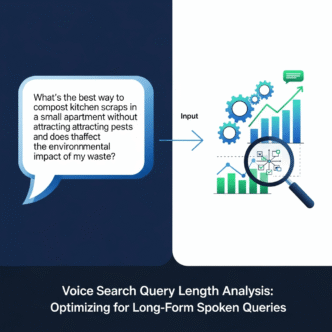
Voice search query length fundamentally changes SEO strategy. While typed searches average 2-3 words, voice queries span 29 words according to Backlinko’s comprehensive study. This 10x difference isn’t just interesting data—it’s the difference between appearing in voice results and being completely ignored.
This guide reveals exactly how query length affects optimization and how to capture those lengthy, conversational, high-intent voice searches driving today’s customer acquisition.
Table of Contents
ToggleWhy Are Voice Queries So Much Longer Than Text?
The cognitive and physical mechanics of search create dramatically different behavior patterns between typing and speaking.
The Friction Factor
Typing requires deliberate effort for every character. This friction forces economy—users minimize keystrokes to reduce effort. Weather NYC” conveys intent with minimal typing.
Speaking eliminates this friction completely. Words flow naturally without physical effort, so users express complete thoughts: “What’s the weather going to be like in New York City this weekend?”
According to PwC’s consumer research, 71% of people prefer voice queries over typing specifically because speaking requires less effort and feels more natural.
The Conversation Habit
We’ve spent our entire lives speaking in complete sentences but only decades typing abbreviated queries. Lifelong conversational habits persist when talking to devices.
Spoken search behavior mirrors how we’d ask another person—polite markers (“please,” “can you”), complete grammatical structure, contextual details, and natural phrasing.
“Where’s a good Italian restaurant?” sounds natural spoken. “Italian restaurant” feels incomplete and robotic—yet that’s what we type.
Context and Specificity
Long voice queries include details that typing omits:
Typed: “plumber emergency”
Spoken: “Find me an emergency plumber who can come to my house in the next hour”
The spoken version includes timeframe, service type, location context, and urgency—information typed searches communicate through browsing multiple results.
Voice users want single, perfect answers. They provide details upfront to get accurate results immediately.
Multitasking Enablement
Voice searches happen while cooking, driving, exercising, or caring for children. Users can’t stop activities to type, so they speak complete, detailed queries conveying full intent in one utterance.
According to Google’s mobile search data, 51% of smartphone users discover new products or companies through mobile search, with voice queries showing 35% higher specificity than typed equivalents.
What Does Data Reveal About Voice Search Query Length?
Understanding actual conversational query length patterns informs realistic optimization strategies.
Average Query Length Statistics
Text searches: 2-3 words average (Moz, SEMrush data)
Voice searches: 29 words average (Backlinko voice search study)
Mobile text: 2.8 words (Google internal data)
Mobile voice: 23-35 words depending on query intent
This represents a 10-15x difference in query verbosity between modalities.
Query Length Distribution
Voice searches don’t cluster around one length—they span a wide spectrum:
Short voice queries (5-10 words):
- “What’s the weather tomorrow?”
- “Set alarm for seven AM”
- “Call Mom’s cell phone”
Medium queries (15-25 words):
- “How do I remove red wine stains from white carpet?”
- “What’s the best Italian restaurant near me that’s open now?”
- “When does the pharmacy on Main Street close today?”
Long queries (30+ words):
- “Hey Google, I need to find a pediatric dentist who accepts Delta Dental insurance, is within 10 miles of downtown Austin, and has Saturday appointments available for my 7-year-old daughter”
According to Search Engine Journal analysis, 70% of voice queries use natural, conversational language regardless of length, compared to just 30% of text searches.
Query Length by Intent Type
Different query intents correlate with different lengths:
Informational queries: Longest (25-40 words)
- “Why does my car make a grinding noise when I brake and what should I do about it?”
Navigational queries: Moderate (10-20 words)
- “Take me to the nearest Starbucks that’s open right now”
Transactional queries: Variable (15-35 words)
- “Order a large pepperoni pizza for delivery to my house”
Local queries: Moderate-long (15-30 words)
- “Find a plumber near me who can fix a leaky faucet today and accepts credit cards”
High-intent commercial queries tend toward longer lengths because users specify requirements, constraints, and preferences upfront.
For broader voice search optimization strategies, see our complete voice search guide.
How Do Question Words Affect Voice Query Length?
Verbose voice searches heavily favor question formats, with different question types producing different characteristic lengths.
“How” Questions (Longest)
How-to queries generate the longest voice searches because users describe specific situations:
Average length: 25-40 words
Examples:
- “How do I fix a toilet that keeps running after I flush it?”
- “How can I get red wine stains out of my white carpet without damaging it?”
- How do I know if my air conditioner needs to be repaired or replaced?
Users provide context, describe symptoms, and specify constraints—all contributing to length.
“What” Questions (Long)
What queries seek definitions, explanations, or options:
Average length: 20-30 words
Examples:
- “What’s the best way to clean hardwood floors without leaving streaks?”
- “What are the symptoms of strep throat in children?”
- “What’s the difference between a CPA and a tax preparer?”
“Where” Questions (Moderate-Long)
Location queries include geographic context and requirements:
Average length: 15-25 words
Examples:
- “Where can I buy organic vegetables in downtown Seattle?”
- “Where’s the closest urgent care that accepts my insurance?”
- “Where should I take my car for an oil change near my office?”
“When” Questions (Moderate)
Temporal queries are typically more concise:
Average length: 10-20 words
Examples:
- “When does the pharmacy close today?”
- “When is the best time to plant tomatoes in zone 7?”
- “When should I replace my car’s timing belt?”
“Why” Questions (Long)
Why queries seek explanations and reasoning:
Average length: 20-35 words
Examples:
- “Why is my internet connection so slow all of a sudden?”
- “Why do I need to change my oil every 3000 miles?”
- “Why does my shoulder hurt when I raise my arm above my head?”
“Who” Questions (Short-Moderate)
Who queries identify people or businesses:
Average length: 10-18 words
Examples:
- “Who is the best divorce lawyer in Austin Texas?”
- “Who can fix my furnace on a Sunday?”
- “Who won the 2024 World Series?”
Understanding these patterns lets you create content matching actual query structures users employ.
What Content Strategies Work for Long Voice Queries?
Optimizing for longer conversational voice queries requires abandoning keyword-focused thinking for natural language content.
The Long-Tail Question Framework
Instead of targeting “pizza delivery,” create content answering actual questions people ask:
Short-tail thinking: “pizza delivery”
Long-tail reality:
- “Where can I order gluten-free pizza delivered in under 30 minutes?”
- “Which pizza places deliver to South Austin after 10 PM?”
- “How do I get pizza delivered without using a credit card?”
Create dedicated sections answering each complete question variation.
Comprehensive Answer Development
Long queries demand comprehensive answers addressing all implied sub-questions:
Query: “How do I know if I need a new roof or if it can be repaired and how much should either option cost?
Answer structure:
H2: How do you know if your roof needs replacement or can be repaired?

[40-60 word overview answer]

H3: Signs your roof needs complete replacement
[List of specific indicators]

H3: When roof repair is sufficient
[Specific situations where repair works]

H3: Cost comparison: Repair vs replacement
[Detailed pricing information]

H3: How to decide between repair and replacement
[Decision framework]
This comprehensive structure answers the complete query plus natural follow-ups.
Conversational Content Voice
Write exactly how people speak, not how they type:
Poor (keyword-focused): “Roof repair cost calculator for shingle roof types in Texas regions.”
Better (conversational): “How much does it cost to repair a shingle roof in Texas? Most homeowners pay between $300 and $1,200 depending on damage extent, roof size, and accessibility. Here’s what affects your specific cost…”
Read content aloud—if it sounds unnatural spoken, rewrite it.
Multi-Intent Content Structure
Long queries often contain multiple intent layers:
Query: “What’s the best way to remove pet stains from carpet and what products work best and where can I buy them?”
Intent layers:
- Information: How to remove pet stains (process)
- Recommendation: Best products (evaluation)
- Transaction: Where to buy (purchase)
Address all intent layers comprehensively:
H2: How do you remove pet stains from carpet?
[Step-by-step process]

H2: What products work best for pet stain removal?
[Product comparisons and recommendations]

H2: Where can you buy pet stain removal products?
[Purchasing options with links]
This structure satisfies the complete query in one piece of content.
For advanced content strategies, explore our voice search optimization framework.
How Do You Research Long-Form Voice Queries?
Understanding voice search query patterns requires tools and techniques revealing actual questions people ask.
AnswerThePublic for Question Discovery
AnswerThePublic visualizes questions people ask about topics:
Process:
- Enter your core topic
- Review question variations (who, what, when, where, why, how)
- Note long-tail specific questions
- Identify patterns in user concerns
- Group related questions for content planning
The tool reveals 200+ question variations per topic—representing actual voice query patterns.
“People Also Ask” Mining
Google’s PAA boxes reveal real questions with follow-up branches:
Method:
- Search your target keyword
- Expand every PAA question (reveals more)
- Document entire question trees
- Note question length and specificity
- Identify comprehensive answer opportunities
PAA questions mirror voice search language—conversational, complete, specific.
Search Console Long-Tail Analysis
Google Search Console reveals actual queries driving your traffic:
Filter strategy:
- Performance → Search results
- Sort by impressions
- Filter for queries 7+ words long
- Identify question-format queries
- Note conversational patterns
- Group by intent and topic
Queries already driving traffic show proven search demand.
Customer Service Question Analysis
Your support team hears voice-style questions daily:
Process:
- Review support tickets and chat transcripts
- Document common questions verbatim
- Note exact phrasing customers use
- Identify vocabulary and terminology
- Track seasonal variations
- Create content answering frequent questions
Customer questions are essentially voice queries in written form.
Competitor Content Gap Analysis
Identify long-tail questions competitors answer poorly or ignore:
Tools:
- Ahrefs Content Gap: Shows keywords competitors rank for that you don’t
- SEMrush Keyword Gap: Reveals missed long-tail opportunities
- AlsoAsked: Maps question relationships showing content gaps
Target questions competitors answer inadequately with superior, comprehensive content.
What Technical Optimizations Support Long Voice Queries?
Spoken query length optimization requires specific technical implementations beyond content quality.
Schema Markup for Comprehensive Content
Implement markup helping voice assistants understand and extract lengthy content:
FAQ Schema for multiple questions:
{
  "@context": "https://schema.org",
  "@type": "FAQPage",
  "mainEntity": [
    {
      "@type": "Question",
      "name": "How do I know if I need a new roof or if it can be repaired?",
      "acceptedAnswer": {
        "@type": "Answer",
        "text": "You need a new roof if more than 30% of shingles are damaged, the roof is over 20 years old, or you see widespread granule loss. Repairs work for isolated damage affecting less than 20% of the roof area."
      }
    }
  ]
}
HowTo Schema for process questions:
{
  "@context": "https://schema.org",
  "@type": "HowTo",
  "name": "How to remove pet stains from carpet",
  "totalTime": "PT30M",
  "step": [
    {
      "@type": "HowToStep",
      "name": "Blot the stain immediately",
      "text": "Use clean white towels to blot up as much liquid as possible without rubbing"
    }
  ]
}
Speakable Schema for Voice Sections
Google’s speakable markup identifies voice-friendly content:
{
  "@context": "https://schema.org/",
  "@type": "Article",
  "speakable": {
    "@type": "SpeakableSpecification",
    "cssSelector": [".intro", ".main-answer", ".key-takeaways"]
  }
}
Tag sections optimized for audio delivery.
Internal Linking for Related Questions
Long queries often trigger follow-up questions. Internal linking supports multi-turn conversations:
Strategy:
- Link related questions together
- Create “You might also want to know” sections
- Connect process steps to detailed explanations
- Enable easy navigation between related topics
This helps both users and voice assistants navigate comprehensive content.
Mobile Performance Optimization
Long voice queries happen on mobile. Speed is mandatory:
Requirements:
- Sub-3-second load times
- Minimal render-blocking resources
- Optimized images (compressed, lazy loaded)
- Efficient JavaScript execution
- Fast server response times
Test with Google PageSpeed Insights targeting 90+ mobile scores.
How Do Featured Snippets Handle Long Voice Queries?
Voice search phrases of 20+ words still generate concise featured snippet answers—creating optimization challenges.
The Extraction Paradox
Long questions need short answers. Users ask 30-word questions but want 40-word responses, not 300-word essays.
Optimization approach:
Comprehensive content: 2,000+ words addressing topic thoroughly
Featured snippet answer: 40-60 words directly answering core question
Supporting detail: Elaboration following snippet-perfect answer
This structure captures snippets while providing depth.
Position Zero for Multi-Part Questions
Questions with multiple components require structured answers:
Query: “What’s the best time to plant tomatoes in Texas and how deep should I plant them and how far apart?”
Snippet-optimized answer:
H2: When and how should you plant tomatoes in Texas?

Plant tomatoes in Texas after the last frost (mid-March to early April). Plant seedlings 2-3 inches deep with stems partially buried. Space plants 24-36 inches apart in rows 3-4 feet apart for proper airflow and growth.
Address all question components in one concise paragraph.
List Snippets for Process Questions
Long how-to questions often win list snippets:
Query: “How do I change my car’s oil myself at home without making a mess and what tools do I need?”
Snippet format:
H2: How do you change your car's oil at home?

Required tools: Oil filter wrench, drain pan, funnel, jack stands, new oil, new filter

Steps:
1. Warm engine 5 minutes, then turn off and secure on level ground
2. Drain old oil into pan positioned under drain plug
3. Replace drain plug and remove old oil filter
4. Install new filter hand-tight plus quarter turn
5. Add new oil using funnel, check level, start engine
This list format works perfectly for voice reading while answering the complete long-form query.
Our featured snippet optimization guide covers advanced position zero strategies.
What Common Mistakes Hurt Long Query Optimization?
Even sophisticated voice strategies fail when making these errors.
Keyword Stuffing for Short-Tail Terms
Targeting “plumber” when users actually ask “who can fix a leaky faucet in my bathroom today” misses the query entirely.
Poor: Content optimized for “emergency plumber” repeated 47 times
Better: Content answering “How quickly can an emergency plumber come to my house and what constitutes a plumbing emergency?”
Match actual query language, not imagined keywords.
Ignoring Query Context
Long queries include context short queries omit. Failing to address context reduces relevance.
Query: “What’s the best laptop for college students majoring in engineering who need to run CAD software?”
Missed context: Budget, portability, battery life, specific software requirements
Better answer: Addresses engineering workload, CAD requirements, typical student constraints
Infer and address implied context from query specificity.
Fragmented Content Structure
Creating 50 thin pages targeting variations of one question dilutes authority.
Poor: Separate pages for “roof repair cost,” “roof replacement cost,” “roof cost calculator”
Better: One comprehensive guide answering all cost-related questions thoroughly
Consolidate related long-tail queries into authoritative pillar content.
Robotic, Keyword-Focused Language
Writing for algorithms rather than humans produces unnatural content that fails voice.
Poor: “Roof repair services cost estimation calculation for residential property owners”
Better: “How much does it cost to repair your roof? Most homeowners pay between $300 and $1,500 depending on damage type and roof size.”
Natural language wins voice queries. Keyword-speak loses them.
Neglecting Answer Brevity
Comprehensive doesn’t mean wordy. Long questions need concise answers followed by optional detail.
Poor: 300-word rambling answer before getting to the point
Better: 40-60 word direct answer, then 2,000 words of supporting detail
Front-load answers for snippet extraction, then elaborate.
Pro Tip: According to Stone Temple’s voice search research, 40.7% of voice search results come from featured snippets. Long queries need short answers—master this paradox through answer-first content structure followed by comprehensive elaboration.
How Will AI Affect Long Voice Query Optimization?
Google’s Search Generative Experience and AI-powered assistants change how long queries get answered.
Generative AI and Query Length
AI systems handle conversational, multi-part questions more naturally than keyword-based algorithms:
Traditional: Matches keywords in query to keywords in content
AI-powered: Understands intent, synthesizes from multiple sources, generates natural answers
This rewards genuinely comprehensive, authoritative content over keyword optimization.
Optimizing for AI-Generated Responses
Best practices:
Demonstrate expertise: Detailed, accurate information AI can trust and cite
Structure clearly: Headings, lists, tables AI can parse and extract
Provide sources: Citations and references building credibility
Cover topics exhaustively: Comprehensive depth supporting synthesis
Use natural language: Conversational tone AI mirrors in responses
According to Google’s AI search documentation, AI-powered search will prioritize E-E-A-T (Experience, Expertise, Authoritativeness, Trustworthiness) even more heavily than traditional algorithms.
Multi-Turn Conversation Support
AI enables true multi-turn conversations where follow-up questions reference previous context:
Initial query: “How do I fix a leaky faucet?”
Follow-up 1: “What tools do I need for that?”
Follow-up 2: “Where can I buy those tools nearby?”
Content must answer not just primary questions but logical follow-ups users ask in natural conversation sequences.
Real-World Long Query Optimization Success
A home services company analyzed their long-tail voice queries and discovered customers asked 30+ word questions about specific situations.
They created comprehensive guides answering actual questions:
- “How do I know if my air conditioner needs repair or just needs maintenance and how much should either option cost me?”
- “What should I do if my toilet keeps running after I flush it and is it something I can fix myself or do I need a plumber?”
Result: Featured snippet acquisition increased 156% for long-tail queries. Voice search traffic grew 94% year-over-year. Average query length driving their traffic increased from 4.2 words to 18.7 words—capturing high-intent, specific searches competitors ignored.
A healthcare provider optimized for symptom-based long queries:
- “What are the symptoms of strep throat in children and when should I take my child to the doctor instead of waiting?”
- “How can I tell the difference between a cold and allergies and what should I do for each one?”
Voice search patient acquisition increased 67% as they captured people asking detailed health questions to voice assistants.
Frequently Asked Questions About Voice Search Query Length
Why are voice searches so much longer than typed searches?
Speaking requires no physical effort compared to typing, allowing natural expression of complete thoughts. People use conversational language when speaking (complete sentences, context, polite markers) but economize when typing (minimal keywords). Voice users want single perfect answers, so they provide specific details upfront rather than browsing multiple results.
What’s the optimal content length for targeting long voice queries?
Create 2,000-3,000+ word comprehensive content covering topics thoroughly, but place 40-60 word direct answers immediately after question headings for featured snippet extraction. Long queries need both concise answers AND comprehensive depth—the answer-first approach with detailed elaboration following satisfies both requirements.
How do I find the actual long-tail questions people ask?
Use AnswerThePublic for question variations, mine Google’s “People Also Ask” boxes, analyze Search Console for 7+ word queries, review customer service transcripts for actual questions, and research competitor content gaps. These sources reveal real conversational queries rather than imagined keywords.
Should I create separate pages for every long-tail question variation?
No—consolidate related questions into comprehensive pillar content addressing all variations thoroughly. Creating 50 thin pages targeting slight variations dilutes authority and wastes effort. One authoritative 3,000-word guide answering 20 related questions outperforms 20 separate 300-word pages.
Do long voice queries convert better than short ones?
Yes—longer queries indicate higher specificity and intent. Someone asking a 30-word question has precisely defined needs and is closer to conversion than someone typing 2 words. Long queries also face less competition since most content targets short-tail keywords, creating easier ranking opportunities for businesses addressing conversational searches.
How do featured snippets work for very long questions?
Google extracts concise answers (40-60 words) even from long questions. Structure content with direct answers immediately after question headings, followed by comprehensive elaboration. This captures snippets for voice reading while providing depth that builds authority and improves traditional rankings.
Final Thoughts on Voice Search Query Length Optimization
The 29-word average voice search represents more than interesting statistics—it’s a fundamental shift in how customers communicate needs. Short keyword optimization fails when actual queries are 10x longer and infinitely more specific.
Voice search query length optimization means abandoning keyword-focused thinking for conversational content answering actual questions people ask. It means comprehensive guides, not thin keyword pages. Natural language, not robotic optimization. Depth with brevity, not superficial keyword targeting.
Start by documenting actual questions customers ask—support tickets, voice mail, email inquiries. These reveal real query language. Then create comprehensive content answering those complete questions, not imagined short keywords.
The businesses winning voice search understand that “pizza” isn’t a search query anymore. “Where can I get the best gluten-free pizza delivered to downtown Seattle in under 30 minutes” is. Optimize accordingly.
Your customers are asking detailed, specific, conversational questions right now. Make sure your content answers them.
For comprehensive strategies covering all voice search aspects, explore our complete voice search optimization framework.
Citations & Sources
- Backlinko – “Voice Search SEO Study” (29-word average) – https://backlinko.com/voice-search-seo-study
- PwC – “Consumer Intelligence Series: Voice Assistants” – https://www.pwc.com/us/en/services/consulting/library/consumer-intelligence-series/voice-assistants.html
- Google Think with Google – “Mobile Search Trends & Consumer Insights” – https://www.thinkwithgoogle.com/consumer-insights/consumer-trends/mobile-search-trends/
- Search Engine Journal – “Voice Search Statistics & Natural Language Data” – https://www.searchenginejournal.com/voice-search-stats/
- Stone Temple (Perficient Digital) – “Digital Assistant Voice Search Study” – https://www.stonetemple.com/digital-assistant-study/
- Moz – “Voice Search SEO Guide & Query Analysis” – https://moz.com/learn/seo/voice-search
- Google Blog – “Generative AI in Search” – https://blog.google/products/search/generative-ai-search/
- AnswerThePublic – Question Research Tool – https://answerthepublic.com/
- Google PageSpeed Insights – Mobile Performance Testing – https://pagespeed.web.dev/
- SEMrush – “Voice Search & Long-Tail Keyword Research” – https://www.semrush.com/blog/voice-search/
Related posts:
- Question-Based Content for AI Overviews: Targeting Query Types That Trigger AI
- Google Assistant SEO: Voice Search Optimization for Android & Google Home
- Natural Language Patterns in Voice Search: Understanding How People Speak to Devices (Visualization)
- What is Artificial Intelligence in SEO? A Simple Explanation for Non-Technical Marketers