

You know AI Overviews matter. You read the guides. But where do you actually start?
Optimization feels overwhelming. Twenty different tactics. Fifty competing priorities. Zero clear path forward.
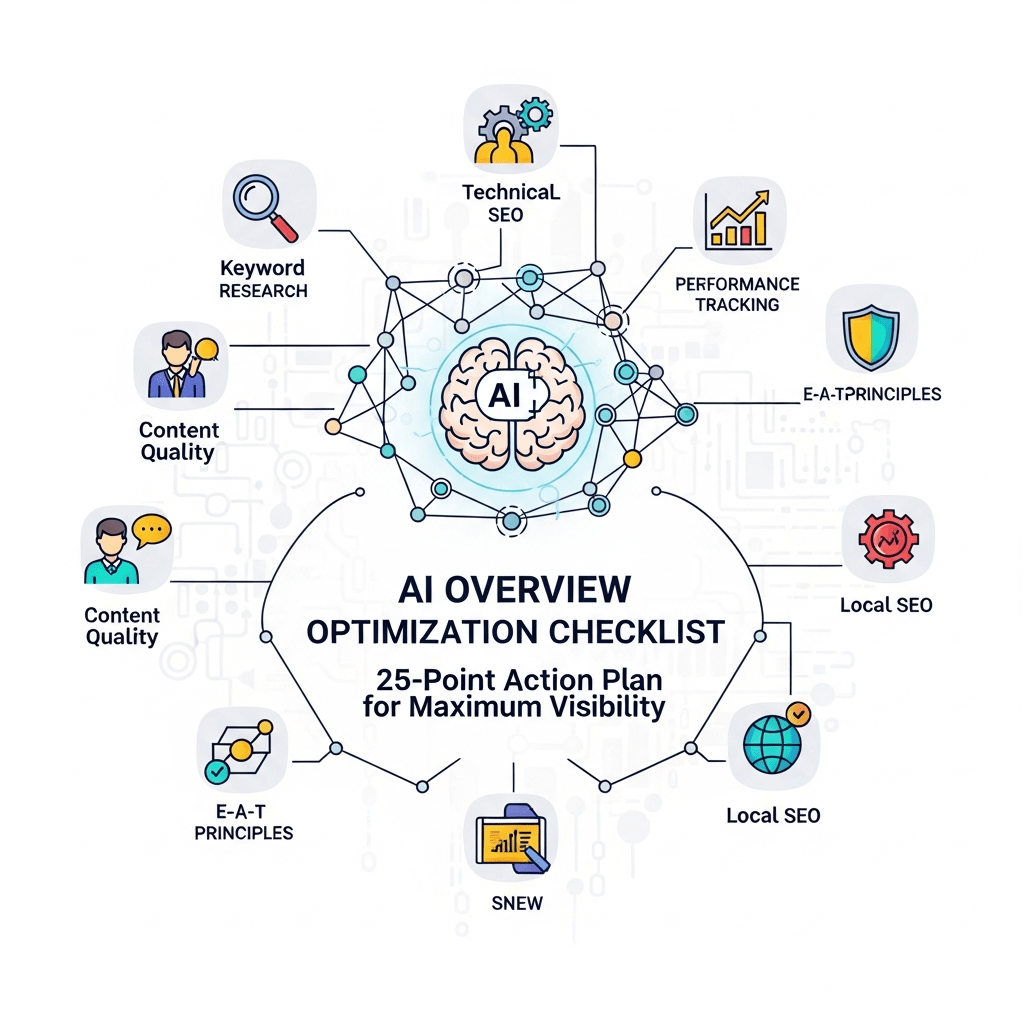
AI Overview optimization checklist changes everything. No more paralysis. No more guessing. Just systematic execution driving measurable citation improvements.
Most businesses fail at AI optimization not from lack of knowledge but from lack of structure. They try everything simultaneously, execute nothing completely, see minimal results. According to BrightEdge’s optimization implementation study, sites following systematic checklists achieve citations 4.3x faster than those using ad hoc approaches.
Step-by-step AI optimization works because it forces completion before moving forward. Each checkpoint builds on previous ones. Foundation before advanced tactics. Measurement before iteration.
This complete checklist for optimizing content for AI Overviews provides exact execution order, specific actions per checkpoint, verification methods, and success criteria. No theory. Pure implementation.
26 action items. Systematic execution. Maximum visibility.
Start today.
Table of Contents
ToggleFoundation Layer: Technical Requirements (Actions 1-5)
Build infrastructure before content optimization.
Technical basics qualify you for consideration. Skip these, nothing else matters.
✅ Action 1: Implement Complete LocalBusiness/Organization Schema
What to do:
Add Organization schema site-wide with name, logo, URL, social profiles, contact information. For local businesses, use LocalBusiness schema variant with address, geo coordinates, business hours, service areas.
Why it matters: Schema tells AI who you are, what you do, where you operate. Missing schema eliminates E-E-A-T verification.
How to verify:
Test with Google’s Rich Results Test. Confirm all properties validate. Check schema appears on all key pages.
Success criteria: ✓ Schema validates without errors ✓ All required properties populated ✓ Implemented site-wide
Time estimate: 2-4 hours
✅ Action 2: Add Article Schema to All Content
What to do:
Implement Article schema on blog posts, guides, and articles with headline, author (Person schema), datePublished, dateModified, publisher (Organization schema), image, articleBody.
Why it matters: Article schema establishes content credentials—who wrote it, when published, when updated, who published it. Core freshness and authority signals.
How to verify:
Rich Results Test for each article. Verify dateModified updates automatically when content changes.
Success criteria: ✓ All content has Article schema ✓ Person and Organization schemas nested correctly ✓ Dates accurate
Time estimate: 3-6 hours initial setup, automated ongoing
✅ Action 3: Optimize Core Web Vitals
What to do:
Achieve LCP under 2.5 seconds, FID under 100ms, CLS under 0.1. Compress images, minimize JavaScript, implement caching, use CDN, optimize fonts.
Why it matters: Poor technical performance disqualifies content from AI citations regardless of quality. Fast sites get processed preferentially.
How to verify:
Test with Google PageSpeed Insights and Core Web Vitals report in Search Console. Verify mobile and desktop pass thresholds.
Success criteria: ✓ LCP < 2.5s ✓ FID < 100ms ✓ CLS < 0.1 ✓ Both mobile and desktop pass
Time estimate: 8-16 hours depending on current state
✅ Action 4: Ensure Mobile Optimization
What to do:
Responsive design on all devices. Touch-friendly buttons (44×44px minimum). Readable fonts (16px+ body text). No horizontal scrolling. Fast mobile load speeds.
Why it matters: 87% of local searches happen mobile. AI prioritizes mobile-friendly content. Poor mobile experience eliminates citations.
How to verify:
Test on actual phones (iPhone, Android). Use Mobile-Friendly Test. Check Search Console mobile usability report.
Success criteria: ✓ Passes Mobile-Friendly Test ✓ No mobile usability errors ✓ Loads under 3 seconds on 4G
Time estimate: 4-12 hours depending on current mobile state
✅ Action 5: Fix NAP Consistency (For Local Businesses)
What to do:
Ensure identical Name, Address, Phone across Google Business Profile, website, Yelp, Facebook, all citations. No variations—exact matches only.
Why it matters: Inconsistent NAP confuses AI about business legitimacy. Perfect consistency required for local AI citations.
How to verify:
Audit top 20 citations manually. Document exact NAP on each. Fix every mismatch.
Success criteria: ✓ 100% NAP consistency across all properties ✓ Website matches GBP exactly ✓ Major citations corrected
Time estimate: 2-6 hours for audit and corrections
More technical foundations appear in our complete optimization guide.
Content Structure Layer (Actions 6-10)
Structure determines extractability. AI can’t cite poorly structured content.
✅ Action 6: Convert 60%+ Headings to Question Format
What to do:
Transform topic headings into questions users actually ask. Benefits of Schema” becomes “What Are the Benefits of Schema Markup?”
Why it matters: Question headings align with query patterns triggering AI Overviews. AI recognizes question-answer structure instantly.
How to verify:
Calculate percentage of H2/H3 headings in question format. Aim for 60-70% minimum.
Success criteria: ✓ 60%+ headings are questions ✓ Questions match actual user searches ✓ Natural language throughout
Time estimate: 1-2 hours per major article
✅ Action 7: Implement Inverted Pyramid Structure
What to do:
Answer questions immediately in first 2-3 sentences after headings. Follow with expanded explanation, then supporting details, examples, advanced nuances.
Why it matters: AI extracts opening content preferentially. Burying answers reduces extraction efficiency and citation probability.
How to verify:
Check each section answers its question in opening paragraph. Verify key information front-loaded.
Success criteria: ✓ Direct answers in first paragraph always ✓ Supporting details follow ✓ No buried answers
Time estimate: 2-3 hours per article
✅ Action 8: Add Comprehensive FAQ Sections
What to do:
Create 5-10 Q&A pairs per article addressing related questions. Use FAQPage schema markup. Keep answers 50-150 words.
Why it matters: FAQ sections with schema get cited 2.1x more frequently. Perfect question-answer format AI prioritizes.
How to verify:
Rich Results Test validates FAQ schema. Verify FAQ questions match People Also Ask queries.
Success criteria: ✓ 5-10 Q&As minimum ✓ FAQ schema validates ✓ Questions from actual searches
Time estimate: 1-2 hours per article
✅ Action 9: Optimize Paragraph Length
What to do:
Limit paragraphs to 2-4 sentences maximum. Break dense paragraphs into shorter chunks. One main idea per paragraph.
Why it matters: Short paragraphs improve scannability and AI parsing efficiency. Dense paragraphs reduce citation probability.
How to verify:
Count sentences per paragraph across articles. Average should be 2-3 sentences.
Success criteria: ✓ 80%+ paragraphs under 4 sentences ✓ Clear paragraph topics ✓ Improved readability
Time estimate: 1-2 hours per article
✅ Action 10: Use Lists Strategically
What to do:
Convert related items to bulleted/numbered lists. Use numbered lists for sequences, bulleted for unordered items. Maintain 3-8 items per list typically.
Why it matters: Lists organize information into discrete, easily extractable units. AI processes lists more efficiently than paragraph-embedded items.
How to verify:
Check lists use proper HTML markup (ul, ol, li tags). Verify parallel structure within lists.
Success criteria: ✓ All multi-item content uses lists ✓ Proper HTML markup ✓ Consistent formatting
Time estimate: 1 hour per article
E-E-A-T Enhancement Layer (Actions 11-15)
Authority signals determine whether AI trusts your content enough to cite.
✅ Action 11: Add Author Bylines with Credentials
What to do:
Display author names prominently. Include relevant credentials, titles, certifications. Link to detailed author bio pages. Implement Person schema for all authors.
Why it matters: AI evaluates author expertise explicitly. Anonymous content or authors without credentials face significant citation disadvantages.
How to verify:
Check every article displays author name and credentials. Verify Person schema validates with qualifications included.
Success criteria: ✓ All content has named authors ✓ Credentials displayed ✓ Person schema implemented
Time estimate: 4-8 hours for site-wide implementation
✅ Action 12: Create Comprehensive Author Bio Pages
What to do:
Build dedicated bio pages for each author with education, professional background, certifications, publications, LinkedIn profile, contact information, photo.
Why it matters: Detailed bios let AI verify credentials. Comprehensive author pages strengthen E-E-A-T signals significantly.
How to verify:
Check each bio page includes minimum 300 words. Verify external verification links (LinkedIn, professional profiles).
Success criteria: ✓ Bio pages for all authors ✓ Credentials verifiable ✓ Professional photos included
Time estimate: 2-3 hours per author
✅ Action 13: Add Citation Sources Throughout Content
What to do:
Link to authoritative sources supporting factual claims. Cite peer-reviewed research, industry studies, official statistics, recognized experts.
Why it matters: Citations demonstrate research depth and factual accuracy. AI cross-references claims against sources.
How to verify:
Check 60%+ of factual claims link to authoritative sources. Verify sources are recent (prefer past 12 months).
Success criteria: ✓ Major claims cited ✓ Authoritative sources only ✓ Working links
Time estimate: 1-2 hours per article
✅ Action 14: Display Trust Signals Site-Wide
What to do:
Add HTTPS security, clear contact information, detailed About page, privacy policy, terms of service, professional design, no intrusive ads.
Why it matters: Trust signals establish site legitimacy. Missing trust elements trigger AI skepticism regardless of content quality.
How to verify:
Audit for SSL certificate, contact page, privacy policy, about page. Verify all accessible and professional.
Success criteria: ✓ HTTPS active ✓ Contact info clear ✓ Legal pages complete ✓ Professional appearance
Time estimate: 4-8 hours for complete implementation
✅ Action 15: Implement Review/Testimonial Schema (If Applicable)
What to do:
For businesses with reviews, add AggregateRating schema showing rating, review count, best/worst rating values.
Why it matters: Review schema provides social proof AI evaluates for trust and authority in commercial contexts.
How to verify:
Rich Results Test validates review schema. Check ratings display correctly.
Success criteria: ✓ Review schema validates ✓ Accurate rating data ✓ Review count current
Time estimate: 2-4 hours
More E-E-A-T tactics appear in our authority building guide.
Content Quality Layer (Actions 16-20)
Quality and comprehensiveness determine synthesis value.
✅ Action 16: Achieve Comprehensive Topic Coverage
What to do:
Cover topics exhaustively—2,500+ words for complex subjects. Answer main question plus all related questions. Address subtopics thoroughly.
Why it matters: AI prefers comprehensive sources providing complete information over multiple thin sources.
How to verify:
Compare content depth to top 3 competitors. Verify you answer more questions, provide more detail, cover more angles.
Success criteria: ✓ Exceeds competitor depth ✓ Addresses all major subtopics ✓ Complete question coverage
Time estimate: 4-8 hours per major article
✅ Action 17: Add Original Data and Examples
What to do:
Include unique insights AI can’t find elsewhere—original research, proprietary data, specific case studies, real examples with results.
Why it matters: Original information provides unique synthesis value. AI cites sources offering information unavailable from multiple alternatives.
How to verify:
Check each article includes minimum 2-3 unique elements competitors lack.
Success criteria: ✓ Original insights included ✓ Specific examples with data ✓ Unique perspective offered
Time estimate: 2-4 hours per article
✅ Action 18: Update Statistics to Current Year
What to do:
Replace all outdated statistics with current data. Cite studies from past 12 months preferentially. Reference current year explicitly.
Why it matters: Dated statistics signal stale content. Current data reinforces freshness critical for AI citations.
How to verify:
Search content for years. Verify 80%+ statistical references are from current/previous year.
Success criteria: ✓ Statistics current ✓ Sources recent ✓ Temporal references accurate
Time estimate: 1-2 hours per article
✅ Action 19: Add Visual Content (Images, Charts, Videos)
What to do:
Include relevant images, data visualizations, charts, diagrams, screenshots, or videos. Add descriptive alt text to all images.
Why it matters: Visual content signals comprehensive coverage. AI favors multimodal content over text-only articles.
How to verify:
Check major articles include 3-5+ relevant visuals. Verify all images have descriptive alt text 100+ characters.
Success criteria: ✓ Visual content included ✓ Alt text descriptive ✓ Images relevant and helpful
Time estimate: 2-4 hours per article
✅ Action 20: Implement Internal Linking Strategy
What to do:
Add 4-6 contextual internal links per article to related content. Use descriptive anchor text. Link to authoritative pages supporting claims.
Why it matters: Internal links demonstrate topic breadth and depth. Site structure signals topical authority to AI.
How to verify:
Audit link count per article. Verify links contextual and helpful, not forced.
Success criteria: ✓ 4-6 internal links minimum ✓ Contextual placement ✓ Descriptive anchor text
Time estimate: 30-60 minutes per article
Freshness Maintenance Layer (Actions 21-23)
Freshness maintains citation eligibility over time.
✅ Action 21: Establish Quarterly Update Schedule
What to do:
Review high-value content every 90 days. Update statistics, examples, and outdated information. Modify 20%+ of content per update. Update dateModified schema.
Why it matters: Fresh content receives citations 4.7x more frequently than stale content. Systematic updates maintain freshness authority.
How to verify:
Create update schedule spreadsheet. Track last update dates. Set alerts for content reaching 90-day threshold.
Success criteria: ✓ Update schedule documented ✓ Quarterly reviews completed ✓ Schema dates updated
Time estimate: 2-4 hours per update cycle
✅ Action 22: Add “Last Updated” Timestamps
What to do:
Display “Last Updated: [Date]” prominently on articles. Update schema dateModified to match. Update timestamp only with substantial content changes.
Why it matters: Visible timestamps signal freshness to users and AI. Timestamps reinforce schema date signals.
How to verify:
Check timestamps display on all key articles. Verify schema dates match displayed dates.
Success criteria: ✓ Timestamps visible ✓ Match schema dates ✓ Only updated with real changes
Time estimate: 2-4 hours site-wide implementation
✅ Action 23: Use Current Year in Temporal References
What to do:
Reference current year explicitly throughout content—”In 2025,” “As of December 2024,” “Recent 2024 studies show.”
Why it matters: Specific temporal markers reinforce freshness throughout content, not just in dates.
How to verify:
Search content for year references. Update to current year during quarterly reviews.
Success criteria: ✓ Current year referenced ✓ Temporal markers specific ✓ No outdated year references
Time estimate: 30 minutes per article during updates
Measurement & Iteration Layer (Actions 24-26)
Tracking reveals what works. Iteration improves results.
✅ Action 24: Track Citation Frequency
What to do:
Manually test target keywords weekly/biweekly. Document which content gets cited in AI Overviews. Calculate citation rate (cited keywords / total AI-triggering keywords).
Why it matters: Can’t improve what you don’t measure. Citation tracking reveals optimization effectiveness.
How to verify:
Build tracking spreadsheet with keywords, citation status, dates checked, trends over time.
Success criteria: ✓ Weekly citation checks ✓ Data documented ✓ Trends analyzed
Time estimate: 30-60 minutes weekly
✅ Action 25: Monitor Competitor Citations
What to do:
Track which competitors get cited for your target keywords. Analyze their advantages. Identify gaps you can exploit.
Why it matters: Competitive intelligence reveals successful tactics you should implement and weaknesses you can exploit.
How to verify:
Document competitor citations in tracking spreadsheet. Note patterns in who gets cited when.
Success criteria: ✓ Top 5 competitors tracked ✓ Citation patterns documented ✓ Insights actionable
Time estimate: 60 minutes weekly
✅ Action 26: Iterate Based on Data
What to do:
Analyze what content gets cited versus ignored. Identify successful patterns. Apply winning tactics to more content. Test variations systematically.
Why it matters: Data-driven iteration compounds results. Random optimization wastes effort.
How to verify:
Monthly review of citation data. Document pattern insights. Plan next month’s optimization priorities based on findings.
Success criteria: ✓ Monthly data reviews ✓ Patterns identified ✓ Tactics adjusted based on evidence
Time estimate: 2-4 hours monthly
More tracking methods appear in our measurement guide.
Priority Implementation Roadmap
AI snapshots checklist execution requires sequencing.
Not all 26 actions happen simultaneously. Follow this timeline.
Week 1: Technical Foundation
Complete Actions 1-5. These qualify you for consideration. Without technical basics, content optimization wastes effort.
Focus: Schema implementation, Core Web Vitals, mobile optimization, NAP consistency.
Verification: All technical checks pass before proceeding.
Week 2-3: Content Structure
Execute Actions 6-10 on highest-value content (10-20 articles generating most traffic).
Focus: Question headings, inverted pyramid, FAQ sections, paragraph optimization, list usage.
Verification: Structure improvements visible, FAQ schema validates.
Week 4-5: E-E-A-T Enhancement
Implement Actions 11-15 site-wide.
Focus: Author attribution, bio pages, citations, trust signals, review schema.
Verification: All authority signals present and verifiable.
Week 6-8: Content Quality Upgrade
Complete Actions 16-20 on priority content.
Focus: Comprehensive coverage, original data, current statistics, visual content, internal linking.
Verification: Content depth exceeds competitors, freshness signals strong.
Week 9: Freshness Systems
Establish Actions 21-23 as ongoing processes.
Focus: Update schedules, timestamp systems, temporal reference strategy.
Verification: Systems documented, first update cycle scheduled.
Week 10+: Measurement & Optimization
Launch Actions 24-26 as continuous improvement cycle.
Focus: Citation tracking, competitive monitoring, data-driven iteration.
Verification: Tracking systems operational, insights driving decisions.
This 10-week roadmap establishes complete optimization infrastructure. Results typically appear Week 6-8 as enough optimizations compound.
Success Metrics Checklist
Track these metrics validating checklist execution effectiveness.
Technical Layer:
- [ ] All schema validates without errors
- [ ] Core Web Vitals pass on mobile and desktop
- [ ] Mobile-Friendly Test passes
- [ ] NAP 100% consistent (local businesses)
Content Structure:
- [ ] 60%+ headings in question format
- [ ] FAQ schema on 80%+ of content
- [ ] Average paragraph length under 3.5 sentences
- [ ] Lists used for all multi-item content
E-E-A-T Signals:
- [ ] All content has named, credentialed authors
- [ ] Author bio pages complete for all writers
- [ ] 60%+ claims have authoritative citations
- [ ] All trust signals present site-wide
Content Quality:
- [ ] Priority content exceeds competitor depth
- [ ] Each article includes 2+ unique elements
- [ ] 80%+ statistics from current/previous year
- [ ] Visual content on all major articles
Freshness:
- [ ] Update schedule established and documented
- [ ] Timestamps visible on all articles
- [ ] Current year referenced throughout content
- [ ] 90% of content updated within threshold
Measurement:
- [ ] Citation tracking operational
- [ ] Competitor monitoring systematic
- [ ] Monthly data reviews scheduled
- [ ] Citation rate improving quarter-over-quarter
Complete this metrics checklist monthly. Any unchecked items become next month’s priorities.
Common Implementation Mistakes
Avoid these checklist execution errors.
Skipping verification steps. Checking boxes without actually verifying completion wastes effort. Use Rich Results Test, PageSpeed Insights, manual checks—verify everything.
Attempting everything simultaneously. Spreading effort across all 26 actions produces incomplete execution everywhere. Follow sequential roadmap—complete sections before advancing.
Focusing on easy items, avoiding hard ones. Technical optimization and comprehensive content upgrades are hard. But they matter most. Don’t optimize easy items (timestamps) while ignoring hard ones (Core Web Vitals).
One-time execution without maintenance. Checklist isn’t one-and-done. Freshness, measurement, and iteration require ongoing commitment. Build systems, not just complete tasks.
Checking boxes without understanding why. Understand purpose behind each action. When you know why, you execute better and adapt intelligently.
Paralysis from perfection-seeking. 80% execution across all items beats 100% perfection on three items. Complete good enough, then iterate.
Tools Supporting Checklist Execution
Google Rich Results Test: Validates schema implementations (Actions 1-2, 8, 15)
PageSpeed Insights: Verifies Core Web Vitals (Action 3)
Mobile-Friendly Test: Confirms mobile optimization (Action 4)
Screaming Frog: Audits schema, structure, links at scale (Multiple actions)
Grammarly/Hemingway: Checks readability, paragraph length (Actions 9)
Answer The Public / AlsoAsked: Identifies questions for headings and FAQs (Actions 6, 8)
Google Search Console: Tracks performance, identifies issues (Action 24)
Spreadsheets: Documents tracking, schedules, metrics (Actions 21, 24-26)
These tools accelerate execution and improve verification accuracy.
Conclusion
AI Overview optimization checklist transforms overwhelming complexity into manageable execution.
26 actions. 10-week roadmap. Systematic implementation. Measurable results.
Most businesses fail AI optimization not from lack of knowledge but from execution paralysis. Too many options. No clear starting point. No verification methods.
Checklists solve paralysis. You know exactly what to do next. You verify completion before moving forward. You track results systematically.
Start today with Actions 1-5. Complete technical foundation this week. Begin content structure next week. Follow the roadmap. Check boxes. Verify completion. Track results.
Every action completed improves citation probability. Every verification ensures quality. Every measurement enables iteration.
Citations don’t come from random tactics. They come from systematic execution of proven optimization fundamentals.
Print this checklist. Check boxes weekly. Review progress monthly. Iterate based on results.
Your competitors either have checklists or they don’t. Those with systematic approaches dominate. Those without flail randomly.
Choose systematic execution. Choose measurable progress. Choose citations over invisibility.
Execute the checklist. Win AI visibility. Grow your business.
Start now. Check the first box today.
, only 23% of businesses systematically test voice search performance despite 58% implementing voice optimization. This gap between optimization and validation creates wasted budgets and missed opportunities. This comprehensive guide reveals exactly how to test, validate, and prove voice search optimization effectiveness across all major platforms and query types. ## Why Traditional SEO Testing Fails for Voice Search Understanding voice search testing challenges informs better methodologies. ### The Invisible Rankings Problem Voice assistants read one answer—no visible position tracking: **Text search**: Clear #1-10 rankings visible in SERPs **Voice search**: Assistant speaks single result, no alternatives shown **Challenge**: Can't track "position 3" when only position 1 gets read Traditional rank tracking tools fail because voice search doesn't have conventional rankings. ### Device and Context Variability Voice results vary dramatically by: **Device type**: Smart speaker vs mobile vs car system **User location**: Different results by geographic location **User history**: Personalization affects results **Platform**: Google vs Alexa vs Siri differences **Language settings**: Regional dialect impacts **Time of day**: Some queries show temporal variation A single test on one device in one location proves little. ### The Featured Snippet Proxy Featured snippets approximate voice results but aren't perfect: **Correlation**: 40.7% of voice results come from featured snippets ([Stone Temple research](https://www.stonetemple.com/digital-assistant-study/)) **Gap**: 59.3% of voice results come from elsewhere **Limitation**: Featured snippet ownership ≠ guaranteed voice visibility Test actual voice results, not just snippet positions. ### Privacy and Encryption Voice assistants protect user data preventing detailed analytics: **Limited data**: No "voice search referrer" in Analytics **Encrypted queries**: "(not provided)" in keyword reports **Indirect signals**: Rely on patterns not explicit labels Testing must work around data limitations. For comprehensive optimization strategies, see our [complete voice search guide](https://aiseojournal.net/voice-search-optimization-for-smart-assistants-alexa-siri-google-assistant-strategy/). ## What Are the Core Voice Search Testing Methodologies? **Voice SEO validation** requires multi-method approaches combining quantitative and qualitative testing. ### Manual Device Testing Direct testing on actual voice assistants: **Process**: 1. Identify target voice queries (20-50 priority keywords) 2. Speak queries to actual devices 3. Record which result gets read aloud 4. Document complete response 5. Note any visual results (smart displays) 6. Test across multiple devices/platforms 7. Test from different locations 8. Repeat weekly or bi-weekly **Documentation template**: ``` Query: "How do I fix a leaky faucet" Device: Google Home Mini Location: Austin, TX Date: [Date] Time: [Time] Result: [Your site / Competitor / Other source] Full Response: [Transcription of what was said] Visual Result (if any): [Screenshot] ``` This manual process is time-intensive but provides ground truth data. ### Featured Snippet Tracking Monitor position zero ownership as voice proxy: **Tools**: - [SEMrush Position Tracking](https://www.semrush.com/): Featured snippet monitoring - [Ahrefs Rank Tracker](https://ahrefs.com/): SERP feature tracking - [AccuRanker](https://www.accuranker.com/): Snippet ownership alerts **Methodology**: 1. Identify target keywords triggering featured snippets 2. Track snippet ownership daily/weekly 3. Measure snippet acquisition rate 4. Monitor competitor snippet losses 5. Correlate snippet gains with traffic increases **Limitation awareness**: Featured snippets predict but don't guarantee voice visibility. ### Search Console Query Analysis Identify voice-indicative query patterns: **Analysis process**: 1. Export Search Console query data 2. Filter for question keywords (how, what, when, where, why, who) 3. Filter for 7+ word queries 4. Identify conversational language patterns 5. Track impressions/clicks month-over-month 6. Measure CTR changes for voice-likely queries **Metrics to track**: - Question keyword impression growth - Long-tail query volume increases - Mobile impression changes - CTR improvements for conversational queries ### Third-Party Voice Testing Tools Specialized tools automating some testing: **Available platforms**: - **BrightLocal**: Local voice search testing tools - **Rank Ranger**: Voice search ranking features - **SEO PowerSuite**: Voice search tracking modules **Capabilities**: - Automated query testing across locations - Featured snippet tracking - Question keyword discovery - Competitor voice visibility analysis **Limitations**: Tools can't fully replicate real user voice experiences but provide scalable testing. ### User Testing and Real User Monitoring Test with actual target customers: **Methodology**: 1. Recruit 10-20 target demographic users 2. Provide voice-enabled devices 3. Give realistic task scenarios 4. Observe voice search behavior 5. Record which results get used 6. Collect qualitative feedback 7. Identify friction points **Example scenario**: "You need to find a plumber who can come today. Use voice search to find one and call them." This reveals real-world voice search usage patterns. ## How Do You Test Voice Search Across Different Platforms? **Testing smart assistants** requires platform-specific approaches. ### Google Assistant Testing Protocol **Device coverage**: - Google Home/Nest smart speakers - Android smartphones - Google Home Hub/Nest Hub (screen + voice) - Android Auto (car systems) **Testing checklist**: □ Test on smart speaker (audio-only results) □ Test on smartphone (audio + visual) □ Test on smart display (multimodal results) □ Test "near me" queries from different locations □ Test at different times of day □ Document featured snippet correlation □ Check Google Business Profile impact (local) **Google-specific variables**: - Personalization effects (logged in vs logged out) - Search history influence - Location precision impact - Language/accent recognition ### Amazon Alexa Testing Protocol **Device coverage**: - Echo smart speakers (all models) - Echo Show/Spot (screen-enabled) - Fire tablets - Alexa mobile app **Testing methodology**: □ Test shopping queries (Alexa's strength) □ Test Alexa Skills discoverability □ Document Amazon product selection □ Verify Alexa Answers responses □ Check local business information accuracy □ Test across account types (Prime vs non-Prime) **Alexa-specific considerations**: - Amazon catalog bias in shopping queries - Skills ranking and discoverability - Account linking effects - Prime membership advantages ### Apple Siri Testing Protocol **Device coverage**: - iPhone (all supported models) - iPad - Apple Watch - HomePod/HomePod Mini - Mac computers - CarPlay (vehicle integration) **Testing approach**: □ Test on iPhone (primary Siri usage) □ Test HomePod (smart speaker context) □ Verify Apple Maps integration □ Check Yelp data accuracy □ Test iOS app integration □ Validate Shortcuts functionality **Siri-specific factors**: - Apple Maps business listing accuracy - Yelp profile optimization impact - iOS app indexing effects - Regional availability differences ### Multi-Platform Comparison Testing Test same queries across platforms: **Comparison matrix**: ``` Query: "Best pizza near me" Google Assistant Result: [Result A] Amazon Alexa Result: [Result B] Apple Siri Result: [Result C] Your visibility: Google ✓, Alexa ✗, Siri ✓ ``` Identify platform gaps and prioritize optimization accordingly. Our [platform comparison guide](https://aiseojournal.net/voice-search-optimization-for-smart-assistants-alexa-siri-google-assistant-strategy/) covers platform differences comprehensively. ## What Specific Test Scenarios Validate Voice Optimization? **Voice search audit** requires testing diverse query types and contexts. ### Informational Query Testing Test knowledge and how-to queries: **Test queries**: - "How do I [task related to your expertise]" - "What is [concept in your industry]" - "Why does [phenomenon occur]" - "When should I [take action]" **Success metrics**: - Your content gets read as the answer - Correct information extracted - Natural-sounding delivery - Appropriate answer length - Follow-up question handling ### Navigational Query Testing Test brand and location discovery: **Test queries**: - "Find [your business name]" - "Where is [your business] located" - "Navigate to [your business]" - "What are [your business] hours" - "Call [your business]" **Validation points**: - Correct business information returned - Phone number clickable/callable - Address accurate and complete - Hours current and correct - Directions functionality works ### Transactional Query Testing Test purchase and booking queries: **Test queries**: - "Order [your product]" - "Book appointment at [your business]" - "Schedule service with [your business]" - "Buy [your product]" - "Reserve table at [your business]" **Success indicators**: - Transaction pathway clear - Pricing information accurate - Availability shown correctly - Booking process functional - Payment integration works ### Local "Near Me" Testing Test location-based discovery: **Test queries** (from different locations): - "[Your service] near me" - "Best [your category] nearby" - "[Your service] open now" - "[Your category] close to me" **Testing locations**: - Within 1 mile of business - 2-5 miles from business - 5-10 miles from business - Different neighborhoods in service area - Neighboring cities/suburbs ### Comparison Query Testing Test competitive positioning: **Test queries**: - "Compare [your product] vs [competitor]" - "Difference between [your service] and [competitor]" - "[Your category] reviews" - "Best [your category]" **Evaluation criteria**: - Appear in comparison results - Favorable positioning - Accurate information - Positive sentiment extraction - Competitive advantages highlighted ## How Do You Measure Voice Search Testing Results? **Voice optimization testing** requires systematic measurement frameworks. ### Voice Visibility Score Create weighted scoring system: **Scoring methodology**: ``` For each target query: - Appears as primary result: 10 points - Mentioned in result: 5 points - Featured snippet owned: 8 points - No visibility: 0 points Overall Score = Total Points / (Number of Queries × 10) × 100 Example: 20 queries tested 12 primary results (120 points) 5 mentions (25 points) 3 no visibility (0 points) Total: 145 / 200 = 72.5% voice visibility score ``` Track score monthly to measure improvement. ### Platform-Specific Performance Measure performance by platform: **Tracking matrix**: ``` Google Alexa Siri Informational 85% 45% 60% Navigational 100% 80% 90% Transactional 70% 30% 40% Local "Near Me" 95% 75% 85% Comparison 60% 20% 35% ``` Identify platform weaknesses for targeted optimization. ### Query Type Analysis Performance by intent category: **Metrics per category**: - Percentage of queries where you appear - Average answer quality score - Competitor appearance rate - Response accuracy rate - Follow-up question handling ### Geographic Coverage Testing Voice visibility across locations: **Testing locations** (for local businesses): - Primary service area: 90%+ visibility target - Secondary service areas: 70%+ target - Neighboring markets: 50%+ target Map geographic gaps for expansion opportunity identification. ### Temporal Testing Results stability over time: **Testing schedule**: - Daily: Critical business queries - Weekly: Priority keyword sets - Monthly: Full comprehensive testing - Quarterly: Competitive benchmarking **Trend analysis**: - Visibility improvement trajectory - Seasonal variation patterns - Day-of-week differences - Time-of-day variations ## What Tools Enable Systematic Voice Search Testing? Specialized and adapted tools streamline **test voice search** processes. ### Manual Testing Documentation Tools **Spreadsheet templates**: ``` Columns: - Date/Time - Query - Platform (Google/Alexa/Siri) - Device Type - Location - Result Source (Your site/Competitor/Other) - Full Response Transcript - Visual Display (Y/N) - Screenshot Link - Notes ``` Maintain systematic records enabling trend analysis. ### Screen Recording Tools Capture visual voice search results: **Recommended tools**: - **Loom**: Screen + audio recording - **OBS Studio**: Free comprehensive recording - **QuickTime** (Mac): Built-in screen recording - **Windows Game Bar**: Built-in Windows recording Record both audio response and any visual displays. ### Voice Transcription Services Convert voice responses to searchable text: **Options**: - **Otter.ai**: AI transcription service - **Rev**: Human + AI transcription - **Google Speech-to-Text**: API for automation - **Built-in voice memos**: Native device transcription Transcriptions enable text-based analysis of responses. ### Rank Tracking Adaptations Configure traditional tools for voice: **SEMrush setup**: 1. Add question keyword variations 2. Enable featured snippet tracking 3. Track mobile rankings separately 4. Set up custom tags for voice queries **Ahrefs configuration**: 1. Use Questions filter in keyword tools 2. Track SERP features (snippets) 3. Monitor PAA (People Also Ask) boxes 4. Create voice-specific ranking reports ### Automated Testing Scripts Build custom testing automation: **Python + API approach**: ```python # Pseudo-code for automated testing import voice_api # Platform-specific API queries = load_target_queries() devices = ["google_home", "alexa", "siri"] for query in queries: for device in devices: result = voice_api.search(query, device) log_result(query, device, result) analyze_visibility(result) ``` Automation enables scale but requires technical development. ## How Do You Conduct Voice Search Competitive Analysis? Understanding competitor voice visibility informs strategy. ### Competitor Voice Visibility Audit **Process**: 1. Identify 5-10 direct competitors 2. Define 50-100 target voice queries 3. Test queries systematically 4. Document competitor appearances 5. Analyze competitive gaps 6. Identify opportunity areas **Competitive matrix**: ``` Query Your Co. Comp A Comp B Comp C "How to fix leaky faucet" ✓ ✗ ✗ ✗ "Best plumber near me" ✗ ✓ ✗ ✗ "Emergency plumbing service" ✗ ✗ ✓ ✗ "Plumber open now" ✓ ✓ ✗ ✗ ``` ### Featured Snippet Gap Analysis Identify snippets competitors own: **Methodology**: 1. Export competitor domains to SEMrush/Ahrefs 2. Filter for featured snippet ownership 3. Identify high-value snippet opportunities 4. Analyze competitor content structure 5. Create superior content targeting gaps ### Voice Content Quality Comparison Evaluate response quality objectively: **Scoring rubric**: - **Accuracy**: Factually correct (Y/N) - **Completeness**: Fully answers query (1-10) - **Readability**: Natural when spoken (1-10) - **Length**: Appropriate (too short/right/too long) - **Actionability**: Clear next steps (Y/N) Compare your responses to competitors quantitatively. ### Platform Presence Comparison Who shows up where: **Analysis**: ``` Platform Coverage: Your Business: Google ✓, Alexa ✓, Siri ✓ Competitor A: Google ✓, Alexa ✗, Siri ✓ Competitor B: Google ✓, Alexa ✓, Siri ✗ ``` Identify platform advantages to maintain and gaps to fill. ## What Common Voice Search Testing Mistakes Should You Avoid? Even sophisticated testing fails when making these errors. ### Testing Only on One Platform Google dominance creates Google-only testing: **Problem**: Miss Alexa and Siri visibility gaps **Solution**: Test all three major platforms systematically **Priority**: Weight testing by your audience platform usage ### Testing Only from One Location Geographic variation affects results dramatically: **Problem**: Voice results vary by location significantly **Solution**: Test from multiple locations within service area **Tools**: Use VPN or multiple testing locations ### Not Testing on Actual Devices Simulator testing misses real-world behavior: **Problem**: Web simulators don't replicate actual voice UX **Solution**: Test on physical smart speakers and mobile devices **Investment**: Purchase representative devices for testing ### Testing Immediately After Changes Search algorithms need time to process updates: **Problem**: Testing 24 hours post-optimization shows nothing **Solution**: Wait 2-4 weeks for re-indexing and ranking impact **Schedule**: Establish regular testing cadence (weekly/bi-weekly) ### Not Documenting Methodology Inconsistent testing produces unreliable data: **Problem**: Results aren't comparable without consistent methodology **Solution**: Document exact testing process and replicate precisely **Template**: Use standardized recording templates ### Ignoring Qualitative Feedback Pure metrics miss usability issues: **Problem**: Quantitative data doesn't reveal why results fail **Solution**: Include user testing with qualitative observation **Method**: Watch real users interact with voice search > **Pro Tip**: According to [Gartner research](https://www.gartner.com/en/marketing/insights/daily-insights/the-future-of-voice-search), 30% of web browsing will be screenless by 2025. Testing screenless experiences (pure audio) is critical even if most testing happens on screen-enabled devices today. ## How Do You Report Voice Search Testing Results? Executive reporting requires clear **voice search testing** presentation. ### Voice Search Testing Dashboard **Key metrics display**: **Overall Performance**: - Voice visibility score: 72.5% (↑5% vs last month) - Featured snippet ownership: 23 of 50 queries - Platform coverage: Google 85%, Alexa 45%, Siri 60% **Query Type Performance**: - Informational: 80% visibility - Navigational: 95% visibility - Transactional: 55% visibility - Local: 90% visibility **Competitive Position**: - Queries where you rank #1: 34% - Queries where competitors rank #1: 28% - Queries with no clear winner: 38% ### Testing Report Template **Monthly voice search testing report structure**: **Executive Summary**: - Overall visibility score and trend - Key wins and losses - Strategic recommendations **Methodology Section**: - Queries tested (quantity and examples) - Platforms covered - Testing locations - Testing schedule **Results by Platform**: - Google Assistant performance - Amazon Alexa performance - Apple Siri performance - Platform-specific recommendations **Query Type Analysis**: - Performance by intent category - Improvement opportunities - Content gaps identified **Competitive Analysis**: - Your position vs competitors - Competitor strategies observed - Competitive advantages/disadvantages **Action Items**: - Prioritized optimization recommendations - Timeline for implementation - Resource requirements ### Visualization Best Practices **Effective charts for voice testing**: **Voice Visibility Trend**: Line graph showing score over time **Platform Comparison**: Bar chart of visibility by platform **Query Type Performance**: Stacked bar showing category breakdown **Competitive Position**: Pie chart of voice result distribution **Geographic Coverage**: Heat map of visibility by location ## Real-World Voice Search Testing Implementation A healthcare network implemented systematic voice testing: **Testing program**: - 150 target queries covering symptoms, conditions, providers - Testing schedule: Weekly on all three platforms - Geographic testing: 12 locations across service area - Device coverage: 15+ devices (speakers, phones, displays) - Documentation: Comprehensive spreadsheet tracking **Results**: - Identified 47 high-value queries with zero visibility - Discovered Siri weakness (only 40% vs 85% Google) - Found temporal patterns (medical queries peak evenings) - Validated featured snippet optimization impact (+23% visibility) - Proved voice optimization ROI: 4:1 A retail chain tested voice commerce: **Methodology**: - Product-specific purchase queries - Cross-platform shopping command testing - Price/availability query validation - Inventory accuracy verification - Purchase flow usability testing **Findings**: - Amazon Alexa shopping dominance confirmed - Google Shopping gaps identified and filled - Voice reorder functionality tested and improved - Inventory sync issues discovered and fixed - Voice-specific product naming optimized ## Frequently Asked Questions About Voice Search Testing ### How often should I test voice search performance? Comprehensive testing monthly with weekly spot-checks on critical queries. Test immediately before and 2-4 weeks after major optimization changes. Competitive benchmarking quarterly. Continuous monitoring of featured snippet ownership and Search Console metrics. Frequency scales with business size and voice search importance. ### What's the minimum number of queries to test? Start with 20-30 highest-priority queries covering different intent types and business goals. Expand to 50-100 queries for comprehensive coverage. Enterprise-level testing often covers 200+ queries. Quality beats quantity—thoroughly test core queries rather than superficially testing hundreds. ### Do I need to buy all three smart speaker types? Ideally yes for comprehensive testing. Minimum: One Google device and one Amazon Alexa device (largest market share). Siri testing possible on any iOS device. Budget-conscious: Start with Google Home Mini and Echo Dot (under $100 combined). Test on actual hardware—simulators miss real-world behavior. ### How do I test voice search from different locations? VPN services simulate different locations but aren't perfect for local voice search. Better: Travel to actual test locations, partner with colleagues/friends in different areas, hire remote testers through platforms like UserTesting, or use BrightLocal's multi-location testing tools. Physical location testing most accurate. ### Can automated tools replace manual voice search testing? No—automated tools supplement but don't replace manual testing. Tools track featured snippets and keywords well but can't test actual voice assistant responses. Combine automated tracking (snippets, rankings, keywords) with monthly manual device testing for comprehensive validation. Automation for scale, manual for accuracy. ### How do I prove voice search testing ROI? Establish baseline metrics before optimization (visibility score, traffic from voice-likely queries, voice-attributed conversions). Track improvements post-optimization. Calculate: (revenue from voice-attributed conversions - optimization costs) / optimization costs × 100. Include softer benefits: brand visibility, competitive positioning, future-proofing. Typical proven ROI: 3:1 to 6:1. ## Final Thoughts on Voice Search Testing Methodology Voice search optimization without testing is guesswork. Testing without methodology is chaos. Systematic validation separates successful voice strategies from wasted budgets. **Voice search testing** requires multi-platform coverage, diverse query types, geographic variation, temporal consistency, and competitive context. Manual device testing provides ground truth. Featured snippet tracking offers scalable proxies. Search Console analysis reveals patterns. Combined, these methods prove optimization effectiveness. Start simple: Test 20 priority queries monthly on Google and Alexa devices. Document systematically. Track trends. Expand complexity as methodology matures. The businesses dominating voice search don't just optimize—they validate. They test. They measure. They prove results. They iterate based on data, not assumptions. Your voice optimization might be working brilliantly. Or it might be failing completely. You'll never know without testing. Start testing today. Prove your voice search success tomorrow. For comprehensive strategies covering all voice search aspects, explore our [complete voice search optimization framework](https://aiseojournal.net/voice-search-optimization-for-smart-assistants-alexa-siri-google-assistant-strategy/). --- ## Citations & Sources 1. Backlinko - "Voice Search SEO Study & Testing Data" - https://backlinko.com/voice-search-seo-study 2. Stone Temple (Perficient Digital) - "Digital Assistant Voice Search Study" - https://www.stonetemple.com/digital-assistant-study/ 3. SEMrush - "Position Tracking & Featured Snippets" - https://www.semrush.com/position-tracking/ 4. Ahrefs - "Rank Tracker & SERP Features" - https://ahrefs.com/rank-tracker 5. BrightLocal - "Voice Search Testing Tools" - https://www.brightlocal.com/ 6. Google Search Console - "Performance Report Guide" - https://support.google.com/webmasters/answer/7576553 7. Gartner - "Future of Voice Search & Screenless Browsing" - https://www.gartner.com/en/marketing/insights/daily-insights/the-future-of-voice-search 8. AccuRanker - "SEO Rank Tracking Platform" - https://www.accuranker.com/ 9. Voicebot.ai - "Voice Assistant Testing Research" - https://voicebot.ai/ 10. Moz - "Local Search Ranking Factors & Testing" - https://moz.com/local-search-ranking-factors](https://aiseojournal.net/wp-content/uploads/2025/12/Voice-Search-Testing-Methodology-332x221.png)
, only 23% of businesses systematically test voice search performance despite 58% implementing voice optimization. This gap between optimization and validation creates wasted budgets and missed opportunities. This comprehensive guide reveals exactly how to test, validate, and prove voice search optimization effectiveness across all major platforms and query types. ## Why Traditional SEO Testing Fails for Voice Search Understanding voice search testing challenges informs better methodologies. ### The Invisible Rankings Problem Voice assistants read one answer—no visible position tracking: **Text search**: Clear #1-10 rankings visible in SERPs **Voice search**: Assistant speaks single result, no alternatives shown **Challenge**: Can't track "position 3" when only position 1 gets read Traditional rank tracking tools fail because voice search doesn't have conventional rankings. ### Device and Context Variability Voice results vary dramatically by: **Device type**: Smart speaker vs mobile vs car system **User location**: Different results by geographic location **User history**: Personalization affects results **Platform**: Google vs Alexa vs Siri differences **Language settings**: Regional dialect impacts **Time of day**: Some queries show temporal variation A single test on one device in one location proves little. ### The Featured Snippet Proxy Featured snippets approximate voice results but aren't perfect: **Correlation**: 40.7% of voice results come from featured snippets ([Stone Temple research](https://www.stonetemple.com/digital-assistant-study/)) **Gap**: 59.3% of voice results come from elsewhere **Limitation**: Featured snippet ownership ≠ guaranteed voice visibility Test actual voice results, not just snippet positions. ### Privacy and Encryption Voice assistants protect user data preventing detailed analytics: **Limited data**: No "voice search referrer" in Analytics **Encrypted queries**: "(not provided)" in keyword reports **Indirect signals**: Rely on patterns not explicit labels Testing must work around data limitations. For comprehensive optimization strategies, see our [complete voice search guide](https://aiseojournal.net/voice-search-optimization-for-smart-assistants-alexa-siri-google-assistant-strategy/). ## What Are the Core Voice Search Testing Methodologies? **Voice SEO validation** requires multi-method approaches combining quantitative and qualitative testing. ### Manual Device Testing Direct testing on actual voice assistants: **Process**: 1. Identify target voice queries (20-50 priority keywords) 2. Speak queries to actual devices 3. Record which result gets read aloud 4. Document complete response 5. Note any visual results (smart displays) 6. Test across multiple devices/platforms 7. Test from different locations 8. Repeat weekly or bi-weekly **Documentation template**: ``` Query: "How do I fix a leaky faucet" Device: Google Home Mini Location: Austin, TX Date: [Date] Time: [Time] Result: [Your site / Competitor / Other source] Full Response: [Transcription of what was said] Visual Result (if any): [Screenshot] ``` This manual process is time-intensive but provides ground truth data. ### Featured Snippet Tracking Monitor position zero ownership as voice proxy: **Tools**: - [SEMrush Position Tracking](https://www.semrush.com/): Featured snippet monitoring - [Ahrefs Rank Tracker](https://ahrefs.com/): SERP feature tracking - [AccuRanker](https://www.accuranker.com/): Snippet ownership alerts **Methodology**: 1. Identify target keywords triggering featured snippets 2. Track snippet ownership daily/weekly 3. Measure snippet acquisition rate 4. Monitor competitor snippet losses 5. Correlate snippet gains with traffic increases **Limitation awareness**: Featured snippets predict but don't guarantee voice visibility. ### Search Console Query Analysis Identify voice-indicative query patterns: **Analysis process**: 1. Export Search Console query data 2. Filter for question keywords (how, what, when, where, why, who) 3. Filter for 7+ word queries 4. Identify conversational language patterns 5. Track impressions/clicks month-over-month 6. Measure CTR changes for voice-likely queries **Metrics to track**: - Question keyword impression growth - Long-tail query volume increases - Mobile impression changes - CTR improvements for conversational queries ### Third-Party Voice Testing Tools Specialized tools automating some testing: **Available platforms**: - **BrightLocal**: Local voice search testing tools - **Rank Ranger**: Voice search ranking features - **SEO PowerSuite**: Voice search tracking modules **Capabilities**: - Automated query testing across locations - Featured snippet tracking - Question keyword discovery - Competitor voice visibility analysis **Limitations**: Tools can't fully replicate real user voice experiences but provide scalable testing. ### User Testing and Real User Monitoring Test with actual target customers: **Methodology**: 1. Recruit 10-20 target demographic users 2. Provide voice-enabled devices 3. Give realistic task scenarios 4. Observe voice search behavior 5. Record which results get used 6. Collect qualitative feedback 7. Identify friction points **Example scenario**: "You need to find a plumber who can come today. Use voice search to find one and call them." This reveals real-world voice search usage patterns. ## How Do You Test Voice Search Across Different Platforms? **Testing smart assistants** requires platform-specific approaches. ### Google Assistant Testing Protocol **Device coverage**: - Google Home/Nest smart speakers - Android smartphones - Google Home Hub/Nest Hub (screen + voice) - Android Auto (car systems) **Testing checklist**: □ Test on smart speaker (audio-only results) □ Test on smartphone (audio + visual) □ Test on smart display (multimodal results) □ Test "near me" queries from different locations □ Test at different times of day □ Document featured snippet correlation □ Check Google Business Profile impact (local) **Google-specific variables**: - Personalization effects (logged in vs logged out) - Search history influence - Location precision impact - Language/accent recognition ### Amazon Alexa Testing Protocol **Device coverage**: - Echo smart speakers (all models) - Echo Show/Spot (screen-enabled) - Fire tablets - Alexa mobile app **Testing methodology**: □ Test shopping queries (Alexa's strength) □ Test Alexa Skills discoverability □ Document Amazon product selection □ Verify Alexa Answers responses □ Check local business information accuracy □ Test across account types (Prime vs non-Prime) **Alexa-specific considerations**: - Amazon catalog bias in shopping queries - Skills ranking and discoverability - Account linking effects - Prime membership advantages ### Apple Siri Testing Protocol **Device coverage**: - iPhone (all supported models) - iPad - Apple Watch - HomePod/HomePod Mini - Mac computers - CarPlay (vehicle integration) **Testing approach**: □ Test on iPhone (primary Siri usage) □ Test HomePod (smart speaker context) □ Verify Apple Maps integration □ Check Yelp data accuracy □ Test iOS app integration □ Validate Shortcuts functionality **Siri-specific factors**: - Apple Maps business listing accuracy - Yelp profile optimization impact - iOS app indexing effects - Regional availability differences ### Multi-Platform Comparison Testing Test same queries across platforms: **Comparison matrix**: ``` Query: "Best pizza near me" Google Assistant Result: [Result A] Amazon Alexa Result: [Result B] Apple Siri Result: [Result C] Your visibility: Google ✓, Alexa ✗, Siri ✓ ``` Identify platform gaps and prioritize optimization accordingly. Our [platform comparison guide](https://aiseojournal.net/voice-search-optimization-for-smart-assistants-alexa-siri-google-assistant-strategy/) covers platform differences comprehensively. ## What Specific Test Scenarios Validate Voice Optimization? **Voice search audit** requires testing diverse query types and contexts. ### Informational Query Testing Test knowledge and how-to queries: **Test queries**: - "How do I [task related to your expertise]" - "What is [concept in your industry]" - "Why does [phenomenon occur]" - "When should I [take action]" **Success metrics**: - Your content gets read as the answer - Correct information extracted - Natural-sounding delivery - Appropriate answer length - Follow-up question handling ### Navigational Query Testing Test brand and location discovery: **Test queries**: - "Find [your business name]" - "Where is [your business] located" - "Navigate to [your business]" - "What are [your business] hours" - "Call [your business]" **Validation points**: - Correct business information returned - Phone number clickable/callable - Address accurate and complete - Hours current and correct - Directions functionality works ### Transactional Query Testing Test purchase and booking queries: **Test queries**: - "Order [your product]" - "Book appointment at [your business]" - "Schedule service with [your business]" - "Buy [your product]" - "Reserve table at [your business]" **Success indicators**: - Transaction pathway clear - Pricing information accurate - Availability shown correctly - Booking process functional - Payment integration works ### Local "Near Me" Testing Test location-based discovery: **Test queries** (from different locations): - "[Your service] near me" - "Best [your category] nearby" - "[Your service] open now" - "[Your category] close to me" **Testing locations**: - Within 1 mile of business - 2-5 miles from business - 5-10 miles from business - Different neighborhoods in service area - Neighboring cities/suburbs ### Comparison Query Testing Test competitive positioning: **Test queries**: - "Compare [your product] vs [competitor]" - "Difference between [your service] and [competitor]" - "[Your category] reviews" - "Best [your category]" **Evaluation criteria**: - Appear in comparison results - Favorable positioning - Accurate information - Positive sentiment extraction - Competitive advantages highlighted ## How Do You Measure Voice Search Testing Results? **Voice optimization testing** requires systematic measurement frameworks. ### Voice Visibility Score Create weighted scoring system: **Scoring methodology**: ``` For each target query: - Appears as primary result: 10 points - Mentioned in result: 5 points - Featured snippet owned: 8 points - No visibility: 0 points Overall Score = Total Points / (Number of Queries × 10) × 100 Example: 20 queries tested 12 primary results (120 points) 5 mentions (25 points) 3 no visibility (0 points) Total: 145 / 200 = 72.5% voice visibility score ``` Track score monthly to measure improvement. ### Platform-Specific Performance Measure performance by platform: **Tracking matrix**: ``` Google Alexa Siri Informational 85% 45% 60% Navigational 100% 80% 90% Transactional 70% 30% 40% Local "Near Me" 95% 75% 85% Comparison 60% 20% 35% ``` Identify platform weaknesses for targeted optimization. ### Query Type Analysis Performance by intent category: **Metrics per category**: - Percentage of queries where you appear - Average answer quality score - Competitor appearance rate - Response accuracy rate - Follow-up question handling ### Geographic Coverage Testing Voice visibility across locations: **Testing locations** (for local businesses): - Primary service area: 90%+ visibility target - Secondary service areas: 70%+ target - Neighboring markets: 50%+ target Map geographic gaps for expansion opportunity identification. ### Temporal Testing Results stability over time: **Testing schedule**: - Daily: Critical business queries - Weekly: Priority keyword sets - Monthly: Full comprehensive testing - Quarterly: Competitive benchmarking **Trend analysis**: - Visibility improvement trajectory - Seasonal variation patterns - Day-of-week differences - Time-of-day variations ## What Tools Enable Systematic Voice Search Testing? Specialized and adapted tools streamline **test voice search** processes. ### Manual Testing Documentation Tools **Spreadsheet templates**: ``` Columns: - Date/Time - Query - Platform (Google/Alexa/Siri) - Device Type - Location - Result Source (Your site/Competitor/Other) - Full Response Transcript - Visual Display (Y/N) - Screenshot Link - Notes ``` Maintain systematic records enabling trend analysis. ### Screen Recording Tools Capture visual voice search results: **Recommended tools**: - **Loom**: Screen + audio recording - **OBS Studio**: Free comprehensive recording - **QuickTime** (Mac): Built-in screen recording - **Windows Game Bar**: Built-in Windows recording Record both audio response and any visual displays. ### Voice Transcription Services Convert voice responses to searchable text: **Options**: - **Otter.ai**: AI transcription service - **Rev**: Human + AI transcription - **Google Speech-to-Text**: API for automation - **Built-in voice memos**: Native device transcription Transcriptions enable text-based analysis of responses. ### Rank Tracking Adaptations Configure traditional tools for voice: **SEMrush setup**: 1. Add question keyword variations 2. Enable featured snippet tracking 3. Track mobile rankings separately 4. Set up custom tags for voice queries **Ahrefs configuration**: 1. Use Questions filter in keyword tools 2. Track SERP features (snippets) 3. Monitor PAA (People Also Ask) boxes 4. Create voice-specific ranking reports ### Automated Testing Scripts Build custom testing automation: **Python + API approach**: ```python # Pseudo-code for automated testing import voice_api # Platform-specific API queries = load_target_queries() devices = ["google_home", "alexa", "siri"] for query in queries: for device in devices: result = voice_api.search(query, device) log_result(query, device, result) analyze_visibility(result) ``` Automation enables scale but requires technical development. ## How Do You Conduct Voice Search Competitive Analysis? Understanding competitor voice visibility informs strategy. ### Competitor Voice Visibility Audit **Process**: 1. Identify 5-10 direct competitors 2. Define 50-100 target voice queries 3. Test queries systematically 4. Document competitor appearances 5. Analyze competitive gaps 6. Identify opportunity areas **Competitive matrix**: ``` Query Your Co. Comp A Comp B Comp C "How to fix leaky faucet" ✓ ✗ ✗ ✗ "Best plumber near me" ✗ ✓ ✗ ✗ "Emergency plumbing service" ✗ ✗ ✓ ✗ "Plumber open now" ✓ ✓ ✗ ✗ ``` ### Featured Snippet Gap Analysis Identify snippets competitors own: **Methodology**: 1. Export competitor domains to SEMrush/Ahrefs 2. Filter for featured snippet ownership 3. Identify high-value snippet opportunities 4. Analyze competitor content structure 5. Create superior content targeting gaps ### Voice Content Quality Comparison Evaluate response quality objectively: **Scoring rubric**: - **Accuracy**: Factually correct (Y/N) - **Completeness**: Fully answers query (1-10) - **Readability**: Natural when spoken (1-10) - **Length**: Appropriate (too short/right/too long) - **Actionability**: Clear next steps (Y/N) Compare your responses to competitors quantitatively. ### Platform Presence Comparison Who shows up where: **Analysis**: ``` Platform Coverage: Your Business: Google ✓, Alexa ✓, Siri ✓ Competitor A: Google ✓, Alexa ✗, Siri ✓ Competitor B: Google ✓, Alexa ✓, Siri ✗ ``` Identify platform advantages to maintain and gaps to fill. ## What Common Voice Search Testing Mistakes Should You Avoid? Even sophisticated testing fails when making these errors. ### Testing Only on One Platform Google dominance creates Google-only testing: **Problem**: Miss Alexa and Siri visibility gaps **Solution**: Test all three major platforms systematically **Priority**: Weight testing by your audience platform usage ### Testing Only from One Location Geographic variation affects results dramatically: **Problem**: Voice results vary by location significantly **Solution**: Test from multiple locations within service area **Tools**: Use VPN or multiple testing locations ### Not Testing on Actual Devices Simulator testing misses real-world behavior: **Problem**: Web simulators don't replicate actual voice UX **Solution**: Test on physical smart speakers and mobile devices **Investment**: Purchase representative devices for testing ### Testing Immediately After Changes Search algorithms need time to process updates: **Problem**: Testing 24 hours post-optimization shows nothing **Solution**: Wait 2-4 weeks for re-indexing and ranking impact **Schedule**: Establish regular testing cadence (weekly/bi-weekly) ### Not Documenting Methodology Inconsistent testing produces unreliable data: **Problem**: Results aren't comparable without consistent methodology **Solution**: Document exact testing process and replicate precisely **Template**: Use standardized recording templates ### Ignoring Qualitative Feedback Pure metrics miss usability issues: **Problem**: Quantitative data doesn't reveal why results fail **Solution**: Include user testing with qualitative observation **Method**: Watch real users interact with voice search > **Pro Tip**: According to [Gartner research](https://www.gartner.com/en/marketing/insights/daily-insights/the-future-of-voice-search), 30% of web browsing will be screenless by 2025. Testing screenless experiences (pure audio) is critical even if most testing happens on screen-enabled devices today. ## How Do You Report Voice Search Testing Results? Executive reporting requires clear **voice search testing** presentation. ### Voice Search Testing Dashboard **Key metrics display**: **Overall Performance**: - Voice visibility score: 72.5% (↑5% vs last month) - Featured snippet ownership: 23 of 50 queries - Platform coverage: Google 85%, Alexa 45%, Siri 60% **Query Type Performance**: - Informational: 80% visibility - Navigational: 95% visibility - Transactional: 55% visibility - Local: 90% visibility **Competitive Position**: - Queries where you rank #1: 34% - Queries where competitors rank #1: 28% - Queries with no clear winner: 38% ### Testing Report Template **Monthly voice search testing report structure**: **Executive Summary**: - Overall visibility score and trend - Key wins and losses - Strategic recommendations **Methodology Section**: - Queries tested (quantity and examples) - Platforms covered - Testing locations - Testing schedule **Results by Platform**: - Google Assistant performance - Amazon Alexa performance - Apple Siri performance - Platform-specific recommendations **Query Type Analysis**: - Performance by intent category - Improvement opportunities - Content gaps identified **Competitive Analysis**: - Your position vs competitors - Competitor strategies observed - Competitive advantages/disadvantages **Action Items**: - Prioritized optimization recommendations - Timeline for implementation - Resource requirements ### Visualization Best Practices **Effective charts for voice testing**: **Voice Visibility Trend**: Line graph showing score over time **Platform Comparison**: Bar chart of visibility by platform **Query Type Performance**: Stacked bar showing category breakdown **Competitive Position**: Pie chart of voice result distribution **Geographic Coverage**: Heat map of visibility by location ## Real-World Voice Search Testing Implementation A healthcare network implemented systematic voice testing: **Testing program**: - 150 target queries covering symptoms, conditions, providers - Testing schedule: Weekly on all three platforms - Geographic testing: 12 locations across service area - Device coverage: 15+ devices (speakers, phones, displays) - Documentation: Comprehensive spreadsheet tracking **Results**: - Identified 47 high-value queries with zero visibility - Discovered Siri weakness (only 40% vs 85% Google) - Found temporal patterns (medical queries peak evenings) - Validated featured snippet optimization impact (+23% visibility) - Proved voice optimization ROI: 4:1 A retail chain tested voice commerce: **Methodology**: - Product-specific purchase queries - Cross-platform shopping command testing - Price/availability query validation - Inventory accuracy verification - Purchase flow usability testing **Findings**: - Amazon Alexa shopping dominance confirmed - Google Shopping gaps identified and filled - Voice reorder functionality tested and improved - Inventory sync issues discovered and fixed - Voice-specific product naming optimized ## Frequently Asked Questions About Voice Search Testing ### How often should I test voice search performance? Comprehensive testing monthly with weekly spot-checks on critical queries. Test immediately before and 2-4 weeks after major optimization changes. Competitive benchmarking quarterly. Continuous monitoring of featured snippet ownership and Search Console metrics. Frequency scales with business size and voice search importance. ### What's the minimum number of queries to test? Start with 20-30 highest-priority queries covering different intent types and business goals. Expand to 50-100 queries for comprehensive coverage. Enterprise-level testing often covers 200+ queries. Quality beats quantity—thoroughly test core queries rather than superficially testing hundreds. ### Do I need to buy all three smart speaker types? Ideally yes for comprehensive testing. Minimum: One Google device and one Amazon Alexa device (largest market share). Siri testing possible on any iOS device. Budget-conscious: Start with Google Home Mini and Echo Dot (under $100 combined). Test on actual hardware—simulators miss real-world behavior. ### How do I test voice search from different locations? VPN services simulate different locations but aren't perfect for local voice search. Better: Travel to actual test locations, partner with colleagues/friends in different areas, hire remote testers through platforms like UserTesting, or use BrightLocal's multi-location testing tools. Physical location testing most accurate. ### Can automated tools replace manual voice search testing? No—automated tools supplement but don't replace manual testing. Tools track featured snippets and keywords well but can't test actual voice assistant responses. Combine automated tracking (snippets, rankings, keywords) with monthly manual device testing for comprehensive validation. Automation for scale, manual for accuracy. ### How do I prove voice search testing ROI? Establish baseline metrics before optimization (visibility score, traffic from voice-likely queries, voice-attributed conversions). Track improvements post-optimization. Calculate: (revenue from voice-attributed conversions - optimization costs) / optimization costs × 100. Include softer benefits: brand visibility, competitive positioning, future-proofing. Typical proven ROI: 3:1 to 6:1. ## Final Thoughts on Voice Search Testing Methodology Voice search optimization without testing is guesswork. Testing without methodology is chaos. Systematic validation separates successful voice strategies from wasted budgets. **Voice search testing** requires multi-platform coverage, diverse query types, geographic variation, temporal consistency, and competitive context. Manual device testing provides ground truth. Featured snippet tracking offers scalable proxies. Search Console analysis reveals patterns. Combined, these methods prove optimization effectiveness. Start simple: Test 20 priority queries monthly on Google and Alexa devices. Document systematically. Track trends. Expand complexity as methodology matures. The businesses dominating voice search don't just optimize—they validate. They test. They measure. They prove results. They iterate based on data, not assumptions. Your voice optimization might be working brilliantly. Or it might be failing completely. You'll never know without testing. Start testing today. Prove your voice search success tomorrow. For comprehensive strategies covering all voice search aspects, explore our [complete voice search optimization framework](https://aiseojournal.net/voice-search-optimization-for-smart-assistants-alexa-siri-google-assistant-strategy/). --- ## Citations & Sources 1. Backlinko - "Voice Search SEO Study & Testing Data" - https://backlinko.com/voice-search-seo-study 2. Stone Temple (Perficient Digital) - "Digital Assistant Voice Search Study" - https://www.stonetemple.com/digital-assistant-study/ 3. SEMrush - "Position Tracking & Featured Snippets" - https://www.semrush.com/position-tracking/ 4. Ahrefs - "Rank Tracker & SERP Features" - https://ahrefs.com/rank-tracker 5. BrightLocal - "Voice Search Testing Tools" - https://www.brightlocal.com/ 6. Google Search Console - "Performance Report Guide" - https://support.google.com/webmasters/answer/7576553 7. Gartner - "Future of Voice Search & Screenless Browsing" - https://www.gartner.com/en/marketing/insights/daily-insights/the-future-of-voice-search 8. AccuRanker - "SEO Rank Tracking Platform" - https://www.accuranker.com/ 9. Voicebot.ai - "Voice Assistant Testing Research" - https://voicebot.ai/ 10. Moz - "Local Search Ranking Factors & Testing" - https://moz.com/local-search-ranking-factors](https://aiseojournal.net/wp-content/uploads/2025/12/Voice-Search-Testing-Methodology-688x387.png)


 is AI SEO gold. Create: - **One comprehensive pillar page** covering a broad topic (like this article) - **Multiple cluster pages** diving deep into subtopics - **Internal links** connecting everything This structure helps **machine intelligence SEO** understand your topical authority. Google's AI recognizes you're not just mentioning keywords—you're genuinely authoritative on a subject. **Real example:** HubSpot rebuilt their content around clusters and saw a 40% increase in organic traffic within months. ### 3. Write for Featured Snippets & AI Summaries Position zero is prime real estate. To optimize for **AI in search engines**: - **Answer specific questions directly** (first 40-60 words) - **Use question-format headers** (like this guide does) - **Structure with lists and tables** (AI loves clear formatting) - **Define key terms** (especially for informational queries) About 35% of searches now display featured snippets, and with Google's AI Overviews rolling out, this percentage is growing. ### 4. Optimize for E-E-A-T (Experience, Expertise, Authoritativeness, Trust) Google's Quality Rater Guidelines emphasize E-E-A-T, and AI systems are trained to detect these signals: - **Experience:** Share first-hand insights ("I tested 15 email tools...") - **Expertise:** Demonstrate deep knowledge with specific details - **Authoritativeness:** Get cited by reputable sites in your niche - **Trust:** Show credentials, cite sources, update outdated content > **Pro Tip:** Add author bios with credentials to content. Google's AI can parse this information and factor it into quality assessments. ### 5. Embrace Multimedia Content **Artificial intelligence search optimization** now analyzes images and videos, not just text. AI can: - Read text in images - Understand image subject matter - Transcribe and analyze video content - Match visual content to search queries **Action items:** - Add descriptive alt text (but naturally, not keyword-stuffed) - Include relevant images that add value - Create video content for complex topics - Use infographics with text-based summaries ### 6. Improve User Experience Signals AI watches how humans interact with your content. Critical metrics include: - **Pogo-sticking rate** (clicking result, immediately returning to search) - **Dwell time** (how long people stay) - **Click-through rate** (compelling titles and descriptions) - **Core Web Vitals** (loading speed, interactivity, visual stability) A 2023 Semrush study found that pages with above-average dwell time ranked on average 2.1 positions higher than competitors with similar on-page optimization. ### 7. Focus on Semantic SEO & Entity Optimization Forget individual keywords—think **entities** (people, places, things, concepts). **Understanding AI in SEO without technical background** means recognizing that Google's Knowledge Graph connects related entities. **Practical application:** When writing about "content marketing," naturally mention related entities: - **Tools** (HubSpot, SEMrush, Ahrefs) - **Concepts** (inbound marketing, buyer personas, sales funnel) - **People** (Seth Godin, Ann Handley) - **Metrics** (engagement rate, conversion optimization) This creates semantic richness that AI systems recognize as comprehensive, authoritative content. ## What Tools Can Help Non-Technical Marketers With AI SEO? You don't need to be a data scientist to leverage AI. Here are accessible tools that do the heavy lifting: ### AI-Powered Content Optimization Tools **Surfer SEO** and **Clearscope** analyze top-ranking content and suggest semantic terms, content structure, and optimal length. They reverse-engineer what's working for AI algorithms. **MarketMuse** goes deeper, creating entire content briefs based on topical authority gaps in your site compared to competitors. ### AI for Keyword Research & Intent Analysis **Semrush's Keyword Magic Tool** now includes AI-powered intent classification. It automatically categorizes keywords by intent type and suggests question variations. **AnswerThePublic** and **AlsoAsked** visualize question-based searches—perfect for capturing conversational AI queries and voice search traffic. ### Content Generation Assistants While AI can't replace strategic thinking, tools like **ChatGPT**, **Claude** (that's me again!), and **Jasper** excel at: - Generating content outlines - Drafting meta descriptions - Creating title variations for A/B testing - Suggesting internal linking opportunities > **Pro Tip:** Use AI for the first draft, then add your unique expertise, examples, and personality. This hybrid approach delivers the best results. ### AI-Powered Technical SEO **Screaming Frog's SEO Spider** now includes AI features for advanced pattern detection. **Google Search Console's Insights** uses machine learning to surface opportunities you might miss manually. For [AI and machine learning approaches in SEO](https://aiseojournal.net/ai-machine-learning-for-seo-beginners/), these tools democratize advanced optimization that once required developer expertise. ## What Common Mistakes Should You Avoid With AI SEO? Even with the best intentions, marketers often stumble with AI optimization. Here are the pitfalls to sidestep: ### Mistake #1: Keyword Stuffing 2.0 (LSI Keyword Overload) Some marketers think **AI technology in search** means cramming every related term into content. Wrong. Google's AI detects unnatural language patterns. **Instead:** Write naturally and comprehensively. Related terms appear organically when you thoroughly cover a topic. ### Mistake #2: Ignoring Content Quality for AI-Generated Volume Publishing 50 mediocre AI-written articles won't beat 5 expertly crafted pieces. Google's Helpful Content Update specifically targets this. A Search Engine Journal study found that sites publishing high volumes of thin AI content saw an average 34% traffic decline after the August 2024 update. ### Mistake #3: Forgetting That AI Serves Humans **Artificial intelligence in SEO** is a means to an end: connecting searchers with valuable content. Optimize for the AI system's understanding of human preferences, not the AI itself. Ask yourself: "Would this content satisfy someone with this question?" If yes, you're on track. ### Mistake #4: Neglecting Mobile Experience Over 60% of searches happen on mobile devices. Google's AI prioritizes mobile-first indexing. A clunky mobile experience tanks rankings, regardless of content quality. ### Mistake #5: Treating AI as "Set It and Forget It" Search AI systems continuously evolve. What worked six months ago might be outdated. Stay current with [AI developments in SEO strategies](https://aiseojournal.net/ai-machine-learning-for-seo-beginners/) and test regularly. ## How Will AI in SEO Evolve in the Next Few Years? Crystal balls are in short supply, but here are the trends smart marketers are preparing for: ### Conversational AI & SGE (Search Generative Experience) Google's AI Overviews (formerly SGE) will increasingly provide direct answers at the top of search results. This doesn't mean SEO is dead—it means adapting strategy. **Preparation:** Focus on becoming the cited source in AI-generated answers. Clear, authoritative, well-structured content gets referenced. ### Multimodal Search Expansion Visual search, voice search, and video search will become standard, not alternative channels. **AI in search engines** will seamlessly blend these modalities. **Opportunity:** Create diverse content formats covering the same topics. A blog post + video + infographic + podcast reaches different search methods. ### Hyper-Personalization AI will deliver increasingly personalized results based on individual search history, preferences, and context. This makes broad keyword ranking less meaningful. **Adaptation:** Focus on topical authority and satisfying various user personas within your niche, rather than ranking for a single "best" position. ### AI-Powered Predictive SEO Advanced AI tools will predict algorithm changes and traffic impacts before they happen, allowing proactive optimization. **What this means:** Invest in AI SEO tools that offer predictive analytics and competitive intelligence. ## Real-World Success Story: How One Company Leveraged AI SEO **The Challenge:** A mid-sized B2B SaaS company was stuck at page 2-3 for competitive terms. Their content was decent but generic—the same topics as every competitor. **The AI SEO Transformation:** 1. **Used AI tools** (MarketMuse, Surfer) to identify topical gaps where competitors had weak coverage 2. **Created comprehensive pillar content** around three core topics—[implementing machine learning for search visibility](https://aiseojournal.net/ai-machine-learning-for-seo-beginners/) 3. **Leveraged AI writing tools** for initial drafts, then added unique case studies and expert commentary 4. **Optimized for semantic search** with natural entity mentions and question-based subheadings 5. **Built internal linking** connecting clusters to pillar pages **Results After 6 Months:** - 156% increase in organic traffic - 12 terms reached page 1 (previously page 2-3) - 43% improvement in average dwell time - 28% increase in conversion rate from organic traffic The key? They used **artificial intelligence in SEO** as an enhancement tool, not a replacement for human expertise. ## Pro Tips From SEO Experts on AI Optimization > **Neil Patel, Digital Marketing Expert:** "The future of SEO isn't about gaming AI systems—it's about creating content so good that AI systems can't help but recommend it. Focus on being the best answer, not just a ranked answer." > **Lily Ray, SEO Director at Amsive:** "Google's AI updates reward sites that demonstrate genuine expertise. The question isn't 'how do I trick the AI?' but 'how do I prove I'm the authority AI should trust?'" > **Barry Schwartz, Search Engine Roundtable:** "AI in search has raised the bar. Average content won't cut it anymore. You need to be exceptional, thorough, and genuinely helpful. The good news? AI also gives you tools to get there faster." ## Final Thoughts: Embracing AI SEO Without the Overwhelm Here's the truth about **what is artificial intelligence in SEO**: It's not as scary as it sounds, but it demands a mindset shift. Stop thinking about "beating" algorithms. Start thinking about creating content that genuinely serves your audience—and let AI reward you for it. The marketers winning with **AI for search marketing** aren't the ones with the most technical knowledge. They're the ones who: - **Understand their audience deeply** (better than any AI can) - **Create authentic, valuable content** (with AI assistance, not AI replacement) - **Stay curious and adaptable** (because AI will keep evolving) - **Focus on intent over keywords** (answering real questions, not just ranking) The [intersection of AI and SEO strategy](https://aiseojournal.net/ai-machine-learning-for-seo-beginners/) isn't about choosing between human creativity and machine efficiency—it's about combining both. You don't need to become a data scientist. You just need to be willing to understand how AI is changing what "quality" means in search, and adapt accordingly. Ready to dive deeper into specific AI applications? Check out [advanced machine learning techniques for SEO professionals](https://aiseojournal.net/ai-machine-learning-for-seo-beginners/) or explore [practical AI tools for everyday SEO tasks](https://aiseojournal.net/ai-machine-learning-for-seo-beginners/). --- ## Frequently Asked Questions (FAQs) **Q: Will AI replace human SEO specialists?** No. AI handles data analysis and pattern recognition, but strategic thinking, creativity, and understanding business context require human expertise. The most effective approach combines AI efficiency with human insight. **Q: Do I need coding skills to do AI SEO?** Absolutely not. Modern AI SEO tools have user-friendly interfaces. Understanding concepts matters more than technical implementation. Focus on strategy; tools handle the complexity. **Q: Is AI-generated content penalized by Google?** Not automatically. Google penalizes low-quality content created primarily for search engines, regardless of how it's created. AI-assisted content with genuine value and human expertise is fine. Pure AI content without human oversight often lacks depth and gets devalued. **Q: How often do Google's AI algorithms update?** Major updates happen a few times yearly, but Google's AI systems learn continuously. Small adjustments happen daily. Focus on long-term quality rather than chasing every fluctuation. **Q: Can small businesses compete with AI SEO against big brands?** Yes! AI actually levels the playing field. Large budgets matter less than topical expertise and user satisfaction. Niche authority beats generic coverage every time. **Q: What's the single most important thing for AI SEO success?** **Search intent alignment.** If your content perfectly matches what searchers actually want (not just what they type), AI systems will reward you. Everything else supports this foundation. **Q: Should I rewrite all my old content for AI optimization?** Not all at once. Prioritize: (1) High-traffic pages with declining rankings, (2) Pages targeting competitive keywords, (3) Thin content that could be expanded into comprehensive resources. Update strategically, not desperately. **Q: How do I measure AI SEO success differently from traditional SEO?** Look beyond rankings. Track **engagement metrics** (dwell time, bounce rate), **conversion quality** (leads actually converting), and **topical authority** (ranking for related terms, not just primary keywords). AI rewards holistic performance.](https://aiseojournal.net/wp-content/uploads/2025/11/What-is-Artificial-Intelligence-in-SEO-332x332.png)
 is AI SEO gold. Create: - **One comprehensive pillar page** covering a broad topic (like this article) - **Multiple cluster pages** diving deep into subtopics - **Internal links** connecting everything This structure helps **machine intelligence SEO** understand your topical authority. Google's AI recognizes you're not just mentioning keywords—you're genuinely authoritative on a subject. **Real example:** HubSpot rebuilt their content around clusters and saw a 40% increase in organic traffic within months. ### 3. Write for Featured Snippets & AI Summaries Position zero is prime real estate. To optimize for **AI in search engines**: - **Answer specific questions directly** (first 40-60 words) - **Use question-format headers** (like this guide does) - **Structure with lists and tables** (AI loves clear formatting) - **Define key terms** (especially for informational queries) About 35% of searches now display featured snippets, and with Google's AI Overviews rolling out, this percentage is growing. ### 4. Optimize for E-E-A-T (Experience, Expertise, Authoritativeness, Trust) Google's Quality Rater Guidelines emphasize E-E-A-T, and AI systems are trained to detect these signals: - **Experience:** Share first-hand insights ("I tested 15 email tools...") - **Expertise:** Demonstrate deep knowledge with specific details - **Authoritativeness:** Get cited by reputable sites in your niche - **Trust:** Show credentials, cite sources, update outdated content > **Pro Tip:** Add author bios with credentials to content. Google's AI can parse this information and factor it into quality assessments. ### 5. Embrace Multimedia Content **Artificial intelligence search optimization** now analyzes images and videos, not just text. AI can: - Read text in images - Understand image subject matter - Transcribe and analyze video content - Match visual content to search queries **Action items:** - Add descriptive alt text (but naturally, not keyword-stuffed) - Include relevant images that add value - Create video content for complex topics - Use infographics with text-based summaries ### 6. Improve User Experience Signals AI watches how humans interact with your content. Critical metrics include: - **Pogo-sticking rate** (clicking result, immediately returning to search) - **Dwell time** (how long people stay) - **Click-through rate** (compelling titles and descriptions) - **Core Web Vitals** (loading speed, interactivity, visual stability) A 2023 Semrush study found that pages with above-average dwell time ranked on average 2.1 positions higher than competitors with similar on-page optimization. ### 7. Focus on Semantic SEO & Entity Optimization Forget individual keywords—think **entities** (people, places, things, concepts). **Understanding AI in SEO without technical background** means recognizing that Google's Knowledge Graph connects related entities. **Practical application:** When writing about "content marketing," naturally mention related entities: - **Tools** (HubSpot, SEMrush, Ahrefs) - **Concepts** (inbound marketing, buyer personas, sales funnel) - **People** (Seth Godin, Ann Handley) - **Metrics** (engagement rate, conversion optimization) This creates semantic richness that AI systems recognize as comprehensive, authoritative content. ## What Tools Can Help Non-Technical Marketers With AI SEO? You don't need to be a data scientist to leverage AI. Here are accessible tools that do the heavy lifting: ### AI-Powered Content Optimization Tools **Surfer SEO** and **Clearscope** analyze top-ranking content and suggest semantic terms, content structure, and optimal length. They reverse-engineer what's working for AI algorithms. **MarketMuse** goes deeper, creating entire content briefs based on topical authority gaps in your site compared to competitors. ### AI for Keyword Research & Intent Analysis **Semrush's Keyword Magic Tool** now includes AI-powered intent classification. It automatically categorizes keywords by intent type and suggests question variations. **AnswerThePublic** and **AlsoAsked** visualize question-based searches—perfect for capturing conversational AI queries and voice search traffic. ### Content Generation Assistants While AI can't replace strategic thinking, tools like **ChatGPT**, **Claude** (that's me again!), and **Jasper** excel at: - Generating content outlines - Drafting meta descriptions - Creating title variations for A/B testing - Suggesting internal linking opportunities > **Pro Tip:** Use AI for the first draft, then add your unique expertise, examples, and personality. This hybrid approach delivers the best results. ### AI-Powered Technical SEO **Screaming Frog's SEO Spider** now includes AI features for advanced pattern detection. **Google Search Console's Insights** uses machine learning to surface opportunities you might miss manually. For [AI and machine learning approaches in SEO](https://aiseojournal.net/ai-machine-learning-for-seo-beginners/), these tools democratize advanced optimization that once required developer expertise. ## What Common Mistakes Should You Avoid With AI SEO? Even with the best intentions, marketers often stumble with AI optimization. Here are the pitfalls to sidestep: ### Mistake #1: Keyword Stuffing 2.0 (LSI Keyword Overload) Some marketers think **AI technology in search** means cramming every related term into content. Wrong. Google's AI detects unnatural language patterns. **Instead:** Write naturally and comprehensively. Related terms appear organically when you thoroughly cover a topic. ### Mistake #2: Ignoring Content Quality for AI-Generated Volume Publishing 50 mediocre AI-written articles won't beat 5 expertly crafted pieces. Google's Helpful Content Update specifically targets this. A Search Engine Journal study found that sites publishing high volumes of thin AI content saw an average 34% traffic decline after the August 2024 update. ### Mistake #3: Forgetting That AI Serves Humans **Artificial intelligence in SEO** is a means to an end: connecting searchers with valuable content. Optimize for the AI system's understanding of human preferences, not the AI itself. Ask yourself: "Would this content satisfy someone with this question?" If yes, you're on track. ### Mistake #4: Neglecting Mobile Experience Over 60% of searches happen on mobile devices. Google's AI prioritizes mobile-first indexing. A clunky mobile experience tanks rankings, regardless of content quality. ### Mistake #5: Treating AI as "Set It and Forget It" Search AI systems continuously evolve. What worked six months ago might be outdated. Stay current with [AI developments in SEO strategies](https://aiseojournal.net/ai-machine-learning-for-seo-beginners/) and test regularly. ## How Will AI in SEO Evolve in the Next Few Years? Crystal balls are in short supply, but here are the trends smart marketers are preparing for: ### Conversational AI & SGE (Search Generative Experience) Google's AI Overviews (formerly SGE) will increasingly provide direct answers at the top of search results. This doesn't mean SEO is dead—it means adapting strategy. **Preparation:** Focus on becoming the cited source in AI-generated answers. Clear, authoritative, well-structured content gets referenced. ### Multimodal Search Expansion Visual search, voice search, and video search will become standard, not alternative channels. **AI in search engines** will seamlessly blend these modalities. **Opportunity:** Create diverse content formats covering the same topics. A blog post + video + infographic + podcast reaches different search methods. ### Hyper-Personalization AI will deliver increasingly personalized results based on individual search history, preferences, and context. This makes broad keyword ranking less meaningful. **Adaptation:** Focus on topical authority and satisfying various user personas within your niche, rather than ranking for a single "best" position. ### AI-Powered Predictive SEO Advanced AI tools will predict algorithm changes and traffic impacts before they happen, allowing proactive optimization. **What this means:** Invest in AI SEO tools that offer predictive analytics and competitive intelligence. ## Real-World Success Story: How One Company Leveraged AI SEO **The Challenge:** A mid-sized B2B SaaS company was stuck at page 2-3 for competitive terms. Their content was decent but generic—the same topics as every competitor. **The AI SEO Transformation:** 1. **Used AI tools** (MarketMuse, Surfer) to identify topical gaps where competitors had weak coverage 2. **Created comprehensive pillar content** around three core topics—[implementing machine learning for search visibility](https://aiseojournal.net/ai-machine-learning-for-seo-beginners/) 3. **Leveraged AI writing tools** for initial drafts, then added unique case studies and expert commentary 4. **Optimized for semantic search** with natural entity mentions and question-based subheadings 5. **Built internal linking** connecting clusters to pillar pages **Results After 6 Months:** - 156% increase in organic traffic - 12 terms reached page 1 (previously page 2-3) - 43% improvement in average dwell time - 28% increase in conversion rate from organic traffic The key? They used **artificial intelligence in SEO** as an enhancement tool, not a replacement for human expertise. ## Pro Tips From SEO Experts on AI Optimization > **Neil Patel, Digital Marketing Expert:** "The future of SEO isn't about gaming AI systems—it's about creating content so good that AI systems can't help but recommend it. Focus on being the best answer, not just a ranked answer." > **Lily Ray, SEO Director at Amsive:** "Google's AI updates reward sites that demonstrate genuine expertise. The question isn't 'how do I trick the AI?' but 'how do I prove I'm the authority AI should trust?'" > **Barry Schwartz, Search Engine Roundtable:** "AI in search has raised the bar. Average content won't cut it anymore. You need to be exceptional, thorough, and genuinely helpful. The good news? AI also gives you tools to get there faster." ## Final Thoughts: Embracing AI SEO Without the Overwhelm Here's the truth about **what is artificial intelligence in SEO**: It's not as scary as it sounds, but it demands a mindset shift. Stop thinking about "beating" algorithms. Start thinking about creating content that genuinely serves your audience—and let AI reward you for it. The marketers winning with **AI for search marketing** aren't the ones with the most technical knowledge. They're the ones who: - **Understand their audience deeply** (better than any AI can) - **Create authentic, valuable content** (with AI assistance, not AI replacement) - **Stay curious and adaptable** (because AI will keep evolving) - **Focus on intent over keywords** (answering real questions, not just ranking) The [intersection of AI and SEO strategy](https://aiseojournal.net/ai-machine-learning-for-seo-beginners/) isn't about choosing between human creativity and machine efficiency—it's about combining both. You don't need to become a data scientist. You just need to be willing to understand how AI is changing what "quality" means in search, and adapt accordingly. Ready to dive deeper into specific AI applications? Check out [advanced machine learning techniques for SEO professionals](https://aiseojournal.net/ai-machine-learning-for-seo-beginners/) or explore [practical AI tools for everyday SEO tasks](https://aiseojournal.net/ai-machine-learning-for-seo-beginners/). --- ## Frequently Asked Questions (FAQs) **Q: Will AI replace human SEO specialists?** No. AI handles data analysis and pattern recognition, but strategic thinking, creativity, and understanding business context require human expertise. The most effective approach combines AI efficiency with human insight. **Q: Do I need coding skills to do AI SEO?** Absolutely not. Modern AI SEO tools have user-friendly interfaces. Understanding concepts matters more than technical implementation. Focus on strategy; tools handle the complexity. **Q: Is AI-generated content penalized by Google?** Not automatically. Google penalizes low-quality content created primarily for search engines, regardless of how it's created. AI-assisted content with genuine value and human expertise is fine. Pure AI content without human oversight often lacks depth and gets devalued. **Q: How often do Google's AI algorithms update?** Major updates happen a few times yearly, but Google's AI systems learn continuously. Small adjustments happen daily. Focus on long-term quality rather than chasing every fluctuation. **Q: Can small businesses compete with AI SEO against big brands?** Yes! AI actually levels the playing field. Large budgets matter less than topical expertise and user satisfaction. Niche authority beats generic coverage every time. **Q: What's the single most important thing for AI SEO success?** **Search intent alignment.** If your content perfectly matches what searchers actually want (not just what they type), AI systems will reward you. Everything else supports this foundation. **Q: Should I rewrite all my old content for AI optimization?** Not all at once. Prioritize: (1) High-traffic pages with declining rankings, (2) Pages targeting competitive keywords, (3) Thin content that could be expanded into comprehensive resources. Update strategically, not desperately. **Q: How do I measure AI SEO success differently from traditional SEO?** Look beyond rankings. Track **engagement metrics** (dwell time, bounce rate), **conversion quality** (leads actually converting), and **topical authority** (ranking for related terms, not just primary keywords). AI rewards holistic performance.](https://aiseojournal.net/wp-content/uploads/2025/11/What-is-Artificial-Intelligence-in-SEO-688x387.png)